
A store selling $5,000 a month pays about $203 a month all in on the Standard plan once card processing is counted, and a store selling $30,000 a month pays about $1,196 a month all in on Pro. Those two numbers explain the cost of BigCommerce for small business monthly planning better than any headline subscription price, because the subscription is only one part of what a store actually pays. Processing fees, payment route fees and automatic tier upgrades shape the real bill far more than the $29 to $299 subscription range suggests.
BigCommerce is a hosted online store platform, which means hosting, security, updates and core store tools are included in the subscription. A small business does not need a separate host or a developer to keep the store running, and that simplicity is worth money for an owner who would rather sell than maintain software. The trade off is control over pricing structure, because BigCommerce ties plan eligibility to sales volume and charges a platform fee on some payment routes.
This guide breaks down Standard, Plus and Pro tiers, explains transaction fees by payment route, and gives worked monthly totals for a small store at three sales levels. Prices below are starting points from vendor pages and recent comparisons, and BigCommerce changed plan names and sales thresholds in June 2026, so check the vendor page before you buy. The older names Standard, Plus and Pro are used here because most guides and many store owners still use them, and the newer names Core, Growth and Scale refer to the same tiers at the same prices.
Three Tiers at a Glance
Use this table to shortlist a tier, then read the sales cap section before you commit, because the cap can move a store to a higher tier even when the features of the lower tier still suit it.
| Tier, newer name | Monthly billing | Annual billing, per month | Annual sales threshold |
|---|---|---|---|
| Standard, now Core | $39 a month | $29 a month | Up to $30,000 |
| Plus, now Growth | $105 a month | $79 a month | Up to $100,000 |
| Pro, now Scale | $399 a month | $299 a month | Up to $400,000, then overage |
The threshold figures above are the newer June 2026 limits based on trailing 12 month Inclusive GMV, which BigCommerce calculates as gross order value after a 10 percent reduction. Older guides show $50,000 for Standard and $180,000 for Plus, and those older figures still circulate widely, so a store owner comparing guides should confirm which threshold set the vendor page currently shows. The subscription prices did not change with the rename, which makes the threshold change easy to miss.
What the Cost of BigCommerce for Small Business Monthly Really Includes
Every BigCommerce plan includes unlimited staff accounts, unlimited products in most configurations, a mobile responsive store, basic search optimisation tools, payment options and a 15 day free trial. That inclusion matters for a small team, because a store with several staff members does not pay per seat the way a CRM or email tool charges. The subscription buys the store itself, not a number of logins, and that makes budgeting simpler for a growing team.
Plus adds the features most growing stores notice first, including abandoned cart saver, customer groups, segmentation and more advanced reporting. Pro adds Google customer reviews integration, custom product filtering, higher API limits and priority features for larger catalogues. A small store should buy the tier whose features it will use this quarter, not the tier whose features sound impressive, because the price steps between tiers are large.
Support also differs by tier in ways that matter during a busy period. Standard lost phone support in the June 2026 restructure according to recent comparisons, while higher tiers retain stronger support options. A store that cannot afford to wait for email support during a holiday sale should weigh support access alongside features when choosing between Standard and Plus, because one lost sales weekend can cost more than a year of tier difference.

Standard, Plus and Pro in Detail
Standard
Standard is the starter store tier, priced at $39 a month on monthly billing or $29 a month on annual billing, for stores with up to $30,000 in trailing 12 month Inclusive GMV under the newer thresholds. It covers the full store build, product catalogue, checkout, discounts, basic reporting and payment options, which is enough for a new store proving its first products and channels.
The limit is growth features and headroom. There is no abandoned cart saver, no customer grouping, no advanced reporting and no custom filtering, and the sales threshold is the lowest in the range. A store that grows past $30,000 in trailing sales will be moved up automatically, so Standard suits a store that is testing demand rather than a store already selling steadily above that level.
Choose Standard if the store is new, sales are under $2,500 a month on average, and basic features cover the catalogue. Skip Standard if abandoned cart recovery or customer groups already matter, because those features alone often justify Plus before the sales threshold forces it.
Plus
Plus is the tier most established small stores should price first. It costs $105 a month on monthly billing or $79 a month on annual billing, for stores with up to $100,000 in trailing 12 month Inclusive GMV under the newer thresholds. Abandoned cart saver, customer groups, segmentation, stored payment methods and advanced reporting arrive here, and those features directly recover revenue that Standard leaves on the table.
The value of Plus shows up in recovered carts and repeat buyers. Abandoned cart emails alone can recover a meaningful share of lost checkouts each month, and customer groups let a store offer trade pricing, loyalty pricing or wholesale terms without a separate system. A store doing $8,000 to $15,000 a month in sales will often find that Plus pays for itself through recovery and repeat purchase improvements.
Choose Plus if the store sells steadily and needs cart recovery or customer groups. Skip Plus if the store is still proving its first product, because Standard covers the catalogue for far less money until sales prove the need.
Pro
Pro is the high volume small business tier, priced at $399 a month on monthly billing or $299 a month on annual billing, for stores with up to $400,000 in trailing 12 month Inclusive GMV. It adds Google reviews integration, custom product filtering, higher API call limits and faceted search features that help larger catalogues convert, plus lower card processing rates and a lower platform fee on non embedded payment routes.
The cost only makes sense at volume or catalogue complexity. A store doing $30,000 a month in sales pays $299 a month on annual billing for Pro, which is under 1 percent of sales, while a store doing $5,000 a month would pay the same $299 and lose 6 percent of sales to subscription alone. Pro suits a store with a large catalogue, heavy filtering needs or sales near the Plus threshold, not a store that simply likes the idea of a top tier.
Choose Pro if sales approach $100,000 a year or catalogue filtering drives conversion. Skip Pro if sales are under $50,000 a year, because Plus delivers the revenue features that matter at that size for a quarter of the price.
Transaction Fees by Payment Route
Transaction fees are where BigCommerce pricing changed most in 2026, and they depend entirely on payment route. The old claim that BigCommerce never charges a platform fee is no longer accurate for every configuration, so a store must price its actual gateway rather than relying on a general claim.
Stores using an embedded payment provider pay no extra platform fee. The embedded list includes BigCommerce Payments, PayPal, Stripe, Adyen, Checkout.com, Klarna, Affirm, Afterpay, Amazon Pay and Worldpay among others, according to recent comparisons of the vendor documentation. A store on one of those providers pays only card processing to the provider, which is the normal cost of taking cards online.
Stores using a gateway outside the embedded list pay an open payment provider fee to BigCommerce. The fee is 2.0 percent of order value on Standard, 1.0 percent on Plus and 0.6 percent on Pro, billed monthly on top of the subscription and any processing charged by the gateway itself. A store on a niche, regional or industry specific gateway can therefore pay hundreds of dollars a month in platform fees that an embedded provider store avoids entirely.
Card processing rates through PayPal powered by Braintree are reported at 2.89 percent plus $0.29 per transaction on Standard, 2.59 percent plus $0.30 on Plus and 2.39 percent plus $0.30 on Pro. Those rates fall as the tier rises, which is a second reason higher volume stores benefit from higher tiers beyond features alone. Check the vendor page for the current processing rate on your chosen provider, because negotiated rates and provider changes move these figures.
Sales Caps and Automatic Upgrades
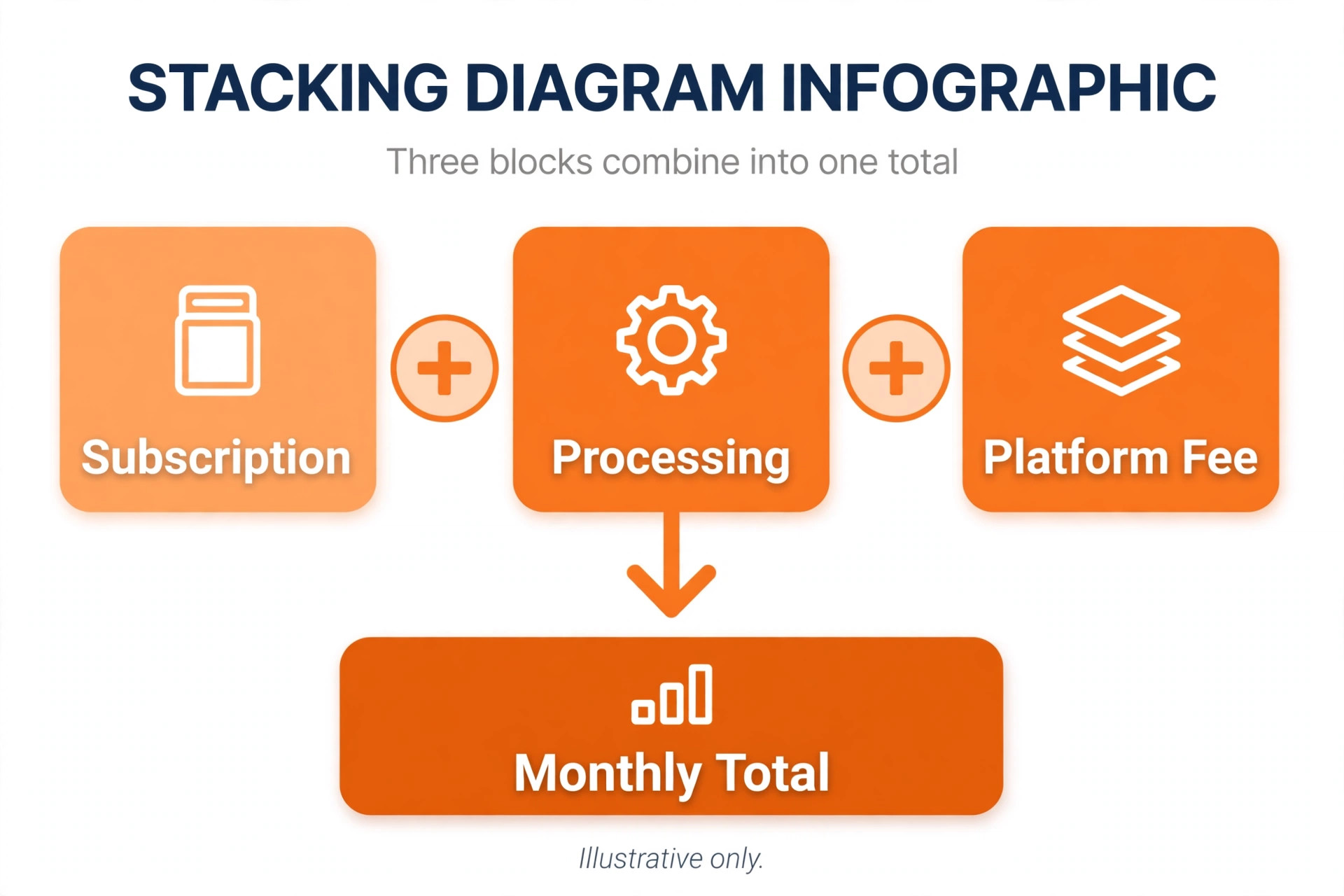
Sales caps are the most surprising part of the cost of BigCommerce for small business monthly budgeting, because they move a store without the owner choosing to move. When trailing 12 month Inclusive GMV passes a tier threshold, BigCommerce can automatically move the store to the next tier, and the subscription rises to that tier price from the next cycle. A store that grows well therefore pays more, which is fair in principle but painful when the jump arrives without warning.
The newer thresholds are $30,000 for Standard, $100,000 for Plus and $400,000 for Pro, measured on Inclusive GMV after a 10 percent reduction from gross order value. That calculation means the threshold figure will not match the revenue shown in the store own reports, because taxes, shipping and marketplace orders are counted in ways that differ from a simple sales report. A store near a threshold should track Inclusive GMV specifically, not just revenue, and budget for the next tier a quarter before crossing it.
Pro handles growth differently from the lower tiers. Above $400,000 in Inclusive GMV, Pro adds a continuous overage of 0.9 percent above $33,333 in monthly Inclusive GMV, rather than jumping straight to Enterprise pricing. That overage model suits a store growing past $400,000 gradually, but it still adds a real monthly cost that should be forecast alongside marketing and stock costs as sales rise.
Worked Monthly Totals
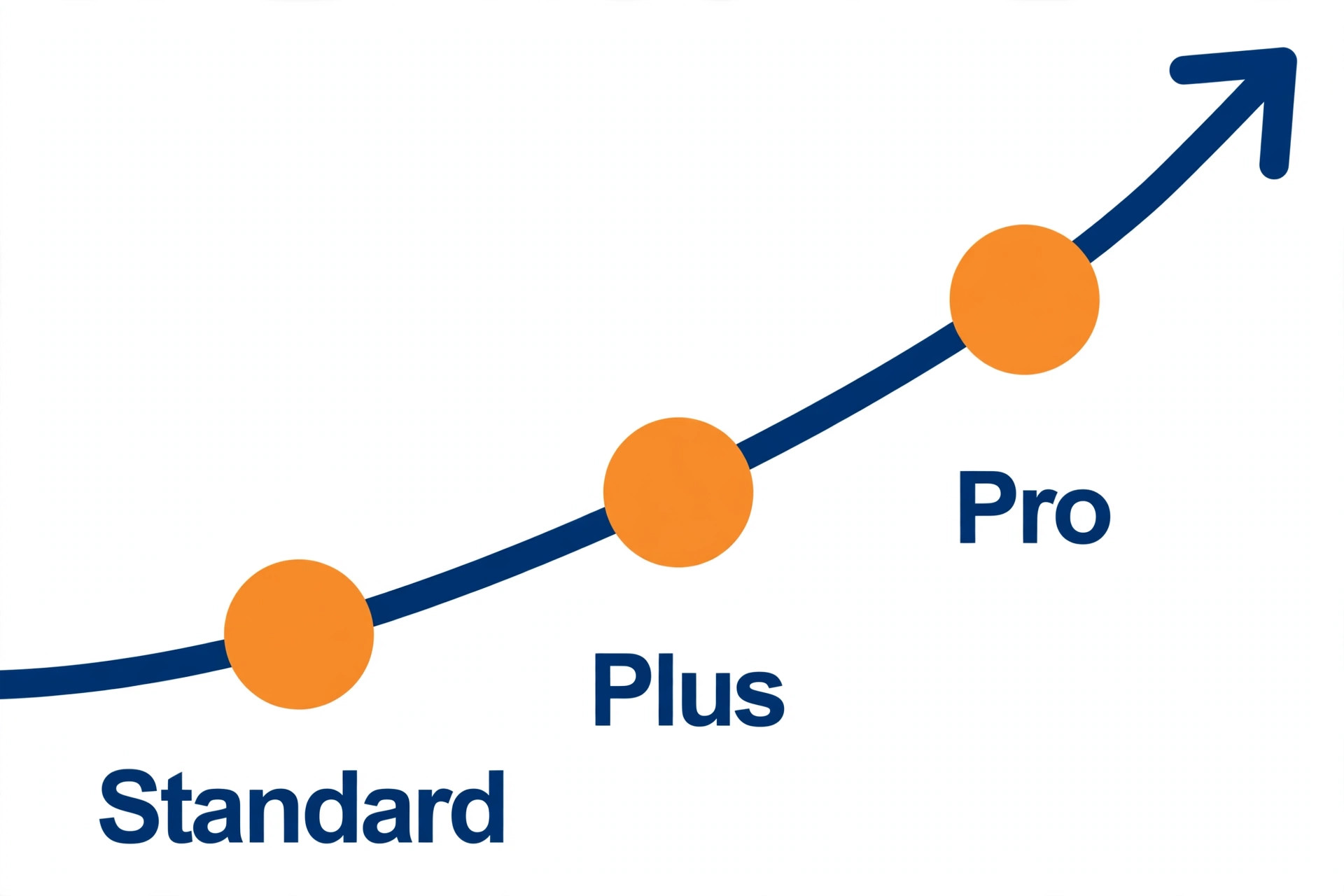
Worked totals turn subscription and processing into a real monthly bill. Each scenario below uses annual billing for the subscription, embedded payment processing at the reported Braintree rates, and an average order value of $50, so you can adjust the maths to your own order value and provider.
A small store on Standard at $5,000 a month in sales, with 100 orders, pays $29 a month in subscription on annual billing. Card processing at 2.89 percent plus $0.29 per order comes to about $174 a month. The realistic all in total is therefore about $203 a month, of which the subscription is only $29 and processing is $174. A store owner who budgets only for the subscription will understate the real cost by a factor of seven.
A growing store on Plus at $15,000 a month in sales, with 300 orders, pays $79 a month in subscription on annual billing. Card processing at 2.59 percent plus $0.30 per order comes to about $479 a month. The realistic all in total is therefore about $558 a month, with processing again dominating the bill. The jump from Standard to Plus subscription is $50 a month, but the processing bill rises with sales regardless of tier, so tier choice matters less than sales volume at this size.
A larger store on Pro at $30,000 a month in sales, with 600 orders, pays $299 a month in subscription on annual billing. Card processing at 2.39 percent plus $0.30 per order comes to about $897 a month. The realistic all in total is therefore about $1,196 a month. Pro processing rates save about $150 a month against Standard rates at this volume, which offsets half the subscription, and the remaining subscription cost buys filtering, reviews and API headroom that a large catalogue needs.
A non embedded payment route changes the small store total sharply. The same $5,000 Standard store on a non embedded gateway adds a 2.0 percent open payment provider fee, which is $100 a month on $5,000 in sales, taking the all in total from about $203 a month to about $303 a month before gateway processing. That $100 is avoidable by switching to an embedded provider, and it is the single largest saving available to a store on a niche gateway.
Premium themes are the first hidden cost, typically $150 to $400 as a one time purchase for a polished theme, against free themes that cover basic stores well. A new store should start free, prove sales, and buy a premium theme only when design limits conversion, because a theme purchase before product proof is money spent on presentation rather than demand.
Apps are the second hidden cost, and they accumulate quietly. Reviews, loyalty, subscriptions, advanced shipping, accounting sync and marketing apps each add a monthly fee, and a store with ten apps can easily add $100 to $300 a month on top of the subscription. Audit apps quarterly, remove apps with no orders or no measurable lift, and favour built in BigCommerce features over an app whenever the built in feature covers 80 percent of the need.
Domains, email and photography form the third group. A domain costs roughly $12 to $20 a year through most registrars, email hosting adds a small monthly fee per user, and product photography costs time or money before launch. None of these items is large alone, but together they add a realistic $30 to $80 a month to a small store operating budget, and they should appear in the launch budget rather than being discovered after launch.
When themes, apps, domains and email are added together, the true cost of BigCommerce for small business monthly operation can run $100 to $300 above subscription plus processing for an app heavy store, which is why a quarterly app audit earns its time many times over.
How to Choose the Right BigCommerce Tier
Choosing a tier starts with trailing sales, not features. Calculate trailing 12 month Inclusive GMV as best you can from order data, allowing for the 10 percent reduction BigCommerce applies, and choose the tier whose threshold comfortably covers that figure with headroom for growth. A store at $28,000 in trailing sales should not buy Standard, because normal growth will trigger an automatic upgrade within months, and the disruption costs more than starting on Plus.
Next, check the payment route before anything else. Confirm whether your gateway sits on the embedded list, and if it does not, price the open payment provider fee into the monthly total or plan a switch to an embedded provider. A store that chooses a tier without checking its gateway can pay an avoidable fee every month for years, which dwarfs any saving from picking a cheaper tier.
Finally, test features on the 15 day trial with real products, real shipping rules and a real checkout. Build the catalogue, set up discounts, test abandoned cart recovery on Plus, and run a test order through the actual gateway. A trial that only browses themes proves nothing about checkout, shipping or fee behaviour, and it leaves the tier decision to guesswork. Document the fee on that test order line by line, because the cost of BigCommerce for small business monthly use is clearest when subscription, processing and any platform fee appear on one real order rather than in separate pricing pages.

BigCommerce Mistakes That Inflate the Bill
The most expensive mistake is staying on a niche gateway out of inertia. A store that chose a regional processor years ago may pay 2 percent of every sale to BigCommerce on top of gateway processing, while an embedded provider would remove that fee entirely. Review the gateway yearly, compare total processing plus platform fees, and switch when the saving exceeds the switching effort, which it usually does within a month.
The second mistake is ignoring the sales threshold until the upgrade lands. A store that grows from $25,000 to $35,000 in trailing sales will move from Standard to Plus automatically, and the subscription jump from $29 to $79 a month on annual billing arrives without a feature decision attached. Forecast the threshold crossing a quarter ahead, decide whether Plus features justify staying, and budget the new subscription before it appears on the invoice.
The third mistake is app sprawl. A store that installs an app for every idea ends up paying for overlapping tools, slowing page load and confusing staff, while the core store features go unused. Limit apps to tools with a clear job and a measurable return, review them quarterly, and remove any app that has not earned its fee in the last ninety days.
A Full Year on BigCommerce
Annual totals make the commitment concrete. A Standard store at $5,000 a month in sales pays about $348 a year in subscription on annual billing and about $2,088 a year in processing, for an all in total near $2,436 a year. A Plus store at $15,000 a month pays about $948 a year in subscription and about $5,748 a year in processing, for an all in total near $6,696 a year. A Pro store at $30,000 a month pays about $3,588 a year in subscription and about $10,764 a year in processing, for an all in total near $14,352 a year.
The cost of BigCommerce for small business monthly planning should therefore focus on processing and fees, not just subscription, because processing dominates every total above. Negotiating a better processing rate, switching to an embedded provider or lifting average order value will save more than haggling over the subscription tier, and those levers deserve attention before any tier debate.
Renewal review should happen thirty days before the annual date. Confirm trailing sales against thresholds, confirm the gateway still sits on the embedded list, audit apps and themes, and check whether the next tier features would earn their price in the coming year. A store that reviews at renewal avoids surprise upgrades, drops dead apps and keeps the platform bill tied to actual sales rather than last year configuration.
BigCommerce Against Shopify and WooCommerce
Shopify is the closest hosted rival, with subscription prices that mirror BigCommerce at entry and mid tiers and a platform fee on third party gateways that BigCommerce now partly matches on non embedded routes. The deciding difference for a small store is usually payment route and sales cap behaviour, not headline subscription. A store on Shopify Payments avoids Shopify platform fees, just as a store on an embedded provider avoids BigCommerce platform fees, so the cheaper platform is the one whose fee free route matches the gateway the store actually wants to use.
WooCommerce is the open source rival, with no platform subscription but real costs elsewhere. Hosting, security, updates, extensions and maintenance time replace the BigCommerce subscription, and a store owner who values time over control will usually spend more in total on WooCommerce than the BigCommerce subscription suggests. A technically confident owner with an existing WordPress site may still prefer WooCommerce, because it removes sales caps and platform fees entirely, but the saving must be weighed against maintenance hours every month.
The cost of BigCommerce for small business monthly buyers should therefore be compared on system total, not subscription alone. Add hosting and maintenance for WooCommerce, add subscription plus processing plus platform fees for BigCommerce and Shopify, and add app costs for all three, because apps accumulate on every platform. The platform with the lowest subscription often carries the highest app or maintenance bill, and the honest comparison catches that trade off before launch rather than after a year of invoices.
More Reading on Stratilyze
Readers pricing store platforms usually check the neighbouring guides next. The guide to POS systems for coffee shops covers in person selling that pairs with an online store, the guide to accounting software for small business covers bookkeeping for store revenue, and the guide to website builders for restaurants covers a simpler site option for food businesses.
Frequently Asked Questions
How much does BigCommerce cost per month for a small business
A small store pays $39 a month on Standard, $105 a month on Plus and $399 a month on Pro with monthly billing, or $29, $79 and $299 a month with annual billing. Card processing adds roughly 2.39 to 2.89 percent plus about $0.30 per order depending on tier and provider, so a $5,000 a month Standard store pays about $203 a month all in, while a $30,000 a month Pro store pays about $1,196 a month all in.
Does BigCommerce charge transaction fees
BigCommerce charges no extra platform fee on orders through embedded payment providers, which include BigCommerce Payments, PayPal and Stripe among others. Orders through a gateway outside the embedded list attract an open payment provider fee of 2.0 percent on Standard, 1.0 percent on Plus and 0.6 percent on Pro. Card processing charged by the provider itself applies on every order regardless of route.
What are the BigCommerce sales limits
Under the June 2026 thresholds, Standard covers up to $30,000 in trailing 12 month Inclusive GMV, Plus covers up to $100,000 and Pro covers up to $400,000, after which Pro adds a 0.9 percent overage above $33,333 in monthly Inclusive GMV. Older guides show $50,000 and $180,000 for the lower tiers, so confirm the current thresholds on the vendor page before choosing a tier near a limit.
Is BigCommerce cheaper than Shopify for a small store
For a store on an embedded provider, BigCommerce and Shopify subscription prices are similar at entry and mid tiers, and BigCommerce avoids a platform fee that Shopify charges on third party gateways. For a store on a non embedded gateway, BigCommerce now charges its own platform fee, which narrows that advantage. Compare subscription plus processing plus platform fees on your actual gateway, because the cheaper platform depends on payment route rather than headline price alone.
Should a new store start on Standard or Plus
Start on Standard if sales are under $2,500 a month on average and basic features cover the catalogue, because the $29 a month annual rate leaves budget for marketing and stock. Move to Plus when abandoned cart recovery, customer groups or sales approaching the $30,000 threshold make the $79 a month annual rate worthwhile. Starting on Plus too early wastes $50 a month that could fund ads or product development.
What happens if my store exceeds its sales limit
BigCommerce can automatically move the store to the next tier when trailing 12 month Inclusive GMV passes the threshold, and the subscription rises to that tier price. On Pro, growth past $400,000 adds a continuous overage instead of an immediate jump to Enterprise pricing. Track Inclusive GMV specifically, forecast threshold crossings a quarter ahead, and budget for the next tier before the automatic move arrives.
Final Verdict on BigCommerce Costs
For most small stores, the right BigCommerce spend is the lowest tier whose sales threshold comfortably covers trailing sales, on an embedded payment provider, with annual billing once the store has proven itself for a quarter. Start on Standard for a new store, move to Plus when cart recovery and customer groups earn their keep, and move to Pro when sales or catalogue complexity demand it. That ladder keeps the subscription honest and ties every upgrade to revenue or features that actually convert.
Before you buy, confirm your gateway sits on the embedded list, forecast your trailing sales against the current thresholds, and price processing alongside subscription in every comparison. The cost of BigCommerce for small business monthly use is fair when the store sells through an embedded provider and sits comfortably inside its tier, and wasteful when a niche gateway fee or an automatic upgrade goes unnoticed, so let sales data and payment route decide the tier.