

A one star review lands on a Saturday morning, visible to every shopper who searches your business that weekend, and it stays there while you decide what to do. The reviewer may be a genuinely unhappy customer, a confused customer who visited the wrong business, or a competitor testing your patience, and the shoppers reading it cannot tell which one it is. They can only judge your reply. Learning how to handle negative reviews small business owners face every week starts with that uncomfortable truth, because the review itself is already public, but your response is still entirely in your hands.
Reviews matter more than most owners admit. Research on review behaviour consistently shows that shoppers read reviews before choosing, that a large share of consumers are put off by negative reviews, and that businesses which reply to reviews earn more trust than businesses which stay silent.
A Harvard Business School study of hotel reviews found that hotels which started responding received 12 percent more reviews and saw ratings rise by an average of 0.12 stars, with about a third of hotels gaining half a star or more within six months of their first management response.
Other surveys report that more than half of reviewers expect a reply within a week, with a third expecting three days or less, and that a personalised reply within a day makes reviewers substantially more likely to improve their rating.
This guide gives you a repeatable system. It covers the response window, sorting fair complaints from fake or policy breaking reviews, apology scripts that work in public, moving conversations offline without hiding them, fixing the problem and proving the fix, and asking for new reviews after a recovery. Keep the scripts in this guide beside your review inbox, and a bad Saturday review becomes a Monday task with a known sequence, rather than a weekend of worry.
How to Handle Negative Reviews Small Business in the First 24 Hours
Speed is the first rule, and it matters more than polish. Aim to acknowledge every new negative review within one business day, even when the full facts are not yet known, because a fast acknowledgement shows shoppers that the business is attentive, and it gives the reviewer a reason to wait for a resolution instead of escalating. A reply posted three weeks later reads as an afterthought, while a reply posted the same day reads as a business that cares, even if the reply only says that you are looking into the matter and will follow up privately.
Start with a short internal check before you write anything. Identify the job, the staff involved and the facts of the visit, and decide whether the complaint is fair, partly fair, mistaken or fake, because each category needs a different reply. Do not reply while angry, and never reply with accusations, customer details or confidential information, since the reply is public and will be read by future customers judging your character, not just by the reviewer. One calm owner reply can win more future customers than the original complaint lost, while one defensive reply can confirm every suspicion the review raised.
Write the public reply in three moves, and keep it short. Thank the reviewer for raising the issue, acknowledge the specific experience rather than offering a generic apology, and invite the conversation offline with a named contact and a direct method, such as a phone number or email address. Avoid repeating the complaint in aggressive detail, avoid legal language, and avoid promising outcomes you cannot deliver. A reply of four to six sentences is usually enough, and a reply that runs to three paragraphs usually says more than it should. The public reply is written for future readers as much as for the reviewer, so every sentence should sound like a business a stranger would trust.

Sorting Fair Complaints From Fake and Policy Breaking Reviews
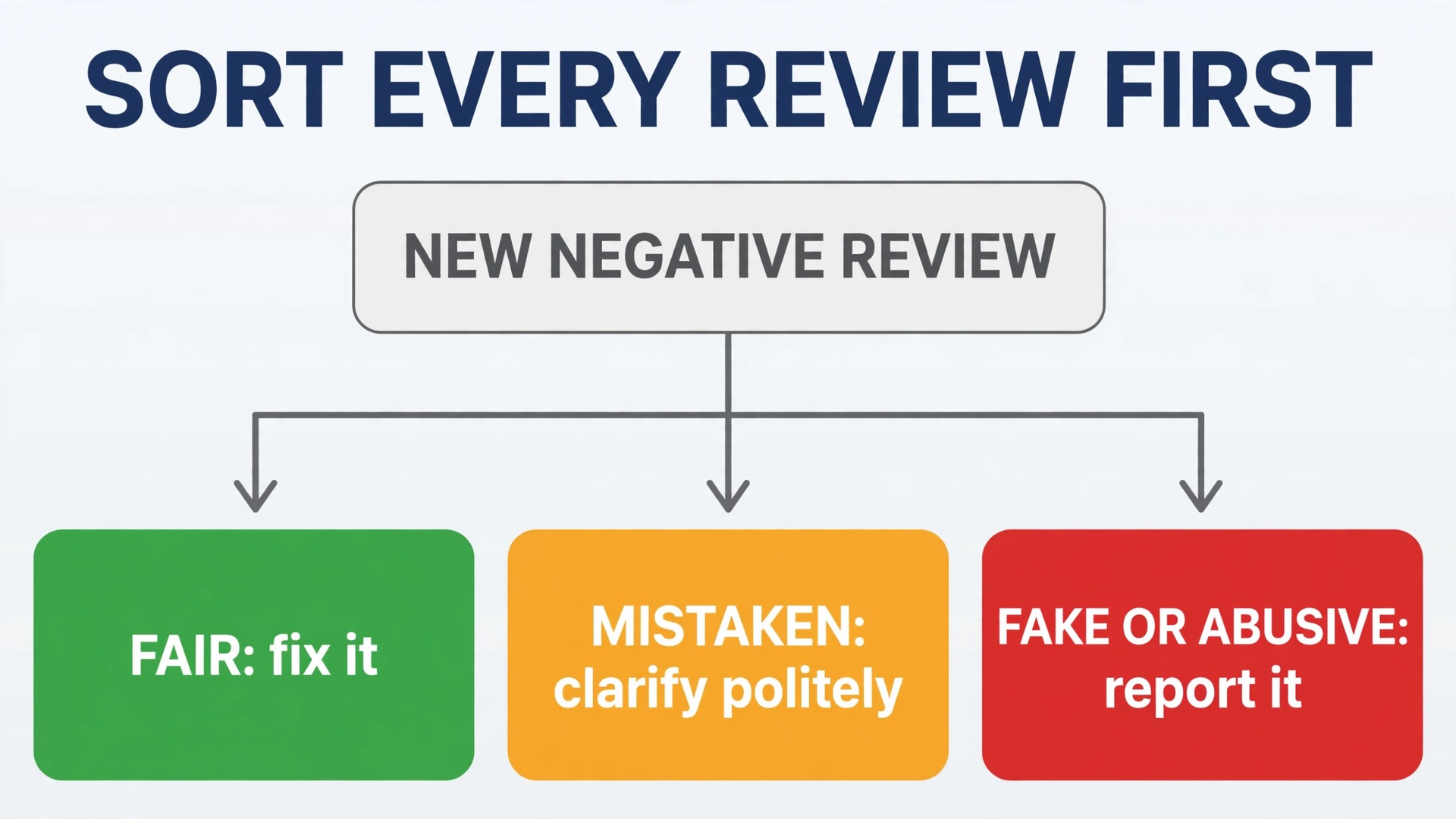
Not every negative review deserves the same response, and sorting correctly saves time and credibility. A fair complaint describes a real visit, a real problem and a plausible sequence of events, and it deserves a full apology, a fix and a follow up.
A mistaken review describes a different business, a wrong date or a service you do not offer, and it deserves a polite correction with evidence, such as your opening hours or service list, plus an invitation to confirm details privately. A fake review shows no sign of a real visit, uses generic language that could fit any business, or arrives in a suspicious cluster, and it deserves a flag to the platform plus a calm public note that you cannot find a record of the visit.
Platforms allow businesses to flag reviews that break their policies, but a genuine negative opinion, however unfair it feels, generally cannot be removed simply because it is negative. Google and Yelp both review flagged content against their policies on conflicts of interest, fake engagement, profanity, personal information and off topic content, and they remove only reviews that breach those policies.
Do not offer payment, gifts or discounts in exchange for removing or changing a review, because incentivised review changes breach platform policies and can attract penalties, including removal of reviews or profile restrictions.
The honest route is slower but safer, which is to reply well, fix what can be fixed, and earn newer positive reviews that push the old one down the page.
Keep a simple log of every negative review, with the date, platform, star rating, category, reply date and outcome. The log turns isolated complaints into patterns, and patterns reveal the real problems worth fixing, such as a recurring late delivery, a confusing price, or a staff training gap.
A business that logs reviews will spot after a month that three complaints mention the same issue, while a business that handles reviews from memory will treat each one as a surprise. That logging habit is a quiet part of how to handle negative reviews small business owners master over time, because patterns beat memory every time. The log also proves diligence if a platform ever asks for evidence about a fake review, because dates and records beat recollection every time.
The Apology Script That Works in Public
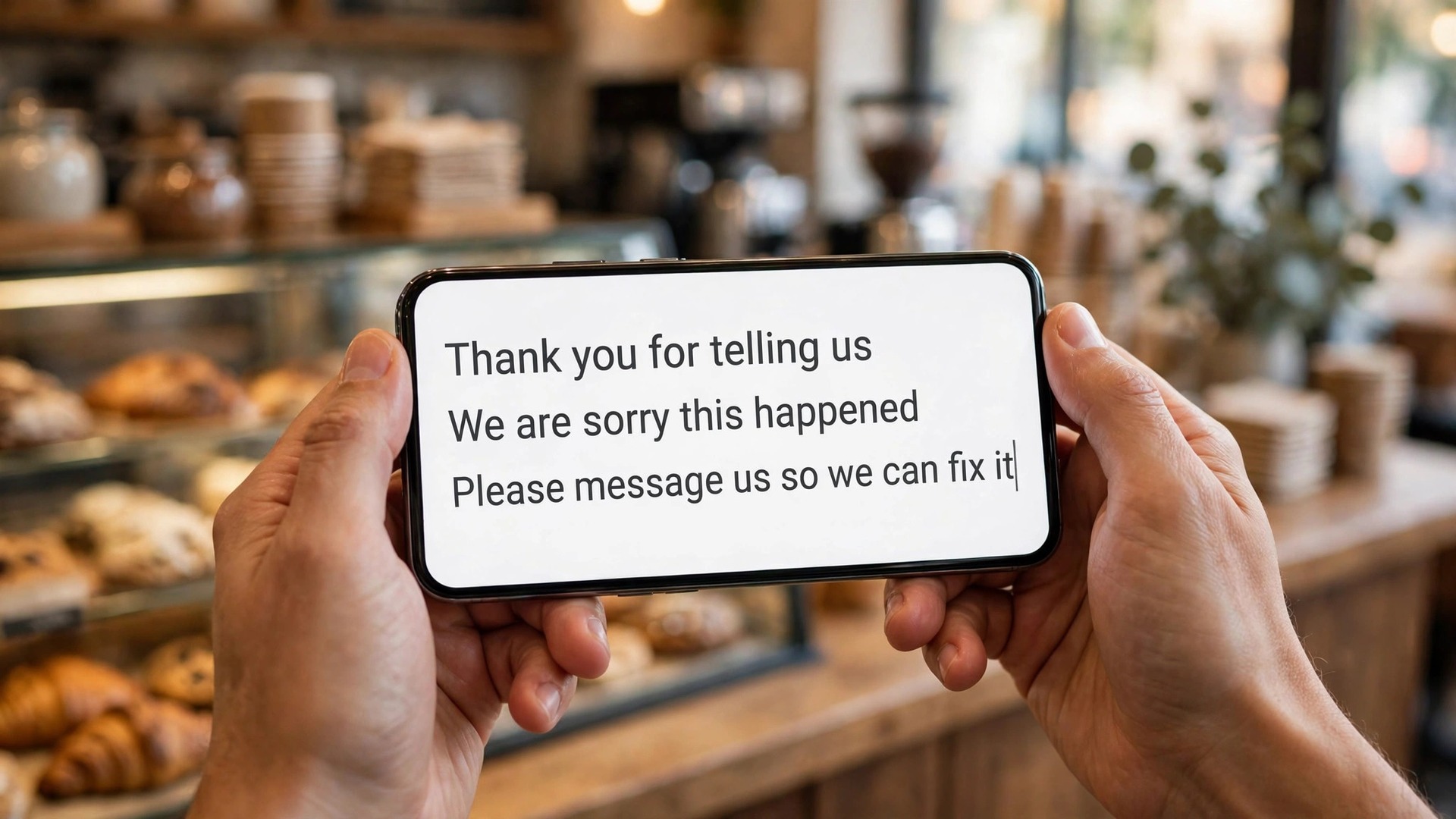
A good public apology has a shape that shoppers recognise instantly, and it works because it is specific, human and forward looking. Start by naming the experience, not the reviewer, so the reply reads as empathy rather than confrontation. Then take responsibility for the part that belongs to you, without blaming the customer, your staff or circumstances the customer cannot verify. Then state the concrete next step, meaning the fix, the contact or the invitation offline, so the reader sees action rather than only words. Close with thanks for the feedback, because feedback, even painful feedback, is information a business would otherwise pay to learn.
Use scripts as starting points, not as copy and paste replies, because shoppers spot template replies instantly and trust them less. A template with blanks for the specific issue, the staff member or the job type keeps replies fast while staying personal, and personalisation is what makes reviewers more likely to update their rating. Research cited by reputation guides reports that reviewers who receive a personalised reply within a day are substantially more likely to upgrade their review, while generic replies earn far less goodwill. Write the reply in your own voice, read it aloud once, and ask whether it sounds like something you would be proud for a future customer to read.
Three short scripts cover most situations, and each should be adapted to the facts. For a fair complaint, try thanking the reviewer, naming the specific failure, apologising plainly, and inviting them to contact you directly so you can make it right. For a partly fair complaint, acknowledge the part that is true, correct the part that is mistaken politely and without argument, and offer the same offline conversation.
For a mistaken review, state calmly that you cannot find a record of the visit, list one verifiable fact, and invite the reviewer to share details privately so you can check further. In every case, sign with a name or role, because a signed reply reads as a person taking responsibility, while an unsigned reply reads as a company hiding behind a logo.
Moving the Conversation Offline Without Hiding It
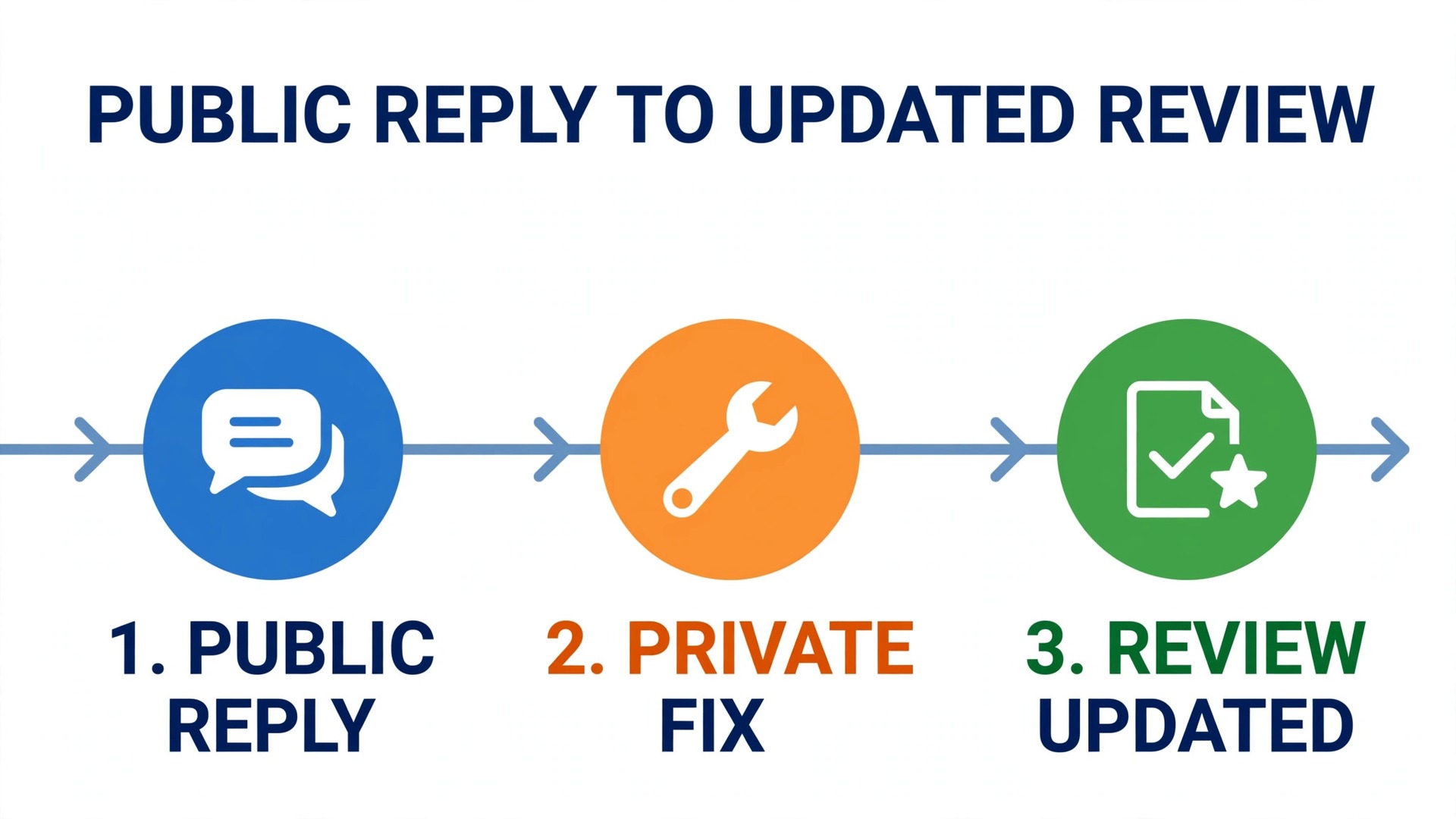
The public reply should open the door, and the private conversation should walk through it, because personal details, order histories and compensation discussions do not belong in public. Invite the reviewer offline in the public reply itself, with a named contact and a direct phone number or email address, and state that you would like to understand the details and put things right. That invitation does two things at once. It shows future readers that you take the complaint seriously, and it gives the reviewer a private channel where a real resolution can happen without an audience.
Do not use the offline move to hide the complaint or to pressure the reviewer. Never ask a reviewer to delete a review as a condition of a refund or a fix, and never discuss the reviewer publicly after moving offline, because shoppers who see a complaint vanish without a public resolution may assume the worst. The right sequence is public acknowledgement, private resolution, and then a brief public follow up only if the reviewer updates the review or if the fix is genuinely newsworthy, such as a process change that benefits all customers. A business that resolves privately and then posts a smug update claiming victory will undo the goodwill the resolution created.
Handle the private conversation with the same care as the public one. Listen first, repeat the problem back to show understanding, agree the fix and the timescale, and then deliver exactly what was promised, on time.
A private fix that arrives late or smaller than promised creates a second complaint that is harder to answer than the first, because the reviewer now has evidence that promises do not hold.
When the fix is delivered, thank the reviewer again and, only if the experience genuinely improved, ask whether they would consider updating their review to reflect the resolution. Never demand an update, and accept a no gracefully, because a reviewer who feels pressured will harden their original rating rather than soften it.
Fixing the Problem and Proving the Fix
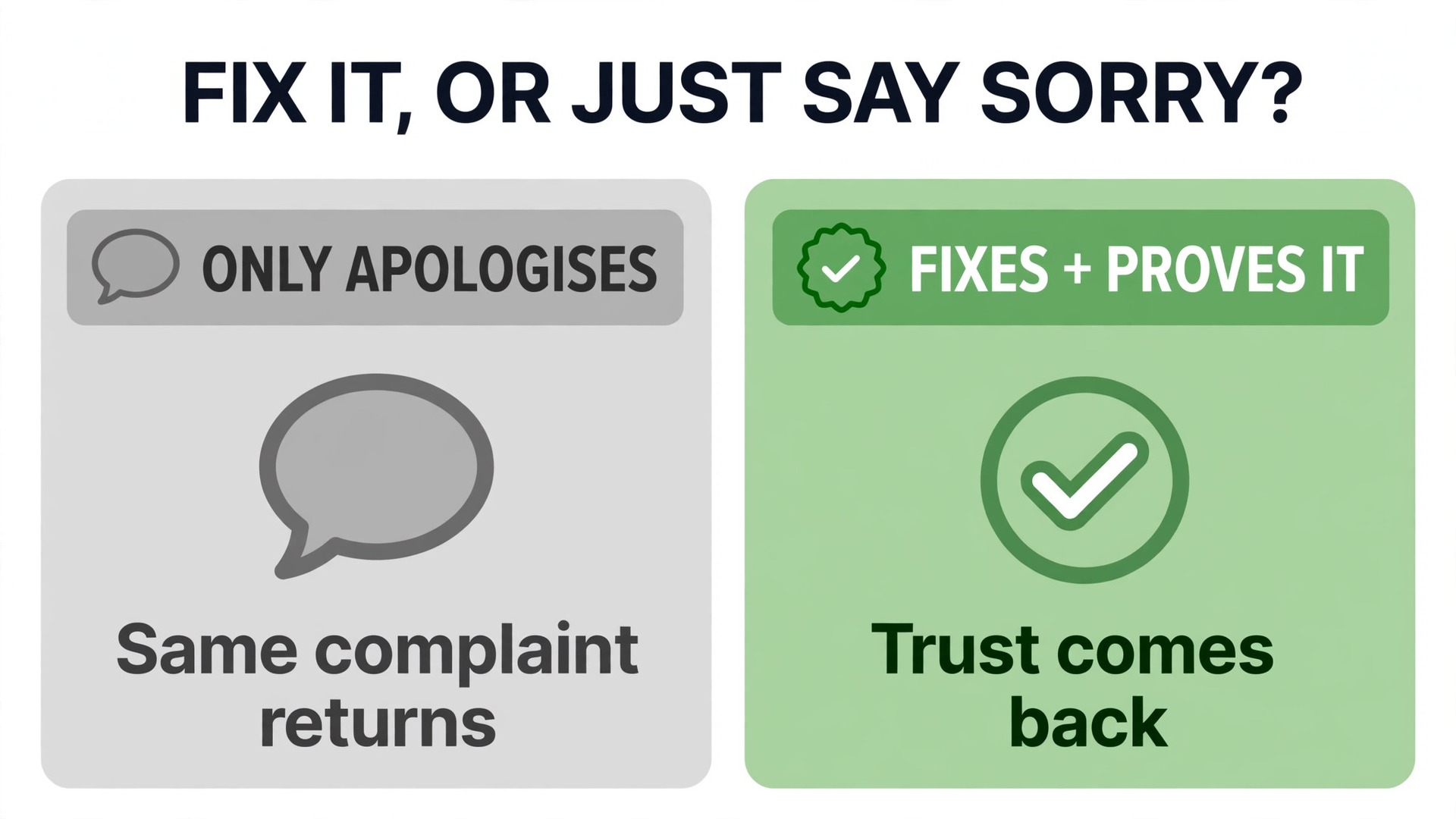
A reply without a fix is a performance, and shoppers eventually notice the difference between businesses that apologise and businesses that change. Once a complaint is understood, decide the fix, assign an owner, and set a date, whether the fix is a refund, a redo, a process change, a training session or a supplier switch. Record the fix in the review log beside the original complaint, because a log that shows complaints without fixes is a list of promises, while a log that shows complaints with fixes and dates is evidence of a business that learns.
Prove the fix where it is visible and honest to do so. If three reviews mention slow replies, publish faster response times and meet them. If reviews mention a confusing price, rewrite the price page and mention the change in future replies. If a product fault recurs, change the supplier or the quality check and say so when the topic arises again. You do not need to announce every fix on the original review thread, and in most cases you should not, because returning to an old thread draws fresh attention to it. The proof lives in newer reviews that mention the improved experience, in updated service pages, and in the absence of repeat complaints about the same issue.
That discipline is the deeper value of learning how to handle negative reviews small business owners can sustain, because each complaint becomes a free audit of a weak point. A business that fixes one recurring issue per month will, within a year, have removed twelve weaknesses that competitors still carry, and its review profile will show the improvement without any manipulation. Track repeat complaint themes monthly, pick the most frequent one, fix it properly, and watch the next month reviews for the change. That loop turns reviews from a reputation threat into a product development input, which is the most valuable use of feedback a small business can find.
Asking for New Reviews After a Recovery
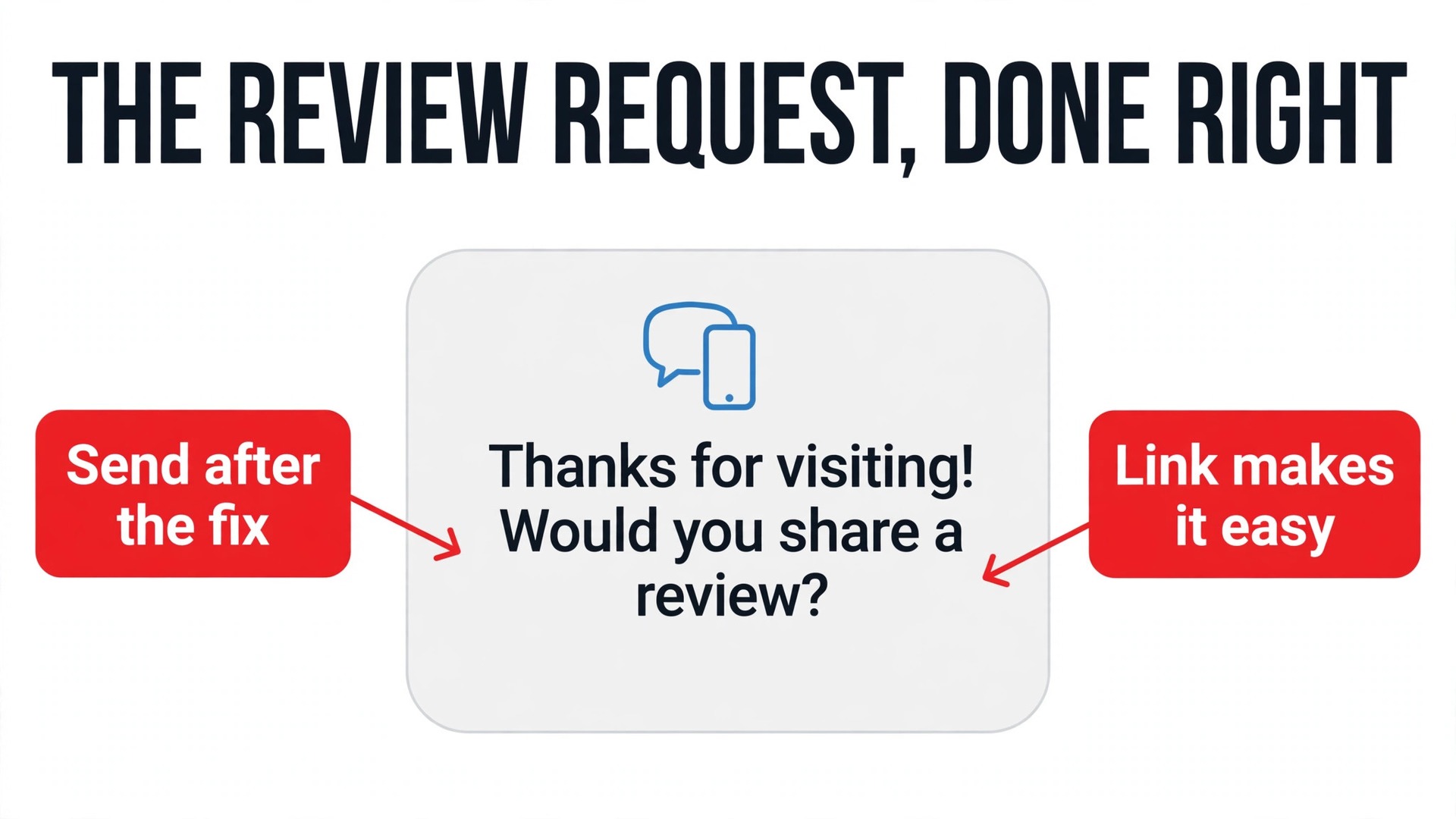
New positive reviews are the honest counterweight to an old negative one, and they should be earned systematically rather than begged for sporadically. The best moment to ask is right after a successful delivery, a resolved problem or a compliment, when the customer experience is fresh and positive. Ask simply, in person, by text or by email, with a direct link to your preferred review platform, and make the request take under a minute. A customer who must search for your profile, choose a platform and remember what to write will usually not bother, while a customer given a single link often will.
Sequence the ask after a recovery with care. Wait until the fix is delivered and confirmed, thank the customer for their patience, and then ask whether they would be willing to share their updated experience. Learning how to handle negative reviews small business recovery sequences properly means never asking before the fix, never offering incentives for positive reviews, and never asking only happy customers while ignoring unhappy ones in a way that skews the record. Ask every customer as a matter of routine, and the review profile will reflect real experience rather than a filtered sample.
Build the ask into the job closeout so it happens without relying on memory. A short message sent after delivery, a link on the invoice or receipt, and a reminder in the team closeout checklist will produce a steady flow of reviews that dilutes any single negative review naturally. Aim for a steady rhythm rather than a burst, because a sudden flood of reviews after a negative one looks manipulated to platforms and to shoppers, while a consistent flow looks like a business that serves customers well every week. Over months, the average rating becomes a fair reflection of the business, and one old negative review becomes a footnote rather than a headline.
The Weekly Review Routine That Prevents Repeat Complaints
A weekly routine of thirty minutes prevents most review crises before they start. Once a week, check every platform where reviews appear, reply to new reviews using the scripts in this guide, update the review log, and note any repeat themes. Reply to positive reviews too, briefly and personally, because shoppers notice when a business only appears to defend itself, and a business that thanks happy customers looks genuinely engaged rather than damage controlling. A routine that covers positive and negative reviews together builds a profile that reads as human.
Share the themes with the team monthly, without blame, and agree one improvement per month from the review evidence. A team that hears that three customers mentioned waiting times will fix waiting times faster than a team that never hears review feedback at all. Celebrate the positive themes too, because a team that only hears complaints will stop caring about reviews, while a team that hears praise for specific work will repeat that work. Reviews are customer research that arrives free, and a business that reads them weekly will rarely be surprised by them.
Set up alerts so no review sits unread for a week. Most platforms offer notifications, and free alert tools can cover the rest, so the weekly check becomes a review of replies rather than a hunt for missed reviews. Assign one owner for review replies, with a backup for holidays, because a routine without an owner becomes nobody job within a month. That ownership, plus the log, plus the monthly improvement, is the whole system, and it costs less time than a single unmanaged review crisis. It is also the routine that makes learning how to handle negative reviews small business work sustainable, rather than a burst of effort after each bad rating.
What Never to Do in a Public Reply
Some replies damage a business more than silence, and the list is worth memorising. Never argue with the reviewer in public, never disclose personal details, order histories or private messages, never accuse the reviewer of lying, and never use legal threats to intimidate a reviewer into silence, because each of those moves creates a screenshot that travels further than the original review. Never post fake positive reviews, never ask friends or staff to post reviews pretending to be customers, and never offer incentives for review changes, because platforms detect these patterns and penalise them, and shoppers detect them even faster.
Never copy the same generic reply onto every review, because a wall of identical thank you messages reads as automation rather than care. Never reply only to positive reviews while ignoring negative ones, because shoppers read the gap as fear. Never blame a single staff member by name in public, because the complaint is about the business system, and public blame damages the team without helping the customer. The rule behind every item on this list is simple. Write every reply as if your best future customer is reading it, because they are, and the reply will still be visible long after the original complaint is forgotten.
Responding to Reviews on Each Major Platform
Google Business Profile is where most local shoppers meet your reviews, and it deserves the fastest replies. A verified business can reply directly to each review, and Google itself notes that responding can support local visibility and trust. Keep Google replies short and specific, because they appear beside your map listing where shoppers decide in seconds. If a review seems filtered or missing, check the profile status and the review guidelines before assuming the worst, since some reviews are delayed or filtered automatically, and a calm re ask sequence usually recovers more than a support complaint.
Yelp plays by stricter display rules, and its software recommends reviews based on quality, reliability and reviewer activity, which means not every genuine review appears prominently. Reply to Yelp reviews through the business owner tools, keep the tone professional, and never offer incentives for reviews or updates, because Yelp enforces its policies actively and penalises businesses that solicit filtered or paid content. TripAdvisor and Facebook follow the same core logic with different audiences, meaning a reply written for Google can be adapted, but should not be pasted identically, because each platform audience reads tone differently.
Industry platforms deserve the same routine even when volume is lower. A trades business may live on Checkatrade or Trustpilot, a restaurant on TripAdvisor, a clinic on specialist health directories, and a single harsh review on a niche platform can outweigh ten Google reviews for a shopper in that niche. Extend the weekly check to every platform where your business is listed, claim any unclaimed profiles so you can reply, and use the same log for all of them.
Claiming profiles is a one time task that pays for itself the first time a review appears somewhere you did not expect. Search your business name on the major platforms once a quarter, claim any profile that is unclaimed or outdated, correct the hours, services and contact details, and add the profile to the weekly check. An unclaimed profile cannot be replied to, and a shopper who sees an unanswered complaint on an unclaimed profile has no way to know whether the business even saw it. Platform specific habits matter, and learning how to handle negative reviews small business owners face across platforms means adapting the reply to each audience while keeping the core sequence identical everywhere.
Frequently Asked Questions
How fast should I reply to a negative review?
Aim to acknowledge a new negative review within one business day, even if the full facts are not yet known, because speed shows attentiveness and gives the reviewer a reason to wait for a resolution. Surveys report that more than half of reviewers expect a reply within a week, with a third expecting three days or less, so a same day acknowledgement puts you ahead of most competitors. A full resolution can follow privately after the public acknowledgement.
Can I get a negative review removed?
You can flag a review that breaks platform policy, such as fake engagement, conflicts of interest, profanity, personal information or off topic content, and the platform will remove it only if it breaches those policies. A genuine negative opinion, however unfair it feels, generally cannot be removed simply because it is negative. Do not offer payment or incentives for removal, because that breaches platform policy and risks penalties. Reply well, fix what can be fixed, and earn newer reviews.
Should I reply to positive reviews too?
Yes, briefly and personally, because shoppers notice when a business only appears to defend itself. A short thank you that mentions something specific from the review shows genuine engagement and encourages more reviewers. Replying to positive reviews also keeps the profile active and human, which makes the occasional negative review look like an exception rather than the rule.
What should I do about a review for the wrong business?
Reply politely with one verifiable fact, such as your location, hours or services, and invite the reviewer to share details privately so you can check further. Flag the review to the platform as misplaced if the policy allows it, but do not argue or accuse. Many mistaken reviews are corrected or removed once the reviewer realises the error, especially when the business reply is calm and helpful rather than confrontational.
Should I ask a customer to update their review after a fix?
You may ask, once, after the fix is delivered and confirmed, and only if the experience genuinely improved. Thank the customer for their patience, explain what changed, and ask whether they would consider updating their review to reflect the resolution. Never demand an update, never make a fix conditional on one, and accept a no gracefully, because pressure hardens an original rating rather than softening it.
How do I handle a review that names a staff member?
Do not discuss the staff member publicly and do not blame anyone by name in your reply. Acknowledge the experience, take responsibility as the business, and move the conversation offline, where you can investigate fairly and support the team member properly. Handle any training or process change internally, and let the public record show a business that fixes systems rather than one that sacrifices individuals.
The Reply Is the Reputation
A negative review is not a verdict on your business. It is a test of your business, conducted in public, with future customers watching. The businesses that pass the test are not the ones with no negative reviews, because no business serving real customers avoids them. They are the ones that reply fast, apologise specifically, move the conversation offline, fix the problem, and earn new reviews that show the improvement. That sequence, repeated every week, builds a review profile that shoppers trust more than a perfect score, because a perfect score looks curated while a handled complaint looks human.
Start this week with the routine, not with a grand strategy. Set up alerts, assign an owner, put the scripts beside the inbox, and reply to the next negative review within a day using the three move shape of thanks, specific acknowledgement and offline invitation. Log the complaint, fix the cause, and ask the next happy customer for a review with a single link. That small system is the practical heart of learning how to handle negative reviews small business owners can rely on, and it turns the Saturday morning dread of a one star review into a Monday task with a known ending. Reply well, fix honestly, and let the record speak for itself.
More Reading on Stratilyze
These related guides cover review visibility, proposal and invoicing tools that sit around reputation management.
– Fix Google Business Profile Reviews Not Showing for a Small Business – Best Proposal Software for Freelancers – Best Invoicing Software for Trades Businesses