

Your costs have risen, your calendar is full, and your hourly earnings have quietly fallen for two years. Yet the price list has not moved, because every time you think about raising it, the same fear appears. What if clients leave. That fear is the problem this guide solves. Learning how to raise prices without losing clients small business owners trust is not about finding a magic percentage. It is about doing the maths first, segmenting clients second, and giving notice with a clear reason third. Done in that order, most rises lose nobody at all, and the clients who do leave are usually the ones you could least afford to keep.
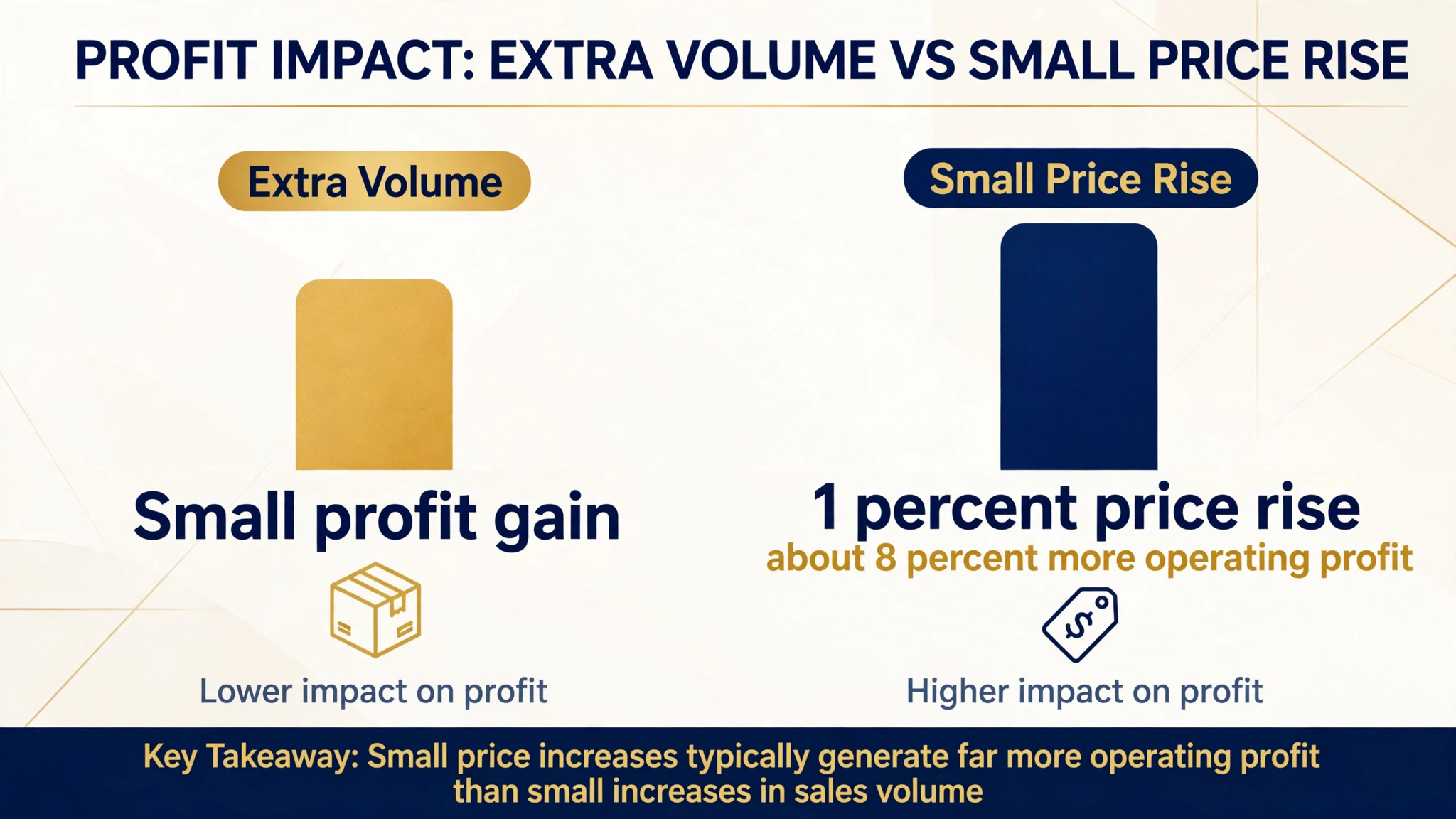
Start with the reason a small rise matters so much. McKinsey found that for the average large company, a 1 percent price rise with volumes unchanged produced roughly an 8 percent increase in operating profit. The effect is even sharper for a small service firm, because your fixed costs do not rise when you raise a price. The extra money from a rise falls almost entirely to profit, while extra volume brings extra delivery cost with it. That is why a firm that raises prices 10 percent and loses a small share of clients often earns more, with less work, than a firm that holds prices and chases volume to cover rising costs.
The fear, then, deserves a number rather than a feeling. Work out how many clients you can afford to lose before a rise costs you money. The formula is simple. Divide the percentage increase by your gross margin percentage plus the percentage increase. Take a service priced at 100 dollars with a 50 percent margin, meaning 50 dollars of cost and 50 dollars of gross profit. A 10 percent rise takes the price to 110 dollars and the profit to 60 dollars. The break-even loss is 10 divided by 60, or about 17 percent. You could lose one client in six and still earn the same gross profit, while doing less work.
Most rises lose far fewer clients than that.
Published pricing guides for appointment based businesses commonly land on 5 to 10 percent a year, with 8 to 12 percent at an annual review for firms that have not moved prices in a while. After two or more years without a change, a rise of 15 to 20 percent may be needed, and in that case two steps six months apart usually land better than one jump. The break-even maths tells you the ceiling your fear should respect. If your margin is 40 percent and you raise prices 10 percent, you can lose one client in five and be no worse off. Very few well handled rises lose anything like that number.
Why Your Old Price Is Quietly Shrinking Your Business
A price that never moves is not stable. It falls every year in real terms, because your costs rise while the number on the price list stays still. Rent, software subscriptions, insurance, materials, and wages all move upward. A firm that held prices through two years of cost growth is not charging the same price. It is charging a lower price in real terms and delivering the same work for it. The gap shows up first as longer hours, then as corners cut, then as staff turnover when wages cannot keep up. Clients rarely notice the slow decline until quality slips, and by then the fix is a large, sudden rise that genuinely does shock them.
Stale pricing also distorts which clients you serve. Low prices attract price sensitive buyers and repel buyers who read price as a signal of quality. Over time the client base tilts toward the people most likely to haggle, most likely to leave for a small discount elsewhere, and least likely to value the extras you provide. A rise does more than repair margin. It rebalances the base toward clients who buy on fit and results rather than on the lowest number. That is why a well planned rise can improve a business even when a few clients leave. The clients who stay are the ones the business was built for.
That rebalance is the deeper reason why guides to how to raise prices without losing clients small business owners trust talk about client fit as much as about percentages.
Watch for the warning signs that a rise is overdue. You are turning away work because the calendar is full, yet profit is flat. You dread quoting new work because the rate feels too low to say out loud. You have added skills, tools, or results since the price was set, and none of that value is in the number. Or you compare your rate with competitors and find you sit well below firms doing visibly worse work. Any two of these signs together mean the price is no longer describing the service. Fixing that description is not greed. It is accuracy, and clients accept accurate prices far more readily than they accept sudden ones.
How to Raise Prices Without Losing Clients Small Business Owners Keep
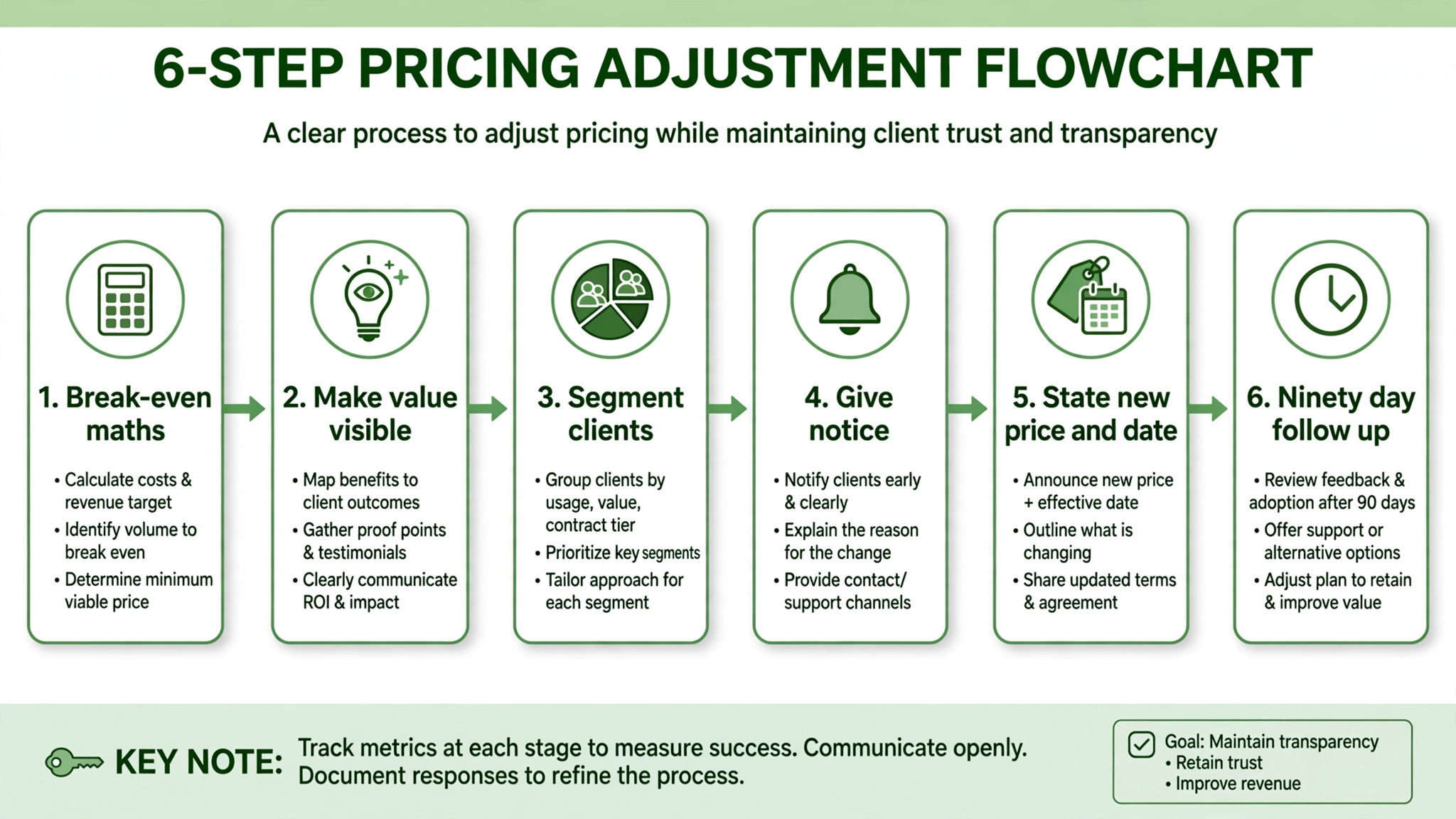
Here is the method in order. Step one, run the break-even maths for your own numbers before you choose a percentage. Knowing you can lose one client in six and still be even changes the conversation in your head, and it stops you from setting the rise by fear. Step two, make your value visible for four to six weeks before you announce. Send a short results summary to each client, in numbers where you have them, showing what you delivered this year. Ship one visible improvement, such as a faster turnaround, a clearer report, or a simpler booking process, so the rise arrives after proof rather than before it.
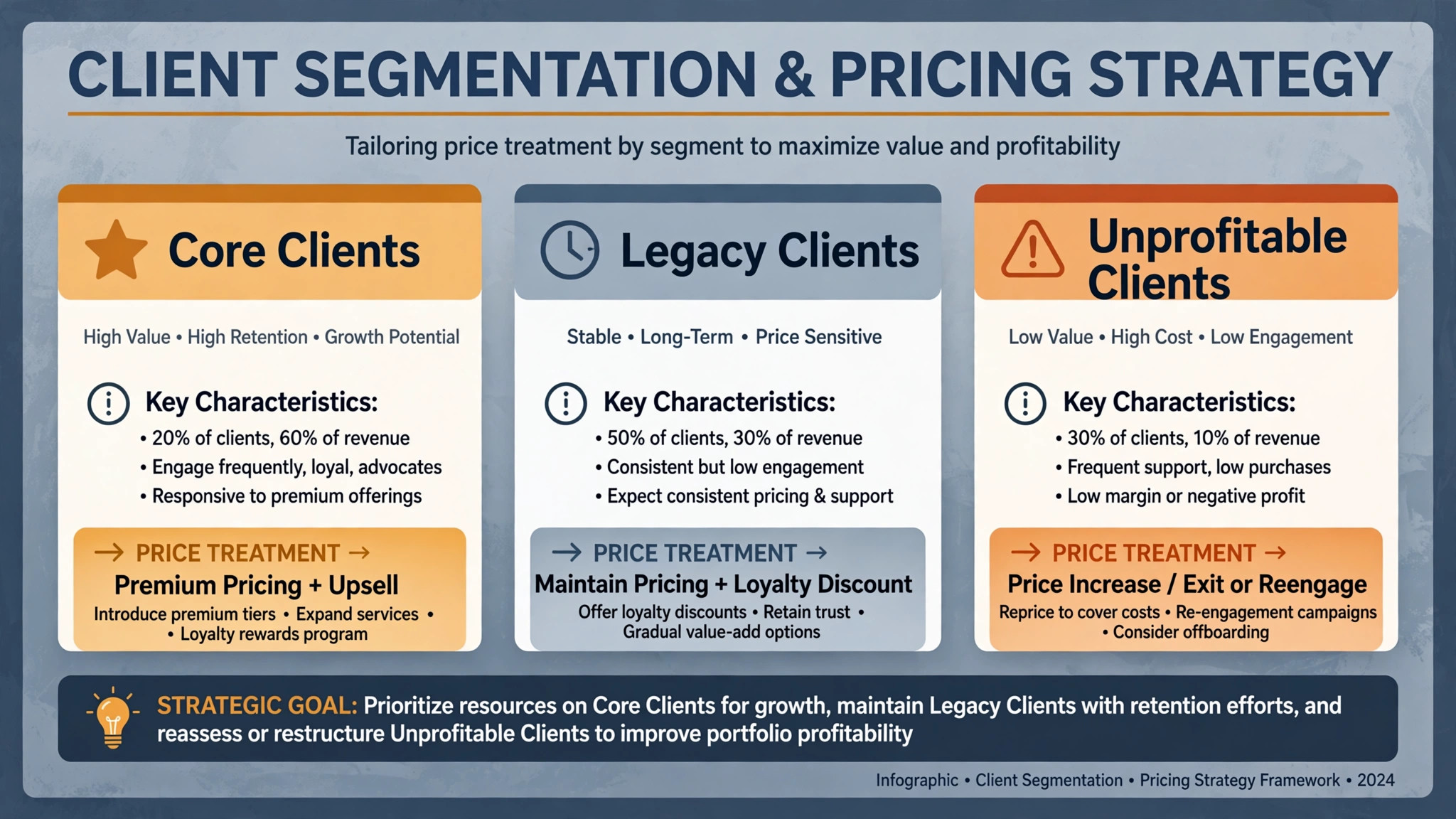
Step three, segment clients instead of raising everyone at once. Split the base into three groups. Core clients are profitable, a good fit, and easy to serve. They get the standard rise with full notice. Legacy clients sit on old pricing far below current rates. They get a staged rise over two cycles, so the correction is real but not a shock. Unprofitable clients cost more to serve than they pay. They get a larger rise, or a plain conversation about fit. New clients move to the new price immediately, and never let a new client pay less than an existing client is about to.
Step four, give notice that fits the relationship. Thirty days suits monthly or transactional clients. Sixty to ninety days suits annual contracts or retainers, or whatever your contracts require. Notice signals respect, while surprise signals desperation even when it is not. Step five, explain the reason in one plain sentence and state the new price clearly, with the date it takes effect. Step six, protect the relationship for ninety days after the change, watching for signs of strain and responding fast. Clients who feel looked after through a rise rarely leave over it.
Cost Plus Versus Value Based. Build Your Price Ladder
Two ways of setting a price dominate small service firms, and understanding both is what lets you raise prices with confidence. Cost plus pricing starts with your costs and adds a margin. You add up delivery cost, overhead, and a target profit, and the total is the price. It is honest and easy to explain, and it guarantees you cover costs if your numbers are right. Its weakness is that it ignores what the work is worth to the client. A task that saves a client thousands can be priced at a few hundred simply because it took you little time, and that gap is money left on the table every time you do it.
Value based pricing starts at the other end. It asks what outcome the client receives, what that outcome is worth to them, and what share of that value your fee represents. A bookkeeping cleanup that recovers a tax penalty, a website rebuild that doubles enquiries, or a maintenance plan that prevents a shutdown all carry value far above the hours involved. Value pricing is harder to set, because it requires evidence of results, but it is the method that lets you raise prices without apology, because the conversation is about results rather than hours. Most small firms do best with a blend. Cost plus sets the floor below which you will not go. Value sets the ceiling and the story.
Build the blend as a price ladder with three rungs. The entry rung is a tightly defined service at a price a new client can accept easily. It exists to start relationships, not to make your profit. The middle rung is your core service at the price most clients pay, with the full result included. The top rung is a premium service with faster turnaround, direct access, or advisory time added. When you raise prices, raise the middle and top rungs first, and hold the entry rung close to where it is. That way a price sensitive prospect still has a way in, while your existing revenue moves up where the value already justifies it.
| Pricing method | How the price is set | Best used when | Risk to watch |
|---|---|---|---|
| Cost plus | Costs plus a target margin | Costs are clear and stable | Ignores client value, so you undercharge for high impact work |
| Value based | Share of the outcome delivered | Results are measurable and large | Needs proof, so weak evidence makes the price feel arbitrary |
| Tiered ladder | Three rungs from entry to premium | You serve mixed budgets | Tiers blur, so define each rung in writing |

Worked Numbers. A Retainer, a Project, and an Hourly Client
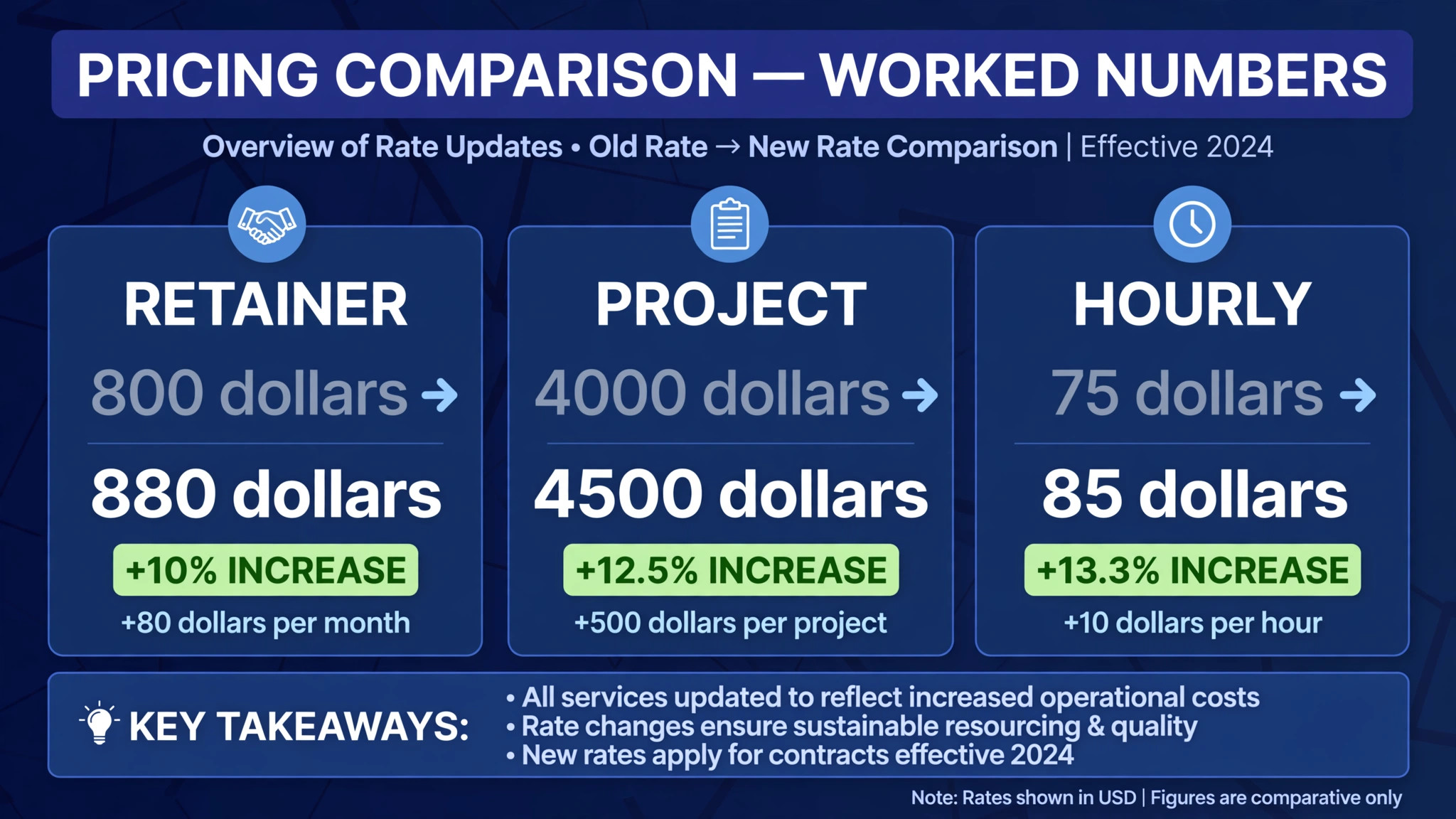
Worked examples turn theory into a decision, so here are three, using round numbers you can adapt to your own rates. First, a retainer client paying 800 dollars a month for ongoing support. Your delivery cost is 480 dollars, leaving a 40 percent margin. A 10 percent rise takes the fee to 880 dollars and the margin to 400 dollars per month. Break-even loss is 10 divided by 50, or 20 percent. You could lose one retainer client in five and earn the same gross profit. In practice, a retainer client with a 60 day notice and a results summary beforehand rarely leaves over 80 dollars, because switching supplier costs them far more in disruption.
Second, a project client quoted 4,000 dollars for a defined build. Delivery cost is 2,400 dollars, again a 40 percent margin. A 12.5 percent rise takes the quote to 4,500 dollars for the next project of the same kind. On a project, timing matters more than the percentage. Apply the new price to new projects, and honour the old price for work already quoted. Clients accept a new price on a new quote without drama, because each project is a fresh decision. Where a project is already underway, use a change form for extras rather than repricing the agreed work, which protects trust.
Third, an hourly client at 75 dollars an hour, with costs of 45 dollars leaving a 40 percent margin. A rise to 85 dollars is a 13 percent increase. Break-even loss is 13 divided by 53, or about 25 percent. That headroom is useful, because hourly clients feel rises most directly, seeing the number on every invoice. For hourly work, soften the landing by offering a monthly package at the new rate, so the client can buy certainty instead of watching a higher hourly number. A package of ten hours a month at 800 dollars feels like a plan, while 85 dollars an hour feels like a charge, even when the totals are close.
Notice what the three examples share. The margin, not the percentage, decides how much room you have. A firm with a 30 percent margin and a 10 percent rise can afford to lose 25 percent of clients. A firm with a 60 percent margin and the same rise can afford to lose about 14 percent, because each lost client takes more profit with them. Run your own numbers before you announce. The formula takes a minute, and it replaces a vague fear with a specific ceiling you can plan around.
Segment Clients Before You Announce Anything
Segmentation is the step most small firms skip, and it is the step that prevents the most damage. A blanket rise treats a loyal, profitable client the same as a draining, unprofitable one, and that is both unfair and wasteful. Start by listing every active client with three facts. What they pay, what they cost to serve, and how easy they are to work with. Cost to serve includes hours, rework, chasing, and the mental load of difficult communication, not just direct delivery cost. A client who pays well but needs constant reassurance may cost more than a quiet client who pays less.
Sort the list into the three groups described earlier, and write a different plan for each. Core clients get the standard rise, full notice, and a personal message that names something specific you delivered for them. Legacy clients get a staged plan, with the rise split across two cycles and the first step communicated now. Unprofitable clients get an honest conversation. Explain that the service at its current price is no longer sustainable, state the new price, and accept that some will leave. That is not a failure of the rise. It is the rise doing its second job, which is clearing space for clients who fit.
Timing also segments well. Raise prices for new clients first, immediately, so the new rate is already real before existing clients hear about it. Then announce to existing clients in waves, starting with the core group you are most confident about, so early acceptances build your confidence before the harder conversations. Never announce a rise during a service problem. A client who is waiting on a fix hears a price rise as indifference. Wait until the work is delivered well, then announce. The order of events shapes how the news lands more than the words do.
Done well, segmentation is the quiet engine of how to raise prices without losing clients small business owners keep, because nobody receives a rise designed for somebody else.
The Notice Script and the Timing That Works
The notice itself should be short, warm, and specific. Long explanations invite argument, because every extra reason is another point a client can dispute. One plain sentence about why, one clear statement of the new price, one date it takes effect, and one sentence about what stays the same. Apologising at length undermines the message, because it suggests the rise itself was wrong. Thank the client, state the change, and move on to the value they will keep receiving.
Use a script close to this, adapted to your own voice. Thank you for your business this year. From a set date, the monthly fee moves from the old figure to the new figure. This reflects the rising cost of delivering the service and the results we have delivered together this year, including one specific result. Everything else about your service stays the same, and work already booked keeps the current price. If you have any questions, I am glad to talk them through. That script works because it does four jobs at once. It thanks, it states, it justifies in one line, and it protects booked work, which removes the most common source of resentment.
Deliver the news personally to your most important clients. A call or a face to face conversation before the written notice lands shows respect that an email alone cannot. For the wider base, a well written email is fine, but send it from a person, not a mailing system, and invite replies. A client who can ask a question stays. A client who receives a cold system notice shops around. For retainer and contract clients, check the contract first. Notice periods, price change clauses, and renewal dates may constrain what you can do and when, and honouring the contract is not optional even when the commercial case for a rise is strong.
Choose the date with care. The start of a new quarter, a new year, or a contract renewal is natural, because clients expect changes at boundaries. Avoid announcing during your busiest season, when clients are stressed, or immediately after a price rise by a competitor, when the news feels like piling on. If you have not raised prices in years, say so plainly. Clients are more understanding of a first rise in three years than of a second rise in six months, and honesty about the gap makes the rise feel overdue rather than opportunistic.
A notice handled this way is the practical core of how to raise prices without losing clients small business owners rely on, since most damage comes from surprise rather than from the amount.
What to Do When a Client Pushes Back
Some pushback is normal and should be expected, not feared. The first response to a pushback is to listen fully before answering. Clients who feel heard often accept the rise in the same conversation, because their real objection was feeling unconsidered rather than the amount itself. Repeat their concern back in your own words, acknowledge it, and then answer the substance. A reply that starts with understanding and moves to the numbers holds the relationship better than a reply that starts with a defence.
Offer a choice rather than a discount. If a client says the new price is too high, do not cut it on the spot. Offer a smaller scope at a lower price, a longer commitment at a modest saving, or a payment schedule that eases cash flow without changing the total. Each of these is a genuine option that respects the client’s budget while protecting your rate. A discount given under pressure teaches the client that pressure works, and the next rise will be negotiated the same way. A choice given calmly teaches the client that the price is real and the service is flexible.
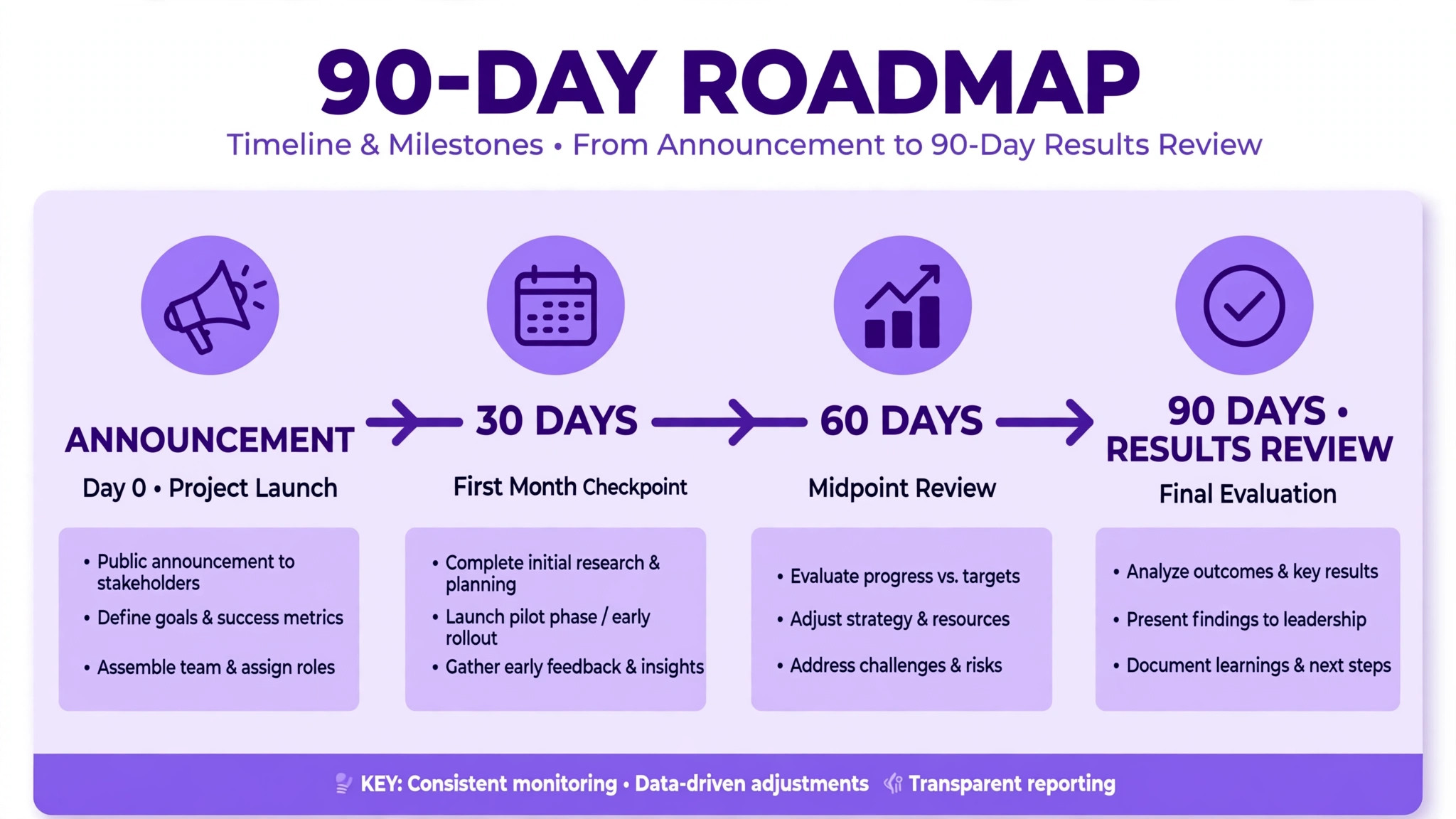
Know in advance which clients you will fight to keep and which you will let go. A core client who pushes back deserves a conversation, a tailored option, and patience. An unprofitable client who pushes back deserves a polite, firm answer and an easy exit. Letting a draining client leave is not losing a client. It is freeing capacity for a better one. Track the results for ninety days after the rise. Record who stayed, who left, and what revenue did. Most firms find revenue rose even where a small number of clients left, and that record becomes the evidence that makes the next rise far easier to approve, including to yourself.
That ninety day record is also the evidence that makes the next conversation about how to raise prices without losing clients small business owners plan easier, including the conversation you have with yourself.
Mistakes That Cost More Than the Rise Earns
The first mistake is raising everything at once, including the entry service that brings new clients in the door. A high entry price chokes the pipeline, and a choked pipeline makes every later decision harder. Hold the entry rung steady, raise the core and premium rungs, and let new clients enter at a price they can accept before they discover the full value. The second mistake is the stealth rise, where a price changes on an invoice with no notice. Clients discover stealth rises, and the discovery damages trust far more than the amount ever could. Announce every rise, even a small one, before it appears on an invoice.
The third mistake is apologising for the price in every conversation after the rise. Each apology reopens the negotiation and signals that the price is still in doubt. State the price once, clearly, and then talk about the work. The fourth mistake is raising prices without improving anything visible. A rise paired with a visible improvement, even a small one, feels earned. A rise paired with nothing feels extracted. Ship the improvement before the announcement, not after, so the client has already experienced it when the notice arrives. The fifth mistake is waiting too long. A rise delayed by fear becomes a rise doubled by necessity, and a doubled rise is the one that genuinely does lose clients.
Avoiding these five mistakes is most of how to raise prices without losing clients small business owners protect, because the rise itself is rarely the problem. The handling is.
After the Rise. Measure What Actually Happened
A rise is not finished when the notices go out. It is finished when you know what happened, and that takes a ninety day review with real numbers. Record three things for each client. Whether they stayed, whether they reduced scope, and what they now pay.
Then compare total revenue and total delivery hours with the same period before the rise. Most firms find revenue up and hours flat or down, which is the outcome the break-even maths predicted. Write the result down, because memory will blur it, and the next rise will feel as scary as this one unless the record says otherwise. That written record is the foundation of how to raise prices without losing clients small business owners repeat with confidence.
Look closely at who left, because the pattern teaches you more than the total. If leavers were mostly unprofitable or legacy clients, the rise did its second job and your base is healthier. If core clients left, something else went wrong, and it is usually notice, timing, or a service problem that coincided with the rise. Interview one or two leavers politely, not to win them back but to learn. Ask what tipped the decision. The answer often points to a fixable gap, such as a notice that arrived during a service problem, rather than to the price itself.
Then set the next review date. Price reviews belong in the calendar once a year, like tax returns, so they never again depend on courage. A firm that reviews prices annually, with fresh break-even maths and a short value summary for each client, rarely needs a large jump, because small annual rises keep the price aligned with the service. That rhythm is the lasting form of how to raise prices without losing clients small business owners sustain, and it is what turns a dreaded event into routine maintenance.
Frequently Asked Questions
How much should I raise my prices in one go?
Most guides land on 5 to 10 percent a year for a firm that reviews prices annually, and 8 to 12 percent at an annual review where prices have been still for a while. After two or more years without a change, a rise of 15 to 20 percent may be needed, and splitting it into two steps six months apart usually lands better than one jump. Run your break-even maths first. The percentage your business can support depends on your margin, not on a rule of thumb.
How much notice should I give before a price rise?
Thirty days suits monthly or transactional clients. Sixty to ninety days suits annual contracts or retainers, or whatever your contracts require. The notice period in a signed contract overrides any general guidance, so check contracts before announcing. Personal notice to your most important clients, by call or in person before the written notice, is worth the time it takes.
What if a long standing client threatens to leave over the rise?
Listen fully, acknowledge the concern, and offer a choice rather than a discount. A smaller scope, a longer commitment, or a payment schedule can bridge a genuine budget gap without cutting your rate. If the client still leaves, check the break-even maths. Losing one client in ten after a 10 percent rise usually leaves you better off, with less work to deliver. A client who leaves over a fair rise was often priced below the value they received.
Should new clients pay the new price immediately?
Yes, always. New clients should never pay less than an existing client is about to. Raising prices for new clients first also makes the new rate real before existing clients hear about it, which strengthens your confidence in the harder conversations. Hold your entry level service close to its current price if you need an easy way in for new buyers, and raise the core and premium rungs.
Is value based pricing suitable for a very small business?
Yes, provided you can show evidence of results. Value pricing needs proof, such as time saved, revenue gained, or problems prevented, expressed in the client’s own numbers. If you cannot yet evidence results, start with cost plus pricing as a floor, collect result stories from every job, and move toward value pricing as the evidence builds. Even one strong result story changes how a price conversation goes.
How do I raise prices without losing clients small business competitors undercut?
Competing on price alone is a race to the lowest margin, and it is a race a small firm rarely wins. Answer a cheaper competitor with specificity, not with a discount. Name what your service includes that theirs does not, show a result they cannot match, and let the client choose on value rather than on the number alone. Clients who buy purely on price will leave for the next discount anyway. Clients who buy on fit stay, and they are the base a price rise is designed to keep.
More Reading on Stratilyze
– How to Set Service Prices for a Trades Business – How to Price Cleaning Services as a Small Business – How to Price Social Media Management as a Small Agency – How to Fire a Client Professionally as a Small Business