

Keeping a difficult client feels safer than ending the relationship, until you count what keeping them actually costs. A client who pays late, expands the scope without paying more, or treats your team poorly does not just take hours. That client takes the hours you could have spent on better work, the energy your team needs for good clients, and the calm you need to run the business well. This guide explains how to fire a client professionally small business owners can use without burning bridges, damaging their reputation, or leaving loose ends that turn into disputes.
Firing a client is not a punishment, and it should not be framed as one. It is a business decision about fit, capacity, and sustainability, and it deserves the same care you give to winning a client in the first place. A professional exit has a clear end date, a written confirmation, completed work handed over cleanly, a final invoice that is easy to pay, and a boundary that holds after the end date. When those pieces are in place, most clients accept the news far better than owners expect, and some even return later under better terms, because the exit itself proved the business is well run.
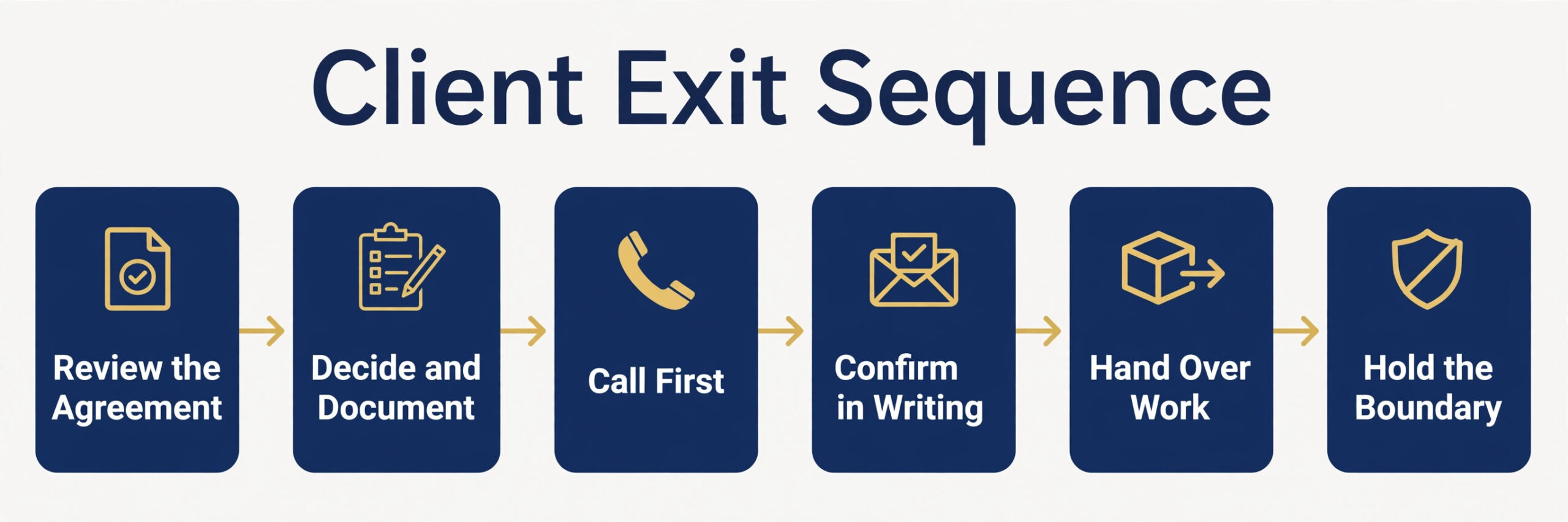
The worst exits share a pattern. They happen in anger, by a long emotional message, with no end date, no handover, and no plan for money owed. That pattern creates the very outcomes owners fear, which are bad reviews, payment disputes, and weeks of follow up messages. The plan below replaces that pattern with a short sequence. Decide the criteria, check the contract, prepare the handover and the money, have a brief conversation, confirm it in writing, and then hold the boundary. Each step is small on its own, and together they turn a dreaded conversation into a routine business process.
How to Fire a Client Professionally Small Business Owners Plan Before They Call
Do not start with the message. Start with the decision, written down before you contact the client, because a decision made in the middle of a tense conversation is easy to negotiate away. Write down the final working date, the deliverables you will complete before that date, the deliverables you will not start, the amount owed, the handover items, and the support you will offer after handover, if any. Decide whether you will offer a referral, and to whom, and check with that person first. A referral offered without checking is a favour that can embarrass both businesses.
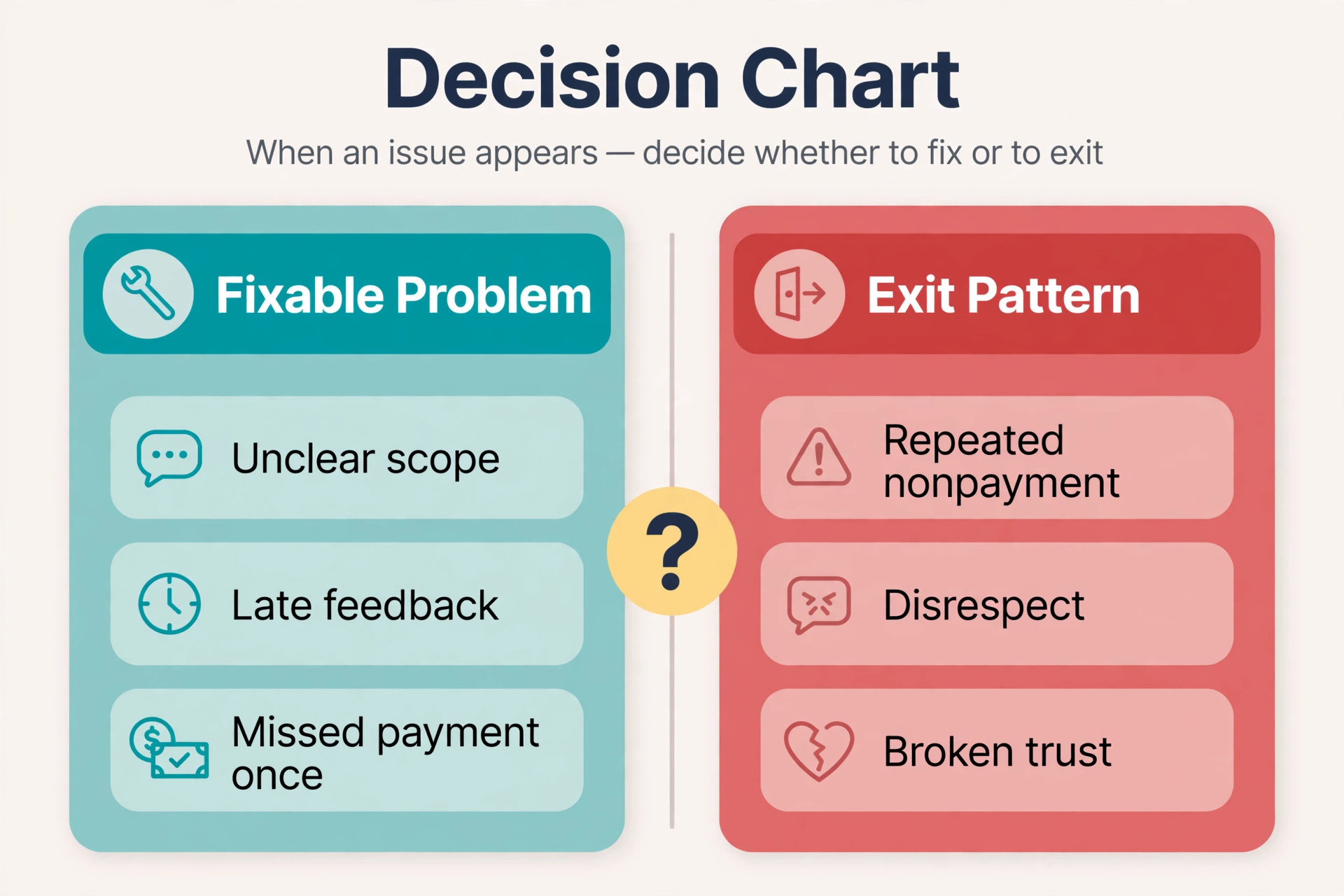
Exit criteria should be decided from patterns, not from a single bad day. One late payment after years of prompt payment is a conversation, not an exit. Repeated late payment, repeated scope expansion without added fees, repeated disrespect toward staff, work that no longer fits the services you offer, and a client who consumes most of your capacity for a small share of revenue are all patterns worth acting on. Use the table below to test whether you have a pattern, a fixable problem, or a temporary strain that a price change or a scope reset could solve.
| Signal | Pattern or one off | First response |
|---|---|---|
| Late payment twice in a row | Pattern | Payment terms reset, then exit if it repeats |
| Scope grows every project without added fees | Pattern | Scope reset with a written change process |
| Staff report disrespect more than once | Pattern | Direct conversation, then exit if it repeats |
| Work no longer fits your services | Ongoing mismatch | Referral out, with a clean handover |
| One difficult week after a long good relationship | One off | Honest conversation and a reset, not an exit |
A price rise is sometimes a gentler exit than a direct ending, and it is worth considering honestly. If the real problem is that the work now takes far more time than the fee covers, quoting the true rate lets the client choose. Some clients will accept the new rate, which solves the problem without an exit. Others will decline, which ends the relationship by their choice, with no blame attached. Do not use a price rise as a trick to force a client out, however, because a rate you would not happily accept if they said yes is not a real quote. It is a disguised firing, and clients can tell.
Before any conversation, check the agreement you actually signed, not the agreement you remember signing. Look for the termination clause, the notice period, the notice method, any minimum term, and any terms about prepaid work, files, or access. Practitioner guides commonly note notice periods of two to four weeks for retainer work where no written agreement exists, and shorter periods for project work, but your contract controls where one exists, so follow it exactly.
If there is no written agreement, choose a notice period that is fair for the work in hand, and state it clearly in writing. Employment, consumer, and contract rules vary by place and by type of work, so take professional advice before ending an arrangement where money, safety, regulated services, or a large prepaid balance are involved. This guide is general business information, not legal advice.
Separating a Fixable Problem From a Relationship That Should End
Not every difficult client should be fired, and firing too quickly can cost you good revenue and a reputation for walking away when work gets hard. Run a short reset test before you decide, unless the issue involves safety, abuse, or fraud, in which case safety comes first and no reset test is needed. The reset test has three parts, which are a direct conversation about the specific problem, a written change to terms or scope that addresses it, and a short period to see whether behaviour changes.
If the problem is late payment, the reset is payment before work or a shorter payment term. If the problem is scope creep, the reset is a written scope and a change process. If the problem is communication, the reset is a single channel and a response window.
Judge the reset by behaviour, not by apology. An apology without changed behaviour is a pause, not a fix, and it often repeats on the next project. Give the reset a clear timeframe, for example the next two invoices or the next project milestone, and note the result in writing. If behaviour improves and stays improved, you have saved a relationship and improved your terms at the same time. If behaviour returns to the old pattern, you have also strengthened your exit decision, because you can show, to yourself and if needed to others, that you tried a fair fix first.
Capacity is a legitimate reason on its own, and it needs no villain. A small business that has grown, changed services, or narrowed its focus will outgrow some early clients, and that is a sign of progress, not failure. Framing the exit around capacity and fit is also kinder and more accurate than inventing a complaint. Clients accept “we no longer offer this service at the standard you need” far more readily than a list of grievances, and that framing protects the relationship for referrals and future work. Keep the reason brief, neutral, and forward looking, and resist the urge to list every frustration, because a grievance list turns a business decision into an argument.
Document the pattern as you go, in a private file, with dates and facts rather than adjectives. Note invoice dates and payment dates, scope requests and your replies, and any incidents involving staff, with the date and what happened. This file is not for sending to the client. It is for your own clarity, for a consistent decision, and for protection if a dispute follows. Save the agreement, the invoices, the handover records, and the written exit confirmation in the same file, so the whole story sits in one place if you need it later.
The Conversation and the Written Confirmation
For a long term or high value client, a call or video meeting first, followed by written confirmation the same day, is usually the most respectful route. For a new, small, or hostile relationship, email alone may be safer, because it creates a clean record and avoids a live argument. Either way, the end date and the handover terms must be confirmed in writing, because a verbal ending with no written record is where most exit disputes begin. Choose the medium that fits the relationship, not the medium that feels easiest in the moment, and then follow it with writing without delay.
Keep the conversation short, direct, and free of blame. State the decision, state the final date, state what you will complete and hand over, and state the next step. Do not debate the decision, do not list grievances, and do not leave the door open with phrases that invite negotiation, such as asking the client to contact you with questions about the decision itself.
Questions about handover and payment are welcome and should be answered promptly. Questions designed to reopen the decision should be answered with a calm repeat of the end date and the handover plan, not with a new discussion. That short message is a core part of how to fire a client professionally small business owners use in practice.
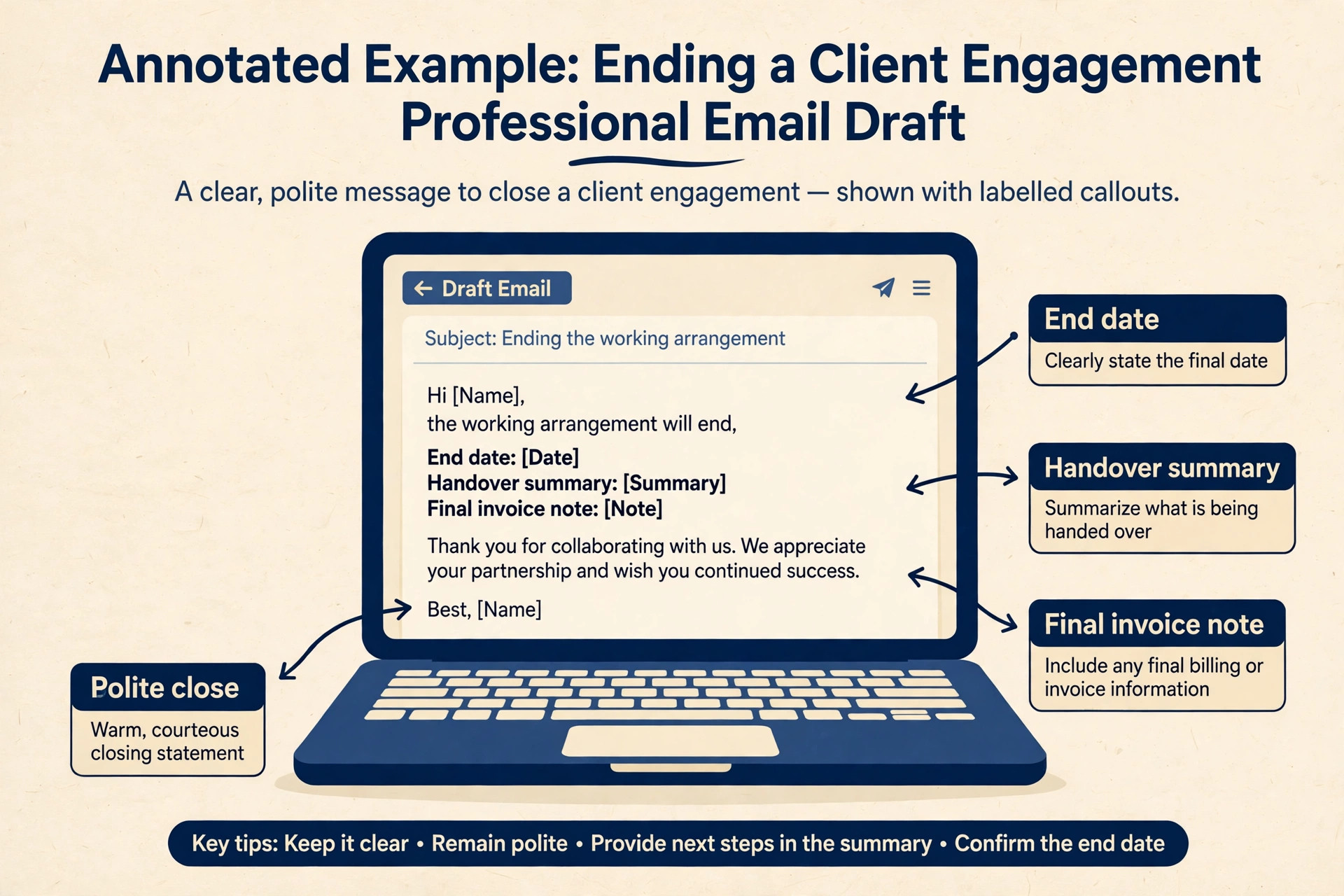
The script below is an original template you can adapt to your voice. Replace the bracketed parts, keep it short, and send the written version the same day even after a good call.
Boundary script, ready to adapt. Opening, thank the client for their time and for the work together. Decision, state that you will no longer be available for their projects after the final date, in line with the notice terms in your agreement. Completion, name the specific deliverables you will finish before that date. Handover, name the files, access, and notes you will transfer, and the date they will be sent.
Money, state that the final invoice is attached or will be sent by a stated date, with its due date. Referral, only if you have checked first, offer an introduction to a provider who may be a better fit. Close, wish the client well and confirm that handover questions can be sent in writing.
After the conversation, send the written confirmation promptly, and keep it under one page where possible. Long exit messages read as defensive, and defensive messages invite a long reply. A short confirmation that states the date, the clause, the remaining deliverables, the handover, and the invoice is easier for the client to accept, easier for a successor provider to act on, and far easier to defend if the exit is ever questioned. Save a copy, and note the date it was sent, in your exit file.
Handover Note That Leaves Nothing for the Next Provider to Guess
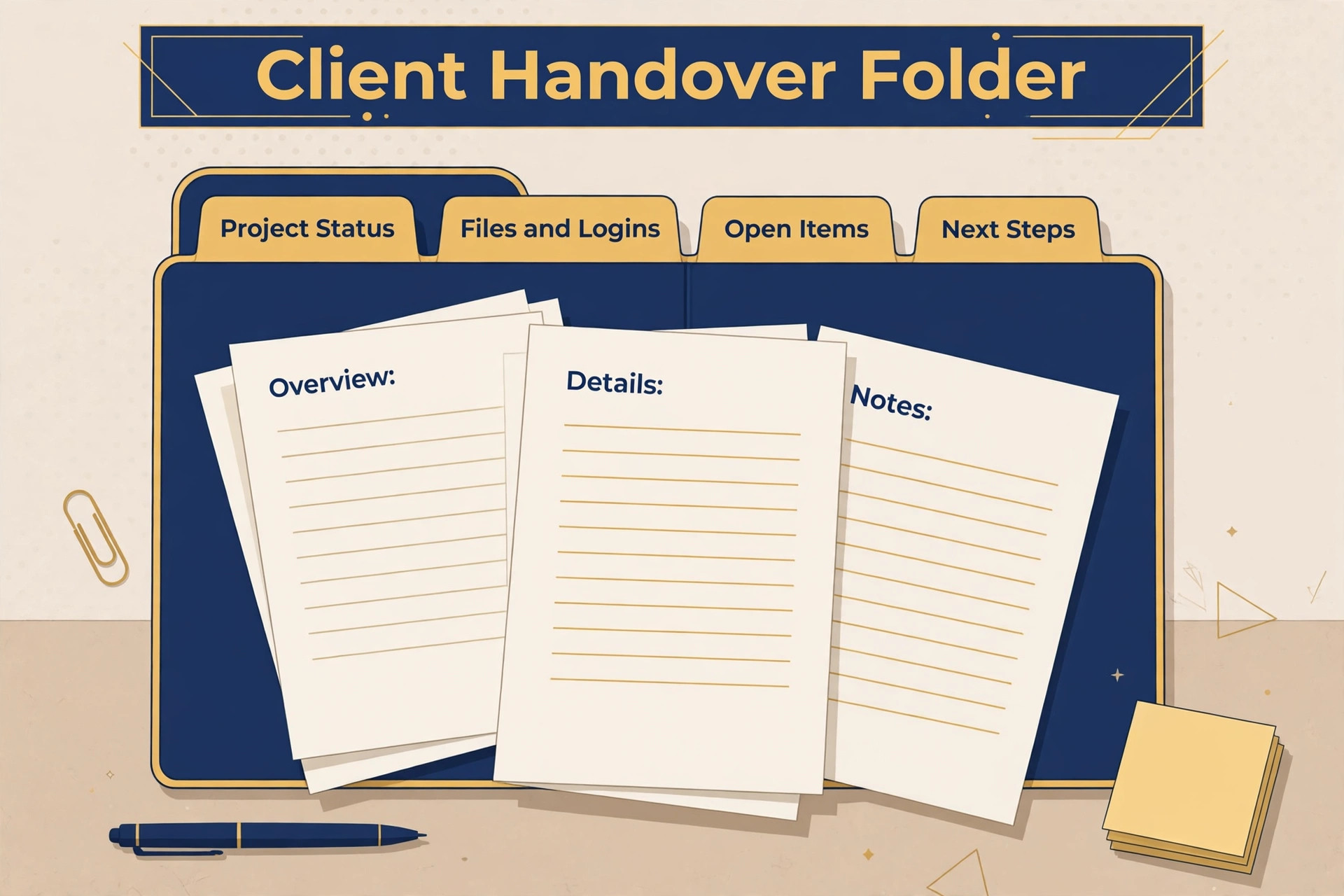
A handover note is the clearest proof that an exit was professional, and it is also the step most often skipped under time pressure. Write it before the final date, not after, and structure it so a new provider can pick the work up without calling you repeatedly. Start with a short summary of the project status, then list what is complete, what is in progress with its current state, and what was agreed but will not be started. That three part status prevents the common problem where a successor assumes unfinished work was finished, or finished work was still open. That clean handover is a central part of how to fire a client professionally small business owners do well.
Include the practical items a successor actually needs. Files and their locations, account access transferred through proper channels rather than shared passwords, key contacts, deadlines already agreed with third parties, and any warnings about constraints, such as a licence expiry, a pending approval, or a supplier lead time. Note decisions already made and decisions still open, with the information needed to make the open ones. Keep the note factual and neutral, with no commentary about the relationship, because the note may be read by people beyond the client, and commentary in a handover note damages your reputation more than it helps your case.
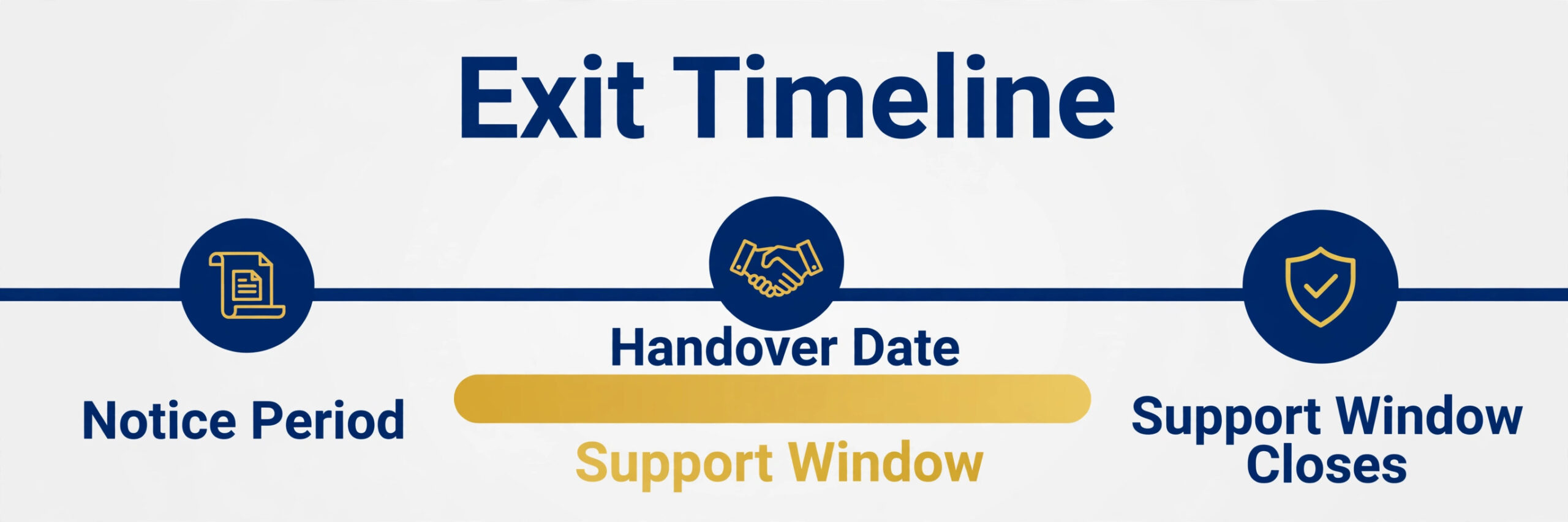
Agree the handover method and the support window in advance, and write both into the confirmation. For example, files will be transferred by a stated date through a shared folder, and handover questions will be answered in writing for a stated short period after that date. A defined support window is kinder than an open ended promise, because it gives the client real help without turning the exit into ongoing unpaid work. When the window closes, close it politely and in writing, by pointing back to the agreed date, rather than by going silent, which reads as abandonment even when the work is complete.
Remove your access and theirs in an orderly way once handover is complete. Return or delete client materials as the agreement requires, revoke shared logins through proper access controls, and confirm in writing that access has been transferred or removed. Do not keep client data longer than needed, and do not use client materials after the relationship ends. A tidy access close protects both sides, and it prevents the awkward follow up where a former client discovers months later that an old login still works.
Final Invoice, Prepaid Work, and Money Without a Fight
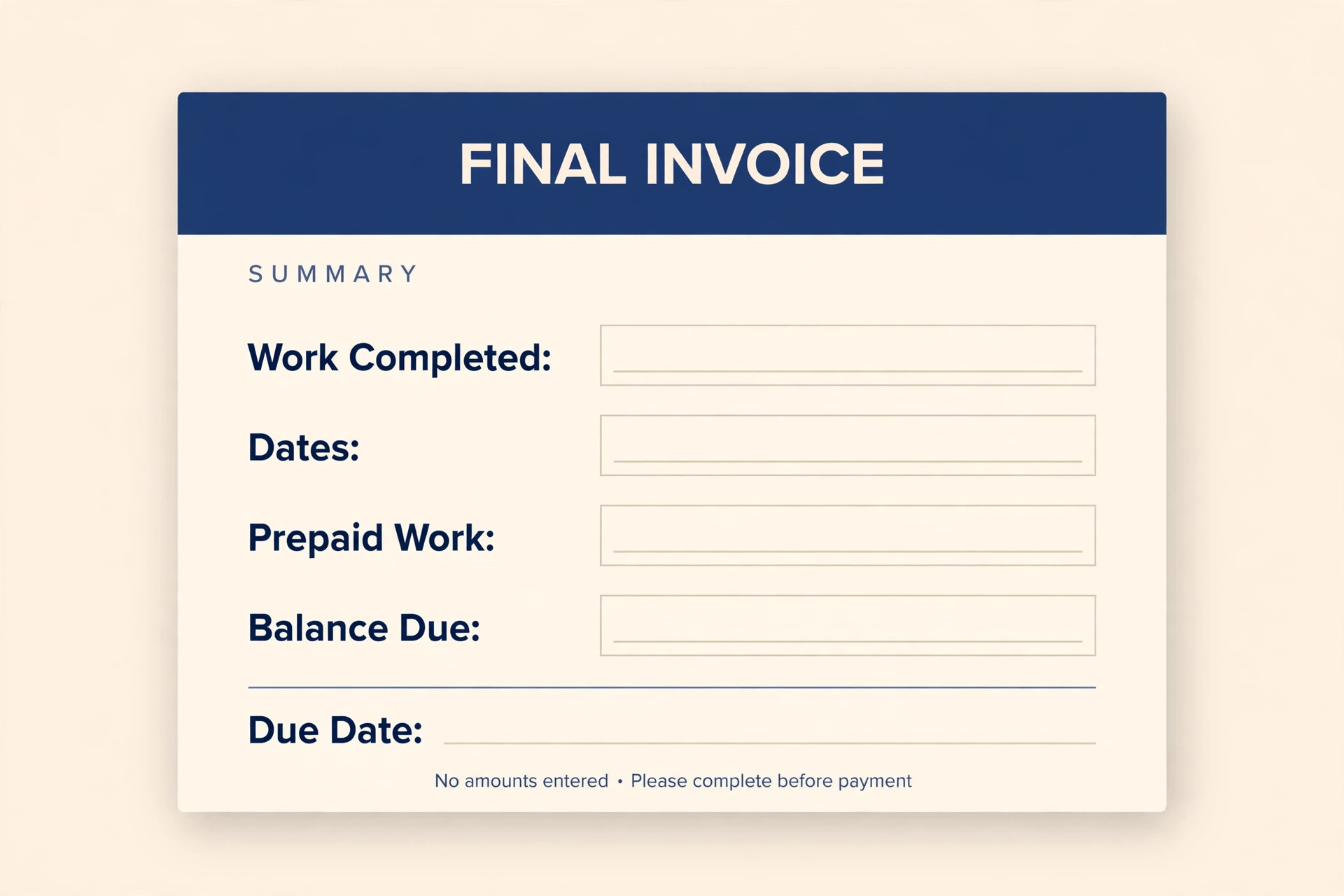
Settle the money before the conversation where possible, so the conversation is about the ending, not about a surprise figure. Calculate work completed, work in progress, prepaid amounts, and any agreed expenses, and reconcile them into one clear statement. If the client has prepaid for work you will not complete, be ready to refund the unearned part or to deliver the agreed work, as the agreement and local rules require. If the client owes money, send the final invoice with the written confirmation, with a clear due date and a simple payment method, and keep the tone factual. That money first order is a practical part of how to fire a client professionally small business owners should follow.
A final invoice should be easy to pay and easy to understand. List the work, the dates, the amounts, and the total, and reference the agreement or the project it relates to. Avoid adding surprise charges at exit, even if you feel they are justified, because a surprise charge at the moment of ending is the fastest route to a payment dispute. If an extra charge is genuinely owed under the agreement, explain it in one plain sentence and point to the term that covers it, rather than burying it in a total the client cannot follow.
If payment does not arrive by the due date, follow a short, calm sequence. A polite reminder with the invoice attached, a second reminder stating the next step, and then escalation through your normal collection route, without threats or public complaints. Do not withhold handover files solely to force payment unless your agreement clearly allows it and professional advice supports that step, because withholding files can escalate a money dispute into a broader claim. In most cases, a clean handover plus a clear invoice collects faster than a handover held hostage, because the client has no remaining grievance to hide behind.
Referral Out That Helps the Client and Protects Your Reputation
A referral, offered well, turns an ending into a helpful transition, and it often determines how the client talks about you afterwards. Offer a referral only when you genuinely believe the provider is a good fit, and only after checking that the provider is willing to be introduced and has capacity. A referral to a provider who is unsuitable, unaware, or unavailable helps no one, and it reflects badly on the business that made it. One or two well matched names are better than a long list, because a long list reads as a dismissal rather than a recommendation. That careful referral is a helpful part of how to fire a client professionally small business owners handle well.
Introduce the referral in a way that respects everyone involved. A short introduction that names the client need, the provider strength, and the next step, sent with permission from both sides, is enough. Do not share private client details with the provider, and do not share the reasons for the exit beyond a neutral statement about fit or capacity. The provider does not need your grievances, and the client does not need to hear their business discussed by a third party. After the introduction, step back. The new relationship is theirs to build, and repeated involvement from you blurs the ending you just made.
There are cases where no referral is appropriate, and saying so plainly is better than inventing one. If the work is highly specialised, if you do not know a suitable provider, or if the client relationship ended over safety or conduct, a simple statement that you are unable to recommend a specific provider, with a clean handover, is more honest than a forced name. You can still point the client to a professional directory or association where they can search, without endorsing a specific firm. Honesty at this point protects your reputation more than a referral made for appearance.
Holding the Boundary After the End Date
The hardest part of an exit often comes after it, when a former client sends one more request, framed as quick, small, or urgent. Each such request, if accepted, quietly restarts the relationship you just ended, and it usually arrives without payment, without a scope, and without the terms that would make it sustainable. Holding the boundary does not require rudeness. It requires a short, consistent reply that points back to the agreed end date and offers the handover route, rather than opening a new negotiation.
A useful boundary reply is brief and repeatable. Thank the client for the message, confirm that you are no longer available for project work after the agreed date, point to the handover note for the information they need, and, where appropriate, repeat the referral offer. Do not explain at length, do not apologise repeatedly, and do not offer a one off exception, because an exception teaches the client that the boundary moves under pressure. If the request is genuinely urgent and within the agreed support window, answer it within that window. If it falls outside the window, answer it as a boundary message, not as work.
Set the boundary inside your business as well. Tell staff who should handle messages from the former client, what the standard reply is, and when to escalate to you. Without that internal clarity, a well meaning team member may accept extra work out of politeness, and the exit unravels quietly. Also set a calendar reminder for the end of the support window, the final invoice due date, and the access removal date, so none of those steps depend on memory. An exit that is tracked to completion stays complete. An exit left to memory often drifts.
Mistakes That Turn a Clean Exit Into a Dispute
The first mistake is firing in anger, by a long message written in the heat of a bad day. A message written in anger almost always contains a grievance list, a threat, or a phrase that will be quoted back later, and it cannot be unsent. Write the decision down, sleep on it where safety allows, and send a short professional version the next day. The second mistake is ending without a written confirmation, which leaves the end date, the handover, and the money open to different memories. A short written confirmation costs minutes and prevents weeks of dispute.
The third mistake is promising ongoing help without a limit. Open ended help after an exit becomes unpaid work, resentment, and a blurred relationship, all of which damage the reputation the exit was meant to protect. Define the support window, put it in writing, and close it politely when it ends. The fourth mistake is withholding handover or adding surprise charges at exit, both of which give a client a legitimate grievance to focus on, even when the exit itself was justified. A clean handover and a clear invoice remove that focus and leave the client with little to dispute.
The fifth mistake is talking about the client afterwards in a way you would not want quoted. Detailed stories, public posts, and warnings to peers may feel satisfying in the moment, but they signal to future clients that their own difficult moments could become public stories too. Keep the account brief, neutral, and factual, inside and outside the business, and let the quality of the handover speak for the exit. That discipline is part of how to fire a client professionally small business owners keep their reputation intact long after the client is gone.
Client Exit Checklist
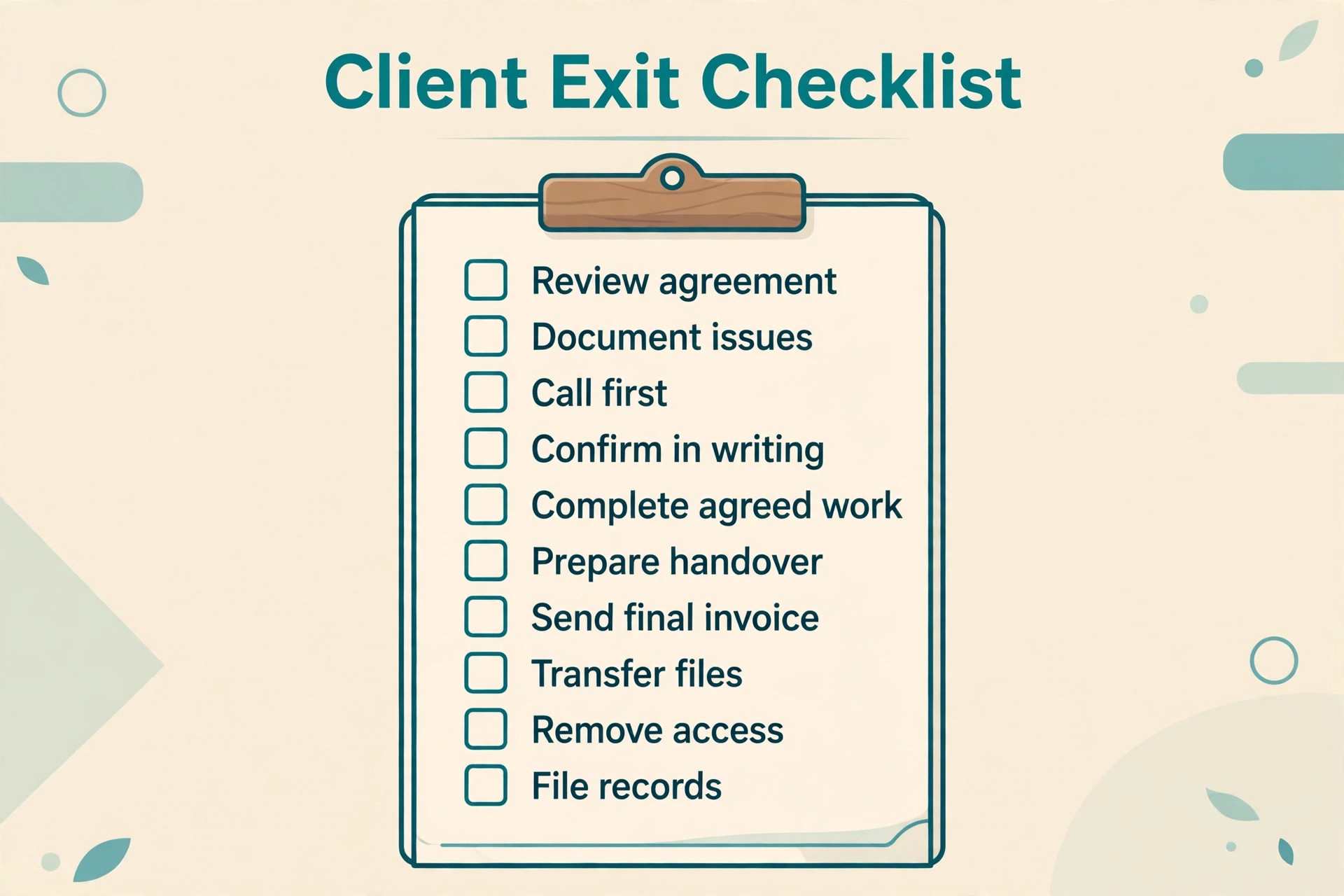
Use this checklist as the overview proof for the whole process, and complete it in order before, during, and after the exit conversation. That ordered checklist is a key part of how to fire a client professionally small business owners can repeat.
1. Confirm the pattern, and run a reset test unless safety or conduct makes that inappropriate. 2. Check the agreement for the termination clause, notice period, notice method, and prepaid terms. 3. Write down the final date, remaining deliverables, handover items, money owed, and support window. 4. Prepare the handover note, with project status, files, access, contacts, and open decisions. 5. Reconcile the money, and prepare a clear final invoice with a due date and a simple payment route. 6. Choose the conversation medium, keep the message short and neutral, and confirm it in writing the same day. 7. Offer a referral only after checking fit and capacity, and introduce it with permission from both sides. 8. Transfer handover, remove access in an orderly way, and confirm both in writing. 9. Track the support window, the invoice due date, and the access removal date to completion. 10. Hold the boundary after the end date with a short repeatable reply, and keep the exit file complete.
Keep this checklist with the agreement, the invoices, and the handover note. When the next difficult relationship arises, the checklist lets you act from a plan rather than from frustration, and that difference is usually visible to the client, to your team, and to anyone who later reviews how the exit was handled.
Frequently Asked Questions
How much notice should I give when firing a client?
Follow your agreement first, because its notice period controls where one exists. Where no written agreement exists, practitioner guides often suggest two to four weeks for ongoing work, which gives the client time to find a successor without leaving you in an open ended arrangement. For a single project near completion, finishing the agreed deliverables and then ending cleanly is often fairer than a long notice period with no work in hand. State the date in writing either way, so there is no doubt about when the relationship ends.
Should I fire a client by email or by phone?
A call or video meeting first, followed by written confirmation the same day, suits long term or high value relationships, because it shows respect and allows a direct conversation. Email alone suits new, small, or hostile relationships, because it creates a clean record and avoids a live argument. In both cases, the end date and handover terms must be confirmed in writing. The medium matters less than the written record that follows it.
What should a client termination message include?
It should include the final date, the contract clause or notice basis in brief, a neutral reason such as fit or capacity, the remaining deliverables, the handover items and date, and the final invoice with its due date. Keep it short, ideally under one page, and avoid grievance lists, threats, and open ended offers of help. A short message is easier to accept, easier for a successor to act on, and easier to defend if it is ever questioned.
Can I fire a client who has not paid?
In most business relationships, non payment is a legitimate reason to pause work and then end the relationship, but the steps matter. Pause work in writing, state what is owed and by when, and follow the agreement terms for ending the relationship. Do not withhold handover files solely to force payment unless your agreement clearly allows it and professional advice supports that step. Rules vary by place and by type of work, so take advice where a large balance, a regulated service, or a formal dispute is involved.
Should I always offer a referral when firing a client?
Offer a referral only when you know a provider who is a genuine fit and has capacity, and after checking with that provider first. A well matched referral helps the client and protects your reputation. A forced referral to an unsuitable or unaware provider helps no one. Where no suitable referral exists, say so plainly, provide a clean handover, and point the client to a professional directory or association where they can search for themselves.
How do I handle a bad review after firing a client?
Respond briefly, factually, and without personal detail, and only if a response will help future readers. State that the engagement ended on a stated date with a handover provided, and invite any outstanding formal matter to be handled through the agreed channel. Do not post grievances, private messages, or detailed accounts in reply, because a public argument damages your reputation more than the original review. Keep the exit file complete, because it is the record you need if the review misstates facts and a platform process follows.
The Verdict on Ending a Client Relationship Well
A professional exit is not about winning an argument or proving a point. It is about ending a business relationship in a way that leaves the client able to move on, leaves your team free to do better work, and leaves your reputation intact. Decide from patterns, check the contract, prepare the handover and the money, keep the message short, confirm it in writing, and hold the boundary after the end date. That sequence is how to fire a client professionally small business owners can repeat without dread, because it replaces emotion with process at exactly the moment emotion is strongest.
The clients you keep deserve your best work, and the clients you end deserve a clean ending. Apply that discipline consistently, and firing a client stops being a crisis. It becomes a routine business decision, handled well, and remembered by former clients as fair, even when it was not the news they wanted.
More Reading on Stratilyze
– Best CRM Software for Consultants – Best Quote Software for Trades Businesses – Best Payment Software for Service Businesses – Automate Small Business with AI