

Agencies that price on value report profit margins 28 to 43 percent higher than agencies stuck on hourly billing, according to figures from a 2025 agency profitability study cited in pricing guides, while agencies that bill hourly report margins 18 to 24 percent lower than project and value based rivals. Those two numbers frame the central question of how to price retainers small agency owners must answer before the next renewal. A retainer priced like cheap hours teaches the client that the retainer is the cheap option, and cheap options are the first to be cut when budgets tighten.
A retainer is not a subscription to your time. It is a promise of availability, a defined scope of work and the accumulated knowledge of the client business, sold as a flat monthly fee. Clients buy it because they want problems handled without a fresh quote every week, and agencies sell it because it turns lumpy project income into predictable monthly revenue that supports hiring and planning. Both sides benefit only when the price covers the real effort, the scope is written clearly, and the terms survive month twelve as well as they survived month one.
This guide prices retainers three ways, hours based, deliverables based and value based, then works through real monthly prices for a 10 hour, a 20 hour and a full scope retainer. It also covers the rollover, overage and notice terms that decide whether a retainer still works for you a year after signing, and the review rhythm that keeps prices honest as effort drifts.
Why Retainers Get Cut First
Retainers get cut first for a reason that has little to do with the quality of the work. When a client finance team reviews spending, every line is judged by the outcome it produces, and a retainer that was sold as discounted hours looks like overhead. Overhead is cut. A retainer sold as an outcome, such as a steady flow of qualified leads, a website that stays fast and secure, or a content engine that never stalls, looks like an investment, and investments survive reviews that kill overhead.
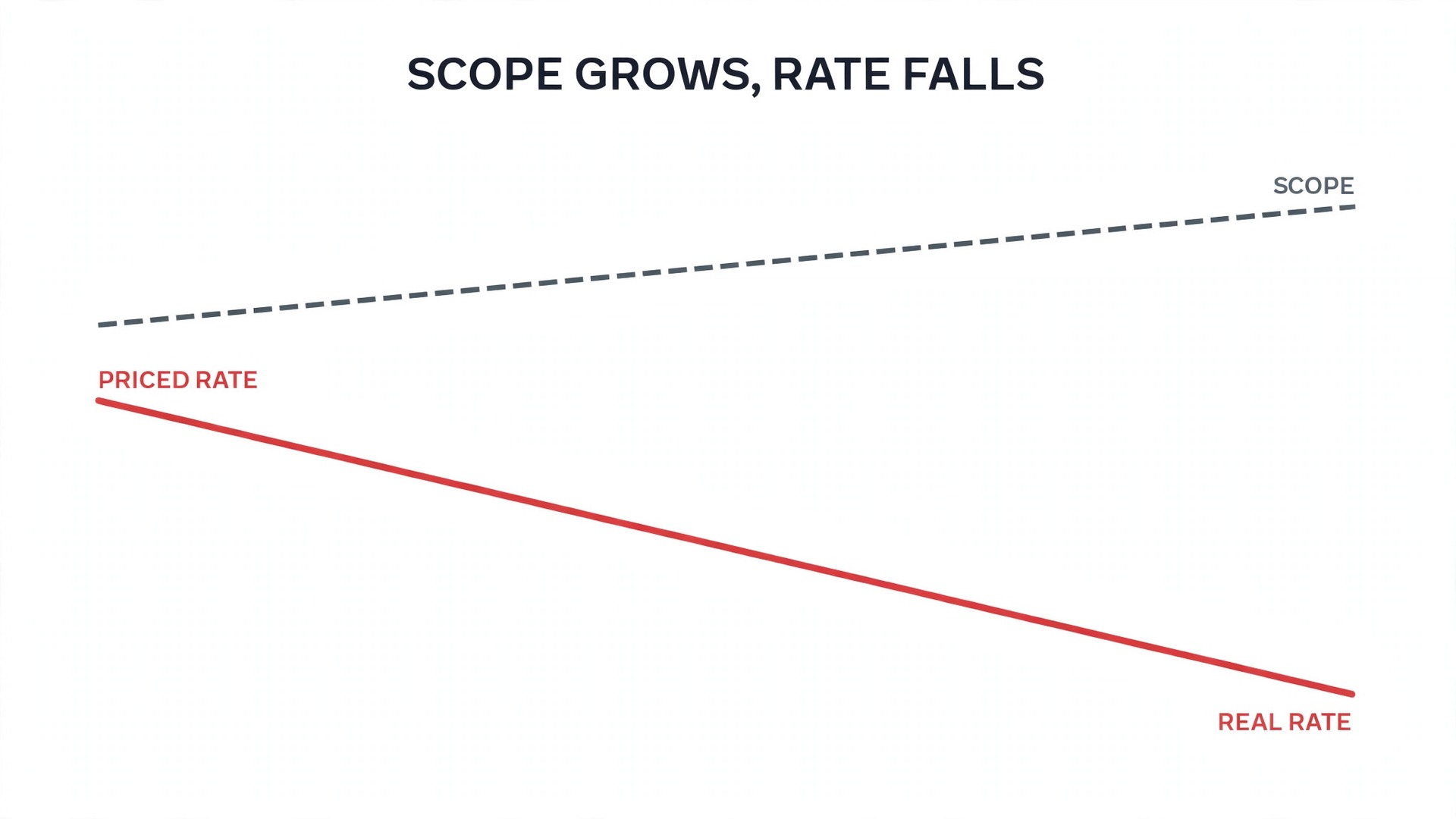
The second reason is scope drift without price drift. A retainer that starts at ten hours of defined work and quietly grows to eighteen hours of favours, urgent extras and unplanned calls is no longer the retainer that was priced. The agency absorbs the extra effort, the effective hourly rate falls, resentment builds, and the renewal conversation becomes a confrontation instead of a routine. Retainers do not usually fail because the price was wrong on day one. They fail because nobody measured whether the price still matched the effort in month six.
The third reason is invisibility. Work delivered quietly, without a monthly report that connects effort to result, feels optional to a client who never sees it. A monthly report that shows what was delivered, what changed and what happens next turns invisible work into visible value, and it gives the client something to defend internally when budgets are questioned. Price, scope and reporting are one system, and a retainer priced well but reported poorly will still be cut.
How to Price Retainers Small Agency From the Cost Floor
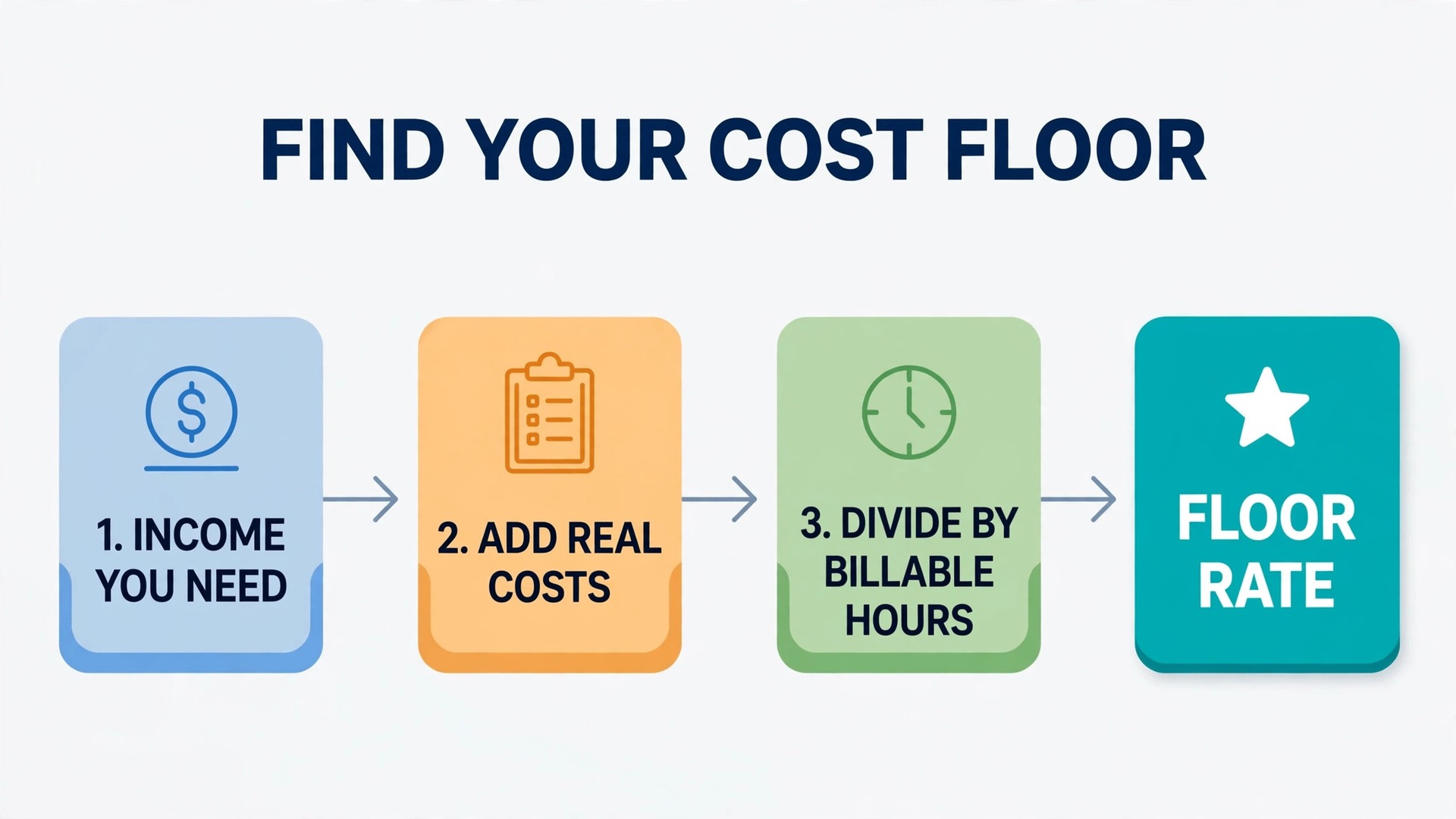
Every retainer price starts from a floor rate, not from a competitor price and not from a discount. The floor rate is your target income plus your business costs, divided by the realistic billable hours you can actually sell in a year. If you target 90,000 dollars of income, carry 30,000 dollars of business costs, and can realistically bill 1,200 hours, your floor rate is 100 dollars an hour. That figure is the minimum the retainer can pay per hour of committed work, and any price below it is a subscription to your own underpayment, however loyal the client seems.
Learning how to price retainers small agency work starts with that floor, because the floor turns every later decision into arithmetic. A 10 hour retainer at a 100 dollar floor costs 1,000 dollars before any premium for availability, priority access or outcome value. A 20 hour retainer costs 2,000 dollars before premium. Those are floors, not quotes, and the quote adds the value of guaranteed availability, the knowledge you hold about the client business, and the results the retainer produces. A retainer that pays less per hour than your project rate trains the client to value you less on retainer than on projects, which is backwards, since retainer clients get priority and continuity.
Test the floor against real time before quoting. Track hours for a month on similar work, including calls, revisions, coordination and admin, not just production time, and compare the total with the hours you assumed. Most small agencies discover that a nominal 10 hour retainer actually consumes 13 to 15 hours once coordination is counted, which means a price built on 10 hours is already underwater. Price from measured hours, add the availability premium deliberately, and write the scope so the measured hours and the promised hours match.
Hours Based Retainers Without the Discount Trap
An hours based retainer sells a block of hours per month at a flat fee, for example 10 hours for 1,200 dollars or 20 hours for 2,400 dollars, and it suits work that is genuinely variable, such as advisory support, design tweaks and campaign adjustments. The model is easy to explain and easy to buy, which is why most agencies start here, and it is also the model most often ruined by a well meaning discount. A 20 percent loyalty discount on hours turns a 100 dollar floor rate into an 80 dollar effective rate, and the agency then does the same work for less money while carrying the same availability obligation.
Price hours retainers at or above your project rate, not below it. The client gains guaranteed availability, faster response and a team that already knows the business, and those benefits are worth a premium, not a discount. If the client pushes for a lower price, reduce the hours or narrow the scope instead of cutting the rate, because a smaller retainer at a healthy rate can grow, while a large retainer at a weak rate traps the agency in unprofitable work that is hard to renegotiate. State the response times and turnaround standards in the agreement, since priority access is part of what the fee buys.
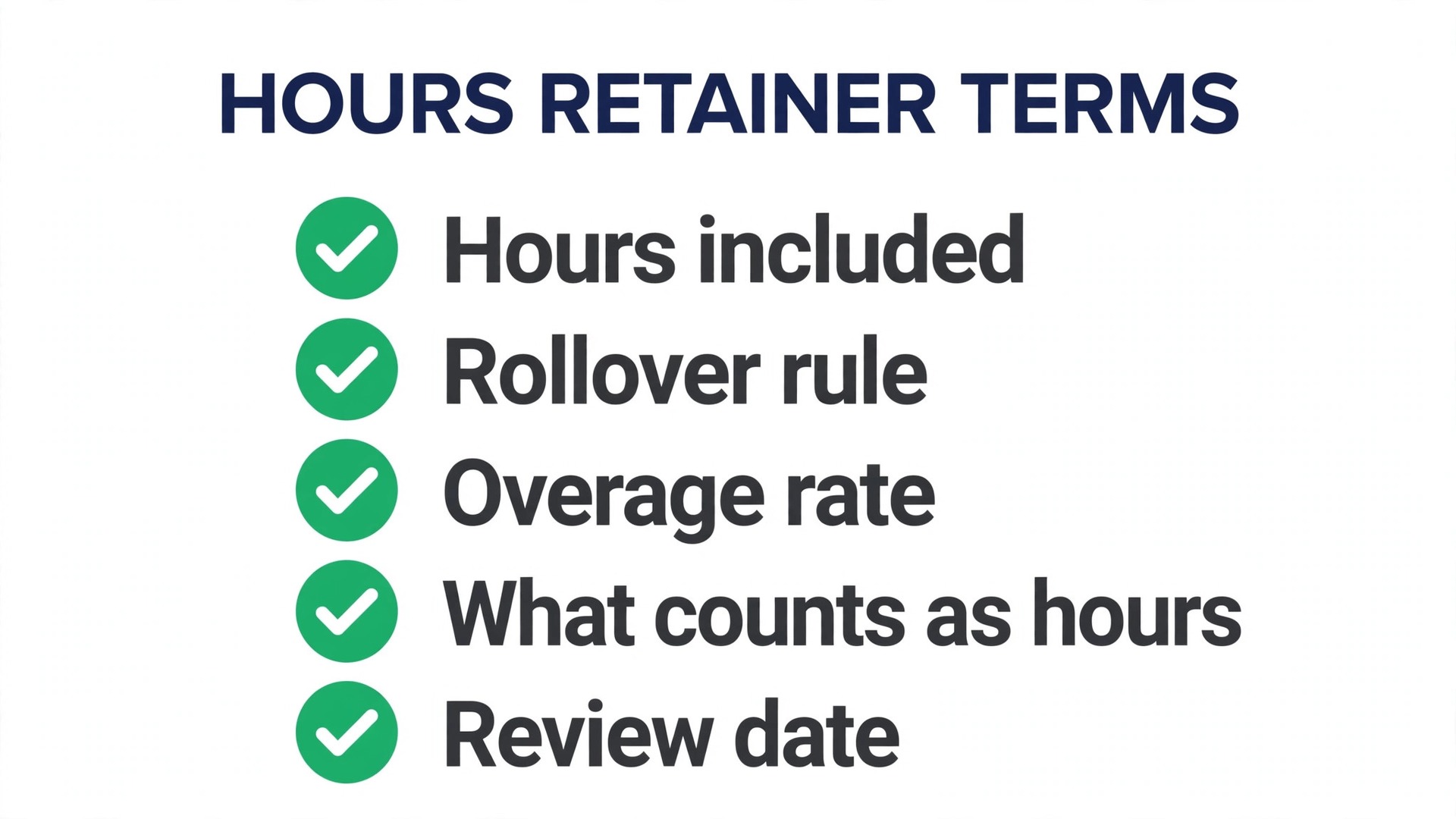
Rollover is where hours retainers quietly break. Unused hours that accumulate month after month become a debt of owed work that the client will eventually call in at the worst possible moment, such as a product launch week. Cap rollover at one month, or replace it entirely with a use it or lose it policy paired with a monthly report that shows exactly what the hours produced. Overage pricing matters just as much. If extra hours cost the same as included hours, the rational client under buys the retainer and tops up as needed, losing the predictability that justified the commitment. Price overage at your standard rate plus 10 to 20 percent, and the incentive points the right way.
Deliverables Based Retainers and Scope That Holds
A deliverables based retainer sells a defined set of outputs each month, for example four blog posts, twelve social graphics, two email campaigns, a monthly analytics report and one strategy call, at a flat monthly fee. The client buys certainty about what arrives, the agency gains control over how the work is produced, and the conversation shifts from hours to results. This model suits repeatable production work where quality can be specified in advance, and it is the easiest retainer to report on, because delivery either happened or it did not.
Scope discipline decides whether this model profits or bleeds. Write each deliverable with its limits, meaning word counts, revision rounds, formats and turnaround times, and state plainly what counts as extra. A blog post with two revision rounds and a 48 hour turnaround is a different product from a blog post with unlimited revisions and same day delivery, and the price must reflect that difference. Quick requests outside the scope are the classic leak, so handle them with a written rule, either a small extras allowance each month, or overage billing at the agreed rate, applied consistently rather than waived to be nice.
Price deliverables from the hours they truly consume, then add the availability and reporting premium. If four posts, twelve graphics and two campaigns consume 22 hours at a 100 dollar floor, the floor is 2,200 dollars, and the quote adds the value of guaranteed capacity and the monthly reporting the client receives. Do not price deliverables by guessing what the market pays, because market prices hide different scopes, and a rival quote for four posts may include half your revision rounds. When a deliverable repeatedly takes longer than planned, reprice it or rescope it at the quarterly review, rather than absorbing the overrun silently until the retainer becomes a loss.

Value Based Retainers and the Outcome Conversation
A value based retainer prices the problem solved, not the hours spent, and it suits work where the agency can draw a clear line from effort to money, such as reducing churn, lifting conversion or replacing an expensive hire. Published pricing guides put value based access retainers for consultants and strategists in the region of 3,000 to 15,000 dollars a month and higher, with the price set by the size of the problem rather than the size of the timesheet. A client losing 50,000 dollars a month to churn will happily pay 5,000 dollars a month to a consultant who fixes it, because the return is tenfold, and the hours involved are irrelevant to that calculation.
The outcome conversation starts in discovery, before any price is mentioned. Ask what the problem costs the client today, what a fix would be worth over a year, and what happens if nothing changes. If the client cannot quantify the problem, value pricing has no anchor, and an hours or deliverables retainer is the honest choice until the value becomes measurable.
If the client can quantify it, price the retainer as a fraction of the value created, commonly in the region of 10 to 20 percent of the projected impact for project work, adapted to a monthly equivalent for a retainer, and confirm the arrangement in the proposal with the client own figures, not invented ones.
Value retainers need measurement rules agreed in advance, or they collapse into arguments about credit. Define the baseline metric, the measurement source, the review date and what happens if the result misses, such as extra work at no charge until the target is met, or a fee adjustment at renewal.
That discipline is what separates learning how to price retainers small agency work on value from guessing a monthly fee. Performance guarantees suit only agencies with high confidence in delivery, and surveys cited in pricing guides note that only about 23 percent of agencies offer them, while those that do close deals faster and at higher average value.
Use guarantees sparingly, tie them to metrics the agency controls, and never guarantee results that depend on client actions the agency cannot enforce.

Worked Prices for a 10 Hour, a 20 Hour and a Full Scope Retainer
Worked prices make the three models comparable, and the table below uses a 100 dollar floor rate so the arithmetic stays visible. Swap in your own floor rate and the structure still holds, because the method matters more than the example numbers. Every figure below is a floor plus a stated premium, not a market quote, and your quote should reflect your own costs, seniority and client value, confirmed against your own time records.
A 10 hour hours based retainer starts at a 1,000 dollar floor. Add a 20 percent availability premium, which is 200 dollars, and the quote becomes 1,200 dollars a month, with rollover capped at one month and overage at 110 to 120 dollars an hour. That retainer suits a client who needs steady advisory access and small adjustments, and it leaves room for a second 10 hour block if demand grows, rather than forcing the client into a 20 hour commitment on day one.
A 20 hour hours based retainer starts at a 2,000 dollar floor. Add the same 20 percent availability premium, which is 400 dollars, and the quote becomes 2,400 dollars a month, with a monthly report, a named contact and agreed response times. The deliverables version of a similar scope, four posts, twelve graphics, two campaigns and a report, might consume 22 hours, giving a 2,200 dollar floor, and a quote of 2,600 to 2,800 dollars once reporting and guaranteed capacity are added. Notice that the deliverables quote is higher than the hours quote for similar effort, because the client buys certainty about outputs as well as time.
A full scope retainer has no hour cap and instead promises a defined outcome with a defined team, such as owning a client content engine, a paid media programme or a product marketing function. Price it from the team cost plus a margin, or from the value of the outcome, whichever is higher and defensible.
A small agency team costing 6,000 dollars a month in loaded time, priced at a 50 percent gross margin, needs a 12,000 dollar retainer, since cost divided by 0.5 gives the price. A value based version for a client whose problem costs 50,000 dollars a month might price at 5,000 to 10,000 dollars a month, and the agency should quote the higher of the cost based and value based figures that the client evidence supports, not the lower one out of modesty.
| Retainer shape | Floor at 100 dollars an hour | Premium added | Worked monthly quote |
|---|---|---|---|
| 10 hour hours based | 1,000 dollars | 20 percent availability, 200 dollars | 1,200 dollars |
| 20 hour hours based | 2,000 dollars | 20 percent availability, 400 dollars | 2,400 dollars |
| Deliverables based, about 22 hours | 2,200 dollars | Reporting and capacity, 400 to 600 dollars | 2,600 to 2,800 dollars |
| Full scope, team cost 6,000 dollars | 6,000 dollars cost | 50 percent gross margin | 12,000 dollars |
| Full scope, value based | Problem worth 50,000 dollars a month | Fraction of value created | 5,000 to 10,000 dollars |
The lesson from the table is that retainer prices rise with certainty and outcome, not just with hours. A client who buys hours buys effort. A client who buys deliverables buys certainty. A client who buys a full scope outcome buys a result and a team, and that is the most valuable product an agency sells. Price each tier for what the client actually receives, and the renewal conversation becomes a discussion of results rather than a negotiation over hourly rates. That progression is the reason learning how to price retainers small agency work by model, rather than by habit, changes the renewal conversation completely.
Rollover, Overage and Notice Terms That Protect Month Twelve
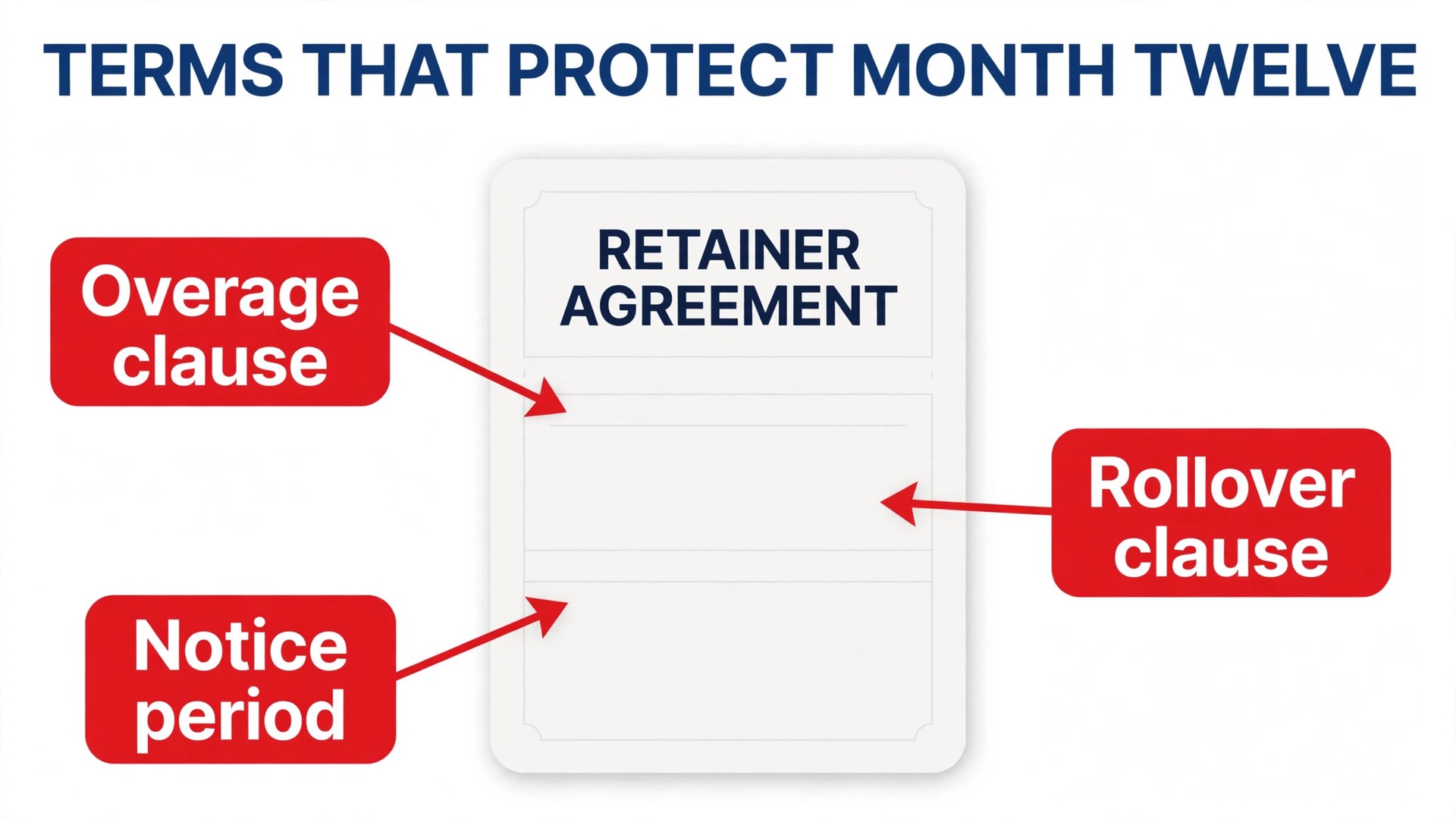
Terms decide whether a good price stays good, and the three terms that matter most are rollover, overage and notice. Rollover caps unused hours or deliverables, so the agency never owes a mountain of back work. Overage prices extra work above the retainer, so growth in demand grows revenue instead of shrinking margin. Notice periods, commonly 30 days on either side, give both parties time to hand over work cleanly, and they prevent a sudden revenue cliff for the agency and a sudden support gap for the client.
Write payment terms that protect cash flow as well. Retainers are paid in advance, at the start of the month, before work begins, and the first month is paid before the first deliverable ships. Agencies that start work before payment trade their strongest bargaining power for a promise, and surveys cited in pricing guides report far fewer cancellations and faster starts for agencies that require deposits and advance payment. State what happens to work in progress if payment stops, and state it politely but plainly, because a term nobody reads until a dispute is a term that failed.
Scope change needs its own term too. A retainer agreement should state how new requests are handled, meaning a written change note, a price for the extra work, and a decision within an agreed window. Without that term, every new request becomes a negotiation conducted under deadline pressure, and deadline pressure always favours the client asking for more. With the term in place, extra work is a normal commercial event with a price, and the client can choose to pay, defer or drop it without damaging the relationship.
Review the terms themselves at renewal, not just the price. A rollover cap that made sense for a quiet client may strangle a growing one, and an overage rate set a year ago may lag the current floor rate. The renewal conversation should cover price, scope, terms and results together, because a retainer that only ever discusses price will eventually be judged on price alone, and price alone is a contest the agency usually loses. Terms reviewed this way are part of how to price retainers small agency owners keep profitable year after year.
Reviewing and Raising Prices Without Losing the Client
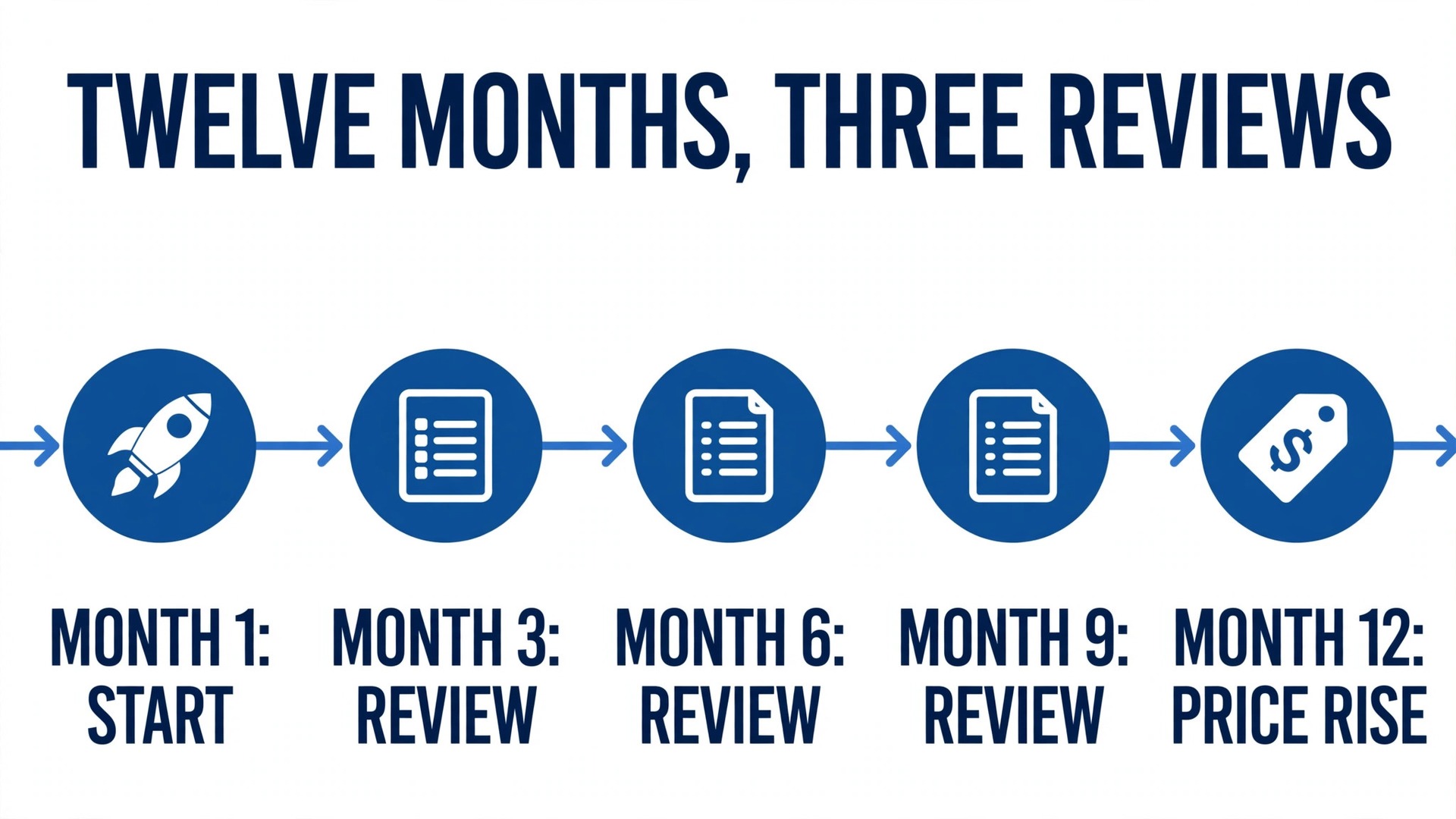
Review retainer prices quarterly against effort, and adjust them annually as a minimum. The quarterly check compares hours delivered, deliverables shipped and overage billed against the retainer fee, and calculates the effective hourly rate actually earned. If the effective rate has fallen below the floor rate, the retainer needs repricing, rescoping or a scope reduction, and the longer that correction waits, the harder the conversation becomes. A 10 percent correction after one quarter is a routine adjustment. A 40 percent correction after a year feels like a betrayal.
Raise prices with evidence, not apology. Show the client the monthly reports, the results delivered, the scope growth since signing, and the new price tied to the new scope, and give notice ahead of the renewal date so the client can plan. Clients accept price rises that arrive with results and warning, and they resist rises that arrive as surprises. Frame the rise as a scope and value update rather than an inflation pass through, because clients pay for outcomes, and an outcome led rise is easier to defend internally than a cost led rise.
When a client cannot accept the new price, offer a smaller retainer at the healthy rate rather than the same retainer at a discounted rate. A reduced scope protects the effective rate, keeps the relationship alive, and leaves a growth path back to the full retainer when budget returns. What you must not do is hold the price and absorb the extra effort, because that teaches the client that scope grows free, and the next renewal will demand the same generosity again. The discipline of learning how to price retainers small agency work sustainably is mostly the discipline of holding that line kindly and consistently.
What to Put in the Retainer Proposal
A retainer proposal should fit on two pages and answer every question a finance reviewer will ask. Page one states the outcome, the monthly scope in plain deliverables or hours, the monthly fee, the start date and the notice period. Page two states the terms that protect both sides, meaning rollover, overage, payment in advance, response times, revision limits and what happens to work in progress at termination. A proposal that hides the terms in small print invites a dispute later, while a proposal that states them plainly builds trust at signing.
Lead with the outcome, not with the hours. A proposal that opens with twenty hours a month invites the client to divide the fee by twenty and compare it with a freelancer rate. A proposal that opens with the result, such as four posts, twelve graphics, two campaigns and a monthly report that keeps the pipeline full, invites the client to judge the fee against the pipeline it produces. Hours belong in the proposal as a scope guardrail, not as the headline, because the headline should sell what the client receives.
Include a pilot option for new clients who hesitate at a twelve month commitment. A one month pilot at the full monthly fee, with a review meeting at the end, removes the fear of being locked into an unproven agency, and it gives the agency a month of measured hours to confirm the price. State plainly that the pilot converts to the retainer on the same terms unless either side gives notice, so the pilot is a beginning rather than a free trial. A pilot priced below the retainer rate undermines the very price it is meant to prove, so hold the rate and sell the low commitment instead.
Close the proposal with a short section on reporting, because reporting is what makes the retainer defensible at renewal. Promise a monthly report with deliverables shipped, hours used, results against the agreed baseline, and next month priorities, and deliver that report on the same day every month without being asked. A client who receives that report twelve times a year never needs to wonder what the retainer bought, and a finance reviewer who sees it will find the renewal an easy approval rather than a line to question.
Frequently Asked Questions
Should a retainer be cheaper than my hourly rate?
No. A retainer should price at or above your project rate, because the client gains guaranteed availability, priority response and a team that already knows the business. Discounting the rate to win the retainer trains the client to treat it as the cheap option, and cheap options are cut first. That discipline is the core of how to price retainers small agency work that survives renewal season. If the client needs a lower monthly figure, reduce hours or narrow scope instead of cutting the rate.
How many hours should a first retainer include?
Start with the hours the client actually used over the past two to three months on similar work, including coordination and revisions, not just production time. A 10 hour retainer suits steady advisory and small production needs, while a 20 hour retainer suits a client with weekly deliverables. Measure first, quote second, and leave room to grow, because a retainer that starts too large at a weak rate is hard to fix.
What happens to unused retainer hours?
That depends on the rollover term, and the agreement should state it plainly. The safest practice caps rollover at one month, or uses a use it or lose it policy paired with a monthly report showing what the hours produced. Unlimited rollover builds a debt of owed work that the client will call in at the worst moment, so never leave rollover uncapped.
How do I handle work outside the retainer scope?
Handle it with a written change note and an overage price agreed in the contract, applied consistently. Price overage at your standard rate plus 10 to 20 percent, so the incentive favours buying the right retainer size rather than under buying and topping up. Waiving overage to be nice feels generous once and becomes an expectation forever, so apply the term kindly but every time.
When should I move a client from hourly billing to a retainer?
Move them when the work has become recurring, the monthly hours are roughly predictable, and the client values availability and continuity over per task quotes. A successful project is the natural moment to propose the retainer, by showing the recurring work you can already see, such as maintenance, content, reporting and optimisation, and offering a one month pilot to make the decision easy.
How often should retainer prices rise?
Review effort against price quarterly, and adjust prices annually at a minimum, with notice ahead of renewal. If the effective hourly rate has fallen below your floor rate, reprice or rescope at once rather than waiting for the annual review, because a small early correction is routine while a large late correction feels like a betrayal. Tie every rise to results and scope, with the monthly reports as evidence.
Price the Retainer You Can Still Defend in Month Twelve
A retainer that only works in month one is a project wearing a monthly label. The test of a good retainer price is whether you can still defend it in month twelve, when the scope has grown, the client has new requests, and the novelty has worn off. That test is passed by a floor rate built from real costs, a scope written tightly enough to hold, terms that price extra work fairly, and a monthly report that makes the value visible to everyone who reviews the budget.
Start from the floor, choose the model that matches the work, price the worked examples for your own numbers, and write the terms before the first month begins. Then review quarterly, report monthly, and raise prices with evidence when effort drifts. That rhythm is the practical core of learning how to price retainers small agency owners can live with, and it turns retainers from a source of resentment into the steadiest revenue a small agency can build. Price for the year you will actually deliver, not for the signature you want this week.
More Reading on Stratilyze
These related guides cover proposal, invoicing and payroll tools that sit around retainer pricing.
– Best Proposal Software for Freelancers – Best Invoicing Software for Trades Businesses – Cost of Gusto for a Small Business Monthly