

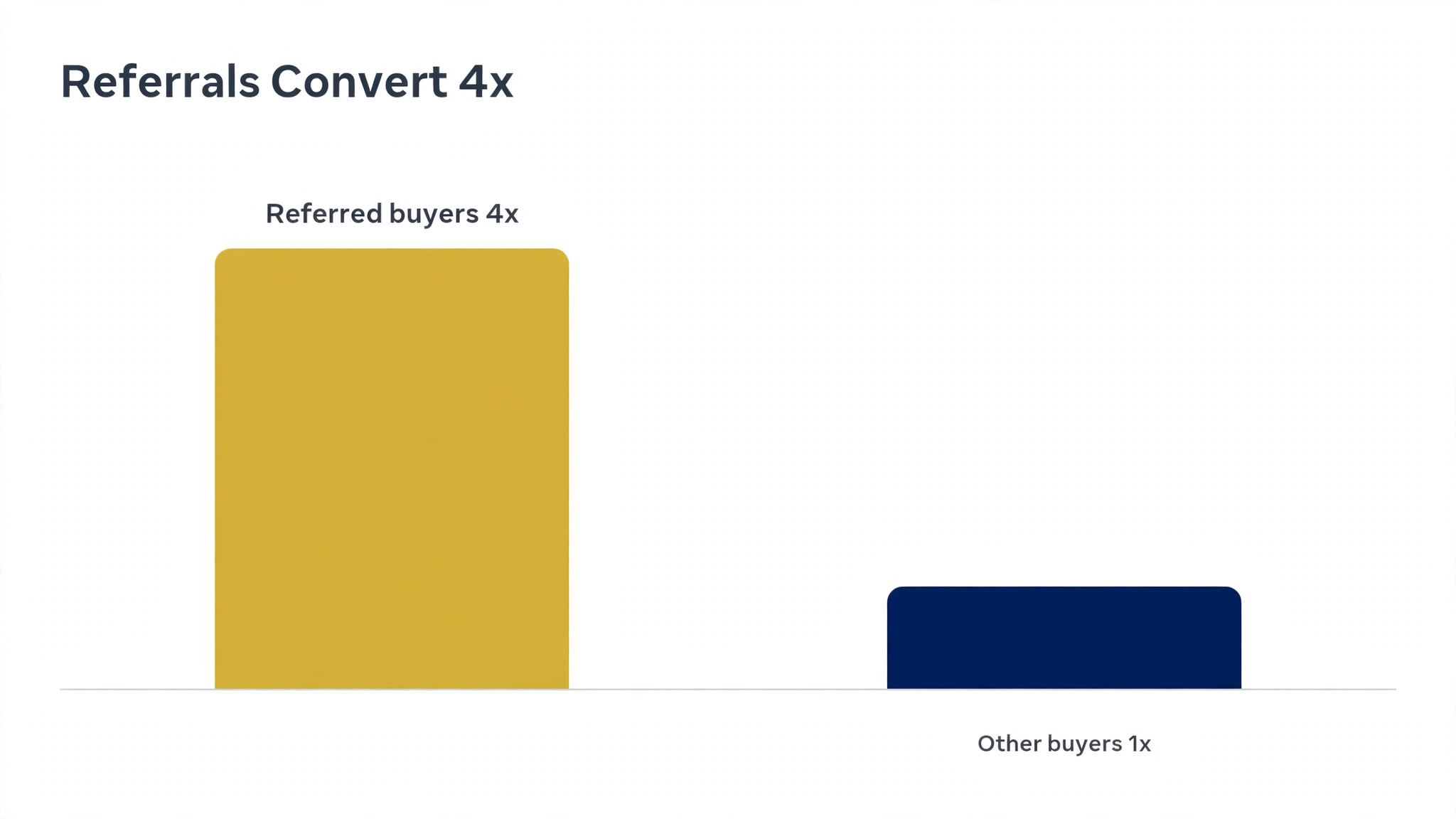
People are four times more likely to buy when referred by a friend, according to a widely cited Nielsen finding that referral guides still quote today. That single fact explains why a partnership strategy small business growth plans so often beat a larger advertising budget. A trusted introducer does work that no advert can do. It transfers trust, shortens the decision, and brings a buyer who already expects a good experience.
Yet most small firms treat partnerships as favours between friends, not as a system. One informal referral here, one shared stall there, and no record of what worked. The result is uneven. A partner sends three good clients in a month and then nothing for a year, because nobody followed up, nobody supplied fresh material, and nobody agreed what a good referral actually looks like. This guide turns that informal habit into a repeatable strategy, with scoring, terms, promotion and review built in from the start.
What a Partnership Is, and What It Is Not
A partnership, in this guide, is a working agreement between two businesses that serve the same kind of buyer at a different point in the journey. A mortgage broker and an estate agent, a wedding photographer and a florist, a bookkeeper and a business bank manager all fit the pattern. The buyer benefits because the handoff feels planned, not accidental. Each business benefits because it reaches buyers it could not reach alone, without paying for every introduction.
A partnership is not a logo swap, a directory listing, or a promise to mention each other sometime. Those gestures cost little and deliver little, because they give the partner no reason to act and no material to act with. A real partnership has a named audience, a specific offer, agreed terms, a way to track referrals, and a date to review results. If those five elements are missing, the arrangement is a friendly intention, not a strategy.
It is also not a discount club. Cutting price to win a partner referral can train buyers to expect a deal and train partners to compete on price rather than fit. The strongest small business partnerships compete on trust and timing. The partner introduces the buyer at the moment of need, the business delivers a clear outcome, and both sides can see the result. Price may play a part, but it should never be the whole offer.
Score Partners Before You Pitch Them
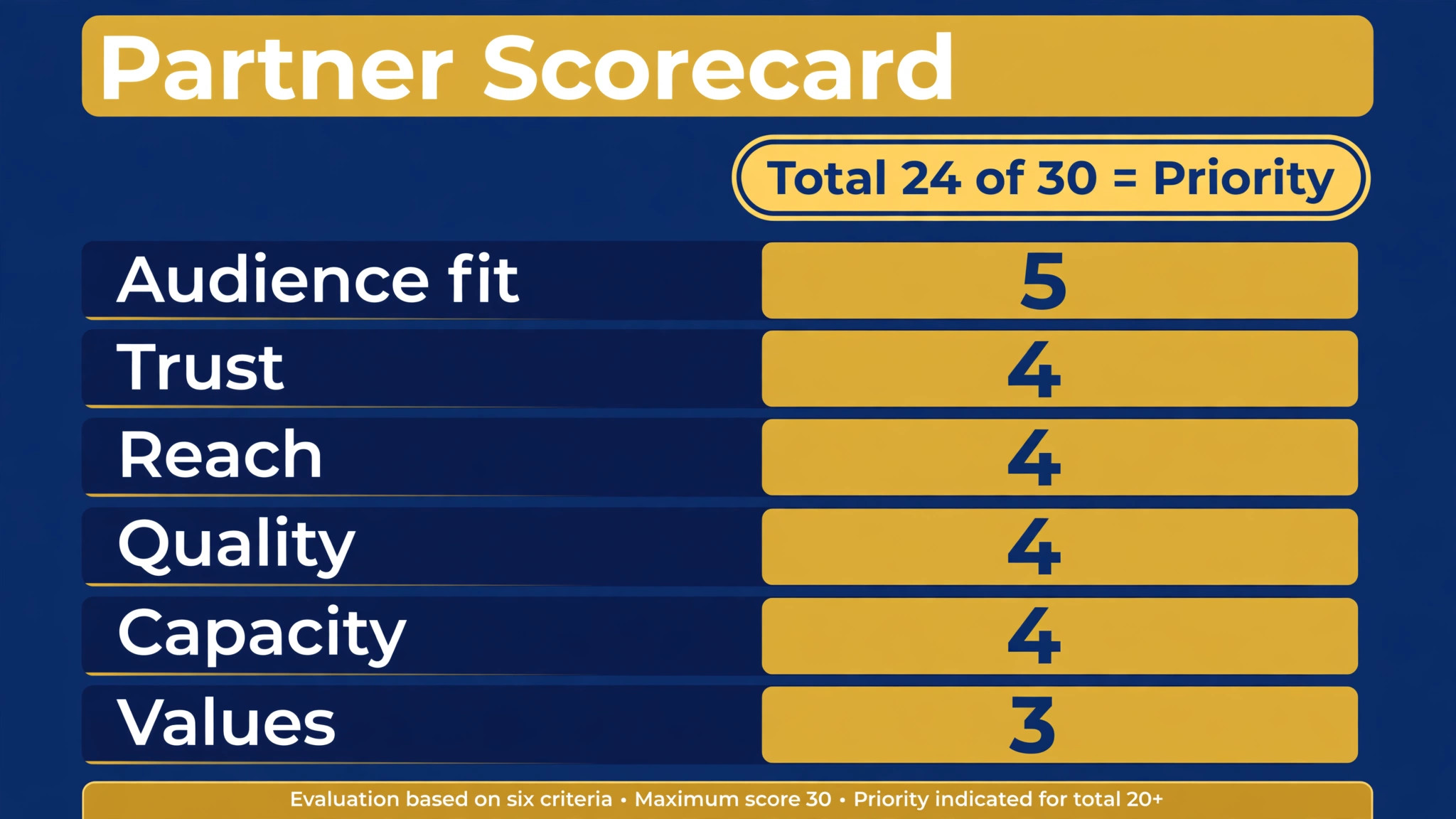
Scoring stops a common error, which is chasing the biggest audience instead of the best fit. A partner with ten thousand followers who serve a different buyer is worth less than a partner with two hundred clients who match your buyer exactly. The scoring table below gives each candidate a simple rating, so the shortlist is based on evidence, not enthusiasm.
| Scoring factor | What to check | Strong signal |
|---|---|---|
| Audience fit | Do their buyers match yours in need, budget and timing | Same buyer, different stage of the same journey |
| Trust level | Do buyers act on their recommendation | Repeat clients, strong reviews, long relationships |
| Reach that converts | Can they actually introduce buyers, not just mention you | A list, a client base, events, or a booking flow |
| Service quality | Would you trust them with your own customers | You have used them, or checked references |
| Capacity | Can they handle referrals well and promptly | Clear contact route, no long waiting list |
| Values and conduct | Do they treat clients the way you do | Honest pricing, clear communication, no pressure |
Score each factor from one to five, and set a threshold before outreach begins. A total of 24 or more out of 30 marks a priority partner. A total between 18 and 23 marks a test partner, worth one small joint activity before a longer commitment. Below 18, thank them and move on, however friendly the conversation felt. This discipline protects time, because every partnership needs onboarding, material and follow up, and a small firm cannot run twenty partnerships well.
Scoring also reveals gaps. If no candidate scores well on reach that converts, the business may need to build its own audience first, through content, reviews or local presence, before partners can help. That is useful knowledge, not a failure. A partnership strategy small business growth effort depends on partners who can actually deliver introductions, and admitting a gap early saves months of polite meetings that lead nowhere.
Five Partner Types Worth Building, in Priority Order
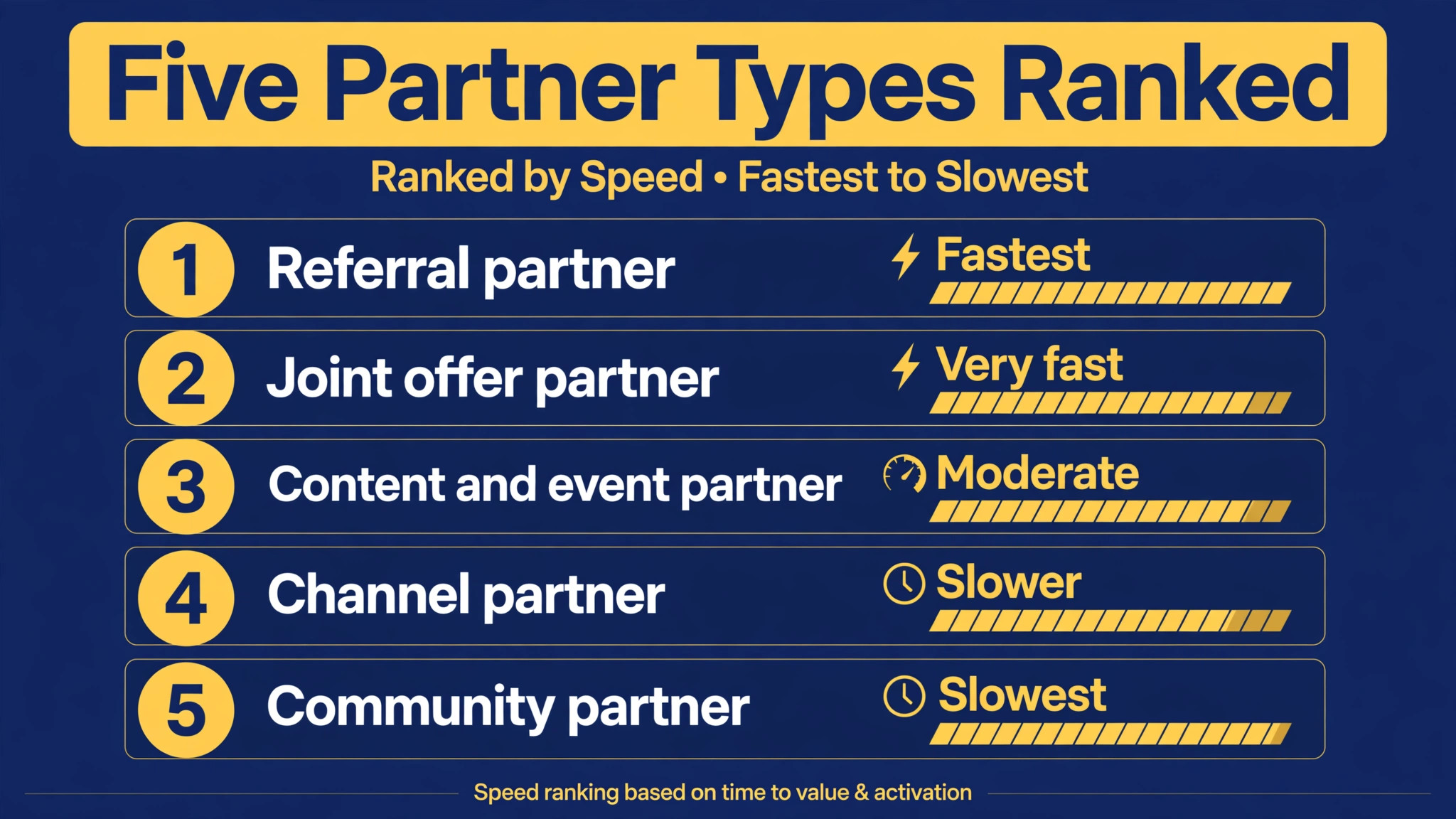
Not all partnerships do the same job. The table below orders five types by how quickly they usually produce qualified referrals for a small firm, with the trade off for each.
| Partner type | How it works | Best for | Watch out for |
|---|---|---|---|
| Referral partner | Each side sends suitable clients to the other | Professional services, trades, local services | One sided flow if only one side has demand |
| Joint offer partner | A combined package or bundle for a shared buyer | Weddings, home moves, health and fitness | Who owns the client if something goes wrong |
| Content and event partner | Co hosted workshop, guide or webinar | Coaches, consultants, studios | Unequal effort if one side does all the work |
| Channel partner | Partner sells or books your service as part of theirs | Software, rentals, venues | Margin and service standards must be agreed |
| Community partner | Local group, charity or association endorsement | Neighbourhood services, family businesses | Slow to start, but deep trust once earned |
Start with referral partners, because they need the least joint production and test fit fastest. Add one joint offer only after a referral flow is working, because a bundle built on an untested relationship will expose every weakness at once. Content and event partnerships are excellent second stage moves, because they let buyers see both businesses working together before any referral is made.
A practical shortlist has five names, not fifty. Three priority partners and two test partners give enough activity to learn, without spreading onboarding thin. Work that shortlist for a quarter, review the results honestly, and only then expand. Growth through partnerships is compounding, because a partner who trusts you introduces you again, and introduces you to other partners. That compounding starts with a small, well served group.
Design an Offer a Partner Can Actually Explain
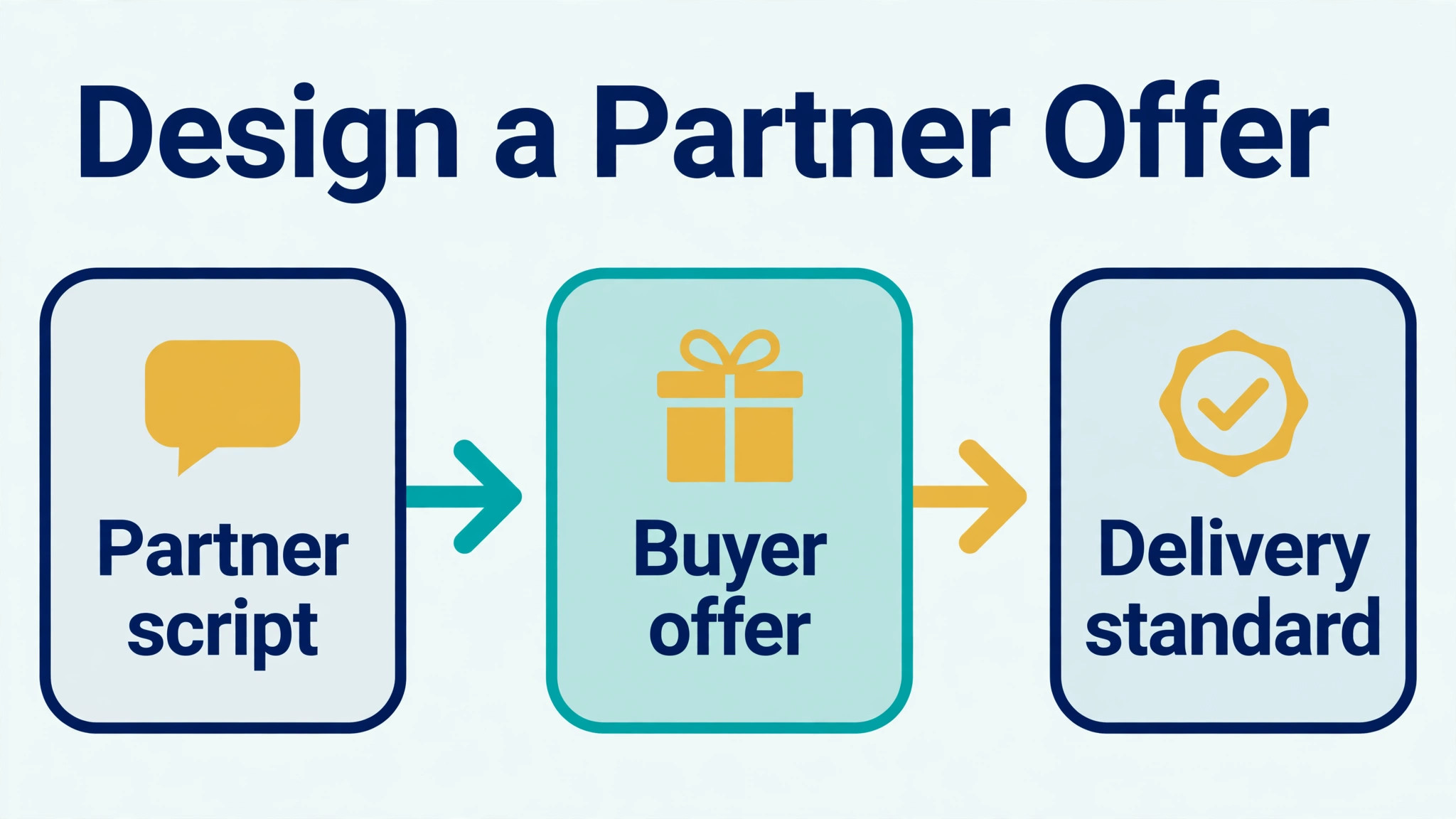
Partners do not sell for you. They introduce you, usually in a sentence or two, at a moment when the buyer is already busy. If the offer cannot be explained in two sentences, it will be explained badly, or not at all. The offer design therefore starts with the partner script, not with your service list.
Write the script first. It should name the buyer problem, the outcome, and the next step. For example, a bookkeeper partner might say that a new client who needs clean monthly accounts can book a short call, bring three months of statements, and leave with a fixed monthly plan. That script is concrete, it sets expectations, and it gives the buyer a reason to act now rather than later. Test the script on the partner, and rewrite any sentence they stumble over.
Next, decide what the buyer receives that is specific to the partnership. It could be priority booking, a free initial review, a starter checklist, or a bundled price for a combined service. Whatever it is, it must be easy to deliver and easy to track, because a partner offer that creates admin work for every referral will quietly die. A partnership strategy small business growth plan fails more often on delivery friction than on partner enthusiasm, so the offer must be as simple to fulfil as it is to explain.
Finally, protect the buyer experience. Agree who contacts the referred buyer, how quickly, and what happens if the business is full or the buyer is not a fit. A referred buyer who waits four days for a reply will blame both businesses, not just one. A one working day response standard, with a named contact and a fallback if that person is away, is a small commitment that preserves trust on both sides.
Referral Terms That Keep Both Sides Honest
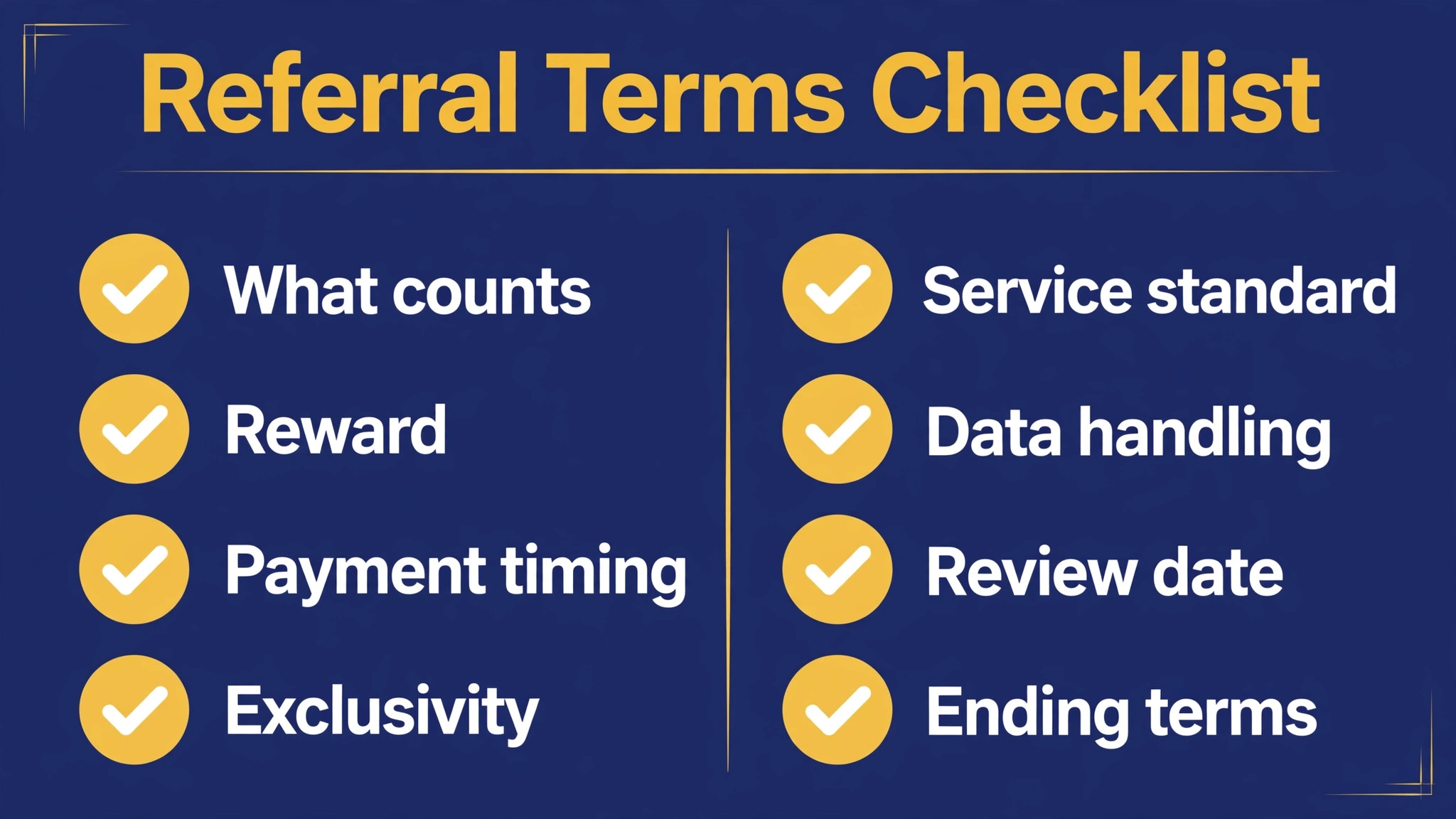
Referral terms should be written down, even between friends, and especially between friends. A short written note prevents the misunderstandings that end otherwise good partnerships. It does not need to be a long legal document at first, but it should cover the points in the table below, and both sides should sign or confirm it by email before the first referral is sent.
| Term | Decision to record | Why it matters |
|---|---|---|
| What counts as a referral | Named introduction, booked call, or completed sale | Stops arguments about who introduced whom |
| Reward or reciprocity | Fee, reciprocal referral, joint promotion, or no fee | Makes the incentive clear and fair |
| Payment timing | On booking, on payment, or after a cooling off period | Avoids chasing money from a partner |
| Exclusivity | Exclusive in a town or niche, or open to several partners | Prevents surprise competition |
| Service standard | Response time, quality promise, complaint route | Protects both reputations |
| Data handling | What buyer details are shared, and with consent | Keeps referrals lawful and trusted |
| Review date | When terms are reviewed, usually after 90 days | Lets both sides adjust without awkwardness |
| Ending the arrangement | Notice period and what happens to open referrals | Lets a partnership end cleanly |
On fees, check the rules for your trade and location before promising a payment for referrals, because some professions restrict referral fees and some platforms restrict paid introductions. Where a fee is not allowed or not wise, reciprocity can work just as well, provided it is tracked. A partner who sends five clients and receives none will notice, even if nobody says so. Track both directions monthly, and raise an imbalance early, as a problem to solve together, not as a complaint.
Exclusivity deserves care. Granting exclusivity to a partner who sends few referrals blocks better partners for no return. A safer pattern is a trial period with no exclusivity, followed by exclusivity only if the partner meets an agreed referral or quality threshold. That pattern rewards performance and keeps the door open while fit is still being tested.
The Joint Promotion Plan, Week by Week
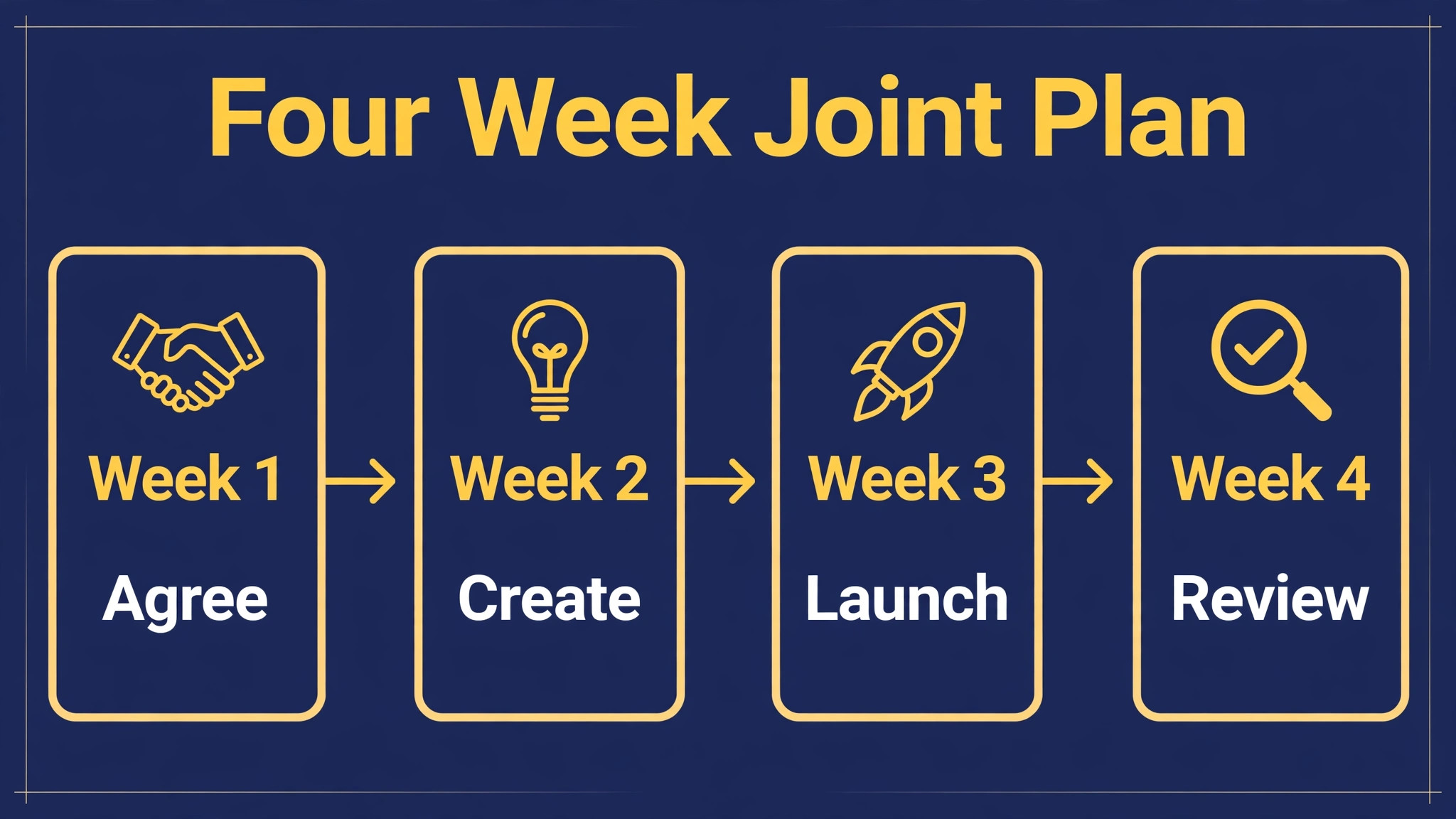
Joint promotion works when both sides show up with material ready, not when one side hopes the other will post something. The plan below runs over four weeks for a first joint activity, such as a workshop, a guide or a bundled offer. It assumes both businesses have small lists and local reach, not large advertising budgets.
In week one, agree the audience, the offer and the tracking. One shared landing page or booking form, with a field that records the referring partner, is enough. Both sides should be able to see how many enquiries arrived, even if they do not share full customer lists. Agree the dates, the roles, and who writes what, and put those roles in writing.
In week two, create the material. Each side writes its own introduction in its own voice, but both sides use the same offer wording, the same next step, and the same dates. A short email, two social posts and one business profile post per side is a realistic package. Avoid asking a partner to write about your service from scratch, because they will delay it. Supply a draft they can edit, and make editing easy.
In week three, launch together. Send emails on the same day, post on the same day, and mention each other by name with a link to the shared page. Buyers trust a promotion more when both businesses visibly stand behind it, and the shared timing creates a sense of an event rather than a stray mention. Respond to enquiries within one working day, and tell the partner daily how many arrived, so momentum is visible.
In week four, review and thank. Share the numbers, name what worked, and decide whether to repeat, adjust or stop. Thank the partner publicly where appropriate, and privately in any case, with specific thanks for a specific action. A partnership strategy small business growth effort lives or dies on that review habit, because partners who feel used once will not promote twice, while partners who feel recognised will.
Track, Review, and Grow the Partnerships That Earn It
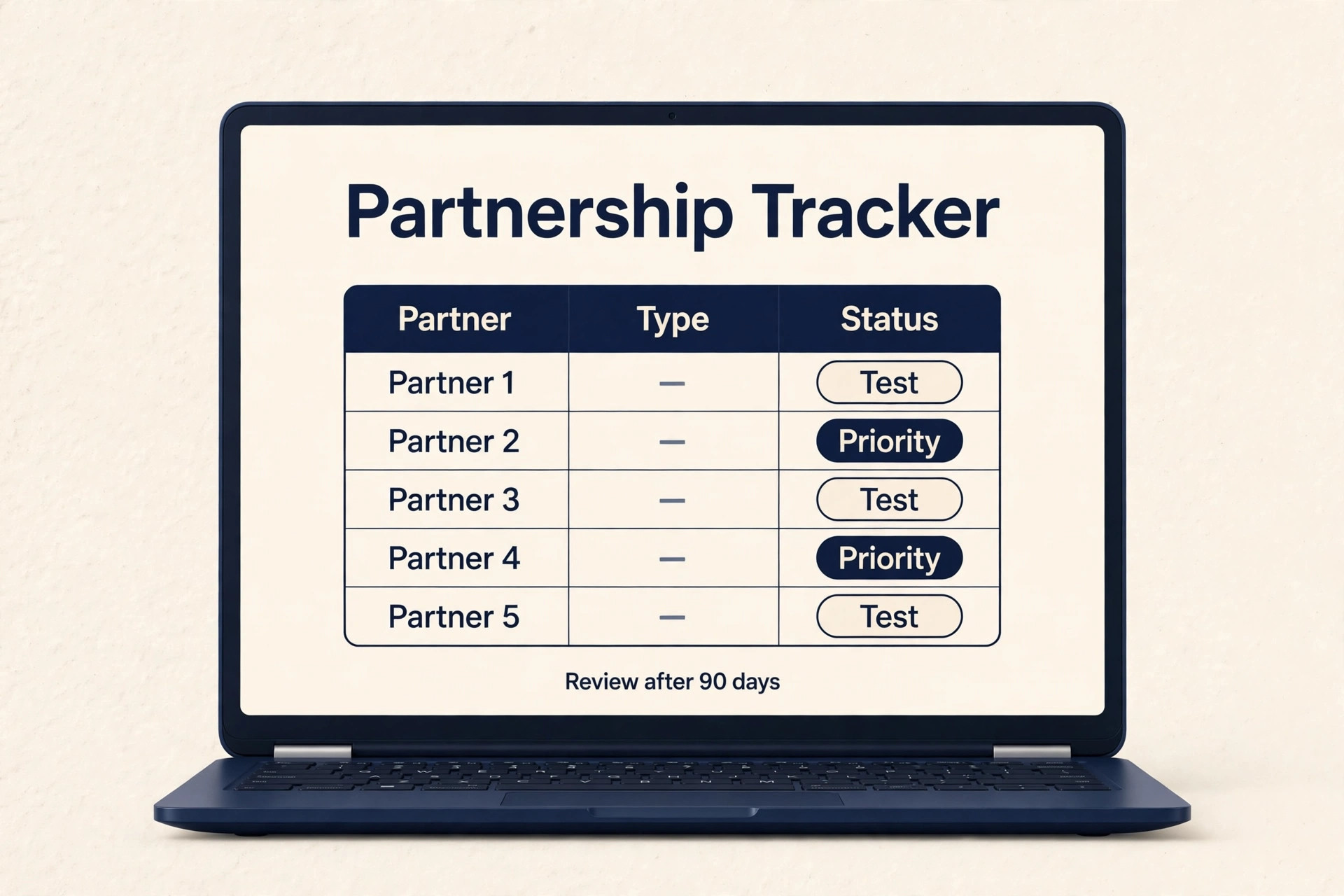
Tracking can be simple. A spreadsheet with partner name, date, referred buyer, outcome and reward is enough for most small firms, provided it is updated weekly. The key fields are referral source, conversion to booked client, revenue from referred clients, and referrals sent in return. Those four fields tell you whether a partnership is balanced, profitable and worth expanding.
Review each partnership after 90 days using three questions. Did it bring qualified buyers, not just enquiries. Did both sides deliver the agreed standard and response time. Is the relationship enjoyable and easy to run. A partnership that fails the first question needs a better offer or audience fit. A partnership that fails the second needs clearer terms. A partnership that fails the third will fade anyway, however good the numbers look, because small firms cannot sustain draining relationships alongside delivery work.
Grow by depth before breadth. A partner who sends steady referrals deserves more joint activity, a better offer, or an introduction to another trusted partner. A new partner should only be added when existing partners are served well. That rule sounds slow, but it is how a network of five strong partners outperforms a list of fifty acquaintances. Depth builds the trust that makes the next introduction easier, and breadth without depth builds a list that nobody uses.
Mistakes That Turn Goodwill Into Friction
The first mistake is asking before giving. A cold message that asks a busy owner to promote you, with no evidence that you understand their clients, will be ignored. Give first, by sharing their content thoughtfully, referring a suitable client where you honestly can, or inviting them to a small event with no strings attached. Generosity that is genuine, not transactional, is the fastest way to be taken seriously.
The second mistake is overpromising on capacity. A partnership that suddenly brings ten enquiries a week to a firm that can take two will damage both reputations. Be honest about capacity in the first conversation, agree a weekly referral limit if needed, and tell the partner when you are full. Partners respect a business that protects its service standard, and buyers respect a business that is honest about waiting times.
The third mistake is letting one person own the relationship on each side, with no backup. If that person leaves, goes on holiday or gets busy, the partnership stops. Record the agreement, the material and the tracking in a shared place, and introduce a second contact early. That small step keeps a partnership alive through the normal disruptions of small business life.
Partner Outreach Template You Can Copy and Adapt
Use this template for a first message to a scored priority partner. Adapt the bracketed parts, keep the tone personal, and never send the same generic message to twenty businesses at once. Partners can tell, and a generic message signals that the sender has not done the scoring work this guide recommends.
– Subject line idea. A short question about their clients, not a pitch about your service. – Opening line. Name one specific thing you admire about their work, with evidence, such as a recent event, guide or review. – Shared buyer. Name the buyer you both serve, and the point in the journey where your services meet. – Offer in two sentences. State the buyer problem, the outcome, and the next step, in plain language. – What you will do for them. Offer a specific first step, such as a referral, a joint post, or a guest spot, rather than a vague promise to help. – Ask for a short call. Propose fifteen minutes, give two times, and make it easy to decline gracefully. – Close with thanks. Thank them for their time, whether or not they reply, and do not chase more than twice.
After the call, send a one page summary within a day. Restate the audience, the offer, the terms, the tracking method and the review date. That summary becomes the working agreement, and it shows the partner that you run partnerships professionally, not casually. If the partner does not reply after two polite follow ups, move on without resentment. Silence is information about timing or fit, not a verdict on your business.
How a Partnership Strategy Small Business Growth Plan Fits a One Person Firm
A one person firm does not need a partnerships department. It needs one afternoon a month, a shortlist that fits on a single page, and a habit of following up. That is the whole operating model for a partnership strategy small business growth plan at solo scale, and it works precisely because it is small enough to survive client work.
Start the month by reviewing the tracking sheet for ten minutes. Which partners sent referrals, which referrals converted, and which partners are owed a referral or a thank you. That review prevents the most common solo failure, which is forgetting a partner who sent a good client three months ago. A short thank you note, a useful introduction, or a shared post in that review week keeps the relationship warm without a large time commitment.
Next, spend one hour on a single joint activity for one partner only. Write the partner draft, send the email, or prepare the workshop outline, and stop there. Solo owners fail when they try to activate five partners in one week, because client work then pushes all five activities into the following month. One partner, one activity, one month is a pace a solo firm can keep for a year, and a year of that pace builds a network that a burst of activity never will.
Finally, protect the boundary between partnership work and delivery work. Partnership meetings should not displace paid client hours in a busy week, so schedule them in a fixed weekly slot, such as a Friday morning, and keep them short. A partnership strategy small business growth plan that steals time from delivery will be resented by the owner, however good the referrals look on paper. When partnerships fit inside a fixed slot, they become a normal part of the business, not an extra project that competes with income.
Not every partnership deserves a second quarter. The warning signs are usually visible in the first month. Referrals arrive without context, the partner stops returning messages once their own launch passes, or every joint offer quietly turns into a discount for their list alone. When two of those signs appear together, pause new joint work and have a direct conversation about what each side expected. A short pause now costs far less than a year of polite effort that produces nothing either side can measure.
A good test for continuing is whether both sides can name one result from the last ninety days without checking a spreadsheet. One booked client, one warm introduction that turned into a paid project, or one shared event that filled a room all count. If neither side can name anything, the partnership is a friendly relationship rather than a growth channel, and that is fine as long as it is labelled honestly. Friendly relationships still matter. They simply should not take the time and budget that a working channel needs.
Frequently Asked Questions
How many partners should a small business start with?
Start with five names, three priority partners and two test partners, and work that shortlist for a quarter before expanding. A partnership strategy small business growth plan built on five well served partners will teach you more than fifty names on a spreadsheet, because you will learn which offers convert and which partners follow through.
Should I pay a referral fee, or offer reciprocal referrals?
Either can work, provided the arrangement is written down and tracked. A fee suits partners who cannot easily refer clients back, while reciprocity suits partners with a similar client flow. Check trade and location rules on referral fees first, and review the balance monthly, because an unpaid imbalance, in money or in referrals, will end a partnership quietly.
How do I approach a larger business as a small partner?
Lead with the specific buyer you can help them serve better, not with your need for exposure. Larger partners respond to a clear offer, a proven service standard, and a low effort first step, such as a single joint post or a trial referral period. Bring evidence, such as reviews or a recent job example, and accept a test before asking for a long commitment.
What if a partner sends poor quality referrals?
Raise it early, with examples, and agree a clearer definition of a good referral. Often the problem is a vague brief, not bad intent, and a tighter partner script fixes it. If quality does not improve after one agreed adjustment, pause referrals gracefully and keep the relationship friendly, because a paused partnership can restart later with a better offer.
How long should a partnership trial last?
Ninety days is a sensible trial, long enough for both sides to send referrals, run one joint activity, and review real numbers. Shorter trials rarely produce enough data, while open ended trials drift without review. Set the review date in the first summary, so neither side has to raise an awkward conversation later.
Do partnerships work for online businesses without a local area?
Yes, provided the shared buyer is clear. Online partners can co host webinars, share guides, bundle services, or refer clients at a specific journey point, just as local partners can. Tracking matters even more online, because referrals arrive from many channels, so a shared form field or a unique booking link for each partner is essential.
What should I do if a partner copies my offer or undercuts me?
Address it directly and privately, with the written terms as the reference point. Most cases are misunderstandings about exclusivity or pricing, and a clear conversation resolves them. If the conduct continues, end the arrangement using the agreed notice period, protect open referrals, and do not retaliate publicly, because your reputation with other partners matters more than one dispute.
Can a partnership strategy replace advertising entirely?
For some local service firms, partnerships and referrals can become the main source of clients, but replacing advertising entirely is rarely wise at the start. Advertising can fill gaps while partnerships build, and partnerships can then reduce dependence on paid channels over time. Judge the mix by cost per qualified client and by client quality, not by channel loyalty.
A Decision Memo for Your Next Quarter
A partnership strategy small business growth plan is not a list of nice contacts. It is a decision about where the next twenty clients will come from, and who will introduce them. Choose five scored partners, write one offer a partner can explain in two sentences, agree terms in writing, run one joint activity in four weeks, and review the numbers after ninety days. That sequence is the whole strategy, repeated with better partners each quarter.
If the first quarter brings even three qualified clients from partners, the system is worth continuing, because those clients arrive with trust already built and often refer others in turn.
Three trusted clients in a quarter, repeated over four quarters, is a meaningful pipeline for a small firm, and it usually costs far less in time and money than the advertising needed to win the same number of cold enquiries. That comparison is the honest test for whether the partnership work deserves a second quarter, and it should be made with real numbers from the tracking sheet, not with a general feeling that partnerships seem promising. If it brings none, the diagnosis is usually specific. The audience fit was wrong, the offer was unclear, the tracking failed, or the follow up was slow. Fix that one cause before adding more partners, because more partners will only multiply the same fault.
For a natural next step, read How to Set Up a Referral Program for a Small Service Business to build the internal referral flow that partners feed into, and Win Your First Ten Clients Without a Big Budget for early client tactics that pair with partner introductions. Then send the first scored outreach message this week, while the scoring is fresh and the offer is clear.
More Reading on Stratilyze
– How to Set Up a Referral Program for a Small Service Business – Win Your First Ten Clients Without a Big Budget – How to Value a Small Service Business in Real Numbers – Best Online Booking Software for a Service Business