

A third party guide reports that friends posts on social media influence 81 percent of customers buying decisions, compared with 78 percent influenced by posts from brands they follow. That figure comes from a third party guide rather than a vendor page, so treat it as directional and confirm current numbers on the vendor page before quoting it to a client. The point behind the number still holds for service businesses. A recommendation from a satisfied customer carries more weight than an advertisement, because the prospect already trusts the person making the introduction. This guide explains how to set up referral program small service business owners can run without a large budget, a marketing team, or complicated software.
Most small service businesses already get referrals, but they get them by accident. A happy customer mentions the business to a neighbour, the neighbour calls months later, and nobody records who made the introduction. The business cannot thank the referrer, cannot repeat what worked, and cannot tell whether referrals are growing or fading. A formal program changes that. It gives customers a clear offer, a simple way to share, and a reason to act now rather than someday. It also gives the owner a record of every introduction, so rewards go to the right people and the cost of each new customer stays visible.
A referral program is not a discount scheme dressed up with a new name. A discount attracts bargain hunters who may never return. A referral program rewards an existing customer for bringing someone who fits the business. The reward should feel generous enough to motivate action, yet small enough that the business still earns a healthy margin on the new customer. Getting that balance right is the core design task, and this guide works through it step by step, from costing the reward to writing the rules, choosing tracking, and launching to the best customers first.
Why Referrals Work So Well for Service Businesses
Service work is hard to judge before it is bought. A prospect cannot test a cleaning service, a plumber, or a coach the way they can test a pair of shoes. They rely on trust, and the fastest route to trust is a person they already know saying the work was good. That is why referrals often convert at a higher rate than cold advertising, and why referred customers tend to stay longer. They arrive with expectations set by someone who has already experienced the service, so there are fewer surprises and fewer early complaints.
Referrals also cost less to win in most cases. Paid advertising charges for every click, whether or not the visitor books. A referral reward is paid only after a real result, such as a first paid booking. That pay on result structure protects cash flow for a small business. It also means the program can start small. Ten active referrers sending one introduction each can matter more than a thousand social media followers who never buy. The business does not need scale to benefit. It needs a clear offer and consistent follow through.
The Math Before the Offer
Before choosing a reward, work out what a new customer is worth. Take the average first job value, then estimate how many jobs that customer typically buys in a year, and how many years they usually stay. Multiply those figures to get a rough lifetime value. Then decide what share of that value the business can afford to spend winning the customer. Many guides suggest a reward in the range of 10 to 20 percent of a new customer first job value, reported in a third party guide, so confirm the range against current vendor guidance before fixing a budget. The exact percentage matters less than the discipline of setting a ceiling before launch.
What Counts as a Successful Referral
Define the qualifying event before anyone asks about it. Common choices include a first paid booking, a first payment clearing, or completion of a first service visit. For subscription services, the trigger might be the second monthly payment, which proves the new customer intends to stay. For one off jobs, the trigger is usually payment for the completed job. Pick one trigger, write it in plain language, and use the same trigger in the customer facing page, the staff script, and the tracking sheet. Confusion here causes disputes later, and disputes cost more goodwill than the reward is worth.
How to Set Up Referral Program Small Service Business Rules That Hold Up
Rules sound dull, yet they are what separate a program that runs for years from one that collapses after the first dispute. Customers accept rules they can read before they take part. They resent rules invented after they have already referred someone. Spend an hour writing the rules, then test them against awkward cases. What happens if the referred customer cancels? What happens if they book but never pay? What happens if two customers claim the same referral? Answer each question in the rules before launch, not after the first claim arrives.
Keep the rules short enough to fit on one page. A ten page legal document will scare away the very customers the program needs. Cover eligibility, the qualifying event, the reward, timing of payment, limits, expiry, and fraud prevention. Use plain words. If a rule needs a lawyer to explain it, rewrite it. Small businesses do not need perfect legal drafting. They need terms that a reasonable customer can understand and that the owner can apply consistently to every claim.

Reward Rules Worth Writing Down
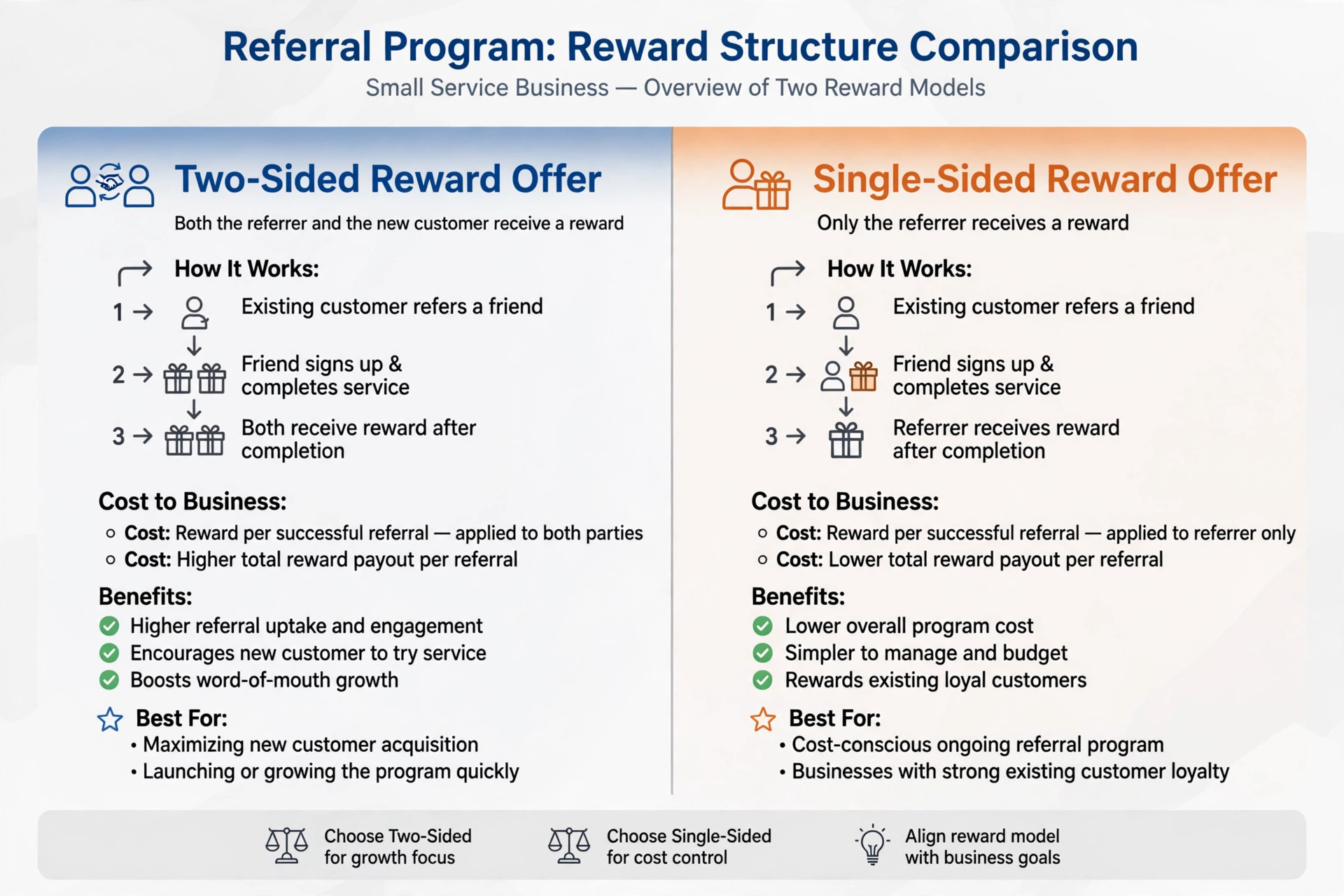
Start with who gets rewarded. A two sided reward, where both the referrer and the new customer receive something, usually outperforms a reward for the referrer alone, because the new customer also has a reason to act. A typical two sided offer might give the new customer a discount on a first booking and give the referrer a credit once that booking is paid. A single sided reward can still work where the service is high trust and customers refer out of goodwill, but the two sided version gives the referrer an easier message to share. They are offering a benefit, not just asking a favour.
Tracking That Works Without Expensive Software
Tracking is the part most owners skip, and it is the part that matters most. Without tracking, the business cannot prove who referred whom, cannot pay rewards fairly, and cannot tell which referrers deserve extra thanks. The simplest tracking method is a unique code or link per customer. When a new customer books, they enter the code or answer a question asking who referred them. Staff then record the match in a spreadsheet or a customer record. That manual method works for a business handling a handful of referrals each month, and it costs nothing to start.
As volume grows, dedicated referral tools remove manual work. ReferralCandy, Friendbuy, Yotpo, and Mention Me are names commonly mentioned in referral guides for this kind of tracking, and each offers different features for links, codes, and reward automation. This guide does not quote their prices or feature lists, because those change, so check the current vendor page before choosing one. The right choice depends on whether bookings happen online, by phone, or in person, and whether the business already uses a booking or payment system the tool must connect with. Choose the tool that fits the actual booking path, not the one with the longest feature list.
Hybrid tracking matters for service businesses, because many referrals arrive offline. A customer may tell a friend at a school gate, and that friend may phone to book without ever clicking a link. Train staff to ask every new caller how they heard about the business, and record the answer before taking payment. Add a referral field to every intake form, online or paper. Without that question, offline referrals stay invisible, and the customers who send them never get thanked. The question takes ten seconds and it is the cheapest tracking upgrade available.
Fraud Guardrails That Stay Friendly
Fraud in a small referral program is rarely criminal. It is usually a customer testing the edges, such as referring a family member who was going to book anyway, or creating a second account to claim both sides of a reward. Guardrails should block the obvious cases without making honest customers feel suspected. Require the referred customer to be genuinely new, with a different name, phone number, and payment method from the referrer. Pay rewards only after the qualifying event, not at the moment of referral. That single delay removes most gaming, because a fake referral still has to pay for a real service.
Review claims regularly, even if the volume is low. Look for patterns such as many referrals from one household, referrals that cancel soon after the reward is paid, or codes shared publicly on discount sites. If a code appears on a public coupon site, replace it and remind the customer that the program is for personal introductions. Handle suspected abuse privately and politely. Accusing a good customer of fraud over a misunderstanding can cost far more than the reward at stake. When in doubt, pay the reward once, tighten the rule, and move on.
Choosing the Reward
The best reward depends on what the customer values and what the business can afford. Cash feels universal, but it can attract people who refer for money rather than belief in the service. Service credit keeps the value inside the business and encourages the referrer to return, which suits most service businesses. A free add on, such as a free deep clean upgrade or a free consultation, can feel more generous than its cost, because the business delivers it at its own cost rather than its retail price. Discounts for the new customer lower the barrier to a first booking, which matters when the service is unfamiliar or expensive.
Two Sided, Single Sided, and Tiered Rewards Compared
A two sided reward spreads the benefit and gives the referrer a natural opening line. The message becomes an offer to a friend, not a request for a favour. A single sided reward is simpler to explain and cheaper to run, and it suits businesses where customers already recommend freely, such as a trusted local tradesperson with a long waiting list. A tiered reward adds milestones, such as a larger reward after three, five, or ten successful referrals, and it can motivate the most enthusiastic advocates. Tiers also add complexity, so they suit a second phase rather than a launch. Start simple, learn what works, then add tiers for proven referrers.

When to Pay the Reward
Timing shapes behaviour. Paying too early invites gaming and pays for customers who cancel. Paying too late frustrates referrers who did the work weeks ago. A sensible middle ground is to pay once the new customer first payment has cleared and any cooling off or refund window has passed. For services with a short refund window, that may be a few days after the first job. For subscription services, it may be after the second payment. Tell referrers the timing when they join, and send a message when the reward is earned, so they are not left wondering whether their introduction was counted.
Automate the notification even if payment itself is manual. A short message saying the referral was successful and the reward is on its way does more for goodwill than the reward alone. It also gives the referrer a reason to refer again, because they now know the system works. If a reward is delayed for a legitimate reason, such as a pending payment, say so promptly. Silence is what turns a happy referrer into a sceptic, and sceptics stop referring.
Launching to the Best Customers First
Launch quietly to the happiest customers before announcing the program to everyone. These customers already trust the business, so they are more likely to share, more forgiving of early rough edges, and more useful as testers. Send a personal message, not a mass blast, explaining the offer and giving them their link or code. Ask for feedback on the wording. If the first group finds the offer confusing, the wider audience will too, and fixing it at this stage costs nothing. A quiet launch also lets staff practise the tracking steps before volume rises.
Staff must know the program before customers do. Brief every person who answers the phone, meets customers, or handles bookings. They should be able to explain the offer in one sentence, find a customer code quickly, and record a referral without delay. Role play the two most common questions, which are how much the reward is and when it is paid. If staff hesitate or give different answers, customers lose confidence. A one page staff sheet with the offer, the trigger, and the tracking steps prevents most of that confusion.

Ask Scripts That Sound Natural
Most customers do not refuse to refer. They simply never get asked at the right moment, or they get asked in a way that feels awkward. The best moment is right after a visible success, such as a completed job the customer is pleased with, a positive review, or a thank you message. At that point the customer is already thinking positively about the service, and a short ask feels like a natural next step rather than a sales push. Build the ask into the job completion routine, so it happens consistently rather than depending on someone remembering.
A spoken script should be short and permission based. One useful form is to say that most new customers arrive through existing customers, then ask whether the customer would like a link to share if they know anyone with a similar need. That wording gives the customer an easy out and frames sharing as an offer to a friend. Avoid pressing for names on the spot. Asking for a name puts the customer on the spot and can damage the relationship. Offering a link respects their judgment about who would welcome an introduction and when to make it.

Scripts for Email, Text, and In Person
Email suits a longer explanation and a forwardable message the customer can pass on unchanged. Write the forwardable part as if the customer wrote it, in plain language, with the benefit for the friend stated first. Text suits a short reminder with a single link, sent only where the customer has agreed to receive texts. In person, a card left with the invoice works for trades and home services, because the customer can hand it to a neighbour without needing to remember a link. Each channel should carry the same offer, the same trigger, and the same link or code, so a referral is tracked the same way however it arrives.
Tools and Systems Compared
A spreadsheet is a legitimate starting system, and owners should not feel pressured into buying software before the program proves itself. A spreadsheet with columns for referrer, referred customer, date, channel, status, and reward paid covers the essentials. The weakness appears as volume grows, when manual entry becomes slow and errors creep in. At that point, a dedicated tool earns its place by generating unique links, tracking conversions automatically, and sending reward notifications without staff intervention. The decision point is usually when referrals exceed a handful per month or when manual tracking starts causing missed rewards.
When comparing tools for how to set up referral program small service business tracking, check four things before price. First, does the tool fit the booking path, including phone and walk in bookings, or only online checkout. Second, can it issue rewards the business actually offers, such as service credit, rather than only discount codes. Third, does it report the metrics the owner needs, including conversion rate and cost per acquired customer. Fourth, does it handle customer data in a way that fits the business privacy policy.
ReferralCandy, Friendbuy, Yotpo, and Mention Me are frequently named in guides for service and retail referral tracking, but their current prices and features must be checked on the vendor page, because this guide does not quote them and they change over time.
Measuring What the Program Earns
Measure the program monthly for how to set up referral program small service business results, using a small set of numbers that tie directly to profit. Count how many referrals were made, how many converted into paying customers, and what share of new customers arrived through referrals. Calculate the cost per acquired customer by dividing total reward costs by the number of converted referrals. Compare that figure with the cost of other channels, such as paid advertising or directory listings. If referrals cost less and those customers stay longer, the program deserves more promotion. If referrals cost more, the reward or the trigger needs adjusting, not more advertising of the same offer.

When to Change the Offer
Change one element at a time, and give the change at least a month to show an effect. If both the reward and the wording change together, the owner cannot tell which change caused the result. Common first changes include raising the new customer discount if referrals are made but do not convert, simplifying the sharing step if customers say they would share but never do, or moving the ask earlier in the job if customers are asked too late. Record each change and the monthly numbers before and after, so the program improves on evidence rather than hunches. A program that is reviewed monthly and adjusted slowly will outperform a program launched with fanfare and then ignored.
Mistakes That Quietly Kill Referral Programs
The most common mistake is making the reward too small to notice. A five dollar credit on a five hundred dollar service will not motivate anyone to risk a personal recommendation. The reward does not need to be large in absolute terms, but it must feel meaningful relative to the service price and the effort of referring. The second mistake is making the process complicated, with multiple steps, account creation, or a form that asks for too much information. Every extra step loses referrers, and the customers lost are usually the busy, well connected ones the program needs most.
The third mistake is forgetting to promote the program after launch week. Owners assume customers will remember, but customers have their own lives and forget quickly. The program must appear in booking confirmations, invoices, newsletters, and job completion messages on a regular cycle. The fourth mistake is failing to thank referrers promptly, even when the referral does not convert. A thank you within a day or two costs nothing and keeps the relationship warm. A referrer who hears nothing after sending a friend will not send a second one, however good the reward might have been.
Referral Program Checklist and Template
This section is the working template to copy into a planning document and complete before launch. It covers reward rules, tracking, ask scripts, and fraud guardrails in one place, so nothing important is left to memory. Complete each line with the business own figures, then share the customer facing parts on the program page and keep the internal parts with staff notes. Review the template quarterly, and update it whenever the reward, the trigger, or the booking path changes. A template that is never updated becomes misleading, so treat the review as part of the program routine.
- Reward for referrer. State the exact amount or credit, and the event that earns it, such as first paid booking.
- Reward for new customer. State the exact discount or benefit, and any minimum booking it requires.
- Qualifying event. Write the single event that counts, in one sentence, and use it everywhere.
- Payment timing. State when the reward is issued, such as after first payment clears.
- Limits and expiry. State any monthly cap per referrer and how long rewards remain valid.
- Exclusions. List self referrals, existing customers, and any staff rules that apply.
- Tracking method. Name the link, code, or form field used, and who records each referral.
- Offline capture. Write the exact question staff ask new callers, and where the answer is recorded.
- Ask moments. List the three moments in the job when the ask happens, such as job completion and follow up message.
- Ask scripts. Attach the spoken script, the email version, and the text version, all carrying the same offer.
- Fraud checks. List the checks applied before payment, such as new customer details differing from the referrer.
- Thank you routine. State who thanks referrers, how quickly, and what happens when a referral does not convert.
- Monthly review. Name the metrics reviewed each month and the person responsible for the review.
- Tool decision. Record whether tracking is manual or tool based, and the reason for that choice.

A Short Launch Plan for the First 30 Days
Week one is for setup. Finalise the reward maths, write the rules, build the program page, and set up tracking. Week two is for the quiet launch to twenty happy customers, with personal messages and a request for feedback. Week three is for fixing whatever the first group found confusing, briefing staff, and adding the program to booking confirmations and invoices. Week four is the wider announcement through newsletter and website, plus a first check of referrals made, converted, and rewarded. At the end of the month, review the numbers, thank every referrer, and decide the single improvement for month two. That rhythm, setup, test, fix, announce, review, is what turns a launch into a lasting channel.
Final Word Before Launch
A referral program rewards customers for doing something many already want to do, which is telling people about good work. The businesses that succeed with referrals are not the ones with the largest rewards. They are the ones with a clear offer, honest rules, tracking that never loses a referral, and a thank you that arrives quickly.
Start with a simple offer that the margin can support, launch to the happiest customers first, and improve from real data rather than guesswork. Done that way, referrals become a steady source of customers who arrive already trusting the business, and that trust is the hardest asset for a small service business to buy any other way. This approach to how to set up referral program small service business growth is deliberately modest at first, because a modest program that actually runs beats an ambitious program that stalls after launch week.
Frequently Asked Questions
How much should a small service business pay for a referral
Pay an amount the margin can support after direct costs, with many guides suggesting a combined cost in the range of 10 to 20 percent of a new customer first job value, reported in a third party guide, so confirm that range on a current vendor page before fixing a budget. A two sided split, such as a credit for the referrer and a discount for the new customer, often feels fairer than giving everything to one side. The exact split matters less than paying only after a real result, such as a first paid booking, so the business never pays for introductions that lead nowhere.
Should the reward go to the referrer, the new customer, or both
Both sides usually works best, because the new customer gets a reason to try the service and the referrer gets a reason to share. A single sided reward can still work where customers already recommend freely, but it gives the referrer a harder message, since they are asking a favour without offering anything in return. When learning how to set up referral program small service business owners often start two sided, then simplify later if the data shows one side does all the work.
How do I track referrals that arrive by phone or in person
Ask every new caller how they heard about the business, and record the answer before taking payment. Add a referral field to every intake form, and give each customer a unique code for cases where a link cannot be used. A spreadsheet with referrer, referred customer, date, channel, status, and reward paid is enough at low volume. The key step is asking the question consistently, because an unasked question produces no data, however good the software might be.
How long should I wait before paying a referral reward
Pay once the qualifying event is complete and payment has cleared, which for most services means a few days after the first job, and for subscriptions means after the second payment. Tell referrers that timing when they join, and send a message when the reward is earned. Late or silent payment damages trust faster than a modest reward ever could, so build a weekly routine for checking earned rewards and issuing them on time.
What stops customers gaming a referral program
Pay only after a genuine new customer has paid for a service, require the referred customer details to differ from the referrer, and set a reasonable cap per referrer. Review claims for patterns such as many referrals from one household or rewards followed quickly by cancellations. Handle suspected abuse privately, and tighten the rule for the next case rather than accusing a good customer over a single unclear claim. This guardrail approach is central to how to set up referral program small service business systems that stay friendly while staying fair.
Can a referral program work with only a few customers
Yes, because a program needs happy customers, not a large list. Ten enthusiastic referrers can supply a steady stream of well matched new customers for a small service business. Start with the happiest customers, give them a simple link or code, and thank them quickly. A small program that runs reliably teaches the owner what works, and that learning is worth more than a large launch that nobody follows up.
More Reading on Stratilyze
For related small business systems, read best CRM for cleaning companies and how to ask customers for Google reviews as a small business. For pricing and invoicing context, see cost of FreshBooks for small business monthly and how to switch from FreshBooks to Xero as a small business. These guides show how to set up referral program small service business follow up fits alongside reviews, customer records, and invoicing, so the new channel connects with systems the business already uses.