
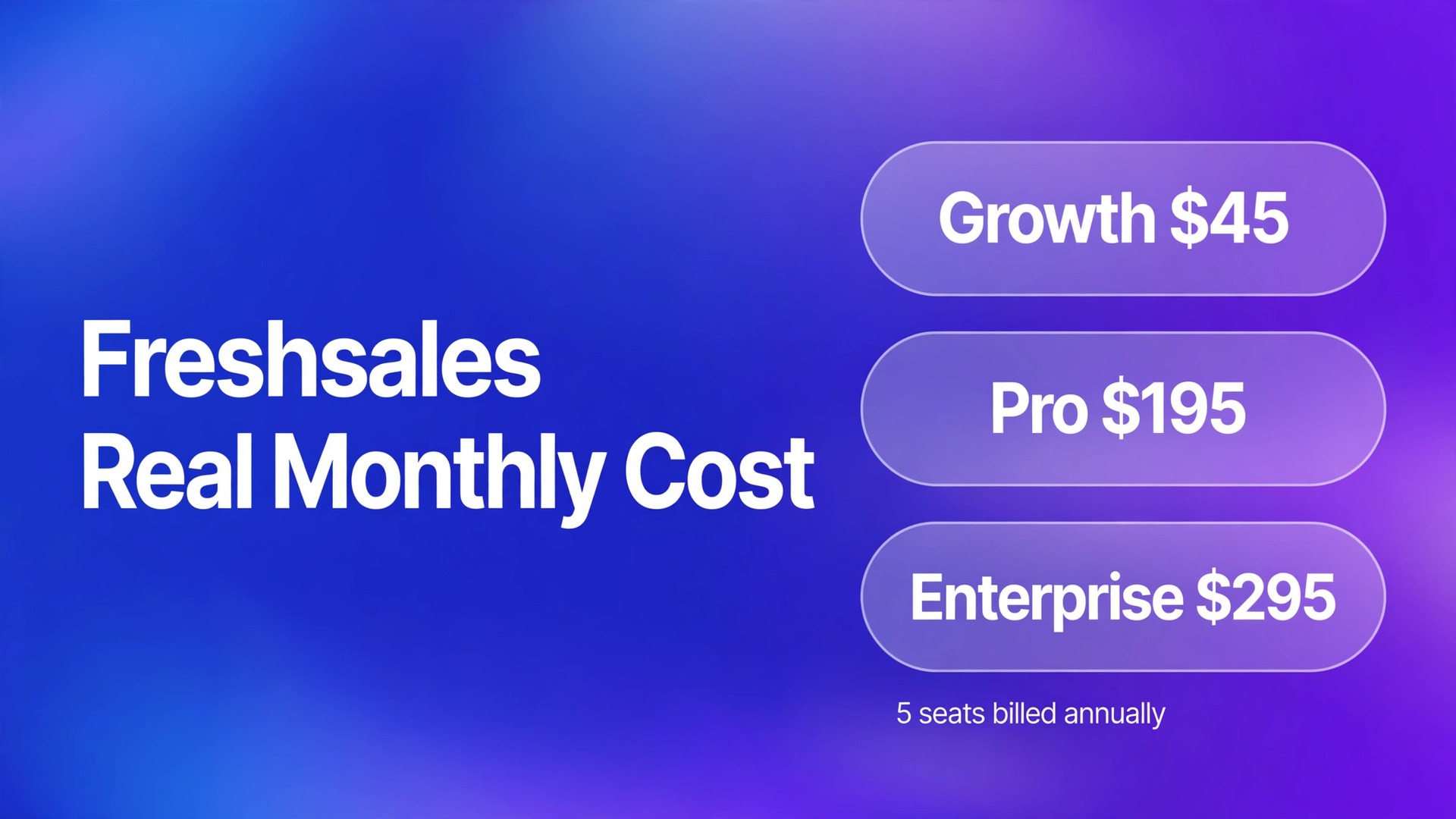
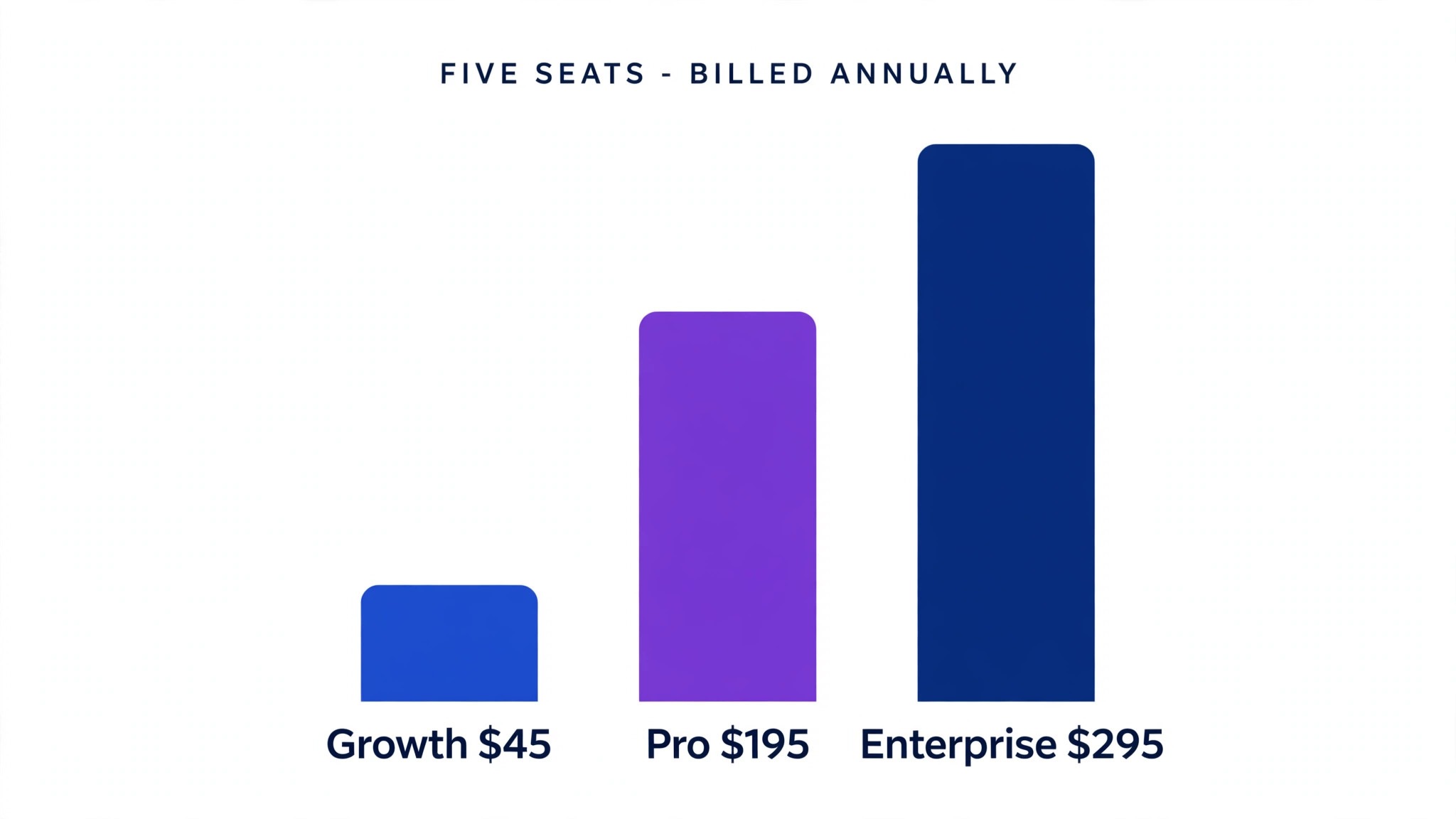
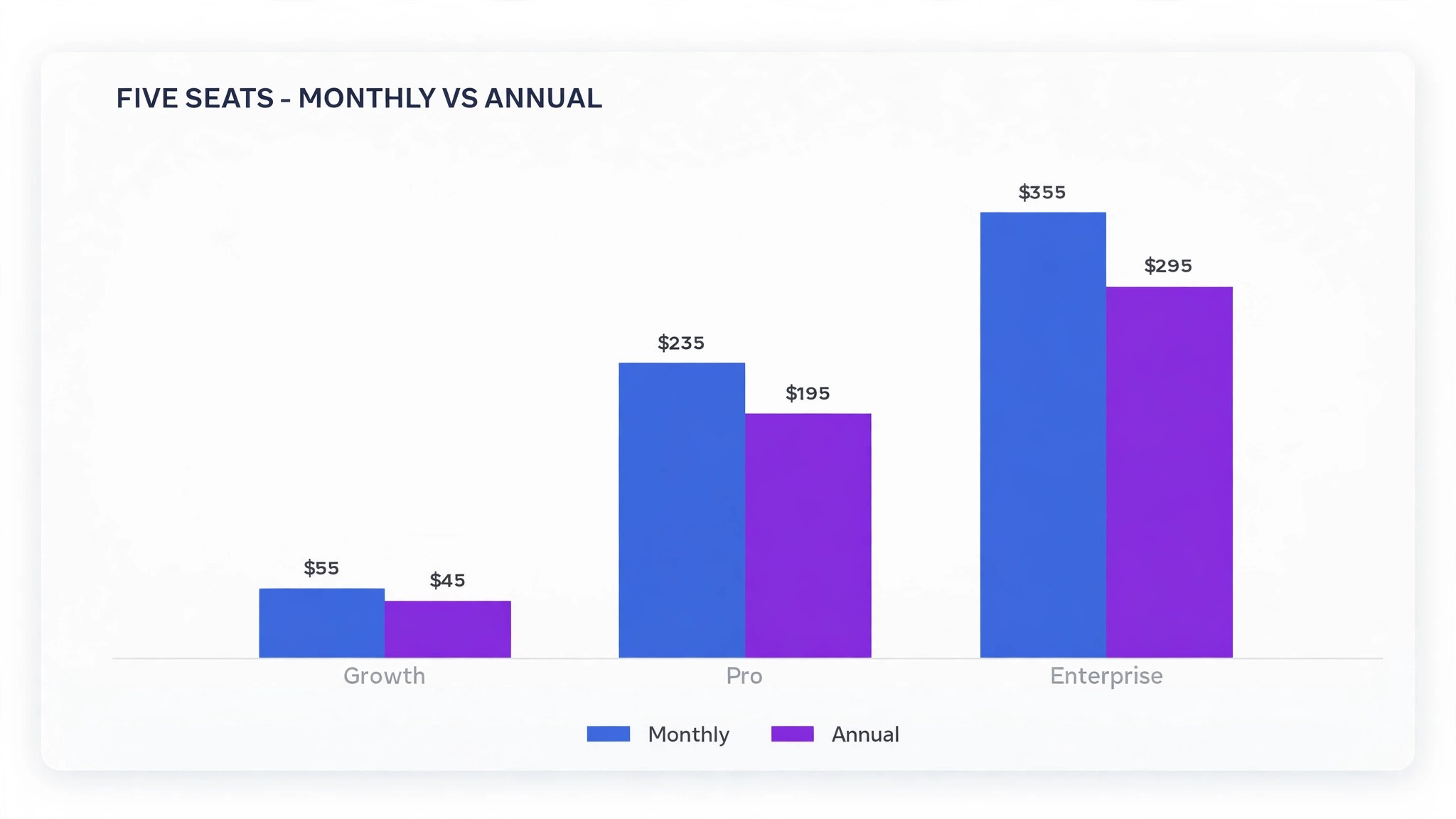
At $9 per user per month billed annually, Growth costs a five person team $45 a month, while Pro costs the same team $195 a month and Enterprise costs $295 a month, and that spread is the whole story in miniature. The cost of Freshsales for small business monthly starts low enough to look like a bargain, then rises more than fourfold between the entry tier and the tier most teams actually need, because sequences, multiple pipelines and advanced reporting live on Pro. A buyer who budgets from the $9 headline and then discovers the team needs Pro has not been misled by a single figure, but has still budgeted for the wrong tier.
Freshsales, sold by Freshworks as Freshworks CRM and as Freshsales Suite in some listings, is a sales CRM for small and growing teams. It covers contacts and accounts, visual pipelines, email, chat and phone, workflows, sales sequences, forecasting and AI help through Freddy AI. Its appeal is a working pipeline within a day rather than a configuration project, with built in calling and email tracking instead of a set of separate tools. Its risk is the opposite of a complex enterprise system, namely that the entry tier looks complete until the team tries to run sequences or manage several pipelines at once.
Prices below come from the Freshworks pricing page as reported in October 2026, together with third party breakdowns that repeat the vendor figures. Growth, Pro and Enterprise figures agree across those sources, for both annual and monthly billing, which makes Freshsales the most cleanly verifiable pricing in this batch. Even so, prices can change, and the instruction to check the vendor current pricing page applies before signing, especially for add ons and for the Suite product, which is sold separately from the standalone CRM in some listings.
Monthly pricing for cost of Freshsales for small business monthly, tier by tier
The table below sets out the three tiers in the brief, with both billing periods, because the annual discount is worth about a fifth of the monthly price. Annual billing means paying for the year in advance at the lower monthly rate, while monthly billing keeps the commitment short at a higher rate. A free plan for up to three users also exists in Freshworks listings, with limited features, and new signups get a twenty one day trial of the full CRM in the reported terms.
| Tier | Monthly price | What it includes | Best for |
|---|---|---|---|
| Growth | $9 per user per month billed annually, or $11 per user per month billed monthly | Kanban pipeline view, contact lifecycle stages, chat, email and phone, email templates, custom fields, basic workflows | A small team that needs a working pipeline, inbox and basic automation |
| Pro | $39 per user per month billed annually, or $47 per user per month billed monthly | Everything in Growth plus contact scoring, deal insights, custom sales activities, territory management, sales sequences, multiple pipelines, time based workflows | A growing team that runs sequences, several pipelines and advanced reporting |
| Enterprise | $59 per user per month billed annually, or $71 per user per month billed monthly | Everything in Pro plus forecasting insights, field level permissions, custom modules, sandbox, audit logs, dedicated account support | A larger team that needs control, compliance and custom objects |
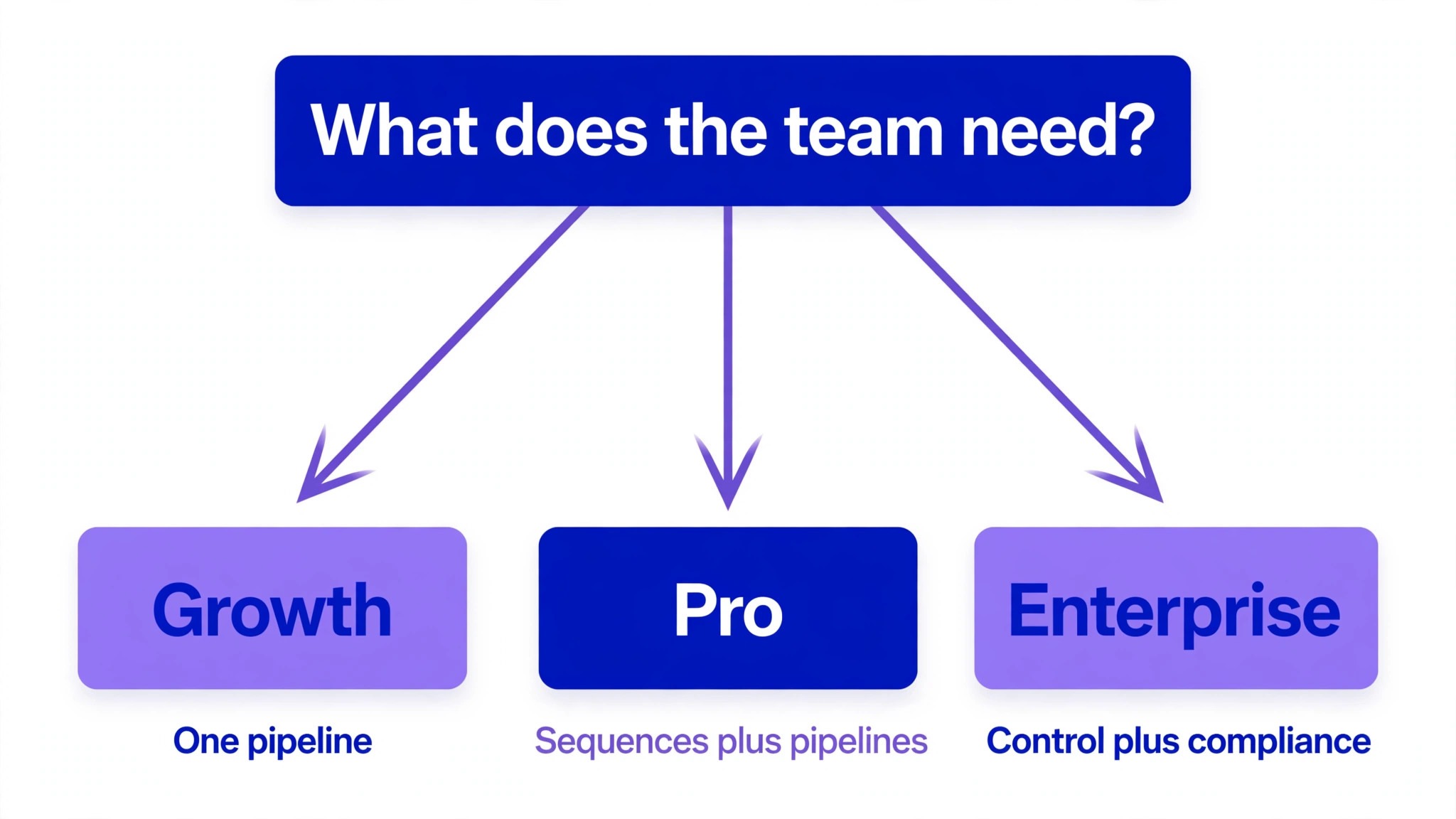
The jump from Growth to Pro is the decision that matters most, because it is a jump of $30 per user per month billed annually, or $150 a month for a five person team. That jump buys the features that turn a pipeline into a sales system, namely sequences that follow up automatically, multiple pipelines for different products or regions, territory management, and custom reports that show what is actually working. A team that buys Growth expecting sequences will be disappointed, not because Growth is poor, but because sequences were never part of its tier. Shortlist Pro first if sequences or multiple pipelines are in the first month plan.
Enterprise adds control rather than selling power, with field level permissions, audit logs, a sandbox for testing changes, custom modules and forecasting insights. Those features matter for a team with compliance needs, with managers who must restrict who sees salary or margin fields, or with a CRM administrator who tests changes before they reach the live system. A small team without those needs will rarely justify the extra $20 per user per month over Pro billed annually, and should treat Enterprise as a later step rather than a starting point.
A five seat example, worked out in full
Take a five person sales team that runs two pipelines, sends sequences to new leads, and wants AI deal insights. On Growth billed annually, the team pays $45 a month, but gets one pipeline and no sequences, so the tool cannot run the planned process. On Pro billed annually, the team pays $195 a month and gets ten pipelines in one third party feature count, plus sequences, territory management and AI insights.
On Enterprise billed annually, the team pays $295 a month for control and forecasting it may not yet need. The honest comparison is therefore $45 against $195 against $295 for the whole team, and the value question is whether sequences and multiple pipelines are worth $150 a month over Growth.
Monthly billing lifts the same example to $55 a month on Growth, $235 a month on Pro and $355 a month on Enterprise for five seats. Over a year, monthly billing on Pro costs $480 more than annual billing for the same five seats, which buys flexibility during a trial period. That flexibility is worth paying for in the first one to three months, while the team proves that sequences actually get used, but it should not become the permanent billing choice by accident. Switch to annual billing once the tier is proved, and diary the renewal date at the same time.
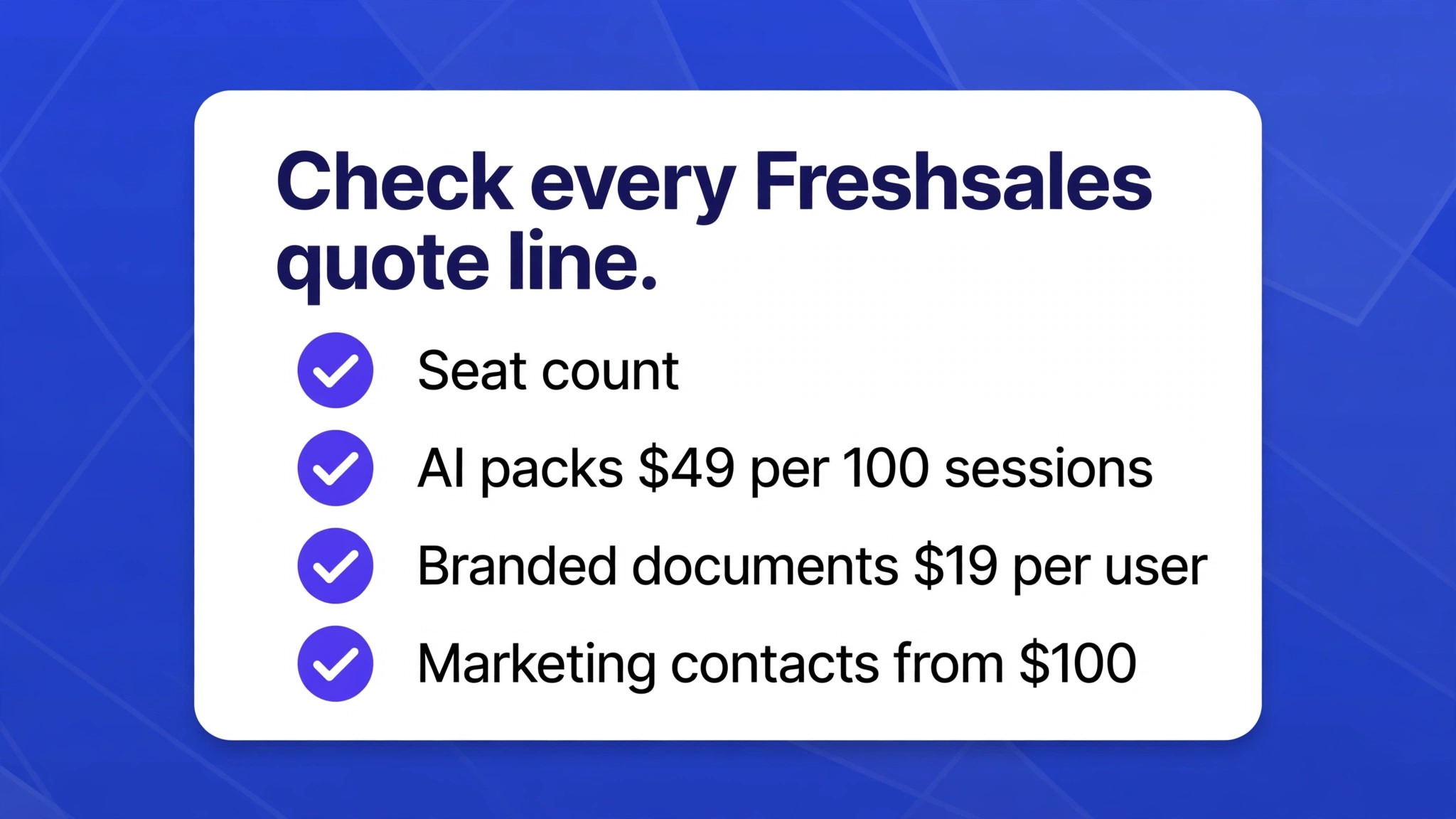
Add ons change the example further. Freddy AI Agent is listed at $49 per 100 sessions in Freshworks pricing material, and branded documents are listed at $19 per user per month, which would add $95 a month for five seats if every seat needs branded proposals. Marketing contacts are listed from $100 per 5,000 contacts a month on Suite terms, which matters for a team that also runs marketing campaigns from the same platform. A five seat Pro team that adds branded documents and one Freddy AI Agent pack therefore pays $195 plus $95 plus $49, or $339 a month billed annually before phone usage, which is far above the $195 headline tier total.
The extras below are where a Freshsales bill grows beyond the tier figure, and the cost of Freshsales for small business monthly should be budgeted against them for the real seat count, not for the team size on paper. Per user billing is the main driver, because every seat pays the full tier price, and AI, documents, marketing contacts and phone minutes stack on top. Work through the list with a quote in hand, and price each line for the seats that will actually use it.
– Per user billing on every seat, including part time sellers, sales managers who only read reports, and support staff who occasionally check a deal. A seat that only reads reports still costs the full tier price. – AI credits and sessions, with Freddy AI Agent listed at $49 per 100 sessions, which scales with how heavily the team uses AI help rather than with seat count. – Branded documents, listed at $19 per user per month, which can add more than the Growth tier price itself for a team that sends many proposals. – Marketing contacts, listed from $100 per 5,000 contacts a month on Suite terms, which matters for a team that runs campaigns from the same platform. – Phone minutes and numbers, where built in calling needs credits, with local calls reported at $0.02 to $0.05 per minute in one third party breakdown, so a phone heavy team should budget call volume separately. – The Suite confusion, where Freshsales Suite is sold as a separate product with its own plans, so a buyer must confirm whether a quote covers the standalone CRM or the Suite bundle. – Storage and pipeline limits on lower tiers, with one pipeline reported on Free and Growth against ten on Pro and twenty five on Enterprise, which can force an upgrade as the business adds product lines. – Implementation time, where setup, migration, workflow building and training cost staff time even though Freshsales lists no mandatory onboarding fee in the reported terms.
Per user billing deserves emphasis, because it punishes casual seats more than any other pricing model. A manager who wants to check the pipeline once a week, a founder who wants a dashboard, and a part time seller who works two days a week each cost the full Pro price of $39 a month billed annually, or $47 billed monthly, if they each hold a seat. Teams should therefore share dashboards and exports with occasional viewers, and should review the seat list quarterly, removing seats for leavers and role changers. That discipline can save hundreds a month for a team that grew quickly and never cleaned up its logins.
AI costs work differently from seat costs, because they scale with usage rather than with headcount. A team that uses Freddy AI Agent heavily for drafting, summarising and scoring will burn through session packs faster than a team that uses AI occasionally, and the $49 per 100 sessions figure should be tested against a real month of usage. Start with one pack, measure how many sessions a real week consumes, and then forecast monthly packs from that evidence rather than from a sales estimate. The same discipline applies to phone minutes, where a team that calls all day needs a call budget alongside the seat budget.
What the monthly fee buys beyond the pipeline
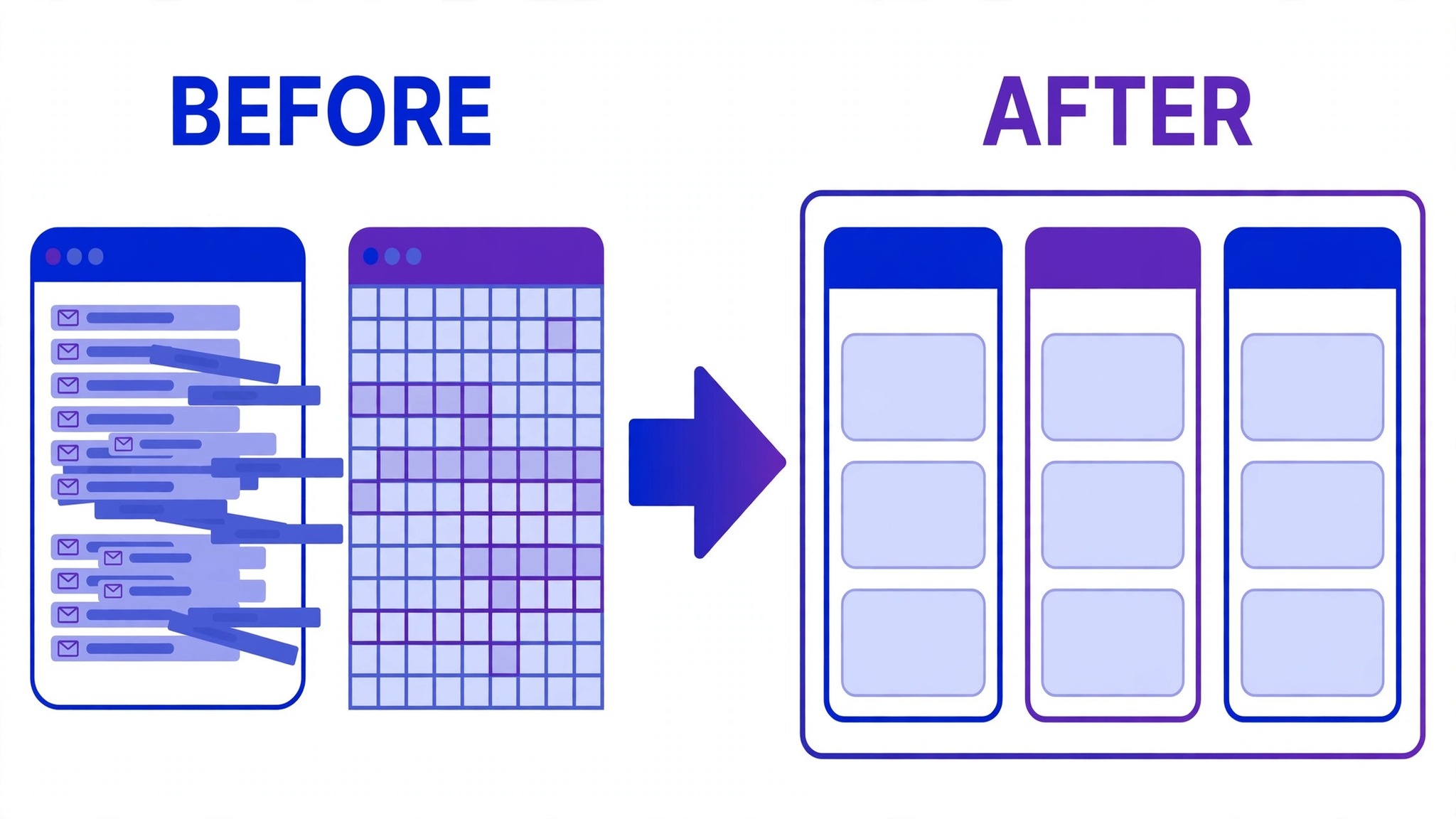
The fee buys a sales workspace where email, chat, phone, pipeline and reporting live together, so a seller can see the full story of a deal without switching tools. Email tracking shows when a prospect opens a message, the built in phone lets a seller call from the record, and the timeline keeps every touch in order. For a small team, that closeness removes the daily copying between inbox, phone system and spreadsheet, and it means a manager can coach from the same record the seller works from. The value is not in any single feature, but in the absence of switching and copying.
Pro adds the automation layer that makes the workspace scale, with sequences that send a timed series of emails and tasks, workflows that move deals and alert owners, and AI insights that highlight deals at risk or ready to close. Territory management lets a team split accounts by region or product without separate systems, and custom reports show which sources, sellers and stages actually produce revenue. Enterprise adds the control layer, with permissions, audit logs, sandbox testing and forecasting that suit a larger team with compliance needs. Each layer is useful, but only the layer the team will use every week earns its fee.
The cost of Freshsales for small business monthly also buys a relatively gentle learning curve, which matters for a small team without a CRM administrator. Pipelines, fields and workflows can be set up in days rather than weeks, and the twenty one day trial is long enough to run real deals through the system. That ease is a real saving, because a powerful system that nobody configures is worth less than a simpler system that the whole team uses. Buyers should still name one owner for the CRM, even on a small team, because pipelines, sequences and reports drift without someone tending them, and drift is what turns a good system into an unreliable one.
Reporting quality is a further reason teams stay on Pro once they try it, because custom reports turn pipeline activity into decisions about where to spend selling time. A team that can see which lead source produces booked meetings, which stage loses the most deals, and which seller follows up fastest can fix the weakest link instead of working harder everywhere. That visibility is hard to value before buying, but it is often the feature managers mention first after a few months. The cost of Freshsales for small business monthly should therefore be judged partly on reporting use, not only on pipeline and sequence features, since a team that never opens its reports is paying for insight it never reads.
When it is worth it and when it is not
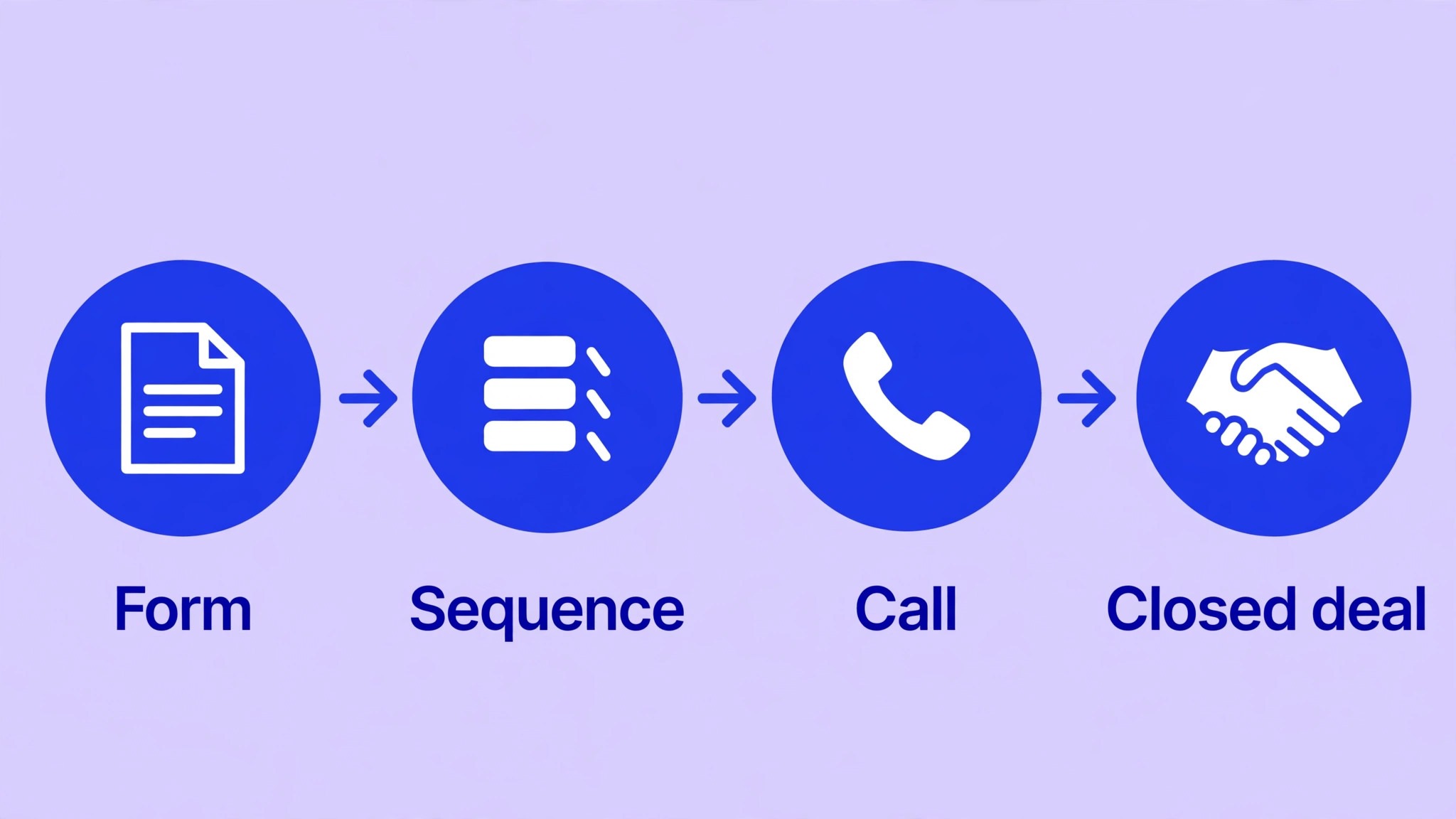
Freshsales is worth the fee when a small team sells actively, runs sequences, and needs several pipelines without hiring a CRM administrator. In that situation, the cost of Freshsales for small business monthly buys back selling time and follow up consistency that a spreadsheet cannot match, and Pro at $39 per user per month billed annually is fair value for sequences, pipelines and reporting together. The test is whether sequences and pipelines are in the first month plan, because if they are, Growth will disappoint and Pro is the honest starting tier.
Freshsales is a weaker buy when the team mainly needs a contact list, when deals are few and simple, or when marketing automation is the main job rather than sales follow up. A solo seller with ten deals a month may do fine on the free plan for up to three users or on Growth, and a team that mainly sends newsletters should compare email platforms before buying a sales CRM. Freshsales is also a weaker buy when the team will not maintain sequences and pipelines, because an unmaintained CRM becomes a second inbox that nobody trusts, whatever the tier.
Team size changes the answer through per user billing. A three person team on Pro billed annually pays $117 a month, which is easy to justify if sequences win even one extra deal a month. A fifteen person team on Pro billed annually pays $585 a month, plus any AI packs, branded documents and phone usage, which is a serious line item that needs to earn its keep in revenue, not in tidiness. At that size, the buyer should set a target before signing, such as faster follow up, more booked meetings or a shorter sales cycle, and should check progress after ninety days.
Migration effort also belongs in the first month plan, even though Freshsales is easier to set up than many rivals. Contacts, deals, email templates and sequences all need moving from the old system, and field names rarely match exactly between tools. A business should map fields before importing, test the import with a small batch, and check that deal history and email threads survive in a usable form. That preparation takes a few days of staff time, but it prevents the common launch problem where sellers distrust the new system because their old deals arrived incomplete or mislabelled.
How to cut the bill
Start on Growth only if the first month plan genuinely needs nothing beyond one pipeline, basic workflows and email tracking, and move to Pro the week sequences or a second pipeline become necessary. Many teams waste months on Growth trying to work around missing sequences, then pay for Pro anyway, so the saving is false. The honest rule is to buy the tier that contains the features in the first month plan, and no higher, and to use the twenty one day trial to test those exact features with real deals.
The cost of Freshsales for small business monthly also falls when seats, AI packs and documents are bought only for the people who use them. Give full Pro seats to sellers who run sequences and pipelines daily, share reports with occasional viewers instead of giving them seats, and buy branded documents only for seats that send proposals. Test Freddy AI Agent usage for a month before committing to multiple packs, and budget phone minutes from real call volume rather than from guesswork. Review seats, packs and documents quarterly, and remove anything unused for a full month.
Other savings come from setup discipline. Build one pipeline well before adding a second, write sequences once and test them on a small segment, and clean the contact list before importing so the team does not pay marketing contact fees for dead records. Take annual billing only after the trial has proved the tier fits, because the annual discount is lost if the team abandons the system. Finally, confirm on the quote whether the price covers the standalone CRM or the Suite bundle, because comparing a Suite quote with a standalone rival price will mislead the whole decision.
– Buy the tier that contains the first month features, and no higher, and upgrade when a named need appears. – Give full seats only to daily sellers, and share reports with occasional viewers. – Buy branded documents only for seats that send proposals, and test AI packs for a month first. – Budget phone minutes from real call volume, not from guesswork. – Take annual billing only after the trial has proved the tier fits. – Confirm whether the quote covers the standalone CRM or the Suite bundle.
Trial discipline is the last saving, because a twenty one day trial only helps if the team uses it like real work. Assign real deals, real sequences and real calls to the trial, and hold a short review at day seven and day twenty one to decide whether the tier fits. A trial spent clicking through demo data ends with a guess, while a trial spent selling ends with evidence. That evidence also helps at renewal, when the owner can point to booked meetings and closed deals that came through the system rather than to a general feeling that the tool seemed useful.
Frequently Asked Questions
How much does Freshsales cost each month for a five person team?
On annual billing, a five person team pays $45 a month on Growth, $195 a month on Pro and $295 a month on Enterprise, while monthly billing lifts those totals to $55, $235 and $355 a month. Add branded documents at $19 per user per month where needed, Freddy AI Agent packs at $49 per 100 sessions, marketing contacts from $100 per 5,000 contacts a month on Suite terms, and phone usage on top. The tier total alone is therefore only the starting point for a real budget.
What is the difference between Growth, Pro and Enterprise?
Growth is the entry sales tier, with one pipeline, basic workflows, email tracking, chat, phone and templates. Pro adds sequences, multiple pipelines, territory management, contact scoring, deal insights and custom reports, which together turn a pipeline into a sales system. Enterprise adds forecasting, field level permissions, custom modules, sandbox testing, audit logs and dedicated support, which suit larger teams with control and compliance needs. Most small teams that sell actively will land on Pro, because sequences and multiple pipelines live there.
Is there a free plan or a free trial?
Freshworks listings describe a free plan for up to three users with limited features, and a twenty one day trial of the full CRM for new signups. The free plan suits a solo seller or a tiny team testing basic pipeline work, but it lacks the sequences and multiple pipelines that most growing teams need. Use the trial with real deals, real sequences and real calls, and set a pass mark before it starts, such as five deals moved through a pipeline and three sequences sent and answered.
How do AI credits work in Freshsales?
Freddy AI Agent is listed at $49 per 100 sessions in Freshworks pricing material, sold separately from the seat price, while AI insights and scoring features are included on Pro and Enterprise in the reported terms. That means a team pays for the seat tier and then pays again for heavy AI agent usage, so AI spend scales with usage rather than with headcount. Test one pack with real usage for a month, measure sessions per week, and forecast packs from that evidence rather than from an estimate.
What do phone calls cost in Freshsales?
Built in calling is included as a feature, but call minutes and numbers need credits, with local calls reported at $0.02 to $0.05 per minute in one third party breakdown, while international rates vary. A team that calls all day should therefore budget call volume alongside seats, and should check the current call rates and number fees on the vendor pricing page before signing. A team that mainly emails and chats will spend little on calls, while a phone heavy team can add a meaningful monthly line.
What is the difference between Freshsales and Freshsales Suite?
Freshsales is the standalone sales CRM, while Freshsales Suite bundles the CRM with marketing automation and related tools under its own plans, and the two are sold as separate products in Freshworks listings. A quote should therefore state clearly which product it covers, because Suite terms such as marketing contacts from $100 per 5,000 contacts a month do not apply in the same way to a standalone CRM quote. Comparing a Suite quote with a standalone rival price, or the reverse, will mislead the decision.
Can a team downgrade from Pro to Growth later?
Downgrades are possible in principle, but annual billing generally does not refund unused months, so a team that downgrades mid year may not see the saving until the next billing cycle. Monthly billing keeps downgrades simpler at a higher monthly price, while annual billing rewards certainty with a lower price. The safe path is to trial on monthly billing, confirm the tier fits, and then move to annual billing, checking the current downgrade and renewal terms at signup.
What should a buyer check before signing up for Freshsales?
Check the tier against the first month feature list, especially sequences and pipeline count, the seat count, the billing period, the branded documents need, the Freddy AI Agent usage, the marketing contact need, the phone call volume, and whether the quote covers the standalone CRM or the Suite. Get the total monthly figure including add ons in writing, trial with real deals for twenty one days, and set a ninety day target such as faster follow up or more booked meetings. A buyer who checks those points will rarely be surprised by the bill.
Verdict
For a small team that sells actively and will run sequences across several pipelines, Pro is the sensible default, and the cost of Freshsales for small business monthly at $39 per user per month billed annually is fair value for what it returns in follow up consistency and pipeline visibility. Start on monthly billing, prove the tier with real deals during the trial, then move to annual billing for the saving, and keep seats, AI packs and documents tight. Growth suits a team with one pipeline and simple needs, while Enterprise suits a larger team with control and forecasting requirements.
Freshsales is not the cheapest CRM for a team that only needs a contact list, and it is not the deepest marketing platform for a team that mainly sends campaigns. Its strength is a working sales pipeline with sequences, calling and reporting that a small team can run without an administrator. Price the whole team, price the add ons, and confirm whether the quote is for the standalone CRM or the Suite. Done that way, Freshsales is a predictable and workable monthly cost, and done carelessly, it is an easy way to pay Pro prices for Growth usage.
More Reading on Stratilyze
These related guides cover CRM switches, pricing for other small business platforms and the wider systems that sit around sales pipelines and follow up.
– Switch From HubSpot to Freshsales for a Small Business – Cost of Brevo for Small Business Monthly – Cost of MailerLite for Small Business Monthly – Cost of Acuity for Small Business Monthly – Software Stack for Home Stagers at a Small Business