

Verdict first. A bowling centre that treats leagues as a weekly booking problem will always struggle with sign ups, standings arguments and prize payouts, while a centre that treats leagues as a season long membership product will fill lanes on quiet nights and keep teams returning year after year. The difference is rarely the lanes or the oil pattern. It is the admin system behind the league, and that is why this guide recommends a clear verdict. Centres that choose to use AI for bowling alley league management, with officers still in charge of rules and money, run calmer seasons, publish faster standings, and keep more teams for the next season than centres that rely on paper sheets and memory.
That verdict needs a qualifier, because AI cannot certify a league, settle a rules dispute, or hold league money. Those duties belong to league officers and, for certified leagues, to the association process. What AI can do well is remove the repetitive work that burns out secretaries, which is roster updates, average calculations, standing sheets, schedule changes, fee reminders and prize tracking. When that work runs reliably, officers have time for the human parts, such as welcoming new bowlers, handling a team dispute fairly, and planning the banquet that ends the season well.
Leagues matter commercially in a way that open play does not. A league team books the same lanes at the same time for thirty or more weeks, brings food and drink spend with it, and creates a community that recruits the next team. Lose a league secretary to burnout, and the centre may lose four or five teams at once. Lose a prize payout to a bookkeeping error, and trust takes a season to rebuild. League management is therefore not back office admin. It is retention work, and it deserves a system as reliable as the lane machines.
How a League Season Actually Works
A league season has a rhythm that newcomers often miss. Before the first session, the league adopts rules, opens a league account, collects membership applications and fees, and sends its application to the local association. USBC guidance for league officers sets clear deadlines in this stage, including sending the completed league application and fees to the local association within 30 days of the start of the schedule. The prize list must be adopted within five weeks of the start, and that deadline matters because prize arguments almost always trace back to a list that was vague, late or never shared with captains.
During the season, the weekly cycle repeats. Scores are recorded, averages updated, standings published, fees collected, and league funds deposited promptly. USBC officer guidance stresses depositing money into the league account within seven days of receipt, with withdrawals requiring two officer signatures and the president verifying the account monthly. Those controls sound bureaucratic until a season ends with a shortfall nobody can explain, at which point every team wants to know exactly where the money went. A system that logs every fee, every deposit and every payout with a date and a name prevents that argument before it starts.
At season end, final standings decide prizes, awards are processed, and the financial report is shared. Awards earned during the season should be processed within 20 days of the score bowled under USBC guidance, so a secretary who waits until the banquet to chase awards will disappoint bowlers who earned recognition months earlier. The banquet itself is not a formality. It is the moment teams decide whether to return, and a centre that presents prizes accurately, thanks officers publicly, and opens next season sign ups on the night will keep more teams than a centre that mails cheques weeks later.
Sign Ups Without the Paper Chase
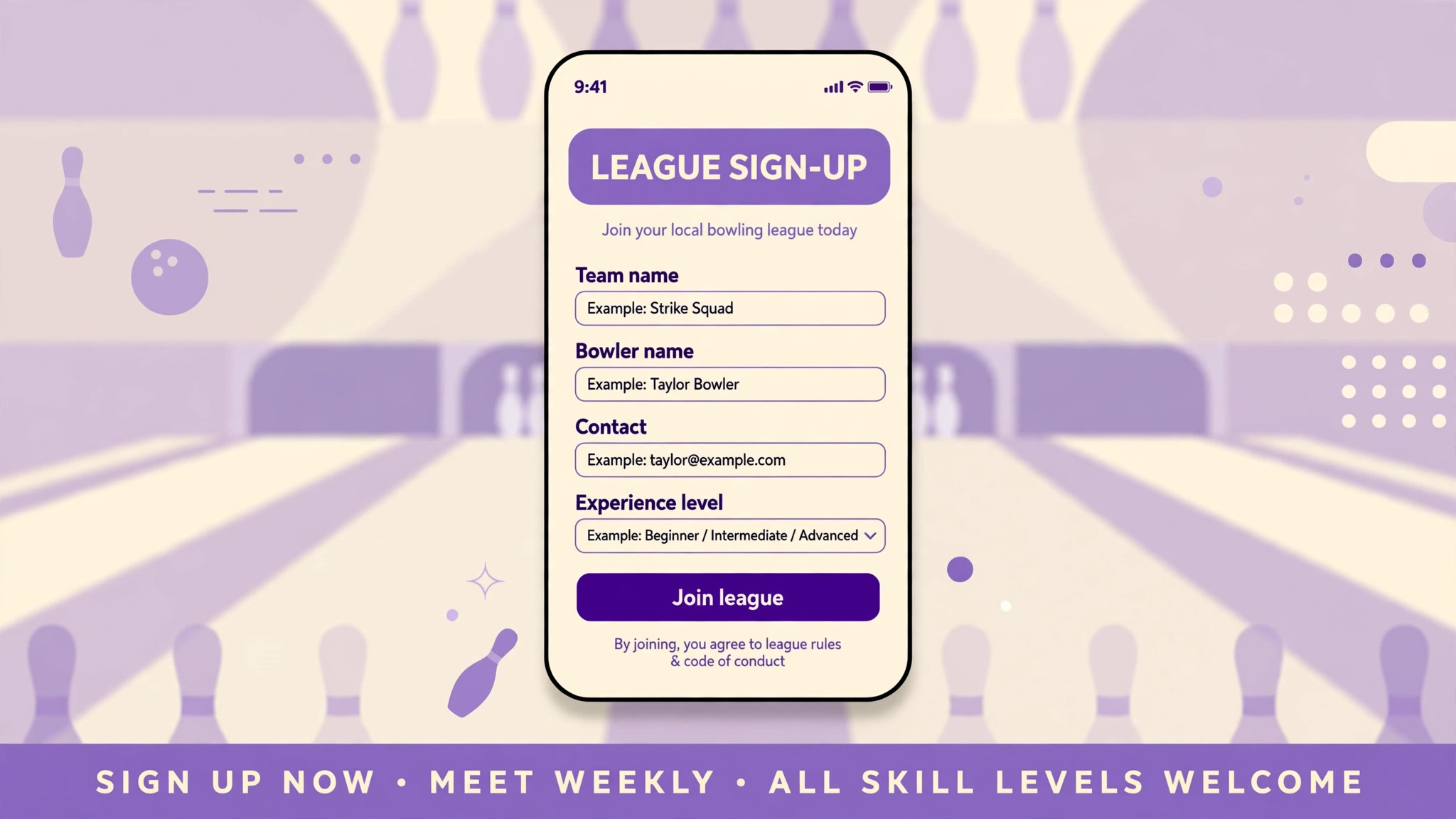
Sign up season is where many leagues lose teams before a ball is bowled. Captains are asked to collect paper forms, chase teammates for fees, and return everything to a secretary who is also trying to run a centre. The process should be split into three clear steps. First, the league publishes its format, night, time, fee breakdown and prize approach in one place that captains can forward. Second, each bowler completes their own membership and roster details online, with the captain seeing who is still missing rather than chasing everyone blindly. Third, fees are collected with a record attached to each bowler, so nobody is marked paid on a promise.
AI help here is practical rather than flashy, and a centre that decides to use AI for bowling alley league management should judge it on fewer chasing messages, not on fancier ones. It can draft the sign up announcement from last season details, personalise reminders to bowlers who have not completed a form, and summarise captain questions into a short list for the secretary. It can also flag roster problems early, such as a team with too few members, a bowler registered on two teams, or a new bowler without a membership application. Staff still approve every message and every roster change, because a wrong roster on week one creates average and handicap problems that run all season.
New bowler welcome deserves special attention, because leagues grow by keeping first season bowlers, not by recruiting a new batch every year. A short welcome note that explains handicap in plain language, names the team captain, states the weekly fee and what it covers, and gives the first night arrival time will calm nerves far better than a rules PDF. Pairing a new bowler with a returning teammate for the first three weeks, and checking in after week two, turns a nervous newcomer into a regular. Centres that track first season retention separately from overall retention soon learn whether their welcome works.
Standings, Averages and Handicaps That Bowlers Trust
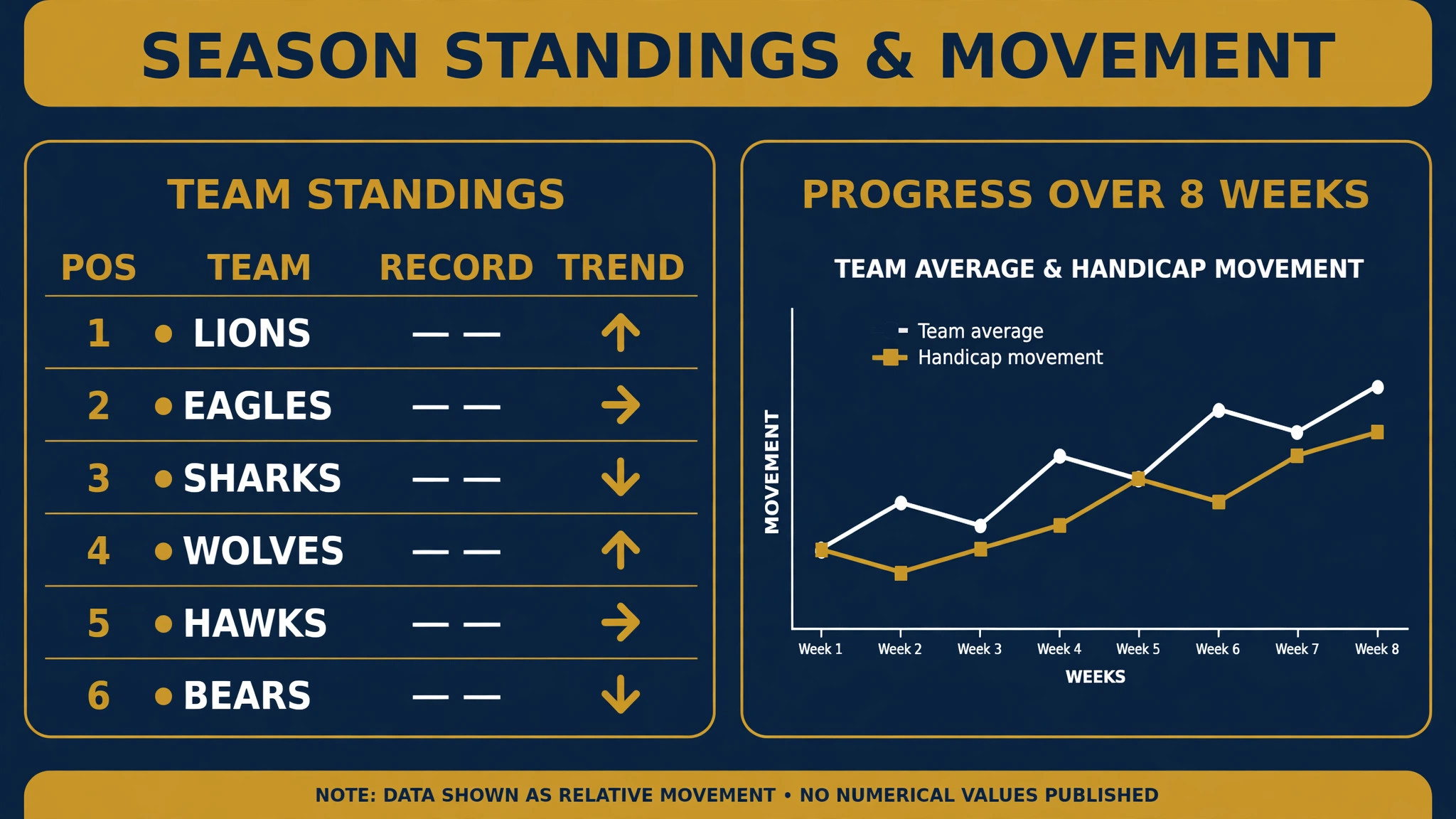
Standings are the weekly newspaper of a league, and bowlers read them closely. A standing sheet that is late, wrong or hard to find will generate more complaints than a lane breakdown, because it touches pride and prize money. The workflow should therefore be fixed. Scores are entered once, from the scoring system or a checked recap sheet, averages are recalculated by the system, and the standing sheet is published to the same place at the same time each week. Any correction is logged with the reason, so a team that questions a change can see what happened rather than hearing that the sheet was fixed.
Handicap is the topic that causes most confusion, and plain explanation prevents most arguments. The league rules should state the handicap basis, the percentage, and the maximum, in words a new bowler can follow, and the standing sheet should show the basis beside the numbers. When a bowler asks why their handicap changed, the answer should point to the average change and the rule, not to a feeling that the system was adjusted. AI can draft that explanation from the actual numbers, but the secretary should check it, because a confident sounding wrong explanation is worse than a short honest one that says the secretary will confirm the figure.
Schedule changes need the same discipline. A postponed night, a lane change, or a team that folds mid season should be communicated to every captain at once, with the revised schedule attached and the reason stated. Rolling changes by word of mouth creates a league where half the teams play by the old schedule and half by the new one. A single published schedule, with changes dated and announced, keeps everyone on the same page. That habit matters even more for leagues that share lanes with open play, where a schedule slip can double book a pair of lanes on a busy night.
Prize Tracking That Survives Scrutiny
Prize money is where trust is won or lost, and the rules around it are specific for a reason. Prize lists are estimates based on expected income less expected expenses, and USBC guidance notes that the list must be adopted within five weeks of the start of the schedule, with a committee preparing proposals for the league to vote on. A centre that helps leagues meet that deadline, by prompting the committee and publishing the adopted list to every captain, prevents the most common end of season argument, which is a team claiming it expected a different payout.
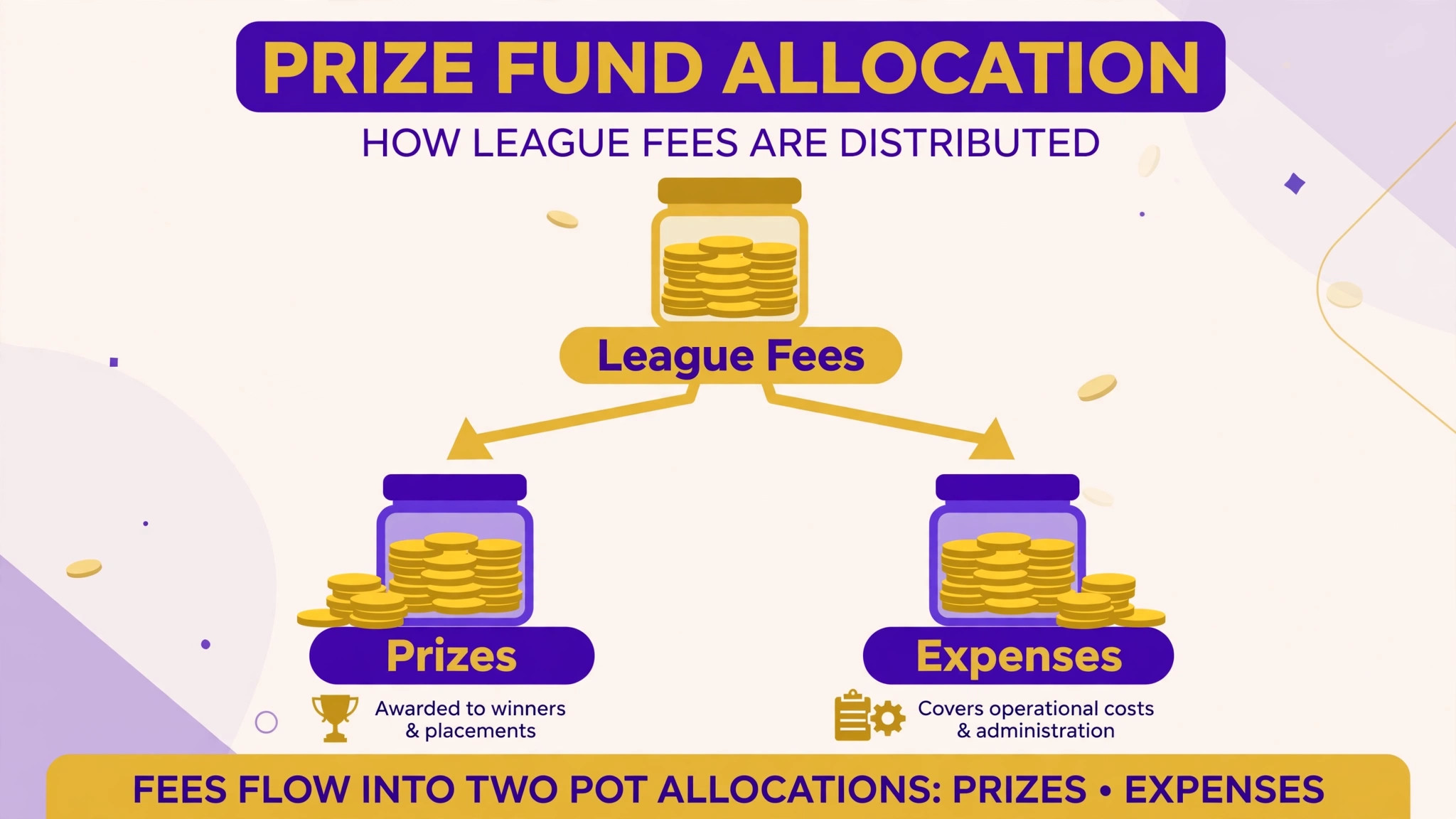
Tracking should separate three pots clearly. Bowling fees pay the centre, league funds cover prizes and awards, and any secretary salary or expense is shown as its own line rather than buried in a total. Weekly fee collection should be reconciled against the roster, so a team that is behind on fees is known in week three, not discovered at the banquet. When a team falls behind, the league rules on forfeits and fee currency should be applied consistently, with the secretary contacting the captain privately before any public action. Consistency here protects the secretary as much as the league, because selective enforcement is what turns a fee problem into a personal dispute.
At payout time, the final standings, the prize list and the financial report should agree to the dollar, and every captain should receive the same figures. If a prize fund comes in short because a team folded or fees went unpaid, that shortfall should be explained in writing before payouts, with the rule that governs the adjustment cited. Bowlers accept a smaller prize when they understand why, but they do not accept a surprise. A centre that supports that transparency, without taking over league money, earns a reputation that attracts new leagues.
The Season Workflow, Week by Week
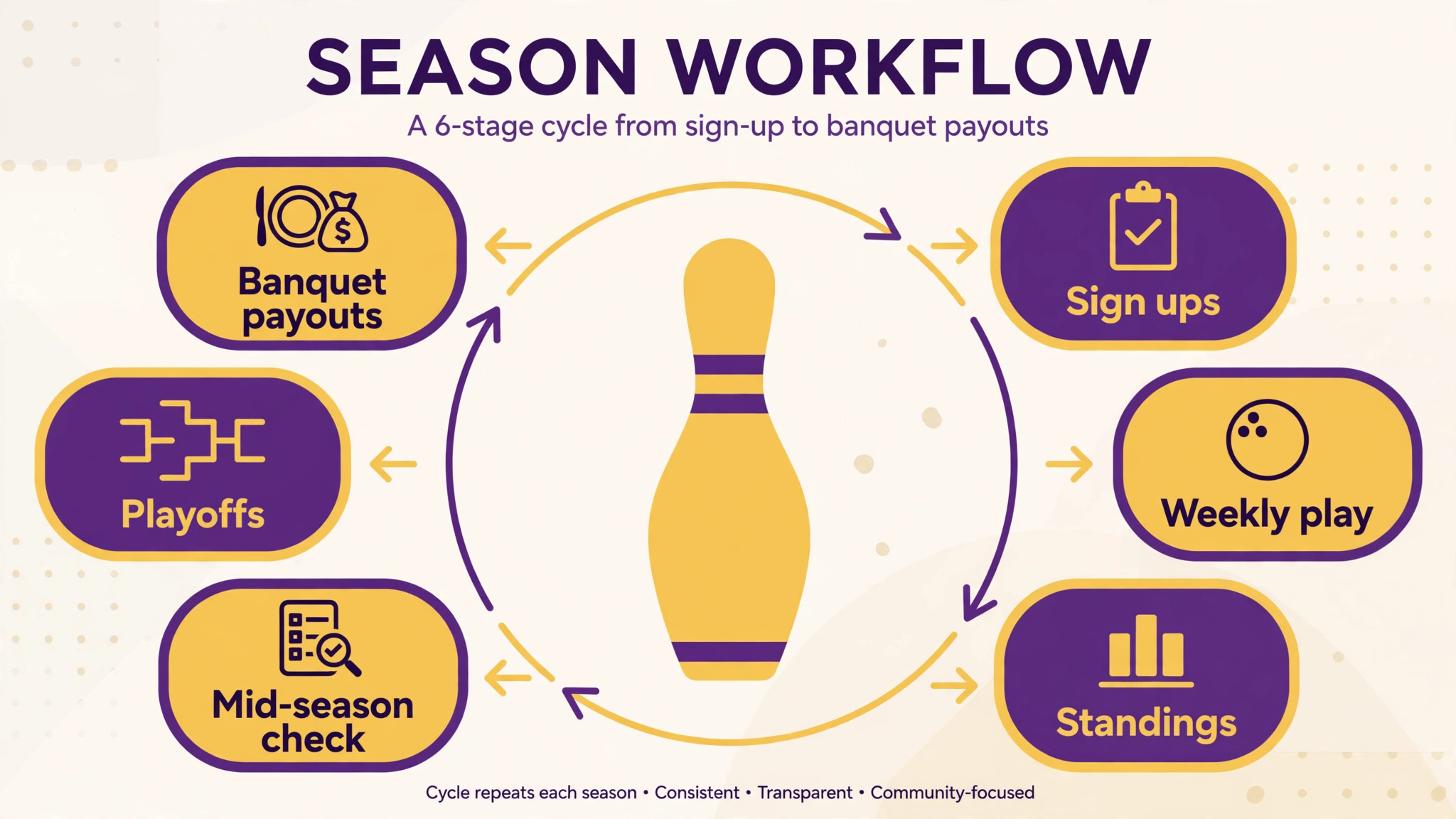
The workflow below is the operational heart of this guide. It assumes officers remain responsible for rules and funds, while the system handles drafting, reminders, calculations and publishing. Each stage names its output, because a workflow without a visible output drifts.
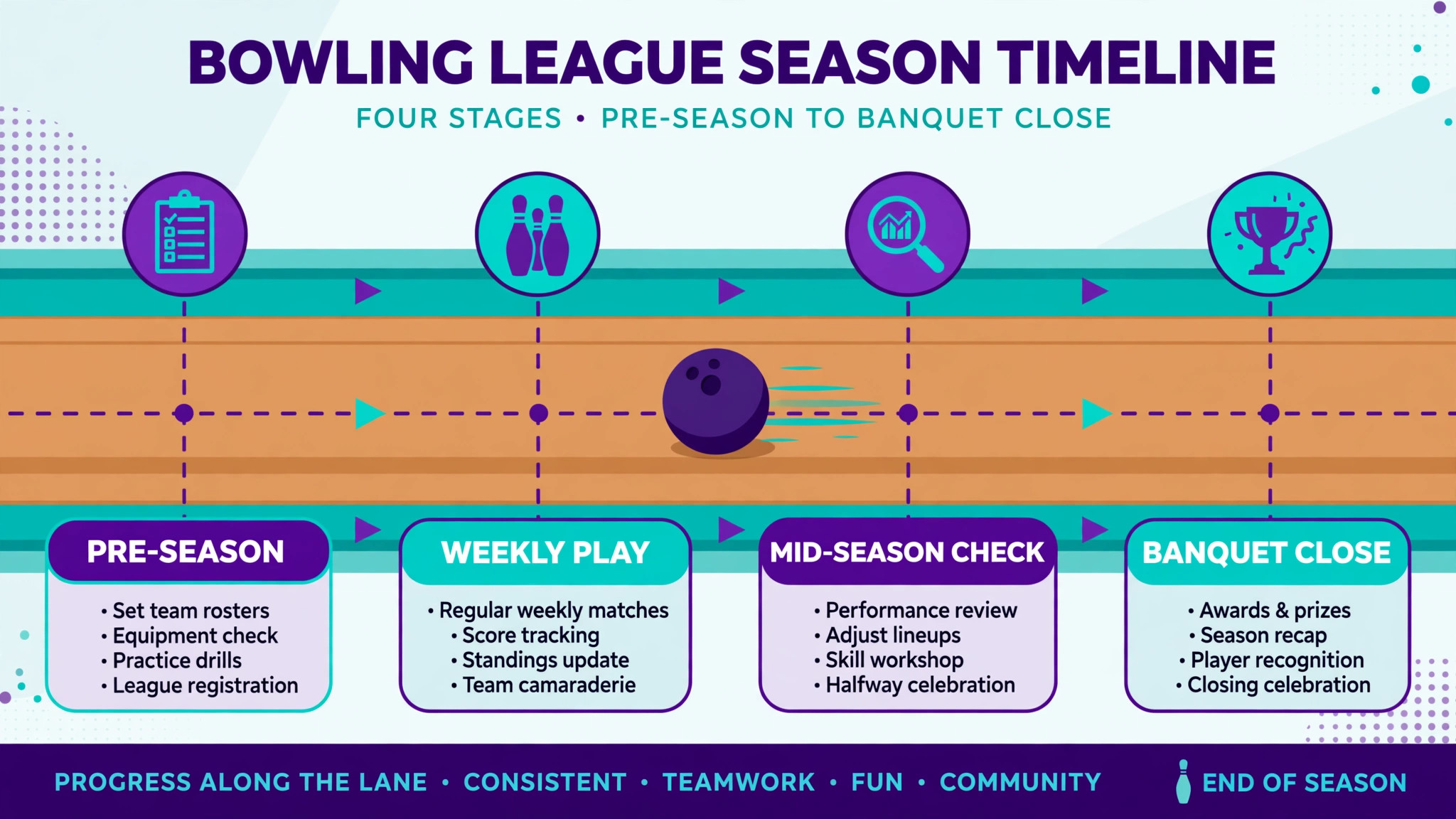
1. Pre-season setup, eight to four weeks out
Confirm the league format, night, fee breakdown and prize approach with officers, and publish the sign up page. Open the league account with two signatures, and set the deposit and verification routine before any money arrives. Draft the rules summary in plain language alongside the formal rules, so new bowlers can follow the season without reading a rule book first. This is the stage where a plan to use AI for bowling alley league management pays off earliest, because drafting and chasing sign ups take the most officer time.
2. Registration and certification, four weeks to week one
Collect membership applications and fees per bowler, chase only the missing items, and reconcile fees against the roster weekly. Send the league application and fees to the local association within the 30 day deadline, and keep a copy with the submission date. Publish the schedule to every captain, with lane assignments and bye weeks marked. Appoint the prize committee and set the date for the prize list vote inside the five week window.
3. Weekly operations, week one to final week
Enter scores once, publish standings at the same time each week, and log any correction with its reason. Collect fees, deposit within seven days, and reconcile the league account monthly with presidential verification. Process awards within 20 days of the score bowled, and announce them so bowlers feel recognised during the season, not only at the end. Communicate schedule changes to all captains at once, with the revised schedule attached.
4. Mid-season health check, halfway point
Review retention, fee arrears, average and handicap queries, and team satisfaction in one short meeting with officers. Ask captains what is working and what is not, and fix one process problem before it becomes a season long complaint. Open early sign up interest for next season, so teams that are enjoying the league can commit while enthusiasm is high. A mid-season check is also the right time to plan social events, such as a fun night or a charity game, that keep the league feeling like a community rather than a fixture list.
5. Season close and payouts, final week to banquet
Publish final standings, apply the adopted prize list, and reconcile the financial report before any payout. Share the report with captains, explain any shortfall in writing, and pay prizes at the banquet where possible. Process any outstanding awards, thank officers and captains by name, and open next season registration on the night. Record lessons for next season while they are fresh, including fee problems, schedule clashes and communication gaps, so the next season starts better rather than repeating the same fixes.
How to Use AI for Bowling Alley League Management Without Losing Officer Control
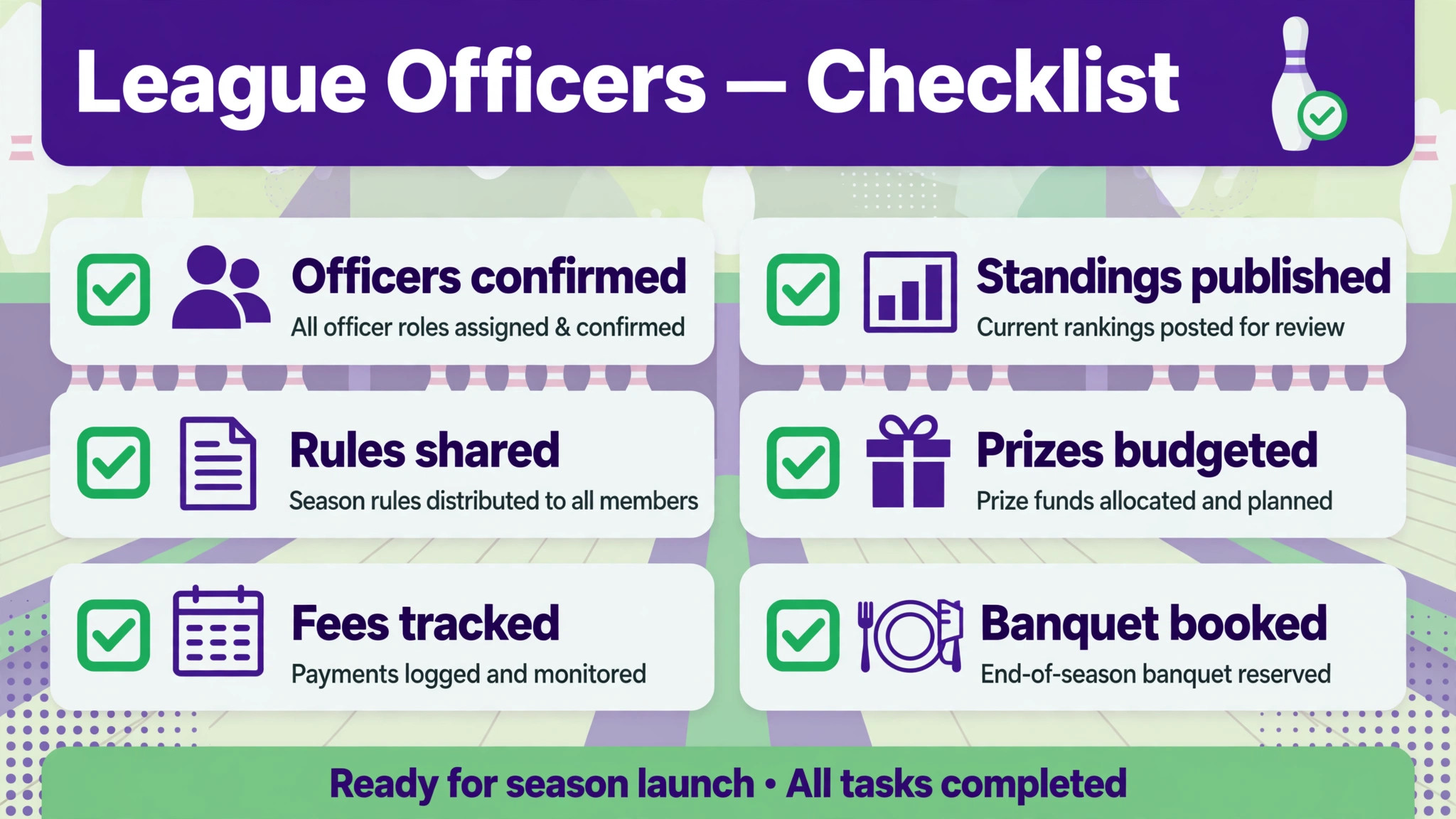
The safest way to adopt AI in a league is to write down, before any tool is bought, which decisions stay with officers and which tasks the system may handle. Officers keep rules, prize lists, fee enforcement, forfeits and disputes. The system handles drafting, reminders, calculations, publishing and reconciliation records. When that boundary is written into the league handbook, bowlers trust the system because they can see that no software is quietly changing a rule or moving money. A centre that wants to use AI for bowling alley league management well should start with that one page boundary, not with a software demo.
Training follows the boundary. Secretaries need a short routine for checking drafted messages, spotting a wrong average, and logging a correction with its reason. Captains need to know where standings appear, how fee reminders work, and who to contact about a dispute. New officers need a handover note that lists the league account routine, the association deadlines, and the prize list vote date. None of that training needs to be long, but all of it needs to be written, because league knowledge that lives only in one secretary head leaves with that secretary.
Tool trials should use a real league, not a demo league. Run the new system alongside the old sheet for three weeks, compare standings line by line, and check that fee reconciliation matches the bank record. If the trial produces one unexplained difference, stop and find the cause before going live, because bowlers will find it later and trust will drop faster than any time saved. A careful trial is also the moment to confirm that the system can publish standings to the place bowlers actually check, whether that is a centre screen, a league page, or a captain message thread.
Data protection in a league is simpler than in many businesses, but it still needs care. Publish standings and averages, keep fee arrears and contact details private, and give bowlers a clear way to update their details or ask for a correction. When a bowler leaves a league, remove their contact details from active lists while keeping the season record that the league needs for averages and prizes. A league that handles those basics well feels like a club that respects its members, and that feeling is part of why teams return. Centres that use AI for bowling alley league management with that respect built in will find the technology fades into the background, which is exactly where it belongs.
Finally, review the system once a season with officers, not only when something goes wrong. Ask which messages saved time, which calculations needed correction, and which bowlers still prefer a paper sheet. Keep what worked, fix one weak step, and retire any feature that nobody used. That annual review keeps the league system honest, and it gives the next secretary a record of why each choice was made, rather than a set of tools nobody remembers choosing.
League Season Template
The template below can be copied into a league handbook or a centre operations doc. Bracketed parts are filled per league, and officers should approve the final version before it is shared.
> Season at a glance > > League name [name], night [night], start date [date], weeks [number], teams [number], weekly fee [amount] covering bowling [amount], prize fund [amount] and expenses [amount]. Prize list adopted on [date], published to all captains on [date]. League account held at [bank], withdrawals need two officer signatures, president verifies monthly. >
> Weekly rhythm > > Scores entered by [day], standings published by [day and time] at [place or link], fees collected by [person], deposits made within seven days. Awards processed within 20 days of the score bowled. Schedule changes announced to all captains at once with a revised schedule attached. >
> Captain duties > > Captain confirms roster, collects nothing in cash without a receipt, reports roster changes before the next session, and raises disputes through the secretary rather than on the lanes. Captain notifies the secretary by [date] whether the team will retain its franchise for next season. >
> Season close > > Final standings published on [date], financial report shared with captains on [date], prizes paid at the banquet on [date]. Next season registration opens on banquet night, with returning teams given priority until [date].
A template only helps if it is followed visibly. Centres should check each week that standings were published on time, fees were reconciled, and deposits were made, rather than discovering gaps at season end. A short weekly check, done by the secretary with a second officer spot checking monthly, keeps the template honest without adding a heavy audit burden.
Communication That Keeps Teams Coming Back
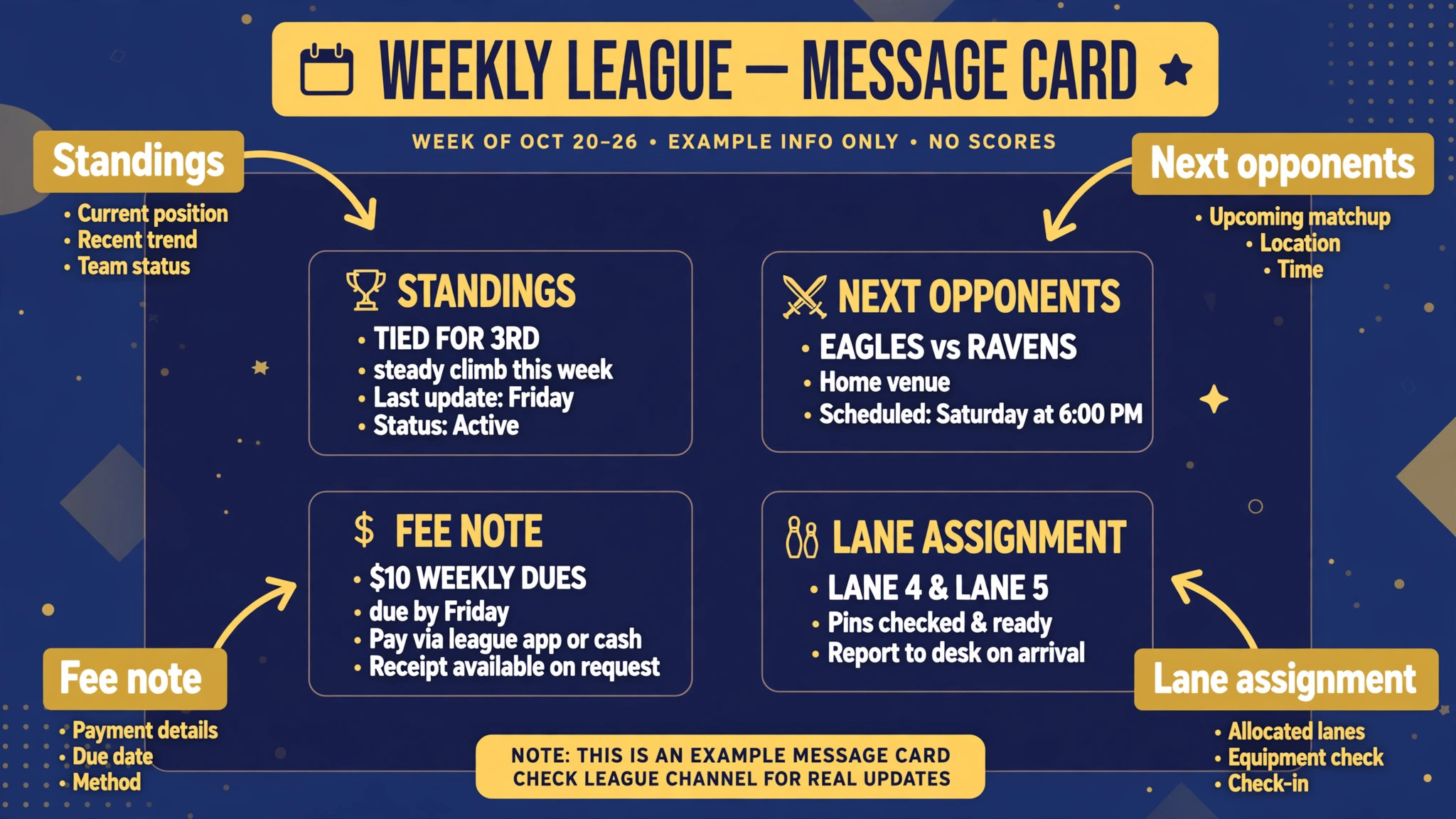
League communication should be short, regular and in one channel that captains actually read. A weekly message with standings, next week opponents, fee reminders for teams in arrears, and one social note will be read far more than a long monthly newsletter. Captains should forward the same message to their teams, so bowlers hear the same news rather than five versions of it. Social content, such as a high game, a new bowler welcome, or a team milestone, keeps the league feeling human and gives teams something to share beyond scores.
AI can draft those weekly messages from standings and schedule data, and can personalise the fee reminder to the captain of the team in arrears without naming individuals publicly, which is a quiet but real benefit when a centre starts to use AI for bowling alley league management. Staff should still approve every message, because a drafted note that announces the wrong opponent or the wrong lane will be remembered longer than ten correct ones. The approval step takes two minutes and protects the trust that the whole season depends on. Centres should also keep a simple rule that disputes are never settled by group message, but by a private conversation with the secretary and, where needed, the league board.
Retention work continues between seasons, not only during them. A short off season message that thanks teams, shares banquet photos, and states next season dates will keep the league warm. Teams that hear nothing for three months often drift to other activities, and re-recruiting them costs far more than one message. A centre that plans the off season message before the banquet, rather than after teams have scattered, will start the next sign up season ahead.
What AI Should Not Decide
The boundary matters, and it should be written into the league operations doc. AI should not set handicap rules, change a prize list, decide a forfeit, approve a league expense, or judge a rules dispute. Those decisions belong to officers under league rules and association guidance, and a system that appears to make them will undermine officer authority. AI should also not contact bowlers about fee arrears in a way that embarrasses a team, because a private captain conversation is the right channel for money problems.
Money handling needs the same boundary. The system can track and reconcile, but it should not move league money, authorise withdrawals, or present itself as the league bank. Officers keep the account, the signatures and the verification, while the system keeps the record that makes verification easy. That separation protects officers if a question arises, because the record shows who decided what and when, rather than blending a system action with an officer decision.
Data handling follows the same principle. Bowler contact details, averages and fee records should be used only for league operations, with access limited to officers and centre staff who need them. Bowlers should know what is published, such as standings and averages, and what stays private, such as fee arrears and contact details. Clear data practice keeps the league feeling like a club, not a marketing list.
Measuring a Healthy League Programme
Four measures show whether league management is working. Team retention from one season to the next shows whether teams want to return. New bowler retention after a first season shows whether welcome and handicap explanation work. Standing publication timeliness shows whether weekly operations run on schedule. Fee arrears at season end shows whether collection and reconciliation are tight. A centre that tracks those four per league can compare leagues fairly and support the secretary who needs help before a problem becomes a lost league.
It also helps to review one league per month in depth, including a clean season, not only a troubled one. Clean seasons show what good looks like, and their routines can be copied to other leagues. Troubled seasons show where the routine broke, whether sign ups, standings, fees or prizes. That review should end with one change per league, adopted for the next season, so improvement is steady rather than a rewrite that nobody follows.
Frequently Asked Questions
How early should league sign ups open
Open sign ups at least eight weeks before the season, with returning teams given a clear priority window. Early opening gives captains time to confirm rosters, collect fees and resolve team changes before week one. It also lets the centre plan lane assignments and staffing, rather than filling gaps in the first two weeks.
Who owns league money and prize decisions
League officers own league funds and prize decisions under league rules, with the prize list adopted by vote within five weeks of the start. The centre can support tracking, publishing and reconciliation, but it should not take over the account or decide payouts. That separation protects both the league and the centre if a question arises.
How fast should standings be published each week
Standings should be published at the same time each week, as soon as scores are checked and averages recalculated. Bowlers plan around that rhythm, and a late sheet generates more complaints than most operational problems. Any correction should be logged with its reason and republished promptly.
Can AI calculate handicaps and averages
AI and league software can calculate averages and handicaps from entered scores, provided the league rules for basis, percentage and maximum are set correctly. Officers should still spot check figures, especially after corrections or roster changes, because a wrong rule setting will produce confident looking wrong numbers all season.
What happens when a team falls behind on fees
The league rules on fee currency and forfeits apply, with the captain contacted privately first and the position reconciled against the roster. Early private contact usually resolves arrears, while public naming or selective enforcement turns a money problem into a dispute. Consistent application of the written rule is what keeps the process fair.
How do centres keep first season bowlers
Welcome new bowlers plainly, explain handicap in simple words, pair them with a returning teammate for the first weeks, and check in after week two. Social recognition, such as announcing a personal best, helps a newcomer feel part of the team. Tracking first season retention separately shows whether that welcome actually works.
Closing the Season Strong
The strongest leagues are not the ones with the most teams. They are the ones that use AI for bowling alley league management as a support for officers, not as a replacement for them, where sign ups run cleanly, standings arrive on time, prize money reconciles to the dollar, and teams feel welcomed from week one to the banquet. A centre that builds that routine will keep teams through quiet winters and busy summers alike. Start with the weekly rhythm and prize tracking, because those two habits carry the trust everything else depends on, and add the rest once they run without drama.
For centres building the wider membership habit, the waitlist patterns in yoga studio waitlist management show how demand is handled when places are limited. Timed arrivals and lane planning also echo the booking discipline in escape room booking management. Holiday and seasonal planning matters for leagues too, and holiday scheduling for service businesses covers that calendar work. Recurring income thinking helps leagues as well, and recurring revenue strategy for service businesses frames the season as a membership product. Finally, a regular client feedback loop will tell a centre what captains actually want changed next season.