A customer walks in for a recommended book, finds an empty space where it should be, and leaves with nothing. That moment is the whole problem, and it is why a plan to use AI for bookstore inventory replenishment must start on the shop floor, not in a software demo. The customer does not care that your supplier was slow, that your last order was miscalculated, or that a title sold faster than expected. They care that the book is not there, and many will buy it elsewhere the same day, or forget about it entirely. A bookstore loses more than one sale in that moment. It loses a reason for that customer to come back first next time.
The opposite problem is just as real, and quieter. A back room full of slow titles ties up cash that could have bought the books customers actually want. Those slow titles take up shelf space, gather dust, and eventually get returned at a loss or sold at a deep discount. A bookstore that overbuys to avoid stockouts will feel safe for a month, then feel cash-poor for a year. Replenishment is therefore a balancing act, not a buying spree. Buy enough of the right titles, early enough to avoid empty shelves, without buying so much of the wrong titles that cash and space disappear.
AI helps with that balance because it can do what a busy bookseller cannot do by hand every week. It can rank thousands of titles by sales velocity, adjust for seasonality, flag titles approaching a reorder point, track preorders, and draft purchase orders for review. It cannot judge a local author event, a school reading list, or a sudden community interest in a topic, unless a human tells it about those things. This guide gives you a step workflow for sales-velocity ranking, reorder points and preorder tracking, plus a reorder-point worksheet you can use with or without software. It keeps human judgement in charge, and uses AI for the arithmetic and the reminders that humans forget under pressure.
Why Bookstores Are Harder to Replenish Than Most Retail
Bookstores sell a very large number of distinct products, each with a short life and an unpredictable demand curve. A grocery store sells the same milk every week. A bookstore sells a new novel that may sell twenty copies in a week, then two copies a month, then none, while a backlist classic sells steadily for years. That mix makes simple reorder rules fail. A rule that works for a bestseller will overbuy a slow backlist title, and a rule that works for backlist will stock out on a bestseller. Replenishment must therefore be title by title, or at least category by category, not store-wide.
Supplier lead times add a second difficulty. Published bookstore guidance notes domestic lead times of around five to fifteen days, with international titles taking thirty days or more, and advises planning reorders two to three weeks ahead of demand. That means a reorder point is not just a stock number. It is a stock number plus a time buffer, longer for imported or specialist titles. A store that orders when stock hits zero, and then waits two weeks for delivery, will have an empty shelf for two weeks. A store that orders when stock hits the level needed to cover lead time demand, plus safety stock, will usually have the book when the customer asks for it.
Seasonality is a third difficulty. Holiday gift buying, back-to-school periods, local festivals, author events and school reading lists all create spikes that a simple average will miss. Bookstore guidance suggests increasing inventory by around thirty to fifty percent during autumn and late-year peak periods, though that figure is a general guide, not a rule for every store. Your own sales history by week, over two or three years if you have it, is a better guide than any general figure. AI can surface those seasonal patterns, but only if your sales data is clean, with returns, damaged copies and staff purchases handled consistently, so the pattern is not distorted by noise.
Sales Velocity Ranking, the List That Tells You What Matters
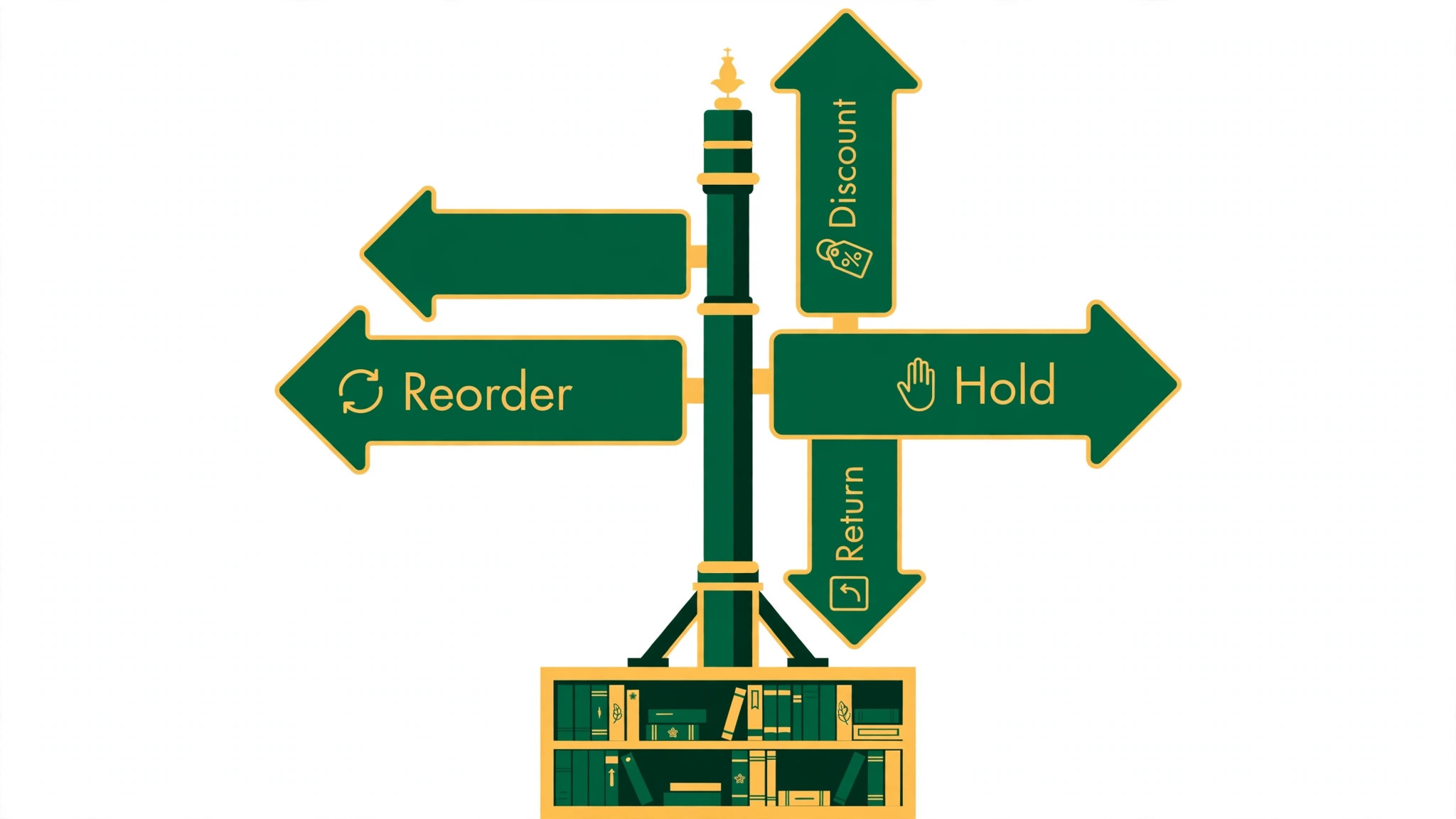
Sales velocity is simply how fast a title sells, usually measured as copies sold per week or per month, over a recent period. Ranking titles by velocity gives you a priority list for buying, display and staff attention. The top of the list, your fast movers, deserve weekly review, prominent display and higher safety stock. The middle of the list, your steady backlist, deserves monthly review and reliable reorder points. The bottom of the list, your slow movers, deserves a decision. Keep, return, discount, or move to a less prominent shelf, but do not keep reordering them out of habit.
AI can build this ranking quickly, but it needs clean inputs and sensible time windows. Use the last 90 days for fast movers, because a 90 day window captures recent demand without being distorted by a single event week. Use the last 12 months for backlist, because a backlist title may sell steadily but slowly, and a 90 day window alone will understate it. Exclude returns and damaged copies from sales velocity, or a title with many returns will look like a strong seller. Include both in-store and online sales if you sell through both channels, because a title that sells online but not in store still needs stock, though perhaps in a different location.
Segment velocity by category and format, not just overall. A children’s picture book, a literary novel, a cookbook and a local history title have different demand patterns, different margins and different supplier terms. Ranking them together will always favour the category with the highest overall volume, and will hide a strong title in a smaller category. AI can rank within each category, and can also flag titles that are rising fast within a category, even if their absolute sales are still modest. Those rising titles are often the ones worth buying early, before a local event or a review makes them hard to get.
| Velocity tier | Review rhythm | Typical action | Safety stock approach |
|---|---|---|---|
| Fast mover, top 10 percent | Weekly, daily in peak | Reorder promptly, display prominently | Higher, to cover demand spikes |
| Steady seller, middle 60 percent | Monthly | Reorder at reorder point, keep in stock | Standard, based on lead time |
| Slow mover, bottom 20 percent | Quarterly | Decide to keep, return or discount | Low, or no automatic reorder |
| New title, no history yet | Weekly for first month | Buy small, watch early sales closely | Low, until velocity is proven |
| Event or seasonal title | Before and after event | Buy for event window, then review | Event-specific, not ongoing |
Reorder Points That Work in a Real Store
A reorder point is the stock level at which you place a new order, so the new stock arrives before you run out. The standard formula, published by inventory guides, is average daily sales multiplied by lead time in days, plus safety stock. That formula is correct, but it is only useful if the inputs are honest. Average daily sales should reflect recent demand, not a lifetime average that includes a launch spike from two years ago. Lead time should be the longest realistic time, not the fastest time a supplier once achieved. Safety stock should reflect how variable demand and delivery are, not a guess that feels safe.
Work through an example with your own numbers. If a title sells one copy every two days, that is 0.5 copies per day. If lead time is ten days, lead time demand is five copies. If demand varies, and delivery sometimes takes fifteen days instead of ten, add safety stock of two or three copies, giving a reorder point of seven or eight copies. Order when stock falls to that level, not when it falls to zero. For a backlist title that sells one copy a month, the same formula gives a reorder point of one or two copies, which is sensible. The formula scales, provided you use recent sales and realistic lead times for each title.
AI can calculate reorder points for thousands of titles, update them as sales change, and alert you when a title hits its point. That automation is valuable, but it needs guardrails. Set a minimum order quantity that matches supplier terms, so you do not order a single copy at high shipping cost unless the title justifies it. Set a maximum stock level as well, so a sudden spike does not trigger an order for fifty copies of a title that will sell five. Review reorder points quarterly, and after any major event, because a title that was fast during a local festival may be slow again a month later, and its reorder point should fall with it.

Preorder Tracking, or How Not to Miss a Launch
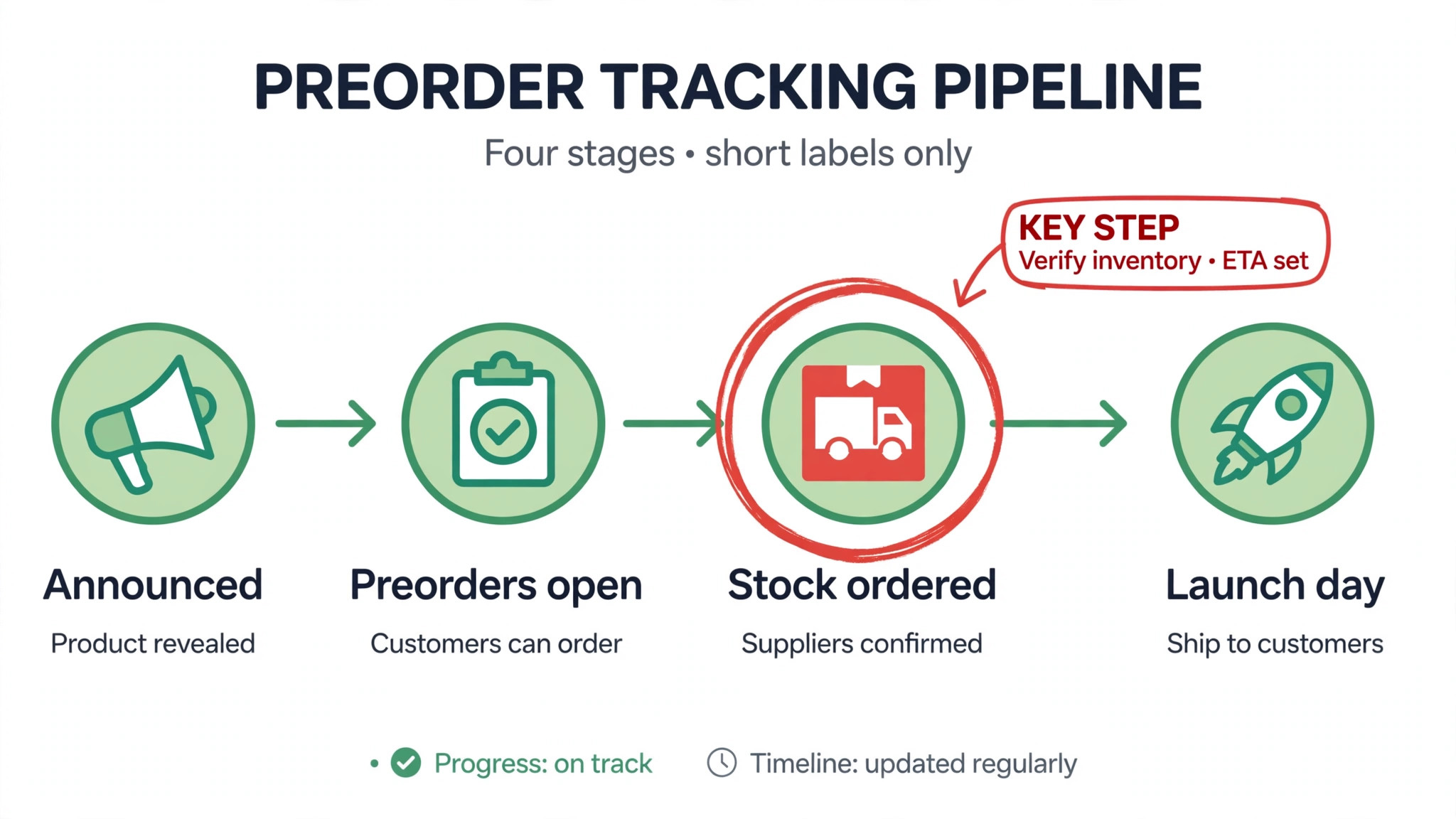
Preorders are a different kind of replenishment, because demand is known in advance, but fulfilment depends on allocation, delivery timing and customer communication. A preorder system should track, for each title, how many copies were ordered by customers, how many were ordered from the supplier, how many arrived, how many were collected, and how many are still waiting. AI can keep that list current and alert you when ordered quantity falls short of customer preorders, or when a delivery is late. Staff should handle the customer conversation, especially when a book is delayed, because a delayed preorder is a trust issue, not just a stock issue.
Start preorder tracking early, at least when a title is announced for a launch, a signed edition, or a school list, not when customers start asking about it in store. Record the customer’s preferred contact method, and whether they want a signed copy, a specific edition, or any edition. Those details matter, because a customer who preordered a signed edition will not be happy with an unsigned copy, even if it arrives on time. AI can draft preorder updates, but staff should approve any message about a delay, a price change, or an edition change, because those messages affect trust directly.
A Step Workflow From Sales Data to Purchase Order
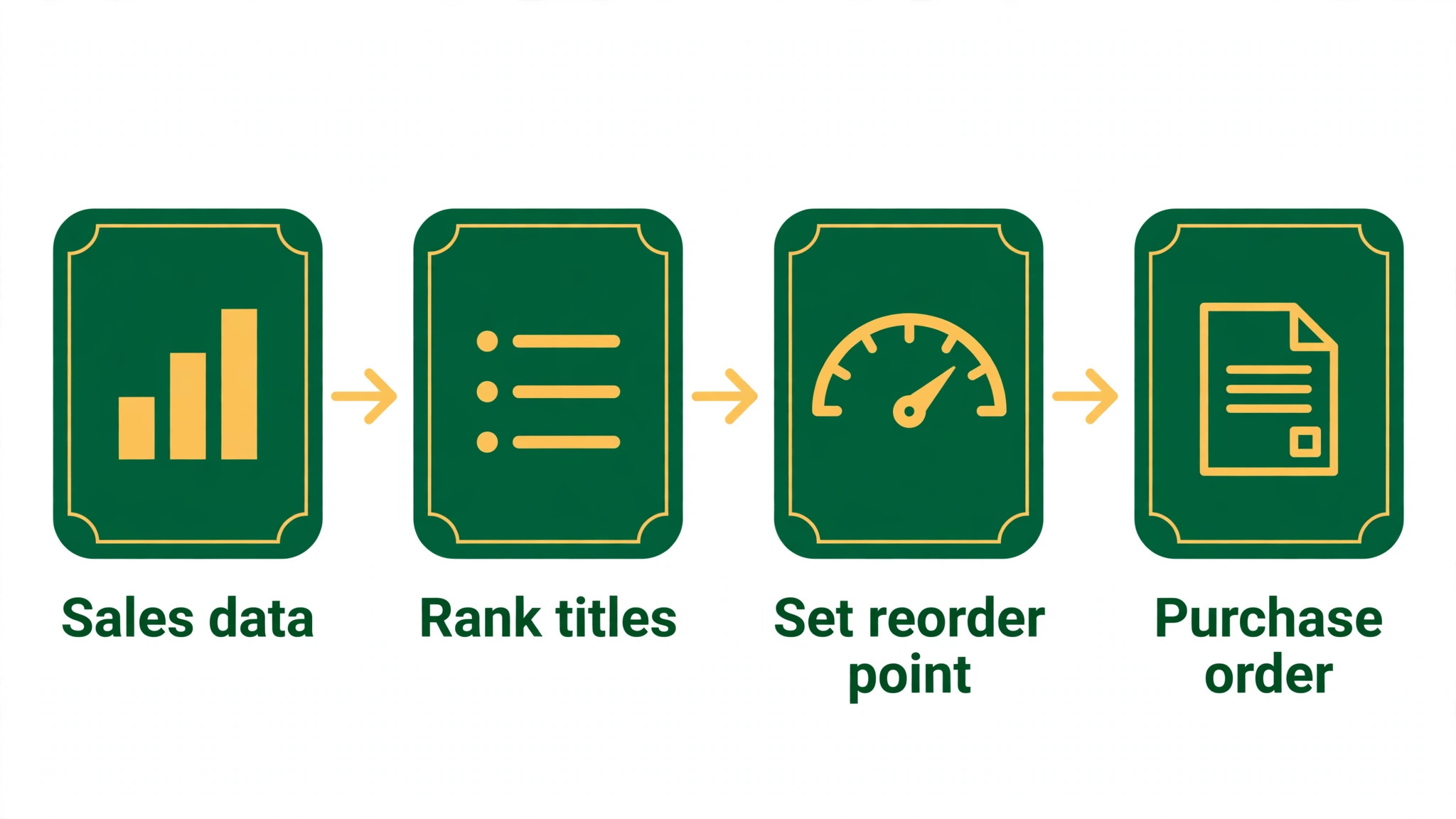
This workflow assumes a small bookstore with a point-of-sale system, a supplier ordering system, and an AI-assisted inventory tool that can rank, calculate and draft, with staff approval for every order. Keep the order, adapt the tools, and do not skip the human review of high-value orders.
Step 1, clean sales and stock data weekly
Check for unrecorded returns, damaged copies still counted as stock, titles with wrong ISBNs, and stock counts that do not match the shelf. AI can flag anomalies, such as a title that sold ten copies but shows no stock change, but staff should investigate the cause. Ordering from dirty data will repeat the error at scale, and a weekly ten minute data check is cheaper than a monthly stocktake surprise.
Step 2, rank titles by velocity and review the top movers
Run the velocity ranking by category and format, using 90 days for fast movers and 12 months for backlist. Review the top movers weekly, and the steady sellers monthly. Flag rising titles, falling titles, and titles that hit their reorder point since the last review. Staff should add local knowledge at this step, such as an upcoming school list, a local author event, or a community group that plans to read a particular title. AI cannot know those things unless someone tells it.
Step 3, check reorder points and draft the order
For each flagged title, check current stock, stock on order, reorder point, and supplier lead time. AI drafts a suggested order quantity, based on lead time demand, safety stock, and any seasonal adjustment. Staff review the draft, adjust for events and cash flow, and approve the order. Set a rule that orders above a certain value need a second review, because a single large order is where cash flow mistakes happen. Record why an order quantity was changed, so the next review can learn from it.
Step 4, place orders by supplier and track delivery
Group orders by supplier, to meet minimum order terms and reduce shipping costs, without delaying an urgent title for the sake of grouping. Record expected delivery dates, and track actual delivery against them. AI can alert you when a delivery is late, or when a partial delivery leaves a title below its reorder point. Staff should follow up late deliveries promptly, especially for preorders and fast movers, because a late delivery that nobody chases will stay late.
Step 5, receive, check and shelve promptly
When stock arrives, check it against the order, update stock counts, and shelve fast movers and preorders first. A book that sits in a back room for a week is effectively out of stock for customers, even though the system says it is available. Notify preorder customers the same day stock arrives, in their preferred channel. Record any damaged or short deliveries, and claim them promptly, because supplier claims have time limits that are easy to miss during a busy week.
Step 6, review, return or discount slow movers quarterly
Each quarter, review slow movers by category. Decide whether to keep a title, return it if returnable, discount it, or move it to a less prominent shelf. AI can list slow movers by age, quantity and tied-up cash value, which makes the decision concrete. Staff should consider local relevance before returning a slow title, because a local history book may sell slowly but steadily to visitors, and returning it may lose a distinctive part of your store. A quarterly slow mover review keeps cash moving and shelves fresh, without turning the store into a bestseller-only shop.
How to Use AI for Bookstore Inventory Replenishment Without Losing Local Judgement
AI is excellent at arithmetic and terrible at local knowledge, unless you feed it that knowledge. A title that sold slowly last year may sell fast this year because a local school adopted it, a book club chose it, or an author is visiting your town. A title that sold fast last year may sell slowly now because a competing edition appeared, or because the local interest has passed. Staff should record those local factors in a simple weekly note, and AI should use that note when it drafts orders. Without that note, AI will order based on the past, and the past is a poor guide when local life changes.
The way to use AI for bookstore inventory replenishment well is to treat its draft order as a proposal, not an instruction. Review the top titles by cash value every week, check any order that looks surprising, and ask why AI suggested it. If the reason is a genuine sales pattern, approve it. If the reason is a data error, a one-off event, or a title that is no longer relevant, adjust it and record why. That review loop is what makes AI smarter over time, because the system learns from corrections, provided corrections are recorded in a form it can use. A system that is never corrected will keep making the same mistake, confidently, at scale.
Cash flow guardrails belong in this section too. Set a weekly or monthly buying budget by category, based on expected sales and cash available, and let AI draft orders within that budget. If a draft order exceeds the budget, staff should prioritise fast movers and preorders first, and defer slow movers, rather than cutting everything equally. An equal cut across all titles will stock out fast movers and still leave slow movers overbought. Prioritisation is a human decision, and it should be made explicitly, not by an algorithm that does not know your rent is due this week.
The Reorder-Point Worksheet
Use this worksheet when you use AI for bookstore inventory replenishment, for any title, with or without software. Fill in one row per title, review the top rows weekly, and update the numbers when sales or lead times change. The worksheet is deliberately simple, because a worksheet nobody uses is worse than a complex system nobody understands.
Title and ISBN. Record the exact title, author, format and ISBN, so a reorder does not accidentally buy the wrong edition. Edition errors are common in bookstores, and they are expensive to return. Check the ISBN against the shelf copy, not from memory, when you first set up the row.
Average daily sales. Calculate copies sold per day over the last 90 days for fast titles, and over the last 12 months for backlist titles, excluding returns and damaged copies. If a title had a one-off event spike, note that spike separately, and use a normal period for the average, so the reorder point does not stay inflated after the event ends.
Lead time in days. Record the longest realistic delivery time for this supplier and format, not the fastest time you once saw. Update this number when a supplier becomes slower or faster, and note whether the title is domestic or international, because that difference alone can change the reorder point by weeks.
Safety stock. Add copies to cover demand variability and delivery delay. A useful starting point is enough stock to cover a few extra days of average sales for steady titles, and more for titles with variable demand or unreliable delivery. Review safety stock quarterly, because a title that was variable during launch may become steady later, and its safety stock should fall.
Reorder point. Multiply average daily sales by lead time in days, then add safety stock. That is the stock level at which you order. Record the result, and the date you calculated it, so the next reviewer can see whether it is current. If stock on hand plus stock on order falls to or below that point, order now, unless a local factor says otherwise, and record that reason.
Order quantity. Decide how many copies to order, based on expected sales until the next order cycle, plus safety stock, minus stock on hand and stock on order. Do not order to a round number out of habit. Order to the quantity the worksheet suggests, adjusted for supplier minimums, event plans and cash flow. Record the order date, supplier, expected delivery date and actual delivery date, so late deliveries are visible and supplier reliability can be judged over time.
Review date and decision. Record when the row was last reviewed, and what decision was made, such as reorder, hold, return or discount. A row with no review date is a row nobody owns, and it will drift. Assign ownership for the top titles to a named staff member, and review the rest on a monthly or quarterly rhythm, by category.
| Worksheet field | What to record | Review rhythm |
|---|---|---|
| Title, author, format, ISBN | Exact edition details | At setup, and when edition changes |
| Average daily sales | Recent copies per day, returns excluded | Monthly for fast titles, quarterly for backlist |
| Lead time in days | Longest realistic delivery time | Quarterly, or when supplier changes |
| Safety stock | Buffer for variability and delay | Quarterly |
| Reorder point | Daily sales times lead time, plus safety stock | Monthly for fast titles |
| Order quantity and supplier | Quantity, supplier, dates, delivery | At each order |
| Review date and decision | Last review, and action taken | Weekly for top titles |

Mistakes That Tie Up Cash or Empty Shelves
The first mistake when you use AI for bookstore inventory replenishment is ordering from a lifetime average. A title that sold well at launch two years ago, and slowly since, will look like a strong seller if you average its whole life. Use recent windows, and note event spikes separately, so the average reflects current demand. The second mistake is ignoring stock on order. A title that looks out of stock may already have twenty copies on the way, and ordering again will double up. Always check stock on hand plus stock on order against the reorder point, not stock on hand alone.
The third mistake is buying for a display, not for demand. A beautiful front table full of a slow title looks impressive for a week, then becomes a cash problem for months. Displays should feature titles with proven or plausibly strong demand, or titles tied to a specific event, with a plan to move unsold copies after the event. The fourth mistake is forgetting returns and discounting until it is too late. A slow title that is returnable should be returned promptly, while the return window is open. A slow title that is not returnable should be discounted early, while it still has some appeal, rather than held until it is worthless.
For related reading on inventory and ordering in other small businesses, see ecommerce seller product listing creation, online course creator student onboarding, choosing a payment processor, fixing an Etsy listing not showing in search and fixing Shopify payments on hold. Those posts cover adjacent operational problems, and the same discipline applies when you use AI for bookstore inventory replenishment. Use data to rank, use a worksheet to decide, and keep human judgement for the local factors data cannot see.
Measuring Whether Replenishment Is Improving
Track stockout rate, meaning how often a customer asks for a title you do not have, or how often a fast title hits zero stock. Track inventory turn, meaning cost of goods sold divided by average inventory value, by category, because turn shows whether stock is moving or sitting. Track cash tied up in slow movers, meaning the wholesale value of titles that have not sold in 90 days. Track preorder fulfilment rate, meaning how many preorders were filled on time, and how many were delayed. Those four measures, reviewed monthly, tell you more than a single sales total.
Compare those measures with the same month last year, not just with last month, because seasonality will distort a month-to-month comparison. If stockouts fell but cash tied up in slow movers rose, your fast title buying improved while your slow title buying did not, and the next action should be a slow mover review, not more fast title orders. If turn improved but stockouts rose, you may have cut too hard, and safety stock for fast titles needs to rise. Measurement is only useful when it leads to a specific next action, with an owner and a date.
A store that wants to use AI for bookstore inventory replenishment successfully should also measure how often staff overrode AI suggestions, and why. If staff override often because of local events, feed those events into the system earlier. If staff override often because of data errors, fix the data. If staff override rarely, check whether they are reviewing at all, or simply approving drafts without thought. An AI system that is never questioned is not a trusted system. It is an unreviewed system, and unreviewed systems make expensive mistakes quietly.
Frequently Asked Questions
How often should a bookstore review fast-moving titles?
Fast movers deserve a weekly review, and daily review during peak periods such as holidays or a major local event. Steady backlist titles can be reviewed monthly, and slow movers quarterly. That rhythm matches effort to cash risk, because fast titles carry the most stockout risk, while slow titles carry the most tied-up cash risk over time. Adjust the rhythm if a title suddenly rises or falls, rather than waiting for the next scheduled review.
What is a safe reorder point for a new title with no sales history?
Buy small, watch early sales closely, and set a provisional reorder point based on similar titles in the same category, with low safety stock until velocity is proven. Review the title weekly for its first month, and adjust the reorder point as real sales data arrives. A new title with no history is a guess, so keep the guess small and the review frequent, rather than buying a large quantity on hope.
Should AI place orders automatically without staff approval?
For low-value, steady titles, automatic ordering within set limits can save time when you use AI for bookstore inventory replenishment, provided staff review exceptions and high-value orders. For high-value orders, event titles, preorders and any order that exceeds a budget threshold, staff approval should be required. The safest model for a small bookstore is AI drafts, staff approves, with automatic ordering only for a small set of proven, low-risk titles, and a clear audit trail for every order.
How do you handle a supplier that is often late?
Record actual delivery times against expected times, by supplier and title type, so lateness is measured, not just felt. Increase safety stock and reorder points for titles from that supplier, order earlier for preorders and events, and consider an alternative supplier for fast titles where possible. If lateness persists, raise it with the supplier with data, and review whether the margin and reliability still justify the relationship, rather than quietly absorbing the cost of empty shelves.
What should you do with slow titles that cannot be returned?
Discount them early, move them to a less prominent shelf or a bargain section, bundle them with a related strong title where appropriate, or donate them if discounting fails and shelf space is needed. Record the decision and the outcome, so the next buying decision for a similar title is informed. Holding a non-returnable slow title at full price for a year, in the hope it will sell, usually ties up cash and space that a faster title could use.
How does preorder tracking change the initial order quantity?
Preorders give you known demand, so your initial order should cover preorders plus a reasonable walk-in quantity based on similar past launches, not preorders alone and not a large speculative quantity. If preorders are strong, buy for walk-ins as well. If preorders are weak, buy conservatively and reorder quickly if demand rises. Track preorder fulfilment separately, because a delayed preorder affects trust more than a delayed walk-in restock.
A Bookseller’s Verdict
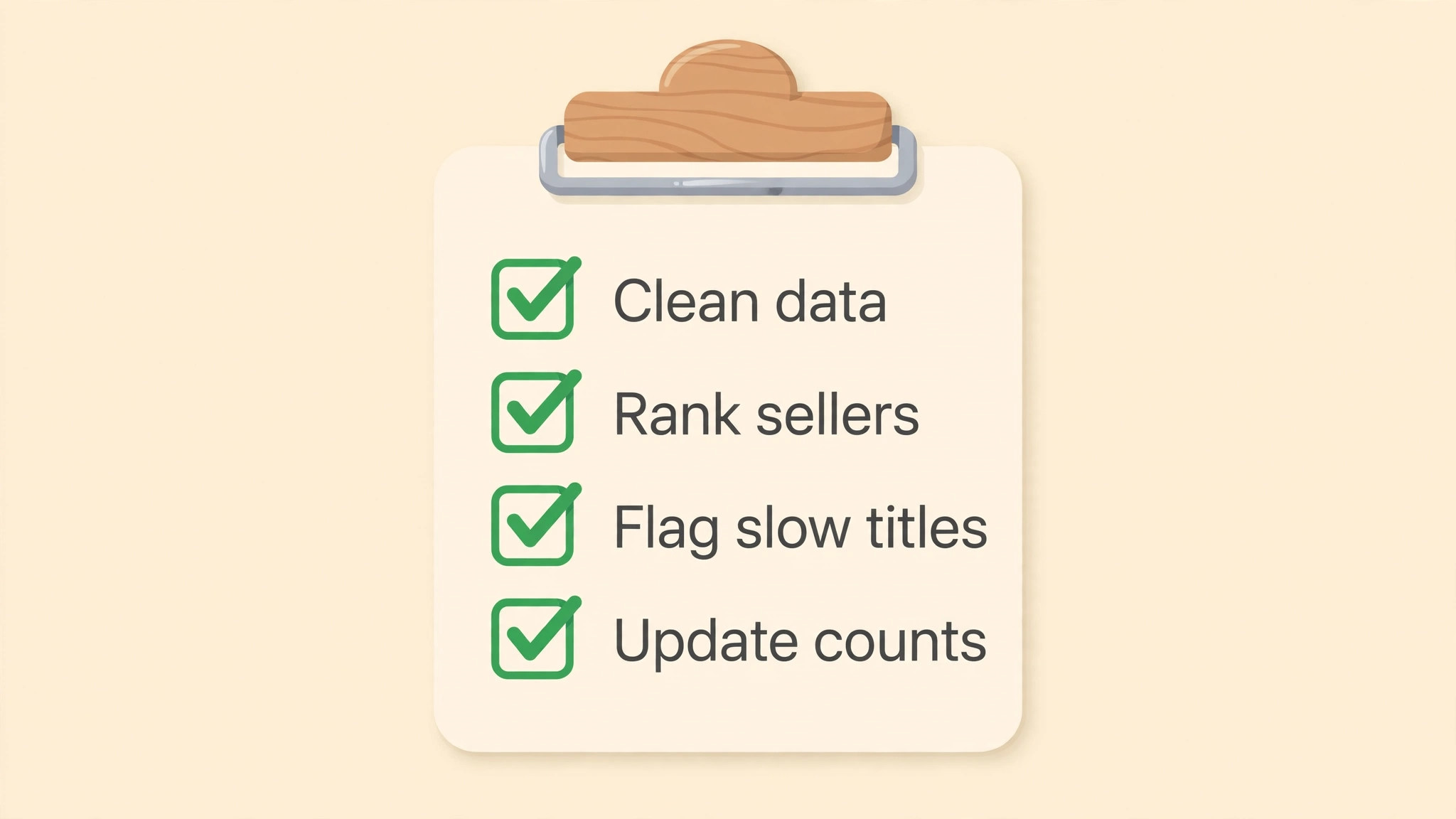
Good replenishment is not about having every book, every time. It is about having the right books, most of the time, without tying up cash needed for the next good title. AI helps by ranking velocity, calculating reorder points, tracking preorders and drafting orders, while staff keep local judgement and cash flow decisions in human hands. Start with clean data, rank by category, set title-level reorder points, track preorders from announcement, and review slow movers quarterly. A store that chooses to use AI for bookstore inventory replenishment as an assistant rather than an automatic buyer will see fewer empty shelves, less dead stock, and more cash for the books customers want.