
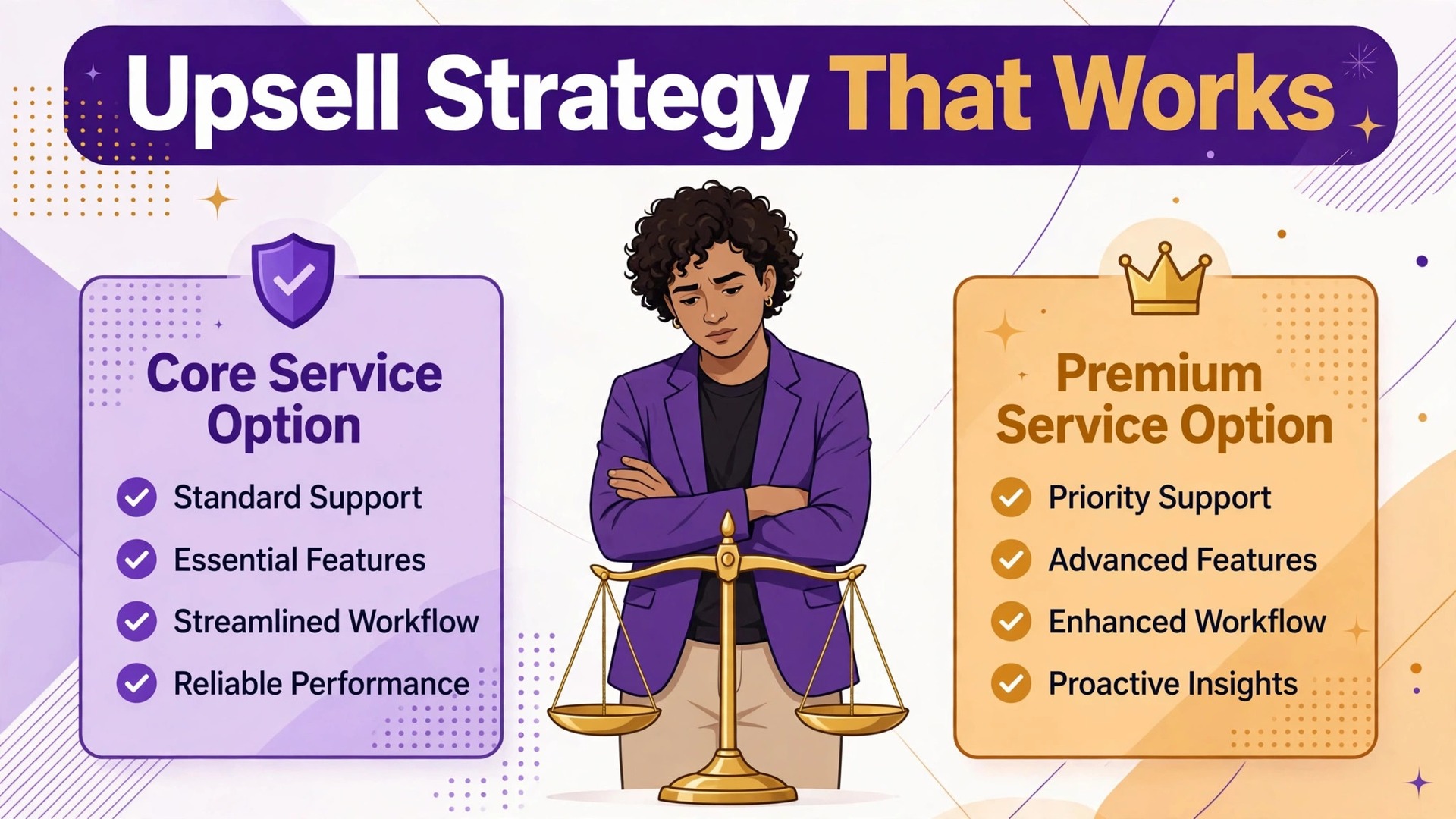
The verdict is simple. An upsell should only be offered when it solves a problem the client already has, at a moment when the client can judge its value, with a clear way to say no. Everything else in this guide, timing, pricing, scripts, and testing, exists to support that verdict. An upsell strategy small service business owners build on that rule will raise revenue without damaging trust, because clients experience the offer as help rather than pressure. An upsell built on pressure, timing tricks, or confusion will raise one sale and cost the next three.
That verdict matters especially for service businesses, because the client relationship is personal and ongoing. A shopper who dislikes an upsell can leave a store and never return, but a client who feels pushed by a cleaner, a coach, a clinic, or a repair service carries that feeling into every future appointment. The cost of a bad upsell is therefore higher than the revenue of a good one, which is why this guide treats trust as a constraint, not as a soft extra. If an offer would embarrass you to explain plainly to the client, it is not an upsell worth testing.
This guide covers how to map core services to premium paths, when to offer each upgrade, how to price it so it feels proportional, what to say in plain scripts, and how to test offers without annoying clients. It includes an upsell menu worksheet and an offer test checklist you can copy. Figures quoted are vendor reported or drawn from guides, presented as ranges to test on your own clients, and you should check current vendor pricing and plan terms on their own pages before committing to any tool mentioned in passing.
Upsell Strategy Small Service Business Owners Can Defend to a Client
Start by defining upselling precisely, because confusion with cross selling leads to muddled offers. Upselling moves a client to a higher value version of what they already want, such as a deeper clean, a longer session, a priority booking, or a premium package. Cross selling adds a related item alongside the original purchase, such as a product to maintain a service result. Both can work, and many service businesses combine them, but they need different timing and different scripts. An upsell belongs where the client is already deciding on scope or quality, while a cross sell belongs after the core service has delivered value.
The relevance test comes before any offer is written. For each possible upgrade, write down the client problem it solves, the client who benefits most, and the moment that client will recognise the benefit. If you cannot complete those three lines honestly, the upgrade is probably a revenue idea looking for a problem, and clients will sense it. A premium package that adds reporting, priority support, or a guarantee solves a real problem for a busy client. A premium package that adds features the client never asked about, at a price that dwarfs the core service, solves a revenue problem for the business, and clients treat it accordingly.
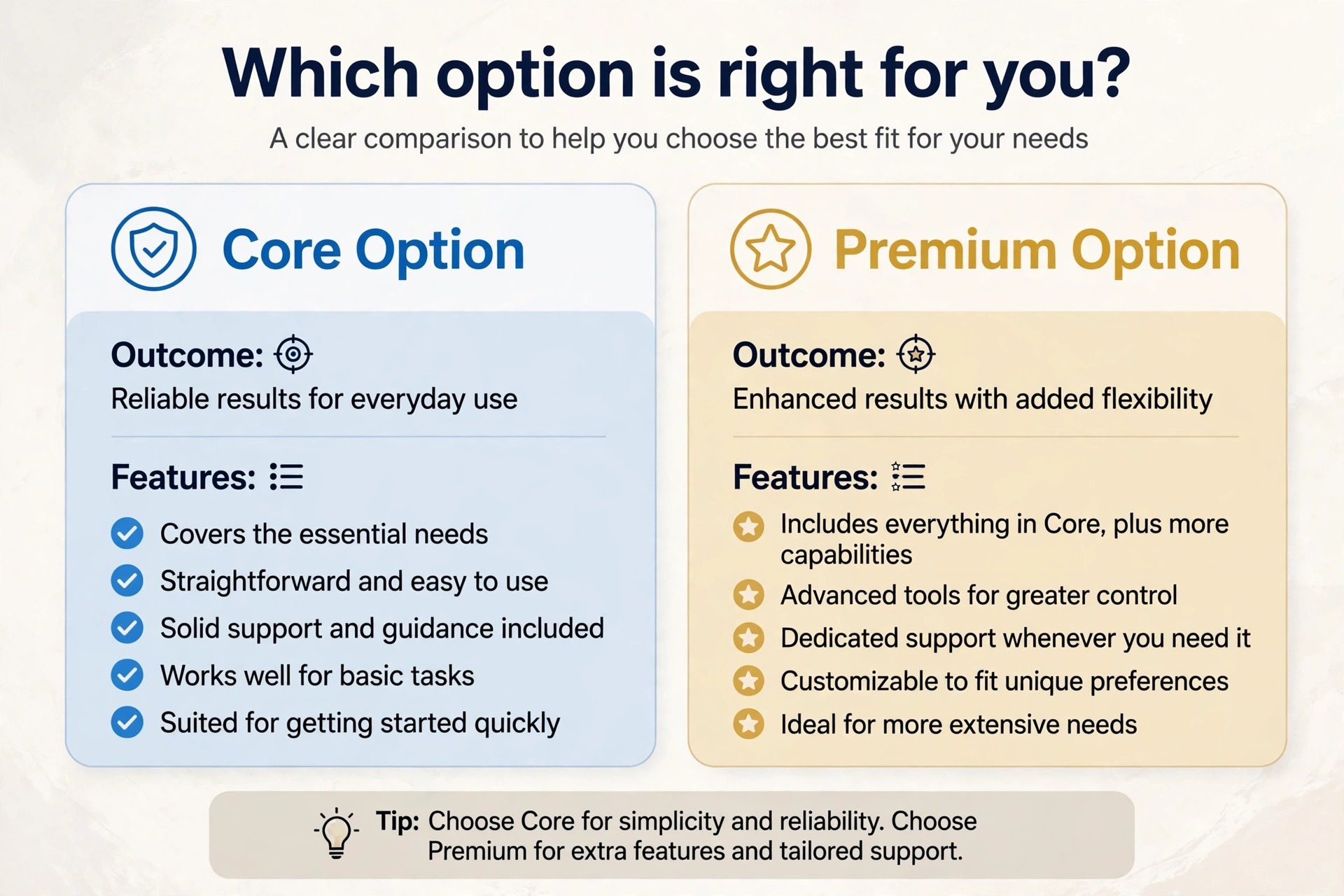
Price proportion matters, and guides give a useful starting range. Per guides from accounting and small business sources, many successful upsells fall within about ten to twenty five percent above the original service price, a range that feels proportional to the added value without triggering sticker shock. Larger jumps can work when the upgrade is genuinely a different service level, such as a full day booking versus a single session, but they need a stronger explanation and a clearer comparison. Always show the core and premium options side by side, with the difference in outcome stated plainly, so the client chooses rather than being steered.
An upsell menu is a map, not a list of everything you could sell. For each core service, define one premium path, one add on path, and one longer term path, and no more. The premium path upgrades the same service, such as a standard clean to a deep clean, or a single session to a session with a written plan. The add on path adds a related service at the same visit, such as maintenance between main appointments. The longer term path converts a one off purchase into a package or retainer, such as monthly visits at a set rate. Three paths per core service keep the menu usable for staff and understandable for clients.
Build the menu from client patterns, not from imagination, and an upsell strategy small service business owners map this way will fit real demand. Look at past bookings and note what clients ask for next, what problems recur after the core service, and which clients return for more. A cleaning business may find that clients who book a deep clean then ask about oven or carpet care. A coaching business may find that clients who finish a single programme ask for accountability check ins. A repair business may find that clients who fix one fault ask about a maintenance check for related parts. Those observed next steps are your best upsell candidates, because they already exist in client behaviour.
Write each path as a client outcome, not as a feature list. A premium path described as priority booking, a written summary, and a follow up check reads as a set of features, while the same path described as less waiting, a clear record of what was done, and a check that it stays fixed reads as outcomes. Clients buy outcomes, and staff find outcome language easier to say naturally. Keep the menu in one document, with the core price, the premium price, the outcome difference, and the best timing for each path, so every staff member offers the same options in the same words.
| Core service | Premium path | Add on path | Longer term path |
|---|---|---|---|
| Standard visit or session | Extended or deep version with a written summary | Related maintenance at the same visit | Monthly package or retainer |
| One off project | Priority scheduling and a dedicated contact | Follow up review after completion | Quarterly check in plan |
| Basic package | Premium package with guarantee or priority | Single extra service tied to the result | Annual plan with set visits |

Timing That Makes an Offer Feel Helpful
Timing decides whether the same offer feels helpful or pushy, and guides consistently identify four windows worth testing. Before purchase, when a client is comparing options, premium choices shown side by side let value speak for itself. During booking or checkout, a single relevant upgrade, presented once, suits a client already in buying mode. After purchase, a follow up once the client has experienced the core service suits a client who can now judge the benefit. During a support interaction, an upgrade that solves the problem the client just raised feels like a solution rather than a pitch, provided it genuinely solves that problem.
Avoid offering an upsell before the client has seen value from the core service, unless the premium option is part of the initial choice itself. A new client who has not yet experienced your work has no basis to judge a premium tier, so an early upsell reads as a sales tactic. Wait until a result, a report, or a first successful visit gives the client evidence, then offer the next step as a natural continuation. That patience costs a few early upsells and saves many relationships, which is a good trade for a service business that depends on repeat work.
Sequence matters within a single interaction too. Offer one upgrade at a time, state the price and the outcome, and pause for the client response before mentioning anything else. A staff member who lists three upgrades in one breath forces the client to reject a bundle rather than choose an option, which feels like pressure even when the intention is helpful. If the client declines, accept the no gracefully, note the preference, and move on. A declined upsell handled well often leads to a later yes, because the client remembers being respected, while a declined upsell argued about usually leads to no further business at all.

Scripts That Sound Like Advice, Not a Pitch
Scripts help staff offer consistently, but they should read as guidance, not as lines to recite word for word. A good script has three parts, an observation tied to the client situation, a recommendation with a reason, and an easy out. An example for a service visit might run as follows. Many clients in your situation find the extended visit helpful, because it covers the areas that usually need attention next month. It costs a stated amount more than the standard visit. Would you like me to book that, or keep the standard visit for now. That structure respects the client, states the price early, and makes declining easy.
Adapt the script to the channel. In person, keep it short and conversational, and let the client ask questions before you add detail. By email, keep the message focused on one recommendation, explain why it fits the recent purchase or visit, and include a single clear next step. By phone, confirm the core booking first, then offer the upgrade as a separate question, so the client never feels the core booking depends on accepting the upgrade. In every channel, avoid urgency language that is not true, such as claiming limited availability when availability is normal, because a client who discovers the claim was invented will not trust the next genuine offer.
Train staff with role play, not just with a document. Pair staff members, give one a client situation and the other the upsell menu, and practise the observation, recommendation, and easy out structure until it sounds natural. Review real offers weekly at first, by asking which offers were made, which were accepted, and what clients said when they declined. That review teaches more than any script document, because it surfaces the offers that clients welcome and the phrasing that causes hesitation. An upsell strategy small service business teams can sustain is usually one where staff feel comfortable offering, which only happens when the offer itself is genuinely helpful.
Pricing, Bundles, and Packages
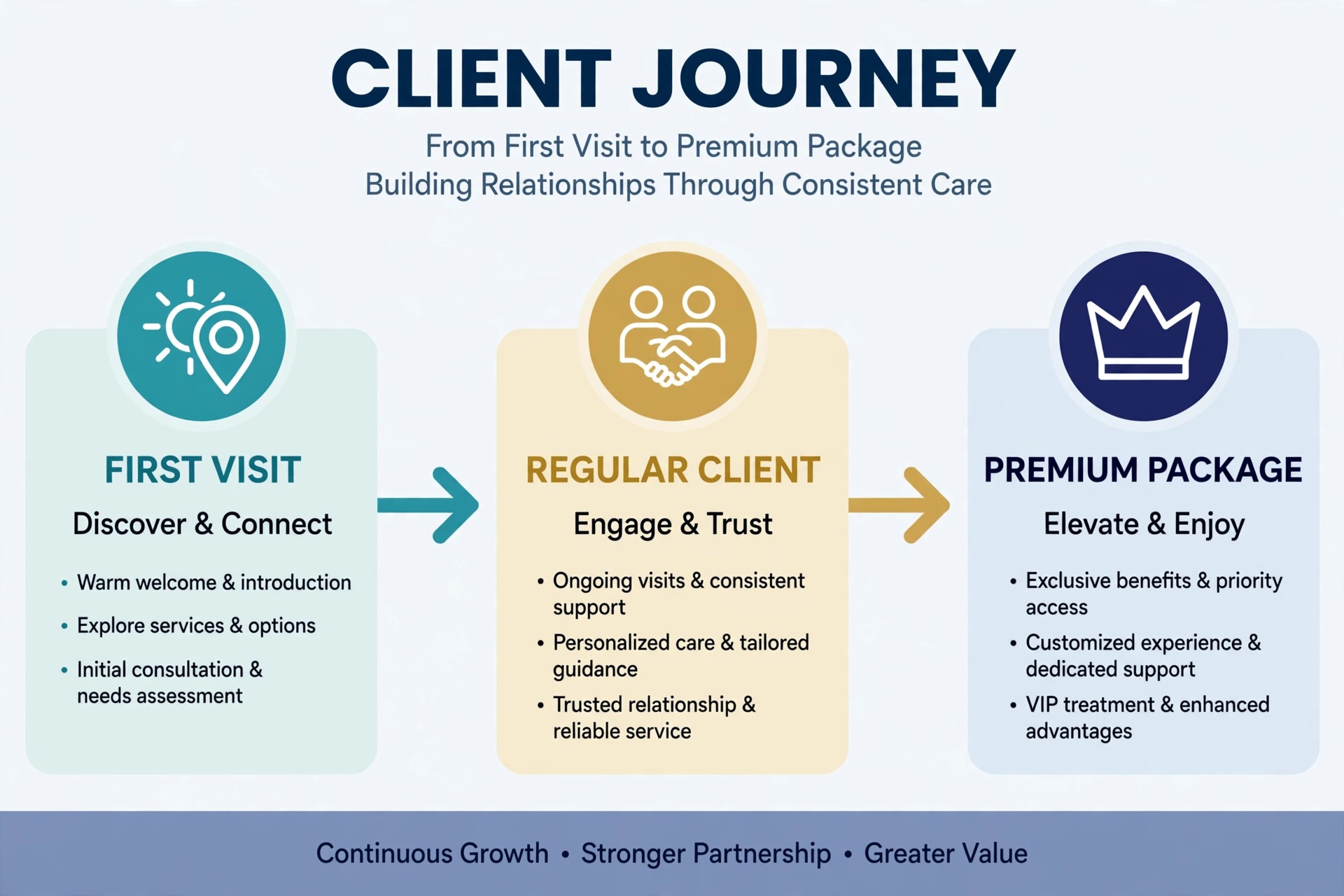
Bundling groups related services at a price that feels better than buying each separately, and an upsell strategy small service business bundles well will mirror a real client journey, and it suits service businesses well when the bundle matches a real client journey. A bundle that combines a main service, a follow up, and a maintenance check mirrors how clients actually use the service over time, while a bundle that combines unrelated services for the sake of a larger ticket feels artificial. Price bundles from the client outcome, not from the sum of parts minus an arbitrary discount, and state what is included plainly, so the client can compare the bundle with the core service without doing arithmetic.
Packages and retainers convert one off clients into ongoing relationships, but they need a clear exit and a clear value rhythm. A monthly package should state how many visits or hours it includes, what happens to unused visits, and how the client pauses or cancels. A retainer that is hard to leave will retain clients for a month and lose them permanently afterwards, while a retainer that is easy to pause often retains clients longer, because pausing feels safer than cancelling. Test package pricing with existing loyal clients first, since they can tell you whether the package feels like a saving or a lock in, before you offer it widely.
Discounting an upsell should be used sparingly, and only for a clear reason, such as a first time trial of a premium tier or a bundle launch. A premium offer that is immediately discounted teaches clients that the premium price was inflated, which undermines the next offer. A better incentive for trying a premium tier is a smaller trial version, a shorter commitment, or a guarantee, each of which reduces risk without resetting price expectations. If you do discount, limit it in time and scope, and record the redemption rate, so you can tell whether the discount bought new premium clients or merely subsidised clients who would have upgraded anyway.
Segmenting Clients for Upsell Offers
Not every client should receive the same upsell, and segmentation is what prevents a good offer from reaching the wrong person at the wrong time. An upsell strategy small service business owners segment well will usually divide clients by stage, new, returning, and loyal, and by need, time poor, outcome focused, or price sensitive. A loyal client who values convenience may welcome a priority package, while a price sensitive new client may prefer a smaller add on that proves value before a larger commitment. Sending the premium package to both, with the same script, wastes the first opportunity and risks the second relationship.
Behaviour gives a more reliable segment than demographics alone. Clients who book regularly, arrive on time, follow aftercare advice, or refer others have shown engagement that predicts premium acceptance. Clients who book sporadically, reschedule often, or only buy during promotions have shown a different pattern, and a premium offer to that group needs a trial or a shorter commitment to reduce risk. Use booking history, not assumptions about income or age, to form segments, because behaviour is evidence while demographics are guesswork. Record the segment with the offer in your booking notes, so the next staff member does not repeat an offer the client already declined.
Segment size matters for testing too. A segment of twenty clients can test an offer in a few weeks, while a segment of five cannot produce a meaningful result, however enthusiastic those five are. If a segment is too small to test, combine it with a similar segment or test the offer over a longer period, and judge it by client feedback as well as by acceptance rate. An upsell strategy small service business teams test carefully will also rotate segments, so no single group receives every new offer first. Rotation spreads learning across the client base and prevents loyal clients from feeling like a test audience.
Finally, respect a declined offer across segments and channels. If a client declines a premium package in person, do not offer the same package by email the next day as if the conversation never happened. Note the decline, the reason if given, and a date to revisit, usually after the next successful core service delivery. That record protects the client from repetition and protects the business from the reputation of a firm that does not listen. A client who knows a no will be respected is far more likely to say yes later, when timing and need align.
Copy the worksheet below, complete one block per core service, and keep it where staff can see it during bookings. Blank lines between items keep the worksheet readable when printed.
- Core service block.
- Core service name and standard price range.
- Client problem the core service solves.
- Premium path, outcome difference, and price difference.
- Add on path, when it fits, and price.
- Longer term path, what it includes, and how to pause or cancel.
- Best timing for each path, before purchase, at booking, after value, or at support.
- Clients who benefit most, and clients who should not be offered this path.
- Script line for each path, observation, recommendation, and easy out.
- Review block.
- Offers made, accepted, and declined in the last month.
- Reasons clients gave for declining, grouped by theme.
- One offer to keep, one to reword, and one to retire this quarter.
A worksheet that is never reviewed becomes decoration, so review it monthly with the staff who actually make offers. Ask which paths feel natural to offer, which produce hesitation, and which clients surprise you by accepting. Those answers, more than any sales book, will shape a menu that fits your clients. Retire a path that is rarely accepted after a fair test, even if you liked the idea, because a menu crowded with weak offers makes the strong offers harder to find.

The Offer Test Checklist
Test one offer at a time, to one segment at a time, for a set period, and judge it by more than acceptance rate. Blank lines between items keep the checklist usable in a team meeting.

- Before the test.
- Offer written as a client outcome with price and timing.
- Segment chosen and size recorded.
- Baseline recorded, such as current average revenue per client.
- Test period set, usually four to six weeks for a small service business.
- During the test.
- Offers made and accepted recorded daily or weekly.
- Decline reasons noted in the client own words where possible.
- Complaints or negative feedback logged separately from declines.
- After the test.
- Acceptance rate, average revenue per client, and repeat booking rate compared.
- Client satisfaction or review trend checked for the test segment.
- Decision recorded, adopt, reword and retest, or retire.
- Staff feedback recorded on whether the offer felt natural to make.

An offer that raises average revenue but lowers repeat bookings or satisfaction is not a success, however good the first month looks. An offer that is accepted rarely but delights the clients who take it may deserve a narrower segment rather than retirement. Judge each test on revenue, retention, and staff comfort together, because an upsell that only scores on one of those three will not last.
Mistakes That Turn Help Into Pressure
The most common mistake in an upsell strategy small service business owners run is offering too many upgrades at once, which turns a helpful suggestion into a sales gauntlet. Clients who face three offers in one interaction often reject all three, not because each is bad, but because choosing among them feels like work. Offer one, wait for an answer, and only then consider whether a second offer fits the conversation. A service business that offers less, more carefully, will usually sell more premium work than a business that offers everything to everyone.
A second mistake is upselling to the wrong segment. A client on a tight budget, a client in distress, or a client who has just complained is rarely the right audience for a premium offer, even if the offer is relevant in theory. Sensitivity matters, and staff should be empowered to skip an offer when the moment is wrong, without penalty. A skipped offer costs one sale, while an ill timed offer can cost a client and a review. Build that judgement into training explicitly, so staff know that skipping is sometimes the correct upsell decision.
A third mistake is hiding the price until the end. An upsell whose price appears only after the client has agreed in principle feels like a trap, even when the price is fair. State the price with the recommendation, in the same sentence or the next, so the client can judge value and cost together. Transparency also protects staff, because a client who knows the price upfront rarely feels misled later. If a price cannot be stated without a quote, say so plainly, give a range, and explain what determines the final figure.
For related reading, see how a client system supports repeat work and how appointment reminders reduce no shows for service clients. If premium packages depend on a reliable till or booking flow, the guide on point of sale for a local venue is a useful comparison. Email follow up for premium offers can borrow from the guide on switching email tools, and social proof for premium tiers relates to the guide on reels that are not reaching followers.
Frequently Asked Questions
What is the difference between upselling and cross selling?
Upselling moves a client to a higher value version of what they already want, such as a premium package instead of a basic one. Cross selling adds a related item alongside the original purchase, such as a maintenance product after a service visit. Service businesses often use both, but they need different timing. An upsell fits where the client is deciding scope or quality, while a cross sell fits after the core service has delivered value.
When is the best time to offer an upsell in a service business?
The best times are usually during initial choice, at booking, after the client has experienced value, or during a support conversation where the upgrade solves the raised problem. Avoid offering before the client has seen value, unless the premium option is part of the initial choice. Test timing for your own clients, because a timing window that works for a clinic may differ from one that works for a repair service or a coaching practice.
Per guides, many successful upsells fall within about ten to twenty five percent above the original service price, which feels proportional without causing sticker shock. Larger jumps can work for a genuinely different service level, but they need a stronger outcome explanation and a clear side by side comparison. Always show the core and premium options together, with the outcome difference stated plainly.
How do I upsell without sounding pushy?
Offer one relevant upgrade at a time, state the price and the outcome together, and make declining easy. Use an observation tied to the client situation, a recommendation with a reason, and a clear out, such as asking whether to keep the standard option. Accept a no gracefully and note the preference. Clients who feel respected after declining are far more likely to accept a later offer than clients who felt argued with.
Should staff be paid commission on upsells?
Commission can motivate offers, but it can also motivate ill timed offers if it is the only measure. If you use incentives, balance them with client satisfaction, repeat booking, and complaint measures, so staff are rewarded for helpful offers rather than for volume alone. Many small service businesses do better with team recognition for good client outcomes than with individual commission on upgrade revenue.
What should I do if an upsell test fails?
Check whether the problem was relevance, timing, price, or phrasing, using the offer test checklist, and change one variable before retesting. An offer accepted rarely but loved by those who take it may need a narrower segment. An offer that raises revenue but lowers repeat bookings should be retired or reworked, because retention is the longer term measure for a service business.
A Closing Standard to Hold Every Offer Against
Hold every future upsell against a single test before it reaches a client. Could you explain this offer, its price, and its benefit to the client in two sentences, and feel comfortable if the client repeated those sentences to a friend. If the answer is yes, the offer is probably a genuine premium path. If the answer is no, the offer needs rewording, repricing, retiming, or retiring, however attractive its revenue looks on paper. That test is stricter than any sales target, and it is the reason clients of a well run service business often describe upsells as recommendations rather than sales.
Start with one core service and one premium path from the worksheet for your upsell strategy small service business plan.
Keep a short log of every offer made in the first month, including the client segment, the timing, and the response in plain words. That log will reveal patterns that memory misses, such as a timing window that consistently works or a script line that consistently causes hesitation, and those patterns are the real foundation for the next offer you add.
Write its outcome, price difference, timing, and script line, test it for four to six weeks with one segment, and judge it on revenue, retention, and staff comfort together. A single well tested path, offered consistently and respectfully, will teach you more about your clients than a menu of ten untested offers. Build from that one path, and let the menu grow only as fast as client evidence supports it.