

3Commas is the strongest choice among the best ai trading tools for crypto traders, because its Starter plan costs 20 dollars a month, its DCA, grid, and signal bots run across nine exchanges, and its backtests and demo account let you test a strategy before any real money moves. Crypto traders do not need the most bots or the cleverest AI label. They need automation that follows the rules they set, fees that do not eat a small account, and an API key setup that cannot withdraw their funds.
That need shapes every pick below. A trading bot is not a money machine, and no tool in this list can guarantee a return. What a bot can do is execute a plan without emotion, run around the clock, and keep a record of every trade.
Price matters more than it does for most software, because a subscription is a fixed cost against an uncertain return. A 29 dollar a month plan on a 1,000 dollar account costs 35 percent of the account every year, which is a hurdle most strategies will not clear. This guide states the real starting price for each tool and what the free tier covers.
Bots, Rules and Signals: What Each Tool Really Automates
DCA, grid, and signal bots do different jobs, and a tool that is strong on one may be weak on another. A DCA bot buys a fixed amount on a schedule, which smooths the entry price over time. A grid bot buys low and sells high inside a price range, which suits sideways markets. A signal bot trades when an indicator or a signal provider says so, which is the riskiest of the three. Among the best ai trading tools for crypto traders, 3Commas covers all three, Bitsgap leads on grid and DCA, and Cryptohopper leads on signals and copy trading.
Rules-based tools are a different shape. Coinrule lets you build if-this-then-that rules from templates, which suits traders who think in conditions rather than bot types. WunderTrading and TradeSanta both offer straightforward DCA and grid bots with a lower entry price, while Altrady and Quadency add portfolio tracking alongside the bots.
The AI label in this category is mostly marketing. Pionex offers an AI assistant for grid setup, Coinrule offers an AI bot builder, and 3Commas offers an assistant for setup, but none of them replaces your judgement about risk. Judge the tool on the bot types, the backtests, and the fees, and treat the AI label as decoration.
Fees, Subscriptions and the Cost on a Small Account
The subscription is the first cost, and the exchange fees are the second. 3Commas Starter costs 20 dollars a month, or 15 dollars a month on annual billing, while Cryptohopper Explorer costs 29 dollars a month and Bitsgap Basic costs 29 dollars a month. Coinrule Investor costs 29.99 dollars a month, TradeSanta Basic costs 25 dollars a month, and WunderTrading starts at 4.95 dollars a month, which makes it the cheapest paid entry here. Pionex charges no subscription at all, taking a 0.05 percent fee per trade instead.
The maths on a small account is brutal. A 29 dollar a month subscription is 348 dollars a year, which is 35 percent of a 1,000 dollar account and 7 percent of a 5,000 dollar account. A strategy must earn that much before it earns anything for you, and most strategies do not. On a small account, the right choice is Pionex with no subscription, or WunderTrading at 4.95 dollars a month, or a free plan with limited bots.
Exchange fees sit on top of every subscription. Most exchanges charge 0.1 percent or less per trade, and a grid bot that trades hundreds of times a month can generate meaningful fee volume even at a low rate. Pionex builds the fee into its model, since the bots run on its own exchange, while the other tools connect by API and leave the exchange fees to you.
API Keys, Custody and the Safety Rules That Matter
Your funds stay on the exchange with almost every tool here, and the connection runs through an API key. That key must have trade rights and must never have withdrawal rights. Among the best ai trading tools for crypto traders, every tool in this list is designed to work with a trade-only key, and Bitsgap goes further by rejecting keys that have withdrawal enabled. If a tool asks for withdrawal rights, do not use it. If an exchange offers IP whitelisting for the key, turn it on, so the key only works from the tool servers.
Custody is the exception, not the rule. Pionex holds your funds, because its bots run on its own exchange, which means you deposit money with Pionex itself. That removes the API key step, but it also means you trust Pionex with custody, and Pionex does not serve US residents.
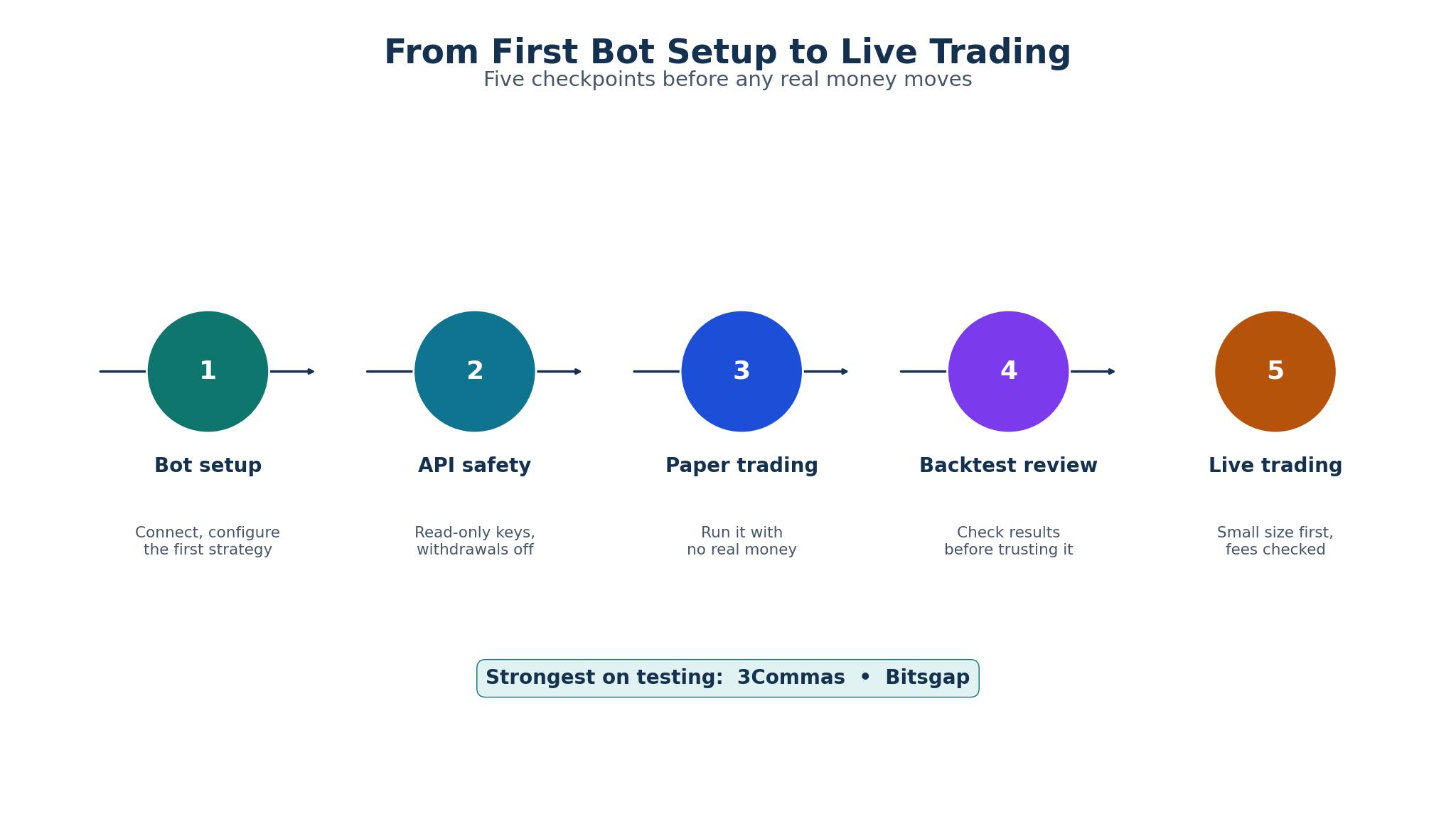
Paper trading is the safety rule that matters most. Every tool worth using offers a demo account or a paper mode, and you should run a strategy there for at least a week before any real money moves. A backtest is not enough, because backtests skip fees, slippage, and the moments when the exchange is slow.
The 12 Tools at a Glance
| Tool | Main job | Best for | Starting price |
|---|---|---|---|
| 3Commas | DCA, grid and signal bots | Multi-exchange automation | From $20 per month |
| Cryptohopper | Indicator strategies and copy trading | Strategy marketplace and signals | From $29 per month |
| Bitsgap | Grid, DCA and futures bots | Grid and futures traders | From $29 per month |
| Pionex | Free bots built into an exchange | No-subscription grid trading | No subscription; 0.05% per trade |
| Coinrule | If-this-then-that rule builder | Traders who prefer rules | From $29.99 per month |
| TradeSanta | Simple DCA and grid bots | Beginners on a budget | From $25 per month |
| Altrady | Multi-exchange trading and portfolio | Portfolio plus bots | From $39 per month |
| Quadency | Bots with portfolio tracking | All-in-one trading and tracking | From $49 per month |
| WunderTrading | DCA, grid and copy trading | Cheapest paid entry | From $4.95 per month |
| HaasOnline | Scriptable bots with backtests | Traders who write scripts | From $9 per month |
| Gunbot | Self-hosted bot with a one-time licence | Traders who want full control | One-time licence from $399 |
| CryptoHero | Cloud bots with a simple setup | Simple cloud automation | Pricing on the vendor site |
Best Pick by Job
| Job type | First pick | Second tool | Why this pair works |
|---|---|---|---|
| Multi-exchange DCA and grid | 3Commas | Bitsgap | 3Commas covers the most bot types, and Bitsgap leads on grid and futures |
| No subscription cost | Pionex | WunderTrading | Pionex charges no subscription, and WunderTrading starts at 4.95 dollars a month |
| Rules instead of bot types | Coinrule | TradeSanta | Coinrule builds rules, and TradeSanta keeps DCA and grid simple |
| Strategy marketplace and copy | Cryptohopper | WunderTrading | Cryptohopper has the marketplace, and WunderTrading adds copy trading cheaply |
| Full control and self-hosting | Gunbot | HaasOnline | Gunbot runs on your machine, and HaasOnline adds scripting and backtests |
How to Vet the Best AI Trading Tools for Crypto Traders Before Risking Funds
A paper-trading week beats a month of reading reviews, because a bot is judged by what it does in a live market, not by its backtest. Pick two tools from the glance table and run the same strategy on both in paper mode for a week. Compare the number of trades, the fees, the drawdown, and the moments the bot did something you did not expect. The winner is the tool that behaved most like the plan you wrote.
Start with the backtest, but read it sceptically. Run the same strategy over the same period on both tools and compare the results. A backtest that skips fees and slippage will flatter the strategy, so check whether the tool includes both. 3Commas and Bitsgap both offer backtests with realistic settings, while Coinrule cloud backtests skip fees and slippage.
Then test the safety setup. Create the API key with trade-only rights, turn on IP whitelisting if the exchange offers it, and confirm the tool cannot withdraw. Bitsgap rejects keys with withdrawal enabled, which is a useful guard.
Finish by pricing the month. Add the subscription, the exchange fees on your expected volume, and any marketplace or copy bot extras, then compare the total with the account size. A strategy that cannot cover its own costs is not a strategy, and the cheapest tool that runs it cleanly is the right one.
The 12 Tools in Detail
1. 3Commas
3Commas is the broadest bot platform here, with DCA, grid, signal bots, and SmartTrade across nine exchanges. Starter costs 20 dollars a month, or 15 dollars a month on annual billing, and Pro costs 50 dollars a month, while Expert costs 140 dollars a month. The platform offers backtests, a 10,000 dollar virtual demo account, and an assistant for setup.
The change of operator is the risk. The original platform was deactivated in September 2026, and v2 is run by WunderTrading under a 3Commas licence, which means the product you buy today is not the product long-time users reviewed.
It suits traders who run several bot types across several exchanges. If your strategy mixes DCA on one pair, grid on another, and signals on a third, 3Commas handles all three in one dashboard, which is why it leads the best ai trading tools for crypto traders on breadth.
Test it by running the same DCA strategy in the demo account and in paper mode on a rival, then comparing the fills and the fees over a week. If the results match and the dashboard is clear, the platform is doing the job.
2. Cryptohopper
Cryptohopper is the strategy marketplace pick. It offers an indicator strategy designer, a signals marketplace, DCA, and copy trading, with a backtester and one paper bot per subscription. Explorer costs 29 dollars a month, or 24.16 dollars a month on annual billing, and Adventurer costs 69 dollars a month, while Hero costs 129 dollars a month.
The extras push the bill up. Copy bots cost 9.99 to 99.99 dollars a month on top of the subscription, and marketplace items cost extra too, so the real monthly bill can be double the headline price.
It suits traders who want to follow strategies built by others. If you prefer to copy a strategy with a track record rather than design your own, the marketplace and the copy bots are the reason to pick Cryptohopper.
Test it by paper trading a marketplace strategy for a week and comparing the result with the strategy published track record. If the paper result is close to the published one, the marketplace is honest. If the gap is large, the track record is not a guide to what you will get.
3. Bitsgap
Bitsgap is the grid and futures specialist, with GRID, DCA, COMBO, BTD, LOOP, and QFL bots across 17 exchanges. Basic costs 29 dollars a month, or 23 dollars a month on annual billing, and Advanced costs 69 dollars a month, while Pro costs 149 dollars a month. The platform offers backtests by plan, a 100,000 dollar virtual demo, and a 7-day Pro trial with no card needed.
The free plan has no live grid or DCA bots, so you must pay to trade for real. The backtest window and slippage handling are also less transparent than 3Commas, which means the test may flatter the strategy.
It suits grid and futures traders who want the widest bot range. If your strategy is a grid on a volatile pair, or a futures bot, Bitsgap has the bot types and the exchange coverage to run it.
Test it by running a grid bot in the demo for a week, then checking the fills against the backtest. If the demo fills match the backtest within a small margin, the numbers are honest.
4. Pionex
Pionex is the no-subscription pick. Its bots are built into its own exchange, so there is no monthly fee and no API key to manage. The spot fee is 0.05 percent per trade, and the platform offers grid, DCA, and margin bots with an AI assistant for setup. Everything is free to use, and the only cost is the trading fee.
Custody and availability are the concerns. Pionex holds your funds, because the bots run on its own exchange, and it does not serve US residents. The platform has also faced regulatory action, so traders should check the current status in their jurisdiction before depositing.
It suits traders outside the US who want bots without a subscription. If your account is small and a monthly fee would eat the returns, Pionex removes that cost entirely.
Test it by running a grid bot with a small amount for a week and tracking the fees against the returns. If the fees are clear and the bot behaves as set, the no-subscription model is real.
5. Coinrule
Coinrule is the rules pick. It lets you build if-this-then-that strategies from more than 150 templates, with a demo exchange and an AI bot builder that turns a description into a rule. The free Starter plan covers two live rules and two demo rules with 3,000 dollars of monthly volume, while Investor costs 29.99 dollars a month and Trader costs 59.99 dollars a month.
Pricing is confusing. Coinrule own pages list three different prices for its Pro plan, and the paid plans add usage credits with overage charges of 0.02 dollars per credit, so the real monthly cost is hard to predict. The cloud backtests also skip fees and slippage, which means the test will flatter the strategy.
It suits traders who think in rules rather than bot types. If your strategy is a set of conditions, such as buying when a price drops and selling when it rises, Coinrule expresses that directly.
Test it by building one rule from a template and running it on the demo exchange for a week. If the rule triggers as written and the fills are clear, the rule engine is sound.
6. TradeSanta
TradeSanta is the simple pick. It offers DCA and grid bots with a straightforward setup, a low entry price, and a clean interface that a beginner can follow. Basic costs 25 dollars a month, or 18 dollars a month on annual billing, which makes it one of the cheapest paid entries here.
Depth is lacking. TradeSanta covers DCA and grid well, but it has fewer bot types than 3Commas or Bitsgap, no strategy marketplace, and lighter backtesting.
It suits beginners who want a first bot without a steep learning curve. If you have never run a trading bot and you want to start with DCA on one pair, TradeSanta gets you running in an afternoon.
Test it by running a DCA bot on one pair in paper mode for a week, then comparing the fills with the plan. If the bot buys on schedule and the dashboard is clear, the simplicity is real. If you find yourself wanting a bot type it does not offer, the platform is too small for your strategy.
7. Altrady
Altrady is the multi-exchange trading platform with bots, portfolio tracking, and a desktop and web app. It offers grid, DCA, and signal bots alongside a full trading terminal. Plans start at 39 dollars a month, and the platform covers the major exchanges with a single dashboard.
Price and complexity both count against it. At 39 dollars a month, Altrady is more expensive than 3Commas Starter, and the interface carries more than a beginner needs. It suits traders who already manage a portfolio across exchanges, not traders who want a single bot.
It suits active traders who manage several exchanges at once. If your day is manual trading on three exchanges plus a grid bot on a fourth, Altrady keeps it all in one place.
Test it by connecting two exchanges and running one bot while placing one manual trade, then checking whether the dashboard keeps both clear. If the portfolio view and the bot view stay in step, the platform is doing two jobs well. If either view lags, a specialist tool will serve you better.
8. Quadency
Quadency is the all-in-one pick, with bots, portfolio tracking, and a trading terminal in a single platform. It offers DCA, grid, and smart order bots, plus a portfolio view that aggregates balances across exchanges. Pro costs 49 dollars a month, and the free tier covers basic portfolio tracking.
Price is the issue. At 49 dollars a month, Quadency is the most expensive bot platform in this list, and the bot range is narrower than 3Commas or Bitsgap. It suits traders who value the combined view enough to pay for it.
It suits traders who manage a portfolio across several exchanges and want automation in the same place. If you track balances, run a DCA bot, and place manual trades in one session, Quadency keeps the whole picture together.
Test it by connecting your exchanges and checking whether the portfolio total matches the sum of the exchange balances. If the numbers agree and the bot runs cleanly, the all-in-one view is accurate. If the balances drift, the aggregation is not trustworthy.
9. WunderTrading
WunderTrading is the cheapest paid entry here, starting at 4.95 dollars a month. It offers DCA, grid, and copy trading, with a clean interface and a low barrier to entry. The platform also runs the 3Commas v2 service under licence.
The low price reflects a smaller feature set than 3Commas or Bitsgap. The bot range is narrower, and the backtesting is lighter.
It suits traders on a small account who want a real bot for the price of a coffee. If your account is under 1,000 dollars and a 29 dollar subscription would eat the returns, WunderTrading lets you automate without that burden.
Test it by running a DCA bot on a small amount for two weeks and tracking the fees against the returns. If the bot runs cleanly and the bill stays at 4.95 dollars, the value is real. If you need a bot type it does not offer, the saving is not worth the limitation.
10. HaasOnline
HaasOnline is the scripting pick. It offers bot automation with a scripting language, backtests, and a trade server that runs your strategies around the clock. Plans start at 9 dollars a month, which makes it the second cheapest paid entry here.
The learning curve is steep. HaasOnline expects you to write scripts, so a trader who does not code will find it harder to start than TradeSanta or WunderTrading. It suits traders with a technical background, not beginners looking for a first bot.
It suits traders who want to code their own strategies. If your edge is a specific logic that no template covers, HaasOnline lets you write it, backtest it, and run it.
Test it by writing a simple script, backtesting it over six months, and checking whether the report is clear enough to trust. If the backtest is detailed and the live result tracks it, the scripting is worth the learning curve.
11. Gunbot
Gunbot is the self-hosted pick. It runs on your own machine, with a one-time licence from 399 dollars and no monthly fee, which makes it the only tool here that you own outright. It offers grid, DCA, and custom strategies, with a community that shares configurations.
The responsibility sits with you. A self-hosted bot means you manage the uptime, the updates, and the security, and a machine that goes offline stops the bot.
It suits technical traders who want to own their automation. If you run a home server, you distrust cloud bots, and you want no monthly fee, Gunbot is the only option that fits. It also suits traders who want to customise deeply, since the community configurations cover strategies no cloud tool offers.
Test it by running Gunbot on a virtual machine for a week with a small amount, then checking the uptime and the fills. If the machine stays up and the bot trades as configured, the self-hosted model works. If the setup takes days, the independence is costing more than the subscription it replaces.
12. CryptoHero
CryptoHero is the simple cloud pick. It offers DCA, grid, and AI-assisted bots from a clean cloud dashboard, with no software to install and a setup that takes minutes. Pricing is listed on the vendor site rather than published in a fixed table, so check the current plans before you commit.
Transparency is poor. The pricing is not published in a simple list, which makes it hard to compare with rivals, and the bot range is narrower than Bitsgap or 3Commas.
It suits traders who want a simple cloud bot and a clear interface. If you want to set up a DCA bot in ten minutes and check it from your phone, CryptoHero gets you there faster than the bigger platforms.
Test it by setting up one bot from the dashboard and checking the price on the checkout page before you pay. If the setup is fast and the price is clear, the simplicity is real. If the price is hard to pin down, treat that as a warning sign.
A Paper-Trading Week Before Any Real Money Moves
A paper-trading week is the cheapest insurance in this guide. Pick one strategy, one pair, and one tool, and run it in paper mode for seven days. Write the rules down first, so you can tell whether the bot followed them, and check the dashboard every evening.
Compare the paper result with the backtest. A backtest that shows a 20 percent gain and a paper week that shows 2 percent is telling you the backtest skipped something, usually fees, slippage, or the moments the exchange was slow.
Set a loss limit before the week ends. Decide the maximum drawdown you will accept, and write it down. If the paper week hits that limit, the strategy is wrong, not the tool, and you should change the strategy before you change the platform. A trader who paper trades for a week and then risks real money with a written loss limit is already ahead of most of the market.

When Automation Helps and When It Only Adds Fees
Automation helps when the strategy is mechanical. A DCA plan, a grid in a sideways market, and a rebalancing rule are all mechanical, and a bot executes them without emotion, around the clock, and without forgetting. A trader who would otherwise miss entries while asleep, or sell in a panic during a dip, gains real value from automation. Among the best ai trading tools for crypto traders, the ones that earn their keep are those that run a mechanical strategy without drama.
Automation only adds fees when the strategy is not mechanical. A discretionary trade based on news, a hunch, or a chart pattern that changes every hour cannot be automated well, and a bot forced to trade it will generate fees without an edge. A bot that trades fifty times a day on a small account is also adding fees faster than it adds returns.
The honest test is the fee ratio. Add the subscription and the exchange fees for a month, then divide by the account size. If the total is more than 2 percent of the account a month, the automation is too expensive for the account, and the right move is a cheaper tool or a larger account.
Frequently Asked Questions
Can a trading bot guarantee profits?
No. No bot, tool, or strategy can guarantee a return, and any tool that claims otherwise should be avoided. A bot executes a plan without emotion, but the plan itself must have an edge, and most strategies lose money after fees. Treat every return claim as marketing, and test every strategy in paper mode before you risk real funds.
How much money do I need to start with a crypto trading bot?
You can start with a few hundred dollars, but the fees matter more than the minimum. A 29 dollar a month subscription is 35 percent of a 1,000 dollar account every year, so a small account should use Pionex with no subscription, or WunderTrading at 4.95 dollars a month. A larger account can absorb a subscription, but the fee ratio should stay under 2 percent a month.
Is it safe to connect a bot to my exchange account?
It is safe if the API key has trade-only rights and never has withdrawal rights. Every tool in this guide is designed to work with a trade-only key, and Bitsgap rejects keys with withdrawal enabled. Turn on IP whitelisting if the exchange offers it, and revoke the key the moment you stop using the tool.
Which crypto trading bot is best for beginners?
TradeSanta and WunderTrading are the best starting points among the best ai trading tools for crypto traders, because both are simple, cheap, and quick to set up. Pionex is the best pick if you want no subscription at all, though it does not serve US residents.
Do I need to pay tax on bot trades?
Yes, in most jurisdictions, every trade a bot makes is a taxable event, and the bot does not file your taxes for you. Keep the trade history from the tool and the exchange, and use a crypto tax tool or an accountant to reconcile it. A bot that trades hundreds of times a month creates a long tax record, so check the reporting tools before you start.
What happens if the bot goes offline?
A cloud bot keeps running when your computer is off, because it runs on the vendor servers, while a self-hosted bot such as Gunbot stops when your machine stops. Check the vendor status page before you commit, and set up alerts so you know when a bot stops trading. A bot that fails silently during a volatile market can cost more than a month of subscription.
The Verdict for Crypto Traders
3Commas is the pick for most traders comparing the best ai trading tools for crypto traders, because it covers the most bot types, its Starter plan costs 20 dollars a month, and its demo account lets you test before you pay. Pionex is the pick when the account is small and a subscription would eat the returns, and WunderTrading is the pick when you want the cheapest paid bot that still runs cleanly. Paper trade for a week, set a loss limit, and never give a bot withdrawal rights. The tool that executes your plan without emotion, at a cost your account can carry, is the tool that earns its fee.