
Freed is the best pick for most small clinics, because it starts at 39 dollars a month, needs no sales call to begin, and writes the note into the chart without a complex setup, which is exactly what a two-doctor practice needs. The best ai medical scribe tools for small clinics are not the ones built for hospital systems. They are the ones a small team can trial in a week, afford per clinician, and trust with patient audio.
A medical scribe listens to the visit, drafts the note, and hands it back for the clinician to review and sign. The time it saves is real. A clinician who spends two hours a night on notes can cut that to minutes, which is the difference between a sustainable practice and burnout. The risk is real too. A note with a wrong dose, a missed allergy, or a hallucinated symptom is a clinical error, so every tool here must be judged on accuracy first and price second.
Prices were checked against live pricing pages and reported figures in November 2026, and where a vendor does not publish a price, this guide says so.
Accuracy, Note Structure and the EHR Question
Accuracy is the first test, and it is not a single number. A scribe can transcribe words correctly and still write a bad note, because the note must pick the right facts, put them in the right section, and leave out the small talk. Vendor accuracy claims come from their own tests, so trial the tool on your own visits before trusting any claim.
Note structure is the second test. A good scribe writes a SOAP note, or the template the clinic already uses, with the history, the exam, the assessment and the plan in the right places. Freed, Suki and Heidi Health all let the clinician set a template, while Nabla and Sunoh.ai offer structured notes with less customisation. The best ai medical scribe tools for small clinics let the clinician edit the template once and reuse it for every visit, because a note that needs reformatting every time saves no time at all.
The EHR question is the third test, and it is the one that kills most trials. A scribe that cannot push the note into the clinic EHR leaves the clinician copying and pasting, which defeats the purpose. Abridge, DeepScribe and Ambience Healthcare integrate with Epic and other major EHRs, while Freed, Heidi Health and Sunoh.ai offer integrations with common systems plus a copy-and-paste fallback.
HIPAA, BAAs and Where Your Audio Goes
Every tool in this list must sign a Business Associate Agreement, and a vendor that will not sign one is not a medical tool. A BAA makes the vendor legally responsible for protecting patient data, and without it the clinic carries the risk alone. Every tool in this list states that it signs BAAs, but a small clinic should still get the signed agreement before the first real visit is recorded.
Where the audio goes matters as much as the agreement. Some tools process audio on their own servers, some send it to a third-party transcription service, and a few keep it on the device.
The clinician should also know what happens when the tool fails. A tool that silently drops a visit is a clinical risk, not a software bug.
Per-Clinician Pricing and the Cost of a Bad Note
Per-clinician pricing is the fairest way to compare scribes, because a small clinic buys seats, not a site licence. Freed Starter costs 39 dollars a month on annual billing, or 59 dollars a month paid monthly, . DeepCura costs 129 dollars a month, or 83 dollars a month on annual billing, while Sunoh.ai starts at 59 dollars per user a month. Nabla offers a free tier, with paid plans reported around 119 dollars per clinician a month.
The custom-quote tools are harder to compare. Abridge is reported around 208 dollars per clinician a month, DeepScribe is reported between 350 and 750 dollars per provider a month, and Suki is reported between 299 and 399 dollars a month. Ambience Healthcare, Augmedix, Nuance DAX Copilot, Notable and S10.AI do not publish prices, and a small clinic should expect a sales process and an annual contract.
The cost of a bad note is the number that matters most. A single documentation error that leads to a wrong prescription, a missed follow-up, or a denied claim can cost more than a year of scribe fees.
The 15 Tools at a Glance
| Tool | Main job | Best for | Starting price |
|---|---|---|---|
| Freed | Visit notes for small practices | Small clinics that want self-serve pricing | $39/mo |
| Abridge | Clinical notes for health systems | Clinics that need deep EHR integration | Custom quote |
| DeepScribe | Ambient notes with EHR sync | Practices that want structured notes | Custom quote |
| Nabla | Ambient notes with a free tier | Clinics that want to trial free first | Free tier |
| Suki | Voice assistant and notes | Clinicians who dictate and command | Custom quote |
| Ambience Healthcare | Ambient notes for specialties | Specialty clinics with complex notes | Custom quote |
| Heidi Health | Notes with templates and dictation | Clinicians who want template control | ~$150/user/mo |
| Augmedix | Remote and ambient scribing | Clinics that want a human in the loop | Custom quote |
| Nuance DAX Copilot | Ambient notes in the Microsoft stack | Clinics already on Microsoft tools | Custom quote |
| Sunoh.ai | Ambient notes with EHR sync | Small clinics that want a low entry price | $59/user/mo |
| Tali AI | Notes and dictation for Canadian clinics | Clinics that need Canadian data handling | Pricing on vendor site |
| Notable | Intake, notes and admin automation | Clinics that want more than notes | Custom quote |
| DeepCura | Notes with specialty templates | Clinics that want specialty coverage | $129/mo |
| Lyssa | Ambient notes for small practices | Small clinics that want a simple setup | Pricing on vendor site |
| S10.AI | Ambient notes with EHR sync | Clinics that want a modern interface | Pricing on vendor site |
Best Pick by Job
| Job type | First pick | Second tool | Why this pair works |
|---|---|---|---|
| Small clinic, first scribe | Freed | Sunoh.ai | Freed is cheapest and self-serve; Sunoh.ai is the low-cost backup |
| Deep EHR integration | Abridge | DeepScribe | Abridge leads on Epic; DeepScribe syncs well too |
| Free trial before paying | Nabla | Freed | Nabla has a free tier; Freed has the cheapest paid plan |
| Specialty practice | Ambience Healthcare | DeepCura | Ambience covers specialties; DeepCura offers specialty templates |
| Clinician who dictates | Suki | Heidi Health | Suki is built for voice commands; Heidi handles templates |
| Admin automation too | Notable | Augmedix | Notable automates intake; Augmedix adds a human layer |
How to Trial the Best AI Medical Scribe Tools for Small Clinics Safely
Start with two tools, not one, and run them on the same visits for a week. Record five visits a day, review every note before it enters the chart, and keep a simple score for each note. Was the history right, was the plan right, and did the note need edits.
Then check the accuracy on your own cases, not on the vendor demo. The best ai medical scribe tools for small clinics hold up on the messy visits, and the ones that only work on clean audio will show their limits in the first two days.
Then check the EHR step. Open the note in the EHR, confirm it landed in the right section, and time how long it takes from the end of the visit to a signed note. If the note lands cleanly and the clinician signs it in under two minutes, the tool is saving real time.
Finish by checking the BAA and the data handling. Get the signed agreement, ask where the audio is stored, and confirm that recordings are deleted after the note is complete.
The 15 Tools in Detail
1. Freed
Freed listens to the visit, drafts a SOAP note, and lets the clinician review and sign it in the EHR or in the Freed app. It offers specialty templates and a self-serve signup with no sales call. Starter costs 39 dollars a month on annual billing, or 59 dollars a month paid monthly, while Core costs 79 dollars a month and Premier costs 104 dollars a month on annual billing.
EHR integration is not as deep as the leaders. Freed works with common systems, but it does not integrate as deeply as Abridge or DeepScribe, and some clinics will copy and paste notes rather than push them directly.
It suits small clinics that want a scribe this week, not next quarter. If your practice has one to five clinicians, no IT team, and a budget that needs a published price, Freed is the fastest route to a working scribe.
Test it by recording five visits on day one, reviewing every note, and timing the review. If the notes are accurate and the review takes under two minutes each, Freed is doing the job.
2. Abridge
Abridge records the visit, drafts the note, and pushes it into the EHR with deep integration covering Epic, Oracle Health and other major systems. Pricing is by custom quote, with reported figures around 208 dollars per clinician a month.
Price and the sales process both weigh on it. A small clinic will need to negotiate, sign an annual contract, and wait for implementation, which is a heavier lift than Freed self-serve signup.
It suits clinics that already run Epic and want the note to land without copying and pasting. If your EHR is Epic and your clinicians will not tolerate a manual step, Abridge is the strongest integration in this list.
Test it by running Abridge and Freed on the same five visits, then comparing the time from visit end to signed note in the EHR. If Abridge lands the note cleanly and Freed needs a copy and paste, the price difference is real.
3. DeepScribe
DeepScribe records the visit, drafts a structured note, and syncs it with the EHR, with support for multiple specialties and a review workflow that lets the clinician edit before signing. Pricing is by custom quote, with reported figures between 350 and 750 dollars per provider a month.
Cost is the issue. At the reported range, DeepScribe is the most expensive tool in this list, and a small clinic will need a clear return on that spend.
It suits larger small clinics with several clinicians and a budget that can absorb a premium scribe. If your practice has five or more clinicians and documentation quality is the top priority, DeepScribe is worth the trial.
Test it by comparing its notes with Freed notes on the same visits, and asking each clinician which note needed fewer edits. If DeepScribe consistently needs fewer edits, the quality is real. If the edit counts match, the cheaper tool wins.
4. Nabla
Nabla offers an ambient scribe with a free tier, which makes it the easiest tool in this list to trial without a budget. It records the visit, drafts the note, and lets the clinician review and export it. Paid plans are reported around 119 dollars per clinician a month, and the free tier covers a limited number of consultations.
The free tier runs out fast. A clinic that exceeds the free consultations will need a paid plan, and the reported price is higher than Freed Starter.
It suits clinics that want to trial a scribe for free before committing. If your team is unsure whether a scribe will work in your workflow, Nabla lets you find out without spending anything, and the free tier is enough for a real two-week test.
Test it by running Nabla free tier for two weeks, tracking how many consultations it covers and how often the notes need edits. If the free tier covers your volume and the notes are accurate, the paid plan is a fair next step.
5. Suki
Suki is a voice assistant that drafts notes and takes voice commands, which makes it different from a pure scribe. Pricing is by custom quote, with reported figures between 299 and 399 dollars a month.
The price is high and the learning curve is real. At the reported range, Suki costs more than Freed and Sunoh.ai combined, and the voice commands take a week to learn.
It suits clinicians who dictate and want a voice-first workflow. If your doctors already dictate notes and want an assistant that answers back, Suki is the most voice-capable tool here. For a clinic that just needs notes, a simpler scribe is the better buy.
Test it by using the voice commands for a week and counting how many times they saved a step versus how many times they misfired. If the commands work nine times out of ten, the assistant is earning its price.
6. Ambience Healthcare
Ambience Healthcare builds ambient notes for specialty practices, with templates and workflows tuned to cardiology, oncology, orthopaedics and other specialties where a generic note falls short. The vendor prices by custom quote and publishes no starting figure.
Pricing is opaque. Without a published price, a small clinic cannot budget for Ambience without a sales call, and the specialty focus means a general practice may pay for depth it does not need.
It suits specialty clinics where the note structure matters more than the price. If your practice is cardiology or oncology and the note must capture specialty detail, Ambience is built for that job.
Test it by running Ambience and Freed on the same specialty visits, then asking the specialist which note captured the detail that mattered. If Ambience consistently captures more, the specialty focus is real.
7. Heidi Health
Heidi Health records the visit, drafts the note, and offers strong template control, which lets a clinician shape the note to the exact format the practice uses. Pricing is reported around 150 dollars per user a month billed yearly.
The reported price is the problem. At around 150 dollars a month, Heidi costs more than Freed and Sunoh.ai, and the figure is reported rather than vendor-published, so the real quote may differ.
It suits clinicians who want to control the note template precisely. If your practice has a specific note format and the clinician wants it followed exactly, Heidi template control is the strongest in this list.
Test it by building your exact note template in Heidi and in Freed, then comparing the output on five visits. If Heidi follows the template exactly and Freed needs manual fixes, the control is worth the price. If both follow it, the cheaper tool wins.
8. Augmedix
Augmedix combines ambient AI with a human medical documentation specialist who reviews the note, which gives it a safety layer that a pure AI scribe does not have. Augmedix prices by custom quote, so a clinic learns the cost only after a sales conversation.
Cost and turnaround both count against it. A human review adds time to the note, and the service model costs more than a pure software scribe.
It suits clinics that want a human safety check on every note. If your practice handles complex cases and the clinicians want a second pair of eyes before they sign, Augmedix is the only tool here with a human in the loop by design.
Test it by comparing Augmedix notes with Freed notes on the same complex visits, and counting the errors each one makes. If Augmedix catches errors that Freed misses, the human layer is doing real work. If the error counts match, the software-only tool is the better value.
9. Nuance DAX Copilot
Nuance DAX Copilot is Microsoft ambient scribe, built into the Microsoft stack and integrated with Epic through a partnership. It records the visit, drafts the note, and lets the clinician review it inside the EHR. Microsoft prices DAX Copilot by custom quote, with no published starting price.
It is shaped for enterprise, not small clinics. DAX Copilot is built for health systems, not for a two-doctor clinic, and the sales and implementation process reflects that.
It suits clinics already running Microsoft tools and Epic, where the integration is native. If your practice is part of a larger system that already uses Microsoft, DAX Copilot fits the stack.
Test it by asking the vendor for a small-clinic price and a setup timeline, then comparing both with Freed. If the price is within reach and the setup is under two weeks, the integration may be worth it.
10. Sunoh.ai
Sunoh.ai records the visit, drafts the note, and syncs it with the EHR, with a low published entry price that makes it the second cheapest tool here. Plans start at 59 dollars per user a month.
The ecosystem is narrower than the leaders. Sunoh.ai is less established than Abridge or DeepScribe, which means fewer integrations and a smaller user community.
It suits small clinics that want a low published price with EHR sync. If Freed is the cheapest and Sunoh.ai is the second cheapest, the choice between them comes down to which one integrates better with your EHR and which note your clinicians prefer.
Test it by running Sunoh.ai and Freed on the same five visits, then comparing the notes and the EHR step. If Sunoh.ai lands the note cleaner in your EHR, the 59 dollar price is fair.
11. Tali AI
Tali AI is a scribe and dictation tool built for Canadian clinics, with support for Canadian privacy rules and data handling that keeps patient information inside Canada. Pricing is listed on the vendor site rather than published in a fixed table.
Geography limits who it serves. Tali is built for Canada, which means a US clinic will find less reason to pick it, and its EHR integrations are tuned to Canadian systems.
It suits Canadian small clinics that need local data handling. If your practice is in Canada and patient data must stay in the country, Tali is the most focused pick in this list.
Test it by confirming the data residency in writing, then running five visits and checking the note quality. If the data stays in Canada and the notes are accurate, Tali earns its place for a Canadian clinic.
12. Notable
Notable automates more than notes, covering patient intake, scheduling, prior authorisations and documentation in one platform. Notable does not publish a price, so a clinic must request a quote to budget for it.
Scope is broader than most clinics need. Notable is a platform, not just a scribe, which means a small clinic that only needs notes will pay for intake and admin features it may not use.
It suits clinics that want to automate the front desk as well as the notes. If your practice loses hours to intake forms, prior authorisations and scheduling, Notable addresses the whole workflow.
Test it by timing the intake and admin work for a week, then running Notable for a week and timing it again. If the admin time drops by a third, the platform is earning its price. If only the notes improve, the scribe-only tools are cheaper.
13. DeepCura
DeepCura records the visit, drafts the note, and offers specialty templates that cover a wide range of practices, with a clean interface and a published price that a small clinic can budget. Plans cost 129 dollars a month, or 83 dollars a month on annual billing.
Against Freed, the price is hard to justify. At 129 dollars a month, DeepCura costs more than three times Freed Starter, and a small clinic must decide whether the specialty templates earn that difference.
It suits clinics that need specialty templates and a published price. If your practice covers several specialties and you want a transparent bill without a sales call, DeepCura is the clearest option in that group.
Test it by running DeepCura and Freed on the same specialty visits, then comparing the note quality. If DeepCura templates capture detail that Freed misses, the price is justified.
14. Lyssa
Lyssa is an ambient scribe built for small practices, with a simple setup, a clean interface, and a focus on getting a working note without a long implementation. Pricing is listed on the vendor site rather than published in a fixed table.
No published price makes budgeting hard. Without a published price, a small clinic cannot budget for Lyssa without contacting the vendor, and its smaller user base means fewer peer reviews than Freed or Abridge.
It suits small clinics that want a simple scribe and are willing to ask for a quote. If the setup is quick and the notes are accurate, Lyssa can work well for a practice that does not need deep EHR integration.
Test it by asking for the price first, then running five visits and timing the review. If the price is close to Freed and the notes need few edits, Lyssa is a fair alternative.
15. S10.AI
S10.AI is a modern ambient scribe with EHR sync, a clean interface, and a focus on fast notes that land in the chart without a manual step. Pricing is listed on the vendor site rather than published in a fixed table.
Opacity and a young brand both count against it. Without a published price, a small clinic cannot budget without a sales conversation, and S10.AI has fewer peer reviews than the established tools.
It suits clinics that want a modern interface and are willing to trial a newer tool. If the setup is fast and the notes land cleanly in your EHR, S10.AI can work well.
Test it by running S10.AI and Freed on the same five visits, then comparing the time from visit end to signed note. If S10.AI is faster and the notes are accurate, the newer tool earns its place.
A Four-Week Rollout for a Small Clinic
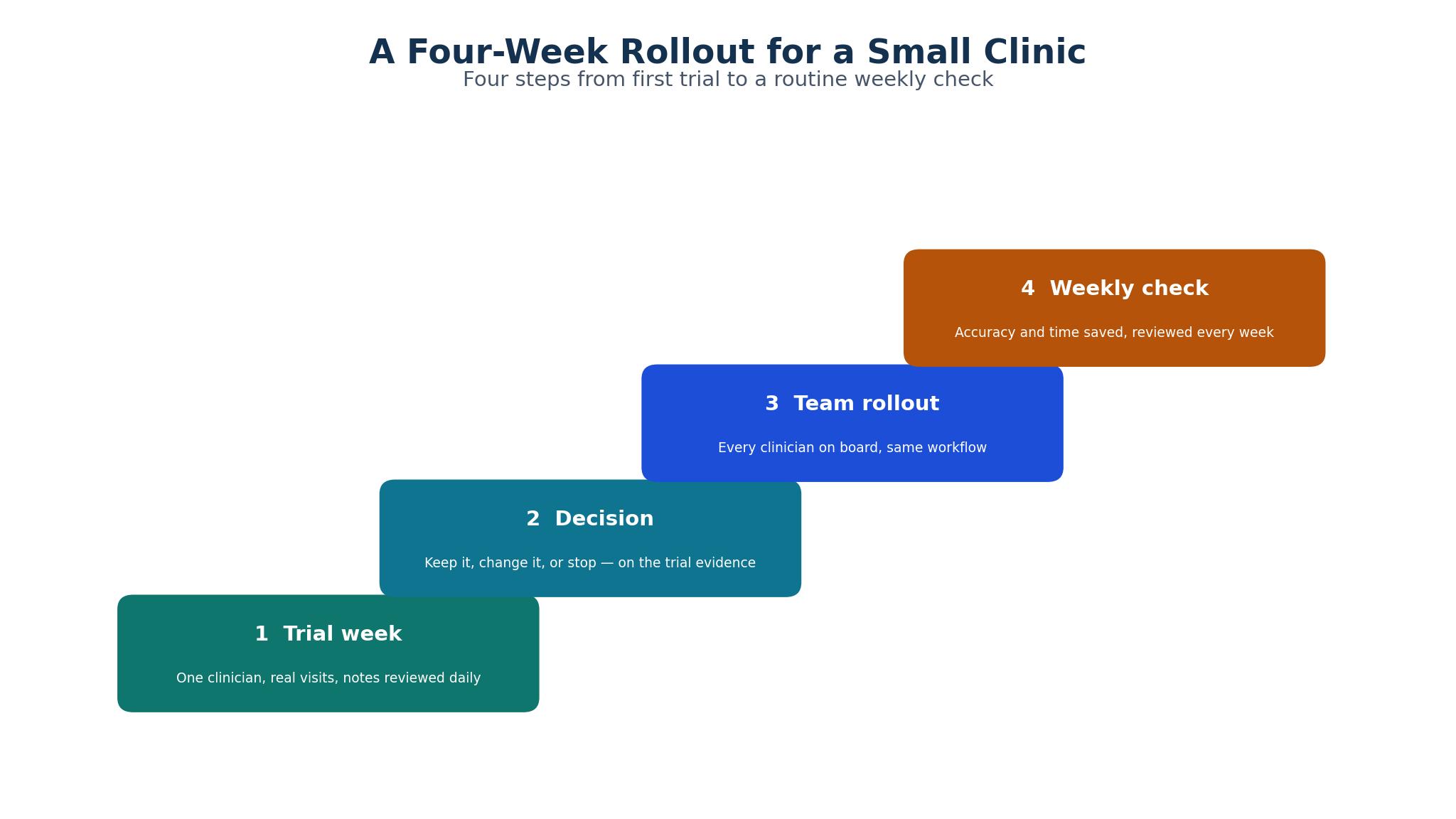
Week one is the trial. Pick two tools, run them on the same visits, and review every note before it enters the chart. Keep a simple score for each note, and note the time from visit end to signed note.
Week two is the decision. Pick the winner, sign the BAA, and confirm the EHR integration works with your exact system. Train the clinicians on the review step, because the note is only as safe as the review, and a clinician who signs without reading is taking a risk the tool cannot fix.
Week three is the rollout to the whole team. Start with one clinician, then add the rest over three days, so the clinic can catch problems early.
Week four is the check. Count the hours saved, count the notes that needed corrections, and ask each clinician whether the scribe made the day easier. If the hours saved cover the cost and the correction rate is low, the scribe stays, which is the outcome the best ai medical scribe tools for small clinics are built to deliver.
When a Scribe Pays for Itself and When It Does Not
A scribe pays for itself when the clinician time it saves is worth more than the subscription. A clinician who spends two hours a night on notes and bills 200 dollars an hour is losing 400 dollars a day to documentation, while Freed Starter costs 39 dollars a month. A small clinic that trials a scribe and finds it saves an hour a day has found a tool that pays for itself many times over.
A scribe does not pay for itself when the notes need heavy editing. If the clinician spends twenty minutes fixing each note, the scribe has only moved the work from typing to editing, and the time saved is small. The best ai medical scribe tools for small clinics are the ones whose notes need a two-minute review, not a twenty-minute rewrite, and the trial week will show which tools meet that bar.
The second case where a scribe does not pay is a clinic with very low visit volume. A practice that sees ten patients a week will not save enough hours to justify a 200 dollar a month subscription, and a free tier or a cheap plan is the right choice. Nabla free tier or Freed Starter at 39 dollars a month fits that volume.

Frequently Asked Questions
Is an AI scribe safe for patient data?
An AI scribe is safe when the vendor signs a BAA, stores audio securely, and deletes recordings after the note is complete. Every tool in this list states that it signs a BAA, but a clinic should get the signed agreement before the first real visit is recorded.
How accurate are AI medical scribes?
Accuracy varies by tool and by visit, with vendors claiming above 95 percent on clean audio, but real visits are messier. A small clinic should trial two tools on its own visits for a week and count the edits each note needs, because the edit count is the honest accuracy measure for the best ai medical scribe tools for small clinics.
Will an AI scribe work with my EHR?
Most scribes in this list integrate with Epic and other major EHRs, but the depth varies, and a clinic should check its exact EHR and version before trialling. Abridge leads on Epic integration, while Freed, Sunoh.ai and DeepCura cover common systems with a copy-and-paste fallback where the integration is thinner.
How much does an AI scribe cost for a small clinic?
Published prices start at 39 dollars a month for Freed Starter, with Sunoh.ai at 59 dollars a month and DeepCura at 129 dollars a month. Custom-quote tools are reported between 150 and 750 dollars per clinician a month.
Do I still need to review the note?
Yes, every note must be reviewed and signed by the clinician, because the scribe can make errors and the clinician is responsible for the chart. A note that enters the chart without review is a clinical risk, and no tool in this list is designed to replace the clinician sign-off.
Can an AI scribe handle specialty visits?
Specialty visits need templates tuned to the specialty, and Ambience Healthcare, DeepCura and Heidi Health offer the strongest specialty coverage in this list. A general scribe will work for primary care, but a cardiology or oncology practice should trial a specialty tool on its own visits before committing.
The Verdict for Small Clinics
Freed is the pick for most small clinics, because it starts at 39 dollars a month, needs no sales call, and writes a note a clinician can review in two minutes.
Sunoh.ai is the second pick when the clinic wants EHR sync at a low published price, and Nabla is the pick when the team wants to trial for free before spending anything. Abridge is the pick when the clinic runs Epic and needs the note to land without a manual step.
Start with two tools, run them on the same visits for a week, and pick the one whose notes need the fewest edits. The best ai medical scribe tools for small clinics are the ones that save an hour a day without adding a new risk, and the trial week will show which tool that is.