
A student who rewrites a source by swapping a few words usually discovers the gap when the similarity checker flags the passage anyway, since changing words is not the same as changing the sentence. A student who pastes a whole essay into a generator usually discovers the opposite gap, when the output reads smoothly but says nothing the student actually understands. The best ai paraphrasing tools for students sit between those two mistakes, and the choice between the two approaches decides whether the tool helps learning or replaces it.
The split comes down to what the student is rewriting. An essay that leans on academic sources needs careful rewording that keeps the meaning exact and the citation intact. A lab report needs precise language where a synonym can change the result. A student writing in a second language needs sentence alternatives that teach phrasing rather than hiding weak English. Each of these is a different job, and the tools below serve them in different proportions.
This guide compares ten live systems on student work, not on generic writing checklists. Prices in this guide are the vendors’ published list prices, checked in late 2026 and shown before tax. Where a vendor offers a free plan, the guide states its limits honestly, since the free limit decides whether the tool works for a real assignment or only for a single paragraph.
Paraphrasing, Plagiarism, and the Line a Student Must Not Cross
Paraphrasing is rewriting an idea in your own words with the source still credited, and it is a skill universities expect students to learn. A paraphrasing tool helps by showing how a sentence can be rebuilt, but the student still has to understand the idea, cite the source, and take responsibility for the final text. A tool that rewrites without the student reading the result produces text the student cannot defend in a seminar, and that is where the academic risk sits.
Similarity checkers do not only match words. They match sentence structure, so a passage with every third word swapped still flags, while a passage rebuilt with a new structure and a proper citation passes. QuillBot’s modes make this visible, since Standard, Fluency, Formal, and Academic each rebuild the sentence differently, and a student can see which version keeps the meaning closest. The best ai paraphrasing tools for students teach that difference rather than hiding it.
The rule for any tool in this list is simple. Use it to learn how a sentence can be rebuilt, check the meaning against the source, and cite the source every time. Never submit text you have not read and do not understand, and never use a paraphraser to disguise a source you have not credited. A tool used that way helps a student write better, while a tool used the other way creates a disciplinary problem that no subscription is worth.
Modes, Tone, and Keeping the Meaning Exact
A paraphraser that offers one rewrite gives the student one choice, while a paraphraser that offers modes gives the student a way to learn. QuillBot offers nine modes on Premium, including Formal, Academic, Simple, and Creative, plus custom modes, and each one changes the sentence in a different direction. Wordtune takes the opposite approach, offering sentence alternatives in the editor, so the student compares several versions of one sentence side by side.
The meaning has to survive the rewrite. A paraphrase that changes “increased by ten percent” to “rose slightly” has changed the fact, and a marker will notice. A paraphrase that changes a technical term to a near-synonym has introduced an error, and a lab report will suffer for it. The student should read every rewrite against the source and reject any version that shifts the meaning, however fluent it reads.
Test this with a real paragraph from a course reading. Run it through two modes, read both outputs against the source, and mark every place the meaning moved. The tool that keeps the meaning closest while changing the structure most is the one worth paying for, and the tool that only swaps words is not a paraphraser at all, however cheap it is.
Free Limits, Word Caps, and the Real Cost of an Assignment
Free plans in this category are real but narrow. QuillBot free allows 125 words per paraphrase in two modes, Wordtune free allows ten rewrites a day, and Grammarly free covers corrections but not full-sentence rewrites. A student with a 2,000-word essay will hit every one of those limits before the first page is done, which is why the paid price matters more than the free tier.
The paid prices are low by student standards. QuillBot Premium costs $8.33 a month billed annually, Wordtune Advanced costs $6.99 a month billed annually, and Grammarly Pro costs $12 a month, while Rytr starts from $7.50 a month and Writesonic from $16 a month. A student who paraphrases daily will save hours for the price of two coffees a month, while a student who paraphrases once a term will find the free tier enough.
Work out the cost per assignment before subscribing. Count the words the student actually rewrites in a term, divide by the free limit, and see how many paid months the work justifies. A student who rewrites heavily should pay for QuillBot and use the plagiarism checker and citation generator that come with it, while a student who rewrites rarely should stay free and spend the money elsewhere.
The 10 Tools at a Glance
The table below gives the short version of the best ai paraphrasing tools for students, with each tool, its main job, and its starting price.
| Tool | Main job | Best for | Starting price |
|---|---|---|---|
| QuillBot | Paraphrasing with modes | Overall paraphrasing and rewriting | From $8.33 per month, billed annually |
| Wordtune | Sentence-level rewriting | Sentence alternatives and tone | From $6.99 per month, billed annually |
| Grammarly | Writing improvement and rewriting | Proofreading plus rewriting | From $12 per month |
| Scribbr | Academic paraphrasing | Students and academic writing | Free |
| Paperpal | Academic revision and rewriting | Research and academic papers | From $19 per month |
| Jasper | Long-form AI writing | Rewriting inside longer drafts | From $39 per month |
| Writesonic | AI writing and paraphrasing | Content rewriting at volume | From $16 per month |
| Paraphraser.io | Simple online paraphrasing | Quick free rewrites | Free plan, paid plans on the vendor site |
| Rytr | AI writing with rewriting | Budget AI writing | From $7.50 per month |
| Copy.ai | AI writing with paraphrasing | Marketing and essay drafting | Free plan, from $49 per month |
Best Pick by Job
This table matches the best ai paraphrasing tools for students to the job it fits, so an essay writer and a lab-report writer do not end up buying the same system.
| Job type | First pick | Second tool | Why this pair works |
|---|---|---|---|
| Essay paraphrasing daily | QuillBot | Scribbr | QuillBot rebuilds sentences while Scribbr checks the academic fit free |
| Sentence alternatives | Wordtune | Grammarly | Wordtune offers several versions while Grammarly polishes the chosen one |
| Proofreading plus rewriting | Grammarly | QuillBot | Grammarly catches errors while QuillBot handles the heavy rewording |
| Academic papers | Paperpal | Scribbr | Paperpal revises research writing while Scribbr offers a free academic check |
| Tight student budget | Rytr | Paraphraser.io | Rytr costs little while Paraphraser.io starts free |
| Long-form drafts | Jasper | Writesonic | Jasper carries long drafts while Writesonic rewrites sections cheaply |
| Quick free rewrite | Scribbr | Paraphraser.io | Scribbr is free for short passages while Paraphraser.io handles quick jobs |
How to Choose the Best AI Paraphrasing Tools for Students
The best ai paraphrasing tools for students prove themselves on a real assignment, not on a demo paragraph. Take one paragraph from a course reading and one paragraph from the student’s own draft, run both through the trial, and read the outputs against the sources. The tool that keeps the meaning exact while changing the structure is the one worth paying for, and the tool that only swaps synonyms will flag on a similarity checker.
Check the extras next, since the paraphraser is rarely the whole purchase. QuillBot Premium bundles a grammar checker, a summariser, a plagiarism checker, and a citation generator, which together cover most of a student’s writing needs. Grammarly Pro adds tone adjustment and AI-text detection, while Paperpal adds academic checks that a general tool misses. A student should price the bundle, not the paraphraser alone, since the extras often decide the purchase.
Price the year on the annual rate, since the monthly rate is far higher. QuillBot costs $8.33 a month billed annually against $19.95 billed monthly, Wordtune costs $6.99 against $13.99, and Grammarly costs $12 against $30. A student who subscribes for a term should pay annually and cancel at the end of the year, rather than paying monthly for three months and spending more for less.
The 10 Tools in Detail
1. QuillBot
QuillBot is a dedicated paraphrasing platform built around one action, paste a passage, choose a rewriting style, and get it back reworded. The free plan allows 125 words per paraphrase in two modes, Standard and Fluency, while Premium at $8.33 a month billed annually unlocks unlimited paraphrasing, nine modes plus custom modes, 23 languages, and 25,000 words a month of plagiarism checks. It also bundles a grammar checker, a summariser, and a citation generator.
The weak spot is the free limit. A student with a long essay will hit the 125-word cap constantly on the free plan, and the monthly price of $19.95 is steep for a student who only needs it for one term. The paraphrases can also be uneven, with some modes producing awkward sentences that need editing.
It suits students reworking existing text at volume, including essays, literature reviews, and source-heavy assignments. A student handling sources daily will get the most from it, while a student who writes from scratch will find it less useful.
Run a real source paragraph through three modes in the trial and read each output against the source. Check which mode keeps the meaning closest, then run the plagiarism checker on the chosen version. If the meaning holds and the similarity score falls, the tool is doing its job.
2. Wordtune
Wordtune, built by AI21 Labs, rewrites at sentence level, offering alternatives for a sentence inside the editor, with tone and clarity controls. The free plan allows ten rewrites and AI suggestions a day, while Advanced at $6.99 a month billed annually allows thirty rewrites a day, and Unlimited at $9.99 a month removes the cap. Its strength is the side-by-side comparison, since the student sees several versions of one sentence at once.
The catch is the daily cap. Ten free rewrites a day will not cover an essay, and even the Advanced plan caps at thirty a day, which a heavy user will hit. Wordtune also works sentence by sentence, so a student rewriting a whole passage will work slowly compared with QuillBot.
It suits students who want sentence alternatives and tone control, especially those writing in a second language. A student polishing sentences one at a time will get the most from it, while a student rewriting whole passages will find it slow.
Take five sentences from a draft and compare the alternatives Wordtune offers for each. Pick the best version of each sentence, then read the paragraph as a whole to check the flow. If the sentences read better together, the tool is teaching phrasing, not just swapping words.
3. Grammarly
Grammarly is a writing assistant that covers grammar, spelling, tone, and clarity, with full-sentence rewrites on Pro at $12 a month. The free plan covers basic corrections and 100 AI prompts a month, while Pro adds full-sentence rewrites, tone adjustment, plagiarism and AI-text detection, and 2,000 AI prompts a month. Its strength is that it works everywhere, in the browser, in Word, and in Google Docs.
The honest drawback is that rewriting is paywalled. The free plan corrects errors but does not rewrite sentences, so a student who only needs paraphrasing will pay $12 a month for a feature that QuillBot offers for less. Grammarly is also a general tool, so its paraphrases are less controlled than QuillBot’s modes.
It suits students who want proofreading and rewriting in one tool, especially those who write in many places. A student who values clean grammar across every document will get the most from it, while a student who only needs paraphrasing will find it dear.
Write a paragraph in the trial, accept the grammar corrections, then use a full-sentence rewrite on the weakest sentence. Check whether the rewrite keeps the meaning and improves the flow. If it does, the Pro price covers two jobs at once.
4. Scribbr
Scribbr offers a free paraphrasing tool with no paid tier for the tool itself, allowing 125 words per input with no account needed. It serves students and academic writing, with a simple interface and a clear academic focus, and the same site offers plagiarism checking and citation generation as separate services. Its strength is that it costs nothing for short passages.
The downside is the limit. The tool handles 125 words at a time with no paid upgrade, so a student with a long essay will paste paragraph by paragraph, which is slow. It also offers fewer modes and less control than QuillBot, so the rewrites are less varied.
It suits students who need a quick free rewrite of a short passage, especially for a single tricky paragraph. A student with occasional paraphrasing needs will get the most from it, while a student rewriting daily will outgrow it within a week.
Run three difficult paragraphs through Scribbr in the trial and read each output against the source. If the meaning holds and the academic tone fits, the free tool is enough for the job at hand.
5. Paperpal
Paperpal is an academic writing assistant built for research papers, with paraphrasing, grammar checks, and academic tone suggestions, starting from $19 a month. Its strength is the academic focus, since it understands research language, checks consistency, and helps a student write in the style journals expect. It suits postgraduate students and researchers.
The honest drawback is price and scope. At $19 a month, Paperpal costs more than QuillBot for a student who only needs paraphrasing, and its tools are tuned for research writing rather than undergraduate essays. A first-year student will find much of it unnecessary.
It suits postgraduate students and researchers writing papers for publication. A student working on a thesis or a journal submission will get the most from it, while an undergraduate writing essays will find it too specialised.
Run a paragraph from a research paper through Paperpal in the trial and check the academic suggestions. If the rewrite keeps the technical terms exact and improves the academic tone, the specialist price is justified.
6. Jasper
Jasper is a long-form AI writing platform starting from $39 a month, with paraphrasing inside a wider set of writing tools. It rewrites passages, expands drafts, and generates content from prompts, with brand voice controls and templates for longer documents. Its strength is scale, since it handles a whole draft rather than a single paragraph.
The trade-off is price and purpose. At $39 a month, Jasper costs far more than a dedicated paraphraser, and it aims at marketers and content teams rather than students. A student who only needs paraphrasing will pay for features they never use, and the academic controls are thinner than Paperpal.
It suits students writing long-form work who also need drafting help, such as a thesis with many chapters. A postgraduate student with a long document will get the most from it, while an undergraduate with short essays will find it far too dear.
Rewrite one chapter section in the trial and check whether the output keeps the argument intact. If the meaning holds across a long passage, the long-form strength is real, and if it drifts, the tool is not built for academic work.
7. Writesonic
Writesonic is an AI writing platform starting from $16 a month, with paraphrasing, article writing, and content generation in one place. It rewrites passages quickly and handles volume well, which suits a student with many short assignments. Its strength is speed, since it produces rewrites fast and offers several tones.
The honest drawback is academic fit. Writesonic is built for content and marketing, so its paraphrases can be loose with facts and technical terms, and a student must check every output carefully. The price is also higher than QuillBot for a tool that does less for academic writing.
It suits students who need fast rewrites at volume, especially for short-form work. A student with many small assignments will get the most from it, while a student writing a thesis will find it too loose.
Rewrite five short passages in the trial and check each one for factual drift. If the facts hold and the tone fits, the speed is useful, and if the facts move, the tool needs more checking than it saves.
8. Paraphraser.io
Paraphraser.io is a simple online paraphrasing tool with a free plan for quick rewrites and paid plans on the vendor site. Its strength is simplicity, since a student can paste a passage and get a rewrite without an account, a download, or a learning curve. It suits a quick job where the student needs one paragraph reworded fast.
The honest drawback is control and depth. Paraphraser.io offers fewer modes and less academic tuning than QuillBot, and the free plan carries limits that a heavy user will hit. A student who needs consistent quality across a long essay will find it uneven.
It suits students who need a quick free rewrite without signing up. A student with one paragraph to fix will get the most from it, while a student rewriting a whole essay will find it too thin.
Paste a difficult paragraph into Paraphraser.io in the trial and read the output against the source. If the meaning holds, the simple tool is enough for the job, and if it drifts, the student should use a tool with more control.
9. Rytr
Rytr is a budget AI writing tool starting from $7.50 a month, with paraphrasing, drafting, and tone controls in one place. Its strength is price, since it is among the cheapest paid tools in this list, and it covers the basics well enough for a student on a tight budget. It offers several tones and use cases.
The honest drawback is depth. Rytr is a general writing tool rather than a dedicated paraphraser, so its rewrites are less controlled than QuillBot’s modes, and the free plan is limited. A student who needs precise academic paraphrasing will find it less reliable than a specialist tool.
It suits students on a tight budget who need a general writing helper. A student who wants one cheap tool for drafting and rewriting will get the most from it, while a student who needs precise paraphrasing will not.
Rewrite three paragraphs in the trial and check each for meaning drift. If the meaning holds and the price fits the budget, Rytr is a fair compromise, and if the meaning moves, the saving is not worth it.
10. Copy.ai
Copy.ai is an AI writing platform with a free plan and paid plans from $49 a month, covering drafting, paraphrasing, and content generation. Its strength is breadth, since it handles many kinds of writing in one place, and the free plan lets a student try it without paying. It suits students who also write marketing or creative work.
The weak spot is price and academic fit. At $49 a month, Copy.ai is the dearest tool in this list for a student, and it aims at marketing rather than academic writing. A student who only needs paraphrasing will pay far more than QuillBot for a tool that does less for essays.
It suits students who write across many formats and need one platform for all of it. A student with a side project in content or marketing will get the most from it, while a student who only writes essays will find it far too dear.
Draft a short passage in the trial, paraphrase it, and check the output against the source. If the meaning holds and the breadth is useful, the price may be justified, and if not, a cheaper specialist tool is the better buy.
What Paraphrasing Tools Cost Over a Student Year
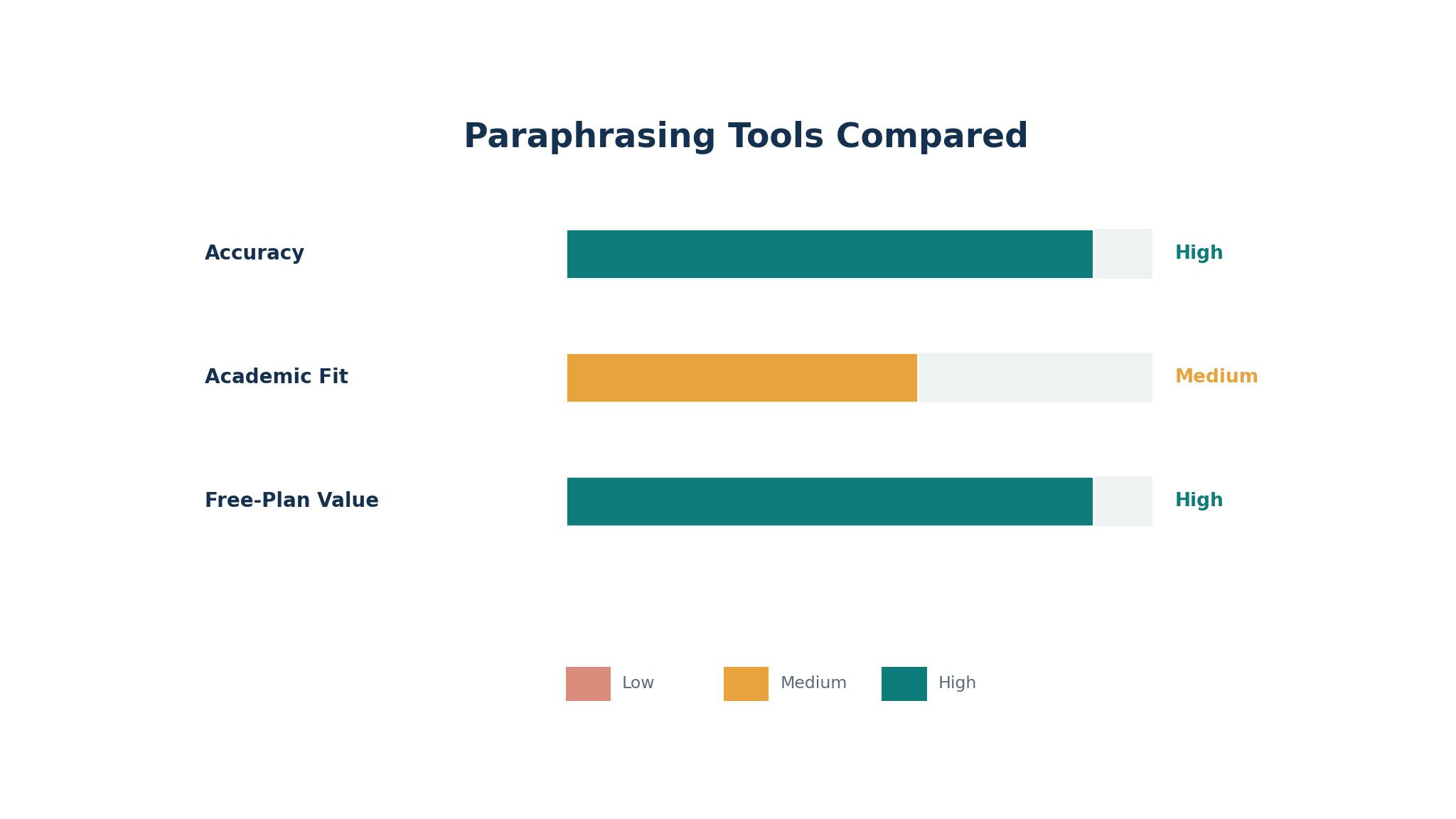
The annual rate is the price that matters for the best ai paraphrasing tools for students, since the monthly rate is far higher across this list. QuillBot costs $8.33 a month billed annually, or about $100 a year, against $19.95 a month billed monthly, which would cost $239 a year. Wordtune costs $6.99 a month billed annually against $13.99 monthly, and Grammarly costs $12 a month against $30 monthly. A student who pays monthly for a term spends more for less, and the annual plan is the cheaper route even for a single semester of heavy use.
Free plans cover the lightest users honestly. Scribbr is free for short passages with no paid tier, Paraphraser.io is free for quick jobs, and Copy.ai offers a free plan for trying the platform. A student who paraphrases rarely should stay free and spend the money on books, while a student who paraphrases daily should pay annually and use the bundled extras, such as QuillBot’s plagiarism checker and citation generator, which together replace two more subscriptions.
Work out the cost per assignment before subscribing. Divide the annual price by the number of assignments that need heavy paraphrasing, and compare that with the time saved per assignment. A tool that saves an hour per essay for $100 a year is cheap, while a tool that saves ten minutes for $49 a month is dear. The maths is simple, and the student should do it before paying.
Using a Paraphraser Without Getting Into Trouble
The safest way to use the best ai paraphrasing tools for students is to treat the tool as a tutor, not as a writer. Read the source, write the idea in your own words first, then use the tool to check whether a better phrasing exists, and keep the version you understand best. A student who follows that order learns from the tool, while a student who pastes first and reads later learns nothing and risks submitting text they cannot explain.
Cite every source, even when the words are entirely your own. Paraphrasing does not remove the need for a citation, and a marker who recognises an idea without a reference will treat it as plagiarism whatever tool produced the words. Keep the citation next to the paraphrase, check the reference list at the end, and run the similarity checker before submitting, since a high similarity score is a warning to rewrite, not a problem to hide.
Check the university rules before using any tool in this list. Some universities allow paraphrasing tools openly, some allow them with disclosure, and some restrict AI writing tools entirely. A student who checks the rules first will never be surprised, while a student who assumes the rules will find out at the worst moment. The tool is only useful when the rules allow it, and the rules are the part the student controls.

Frequently Asked Questions
Is using a paraphrasing tool cheating?
No, when it is used to learn how to rewrite an idea in your own words and the source is still cited. A paraphraser becomes cheating when it is used to disguise a source without credit, or to submit text the student has not read and does not understand. Universities judge the intent and the citation, not the tool, so a student who cites properly and understands the text is using the tool honestly.
Which paraphrasing tool is best for students?
Among the best ai paraphrasing tools for students, QuillBot is the strongest answer for most students, since it offers nine modes, a plagiarism checker, and a citation generator for $8.33 a month billed annually. Scribbr is the best free answer for short passages, and Wordtune is the best answer for sentence-level alternatives. The choice comes down to whether the student rewrites whole passages, single sentences, or only occasional paragraphs.
How much should a student pay for a paraphrasing tool?
Most students in this guide pay between $7 and $12 a month on the annual rate, with QuillBot at $8.33, Wordtune at $6.99, and Grammarly at $12. A student who paraphrases rarely should pay nothing and use Scribbr or Paraphraser.io free, while a student who paraphrases daily should pay annually and use the bundled extras. The cost per assignment is the number that matters.
Does QuillBot really help with plagiarism?
QuillBot helps by rebuilding sentences with a new structure, which lowers the similarity score when the source is still cited, and its Premium plan includes a plagiarism checker that shows the score before submission. It does not help when the student fails to cite the source, since an uncited paraphrase is plagiarism whatever tool produced it. The checker is a warning system, not a shield, and the citation is what protects the student.
Can a paraphraser keep technical terms exact?
Yes, when the student checks the output and rejects any version that changes a technical term. QuillBot’s Formal and Academic modes are the most careful with technical language, while general tools such as Writesonic and Copy.ai are looser and need more checking. A student writing a lab report should use a specialist tool and read every rewrite against the source, since one changed term can alter the result.
Should a student use the free plan or pay?
A student should use the free plan when the work is light, since Scribbr is free for short passages and QuillBot free covers 125 words at a time. A student should pay when the work is heavy, since the free limits will not cover a full essay and the paid plan adds the plagiarism checker and citation generator. The annual rate is far cheaper than the monthly rate, so a student who pays should pay annually.
The Verdict for Students Choosing a Paraphrasing Tool in 2026
QuillBot is the best pick for most students, since it pairs nine modes with a plagiarism checker and a citation generator at a student price. Wordtune is the best pick for sentence-level rewriting, and Grammarly is the best pick for a student who wants proofreading and rewriting in one tool. Scribbr is the best free pick for short passages, and Paperpal is the best pick for postgraduate research writing.
Run a real source paragraph through three modes, read each output against the source, and check the similarity score. The tool that keeps the meaning exact while changing the structure is the right one for the student, and the rest is marketing.