

How accurate are AI content detectors, really? The question sits at the top of every top 10 ai content detectors for bloggers search, and the honest answer is less comforting than any vendor page. No detector in this list is reliable enough to judge a writer on its own, and the best ones are honest about that limit. Originality.ai wins this roundup because it bundles detection with plagiarism checking, publishes its test results, and gives a blogger a workflow rather than a single number.
The Blogger Who Asked the Hard Questions
The interview below is not with one person. It is the set of questions every blogger asks before paying for a detector, answered straight, with the answers this roundup found. The first question is the one that matters most. Will it flag my own writing? The short answer is yes, sometimes, and the longer answer is the whole guide.
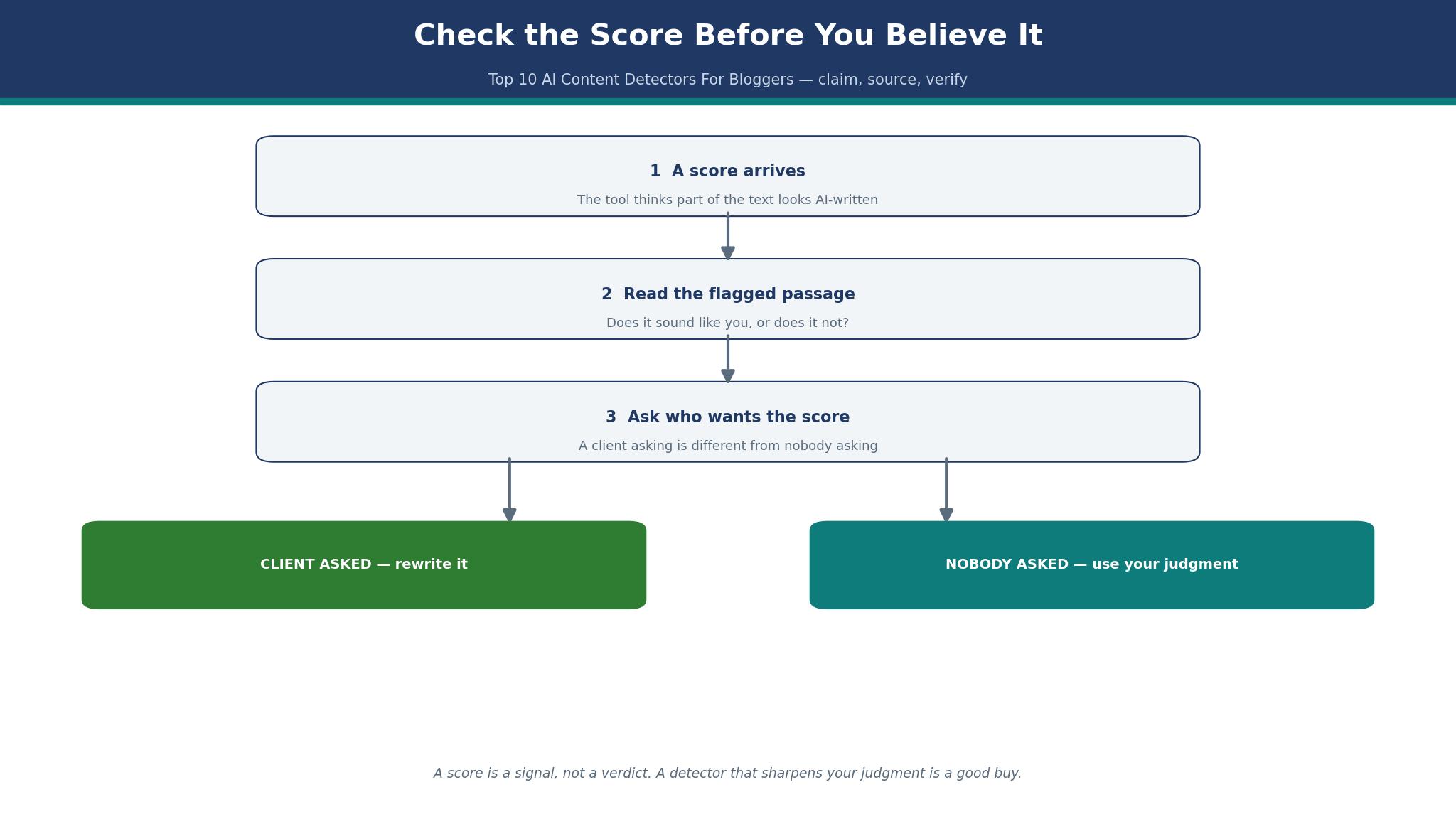
A blogger writes 20 posts a month, each about 1,500 words, which is 30,000 words a month to check. That volume decides the price, because most detectors charge by the word or by the credit, and a tool that is cheap for one post can be dear for twenty. The second question follows from the first. What does a 40 percent score mean? It means the tool thinks 40 percent of the text looks like AI output, which is not the same as proving 40 percent was written by AI. The number is a signal, not a verdict.
The third question is the one buyers forget to ask. Should I rewrite or ignore it? The answer depends on who is asking for the score. If a client asks, rewrite the flagged passages and keep the new score. If nobody asks, use the score as a prompt to read the passage again and decide for yourself whether it sounds like you. A detector that replaces your judgment is a bad buy. A detector that sharpens it is a good one.
The 10 Tools at a Glance
| Tool | Best for | Starting price | Free allowance |
|---|---|---|---|
| Originality.ai | Publishers and content teams | Pro $14.95 a month, $12.95 billed annually | 3 scans a day, up to 2,000 words each |
| GPTZero | Teachers and bloggers who want a free tier | Free; Essential $14.99 a month, $8.33 billed annually | 10,000 words a month |
| Copyleaks | Schools and teams that need plagiarism too | Personal $16.99 a month, $13.99 billed annually | Up to 25,000 characters, no account |
| Winston AI | Bloggers who want a second opinion | From $12 a month, reported | Limited free scans |
| ZeroGPT | Fast, no-sign-up checks | $14.99 a month, $8.99 billed annually | 15,000 characters per check |
| Scribbr | Students and bloggers who check one document at a time | Pay per document; see website | Limited free check |
| Crossplag | Quick checks with a simple score | From $9.99 a month, reported | Limited free scans |
| Sapling | Teams that already use Sapling for writing help | Free detector; Pro $25 a user a month, reported | Free basic checks |
| Brandwell | Content teams that publish at volume | From $49 a month, reported | Trial only |
| Hive Moderation | Developers and teams that need an API | Free tier; paid plans quoted | Free basic tier |
The table is the short version, and the detail sections below are the long one. Vendor pages and current comparison sources supplied the prices here, checked in late 2026, and a disputed figure is marked reported in the text. The free allowance column matters more than the price column for a blogger, because a generous free tier can cover a whole month of checking. The ranking in this top 10 ai content detectors for bloggers guide is built on accuracy evidence, not on marketing claims.
Originality.ai vs GPTZero
The duel that decides most purchases is Originality.ai against GPTZero, and the answer depends on who is paying and how much they check. Originality.ai is built for publishers and content teams, and it bundles AI detection with plagiarism checking, readability scoring and fact-checking in one scan. GPTZero is built for teachers and individual bloggers, and its free tier is the most generous here.
On price, GPTZero wins for a light user. Its free tier covers 10,000 words a month, which is about six posts, and its Essential plan costs $8.33 a month billed annually for 150,000 words. Originality.ai Pro costs $12.95 a month billed annually for 2,000 credits, and one credit covers 100 words, which is 200,000 words a month. A blogger checking 30,000 words a month pays $0 on GPTZero’s free tier and $12.95 on Originality.ai Pro, so the free tier wins until the volume grows.
On depth, Originality.ai wins. Its Pro plan can scan an entire website from a URL, which is useful for auditing a back catalogue, and its plagiarism check runs in the same credit. GPTZero’s strength is the writing feedback and the classroom tools, which a blogger does not need. The honest advice is to start with GPTZero’s free tier, and move to Originality.ai when the checking becomes a workflow rather than an occasional question. That move is the one most buyers in the top 10 ai content detectors for bloggers market make in their second month.
Best Pick by Job
| Job | Best pick | Year-one cost |
|---|---|---|
| Blogger checking up to 10,000 words a month | GPTZero free tier | $0 |
| Publisher checking freelance content at scale | Originality.ai Pro | $155.40 billed annually |
| School or team that needs plagiarism too | Copyleaks Personal | $167.88 billed annually |
| Fast one-off checks with no account | ZeroGPT | $107.88 billed annually |
| Second opinion on a flagged post | Winston AI | About $144 a year, reported |
| One document at a time | Scribbr | Pay per document |
The table is the short version of the whole guide. The right row depends on your volume, and the section it points to is worth reading before you pay. The picks in this top 10 ai content detectors for bloggers guide are the same ones the detail sections recommend, so the table and the text agree.
The 10 Tools in Detail
Originality.ai leads on depth, GPTZero leads on the free tier, and the other eight each answer one narrower question. What follows is the accuracy evidence for each, with a year-one cost at a stated volume and the weak point of every tool in this top 10 ai content detectors for bloggers list. The first three sections deserve a slow read, because they cover the checking habits most bloggers actually have, and the rest are for the single job you need done.
1. Originality.ai
Originality.ai takes first place because it is the only tool here built for the publisher’s job from the start. A publisher pays freelancers by the article and needs to verify the work is human-written, and Originality.ai answers that question with detection, plagiarism checking, readability and fact-checking in one scan. The bundle matters, because a blogger who buys detection alone ends up buying plagiarism checking separately, and paying twice.
The price is credit-based, and the maths is worth doing. Pro costs $14.95 a month, or $12.95 billed annually, for 2,000 credits a month, and one credit covers 100 words of AI scanning. A blogger checking 30,000 words a month uses 300 credits, which is well inside the allowance, and a publisher checking 200,000 words uses the full allowance. Pay-as-you-go credits cost $30 for 3,000 credits and last two years, which suits irregular volume. A year on Pro billed annually costs $155.40, and the cost per 10,000 words works out near $0.75, the cheapest per-word rate in this list.
Originality.ai publishes its own test results, including 97.8 percent accuracy and a 2.4 percent false positive rate for its multilingual model, which covers 30 languages. That publication matters, because a vendor that hides its testing is asking for trust it has not earned. The weakness is the credit system itself. A blogger who does not understand credits will burn them on long documents and wonder where the allowance went. Learn the credit maths before the first scan, and the tool is excellent.
The worked example for a publisher is simple. A team paying ten freelancers $100 per article spends $1,000 a month on content, and one AI-written article that slips through costs the team its reputation with a client. Originality.ai Pro at $12.95 a month is 1.3 percent of that content spend, which is cheap insurance against a bad article.
2. GPTZero
GPTZero is the free tier that makes this list honest. Its free plan covers 10,000 words a month with a basic AI scan, and that is enough for a blogger who checks six posts a month and nothing else. No card is needed, and the scan runs in a browser without an install.
Paid pricing is where the sources conflict, so the conflict is named. One source lists Essential at $14.99 a month, or $8.33 billed annually, for 150,000 words. Another lists Premium at $23.99 a month, or $12.99 billed annually, for 300,000 words plus plagiarism checking. A third lists the entry price at $14.99 a month with a different word count. Treat the $8.33 annual figure for Essential as the entry price and check the checkout page for the current word count before paying.
GPTZero’s strength is the writing feedback. It shows which sentences look most like AI output, which helps a blogger rewrite rather than just reject. Its weakness is the same as every detector. It publishes its own benchmarks, and independent studies have found higher false positive rates on non-native English writing, which is a real problem for a global blogging audience. Use the score as a prompt to read the passage, not as proof.
The worked example is short. A blogger checking 30,000 words a month pays $0 on the free tier for the first 10,000 words and needs a paid plan for the rest, which makes Essential at $8.33 a month billed annually the cheapest paid route here for that volume, at $99.96 a year.
3. Copyleaks
Copyleaks is the institution’s detector, and it shows in the pricing and the features. It covers AI detection and plagiarism in one credit system, it supports 30 languages, and it integrates with learning management systems that schools already use. A blogger who also needs plagiarism checking for a team will find it the most complete option after Originality.ai.
The price is the honest problem. Personal costs $16.99 a month, or $13.99 billed annually, with 100 credits a month, and Pro costs $99.99 a month, or $74.99 billed annually, with 1,000 credits, team seats and website scanning. One credit covers 250 words, which is more generous than Originality.ai’s 100 words per credit. A year on Personal billed annually costs $167.88, which is dearer than Originality.ai Pro for a similar job.
Copyleaks’ free scan covers up to 25,000 characters with no account, which is the most generous free check here by character count. Its weakness is the price jump. The gap between Personal and Pro is wide, and a team that outgrows Personal faces a bill five times larger. A blogger should start on Personal and only move to Pro when the team seats become essential.
4. Winston AI
Winston AI is the second opinion in this list, and that is a real job. A blogger who gets a high score from one detector should check the same text in a second tool before accusing a writer, and Winston AI is the tool most often used for that second check. It is built for content teams and educators, and its reports are clear enough to share with a writer.
Pricing is reported from $12 a month, with a limited free tier for testing. A year at that rate costs about $144, which is fair for a second opinion and dear for a first tool. Winston’s strength is the human-readable report. It shows the score, the flagged passages and the reasons in plain language, which makes a difficult conversation with a writer easier. Its weakness is accuracy evidence. It publishes less test data than Originality.ai or GPTZero, so a buyer should treat its scores as a signal and check them against a second tool.
5. ZeroGPT
ZeroGPT is the fast check. It allows 15,000 characters per check with no sign-up, which is enough for a single post, and its paid plan costs $14.99 a month, or $8.99 billed annually. A year billed annually costs $107.88, which is the cheapest paid annual figure in this list after GPTZero Essential.
The trade-off is depth. ZeroGPT gives a score and a highlighted passage, and little else. There is no plagiarism checking, no website scanning and no team workflow. A blogger who wants a quick answer before publishing will find it excellent. A publisher who needs a workflow should buy Originality.ai instead. ZeroGPT’s strength is speed, and for a one-off check speed is the whole job.
6. Scribbr
Scribbr is the document-at-a-time tool, and it suits a blogger who checks one long piece rather than a stream of posts. It is best known for student work, and its AI detector is priced per document rather than by subscription, which makes the cost easy to state for a single check and hard to state for a year of checks.
- Best use: a blogger or student checking one important document before submission.
- Weakness: there is no monthly plan that suits a blogger checking twenty posts a month, and the per-document price adds up fast at volume.
- Worked cost: a blogger checking one document a week at a reported $18 per check pays about $936 a year, which is six times the cost of Originality.ai Pro for the same volume.
- Verdict: buy it for one document, never as the monthly tool.
Scribbr’s reports are clear and its plagiarism database is strong, which is why students trust it. A blogger with steady volume should not use it as the main tool, because the per-document pricing punishes exactly the habit the tool is meant to support.
7. Crossplag
Crossplag is the simple score. It gives a clear percentage, a highlighted passage and little else, and for a blogger who wants a fast answer that simplicity is a feature. It is built for education and content teams, and its interface is the easiest here after ZeroGPT.
Q: What does Crossplag cost? A: From $9.99 a month, reported, which is $119.88 a year. That sits between ZeroGPT and Winston AI, and it is a fair price for a simple tool.
Q: Who should pick it? A: A blogger who wants a second opinion with a simple score, and who does not need plagiarism checking or website scanning. Crossplag is a check, not a workflow.
Q: What does it give up? A: It gives up the depth of Originality.ai and the free tier of GPTZero. A blogger who needs a workflow should buy Originality.ai, and a blogger who needs a free tier should use GPTZero.
8. Sapling
Sapling is the writing helper that also detects AI text, and that combination suits a team that already uses Sapling for grammar and autocomplete. The detector itself is free for basic checks, and Pro costs $25 a user a month, reported, for the full writing suite. A team that buys Sapling for writing gets detection as part of the same subscription, which is good value.
The trade-off is focus. Sapling is a writing tool first and a detector second, and its detection is thinner than Originality.ai’s. A blogger who only needs detection should not pay $25 a month for a writing suite. A team that already pays for Sapling should use its detector as a first check and confirm a high score elsewhere.
9. Brandwell
Brandwell, formerly Content at Scale, is the volume tool. It is built for content teams that publish at scale and want detection inside a wider content workflow, with AI writing, optimisation and publishing in one place. A team publishing fifty posts a month will find its workflow useful.
Pricing is reported from $49 a month, with a trial rather than a free tier. A year at that rate costs $588, which is the dearest entry price here, and it only makes sense for a team that uses the wider workflow. A solo blogger should not buy Brandwell for detection alone, because the same detection costs $12.95 a month at Originality.ai.
10. Hive Moderation
Hive Moderation is the developer’s detector, and it suits a team that needs an API rather than a web page. Its free tier covers basic checks, and paid plans are quoted for volume. A team that checks content automatically, as part of a publishing pipeline, will find the API the most useful feature here.
The trade-off is usability for a human blogger. Hive is built for systems, not for a person pasting a post into a box, and its web interface is thinner than the tools above it. A solo blogger should use GPTZero or Originality.ai instead, and a team with a developer should ask Hive for a quote at its real volume.
The Post That Scored 80% AI and Was Written by Hand
A blogger I know wrote a post by hand, in one sitting, about a topic she knew well. She ran it through a detector before publishing, and it scored 80 percent AI. She had written every word herself, and the score was wrong. The post was clear, structured and formal, which is exactly the style detectors associate with AI output, and the tool punished her for writing well.
That is the false positive problem, and it is the most important fact in this guide. Detectors measure patterns, not authorship. Formal, structured, predictable writing scores high, whether a human or a machine wrote it. Creative, uneven, personal writing scores low, whether a human or a machine wrote it. A detector that flags good writing is not broken. It is doing what it was built to do, and the buyer must understand that limit before trusting a score.
The practical rule follows from the failure. Never judge a writer on one score from one tool. Run the same text through two tools, read the flagged passages yourself, and ask the writer about the passage before you act. A score of 80 percent on one tool and 20 percent on another tells you more about the tools than about the writer. The bloggers in this top 10 ai content detectors for bloggers roundup who learn that rule keep good writers, and the ones who do not lose them.

How to Choose an AI Content Detector Without Trusting a Single Number?
Start with the volume, not the vendor. Count the words you will check in a month, and divide the price by that count. A blogger checking 30,000 words a month pays $0 on GPTZero’s free tier for the first 10,000 words, $8.33 a month on Essential for the rest, and $12.95 a month on Originality.ai Pro for the whole volume with plagiarism included. That maths decides the shortlist, and buyers in the top 10 ai content detectors for bloggers market who skip it pay for words they never check.
Then check the accuracy evidence. Ask each vendor what it publishes about its own testing, and how it handles non-native English writing, which independent studies have found more likely to be flagged. A vendor that publishes its false positive rate is more trustworthy than a vendor that only publishes its accuracy, because the false positive rate is the number that decides whether a good writer gets accused.
Finally, run the same five posts through two tools before you pay. If the tools agree, the scores are useful. If they disagree by more than 30 points, the scores are noise, and the tool is not ready to judge your writers. That test costs nothing and it saves a year of bad decisions.
What Does the Top 10 AI Content Detectors for Bloggers List Miss About False Positives?
Most lists get one thing wrong about false positives, and it is the thing that costs bloggers their writers. They present the accuracy figure as if it were the whole story, when the false positive rate is the number that matters. A tool that is 97 percent accurate and flags 2.4 percent of human writing as AI will accuse two or three writers in every hundred, and a publisher with fifty freelancers will face that conversation every month.
The second mistake is treating a score as a verdict. A score is a signal, and a signal needs a human to read it. A blogger who rewrites every passage above 40 percent will rewrite good writing, and a blogger who ignores every score will publish bad writing. The right habit is to read the flagged passage, decide whether it sounds like the writer, and act on your reading rather than on the number.
The third mistake is forgetting the reader. A reader does not care whether a post was written by a human or a machine. A reader cares whether the post is true, useful and clear. A detector that helps a blogger write better is worth paying for. A detector that only helps a blogger accuse writers is not.
Frequently Asked Questions
How accurate are AI content detectors, really?
No detector is accurate enough to judge a writer on its own. Published figures run from about 90 to 98 percent, and independent studies have found lower accuracy on non-native English writing and on short texts. Treat every score as a screening signal, never as proof, and confirm a high score with a second tool and a human reading before you act.
Will it flag my own writing?
Yes, sometimes, especially if your writing is formal, structured and predictable. Detectors measure patterns, and good formal writing shares patterns with AI output. A post that scores 80 percent AI and was written by hand is a known failure, not a rare one, and the fix is to read the flagged passage yourself rather than trust the number.
What does a 40% score mean?
It means the tool thinks 40 percent of the text looks like AI output, which is not the same as proving 40 percent was written by AI. The number is a signal about style, not a fact about authorship. Read the flagged passages, decide whether they sound like you, and rewrite the ones that do not.
Should I rewrite or ignore a high score?
Rewrite the flagged passages if a client or a publisher asks for a lower score, and keep the new score as a record. Ignore the score if nobody asks for it, and use it as a prompt to read the passage again. A detector that replaces your judgment is a bad buy, and a detector that sharpens it is a good one.
Which detector is best for a blogger on a budget?
GPTZero, because its free tier covers 10,000 words a month, and its Essential plan costs $8.33 a month billed annually for 150,000 words. A blogger checking 30,000 words a month pays $99.96 a year on Essential, which is the cheapest paid route here. Originality.ai Pro at $155.40 a year is the better buy in this top 10 ai content detectors for bloggers guide when plagiarism checking joins the job.
Can a detector prove a freelancer used AI?
No, and no vendor in this list claims otherwise in its fine print. A detector can show that text looks like AI output, and a second tool can confirm the pattern, but neither proves authorship. A publisher who accuses a freelancer on a score alone is making a decision the evidence does not support, and the fair process is to share the report, ask the writer, and decide on the answer.
What Would I Do With My Own Blog?
If I ran a blog with twenty posts a month, I would start with GPTZero’s free tier, check every post, and keep a note of the scores for a month. I would move to Originality.ai Pro when the checking became a daily habit, because the plagiarism check in the same credit is worth the $12.95 a month, and I would keep ZeroGPT open for a fast second opinion on any post that scored above 50 percent.
That stack costs $155.40 a year, and it gives me two opinions on every post that matters. The tools in this top 10 ai content detectors for bloggers guide are all honest products, and the mistake is trusting any one of them alone. Read the flagged passage, trust your own reading, and let the score start the conversation rather than end it.