
Can I see the full service history of every machine, on every site, before the next job starts? That is the first question a fleet manager asks, and the best heavy equipment management software is the tool that answers it without a phone call to the yard. Fleetio leads this list, because it publishes a clear price and keeps the best maintenance records. Tenna leads for mixed construction fleets, because it tracks heavy iron and small tools together.
Will It Track My Machines Across Sites?
The first question is about location, and the best heavy equipment management software answers it in seconds. A machine that was on the north site yesterday and the south site today should show both moves on one record, with the hours, the fuel and the last service attached. If the tool cannot do that, the fleet manager is back to phoning foremen, and the software has failed its first test.
The second question is about the record behind the location. A machine is not a dot on a map, it is a history of services, repairs, inspections and costs, and the tool should keep that history where the next mechanic can find it. Fleetio does that best on price, Tenna does it best across asset types, and Samsara does it best with safety data attached.
The third question is about the cost of not knowing. A machine that sits idle for a week costs the same to own as a machine that works, and a service that is missed by a month can cost ten times the service itself. A fleet manager who can answer all three questions from one screen, location, history and cost, has a tool that earns its keep, while a manager who needs three systems to answer them has a pile of subscriptions instead.
The 8 Tools at a Glance
The rows give a fleet manager the price and the best job for each tool in one place, so two finalists can be chosen in a minute and their detail read before any vendor is called.
| # | Tool | Starting price | Best for |
|---|---|---|---|
| 1 | Fleetio | Essential $4 per vehicle a month billed yearly | Mixed fleets that want published pricing |
| 2 | Tenna | Quote-based, by asset count | Contractors with mixed fleets and small tools |
| 3 | Samsara | Quote-based | Large fleets that want telematics and safety together |
| 4 | Geotab | Quote-based | Fleets that want deep vehicle data |
| 5 | HCSS Equipment360 | Quote-based | Heavy civil crews with big machines |
| 6 | Trackunit | Quote-based | Mixed-brand fleets that need machine data |
| 7 | Linxup | Quote-based, from about $20 a month reported | Small fleets that want simple GPS |
| 8 | EquipmentShare T3 | Quote-based | Fleets that rent and own side by side |
Best Pick by Job
A mixed fleet needs a different tool from a fleet of trucks, and the best heavy equipment management software changes with that job. A mixed fleet needs a different tool from a fleet of trucks, and the rows below match the tool to the fleet rather than to the logo.
| Job | Pick | Why |
|---|---|---|
| Maintenance records and reminders | Fleetio | Published price and strong records |
| Mixed construction fleet | Tenna | Heavy iron and small tools together |
| Large fleet with safety needs | Samsara | GPS, cameras and maintenance together |
| Deep vehicle data | Geotab | Rich data and many integrations |
| Heavy civil crew | HCSS Equipment360 | Hour-based maintenance for big machines |
| Simple GPS for a small fleet | Linxup | Low price and a simple map |
What Each Fleet Tool Costs and Where It Falls Short
Price is the hardest part of this market, because the best heavy equipment management software rarely publishes a price. Fleetio is the exception, at $4, $7 and $10 per vehicle a month, while most rivals quote by asset count. The comparison that follows pairs each price with the tool’s strongest feature and the limit a buyer should test.
| Tool | Price | Standout strength | Watch out |
|---|---|---|---|
| Fleetio | Essential $4 per vehicle a month billed yearly | Published per-vehicle pricing and strong maintenance records | No GPS of its own, needs a telematics feed |
| Tenna | Quote-based, by asset count | Built for construction, from heavy iron to small tools | Quote-based pricing and a rollout measured in weeks |
| Samsara | Quote-based | GPS, safety cameras and maintenance in one platform | Quote-based, multi-year terms common |
| Geotab | Quote-based | Rich telematics data and a large integration library | Quote-based and data-heavy |
| HCSS Equipment360 | Quote-based | Built for heavy civil, with hour-based maintenance | Quote-based and aimed at large crews |
| Trackunit | Quote-based | Telematics across brands, with utilisation data | Quote-based and hardware-led |
| Linxup | Quote-based, from about $20 a month reported | Simple tracking with a low entry price | Lighter maintenance tools than Fleetio |
| EquipmentShare T3 | Quote-based | Telematics built around rental and owned fleets | Quote-based and tied to the EquipmentShare world |
Two figures in that table deserve a note. Fleetio lists $4 per vehicle a month on Essential billed yearly, and that figure is published on the vendor page. The $20 to $40 per vehicle a month range for telematics software comes from third-party reports, so treat it as a guide rather than a quote, and ask each vendor for the full three-year figure before signing.
The 8 Tools in Detail
The interview continues below, with each tool answering the questions a fleet manager actually asks, and the best heavy equipment management software is the one that answers them without a phone call to the yard. A price that only a review site reports is labelled reported, and a price from the vendor page is stated as published. The first two tools deserve a full read, while the other six are there to check against the fleet you actually run.
1. Fleetio
Fleetio is maintenance software first, and it is the only tool on this list that publishes a clear price. Essential costs $4 per vehicle a month billed yearly, Professional costs $7 and Premium costs $10, with a 14-day free trial. A fleet manager can budget the software before a sales call, which is rare in this market.
The system tracks service schedules, work orders, parts, inspections and fuel, and it treats excavators, forklifts and bulldozers as vehicles alongside trucks. A shop that runs 40 machines and 20 trucks can keep one record for all of them, with service reminders based on hours, miles or dates.
The limit is location. Fleetio sells no GPS hardware, so a fleet that needs to know where a machine is right now must pair it with a telematics provider. That pairing works well, but it is a second contract and a second bill, and a buyer should price both before deciding.
Worked example. A fleet with 60 assets on Professional at $7 per vehicle a month pays $420 a month, or $5,040 a year. If the service reminders prevent two missed services a year, and each missed service costs $1,500 in downtime and repair, the software pays for itself on prevention alone. The maths is simple, and it is the reason Fleetio leads this list.
I would pick Fleetio when the shop needs records and reminders more than it needs live maps. It is the honest, cheap starting point, and it leaves the telematics decision for later, when the fleet knows what it actually needs to track.
2. Tenna
Tenna was built for contractors who run heavy equipment, trucks, attachments and small tools out of the same yard. One dashboard covers the whole fleet, with GPS trackers, Bluetooth tags and QR codes matched to the asset type. A foreman can find a generator, a light tower and an excavator in the same view, which is how a real yard actually works.
Maintenance is a premium add-on to the core platform, with preventive schedules by calendar, engine hours or mileage, and work orders that carry photos and voice notes from the field. Tenna integrates with Viewpoint Vista and other construction systems, so the maintenance record can feed the accounting system without retyping.
Pricing is quoted by asset count, with implementation and training priced separately, and a rollout measured in weeks rather than days. John Deere acquired Tenna in early 2026, and Deere says the platform will keep supporting equipment from other makers, but a fleet that runs mostly non-Deere machines should ask about that in the demo.
Worked example. A contractor with 80 assets, from excavators to small tools, pays a custom quote that third-party reports put near $20 to $40 per vehicle a month for telematics software, plus hardware. At $30 per asset, that is $2,400 a month, or $28,800 a year, which is five times the Fleetio software bill. The extra money buys live location, utilisation and small-tool tracking that Fleetio alone cannot give.
Pick Tenna when the fleet is mixed and the yard loses small tools as often as it services big machines. The platform earns its price when every asset, large and small, sits on one record, and it drags when the fleet is mostly trucks.
3. Samsara
Samsara pairs GPS tracking with dash cameras, safety alerts and maintenance records, so a fleet manager sees where a machine is, how it is driven and when it needs service. A contractor with trucks on the road and machines on site can watch both from one screen, which is the point of a platform this size.
The price is quoted, and third-party reports put telematics software near $20 to $40 per vehicle a month on multi-year terms, plus hardware. Samsara suits a fleet with real scale, where the safety and compliance tools save more than the subscription costs. A small fleet will find the quote heavy for the return.
Worked example. A fleet with 100 vehicles at a reported $30 per vehicle a month pays $3,000 a month, or $36,000 a year, before hardware. If the safety alerts prevent one serious incident a year, the saving can exceed the whole bill, yet a fleet should ask for the full three-year figure, including hardware and renewal, before signing.
The trade-off is depth against simplicity. Samsara does more than Fleetio or Tenna, and it asks more of the team that runs it. A fleet with a dedicated manager will use it well, while a fleet where the manager also runs the yard may find it a lot to keep up with.
4. Geotab
Geotab collects detailed vehicle data, from engine diagnostics to driver behaviour, and it feeds that data into a large library of integrations. A fleet that already runs an ERP or a maintenance system can plug Geotab in and keep its existing workflow, which is a real advantage over a platform that demands a fresh start.
The data is also the burden. Geotab gives a fleet more numbers than most teams can act on, and a manager without time to read reports will pay for insight they never use. Pricing is quoted, so a buyer should ask for the per-vehicle figure, the hardware cost and the contract length in one email.
Worked example. A fleet with 50 trucks at a reported $25 per vehicle a month pays $1,250 a month, or $15,000 a year. If the fuel and idling data cuts fuel use by 5% on a $200,000 annual fuel bill, the saving is $10,000, which covers most of the subscription. The saving only appears if someone acts on the data every week.
5. HCSS Equipment360
HCSS Equipment360 serves heavy civil contractors, with maintenance schedules based on engine hours, cost tracking per machine and a shop workflow that fits a large crew. A fleet that runs dozers, scrapers and pavers will find the hour-based triggers natural, because that is how heavy machines actually wear.
The platform is aimed at mid-size to large crews, and pricing is quoted. A small contractor with ten machines will find it heavy, while a heavy civil crew with a hundred will find it the most natural fit on this list. It integrates with the wider HCSS suite, which matters for a crew already using HCSS for estimating and dispatch.
The trade-off is focus. Equipment360 does heavy equipment maintenance very well, and it does less for a mixed fleet of trucks, vans and small tools. A buyer should check whether the fleet is mostly heavy iron before committing, because the platform rewards that shape and punishes the other.
6. Trackunit
Trackunit tracks machines across brands, with telematics hardware that fits excavators, loaders and access equipment from different makers. A fleet that runs five brands can see utilisation, location and service needs in one view, without depending on any single maker’s system.
The hardware is the starting point, and the price is quoted by asset. A fleet should budget the trackers, the installation and the subscription together, because the hardware bill arrives first and the subscription follows. Trackunit suits a fleet that wants utilisation data to decide which machines to keep and which to sell.
Worked example. A fleet with 40 machines that discovers three machines sit idle half the time can sell or reassign them, and the saving on a single idle machine can exceed a year of tracking. Utilisation is the number that pays for Trackunit, and a fleet that never reads it is paying for a map it does not use.
7. Linxup
Q. Is Linxup enough for a small fleet that just needs to know where its machines are? A. Yes, it tracks location, speed and basic utilisation, with a low entry price reported from about $20 a month. Q. What does it lack? A. Its maintenance tools are lighter than Fleetio, so a fleet that needs work orders and parts tracking should pair it with a maintenance system. Q. Who should pick it? A. A small contractor who loses track of machines across sites and wants a simple map, not a full platform.
Linxup is the simplest telematics tool on this list, and that is its strength. It does not ask a small fleet to learn a platform, and it does not charge like one. A contractor with 15 machines across three sites will find it enough, while a contractor with a shop and a parts room will need more.
8. EquipmentShare T3
EquipmentShare T3 tracks owned and rented machines together, which suits a contractor whose fleet changes with each job. A machine that arrives on rent and a machine that the contractor owns can sit on the same record, with the same service and location data.
The platform comes from the rental world, so it understands short-term assets better than most rivals. Pricing is quoted, and a buyer should ask how the subscription handles machines that leave the fleet mid-contract. T3 suits a fleet that rents often, and it is less suited to a fleet that owns everything and never rents.
The trade-off is breadth against depth. T3 covers the rental case well, while Fleetio covers maintenance records better and Samsara covers safety better. A contractor should pick the platform that matches the fleet’s most common problem, and T3 is the answer when that problem is a fleet that never stays the same shape for long.
How to Choose the Best Heavy Equipment Management Software?
Start with the fleet you actually run. A fleet of trucks and vans needs Fleetio, while a fleet of excavators, generators and small tools needs Tenna, and a fleet that rents half its machines needs EquipmentShare T3. Count the asset types first, and the shortlist shrinks fast.
Then decide whether you need location or records more. A fleet that loses machines across sites needs GPS first, which points to Tenna, Samsara or Trackunit. A fleet that misses services needs records first, which points to Fleetio. Worked example. A fleet with 60 assets on Fleetio Professional at $7 per vehicle a month pays $5,040 a year, while the same fleet on a telematics platform at a reported $30 per asset a month pays $21,600 a year. The $16,560 gap buys a lot of GPS, yet it is wasted if the real problem is missed oil changes.
Check the hour-based triggers before you buy. Heavy machines wear by engine hours, not by miles, so a tool that only reminds by date or mileage will miss the service that matters. Ask the vendor to show a service schedule based on hours, and test it on a machine with a real hour meter during the trial.
Count the downtime a missed service causes, because that is the number that justifies the subscription. A single excavator that stops for a day can delay a whole crew, and the cost of that day can exceed a month of software. Worked example. A fleet that avoids four days of downtime a year, at $2,000 a day in crew and hire costs, saves $8,000, which pays for Fleetio Professional on 60 assets and leaves money over. The software is cheap next to the machine it protects.
What I would do is start on Fleetio for the records, add a telematics feed once the fleet knows which machines move most, and review the utilisation data every quarter. The records come first, because a fleet that cannot prove what it serviced cannot defend what it spent, and the map comes second.
Fleetio vs Tenna: Which One Fits a Mixed Fleet?
Fleetio and Tenna answer different questions, and the head-to-head turns on what the fleet is made of. Fleetio wins on price and on maintenance records, because it publishes $4, $7 and $10 per vehicle a month, and it keeps the cleanest service history. Tenna wins on breadth, because it tracks heavy iron, trucks, attachments and small tools on one dashboard, with hardware that fits each asset type.
The cost gap is large. A fleet with 60 assets pays $5,040 a year on Fleetio Professional, against a reported $21,600 a year on a telematics platform at $30 per asset a month, before hardware. The best heavy equipment management software is not the cheapest, it is the one whose price matches the fleet’s real problem, and Tenna earns its higher price when small tools vanish as often as big machines need service.
The honest trade-off is records against location. Fleetio keeps the best record of what was done, while Tenna knows best where everything is. A fleet that misses services should take Fleetio, and a fleet that loses tools across sites should take Tenna. A fleet that does both should run Fleetio for records and add Tenna or Trackunit for location, rather than expecting one tool to do both perfectly.
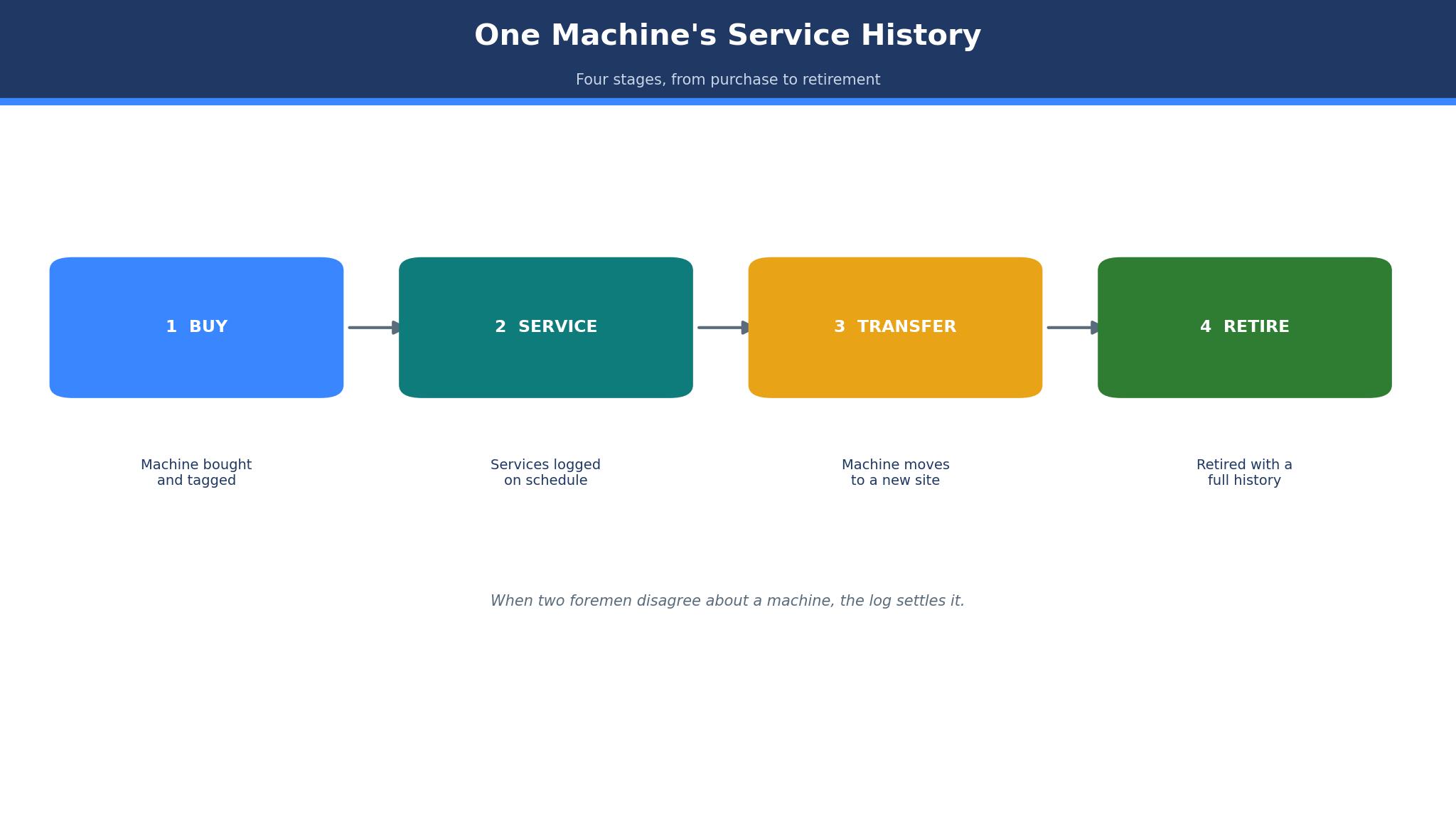
Ask each vendor to show the service history of a machine that has changed sites three times, because that record is the one a fleet manager reads most. Fleetio will show the services and the hours, Tenna will show the moves and the location, and the winner is the tool whose record the mechanic trusts. A record that the shop does not trust is worse than no record, because it sends a mechanic to the wrong machine with the wrong parts.
Worked example. A contractor with 80 assets, from excavators to generators, loses two small tools a month at $400 each, or $9,600 a year. Tenna’s tracking, at a reported $30 per asset a month, costs $28,800 a year, so it does not pay for itself on lost tools alone. It pays when the utilisation data also shows three machines sitting idle, and the contractor sells one of them.
The Machine That Was on the Wrong Site
Two foremen can disagree about where a machine is, and the best heavy equipment management software settles that argument with a record, not with a louder voice. A machine that was on the north site yesterday should show the move, the hours and the operator, so the dispute ends in a minute. A tool that cannot show the move leaves the fleet manager to choose which foreman to believe.
The transfer log is the feature that matters here. It should record who moved the machine, when it moved, and what job it moved for, because that log is also the cost record for the job. A machine that moves without a log creates a billing dispute, and a billing dispute creates a client who pays late. Check the transfer log during the trial, and move a machine yourself to see what it records.
Worked example. A contractor bills a client $2,000 a week for a machine on site, and the machine moves to another job for three days without a log. The client disputes $857, the contractor has no record to answer with, and the payment waits a month. A transfer log that costs nothing to keep would have settled it in a minute, and that is the real price of a tool without one.

Can a Small Fleet Afford Telematics at All?
Yes, if the fleet buys the right kind. A small fleet does not need a platform built for a hundred vehicles, it needs a simple tracker that shows location and hours, and Linxup or Fleetio can do that for a few hundred dollars a month. The mistake is buying a large platform for a small problem, and paying a large price for features the fleet never opens.
The test is the same at any size. Track the machines for a month, read the utilisation data, and count the hours saved, the tools found and the services caught on time. If the saving exceeds the subscription, keep it, and if it does not, cancel it. A small fleet should trial for a month on real machines, not on a demo account with perfect data.
Frequently Asked Questions
Can I switch heavy equipment software without losing service history?
Yes, export the full service history first, including hours, dates, parts and costs, and check that the new tool imports it before cancelling the old one. Keep the old system live for a month so mechanics can check a record they cannot find. A switch done on a quiet week beats a switch done mid-project.
Will it track my machines across sites?
Yes, Tenna, Samsara, Trackunit and Geotab track machines across sites with GPS, while Fleetio needs a telematics feed for live location. Check that the tracker fits the machine type, because a solar tracker suits a machine with no power, while a wired tracker suits a machine that runs daily.
How much does heavy equipment software cost per machine?
Fleetio publishes $4 to $10 per vehicle a month, while telematics platforms are reported at $20 to $40 per vehicle a month plus hardware. A fleet with 60 assets pays about $5,040 a year on Fleetio Professional, against about $21,600 a year on a telematics platform at $30 per asset. Ask for the full three-year figure before signing.
Does it work on machines from different makers?
Yes, Tenna, Trackunit and EquipmentShare T3 are built for mixed-brand fleets, and they track machines from different makers on one dashboard. Check that the tracker fits each machine, and ask about John Deere ownership of Tenna if the fleet runs mostly non-Deere machines.
What happens when a machine moves to another site?
A good tool records the move, the hours, the operator and the job it moved for, so the transfer log settles any dispute. A weak tool shows only the new location, with no history. Test the transfer log during the trial by moving a machine yourself.
How long does it take to set up?
Fleetio can run in days, while Tenna, Samsara and HCSS need weeks for hardware, training and data import. Budget the rollout time as well as the price, and start with a pilot fleet of ten machines before rolling out to the whole yard.
The Record That Settles Every Argument
Fleetio is the pick for a fleet that needs maintenance records at a published price, and Tenna is the pick for a mixed construction fleet that needs location and small-tool tracking together. Samsara wins for a large fleet with safety needs, and HCSS Equipment360 wins for a heavy civil crew. The best heavy equipment management software is the tool that keeps the record a fleet manager can defend, with the location data to back it up.
What I would do is start on Fleetio for the records, add telematics once the fleet knows which machines move most, and review utilisation every quarter. The record comes first, the map comes second, and a fleet that keeps both will stop arguing about where a machine is and start deciding what it should do next.