A 90,000 word novel takes about ten hours to listen to at a normal reading pace. That single fact explains why the best AI audiobook generators matter so much in 2026. A book that exists only in print or on a screen reaches readers who sit down to read. A book that also exists in audio reaches commuters, runners, cooks, parents doing school runs, and listeners who finish two or three books a month without ever opening a page. For independent authors, that audience used to be out of reach, because studio narration, editing, proof listening, and distribution could cost more than the book was ever likely to earn. AI narration has changed the maths, but it has not removed the judgement calls. Voice quality still varies a lot. Rights, pronunciation, pacing, and file quality still decide whether listeners finish the book or stop after chapter one.
This guide compares eight tools that can turn a manuscript into listenable audio in 2026. It does not rank them on a single score, because a solo novelist, a nonfiction author with a backlist, and a publisher producing a series have different needs. Instead, each tool is judged on voice naturalness, control over pronunciation and pacing, how it handles long manuscripts, what you can do with the finished audio, and where it falls short. Prices change often in this market, so every pricing note in this guide tells you to check the vendor checkout page before you buy. Do not buy on a price quoted in a blog post, including this one, without confirming the current plan, character limits, and commercial use terms.
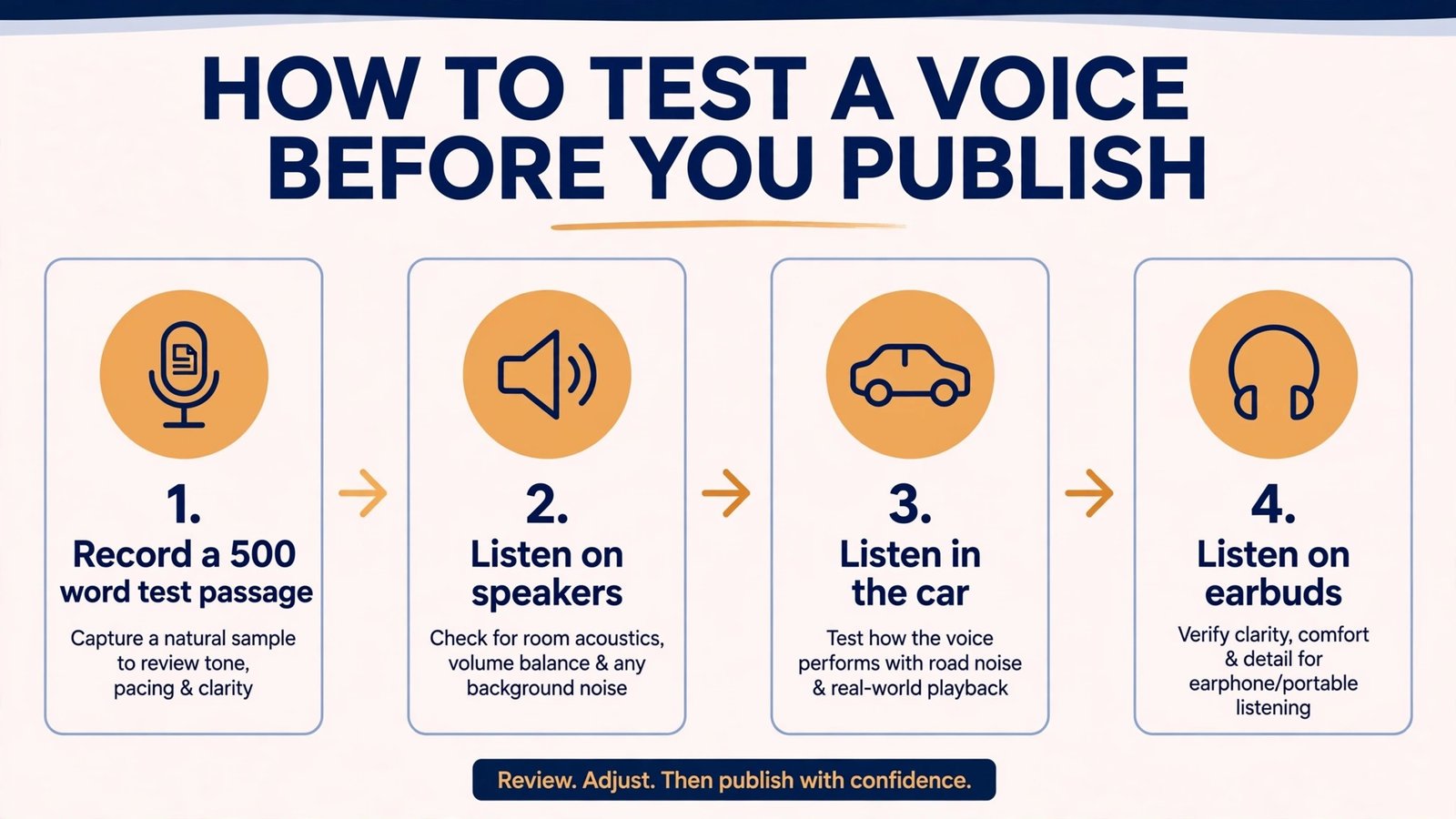
If you are starting from a finished manuscript, the fastest route is usually to test the same 500 word passage, with dialogue, names, numbers, and at least one foreign word, in two or three tools before you commit. That short test tells you more than any demo reel. Demo reels are chosen to sound good. Your chapter, with your names and your sentence rhythms, is the real test. Listen on cheap earbuds and in a car, not only on good headphones, because that is how most listeners will hear it.
Audio listening has grown from a niche habit into a normal way to consume books, courses, and long form nonfiction. That growth creates opportunity and also noise. More tools now claim to produce audiobook quality voices, but many were built for short social clips, ad reads, or customer service messages. Those voices can sound fine for thirty seconds and tiring for ten hours. Long listening exposes problems that short demos hide: flat emphasis, rushed lists, misread numbers, identical intonation on every sentence, and breathless pacing that never gives the listener a moment to absorb an idea.
The practical difference is control: pauses, pronunciation fixes, one consistent voice across a whole book, and clean chapter files you can check one by one. Test dialogue, lists, dates, and chapter openings, because those are where weak tools fail first.
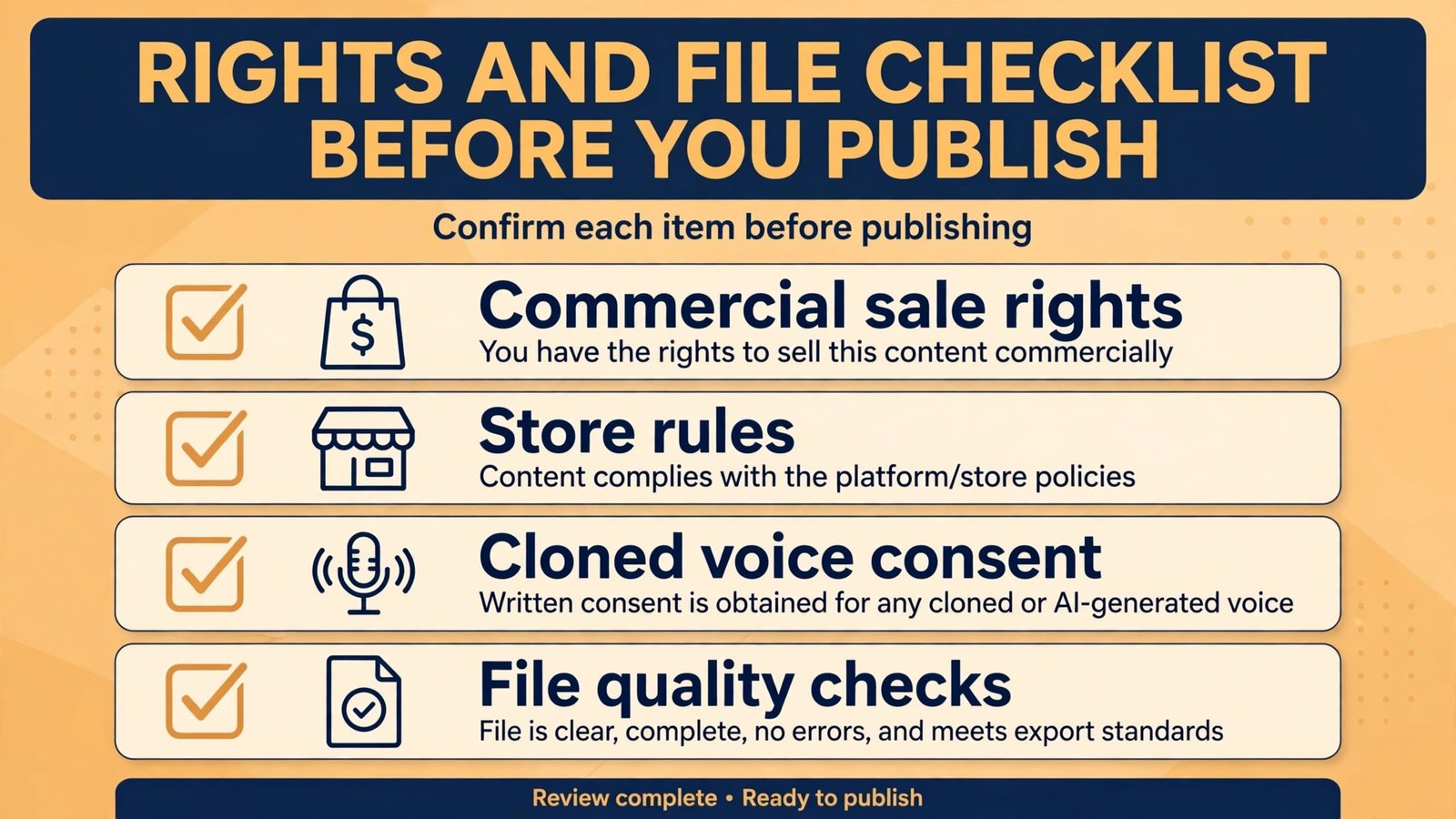
Rights matter as much as sound. Before you publish AI narrated audio, read the tool terms for commercial use, distribution rights, and whether you can sell the audio on more than one store. Some plans allow personal listening only, or limit distribution. If you plan to sell through Audible, Apple Books, Google Play, or your own site, confirm that your plan covers that use in writing, and keep a copy of the terms at the time you publish. For authors working with a co author, a publisher, or a narrator under contract, check who owns the voice output and whether a cloned voice needs separate consent. Never clone a real person’s voice without clear written permission.
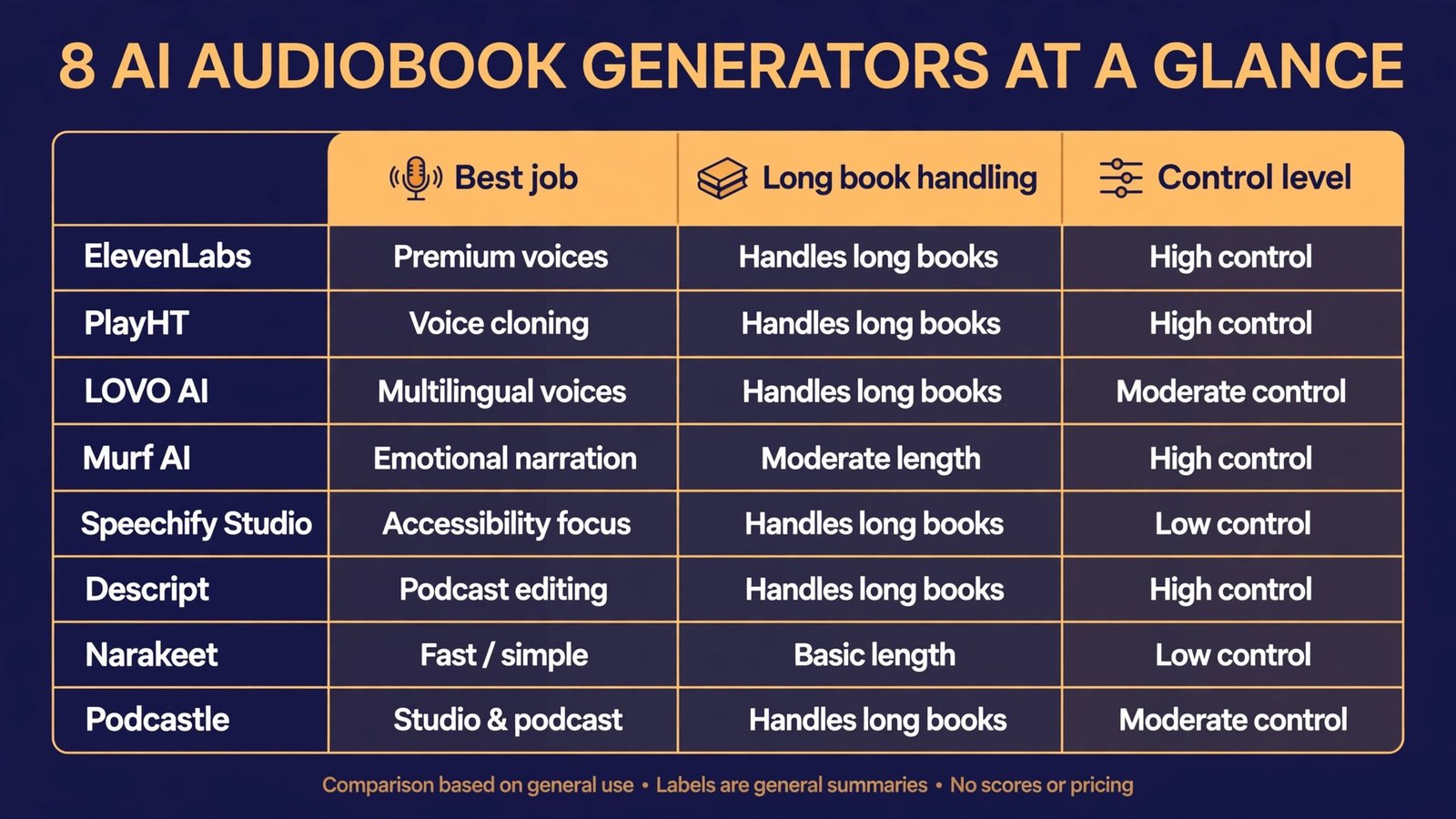
At a glance
| Tool | Best for | Long book handling | Voice control | Check before buying |
|---|---|---|---|---|
| ElevenLabs | Natural narration for fiction and nonfiction | Strong, chapter by chapter | Pronunciation, pacing, voice choice | Commercial use and plan limits on the checkout page |
| PlayHT | High volume backlists | Strong, bulk projects | Voice cloning with consent, pronunciation | Export rights and per month limits |
| Murf AI | Clean nonfiction and business books | Good, project based | Emphasis, pauses, voice styles | Commercial licence on the chosen plan |
| Speechify Studio | Authors who already use Speechify listening | Good, document based | Speed, voice choice, editing | Studio plan terms versus consumer listening plan |
| LOVO AI | Character voices and lighter fiction | Good for shorter books | Voice library, emotion settings | Long form consistency across chapters |
| Descript | Authors who want to edit audio like text | Good, transcript based | Overdub style editing, pacing | Export quality and chapter splitting |
| Narakeet | Simple, low cost production | Good for straightforward text | Voice choice, speed, volume | File formats and distribution terms |
| Podcastle | Creators turning writing into audio shows | Good for episodic audio | Recording, editing, voice tools | Audiobook export versus podcast hosting terms |
Best pick by job
| Job | First pick | Why it fits | Second option to test |
|---|---|---|---|
| A first novel, one voice throughout | ElevenLabs | Consistent, expressive narration that holds up over long chapters | PlayHT |
| A nonfiction backlist, many titles | PlayHT | Bulk handling and a wide voice library for different subjects | Murf AI |
| A business, self help, or how to book | Murf AI | Clear, steady delivery that suits instruction and explanation | Speechify Studio |
| A book plus a course or membership audio | Speechify Studio | Easy movement from manuscript to listenable lessons | Podcastle |
| Light fiction with distinct characters | LOVO AI | A broad voice range for dialogue heavy scenes | ElevenLabs |
| An author who edits by reading the transcript | Descript | Text based editing makes fixes fast | Murf AI |
| A tight budget, simple production | Narakeet | Straightforward conversion without a steep learning curve | Podcastle |
| Essays, articles, or a serial released as audio | Podcastle | Episodic structure and editing in one place | Descript |
1. ElevenLabs
ElevenLabs is the tool most authors test first, and for fiction it often stays first after testing. Its voices handle long sentences, dialogue tags, and emotional shifts better than most competitors, and the difference shows up in chapter three, not in the demo. You can build a consistent narrator voice for a whole book, adjust pacing for tense scenes versus reflective passages, and correct pronunciation for names that a generic voice would flatten. That matters for fantasy names, family names, and place names that recur across a series. If a name is said three different ways in one book, listeners notice, and reviews mention it.
The trade off is cost and care. Long books use a lot of generation capacity, so check the monthly limits on the plan you choose, and budget for regeneration. You will regenerate chapters. A line that reads well on the page can sound odd when spoken, and you will want to fix emphasis or add a pause. That is normal, not a sign the tool failed. Keep a pronunciation list from chapter one, with every name, invented word, and acronym written the way you want it spoken, and reuse it for every book in a series. For authors who also write courses, ElevenLabs audio can double as lesson narration, which helps justify the cost. Visit ElevenLabs and check the current checkout page for commercial terms before you publish.
Watch out for: long book costs adding up through regenerations, and the temptation to accept a good first draft without proof listening. Proof listen to every chapter at least once, ideally at normal speed for the first book you publish with a new voice.
2. PlayHT
PlayHT suits authors with more than one book to produce. Its strength is volume and variety: a large voice library, bulk project handling, and voice cloning for authors who have recorded their own voice and want to produce more audio in a similar style, with proper consent and rights in place. For nonfiction backlists, where each book needs a clear, reliable voice rather than a dramatic performance, PlayHT is efficient. You can move through titles without rebuilding your workflow each time, and you can test several voices quickly against the same passage.
The weakness to check is consistency. With so many voices available, it is easy to choose a voice that sounds great for an introduction and less good for dense middle chapters. Test a technical chapter, not only the opening, and test a chapter with numbers, quotes, and lists. Also confirm export and distribution rights for the plan you buy, because high volume plans and commercial plans are not always the same thing. If you sell audio through several stores, that distinction matters. Visit PlayHT and confirm limits and rights on the checkout page.
Watch out for: choosing voices on demo clips alone, and assuming a high volume plan automatically covers every store you plan to use.
3. LOVO AI
LOVO AI is worth testing for lighter fiction, romance, young adult stories, and books where dialogue carries the plot. Its voice library is broad, and its emotion settings let you push a line toward warmth, excitement, or tension without hiring a cast. For a single narrator book with lively dialogue, that range can make conversations easier to follow. For literary fiction that depends on subtle shifts in tone, test carefully, because strong emotion settings can sound overdone across ten hours. Use the lightest setting that still separates speakers, and let the writing do most of the work.
LOVO AI also appeals to authors who produce short audio extras, such as a free first chapter, a bonus scene, or audio for a newsletter. Those shorter pieces are a good place to learn the tool before committing a full novel to it. Check how a voice holds up across chapters, because a voice that feels fresh for a sample can feel repetitive when it is the only voice a listener hears for a week. If you write a series, keep the same voice and the same pronunciation list, and resist switching voices mid series unless you have a clear story reason. Visit LOVO AI and check the current plan page for long form use.
Watch out for: emotion settings that sound lively in a sample and exhausting over a full book, and voice drift between chapters if settings are changed midway.
For nonfiction, business, and teaching books
4. Murf AI
Murf AI is built for clarity. Business books, self help guides, how to manuals, and books that explain a process benefit from a voice that stays steady, pronounces terms cleanly, and does not distract from the content. Murf AI lets you adjust emphasis and pauses, which matters when a sentence contains a key instruction, a warning, or a definition the listener must remember. A voice that rushes a step by step section makes the listener rewind. A voice that pauses in the right place makes the same section feel easy.
Authors who also make courses will find Murf AI useful beyond the audiobook itself, because the same narration style works for lessons and explainer audio. If you write for freelance writers or for course creators, that reuse matters: one narration workflow can serve a book, a course, and a set of bonus audios. The limit to check is how Murf AI handles very long manuscripts with many headings, tables, and footnotes. Prepare a clean manuscript first, with tables rewritten as spoken sentences where needed, because a voice reading a table cell by cell is painful to listen to. Visit Murf AI and confirm the commercial licence for the plan you intend to use.
Watch out for: tables, footnotes, and URLs read aloud literally. Rewrite those parts for audio before you generate, and proof listen to every instructional chapter.
5. Speechify Studio
Speechify is familiar to many readers as a listening app, and Speechify Studio extends that into production for authors. If you already listen to drafts through Speechify, you will understand its voices quickly, and you can move from listening to a draft to producing a finished audio version without learning a completely new system. For nonfiction authors, for course creators, and for authors who publish lessons alongside books, that familiarity saves time.
The key check is the difference between a consumer listening plan and a studio production plan. Listening to your own draft for editing is not the same as publishing and selling audio. Make sure the plan you buy covers production and distribution, and check the export options for chapter files. Speechify voices tend to be clear and pleasant for instructional content, though for dramatic fiction you should test dialogue and long descriptive passages before committing. A voice that is perfect for a productivity book can feel too even for a memoir. Visit Speechify and check the studio plan terms on the checkout page.
Watch out for: confusing a listening subscription with a production licence, and assuming a clear instructional voice will also carry a dramatic story.
6. Descript
Descript takes a different approach, and for some authors it is the best one. It treats audio as text. You generate or import audio, edit the transcript, and the audio follows the edit. That makes fixing a misread name, a repeated word, or a clumsy sentence far faster than re-recording or regenerating whole sections in a traditional timeline editor. If you are the kind of author who revises by reading aloud and marking changes, Descript will feel natural.
For audiobooks, Descript works best when you already have a draft narration, or when you want tight control over pacing and cuts, rather than when you want a fully automated manuscript to audio conversion in one click. It rewards authors who are willing to edit. It is less ideal if you want to upload a manuscript and receive finished chapters with no further work, because its strength is editing, not hands off generation. For story generators users who draft fiction quickly, Descript is a strong second stage tool: draft fast, then edit the audio as text until it reads cleanly. Visit Descript and check export quality and chapter splitting before you start a long book.
Watch out for: underestimating editing time. Text based editing is faster than timeline editing, but a full audiobook still needs a full proof listen, and edits can introduce new pacing problems if you cut too tightly.
For low cost and episodic production
7. Narakeet
Narakeet is the simplest tool in this list, and simplicity is a real advantage for a first audiobook, a short book, or an author testing whether audio sells at all. You upload text, choose a voice, adjust speed and volume, and generate audio without a complex project setup. For straightforward nonfiction, short guides, children’s stories with simple language, and public domain style projects, Narakeet produces clean, usable audio at a low entry cost.
The trade off is depth of control. You get less fine control over emphasis, character voices, and long form consistency than the top tools in this guide. That is acceptable for a short book, and less acceptable for a complex novel where voice performance matters. Narakeet is also a good tool for producing a free sample chapter to test demand before you invest in a full production with a more expensive tool. If the sample sells the book, upgrade the production. If it does not, you have learned something cheaply. Visit Narakeet and check file formats and distribution terms on the current plan page.
Watch out for: using a simple tool for a complex book and then blaming the tool. Match the tool to the book, and use Narakeet where simplicity is enough.
8. Podcastle
Podcastle began as a podcasting tool, and that background shows in the best way for episodic audio. If you release a book as a serial, publish essays as audio, or turn a blog and a book into an audio show, Podcastle gives you recording, editing, and voice tools in one place. For authors who also host interviews, read listener letters, or add short commentary between chapters, Podcastle handles mixed audio better than a pure text to speech tool.
For a traditional single voice audiobook, Podcastle is workable but not always the first choice. Check its audiobook export options carefully, and distinguish podcast hosting terms from audiobook distribution rights. If your main goal is a finished audiobook for sale on book stores, test chapter exports early, and confirm file quality, chapter markers, and naming. If your main goal is an audio presence that builds an audience for your books, Podcastle may be the better investment, because it serves both the show and the book. For authors who also use book writing software, Podcastle is a natural next step from manuscript to spoken serial. Visit Podcastle and check the current plan page for audiobook export terms.
Watch out for: confusing podcast hosting with book distribution, and releasing chapters as episodes without the clean intros, outros, and file naming that book stores expect.
How the best AI audiobook generators differ over ten hours
Short demos hide the three problems that ruin long listening. The first is sameness. A voice that stresses every sentence in the same pattern sounds professional for a minute and robotic for an hour. Listen for variation in sentence endings, questions, and lists. A good narrator lets a question rise, lets a list build, and lets a final sentence land. The second problem is pronunciation drift. A voice may say a name correctly in chapter one and differently in chapter eight, especially if you regenerate chapters on different days or change a setting. Keep your pronunciation list in one document, and check names again after every regeneration. The third problem is pacing. Nonfiction needs pauses after key ideas. Fiction needs pauses after reveals. A tool that lets you insert pauses, slow a passage, or break a long paragraph into spoken breaths will produce a better book than a tool with a slightly nicer voice but no pacing control.
Test with the same passage in each tool: a conversation with three speakers, a paragraph with numbers and dates, and a quiet reflective paragraph. Listen once with full attention, then again while driving. If you stop noticing the voice and follow the story, it works. Also test at faster speed, since many listeners speed up audio.
Rights, stores, and the questions to ask before you publish
Audiobook rights are less forgiving than blog audio. A store can reject files for quality, naming, or rights reasons, and a rejection after you have announced a launch date is costly. Before you generate a full book, answer these questions in writing. Does your plan allow commercial sale, and on which stores? Can you use the audio on your own site and in ads? How long does the licence last, and what happens if you cancel? If you use a cloned voice, do you have written consent from the voice owner, and does that consent cover audiobook sale? If you are adapting a book you do not fully own, such as a co authored work, does your contract allow AI narration?
File quality matters too: consistent volume, clean chapter breaks, no clipped words, and a clear opening stating title and author. Use a checklist for every chapter, and proof listen fully. One missing paragraph can earn a one star review. If you cannot proof listen yourself, hire a proof listener for your first book with a new tool.
How to Choose the right generator for your book
Choose by book type first, not by voice demo. For a novel with dialogue, prioritise voice consistency and emotion control, and test a conversation chapter. For a business or self help book, prioritise clarity, pacing control, and clean handling of lists and steps. For a backlist, prioritise bulk workflow, consistent pricing, and export rights. For a serial or audio show, prioritise episodic editing and mixed audio handling. For a first test, prioritise low entry cost and simple exports, so you can learn whether audio sells for your audience before you spend more.
Then choose by your tolerance for editing. If you enjoy editing and want sentence level control, Descript or a tool with strong pronunciation and pause controls will suit you. If you want the closest thing to upload and publish, choose a tool with strong chapter handling and accept that you will still proof listen. No tool in this list removes proof listening for a paid book. Budget time for it in the same way you budget time for cover design and copyediting. A book that sounds rushed because you skipped proof listening will cost more in reviews and refunds than the hours you saved.
Cost deserves a separate check. Compare total cost for the whole book, not cost per month. A cheap monthly plan with a low generation limit can cost more in top ups and regenerations than a higher plan that covers the full book. Add proof listening time, cover art, and distribution fees to the total, and compare that total with the expected audio revenue for your genre and audience size. For many independent authors, the honest answer is to start with one book, learn the workflow, and then decide whether to convert the backlist. That is better than converting ten books badly and discovering that listeners do not finish them.
Mistakes to avoid when you publish AI narrated audio
The most common mistake is publishing without proof listening. Authors trust the tool because the sample sounded good, and listeners find the missing paragraph, the misread name, or the repeated sentence. The second mistake is choosing a voice for the author, not for the listener. A deep dramatic voice may suit your taste and tire your audience over ten hours. Test with beta listeners who do not know you, and ask them where they got bored or confused, not whether they liked the voice. The third mistake is ignoring audio specific editing. Tables, footnotes, image captions, and links that work in print do not work in audio, and leaving them in makes a book feel unedited.
Other mistakes are commercial: publishing on a plan that does not allow sale, cloning a voice without consent, or changing voices mid series without explanation. Leave a buffer week between finished audio and launch, and do not hide AI narration where a store requires disclosure. Honest labelling builds trust.
Frequently asked questions
Are the best AI audiobook generators good enough to sell?
Yes, for many books, provided you choose the right tool for the book type, proof listen fully, and fix pronunciation and pacing. They are not a shortcut past editing. The best results come from authors who treat AI narration as a production tool, not as a publish button. Fiction with subtle performance demands is harder than clear nonfiction, so test dialogue chapters before committing.
How long does it take to produce an audiobook with AI?
Generation itself is fast, often hours rather than weeks in a studio. Production is not fast, because proof listening a ten hour book takes ten hours, plus fix time. Budget at least two to three weeks of part time work for a full length book, including manuscript cleaning, generation, proof listening, fixes, and store upload. Short books can be faster, but do not promise a launch date until files are checked.
Can I sell AI narrated audio on Audible and Apple Books?
It depends on the store policy at the time you upload, and on your tool licence. Check both before you generate a full book. Some stores accept AI narration with disclosure, some have specific quality and labelling rules, and policies change. Confirm the current rules on the store help pages, and keep a record of the terms you relied on.
Should I clone my own voice for my audiobook?
Only if you are comfortable with the rights and security questions, and only with a tool that gives you clear control over the voice model. Cloning your own voice can create a consistent brand across books and courses, but it also creates a voice model that must be protected. Read the tool terms on voice model storage, use, and deletion, and do not clone another person’s voice without written consent.
What manuscript format works best?
A clean text or document file, with chapters clearly separated, tables rewritten for audio, and footnotes either removed or rewritten as spoken asides, works best. Remove page numbers, running headers, and image captions that add nothing in audio. Keep a separate pronunciation list for names, places, and invented words, and update it as you proof listen.
Do listeners mind AI narration?
Some listeners prefer human narration and will skip AI narrated books. Others care mainly about story, clarity, and price, and will listen happily if the voice is natural and the production is clean. The way to win the second group, and to avoid complaints from the first, is honest labelling, a strong sample, and a fully proof listened book. A cheap sounding production confirms the worst expectations. A careful production changes minds.
Is it cheaper than hiring a human narrator?
Usually yes for the first book, especially for long books, but compare total cost, not only narration cost. Add your proof listening time, regeneration costs, cover art, and distribution. For a short book with a small audience, AI is often clearly cheaper. For a flagship title where narration performance is central to the brand, a human narrator may still be worth the cost, and some authors publish both versions over time.
Conclusion: start with a sample, then commit to one book
The best AI audiobook generators in 2026 give independent authors a real route into audio, but the tool is only half the decision. The other half is your workflow: a clean manuscript, a pronunciation list, chapter by chapter generation, and a full proof listen. Start by testing the same passage in ElevenLabs and PlayHT if you write fiction, or in Murf AI and Speechify Studio if you write nonfiction. Listen on earbuds and in a car, check rights on the checkout page, and produce one book well before you convert a backlist. One finished, well reviewed audiobook teaches you more than ten rushed conversions. If audio sells for you, scale with the tool that proved itself on that first book, not the tool with the loudest demo.