

The best AI agents for lead generation in 2026 don’t look much like the lead-gen tools of three years ago. The old workflow — buy a list, export a CSV, blast a sequence — is being replaced by agents that research a prospect’s company, verify contact data across multiple sources, score fit, and draft outreach referencing something real: a funding round, a new hire, a job post mentioning your competitor’s tool.
To see which products actually deliver that, we ran the same test through six platforms: given one ideal customer profile (B2B SaaS, 50–500 employees, US-based, hiring SDRs), produce 100 enriched, verified, outreach-ready leads and a first-touch email draft for each. We recorded verified-email hit rate, signal quality, time-to-list, and the true cost per usable lead once credit mechanics were accounted for. Here’s what we found.
Quick Answer
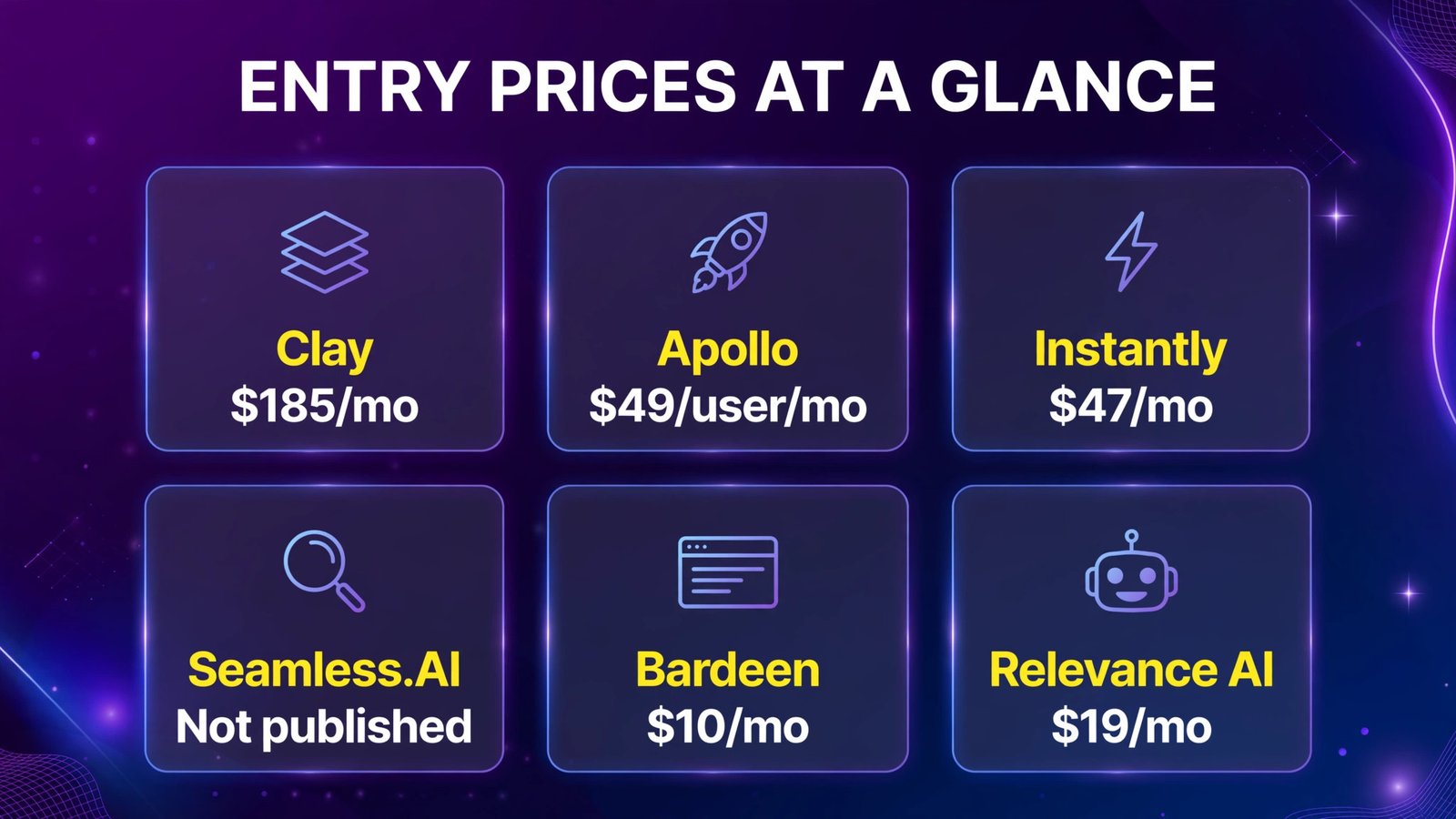
| Tool | Entry price (Oct 2026) | Pricing model | Best for |
|---|---|---|---|
| Clay | $185/mo (Launch) | Usage-based credits, unlimited seats | Enrichment waterfalls + AI research at the core of your stack |
| Apollo | $49/user/mo (annual) | Per-seat + credits | One tool for data, sequences, and dialer on a budget |
| Instantly | $47/mo (Outreach Growth) | Flat by sending volume | Sending at scale + AI reply handling |
| Seamless.AI | Not published (sales-led) | Per-user + credits, annual contracts | Real-time contact search for teams that prefer a vendor call |
| Bardeen | $10/mo (Basic) | Credits per browser action | Browser-based scraping and lightweight GTM automation |
| Relevance AI | $19/mo | Actions/credits | Building custom multi-step lead-gen agents |
Bottom line: For most teams, the answer is a two-tool stack: Clay (or Apollo if budget is tight) for sourcing and enrichment, plus Instantly for sending and reply handling. Bardeen wins for scrappy browser-based list building, Relevance AI for teams who want to build their own lead-gen agent, and Seamless.AI only if you’re comfortable with sales-led, unpublished pricing.
How We Tested
One ICP, one deliverable per tool: 100 leads with verified work email, firmographics, one personalization signal (funding, hiring, tech stack, or news), and a first email under 75 words. We scored verified-email hit rate, signal quality, time to list, and true cost per lead (plan cost amortized over usable leads only — credit burn on misses counted against the tool).
1. Clay — The Enrichment and Research Engine
What it is: Clay is a spreadsheet-like orchestration layer on top of 100+ data providers. You build a table of target companies or people, then run “waterfall” enrichment: it tries the cheapest provider first for an email, falls back to the next, and only charges you when a provider returns a result. Its AI research agent (Claygent) browses the web to answer research questions per row — “did this company raise funding in the last 6 months?” — which is what makes Clay feel like an agent platform rather than a database.
2026 pricing (verified): Clay overhauled pricing in March 2026. Free: 100 Data Credits + 500 Actions/month. Launch: $185/month ($167 annual) with ~2,500–3,000 Data Credits and 15,000 Actions. Growth: $495/month ($446 annual) with 6,000 Data Credits and 40,000 Actions, adding CRM sync and API/webhooks. Enterprise: custom. All plans include unlimited seats — you pay for consumption, not headcount.
Our test: The strongest data result of the six. The waterfall lifted our verified-email hit rate to ~76% (vs. ~40% from any single provider), and Claygent’s research signals were genuinely usable — it correctly flagged two companies mid-fundraise and one that had just posted three SDR roles. Build time was the longest: about 90 minutes to configure the waterfall, research prompts, and scoring column. A tool you set up once and operate.
Pros:
- Waterfall enrichment produces the highest verified-email hit rate we tested
- Bring-your-own-API-keys option cuts Data Credit costs if you already pay providers directly
- Claygent research produces real personalization signals, not filler
- Unlimited seats — cost scales with usage, not team size
Cons:
- Two-meter billing (Data Credits vs. Actions) takes a month to forecast confidently
- Steepest learning curve of the six
Verdict: The best lead-generation agent platform for teams who treat outbound as a system. If you can only buy one “agent-class” tool, it’s Clay — pair it with any sequencer.
2. Apollo — The All-in-One Budget Default
What it is: Apollo combines a 270M+ contact database, waterfall enrichment, intent signals, email sequences, and a dialer in one per-seat product. Its AI features — research assistant, AI email writing, workflow automation on buying signals — layer agent-like behavior on a classic sales platform.
2026 pricing (verified): Free tier with limited credits and 2 sequences. Basic: $49/user/month billed annually ($59 monthly). Professional: $79/user/month annual ($99 monthly) — adds the US dialer, intent topics, advanced filters. Organization: $119/user/month annual ($149 monthly), 3-seat minimum. Watch the credits: credits do not roll over, and overages cost $0.20 each (250-credit minimum purchase).
Our test: Fastest time-to-list by a wide margin — filters to exported list in under 15 minutes. Verified-email hit rate landed around 60–65% on our ICP; built-in waterfall enrichment on paid plans improved it but didn’t match Clay’s multi-provider depth. The AI-drafted first emails were competent but generic until we fed the AI assistant our own examples — bring your own templates.
Pros:
- Data + sequences + dialer in one bill; nothing else to integrate
- Published, predictable per-seat pricing — the easiest budget conversation here
- Generous free tier for a genuine pilot
Cons:
- Credits expire monthly and mobile numbers burn credits several times faster than emails
- Data depth outside North America is noticeably weaker — test your region before committing
Verdict: The right default for small teams: if your whole outbound motion fits in Apollo, you’ll spend less and ship faster.
3. Instantly — The Sending and Reply Layer
What it is: Instantly started as a cold-email sender built around unlimited mailboxes and built-in warmup, and has grown an agent layer on top: an AI Sales Agent that sources leads and runs outbound, and an AI Reply Agent that answers inbound replies in under five minutes. Its lead database (SuperSearch, now Instantly Credits) can also be your data source, though most serious teams feed it lists built elsewhere.
2026 pricing (verified): Outreach plans: Growth $47/month ($37.60 annual) — 1,000 contacts, 5,000 emails/month; Hypergrowth $97/month ($77.60 annual) — 25,000 contacts, 100,000 emails/month; Light Speed $358/month — 100,000+ contacts, 500,000+ emails, private deliverability network. Lead data/AI features run on a separate Instantly Credits subscription (from ~$47/month), where an AI Sales Agent lead or an AI Reply Agent reply costs 5 credits. No per-seat charges.
Our test: As a sending platform it’s the most forgiving we used — unlimited inboxes and warmup removed the deliverability babysitting that eats afternoons elsewhere, and inbox placement testing caught a problem domain before it cost us. The Reply Agent handled the mechanical replies (OOO routing, “send more info,” unsubscribe) well; for genuine buying questions we kept it in human-in-the-loop mode for the first month.
Pros:
- Unlimited sending accounts and warmup on every paid plan — scale by domains, not seats
- AI Reply Agent genuinely removes reply-triage busywork
- Flat, published pricing; no annual commitment required
Cons:
- Data quality from its own database trails Clay/Apollo — best used as the sending layer
- Separate subscriptions for data, CRM, and verification push the real bill above the headline $47
Verdict: The sending half of the modern outbound stack. Pair with Clay or Apollo for data and it’s close to unbeatable value.
4. Seamless.AI — Real-Time Search, Opaque Pricing
What it is: Seamless.AI is a real-time B2B contact search engine: you search by company, role, or criteria and it researches contacts live to surface emails and direct dials, with a Chrome extension for prospecting from LinkedIn and CRM integrations (Salesforce, HubSpot, Salesloft). Its pitch is freshness — contacts researched on demand rather than pulled from a static database.
2026 pricing (could not verify a published price): Seamless.AI does not publish paid pricing — as of October 2026 its pricing page routes to a sales/demo form. The model is per-user licensing plus credit packages, typically on annual contracts, with add-ons (buyer intent, enrichment, API) priced separately. Third parties commonly cite Pro around ~$79/user/month and Basic around ~$147/month billed annually, but treat those as negotiation anchors, not a rate card — reported figures vary widely. The free tier offers a small credit allotment.
Our test: Search speed is excellent and the extension workflow is the slickest of the six for reps prospecting live on LinkedIn. Data accuracy was the weak point: email accuracy trailed Apollo’s verified rate, and roughly six in ten direct dials reached the right person.
Pros:
- Real-time research model means fresher contacts than static databases
- Best-in-class Chrome extension for in-the-flow prospecting
- Credit-back protection on invalid emails
Cons:
- No published pricing; annual contracts and reported renewal friction — read terms carefully before signing
- Phone data accuracy lagged in our test (~60%)
- Add-ons reportedly add 40–60% on top of base pricing
Verdict: A capable search engine for teams that prospect live and prefer a vendor relationship — but in 2026, unpublished pricing is itself a buying signal. Get contract, credit, and renewal terms in writing before committing.
5. Bardeen — The Browser Agent for Scrappy List Building
What it is: Bardeen is a browser-based automation agent: a Chrome extension that scrapes web pages (search results, LinkedIn profiles, directories), enriches records, qualifies them with AI, and pushes results to Sheets, Notion, HubSpot, or Airtable. You build “playbooks” — increasingly by describing the task in plain language and letting its AI assemble the workflow.
2026 pricing (verified): Free: 100 credits/month. Basic: $10/month. Premium: $50/month (1,000 credits, or $480/year), Enterprise: custom. Credits are charged per action per row: most steps cost 1 credit per row, enrichment 3.
Our test: For the job of “turn this attendee page / search result / directory into an enriched list,” nothing else here is as fast to start — a working scraper in under ten minutes. The catch is arithmetic: multi-step playbooks burn credits per row at every step, so Premium’s 1,000 credits evaporate quickly at list scale. A scalpel for targeted list building, not a bulk data engine.
Pros:
- Cheapest way to start — $10/month, plus a usable free tier
- Scrapes sources databases don’t cover (event pages, niche directories, live search results)
- Plain-language playbook building; results land directly in Sheets/CRM
Cons:
- Per-row credit math punishes multi-step workflows at volume
- Browser-based: needs your browser open, and site layout changes can break scrapers
Verdict: The best $10 in outbound for targeted list building. Use it for the accounts databases miss; don’t try to run your whole pipeline on it.
6. Relevance AI — Build Your Own Lead-Gen Agent
What it is: Relevance AI is an agent-building platform: you assemble AI “agents” and multi-agent teams from templates and tools — web research, enrichment APIs, scoring logic, outreach drafting — and schedule them to run autonomously. Where Clay is a data machine with agent features, Relevance is an agent platform you point at lead generation.
2026 pricing (verified): Free: 200 actions/month. Paid plans start at $19/month, scaling by actions and vendor credits; you can also bring your own model/API keys to control costs at volume. Enterprise adds private-cloud deployment options.
Our test: We rebuilt a simplified version of our Clay workflow — research companies against ICP criteria, score, draft outreach — as a scheduled agent, in ~40 minutes from a template. Research quality depended heavily on the prompt engineering we put in, but once tuned it ran hands-free and produced the most judgment-like output of the six: it correctly deprioritized two companies that matched firmographics but had just been acquired. That’s the agent difference — it reasons about edge cases a filter can’t.
Pros:
- True agent model: scheduled, autonomous, multi-step reasoning — not just enrichment
- Bring-your-own-keys keeps model costs transparent at scale
- Strong template library for sales/research agents to start from
Cons:
- Output quality is only as good as your prompts — budget real tuning time
- Per-action pricing needs modeling before you run agents on big lists
Verdict: For teams with an operator mindset who want a lead-gen agent, not a lead-gen database. The ceiling is the highest here; the floor depends on your prompt craft.
A Sample End-to-End Workflow (The Stack in Action)
Here’s the workflow we’d actually run in 2026, using the winners above:
- Define the ICP in Clay. Target account list from firmographic filters + buying signals (hiring SDRs, recent funding, tech-stack mentions).
- Waterfall enrichment in Clay. Email lookup cascades across providers until verified; phones added only for your top tier.
- Claygent research per account. Funding in last 6 months? New sales leader? Job posts mentioning competitors? Output feeds a fit score and personalization line.
- Score and cut. Fit score ≥7 goes to outreach; 4–6 to nurture; <4 is dropped. In our test this cut ~35% of the raw list — leads you don’t send to are pure deliverability savings.
- Push to Instantly. Verified emails + personalization line sync to a 3-step, 10-day sequence across warmed secondary domains.
- Reply handling. Instantly’s AI Reply Agent clears OOO/unsubscribe/info requests; anything with buying intent routes to a human within the hour.

Human time in this workflow: ~2 hours/week on real replies, vs. 10+ hours/week doing the same volume manually.
Cost-Per-Lead Math
Sticker prices lie; cost per usable lead is the number that matters. Using our test (100-target ICP, verified emails only):
| Tool | Plan used | Approx. cost per verified lead | Notes |
|---|---|---|---|
| Apollo | Basic, 1 seat ($49/mo) | ~$0.30–$0.60 | Assumes credit allowance largely spent on this ICP; overages at $0.20/credit raise it |
| Clay | Launch ($185/mo) | ~$0.50–$1.20 | Waterfall hit rate ~76% spreads the plan cost well; Claygent research adds per-row cost |
| Instantly (data via Credits) | Outreach Growth + Credits | ~$0.40–$0.90 | Sending included; best value if you also need the sequencer |
| Bardeen | Premium ($50/mo) | ~$0.80–$2.00 | Multi-step playbooks burn 10–60+ credits per lead depending on steps |
| Seamless.AI | Sales-led | Cannot state | Pricing unpublished — model your cost from the quote, including add-ons and credit burn on misses |
| Relevance AI | $19/mo entry | Varies widely | Depends on actions per lead and BYOK |

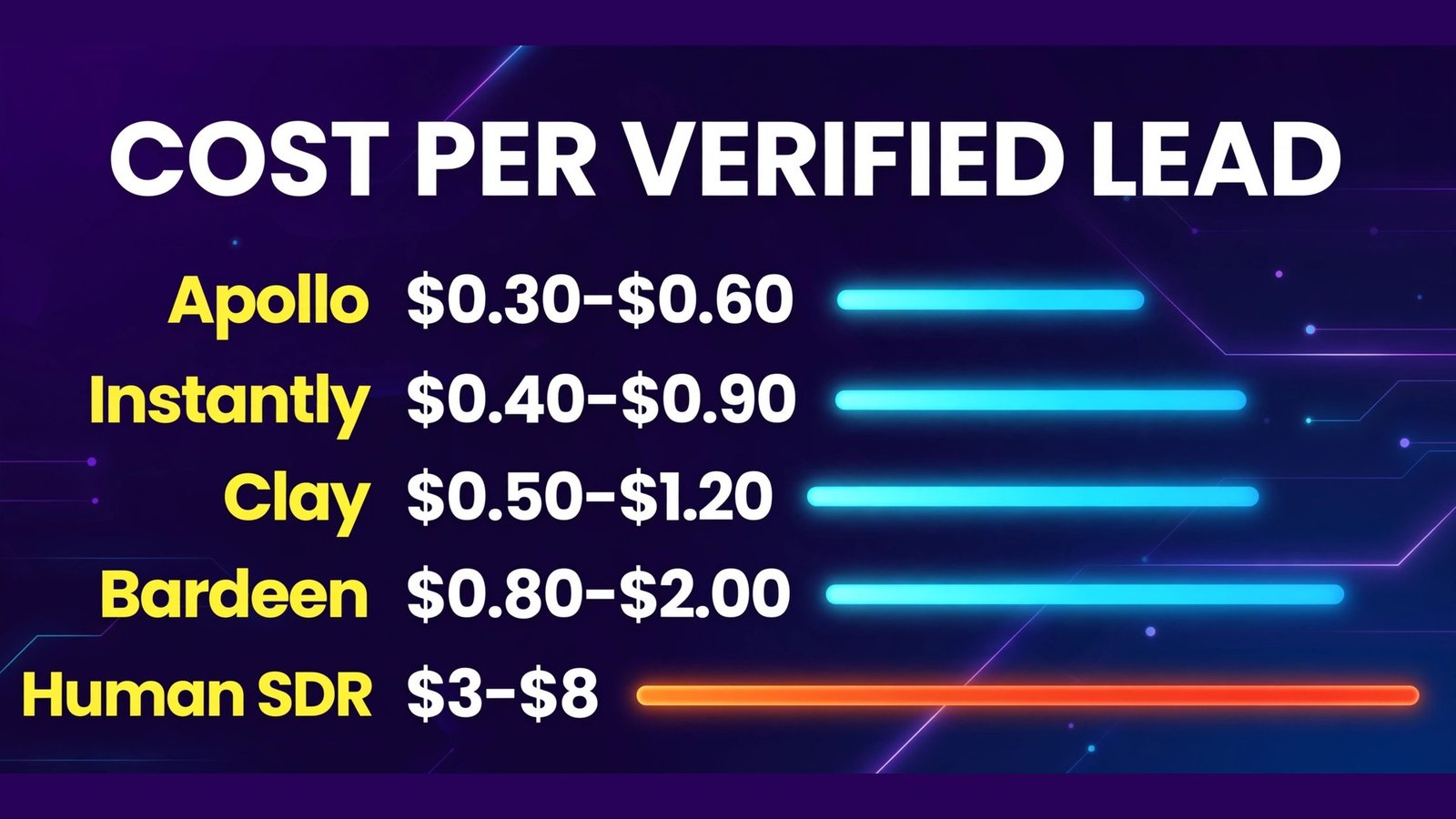
For calibration: a human SDR researching and enriching leads manually typically produces a fully-loaded cost of $3–$8 per researched lead. Every tool here beats that by an order of magnitude.
A Note on GDPR and Compliance

AI lead-gen agents operate at machine speed, which means they can create compliance exposure at machine speed too. The essentials:
- GDPR (EU/UK prospects): B2B outreach generally relies on legitimate interests — which requires a documented balancing test, a clear opt-out in every message, and honoring objections immediately. Scraped personal data (especially personal emails and mobiles) still counts as personal data, and ePrivacy/PEPR-style rules add stricter, country-level variation on electronic marketing.
- CAN-SPAM (US): Accurate headers, no deceptive subject lines, a working unsubscribe, and your physical address are mandatory — agents don’t exempt you.
- Data sourcing: Prefer tools sourcing from business-public sources with suppression-list handling. Keep one global suppression list across all tools so an opt-out in one system can’t be re-emailed by another — the classic multi-tool stack failure.
- AI disclosure: Never let an agent impersonate a specific real person; a growing number of jurisdictions and enterprise buyers expect disclosure when outreach is AI-generated.
This is operational guidance, not legal advice — if EU outreach is a core motion, have counsel review your basis and templates before scaling volume.
Full Comparison Table
| Clay | Apollo | Instantly | Seamless.AI | Bardeen | Relevance AI | |
|---|---|---|---|---|---|---|
| Entry price | $185/mo | $49/user/mo | $47/mo | Not published | $10/mo | $19/mo |
| Free tier | Yes (100 credits) | Yes | Trial only | Small credit allotment | Yes (100 credits/mo) | Yes (200 actions/mo) |
| Pricing model | Usage credits, unlimited seats | Per-seat + credits | Flat by volume + credits | Per-user + credits (annual) | Credits per action | Actions/credits |
| Verified-email hit rate (our test) | ~76% | ~60–65% | ~55–60% (own data) | ~55% | Depends on source | Via connected tools |
| Built-in sending | No | Yes | Yes (core strength) | No | No | No |
| AI research agent | Yes (Claygent) | Basic | Basic | Limited | AI qualification | Yes (core strength) |
| Best role in stack | Data/research core | All-in-one | Sending/replies | Live search | Targeted scraping | Custom agents |
How to Choose
- Decide your stack shape first. One tool (Apollo) or best-of-breed stack (Clay + Instantly)? Solo founders and small teams: Apollo. Dedicated outbound operator: the stack wins.
- Model cost per verified lead, not the plan price. Run your real ICP through free tiers and count verified, usable leads out the other side, including credit burn on misses and overages.
- Match the tool to your bottleneck. Bad data → Clay’s waterfall. No sending infrastructure → Instantly. Leads hiding outside databases → Bardeen. A repeatable research process to automate → Relevance AI.
- Treat unpublished pricing as a cost. If a vendor won’t show prices (Seamless.AI), the sales cycle, annual lock-in, and renewal terms are part of the price — negotiate credit-back and cancellation terms explicitly.
- Start with deliverability, not volume. Whatever you pick: secondary domains, warmup, verified-only sends, and a shared suppression list come before your first campaign.
Frequently Asked Questions
What is the best AI agent for lead generation overall?
For most B2B teams in 2026, Clay — its waterfall enrichment produced the highest verified-email hit rate in our test (~76%), and Claygent’s research generates usable personalization signals. Pair it with Instantly for sending. On a budget, Apollo alone covers data + sequences + dialer from $49/user/month.
How much do AI lead generation tools cost per lead?
In our testing, roughly $0.30–$2.00 per verified lead — Apollo at the low end, credit-heavy multi-step Bardeen playbooks at the high end. Calculate per verified lead: tools that charge for misses or expire credits monthly cost more than the plan price suggests.
Can AI agents replace SDRs for outbound?
They replace the SDR’s research and plumbing hours — list building, enrichment, first-draft personalization, reply triage. They don’t replace discovery calls, objection handling, or multi-threaded account strategy. The realistic model: one operator running agent tooling does the top-of-funnel work that previously took a small team.
Is it legal to use AI agents to scrape and email leads?
It depends on jurisdiction and execution. In the US, CAN-SPAM sets the floor (real headers, working unsubscribe, physical address). In the EU/UK, GDPR legitimate-interests can cover B2B outreach but requires a documented basis and immediate opt-out handling. Machine-generated outreach impersonating a real person is a growing legal and reputational problem — don’t do it. Get counsel’s review before scaling EU outreach.
Clay vs Apollo: which should I pick?
Apollo if you want one login for data, sequences, and calls at a published per-seat price and your market is mainly North America. Clay if data quality and research depth are your bottleneck, you already have a separate sending tool, and someone on the team will build the enrichment system. Many mature teams run both: Clay as the research core, Apollo for gap-filling.
Do I still need an email verification tool?
Mostly no, if you use the tools’ verification correctly: Clay only charges for verified waterfall results, and Apollo and Instantly verify within their flows. Yes if you’re importing lists from elsewhere (events, scrapers like Bardeen, purchased data) — verify those before they touch your sending domains.
Conclusion
The best AI agents for lead generation split into clear roles in 2026: Clay owns enrichment and research, Apollo is the all-in-one budget default, Instantly owns sending and reply handling, Bardeen is the $10 scalpel for off-database list building, Relevance AI is the build-your-own agent platform, and Seamless.AI is a capable search engine held back by sales-only pricing. The teams getting results aren’t using more tools — they’re using a tight stack, scoring before sending, and measuring cost per verified lead instead of cost per plan.
Next step: take your current ICP, run it through Clay’s and Apollo’s free tiers this week, and compare verified-email hit rate and cost per usable lead. Your own market’s numbers will make this decision in an afternoon.