
A product roadmap fails when it tries to be everything at once, a promise to customers, a plan for engineers, and a negotiation tool for stakeholders, all on one crowded board. When you use Miro for product roadmap planning, the board becomes a shared picture of what matters now, what comes next, and what is deliberately not being done, which is often the most valuable decision of all. That shared picture reduces arguments about priorities, because everyone can see the same trade offs in the same place.
This guide builds a roadmap board that survives contact with real stakeholders. You will structure the board, prioritise honestly, connect work to goals, run a review workflow, and update the board on a fixed rhythm. Miro pricing checked at draft time lists a free plan with 3 editable boards, Starter at 8 dollars per member per month billed yearly, and Business at 16 to 20 dollars per member per month depending on the source and billing period, so confirm current pricing on the official page before budgeting.
Why This Approach Works
Roadmaps work when they show sequence and reasoning, not just a list of features. A board that groups work by goal, orders it by time horizon, and shows what was cut and why, helps a team say no with confidence, because the no is visible as a choice, not as neglect. Miro suits this work because the canvas is flexible, sticky notes and frames can be rearranged in a live meeting, and stakeholders can comment without learning a project tool. The board becomes the meeting itself, rather than a slide prepared for a meeting, which keeps discussion honest and decisions visible.
A roadmap board also protects the team from the most common roadmap disease, which is a board that grows without ever shrinking. Every new request adds a card, while completed and rejected items linger, until the board is unreadable and nobody trusts it. A fixed review rhythm, with explicit rules for archiving completed work and parking rejected ideas, keeps the board readable and trustworthy. Trust is the real product of a roadmap process, because a board that stakeholders trust will be consulted, while a board they distrust will be ignored, no matter how detailed it is.

How to use Miro for product roadmap planning Step by Step
Build the board in the order below, and do not add feature cards before goals and horizons are settled. When you use Miro for product roadmap planning, goals come first, because a feature without a goal is a guess, while a goal without features is a prompt for honest discussion about what will actually move it.
- **Define goals and time horizons first.** Write two or three goals for the period, such as improving activation, reducing churn, or entering a new segment, and define three horizons, now, next, and later. Keep horizons as periods, not exact dates, for later work, because false precision in later horizons creates false promises. Every feature card must link to a goal, or it does not belong on the board.
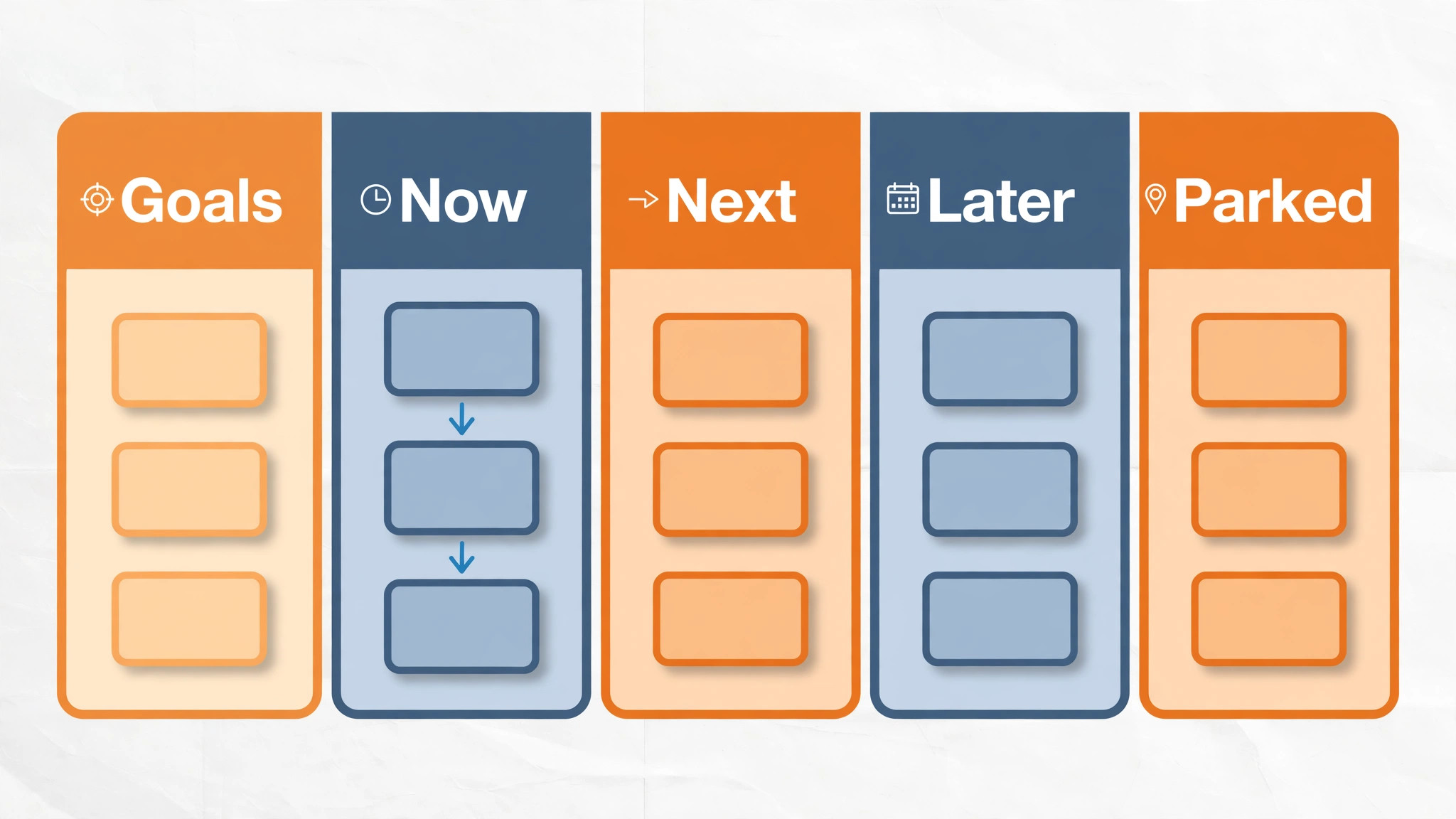
- **Create the board structure with frames.** Set up frames for goals, now, next, later, and parked ideas, with a consistent card format for each item, including title, goal, owner, effort estimate, and success measure. Use colour sparingly, one colour per goal or per horizon, so the board stays readable at a glance. A consistent card format makes comparison fair, because items are judged on the same information.
- **Gather candidate items from all sources.** Collect requests from customers, support, sales, analytics, and the team into a parking area first, without judging them yet. Note the source and the evidence for each item, such as a support count, a sales note, or a usage figure. Gathering before judging prevents the loudest voice in the room from setting the roadmap by default.
- **Prioritise with a simple scoring rule.** Score each candidate on impact, confidence, and effort, using a simple scale, and discuss scores as a team rather than averaging them silently. A simple rule that everyone understands beats a complex model that nobody trusts, because prioritisation is a discussion tool, not a calculation that replaces judgment. Record the score and the reasoning on each card.
- **Sequence the now horizon in detail.** Order the now horizon items by dependency and by value, and break large items into smaller cards that can be delivered in stages. Note dependencies between cards with connectors, so the team can see what blocks what. A now horizon that is sequenced and sized realistically will be believed, while an overloaded now horizon will be ignored.
- **Mark what is deliberately not being done.** Move rejected or deferred items to a parked area with a short reason, such as low impact, high effort, or wrong timing, and review parked items quarterly. Explicit parking is kinder than silent ignoring, because requesters can see their item was considered. It also protects the team from re-arguing the same requests every month.
- **Run a stakeholder review on the board.** Walk stakeholders through the board live, starting with goals, then the now horizon, then the trade offs in next and later. Invite challenges to scores and sequence, and record decisions and dissent on the board itself. A live review on the board creates shared ownership, while a slide deck review creates an audience that feels no responsibility for the decisions.
- **Publish a read only view and a change log.** Share a view only link for stakeholders, with a short change log noting what changed in each update and why. Update the board on a fixed rhythm, such as monthly, and announce updates briefly, so stakeholders learn to check the board instead of asking for ad hoc updates. A published board with a change log is a roadmap, while a board that changes silently is a rumour.
After the first published version, protect the board from silent edits by agreeing who can change priorities and how changes are announced. A roadmap that changes without explanation loses trust faster than a roadmap that is wrong but honest about its changes. Record every priority change with a date and a reason, and the board will remain a reliable reference even when plans shift.
Options Compared
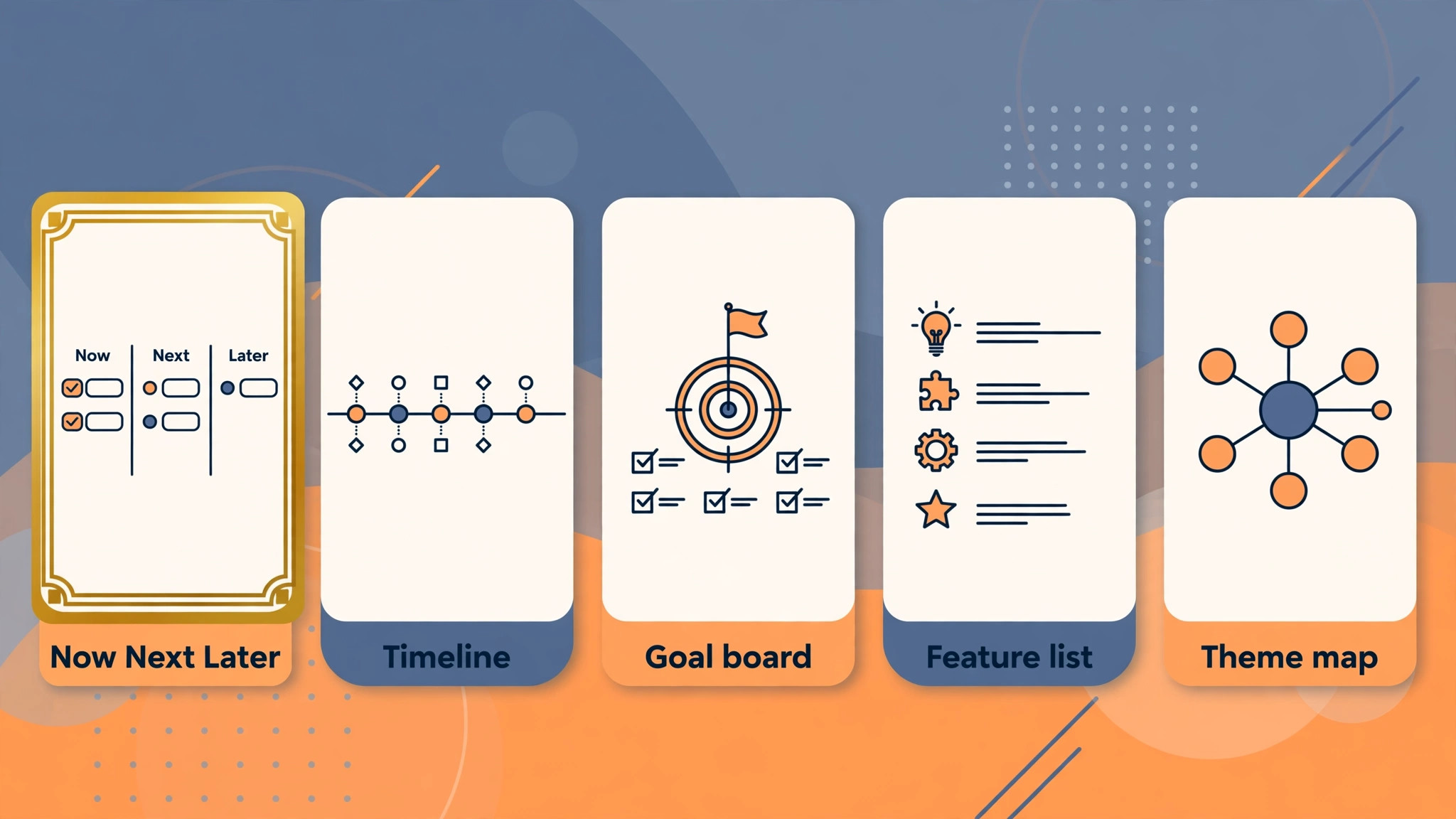
Roadmap formats suit different audiences, and the wrong format for the audience creates confusion even when the priorities are right. When you use Miro for product roadmap planning, choose the format by who will read the board and what decision they need to make, not by which format looks most impressive. The table below compares the main formats on clarity, detail, and best audience.
| Roadmap format | Best audience | Watch out for |
|---|---|---|
| Now, next, later board | Whole team and stakeholders | Vague later horizon needs review |
| Timeline roadmap | Leadership and delivery planning | False precision on distant dates |
| Goal based board | Product and leadership discussion | Needs clear goal measures |
| Feature list | Engineering task planning | Hides goals and trade offs |
| Theme roadmap | Customer and market communication | Too high level for delivery teams |
For most teams, a now, next, later board grouped by goal is the best starting format, because it is easy to read, easy to update, and honest about uncertainty in later work. Add a timeline view only when delivery planning needs dates, and keep the timeline as a view of the same board, not as a second roadmap that can drift apart. One board, with views for different audiences, prevents the classic failure of two roadmaps that disagree.
Costs and Tools to Budget For
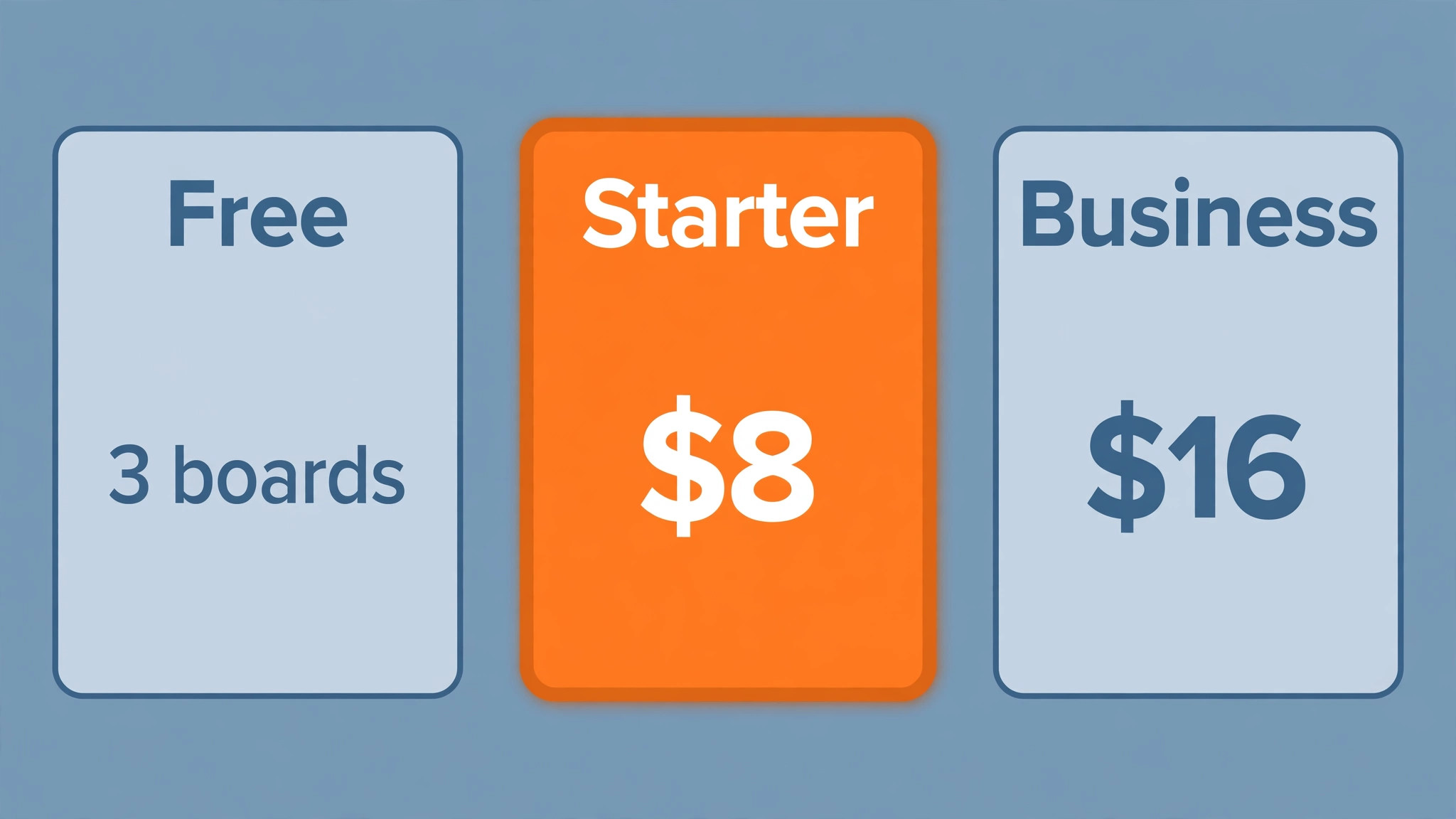
Budget for roadmapping in tool cost and meeting time. Miro lists a free plan with 3 editable boards, which is enough to test one roadmap board, while Starter at 8 dollars per member per month billed yearly removes the board limit and adds private boards and version history. Business adds advanced controls and integrations, with published prices ranging from 16 to 20 dollars per member per month depending on source and billing period, so confirm the current price on the official pricing page. For a small product team, Starter usually covers roadmap work, and Business becomes relevant when guest access, single sign on, or advanced integrations matter.
Meeting time is the larger cost, and it should be budgeted honestly. A monthly roadmap review of one to two hours, plus preparation time for scoring and sequencing, is a realistic rhythm for most teams. That time pays back by reducing ad hoc priority arguments during the month, because stakeholders who have seen the trade offs in a review are less likely to relitigate them in every meeting. If review time is cut, the board will still exist, but trust in it will fade, and the team will return to informal prioritisation.
Template and Checklist
Run this checklist before publishing any roadmap version, and again after a major reprioritisation. When you use Miro for product roadmap planning, the checklist is the gate that stops a board with unclear goals, unsequenced work, or silent changes from reaching stakeholders.
- Two or three goals are written on the board, with a success measure for each.
- Time horizons are defined as now, next, and later, without false precision.
- Every feature card links to a goal and uses the same card format.
- Candidate items include source and evidence, not only a title.
- Prioritisation scores and reasoning are recorded on each card.
- The now horizon is sequenced, sized realistically, and shows dependencies.
- Parked items carry a short reason and a quarterly review date.
- Stakeholders reviewed the board live and decisions are recorded on it.
- A read only view is shared, with a change log for each update.
- No card promises a specific date in the later horizon without a warning.
- Owners are named for now horizon items, not left as a team in general.
- The next review date is set and announced to stakeholders.
File the completed checklist with the change log for that version, so later readers can see what was verified before publication. When a stakeholder questions a priority months later, the checklist and the change log together show the reasoning at the time, which turns a disagreement about memory into a discussion about current evidence. That record is what makes a roadmap a management tool rather than a picture.

Mistakes to Avoid
Roadmap mistakes usually come from trying to satisfy every audience with one board, or from letting the board grow without pruning. When you use Miro for product roadmap planning, watch for these five mistakes, because each one quietly destroys trust in the roadmap.
- **Promising dates for later work.** Specific dates in the later horizon create commitments that the team cannot keep, because later work depends on learning from now work. Use horizons for later items, and reserve dates for the now horizon where delivery is actually planned. Honest uncertainty in later work builds more trust than false precision that later breaks.
- **Letting the board grow without parking.** Every new request adds a card, while completed and rejected items linger, until the board is unreadable. Archive completed work monthly, park rejected items with reasons, and review parked items quarterly. A readable board is a trusted board, while a crowded board is ignored.
- **Prioritising by loudest voice.** When prioritisation follows who shouts loudest or who last spoke to leadership, the roadmap reflects politics rather than value. Use a simple scoring rule, discuss scores openly, and record reasoning on cards. A transparent rule protects the team and gives stakeholders a fair way to challenge a decision.
- **Hiding trade offs.** A roadmap that shows only what will be done, without showing what was cut, hides the real decisions. Show parked items and trade offs explicitly, so stakeholders understand that choosing one item means delaying another. Visible trade offs create adult conversations about priorities, while hidden trade offs create resentment when expectations are missed.
- **Updating silently.** Silent changes to priorities, without announcement or change log, make stakeholders feel misled when they discover them. Announce every update briefly, with what changed and why, and keep a change log on the board. Transparency about changes preserves trust even when the changes themselves are unwelcome.
If trust in the roadmap is already low, rebuild it with a smaller, more honest board rather than a larger, more detailed one. Cut the board to goals, a realistic now horizon, and a parked area, publish it with a change log, and hold a live review. A small board that stakeholders believe will earn the right to grow, while a large board that nobody believes will not be saved by more detail.

A Worked Example
A product lead at a small software team decided to build the first roadmap board around a single quarter, rather than trying to map a whole year that nobody would believe. She began by writing two goals at the top of the board, improving activation for new accounts and reducing churn among existing ones, and she defined three horizons, now, next, and later, without attaching exact dates to anything beyond the now horizon. That restraint mattered, because the team had previously promised dates for distant work and then broken those promises when learning from early work changed the plan.
With goals and horizons settled, she created frames for each horizon plus a parked area, and she fixed a card format that every item had to follow, covering title, goal, owner, effort estimate, and success measure.
Candidate items arrived from support tickets, sales notes, usage figures, and the team itself, and she placed them all in the parking area first without judging them, noting the source and the evidence beside each one. Scoring came next, with each candidate marked for impact, confidence, and effort on a simple scale, and the scores discussed aloud rather than averaged silently in a spreadsheet. One feature that a senior stakeholder had championed scored high on impact but low on confidence, because the evidence rested on a single customer conversation, and the team agreed to move it to next rather than now.
Another item, a small onboarding fix supported by repeated support counts, scored modestly on impact but high on confidence and low on effort, and it earned a place in now ahead of larger, flashier requests.
Sequencing the now horizon forced the hardest choices. The lead ordered the items by dependency and by value, broke one large item into smaller cards that could be delivered in stages, and drew connectors between cards so the team could see what blocked what. Items that did not make now were moved to the parked area with a short reason, such as low impact, high effort, or wrong timing, and a quarterly review date was written beside them. In the live stakeholder review, she walked through goals first, then now, then the trade offs in next and later, and she recorded both decisions and dissent on the board itself.
The published result was a read only view with a short change log, and the most useful outcome was not the board alone but the fact that stakeholders stopped asking for ad hoc updates, because they had seen the reasoning and knew when the next update would arrive.
Advanced Tips Worth Trying
A board that has survived two monthly reviews can carry a second layer that a first board should not, which is a dependency view drawn with connectors across horizons. Link each now item to the next item it unlocks, and mark any card that depends on work outside the team, such as a data change or a partner decision, with a visible flag on the card itself. When a dependency slips, the board shows the knock on effect immediately, instead of leaving the team to discover it in a delivery meeting weeks later.
Keep the connector lines sparse, because a board covered in lines is as unreadable as a board with no structure at all, and remove a connector as soon as the dependency is resolved.
Another step up is to give parked items a proper second life instead of letting them sit until the quarterly review. Once a month, pick the three parked items with the strongest new evidence, such as a fresh support count or a changed market condition, and rescore them against the current now horizon in the open. Most will stay parked, and saying so openly, with the new score beside the old one, builds confidence that parking is a decision rather than a polite way of ignoring a request. The few that return to next will arrive with a clear reason, which makes their promotion easy to explain to the people who originally asked for them.
Colour discipline also pays off as boards grow. Restrict colour to one meaning only, either goal or horizon, and never both at once, so a reader can decode the board at a glance without a legend hunt. If goal colours are chosen, keep horizon order purely spatial, with now on the left and later on the right, and if horizon colours are chosen, group cards by goal inside each frame instead. A board that mixes both systems forces every new reader to ask what a colour means, and that question, repeated in every review, quietly erodes the trust the board is meant to build.
How to Measure Success
Judge the board by whether now items finish in the horizon they were promised for. At the end of each month, count the now cards marked complete, divide by the total cards that were in now at the start of the month, and record that share beside the goal each card served. A board that regularly completes most of its now horizon is sized honestly, while a board that completes only a small share is overloaded or badly sequenced. Break the share down by goal, because a board can look healthy overall while one goal quietly stalls for months behind the progress of another.
Next, measure trust in the board directly, using behaviour rather than opinion. Count how many stakeholder questions about priorities arrive outside the review meeting, and count how many priority changes happen without a change log entry or an announcement. Both figures should fall as the monthly rhythm beds in, because stakeholders who trust the board check it instead of asking for side updates. If side questions stay high, the problem is usually a missing read only view, an out of date change log, or a now horizon that stakeholders do not believe, and each cause points to a different fix.
Finally, track the parked area as a measure of honesty, not as a graveyard to ignore. Each quarter, record how many parked items were reviewed, how many were promoted, and how many stayed parked with a reason still written on the card. A parked area that is never reviewed will breed the same repeated arguments the board was meant to end, while a parked area reviewed on schedule shows requesters that their ideas were considered. Review the three groups together monthly, and change only one board habit at a time, such as scoring, sequencing, or review timing, so the effect of each change can be seen.
Review and Next Steps
Before each monthly review, do the preparation away from the meeting itself, because a review that starts with scoring and archiving already half done will finish with decisions rather than admin. Update scores with any new evidence, move completed cards to an archive, and draft proposed horizon moves with a reason written beside each one. Send the draft to stakeholders a day early, not as a finished decision but as a readable proposal, so the meeting can focus on challenges to scores and sequence. A review where participants arrive already familiar with the proposals will surface genuine disagreements, while a review where proposals appear live will mostly produce polite nods followed by private complaints afterwards.
During the review, walk the board in a fixed order, starting with goals, then the now horizon, then the proposed changes, and record decisions and dissent directly on the cards concerned. Dissent matters as much as agreement, because a stakeholder who disagreed and was recorded will usually accept the outcome, while a stakeholder whose objection vanished from the record will raise it again next month. After the meeting, publish the updated board through the read only view and add a short change log entry stating what changed and why, announced briefly to everyone who uses the board.
Silent edits, even small ones, should be treated as a process failure, because they teach stakeholders to distrust the board they are supposed to consult.
New team members learn the reasoning fastest when they read a board history written by a team that chose to use Miro for product roadmap planning as its shared record, not as a slide deck. Keep that history in the change log and the review notes together, so a newcomer can trace why a current priority exists, which alternatives were parked, and what evidence supported the choice. Once a quarter, read the whole log for patterns, such as a goal that never progresses or a horizon that always overflows, and treat such a pattern as a signal about the goal itself rather than a reason to add more cards.
A goal that never moves may need rethinking, resourcing, or honest abandonment, and recognising that in a quarterly read is far cheaper than carrying it silently for another year.
Prune the board at the same quarterly moment, archiving completed work, confirming parked reasons, and removing card formats or colour meanings that nobody uses any more. Nominate one person to own the change log for the next cycle, so updates, announcements, and archive moves have a single accountable owner rather than drifting between team members. A lean board that the team actually consults will always serve better than a crowded board that looks thorough but is skipped in practice. Looking ahead, the next step is not a larger board but a steadier rhythm, with the same monthly preparation, the same live review order, and the same published change log, repeated until stakeholders check the board before asking for an update.
When that habit forms, the board has become what it was meant to be, a shared picture of choices and trade offs that the whole team can trust.
For related reading on Stratilyze, the guide to remote brainstorming in Miro shows how the same board tool supports idea generation, and the guide to lesson planning in Miro covers structured boards for a different audience. Read the brainstorming guide first if your roadmap needs more candidate ideas, because a good parking area starts with broad input, and the method here for use Miro for product roadmap planning pairs well with that input routine.
Frequently Asked Questions
How often should a product roadmap be updated?
Monthly updates suit most teams, with a fuller quarterly review of goals and parked items. More frequent updates create noise and erode trust, while less frequent updates let the board drift from reality. Announce each update briefly with a change log, so stakeholders learn to check the board on a rhythm.
What belongs in the now horizon?
Only work that is sequenced, sized, owned, and ready to start within the current period belongs in now. Items that need more discovery, depend on unfinished work, or lack an owner belong in next. A realistic now horizon builds trust, while an overloaded now horizon is ignored by delivery teams.
How do I handle stakeholder requests that do not fit?
Record the request in the parking area with its source and evidence, score it honestly, and give a short reason if it is parked. Review parked items quarterly, and invite the requester to provide new evidence if circumstances change. Explicit parking with a reason is fairer and calmer than silent ignoring.
Should a roadmap show exact dates?
Exact dates suit the now horizon where delivery is planned, while later work should use horizons such as next and later. False precision on distant dates creates commitments that break when learning changes priorities. Be honest about uncertainty in later horizons, and stakeholders will trust the dates that do matter.
Which Miro plan do I need for roadmapping?
The free plan with 3 editable boards can test one roadmap board, while Starter at 8 dollars per member per month billed yearly removes the board limit and adds private boards and history. Business adds advanced controls and integrations for larger teams. Start free, and upgrade when board limits or guest access actually block the work.
How do I use Miro for product roadmap planning for a team with several products?
Use one board per product, with a shared goals frame or a portfolio board that links to each product board. Keep card formats and scoring rules consistent across products, so priorities can be compared fairly. Review the portfolio board quarterly, and avoid merging products into one board, which quickly becomes unreadable.
Keep the Roadmap Honest
A roadmap that stakeholders trust is short, goal led, sequenced honestly, and updated on a rhythm with a visible change log. Group work by goal, order it by horizon, park rejected items with reasons, and review live on the board. When you use Miro for product roadmap planning in that disciplined way, the board becomes a shared decision tool rather than a wish list, and the team can say no with confidence because the trade offs are visible to everyone.