
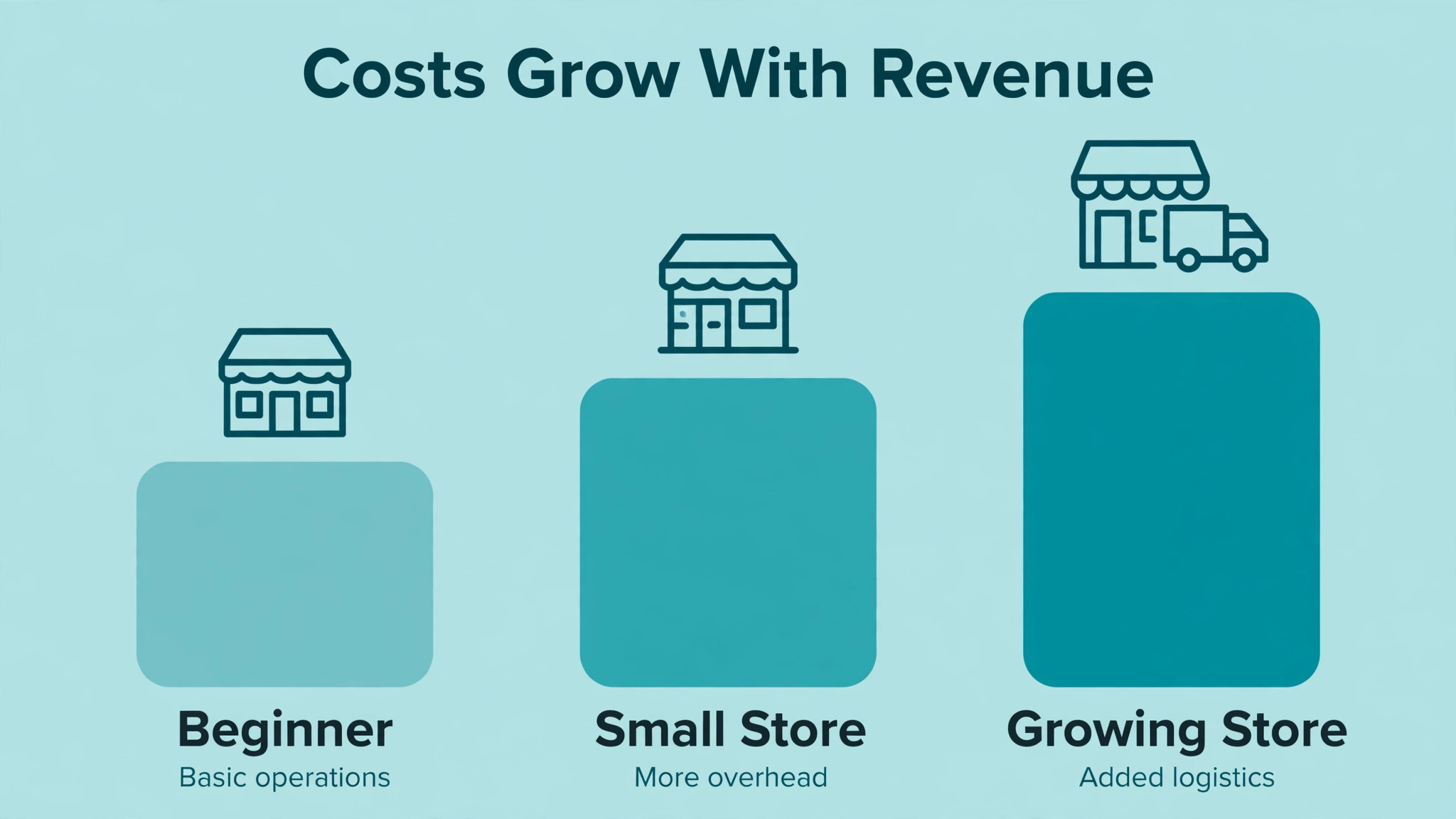
A dropshipping store looks cheap until the first invoice arrives, because the headline platform price is only a fraction of the cost of running a dropshipping store monthly. A beginner store on a basic plan, with a few apps, a domain, and modest ads, commonly totals 50 to 100 dollars a month before product costs, according to published 2026 breakdowns for beginner stores. A store doing 5,000 to 25,000 dollars a month commonly totals 100 to 300 dollars a month in fixed platform and app costs, before payment fees and ad spend. A growing brand at 25,000 to 100,000 dollars a month can total 300 to 1,500 dollars a month in platform related costs.
Those ranges exclude the product itself, which is the largest cost of all, and they exclude ad spend, which is where most stores actually win or lose money. If you want to understand the cost of running a dropshipping store monthly, separate fixed costs, variable fees, product costs, and ad spend, because lumping them together hides which lever is actually eating your margin.
Dropshipping means you sell a product you do not stock. A customer orders from your store, you forward the order to a supplier, the supplier ships directly to the customer, and you keep the difference between the retail price and the supplier price, minus fees. That model removes warehouse rent and inventory risk, which is its real advantage, but it does not remove costs. You still pay for the store platform, payment processing, apps, a domain, customer service time, returns, and advertising to bring buyers to a store nobody has heard of. A store with no traffic costs little and sells nothing, while a store with traffic costs more in fees and ads with every sale.
Profit lives in the gap between price, product cost, fees, and ad cost per order, and that gap is thinner than most beginner guides admit.
The Cost of Running a Dropshipping Store Monthly at Three Revenue Levels
| Cost line | Beginner, under 5,000 dollars revenue | Small store, 5,000 to 25,000 dollars | Growing store, 25,000 to 100,000 dollars |
|---|---|---|---|
| Platform plan | 29 to 39 dollars | 29 to 105 dollars | 105 to 399 dollars |
| Apps and tools | 20 to 50 dollars | 50 to 150 dollars | 200 to 800 dollars |
| Domain | About 1 to 2 dollars | About 1 to 2 dollars | About 1 to 2 dollars |
| Email marketing | Free to 20 dollars | 20 to 80 dollars | 80 to 300 dollars |
| Fixed monthly subtotal | 50 to 100 dollars | 100 to 300 dollars | 300 to 1,500 dollars |
| Payment fees | About 2.9 percent plus 30 cents per order | About 2.6 to 2.9 percent plus 30 cents | About 2.4 to 2.7 percent plus 30 cents |
| Ad spend | 50 to 300 dollars, test budget | 300 to 2,000 dollars | 2,000 to 10,000 dollars and up |
| Product and shipping | Paid per order from supplier price | Paid per order from supplier price | Paid per order, often negotiated lower |
Platform plan figures reflect the range published across 2026 pricing guides, where a basic plan appears as 29 dollars in some guides and 39 dollars in others, reflecting plan changes and billing periods, so confirm the current price on the platform pricing page before budgeting. The fixed subtotal ranges match published beginner and small store totals, while the growing store range reflects higher plans and a larger app stack. Payment fees fall slightly as plan tier rises, which is one reason to upgrade only when order volume makes the fee saving larger than the plan price increase.
A store at 15,000 dollars a month, for example, saves only about 45 dollars a month in card fees by moving from a basic to a mid tier plan, which does not justify a 50 dollar plan increase on fees alone.
Ad spend is deliberately shown as a range, not a fixed line, because it is a choice, and it is the choice that decides whether a store grows or burns cash. A test budget of 50 to 300 dollars a month can validate a product and an audience, but it will not scale a winner. Scaling ad spend without a proven margin per order is how stores lose money quickly, since every extra order at a negative margin deepens the loss. Set ad spend from margin, not from ambition, and scale only when the margin per order after product, fees, and ad cost stays positive across at least a few dozen orders.
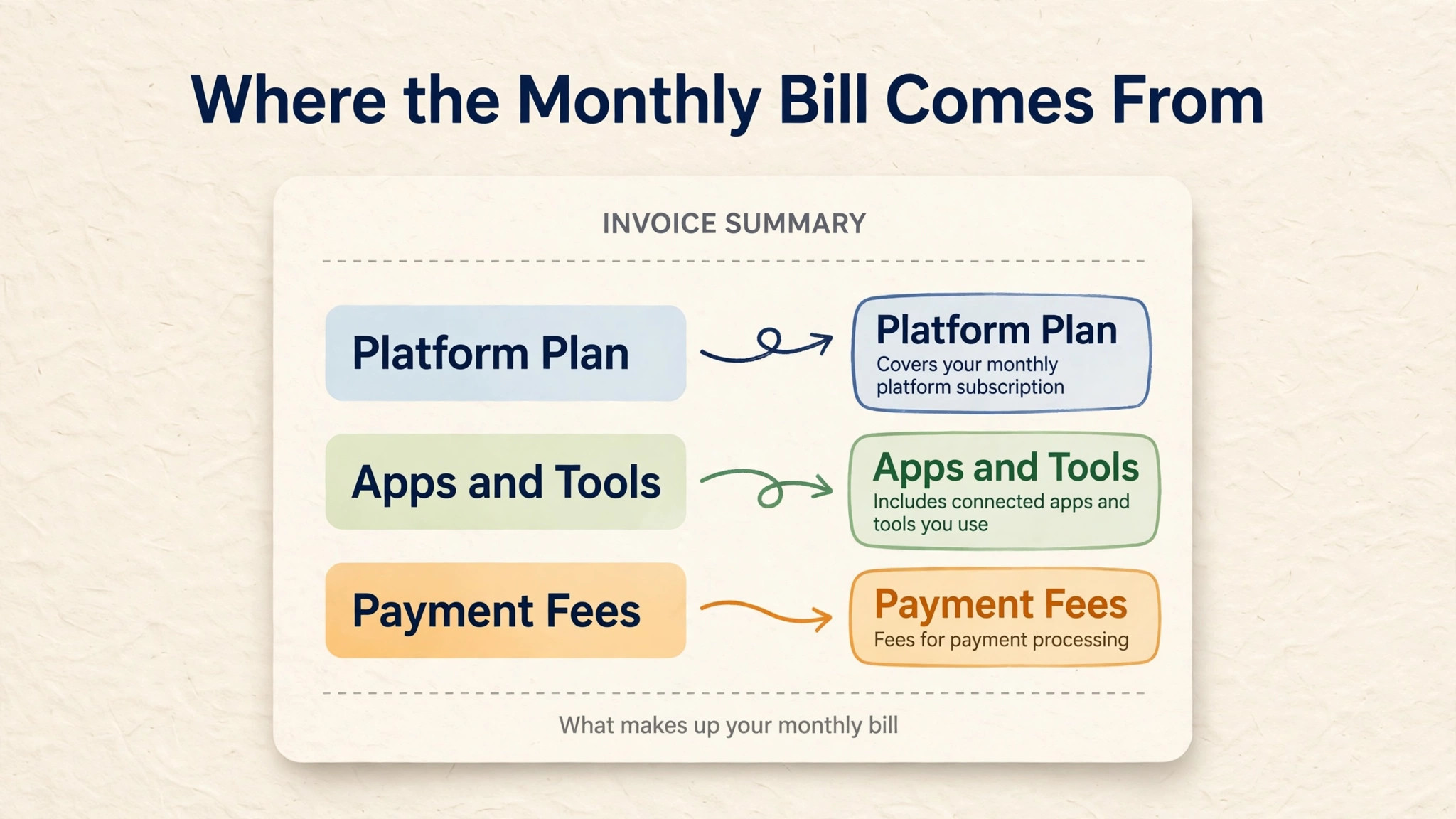
Platform, Payment, and App Fees Explained
The platform plan buys hosting, the store builder, checkout, and basic analytics. Most dropshipping stores stay on a basic plan until revenue justifies an upgrade, because higher plans mainly buy lower card fees, better shipping discounts, and more staff accounts, none of which matter much at low volume. The upgrade rule is simple. Upgrade when the fee saving multiplied by monthly revenue exceeds the plan price difference. Below that break even point, commonly estimated near 25,000 to 30,000 dollars a month in card processed revenue for a mid tier move, staying basic is the rational choice, even if a higher plan feels more professional.
Payment fees deserve careful reading, because they come in two layers. The payment processor charges about 2.9 percent plus 30 cents per online transaction on a basic plan, falling to about 2.6 percent and then 2.4 percent on higher plans in many published breakdowns, with some guides showing 2.7 percent and 2.5 percent for mid tiers after recent plan renames. Using a third party gateway instead of the platform native payments can add a further platform transaction fee, commonly 2 percent on basic, 1 percent on mid tier, and 0.6 percent on advanced, on top of the gateway own fee.
That extra layer is why using native payments, where available, is usually the cheapest route, and why a store that insists on a third party gateway should budget the extra percentage on every order.
Apps are the quiet budget creep. A product import app, a reviews app, an upsell app, an email app, a shipping tracker, and a currency converter can each cost 5 to 30 dollars a month, and a stack of six small apps easily reaches 100 dollars before any of them proves its value. Audit apps monthly. For each app, note its price, what it does, and whether removing it for a week changes conversion or workload. Cancel apps that duplicate a platform feature, that were installed for a single test, or that serve a product you no longer sell.
Published guides warn that most store owners overpay by 200 to 600 dollars a month through unaudited apps and wrong plan choices, and a monthly app audit is the cheapest profit improvement available.
Themes and one time costs sit outside the monthly total but affect the first months. A free theme is sufficient to start, while a paid theme costs 100 to 350 dollars once, and custom design costs 1,000 dollars and up. A domain costs about 10 to 25 dollars a year, which is about 1 to 2 dollars a month. Those one time costs should be amortised mentally over the first year, not ignored, since a store that buys a paid theme, a logo pack, and product photography in month one can easily spend 500 dollars before its first sale.
Product Cost and Margin, Worked With Real Numbers
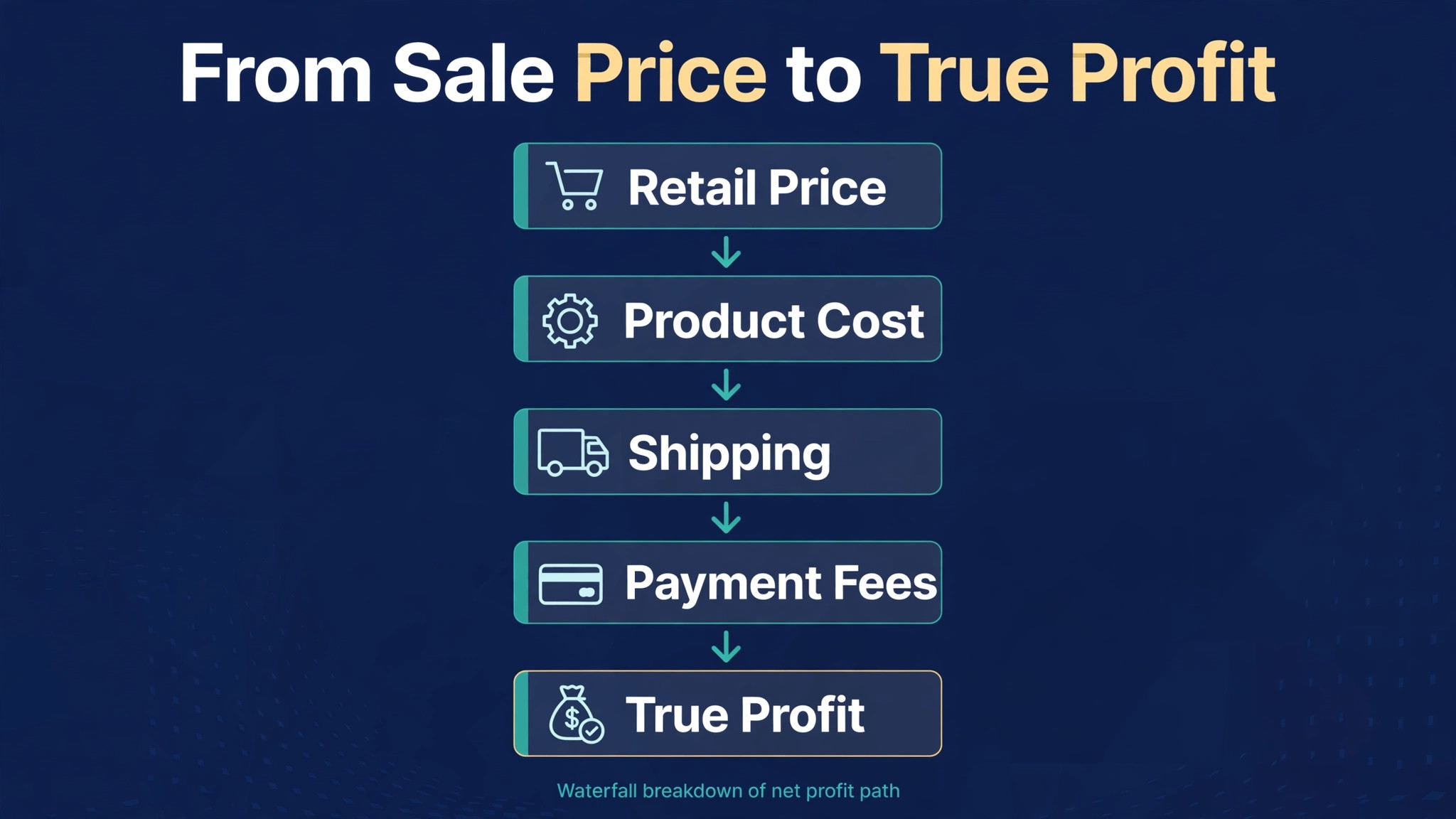
Margin is where dropshipping succeeds or fails, and it must be worked per order, not per month. Take a published worked example. A hoodie sourced through a print supplier costs 23.61 dollars to produce in size medium, plus 8.49 dollars shipping in the United States, plus a 30 cent transaction fee, for a total cost of 32.40 dollars before card percentage fees. Sold at 44.99 dollars, the gross margin before card percentage fees is about 12.59 dollars, and after a 2.9 percent card fee near 1.30 dollars, the remaining margin is about 11.29 dollars per hoodie. That margin must then cover fixed monthly costs, ad cost per order, returns, and customer service time.
At a fixed monthly cost of 81 dollars in that example, covering platform, domain, design, and a small marketing budget, the store needs to sell seven or eight hoodies a month just to cover fixed costs, before ad spend is counted seriously.
Generalise that example into a margin rule. Aim for a gross margin of 30 to 50 percent after product and shipping, as published seller guides recommend, and then subtract payment fees and ad cost per order to find true margin. A product with a 40 percent gross margin that needs 15 dollars of ad spend to acquire each order, on a 40 dollar sale, leaves almost nothing after fees. A product with a 30 percent gross margin that sells organically through search or repeat buyers can be more profitable than a 50 percent margin product that needs heavy paid traffic. Price, product cost, and acquisition cost must be judged together, never separately.
Supplier choice changes margin more than any app. A supplier with a low product price but slow shipping, poor packaging, and high defect rates will generate returns, refunds, and support time that erase the price advantage. A slightly dearer supplier with faster shipping, better tracking, and lower defect rates often yields higher true margin, because fewer orders need refunds and fewer customers need chasing. Test suppliers with small orders to yourself first, check packaging, delivery time, and product quality, and only then scale advertising to that supplier. A store that scales ads to an untested supplier scales its refund problem at the same time.
Advertising, the Cost That Decides Profit
Advertising is not a fixed monthly cost, it is a per order cost, and it should be judged as cost per acquisition. If you spend 300 dollars on ads and get 30 orders, your ad cost per order is 10 dollars. Subtract that, plus product cost, shipping, and payment fees, from the retail price, and the remainder is true profit per order. If that remainder is negative, more ad spend makes the loss larger, not smaller, no matter how exciting the sales chart looks. Many beginners celebrate rising revenue while true profit falls, because they track sales, not profit per order.
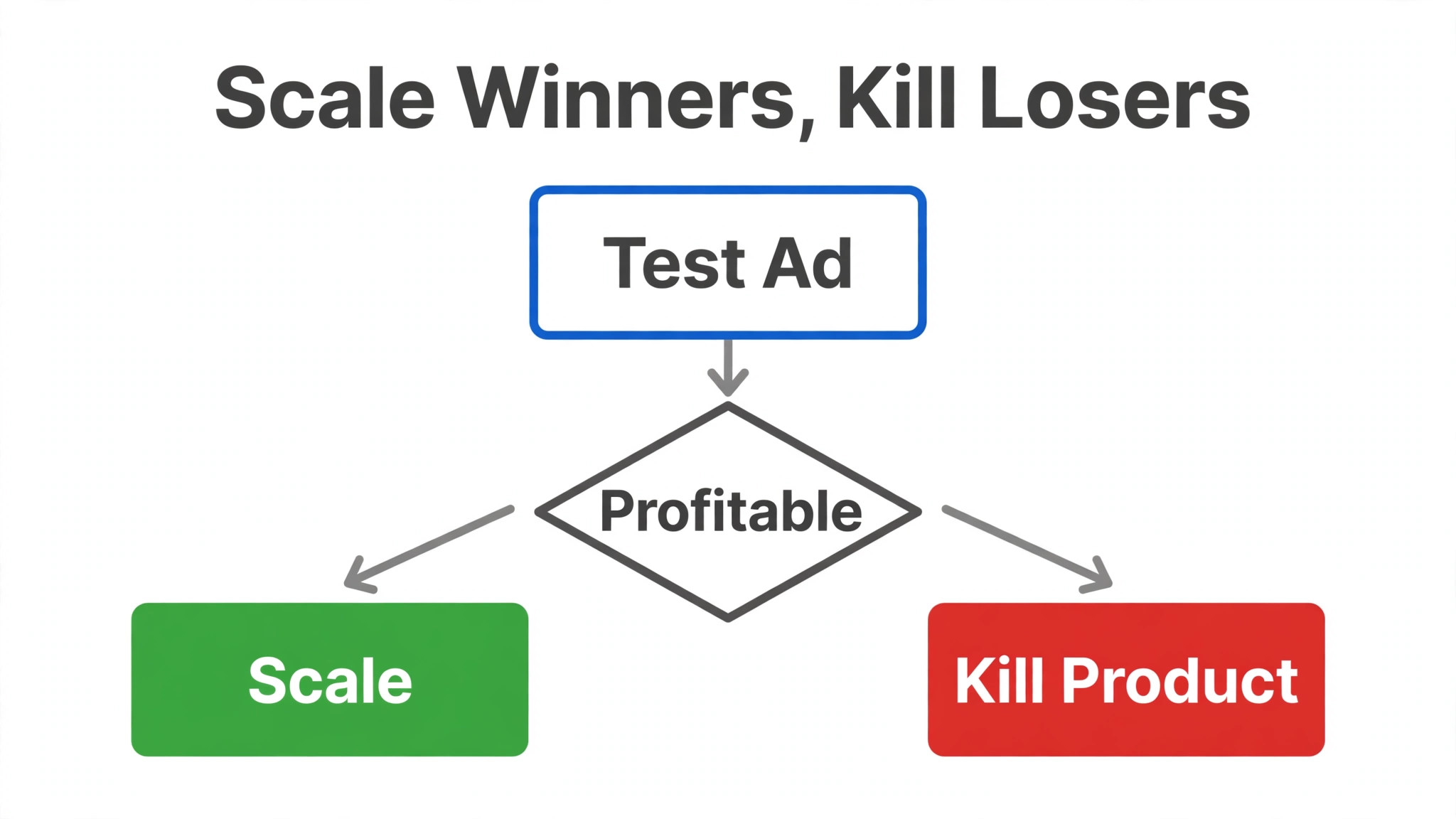
Start advertising with a test budget and a kill rule. Set a test spend per product, such as 50 to 100 dollars, and a rule for when to stop, such as no profitable order after that spend, or a cost per acquisition above your margin per order. Kill losing products quickly, and scale only products that show profitable orders across multiple days, not a single lucky day. Creative testing matters too, since a new image or headline can halve acquisition cost for the same product, which is often cheaper than finding a new product entirely.
Organic traffic is the long term answer to ad cost, but it is slow. Search content, social content, email to past buyers, and repeat purchases all lower blended acquisition cost over time, because a returning buyer costs almost nothing to acquire again. Budget time for organic content from month one, even while ads bring the first sales, so that by month six the store is not entirely dependent on paid traffic. A store that only ever buys traffic rents its customers every month, while a store that builds an email list and search presence gradually owns more of its demand.
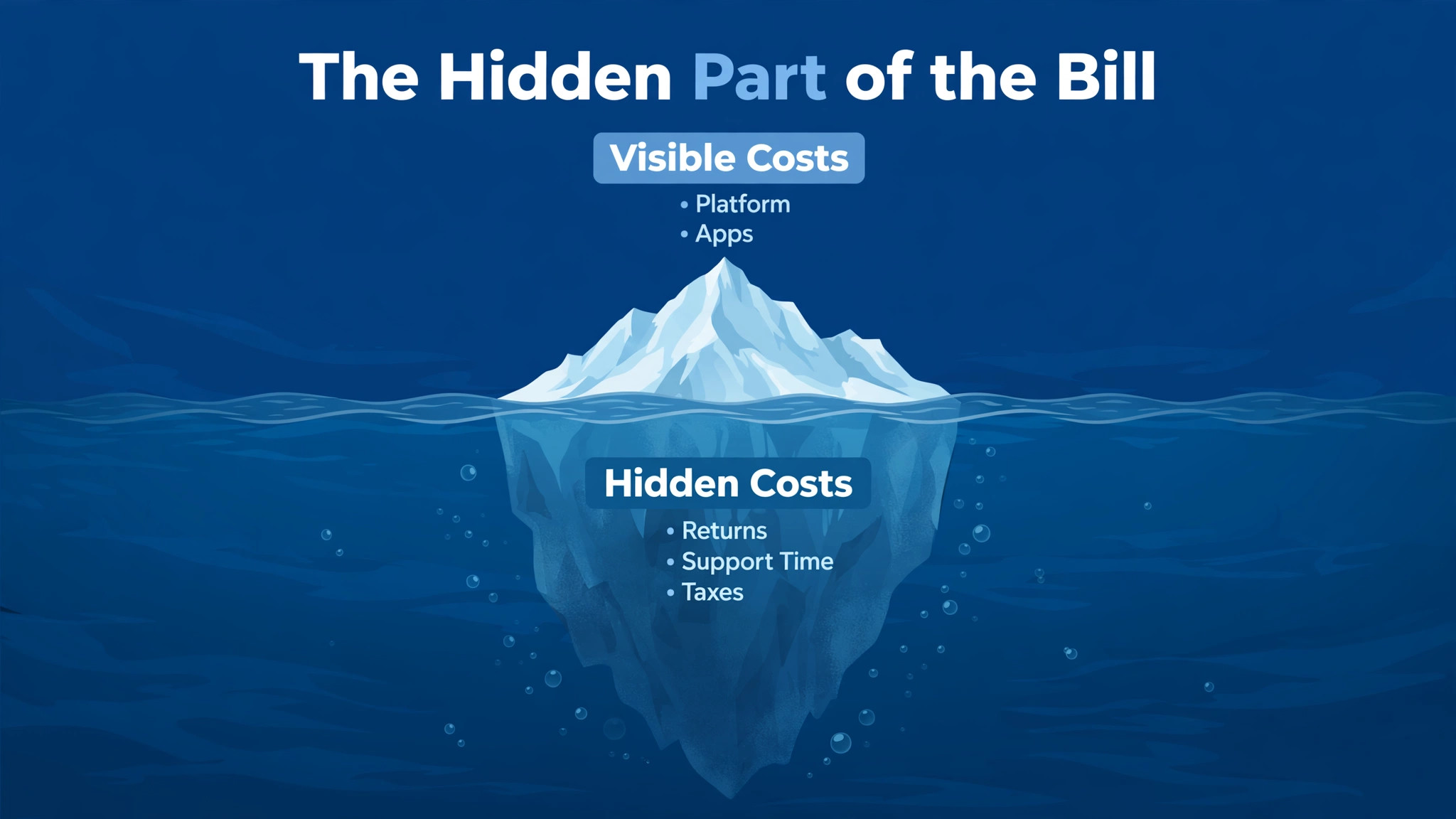
Returns and refunds are a real monthly cost that beginner budgets omit. Dropshipping returns are awkward, because the customer returns to you, while the product came from a supplier, and return shipping, restocking, and supplier policies vary widely. Budget a returns reserve as a percentage of revenue, based on your category, and track return rate monthly. A category with a 10 percent return rate on a thin margin product can erase profit entirely, while the same rate on a high margin product is absorbable. Choose categories and suppliers with return rates you can survive, and state return policies clearly before purchase, so disputes cost less time.
Customer service time is a cost even when it is your own time. Answering tracking questions, handling lost parcels, and mediating supplier problems can consume hours per week, and those hours have a value, even if no invoice shows them. Automate tracking notifications, publish a clear shipping time expectation that matches supplier reality rather than wishful thinking, and use a help page that answers the ten most common questions. Every support ticket prevented is profit protected, and a store that promises delivery in days while the supplier needs weeks will generate support load that no app can fix.
Taxes, accounting, and legal setup are the least exciting costs and the most dangerous to ignore. Business registration in the United States commonly costs 100 to 500 dollars once, depending on state and structure, and sales tax, income tax, and platform tax tools add ongoing complexity. Platform tax tools are often free up to a threshold and then charge a small percentage, commonly cited near 0.25 to 0.35 percent. Budget for an accountant or tax tool from the first profitable quarter, not from the first tax deadline panic, and keep product, fee, and ad records clean monthly, so tax time is a summary, not a reconstruction.
Fee Breakdown for a Single Order
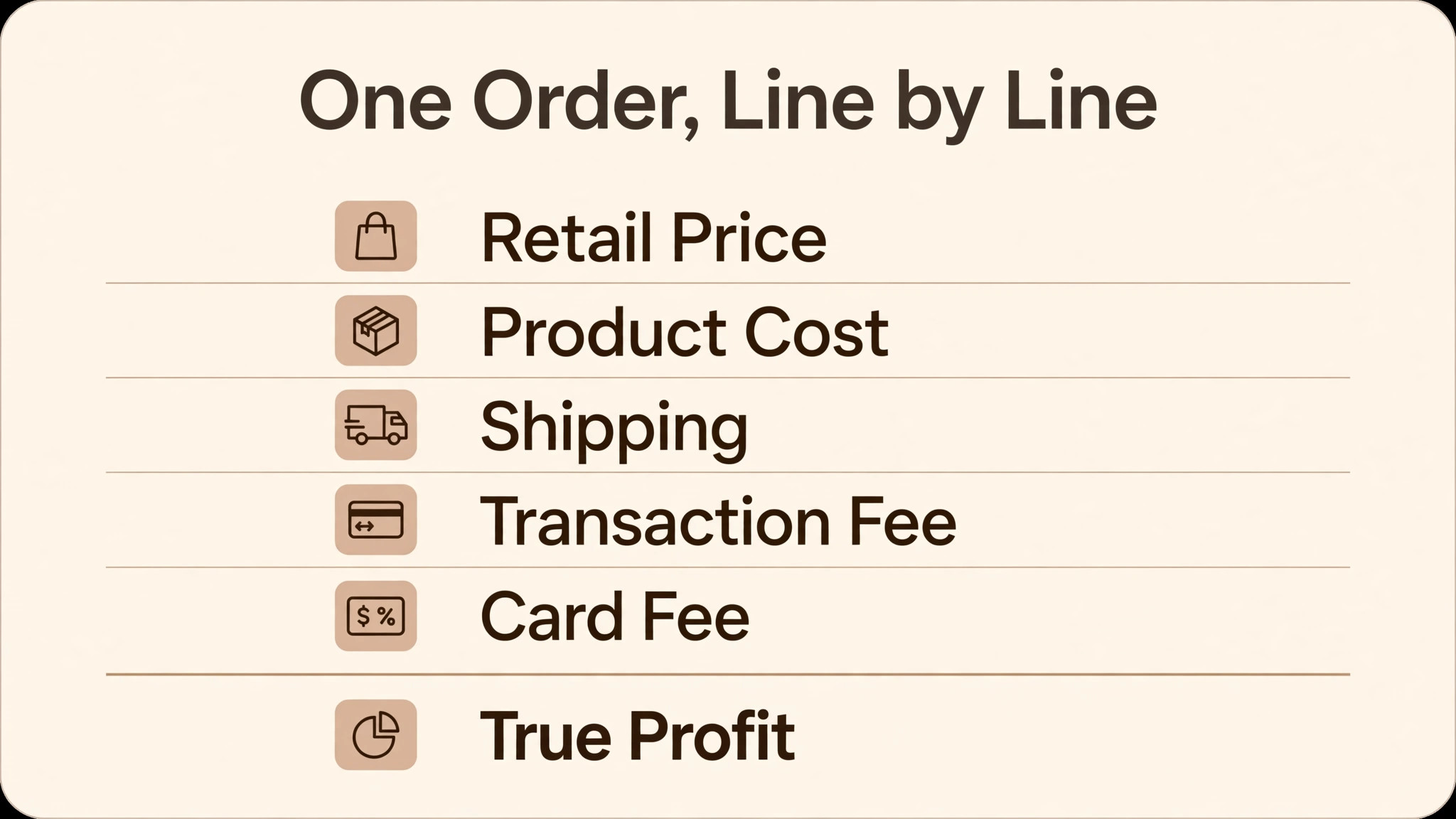
| Line | Amount on a 44.99 dollar hoodie example |
|---|---|
| Retail price paid by customer | 44.99 dollars |
| Product production cost | 23.61 dollars |
| Shipping to customer in the United States | 8.49 dollars |
| Transaction fee flat part | 0.30 dollars |
| Card percentage fee near 2.9 percent | 1.30 dollars |
| Total cost before fixed costs and ads | 33.70 dollars |
| Margin before fixed costs and ads | 11.29 dollars |
| Ad cost per order, example test level | 10.00 dollars |
| True profit per order at that ad level | 1.29 dollars |
That table is the whole business in miniature. A 1.29 dollar true profit per order needs high volume or lower ad cost to justify the work, while a 5 dollar ad cost per order on the same product yields 6.29 dollars true profit, which scales happily. Small changes in ad cost per order move true profit more than small changes in platform plan, which is why ad efficiency deserves more attention than plan tier for most small stores. Work this table for your own product before scaling ads, and update it monthly as supplier prices, fees, and ad costs move.
Mistakes That Inflate Monthly Costs
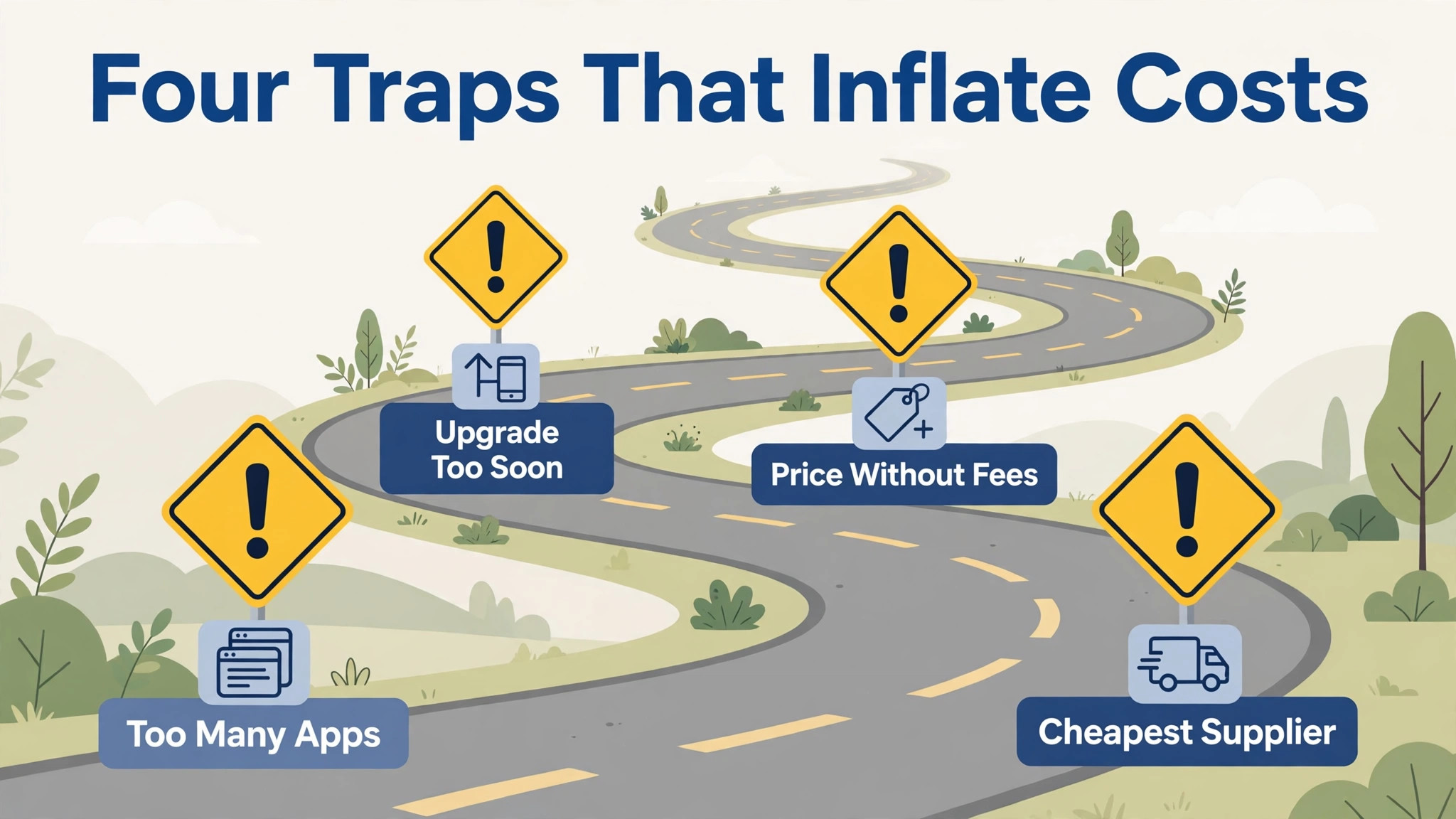
The first mistake is paying for apps before proving sales. A store with no orders does not need six apps, it needs one product, one clear offer, and traffic. Install apps only when a specific problem appears, such as no reviews, no upsell, or no email capture, and cancel the app if the problem does not improve measurably within a month. App stacks grow by installation and shrink only by audit, so audit monthly.
The second mistake is upgrading the platform plan for status. A higher plan feels like progress, but if fee savings do not exceed the price increase, the upgrade is a cost, not an investment. Run the break even calculation before upgrading, and upgrade on volume evidence, not on a sales page. The same logic applies to paid themes and custom design, which should follow proven sales, not precede them.
The third mistake is pricing from supplier cost alone, without fees and ad cost. A product that looks profitable at supplier price can be unprofitable after payment fees, return reserve, and acquisition cost are added. Price from true margin per order, using the fee breakdown table, and test price changes deliberately, since a small price increase that barely dents conversion can transform true profit per order.
The fourth mistake is ignoring supplier quality to chase the lowest price. Cheap suppliers with slow shipping and high defects generate refunds, chargebacks, and support time that cost more than the saving. Test suppliers personally, track defect and delivery performance, and pay a little more for reliability where it protects margin and reputation. A store reputation, once damaged by late and defective orders, costs far more to repair than a supplier saving ever returned.
A Monthly Routine That Keeps Costs Honest
Run a monthly cost review on the same day each month, and keep it to one hour. List every fixed cost, every app with its price, payment fees as a percentage of revenue, ad spend and cost per acquisition, product cost per order, return rate, and true profit per order. Cancel one app, or renegotiate one supplier price, each month, so costs trend down or value trends up continuously. A store that reviews costs monthly will catch a forgotten app, a fee change, or a rising ad cost before it eats a quarter of profit.
Set three guardrails and respect them. Keep fixed platform and app costs under 5 percent of revenue as a health check, using published guidance that under 4 percent is excellent, 4 to 6 percent is healthy, 6 to 8 percent is expensive, and above 8 percent is a problem. Keep ad cost per order below true margin per order before ads, so every order contributes. Keep a cash reserve for returns and supplier price changes, so a bad month does not force a fire sale or a supplier switch under pressure. Guardrails turn budgeting from a yearly panic into a monthly habit.
Choosing a Niche by Margin, Not by Trend
Niche choice changes monthly costs more than platform choice does, because niche decides product price, return rate, ad competition, and repeat purchase potential together. A trending gadget niche may look exciting, but it usually carries thin margins, high ad competition, and high return rates, since many stores sell the same item and customers compare prices instantly. A quieter niche with a specific buyer, such as pet accessories for a particular breed, hobby supplies for a specific craft, or home goods for a specific room, often supports higher prices, lower ad competition, and repeat purchases, which together produce a healthier monthly cost structure even at lower revenue.
Test niche economics before committing to a store design. Price three representative products in the niche, find supplier costs and shipping times, estimate payment fees, and model ad cost per order from a small test campaign. If the model shows true profit per order below a few dollars at realistic ad costs, the niche needs either higher prices, cheaper acquisition through content, or a different product mix. A niche that only works with viral low cost traffic is a gamble, not a business, and its monthly cost will spike the moment paid traffic becomes necessary. A niche that works at modest paid traffic, with room for organic content and email repeat sales, will sustain a monthly budget through normal variation.
Also consider product weight, size, and fragility, since those factors drive shipping cost and return cost directly. Light, durable, non sized products ship cheaply, break rarely, and return rarely, which keeps both supplier shipping and return reserve low. Heavy, fragile, or sized products, such as apparel with many sizes or glass goods, generate higher shipping, higher breakage, and higher size related returns, all of which sit inside the monthly cost even though they never appear on a platform invoice. When you judge the cost of running a dropshipping store monthly, judge it niche by niche, product by product, because a store average hides the one product that loses money on every order while the rest profit.
Drop losing products quickly, double down on products with healthy true margin, and let niche economics, not trend excitement, decide what stays in the catalogue. A disciplined niche choice is the cheapest monthly cost reduction available, since it improves margin, ad efficiency, and return rate at once, without any new app or plan change.
More Reading for Business Costs
If dropshipping costs are clearer now, the wider cost guides on Stratilyze cover neighbouring budgets in the same structure. The guide to running a food truck monthly compares fixed and variable costs in a physical business, the guide to hiring a virtual assistant monthly prices buying back your own time, the guide to building a mobile app for a small business covers a larger build budget, and the guide to email tools for abandoned carts helps recover sales you already paid to attract. Read the email tools guide next if cart abandonment is eating your ad spend, since recovering an existing visitor is cheaper than buying a new one.
Frequently Asked Questions
How much does it cost to run a dropshipping store per month?
Fixed platform and app costs commonly total 50 to 100 dollars a month for a beginner store, 100 to 300 dollars for a small store doing 5,000 to 25,000 dollars revenue, and 300 to 1,500 dollars for a growing store. Those fixed totals are only the starting point for the cost of running a dropshipping store monthly, since variable fees and ads follow every sale. Those totals exclude product costs, which are paid per order, payment fees near 2.9 percent plus 30 cents per order on a basic plan, and ad spend, which ranges from a 50 to 300 dollar test budget to thousands when scaling.
True monthly cost therefore depends on order volume and ad efficiency as much as on the platform plan.
What is the cost of running a dropshipping store monthly at 10,000 dollars revenue?
A published all in estimate for a basic store at 10,000 dollars a month puts total platform related costs near 440 dollars a month, including plan, apps, theme amortisation, payment processing, and domain, before product costs and ad spend. Product costs and ad spend then dominate the remainder, and true profit depends on margin per order after those variable costs. Work the fee breakdown table for your own product at your own ad cost per order, rather than trusting a generic monthly total that omits your largest costs.
Do I need to pay for Shopify to dropship?
You need a store platform of some kind, and Shopify is the most common choice for dropshipping, but it is not the only route. Other platforms and marketplaces have their own fee structures, and selling through a marketplace can involve referral fees from 6 to 45 percent depending on category, plus a monthly account fee in some cases. Compare platform fees, payment fees, app needs, and traffic control together, since a marketplace gives traffic but takes a larger fee and less customer ownership, while a standalone store gives control but requires you to buy traffic yourself.
How much profit margin should a dropshipping store aim for?
Aim for a gross margin of 30 to 50 percent after product and shipping costs, as published seller guides recommend, and then subtract payment fees and ad cost per order to find true margin. Margin after acquisition cost is the number that decides whether the cost of running a dropshipping store monthly leaves any profit at all. A gross margin in that range can still be unprofitable if ad cost per order is high, so judge margin after acquisition cost, not before it. Products with repeat purchase potential, low return rates, and organic traffic potential can succeed at the lower end of the range, while single purchase products bought only through ads need the higher end to survive.
When should a dropshipping store upgrade its platform plan?
Upgrade when fee savings multiplied by monthly card processed revenue exceed the plan price increase, with a commonly cited break even near 25,000 to 30,000 dollars a month for a move from basic to mid tier. Also consider upgrading for features you genuinely need, such as more staff accounts, better shipping discounts, or advanced reporting, but do not upgrade for status alone. Run the break even calculation on your actual revenue and fee rates, and revisit it monthly as volume changes, since the right plan at 5,000 dollars revenue is rarely the right plan at 50,000 dollars.
The biggest hidden costs are unaudited apps, third party gateway fees on top of processor fees, returns and refunds, customer service time, and ad cost per order that exceeds margin. A monthly audit is the simplest control on the cost of running a dropshipping store monthly, because it catches each hidden line before it compounds. Published guides note that owners often overpay by 200 to 600 dollars a month through apps and wrong plan choices alone. A monthly audit of apps, fees, return rate, and ad cost per order catches most hidden costs before they compound, and a fee breakdown table per order makes the remaining costs visible rather than surprising.
The Monthly Number That Matters
The monthly number that matters is not the platform invoice, it is true profit per order after product, shipping, payment fees, ad cost, and a return reserve. A store with a 39 dollar platform bill and a 1 dollar true profit per order is in worse shape than a store with a 399 dollar platform bill and a 10 dollar true profit per order, because the second store earns on every sale while the first merely moves boxes. When you track the cost of running a dropshipping store monthly through that per order lens, platform choices, app choices, and ad choices all become simple, since each one either raises true profit per order or it does not.
Start with a basic plan, a small audited app stack, a tested supplier, and a priced margin table. Scale ads only when true profit per order stays positive across dozens of orders, audit costs monthly, and build organic traffic so acquisition cost falls over time. A dropshipping store run that way will not look exciting in its first month, but it will still be profitable in its twelfth, which is the only test that matters.