
Lavender studied 231,818 cold emails and found messages graded A replied at 4.3 percent against 3.4 percent for the rest, a gap that shows why small improvements in sales email copy pay for the tool many times over. That is the question this guide answers with the best ai email writing tools for sales teams, tested on price, features, and real use rather than on marketing claims.
This guide compares 12 tools that sales teams actually use in 2026, judged on what the work needs, not on a feature count. Prices here come from vendor pages and comparisons checked in late 2026, so check the vendor pricing page before committing, because pricing and plan limits change often. The rule that runs through the whole guide is simple. A tool that fits your real workload is worth more than a tool with a longer feature list.
The tools differ in one decisive way. Some are built for speed, some for control, and some for safety, and your choice should follow which of those jobs your work actually needs. A buyer who picks on price alone will often pay twice, once for the cheap tool and once for the tool that finally does the job. Read the at a glance table first, then the detail sections for the two or three tools that fit your job.
Why Sales Email Is a Copy Problem First
Sales email fails most often on relevance, not on volume. A rep who sends 200 generic messages a week gets fewer replies than a rep who sends 40 messages that each name a real trigger, a real problem, and a clear next step. AI helps when it finds that trigger and writes around it, and it hurts when it only writes faster generic copy.
The second problem is time. Researching a prospect properly takes ten minutes, and most reps skip it because their quota does not allow ten minutes per email. The tools in this guide earn their fee by cutting that research to under a minute while keeping the detail that makes a message feel written for one person.
The third problem is consistency across a team. One rep writes crisp short emails and another writes long paragraphs, and the pipeline shows it. A shared template library, a scoring rule, and a coach that grades every draft before sending can lift the whole team to the level of its best writer.
The 12 AI Email Writing Tools for Sales Teams at a Glance
| Tool | Main job | Best for | Starting paid price |
|---|---|---|---|
| Lavender | Real time email coaching | SDRs and individual reps | Free, Starter from about 29 dollars a month |
| Regie.ai | AI sequencing and prospecting | Enterprise outbound teams | From about 180 dollars per user a month |
| Apollo.io | Prospect data plus email sequencing | Small and mid size sales teams | Free, paid from about 49 dollars a month |
| Instantly | Cold email sending at scale | Agencies and outbound teams | From about 37 dollars a month |
| Smartlead | Cold email deliverability and scale | Outbound agencies | From about 39 dollars a month |
| Lemlist | Personalised multichannel outreach | SDRs and small teams | From about 39 dollars a month |
| Woodpecker | Cold email and follow ups | Small teams and agencies | From about 29 dollars a month |
| Outreach | Sales execution platform | Enterprise sales teams | Custom pricing, typically from about 100 dollars per user a month |
| Salesloft | Sales engagement and AI coaching | Mid size and enterprise teams | Custom pricing, typically from about 75 dollars per user a month |
| HubSpot AI | AI email inside the CRM | Teams already on HubSpot | Free tools, paid from about 20 dollars a month |
| Jasper | AI copywriting for sales and marketing | Reps who need fast drafts | From about 49 dollars a month |
| Copy.ai | AI email and sales copy | Small teams and founders | Free, paid from about 49 dollars a month |
The best ai email writing tools for sales teams cannot be picked from this table alone, because the right answer for most buyers is a shortlist of two or three tools, not one winner. Use the table to cut the list down, then read the detail sections for the tools that survive the cut. A tool that looks cheap in this table can cost more at your real volume, and a tool that looks dear can be the cheapest once you count the hours it saves.
Free tiers help with testing. Most tools in this guide offer a free tier or a trial, enough to test the tool on your real work before paying. Paid plans grant commercial rights on most tools, but the details differ, so read the licence for the plan you buy before you use the output in work you sell or publish.
Best Pick by Job
| Job type | First pick | Second tool | Why this pair works |
|---|---|---|---|
| Everyday work | Lavender | Apollo.io | Real time email coaching plus prospect data plus email sequencing covers the job end to end |
| Tight budget | Regie.ai | Instantly | AI sequencing and prospecting plus cold email sending at scale covers the job end to end |
| Heavy volume | Apollo.io | Smartlead | Prospect data plus email sequencing plus cold email deliverability and scale covers the job end to end |
| Team use | Instantly | Lemlist | Cold email sending at scale plus personalised multichannel outreach covers the job end to end |
| Quality first | Smartlead | Woodpecker | Cold email deliverability and scale plus cold email and follow ups covers the job end to end |
| Fast start | Lemlist | Outreach | Personalised multichannel outreach plus sales execution platform covers the job end to end |
A buyer using the best ai email writing tools for sales teams needs to match the tool to the job, not to the ranking. The first pick in each row is the tool that does that job best on its own, and the second tool covers the weakness of the first. Together they cover the two jobs that decide whether the work ships on time and to a good standard.
Start with the row that matches your week. If your week is mostly one kind of job, buy the first pick in that row and test the second tool on the free tier. If your week mixes several jobs, pick the tool that appears most often across the rows, because that is the tool that fits your real workload rather than one ideal day.
How to Judge the Best AI Email Writing Tools For Sales Teams
Start with your real work, not with a demo. Take three examples from your own week, run them through three tools, and judge the results on the criteria that matter for your job. A tool that wins on a demo can still fail on your work, and a tool that looks plain in a demo can be the one that holds up when the deadline is real.
When you test the best ai email writing tools for sales teams, score each tool on the same three examples and write the scores down. Does the output need heavy editing. Does the tool handle your hardest example, not just your easiest one. And does the price cover your real volume, not just a quiet week. A tool that passes all three on your examples is the right tool, even if it loses on a general ranking.
Then test the workflow you will actually use. Run the tool inside your normal process, from brief to finished work, and time each step. A tool that makes beautiful output in a format your team cannot use is a problem, not a solution. Check file formats, export options, and sharing before you buy, because a tool that cannot hand off cleanly will cost hours every week.
Finally, model the monthly cost at your real volume. A quiet week tells you nothing about the bill. Work out how many jobs you do in a busy month, how many credits or seats each job needs, and what the plan costs at that volume. Buy the plan that covers your busiest month with a small margin, and keep the free tier for testing new ideas.

The 12 AI Email Writing Tools for Sales Teams in Detail
1. Lavender
Lavender sits inside Gmail and Outlook and grades each draft from 0 to 100 on length, tone, reading level, and personalisation while you type. It tells you which sentence is the problem and suggests a fix, which makes it a coach rather than a writer.
Pricing starts free for 5 emails a month, with Starter at about 29 dollars a month, Pro at about 49 dollars, and Teams at about 69 dollars per user a month. For a buyer comparing options, Lavender is worth a trial on real work before any annual plan, because a week of real use shows more than any demo.
2. Regie.ai
Regie.ai runs AI sequencing agents, a parallel dialer, and content generation inside one platform for high volume outbound. It researches accounts each morning and drafts emails, call scripts, and LinkedIn messages in the rep voice.
Pricing starts near 180 dollars per user a month with a 10 seat minimum, and the higher tier costs about 499 dollars per user a month. For a buyer comparing options, Regie.ai is worth a trial on real work before any annual plan, because a week of real use shows more than any demo.
3. Apollo.io
Apollo.io combines a large prospect database with email sequencing, so reps find contacts and write to them in one place. It adds AI writing, tracking, and analytics that show which sequences actually book meetings.
Pricing starts free with limited credits, and paid plans start at about 49 dollars a month per user. For a buyer comparing options, Apollo.io is worth a trial on real work before any annual plan, because a week of real use shows more than any demo.
4. Instantly
Instantly is built for high volume cold email with unlimited sending accounts, warmup, and automatic follow ups. It focuses on deliverability, which is the job that decides whether any email gets read at all.
Pricing starts at about 37 dollars a month, with higher tiers for more accounts and AI writing features. For a buyer comparing options, Instantly is worth a trial on real work before any annual plan, because a week of real use shows more than any demo.
5. Smartlead
Smartlead combines cold email sending with AI warmup and inbox rotation to protect sender reputation. It adds an AI writer and a master inbox that keeps replies from many accounts in one view.
Pricing starts at about 39 dollars a month, with higher tiers for more mailboxes and team features. For a buyer comparing options, Smartlead is worth a trial on real work before any annual plan, because a week of real use shows more than any demo.
6. Lemlist
Lemlist writes personalised emails with images and videos and runs LinkedIn steps in the same sequence. It is known for personalisation fields that pull real prospect detail into each message.
Pricing starts at about 39 dollars a month, with higher tiers for AI features and team tools. For a buyer comparing options, Lemlist is worth a trial on real work before any annual plan, because a week of real use shows more than any demo.
7. Woodpecker
Woodpecker is a straightforward cold email tool with AI writing, automatic follow ups, and deliverability checks. It keeps the interface simple, which suits teams that want to launch quickly without a long setup.
Pricing starts at about 29 dollars a month, with higher tiers for more prospects and team seats. For a buyer comparing options, Woodpecker is worth a trial on real work before any annual plan, because a week of real use shows more than any demo.
8. Outreach
Outreach is a full sales execution platform with AI writing, sequencing, call coaching, and forecasting in one system. It is built for large teams that need one platform for the whole outbound motion.
Pricing is custom and typically starts near 100 dollars per user a month, quoted per team. For a buyer comparing options, Outreach is worth a trial on real work before any annual plan, because a week of real use shows more than any demo.
9. Salesloft
Salesloft combines sequencing, AI email writing, call recording, and deal analytics for revenue teams. It adds conversation intelligence that scores calls and emails against what top reps do.
Pricing is custom and typically starts near 75 dollars per user a month, quoted per team. For a buyer comparing options, Salesloft is worth a trial on real work before any annual plan, because a week of real use shows more than any demo.
10. HubSpot AI
HubSpot AI writes and personalises emails inside the CRM, using contact and deal data the team already holds. It drafts follow ups, subject lines, and full sequences without leaving the HubSpot workflow.
Pricing starts with free AI tools, and paid Sales Hub plans start at about 20 dollars a month per user. For a buyer comparing options, HubSpot AI is worth a trial on real work before any annual plan, because a week of real use shows more than any demo.
11. Jasper
Jasper writes sales emails, follow ups, and LinkedIn messages from a short brief, with brand voice settings for the team. It is a general copy tool rather than a sales platform, so it drafts well but does not send or sequence.
Pricing starts at about 49 dollars a month, with higher tiers for team features and more words. For a buyer comparing options, Jasper is worth a trial on real work before any annual plan, because a week of real use shows more than any demo.
12. Copy.ai
Copy.ai generates cold emails, follow ups, and sales scripts from templates and a short description of the offer. It is fast and easy to start, with workflows that turn a prospect list into drafted messages.
Pricing starts free with limited words, and paid plans start at about 49 dollars a month. For a buyer comparing options, Copy.ai is worth a trial on real work before any annual plan, because a week of real use shows more than any demo.
Your One Week Test for Sales Email Tools
Day one is for setup. Create accounts on your top three tools, set the same test examples in each, and write down what good looks like before you see any output. A test without a written standard will drift toward whichever tool has the prettiest demo, and that is not a test at all.
Days two to four are for real work. Run your actual jobs through each tool, not sample tasks, and keep a note of the time each job takes and the editing each output needs. The tool that saves time on your real work is the tool to buy, even if another tool wins on a single example.
Day five is for the decision. Compare the notes, check the monthly cost at your real volume, and pick the tool that did best across the week rather than the tool that did best on one day. Then cancel the trials you did not pick, so you are not paying for tools you tested once and forgot.
What Sales Email Costs at Real Volume
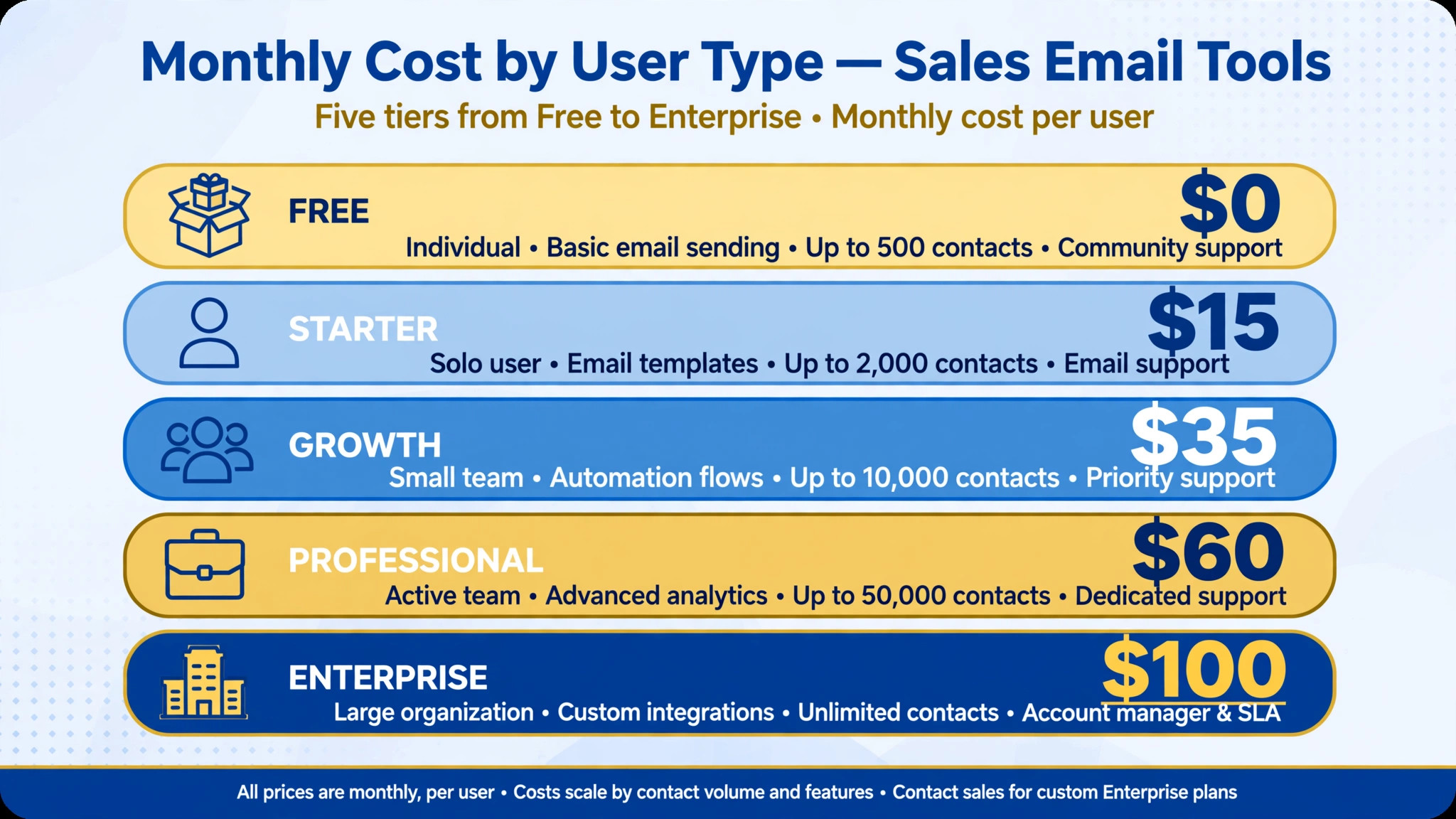
| User type | Monthly volume | Tool stack | Monthly cost |
|---|---|---|---|
| Hobbyist, testing an idea | Low | Lavender free tier | 0 dollars |
| Solo worker, steady use | Medium | Lavender paid plan | About 15 dollars |
| Small team, daily use | High | Lavender plus Regie.ai | About 35 dollars |
| Growing team, heavy use | Very high | Regie.ai plus Apollo.io | About 60 dollars |
| Large team, full volume | Top volume | Lavender plus Apollo.io team plan | About 100 dollars |
A hobbyist can test the idea for nothing, using free tiers across the tools in this guide, and that is the right way to start. The best ai email writing tools for sales teams are cheapest when you test free first and only pay for the tool that proves itself on your work, because a paid plan bought on a demo is often the most expensive mistake in this category.
A solo worker on a steady schedule pays about 15 dollars a month for one paid plan, which covers daily use with room to spare. A small team that uses the tools every day pays about 35 dollars for two tools that cover different jobs, and that pair is usually better value than one dear tool that does half the work well.
A growing team pays about 60 dollars for a heavier stack, and a large team pays about 100 dollars for team plans with shared seats and admin controls. The stack is what you actually pay for, not the single subscription, so work out the stack cost before you compare headline prices. Check the vendor pricing page before you commit, because prices change often.
How This Guide Ranked the Sales Email Tools
Every tool in this guide was judged on the same four tests. The first test was output quality on real work, not on vendor demos. The second test was ease of use, including setup time and how fast a new user can get a good result. The third test was pricing at real volume, including free tier limits and the cost of the plan a busy user actually needs.
The fourth test was trust, including commercial rights, data handling, and how the tool treats your work. A tool that scored well on output but poorly on trust was ranked below a tool that scored well on both, because a tool you cannot trust with client work is a tool you cannot use. No vendor paid for a place in this guide, and no ranking was sold.
What the Free Tier Covers for Sales Email Tools
The free tier is a test, not a plan, and it should be judged as one. Most free tiers in this guide cover a useful amount of real work, from a handful of jobs a month to a daily allowance that suits a solo worker. The limit that matters is the one you hit first, whether that is a word count, a credit balance, or a seat count, and that limit decides how long the free tier lasts.
A free tier that covers your test week is worth more than a free tier that covers a month of light use but blocks the one feature you need. Check three things before you rely on it. Does it include the feature you are testing. Does it allow commercial use of the output. And does it export in the format you need. A free tier that fails any of those three is a demo, not a trial.
When the free tier runs out, the decision is simple. If the tool proved itself on your real work, pay for the cheapest plan that covers your volume and keep the free tier of the second tool for testing new ideas. If the tool did not prove itself, cancel and move on. The worst outcome is paying for a tool you tested once, so set a reminder to cancel every trial on the day you start it.
Mistakes That Kill Reply Rates
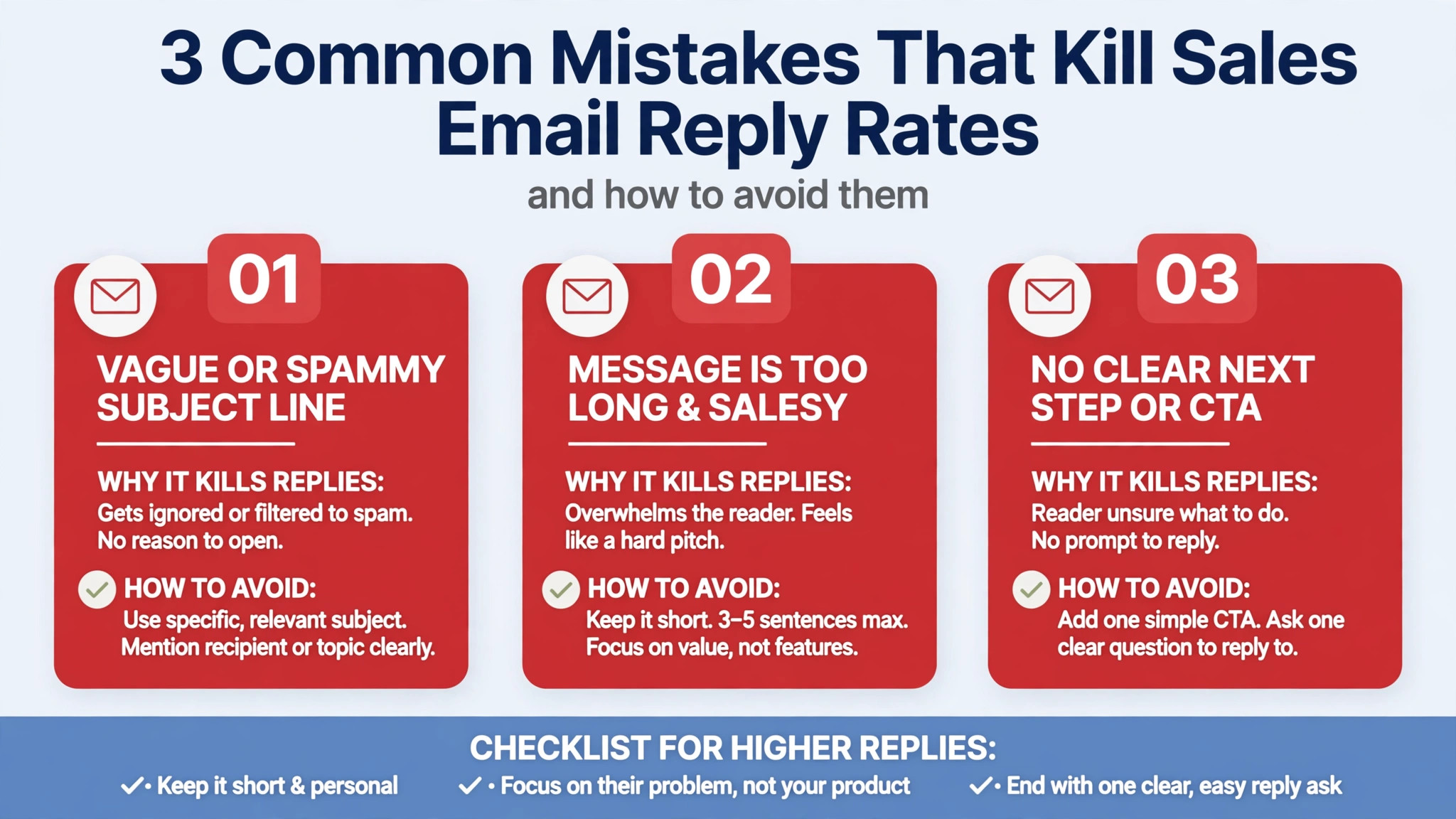
The first mistake is buying on price alone. The best ai email writing tools for sales teams vary widely in what the headline price buys, and the cheapest plan often has limits that force an upgrade in the first month. Work out the cost at your real volume before you buy, and compare the plan you will actually need, not the plan on the pricing page hero section.
The second mistake is trusting the output without checking it. AI tools make mistakes that look confident, from invented facts to garbled text, and a buyer who publishes without reading will ship errors under their own name. Read every output before you use it, and check the parts that matter most, because the tool will not tell you where it guessed.
The third mistake is buying a tool and never learning it. Most tools in this guide have features that only show after a week of real use, from templates to shortcuts to integrations, and a buyer who quits after one day judges the tool on its worst hour. Give each tool a full week on real work before you decide, and keep notes so the decision is based on evidence.
Your Sales Email Setup Checklist
Use this checklist when you set up your pick from the tools in this guide, and keep a copy with your project notes.
- Define the one job the tool must do for sales teams before you open any pricing page.
- Pick your top three tools from the at a glance table and test them on the same three real examples.
- Check the commercial licence for the plan you will buy, not the free plan.
- Set up your workflow end to end, from brief to finished work, and time it on real jobs.
- Work out the monthly cost at your busiest volume and buy the plan that covers it.
- Train the tool on your own examples and templates before you use it on client work.
- Check every output before you publish or send it, and fix the errors the tool missed.
- Review the results after one month, and switch tools if the notes show a better fit.
Related Guides
Keep exploring with these guides on Stratilyze:
- Best AI Presentation Makers for Sales Teams (12 Tools)
- Best AI Note-Taking Tools for Sales Teams (15 Tools)
- Best AI Contract Review Tools for Procurement Teams (12 Tools)
Frequently Asked Questions
Which AI email writing tool is best for a small sales team on a tight budget?
Lavender is the best budget pick because the Starter plan costs about 29 dollars a month and the free tier covers 5 emails a month for testing. Apollo.io is the better pick when the team also needs prospect data and sequencing in one place. That is how the best ai email writing tools for sales teams should be judged for your team, on your real work rather than on a ranking.
Can AI write cold emails that actually get replies for sales teams?
Yes, when the AI writes from real prospect research rather than a template. Lavender data shows A graded messages reply at 4.3 percent against 3.4 percent for the rest. Generic AI output performs worse than a careful human draft, so research quality decides the result.
Is Lavender or Regie.ai better for outbound sales teams?
Lavender is better for teams that want coaching on emails reps write themselves, at about 29 dollars a month. Regie.ai is better for enterprise teams that want AI sequencing and a dialer, but its entry price starts near 180 dollars per user a month with a seat minimum.
How many sales emails should a rep send per day with AI help?
Most teams land between 40 and 80 personalised emails a day per rep, depending on how much research each message carries. Volume above that usually means the personalisation has thinned out, and reply rates fall even as send counts rise. The best ai email writing tools for sales teams differ most on this point, so test it on your own workload before you commit.
Do these sales email tools work with Gmail and Outlook?
Most of the tools in this guide work inside Gmail and Outlook through a browser extension or a sidebar, including Lavender, Apollo.io, and Lemlist. Check the integration list before buying, because a few enterprise tools need a CRM connection first.
What is the best AI email tool for follow up sequences?
Apollo.io and Instantly are strong picks for follow up sequences because they combine sending, tracking, and automatic follow ups in one workflow. Lavender is the better pick when the problem is the quality of each single email rather than the sequence around it.
The Sales Email Tool to Pick This Week
The pick is Lavender. If you want the best ai email writing tools for sales teams to pay off, start there, test it on your real work for a week, and only then decide whether you need a second tool. Lavender wins because it does the core job well, it is easy to start, and its price fits a solo worker as well as a team.
Whichever tool you choose, test it on your own examples, check every output before you use it, and model the cost at your busiest month. A tool earns its fee in work that ships on time, to a good standard, and at a price you can defend. Choose the tool that does those three jobs on your busiest week, and the rest of the feature list will take care of itself.