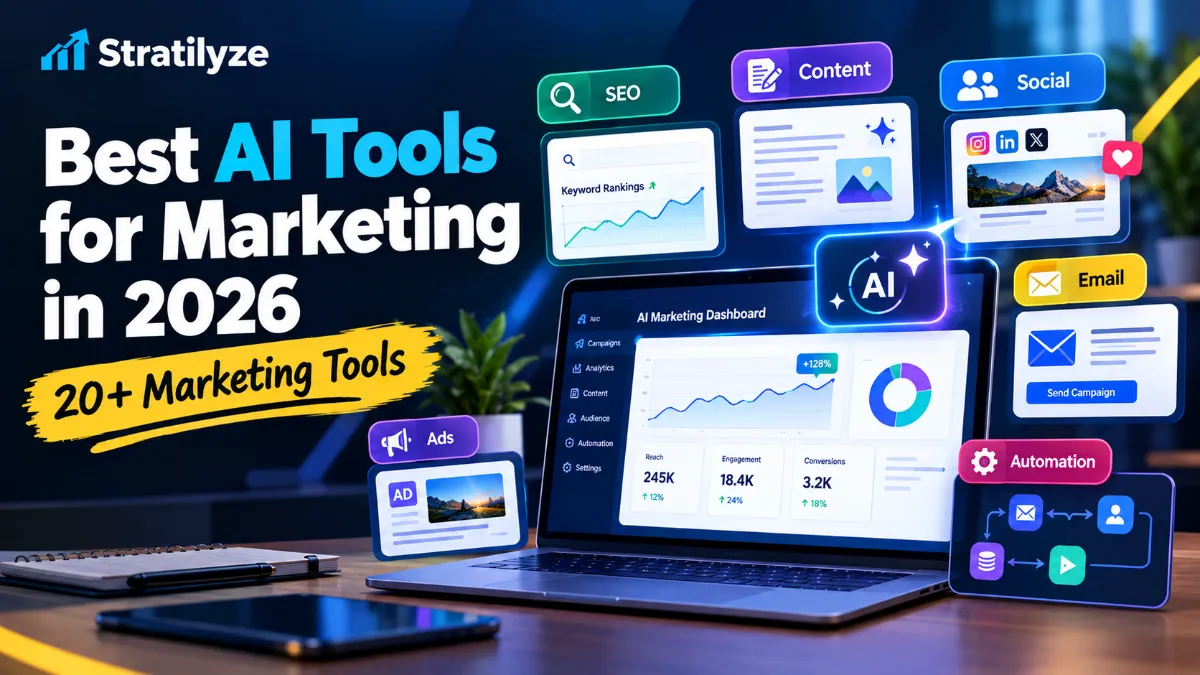
Marketing teams are using AI for much more than writing blog posts. In 2026, AI can help with content creation, SEO, social media, email campaigns, advertising, customer research, design, video, analytics, automation and even visibility in AI search engines.
The challenge is choosing the right tools.
There are hundreds of AI marketing platforms, but most businesses do not need dozens of subscriptions. A better approach is to choose tools based on the marketing tasks that take the most time and then build a small, reliable workflow around them.
This guide covers 24 of the best AI marketing tools in 2026, including tools for content, SEO, social media, email, design, automation, video and marketing operations.
Quick answer: For most marketing teams, Jasper is one of the strongest choices for AI-powered marketing content and workflows, HubSpot is better for an all-in-one marketing platform, Semrush and Surfer are strong choices for SEO, Canva is excellent for marketing design, Buffer and Hootsuite are useful for social media, and Zapier is one of the most useful options for connecting AI with marketing workflows.
What Are AI Marketing Tools?
AI marketing tools are software platforms that use artificial intelligence to help marketers perform, automate or improve marketing tasks.
Depending on the product, AI can help with:
- Content writing
- Blog ideas
- SEO research
- Keyword analysis
- AI search visibility
- Social media posts
- Email campaigns
- Ad copy
- Marketing graphics
- Video creation
- Customer segmentation
- Lead generation
- Marketing automation
- Data analysis
- Personalization
- Content repurposing
- Campaign planning
The important distinction is that an AI marketing tool should not simply generate content. The better platforms connect AI with an actual marketing workflow.
For example, instead of asking AI to “write a social media post,” a modern marketing platform might help you research a topic, create the post, adapt it for different channels, schedule it and then measure performance.
That shift is becoming increasingly important in 2026. Jasper’s 2026 research, based on a survey of 1,400 marketers, reports that 91% of marketers surveyed are actively using AI and that teams are increasingly focused on operationalizing AI rather than simply experimenting with it.
The 24 Best AI Marketing Tools in 2026
| Tool | Best For | Main Marketing Use |
|---|---|---|
| Jasper | AI marketing content | Campaigns, content, brand voice |
| ChatGPT | General marketing AI | Research, copy, ideas, analysis |
| HubSpot | Marketing automation | CRM, leads, campaigns |
| Copy.ai | GTM workflows | Sales and marketing automation |
| Semrush | SEO and advertising | Keywords, competitors, campaigns |
| Surfer | AI SEO | Content optimization and AI visibility |
| Ahrefs | SEO research | Keywords, backlinks, AI visibility |
| Writesonic | SEO + AI search | Content and AI visibility |
| Canva | Marketing design | Graphics, social, presentations |
| Adobe Express | Creative marketing | Design, video, social content |
| Buffer | Social media | Scheduling and AI assistance |
| Hootsuite | Social marketing | Publishing, trends, social insights |
| Predis.ai | Social content | Posts, ads, videos and scheduling |
| Mailchimp | Email marketing | Campaigns and automation |
| Klaviyo | Ecommerce marketing | Email, SMS and customer data |
| Grammarly | Marketing writing | Editing and brand communication |
| Descript | Marketing video | Video and audio content |
| Zapier | Automation | AI workflows and integrations |
| Jasper | Brand-focused content | Brand voice and campaigns |
| Perplexity | Marketing research | Research and discovery |
| Gemini | Google ecosystem | Research, content and analysis |
| Adobe Firefly | Creative AI | Images, video and creative assets |
| Notion AI | Marketing planning | Documents, projects and knowledge |
| Predis.ai | Social content | AI-generated social campaigns |
Jasper appears only once in the actual recommendations below; the table intentionally highlights its main use case rather than treating it as two separate products.
1. Jasper – Best AI Marketing Platform for Content Teams
Jasper is built specifically around marketing rather than general-purpose AI.
It is particularly useful for teams that produce a large amount of branded marketing content and want greater control over tone, messaging and campaign workflows.
Jasper currently offers marketing-focused AI agents, brand voice controls, audience information, knowledge assets, content creation workflows and AI image generation. Its current Pro plan is listed at $59 per month when billed annually or $69 month-to-month, with a 7-day trial available.
Best uses
- Blog content
- Ad copy
- Social posts
- Email campaigns
- Brand messaging
- Campaign planning
- Content repurposing
- Marketing workflows
Best for
Marketing teams that care about brand consistency.
Jasper is more expensive than general AI chatbots, but its advantage is the marketing-specific workflow.
2. ChatGPT – Best All-Purpose AI Marketing Assistant
ChatGPT is one of the most flexible AI tools marketers can use.
It can help with almost every stage of a marketing workflow, including:
- Brainstorming
- Customer research
- Content outlines
- Blog drafts
- Email ideas
- Ad variations
- Social posts
- Competitor research
- Data analysis
- Content repurposing
- Marketing strategy
- Landing-page copy
- Customer personas
The biggest advantage is flexibility.
A marketer can use one conversation to develop a campaign idea, turn that idea into an email sequence, create social variations and analyze campaign data.
It is also useful when you do not want a specialized subscription for every small task.
For a broader comparison of general AI assistants, see our guide to ChatGPT vs Gemini.
3. HubSpot – Best All-in-One AI Marketing Platform
HubSpot is different from most tools on this list because it combines AI with CRM, marketing automation, lead management and customer data.
HubSpot’s Marketing Hub includes tools for lead generation, email, campaigns, automation and reporting. Its current pricing includes a free option, while paid Marketing Hub plans scale significantly depending on features, contacts and usage. HubSpot also uses credits for some AI agents and AI-powered actions.
Best for
- Lead generation
- Email marketing
- CRM
- Marketing automation
- Landing pages
- Customer journeys
- Reporting
- AI agents
Why it stands out
The biggest advantage is that marketing activity and customer information can live inside the same ecosystem.
For businesses that need more than an AI writer, HubSpot can be much more useful than a standalone content generator.
4. Copy.ai – Best for AI Go-to-Market Workflows
Copy.ai has evolved beyond simple AI copywriting.
Its current platform focuses heavily on go-to-market workflows, including marketing and sales processes.
The platform offers AI chat, customizable workflows, multiple model access and automation features. Its current pricing page lists a Chat plan starting at $29 per month, or $24 per month when billed annually, while larger workflow-oriented plans are aimed at businesses and enterprises.
Useful for
- Sales copy
- Marketing workflows
- Campaign content
- Lead generation
- Content repurposing
- GTM operations
Copy.ai makes more sense when you want AI to participate in a repeatable business process rather than simply generate isolated paragraphs.
5. Semrush – Best for SEO and Marketing Intelligence
Semrush is one of the most comprehensive marketing platforms for SEO, competitor research and digital advertising.
Its AI-powered features are increasingly integrated into search and advertising workflows.
For example, Semrush’s current Advertising Toolkit includes AI copy, smart keyword capabilities, competitor insights and an Ads AI Agent. Its listed Advertising Toolkit plans start at $99 per month for Base and $220 for Pro.
Best for
- Keyword research
- Competitor analysis
- SEO
- PPC research
- Advertising
- Content planning
- Market research
If SEO and paid search are major parts of your marketing strategy, Semrush is one of the more complete choices.
6. Surfer – Best for AI SEO Content Optimization
Surfer focuses heavily on content optimization and search visibility.
Its current platform has expanded beyond traditional Google SEO into AI search visibility, including tracking visibility across systems such as ChatGPT, Gemini and Google AI Overviews.
Surfer’s current plans include:
- AI SEO optimization
- Content creation
- Content optimization
- AI search visibility
- Internal linking
- Content gap analysis
- AI visibility tracking
Its Discovery plan currently starts at $49 per month when billed yearly, while Standard is listed at $99 per month annually.
Best for
Content marketers who want to optimize articles for both traditional and AI-driven search.
7. Ahrefs – Best for SEO Research and AI Visibility
Ahrefs remains one of the strongest choices for SEO research.
Its current platform includes:
- Keywords Explorer
- Site Explorer
- Site Audit
- Rank Tracker
- Competitor analysis
- Content Explorer
- Brand Radar
- AI prompt tracking
Ahrefs has also expanded into AI visibility. Its Brand Radar can track how brands appear across large volumes of AI-generated search prompts.
Best for
- SEO professionals
- Content marketers
- Agencies
- Competitor research
- Backlink research
- AI search visibility
For businesses serious about organic search, Ahrefs is worth considering alongside Semrush rather than treating both as identical products.
8. Writesonic – Best for SEO + AI Search Visibility
Writesonic has increasingly positioned itself around both traditional SEO and AI search visibility.
Its current platform tracks visibility across ChatGPT, Gemini and Google AI Overviews and combines that with AI content and site-audit features.
The current Starter plan is listed at $79 per month when billed annually.
Useful for
- AI articles
- SEO content
- AI search visibility
- Site audits
- Brand monitoring
- GEO
- Content optimization
This makes Writesonic particularly interesting for marketers who are trying to understand how their brand appears in AI-generated answers.
9. Canva – Best AI Design Tool for Marketers
Canva is one of the easiest tools for creating marketing visuals without needing professional graphic-design skills.
Canva’s AI features can help marketers create and adapt:
- Social media graphics
- Ads
- Presentations
- Posters
- Blog graphics
- Thumbnails
- Marketing documents
- Videos
- Brand assets
Canva’s 2026 AI platform has moved toward conversational and more agentic workflows, including editable outputs and broader connections between AI and Canva’s existing design ecosystem.
If you regularly need marketing images, social graphics and presentations, Canva can replace several smaller tools.
Our existing guide to the best AI image generators is also useful if image generation is a major part of your workflow.
10. Adobe Express – Best for Adobe-Based Marketing Teams
Adobe Express is another strong option for creating marketing content.
It combines:
- Graphic design
- Photo editing
- Video
- Templates
- Social scheduling
- AI generation
- Brand management
- Adobe Stock assets
Adobe Express Premium is currently listed at $9.99 per month and includes 250 generative credits per month, premium templates, expanded Adobe Stock access, more fonts, brand kits and additional editing features.
Choose Adobe Express if:
- You already use Adobe products
- You need stronger photo editing
- You work with Photoshop or Firefly
- You want Adobe’s creative ecosystem
- You create both static and video content
For a detailed comparison, see Canva vs Adobe Express.
Buffer is useful when social media publishing is the main requirement.
Buffer’s current free plan supports up to three channels and includes its AI Assistant. Paid plans add more scheduling, analytics, collaboration and publishing features.
Best for
- Social scheduling
- Content planning
- Social captions
- Publishing
- Analytics
- Small teams
The major advantage is simplicity.
If you do not need a huge enterprise social platform, Buffer can be easier to manage.
Hootsuite is aimed more toward serious social media management.
Its AI-powered social assistant, now called Wisdom, can help marketers create social posts, identify trends, generate campaign ideas and summarize social insights.
Best for
- Social media teams
- Multiple brands
- Social listening
- Trend monitoring
- Campaign management
- Social analytics
Hootsuite makes more sense when social media is a significant part of your overall marketing operation.
Predis.ai focuses specifically on social content.
It can help generate:
- Social posts
- Captions
- Hashtags
- Carousels
- Videos
- Reels
- Ad creatives
- Product content
- Social calendars
Its current plans use a credit system based on content generation, and the platform supports multiple social channels and publishing workflows.
Best for
Small businesses, agencies and creators that need a high volume of social content.
14. Mailchimp – Best for AI-Assisted Email Marketing
Mailchimp remains a popular email marketing platform, and its current marketing plans include generative AI features, audience insights and automation capabilities.
AI can help with tasks such as:
- Email copy
- Subject lines
- Campaign creation
- Audience insights
- Automation
- Personalization
Best for
- Newsletters
- Small businesses
- Ecommerce
- Email campaigns
- Automated customer journeys
Mailchimp is especially useful when you want email marketing and AI-assisted content creation in one platform.
15. Klaviyo – Best for Ecommerce AI Marketing
Klaviyo is particularly strong for ecommerce and customer lifecycle marketing.
Its platform combines:
- Email marketing
- SMS
- Customer data
- Segmentation
- Analytics
- Automation
- AI-powered subject lines
- AI-assisted campaign creation
Klaviyo currently offers a free plan with limits including 250 profiles, 500 emails per month and a small amount of Composer usage.
Best for
Online stores that need sophisticated customer segmentation and automated marketing.
16. Grammarly – Best for Marketing Copy Editing
Grammarly is useful for marketers who already use AI to create drafts but want better editing.
It can help improve:
- Grammar
- Clarity
- Tone
- Conciseness
- Professional writing
- Marketing messages
- Emails
- Social copy
This is an important category because generating marketing content quickly is only half the job.
AI-generated copy still needs human review for:
- Accuracy
- Brand voice
- Claims
- Audience fit
- Context
- Originality
A writing assistant can help polish the final version.
17. Descript – Best for AI Marketing Video
Descript is particularly useful for marketers producing video and podcast content.
Instead of relying entirely on a traditional timeline editor, Descript lets creators work with audio and video through a transcript-based workflow.
AI features can assist with:
- Transcription
- Editing
- Audio cleanup
- Video editing
- Captions
- Screen recordings
- AI-generated media
- Content repurposing
Its current plans include AI credits for features such as Underlord, Studio Sound, Green Screen, Eye Contact and AI-generated media.
Best for
- YouTube marketing
- Podcasts
- Video ads
- Tutorials
- Webinars
- Social video
18. Zapier – Best for AI Marketing Automation
Zapier becomes particularly valuable when you already have several marketing tools.
For example:
New lead → CRM → AI qualification → email → sales notification → spreadsheet
Instead of moving that information manually, Zapier can connect the applications.
Its current platform combines workflows, Tables, Forms, AI capabilities and MCP, while its free plan includes 100 tasks per month.
Marketing automation examples
You could use Zapier to:
- Send new leads to a CRM
- Add form submissions to a spreadsheet
- Notify sales teams
- Trigger email campaigns
- Connect AI tools
- Organize customer data
- Automate content workflows
For many businesses, automation can create more value than adding another AI writing tool.
19. Perplexity – Best for Marketing Research
Perplexity can be useful during the research stage of marketing.
Marketers can use it to investigate:
- Industries
- Competitors
- Products
- Customer questions
- Market trends
- Content ideas
- Industry developments
The important rule is to verify important claims before publishing them.
Research AI should support marketing decisions, not replace fact-checking.
20. Google Gemini – Best for Google-Centered Marketing Workflows
Google Gemini can be useful for marketers who already work heavily inside Google’s ecosystem.
Potential use cases include:
- Brainstorming
- Content planning
- Research
- Document analysis
- Data interpretation
- Campaign ideas
- Copy variations
Its biggest appeal is its relationship with Google’s broader productivity ecosystem.
For a detailed comparison between the two major general-purpose AI assistants, see ChatGPT vs Gemini.
21. Adobe Firefly – Best for Generative Marketing Creative
Adobe Firefly is useful when marketing teams need AI-generated creative assets.
Marketing applications include:
- Concept images
- Product visuals
- Background generation
- Image editing
- Creative variations
- Video generation
- Campaign concepts
Firefly Pro currently includes Adobe Express Premium plus 4,000 monthly generative credits and access to Photoshop on web and mobile.
For brands concerned about commercial workflows, Adobe also positions Firefly’s generative features around commercially safe use cases.
22. Notion AI – Best for Marketing Planning and Knowledge Management
Notion can act as a central workspace for marketing teams.
Instead of being only an AI writing tool, it can combine:
- Campaign plans
- Content calendars
- Marketing documentation
- Meeting notes
- Research
- Project tracking
- Team knowledge
- AI-assisted writing
This is particularly useful for teams that want marketing strategy, content planning and documentation in one place.
You can also combine it with a dedicated project management system when campaigns become more complex.
23. Grammarly – Best for Final Marketing Copy Review
Grammarly deserves a second mention from a workflow perspective because marketers often use it differently from dedicated AI writing platforms.
The workflow can be:
AI generates draft → marketer adds strategy and facts → Grammarly improves clarity → human approves final copy
That is often safer than publishing AI-generated marketing copy directly.
The tool is especially useful for:
- Landing pages
- Emails
- Sales messages
- Social posts
- Product descriptions
- Business communication
24. Canva AI – Best for Fast Campaign Asset Production
Canva’s AI capabilities deserve special attention because marketers often need many versions of the same campaign.
For example:
One campaign idea
can become:
- Instagram post
- Facebook graphic
- LinkedIn image
- YouTube thumbnail
- Presentation
- Email graphic
- Blog image
- Ad creative
That type of asset repurposing is one reason AI design tools are becoming more useful for marketing teams.
Best AI Marketing Tools by Category
Instead of asking which tool is universally “the best,” it is more useful to match the software to the marketing job.
Best AI tools for content marketing
- Jasper
- ChatGPT
- Copy.ai
- Writesonic
- Notion AI
Best AI tools for SEO
- Semrush
- Ahrefs
- Surfer
- Writesonic
- Buffer
- Hootsuite
- Predis.ai
- Canva
Best AI tools for email marketing
- Klaviyo
- Mailchimp
- HubSpot
Best AI tools for marketing design
- Canva
- Adobe Express
- Adobe Firefly
Best AI tools for video marketing
- Descript
- Canva
- Adobe Express
- Adobe Firefly
Best AI tools for marketing automation
- HubSpot
- Zapier
- Klaviyo
- Copy.ai
Best AI Marketing Tools for Small Businesses
Small businesses should not try to copy the technology stack of a large marketing department.
A smaller stack is usually easier to manage.
A practical small-business stack could be:
ChatGPT + Canva + Buffer + Mailchimp + Zapier
This combination can cover a surprisingly large portion of everyday marketing:
- ChatGPT for ideas and content
- Canva for graphics
- Buffer for social scheduling
- Mailchimp for email
- Zapier for automation
If your business needs CRM and lead management, consider adding HubSpot.
You can also explore our guide to the best software for small businesses.
Best AI Marketing Stack for a Content Website
For a blog, media site or content-focused business, the priorities are different.
A practical stack could be:
ChatGPT + Semrush or Ahrefs + Surfer + Canva + Buffer
Workflow
Research
Use Semrush, Ahrefs or ChatGPT to understand the topic and search demand.
↓
Planning
Build the article structure and content angle.
↓
Writing
Use AI to accelerate drafting, but add original analysis and useful information.
↓
Optimization
Use Surfer or another SEO platform to review the article.
↓
Design
Create the featured image and supporting graphics with Canva.
↓
Distribution
Schedule social posts through Buffer.
The important point is that AI should support the workflow rather than become the entire workflow.
Best AI Marketing Stack for Ecommerce
For ecommerce businesses, the stack should focus more heavily on customer data and lifecycle marketing.
A strong combination could be:
Klaviyo + Canva + ChatGPT + Adobe Express + Zapier
Klaviyo can handle customer segmentation and lifecycle communication, while Canva and Adobe Express can help with creative assets.
ChatGPT can assist with:
- Product descriptions
- Campaign ideas
- Email concepts
- Customer research
- Ad variations
Zapier can connect different systems when native integrations are not enough.
Social media marketing has several separate jobs:
- Creating ideas
- Writing captions
- Designing graphics
- Creating videos
- Scheduling content
- Monitoring performance
- Understanding trends
No single platform is necessarily the best at all seven.
Simple setup
Canva + Buffer
Good for individuals and small businesses.
More advanced setup
Canva + Hootsuite
Better for teams that need stronger social management and insights.
High-volume content
Predis.ai + Buffer
Useful when producing a large amount of social content is a priority.
AI Marketing Tools vs General AI Chatbots
A common question is:
Why pay for a marketing AI tool when ChatGPT or Gemini can already write marketing content?
The answer is workflow.
A general AI assistant is flexible.
A specialized marketing platform may provide:
- Brand controls
- Marketing templates
- Campaign workflows
- SEO data
- CRM integration
- Social scheduling
- Customer segmentation
- Marketing analytics
- Approval systems
- Team collaboration
For example, HubSpot is not simply an AI writer. It connects AI with CRM and marketing operations. Jasper is not simply a chatbot. Its platform is designed around marketing workflows and brand controls. Surfer connects AI with SEO optimization and AI search visibility.
So the right question is not:
“Which AI writes the best?”
Instead ask:
“Which tool removes the most work from my marketing workflow?”
Should You Use Multiple AI Marketing Tools?
Yes, but only when each tool has a clear purpose.
A common mistake is subscribing to five AI writing platforms that all do approximately the same thing.
A better setup might be:
- One general AI assistant
- One SEO platform
- One design tool
- One social platform
- One email platform
- One automation platform
For example:
ChatGPT + Semrush + Canva + Buffer + Mailchimp + Zapier
Each product has a different job.
That is generally more useful than paying for six different AI copywriters.
How to Choose the Right AI Marketing Tool
Before subscribing, ask these questions.
1. What marketing task takes the most time?
If content takes too long, consider Jasper, ChatGPT or Copy.ai.
If SEO is the bottleneck, look at Semrush, Ahrefs or Surfer.
If social content is the problem, consider Buffer, Hootsuite, Canva or Predis.ai.
If email is the problem, look at Mailchimp, Klaviyo or HubSpot.
2. Does the tool fit your existing workflow?
A tool can be excellent but still be a poor choice if your team cannot integrate it into its daily work.
Check:
- Integrations
- Export options
- Team access
- Automation
- APIs
- Existing software compatibility
3. Is AI actually improving the process?
Do not buy a tool simply because it has “AI” in the product description.
Ask:
What does the AI actually save me from doing manually?
If the answer is unclear, the tool may not be worth paying for.
4. How does pricing scale?
AI software can become expensive as a team grows.
Look at:
- Per-user pricing
- Usage limits
- AI credits
- Content limits
- Contact limits
- Automation limits
- API costs
- Additional seats
For example, HubSpot and Jasper use different approaches to AI usage, while platforms such as Zapier and Predis.ai also use usage or credit-based models for certain functionality.
Are AI Marketing Tools Worth Paying For?
They can be, but the answer depends on your workflow.
An AI tool is worth paying for when it consistently saves enough time or improves results enough to justify the subscription.
For example, a marketer who spends several hours each week creating social content may benefit from a dedicated social platform.
A business generating thousands of leads may benefit much more from HubSpot or another marketing automation platform than from another AI writing tool.
A content website may get more value from SEO software than from an expensive AI copywriting platform.
The value comes from solving a real bottleneck.
Are AI Marketing Tools Replacing Marketers?
Not completely.
They are changing what marketers spend their time doing.
AI can handle more of the repetitive work:
- First drafts
- Variations
- Summaries
- Transcriptions
- Data organization
- Basic research
- Image variations
- Content repurposing
- Workflow automation
But humans still need to handle:
- Strategy
- Positioning
- Brand decisions
- Customer understanding
- Fact checking
- Creative direction
- Compliance
- Final approval
- Business judgment
The strongest marketing workflow is usually AI-assisted rather than AI-only.
How to Use AI Marketing Tools Without Producing Generic Content
This is particularly important for SEO and content marketing.
Do not simply give an AI tool a keyword and publish the result.
Instead:
Step 1: Start with the audience
Understand who you are trying to reach.
Step 2: Define the problem
What does the customer actually need?
Step 3: Research the topic
Use reliable sources, customer questions, product information and relevant data.
Step 4: Use AI for acceleration
Let AI help with:
- Outlines
- Ideas
- Variations
- Research organization
- Editing
- Repurposing
Step 5: Add original value
Include:
- Examples
- Comparisons
- Practical recommendations
- Real product differences
- Clear limitations
- Useful workflows
Step 6: Review everything
Check facts, pricing, product claims and recommendations before publishing.
That process creates substantially more useful marketing content than simply generating large volumes of AI text.
Our Picks: The Best AI Marketing Tools in 2026
If you want the shortest possible list, these are the tools I would put on the shortlist:
🏆 Best overall AI marketing platform
Jasper
Best for marketing-focused AI content and brand workflows.
🏢 Best all-in-one marketing platform
HubSpot
Best for CRM, lead generation, automation and marketing operations.
✍️ Best general AI marketing assistant
ChatGPT
Best for flexibility across research, strategy, content and analysis.
🔎 Best SEO platform
Semrush
Best for marketers who need SEO, competitor research and advertising intelligence.
📈 Best AI SEO optimization
Surfer
Best for content optimization and AI search visibility.
🔗 Best SEO research platform
Ahrefs
Best for keyword, backlink, competitor and AI visibility research.
🎨 Best marketing design tool
Canva
Best for creating marketing visuals quickly.
Buffer
Best for straightforward scheduling and social publishing.
Hootsuite
Best for larger social operations, trend discovery and social insights.
📧 Best ecommerce email platform
Klaviyo
Best for customer segmentation, email, SMS and lifecycle marketing.
⚙️ Best automation platform
Zapier
Best for connecting marketing tools and automating repetitive workflows.
🎬 Best AI video tool for marketers
Descript
Best for turning recordings, podcasts and video into usable marketing content.
Final Verdict
The best AI marketing tool in 2026 depends on what you actually need to accomplish.
If you want one marketing-focused AI platform, Jasper is one of the strongest choices for content teams that care about brand consistency and marketing workflows. Its current platform is increasingly focused on AI agents and end-to-end marketing execution.
If you need an entire marketing system rather than a content generator, HubSpot is the stronger option because it connects AI with CRM, lead generation, automation and reporting.
For SEO, Semrush, Ahrefs and Surfer are better choices than general-purpose AI tools because they provide marketing data and optimization workflows.
For visual content, Canva is one of the easiest options for most marketers, while Adobe Express and Firefly are particularly attractive for teams already invested in Adobe’s creative ecosystem.
For social media, Buffer is a strong simple choice, while Hootsuite is better suited to more advanced social teams.
And for automation, Zapier can connect many of these tools so AI becomes part of a repeatable workflow instead of another isolated application.
The biggest lesson is simple: you do not need 20 AI marketing subscriptions.
Choose the tools that solve your biggest bottlenecks, connect them where possible, and keep human strategy and review at the center of the process.
Frequently Asked Questions
What is the best AI marketing tool in 2026?
Jasper is one of the strongest choices for marketing-focused AI content and workflows. HubSpot is a better choice if you need CRM, lead generation and marketing automation in addition to AI.
What is the best free AI marketing tool?
ChatGPT, Canva and several other platforms offer free access with different limits. The best option depends on whether you need writing, research, design, SEO or social media functionality.
What is the best AI tool for marketing content?
Jasper, ChatGPT and Copy.ai are strong options. Jasper is particularly focused on marketing workflows and brand consistency.
What is the best AI tool for SEO?
Semrush and Ahrefs are strong all-around SEO platforms, while Surfer is particularly useful for content optimization and AI search visibility.
Buffer is a strong choice for simple scheduling and publishing. Hootsuite is better for larger social media operations, while Predis.ai is useful for generating large volumes of social content.
What is the best AI email marketing tool?
Klaviyo is particularly strong for ecommerce and customer lifecycle marketing. Mailchimp is a good option for businesses that want a more general email marketing platform.
Can AI completely automate marketing?
AI can automate many repetitive marketing tasks, but completely removing human oversight is generally a bad idea. Strategy, brand positioning, fact-checking and final decisions still require human judgment.
Are AI marketing tools good for small businesses?
Yes. Small businesses can use AI to reduce the time spent on content, design, social media, email and repetitive administrative work. However, starting with a small number of tools is usually better than subscribing to every new AI platform.
Should marketers use ChatGPT instead of specialized AI marketing tools?
Not necessarily. ChatGPT is highly flexible, but specialized tools can provide marketing-specific data, integrations, workflows, automation and analytics that a general AI assistant may not provide by itself.
How many AI marketing tools does a business need?
There is no ideal number. A small business may need only three to six core tools, while a larger marketing team may need a much broader stack. The goal should be to cover important workflows without creating unnecessary complexity.
If you are building an AI-powered marketing stack, these guides may also help: