
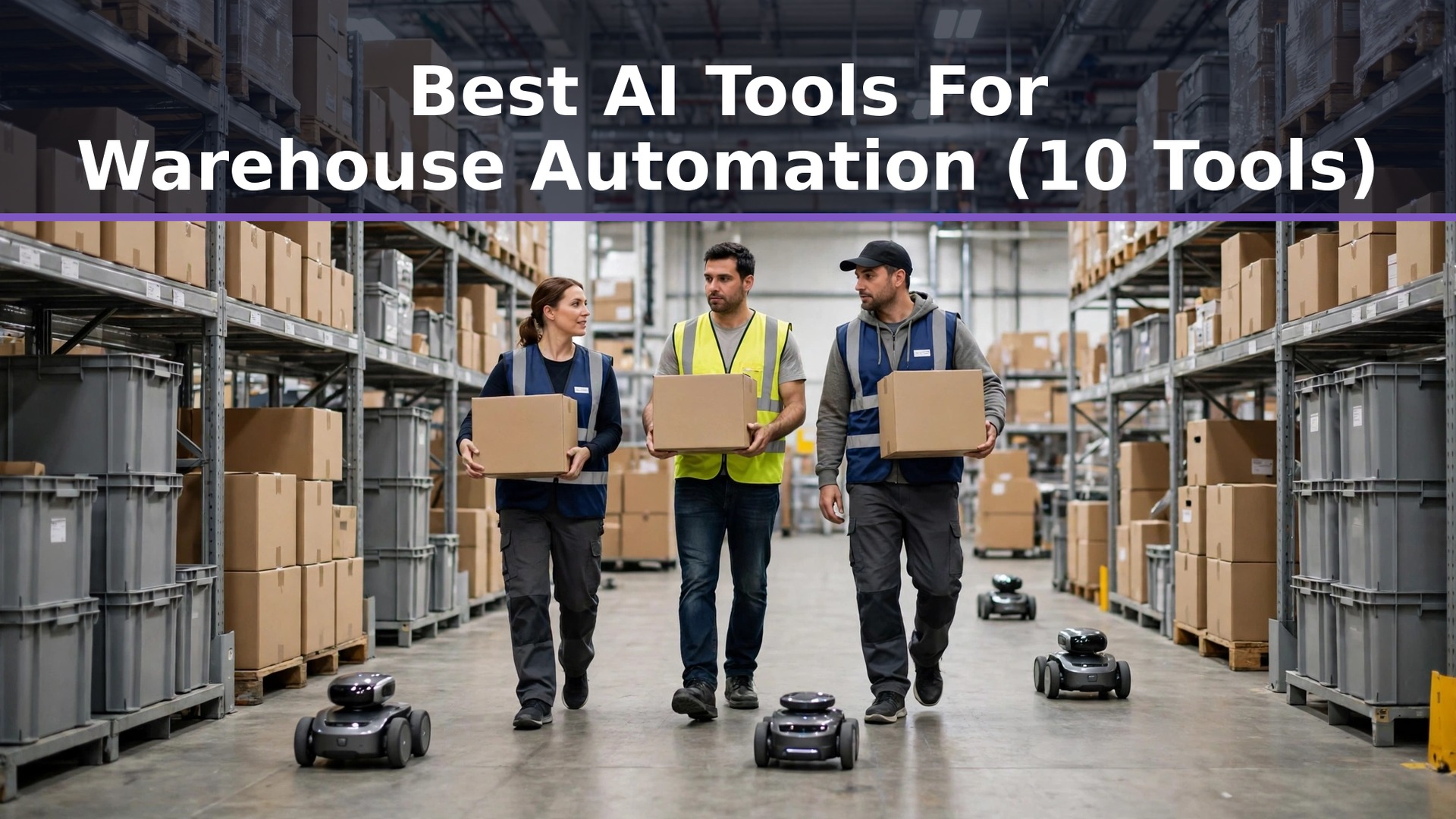
The best ai tools for warehouse automation in 2026 put Locus Robotics first for most midsize fulfilment operations, because its collaborative mobile robots lift picker productivity without rebuilding the warehouse. A third party logistics provider that cannot hire enough pickers, a retailer whose peak season overwhelms the floor and a manufacturer whose order volume doubled all need the same thing, which is more throughput from the same building. The nine tools below differ on whether they move goods, store them, pick them or orchestrate the whole floor.
Warehouse automation is not one purchase. Mobile robots carry shelves to people, cube grids store goods in dense towers, picking arms lift items from bins and software decides which order goes where, and a facility that buys the wrong layer will automate the wrong bottleneck.
The second test is the commercial model. Some vendors sell robots outright at 25,000 to 50,000 dollars per unit, others offer robots as a service from 2,000 to 4,000 dollars per robot a month and others charge per pick, so the same fleet can cost very different totals depending on the model.
The 10 Tools at a Glance
| Tool | Main job | Best for | Starting price |
|---|---|---|---|
| Locus Robotics | Collaborative mobile robots for picking | Midsize fulfilment and 3PL operations | Robots as a service, reported from 2,000 dollars per robot a month |
| 6 River Systems | Collaborative pick cart robots | Retail fulfilment with human pickers | Quote based, subscription model |
| GreyOrange | Multi robot orchestration and AMRs | Operations that run several robot types | Quote based |
| AutoStore | Cube grid storage and retrieval | High density storage for small goods | Quote based, per port reported from 300,000 dollars |
| Geek+ | Goods to person robots and shuttles | High volume ecommerce fulfilment | Quote based |
| Exotec | Skypod robots for high bay storage | Warehouses that need dense high storage | Quote based |
| Symbotic | Large scale automated case handling | Very high volume distribution centres | Quote based |
| Dematic | Full warehouse automation systems | Large facilities that want one integrator | Quote based, systems reported from 5 million dollars |
| Manhattan Associates | Warehouse management software | Operations that need software before hardware | Quote based |
| Blue Yonder | Supply chain and warehouse software | Enterprises that orchestrate the whole chain | Quote based |
Best Pick by Job
| Job type | First pick | Second tool | Why this pair works |
|---|---|---|---|
| Lift picker productivity fast | Locus Robotics | 6 River Systems | Locus Robotics leads on deployment speed and 6 River Systems adds cart based picking |
| Store more in the same building | AutoStore | Exotec | AutoStore leads on cube density and Exotec adds high bay storage |
| Orchestrate several robot types | GreyOrange | Manhattan Associates | GreyOrange leads on orchestration and Manhattan Associates adds WMS depth |
| Very high volume automation | Symbotic | Dematic | Symbotic leads on case handling scale and Dematic adds full integration |
| Software before hardware | Manhattan Associates | Blue Yonder | Manhattan Associates leads on WMS and Blue Yonder adds chain wide planning |
A fulfilment warehouse and a distribution centre ask for opposite things from automation. The fulfilment warehouse needs flexible robots that handle thousands of small orders a day, while the distribution centre needs fixed systems that move pallets and cases at massive scale.
Order volume decides the second cut. A facility processing 5,000 orders a day can justify mobile robots on a service model, while a facility processing 500 orders a day will find the same robots hard to pay for. The best ai tools for warehouse automation match the facility as it runs today, with a clear path to scale when the volume grows.
Which warehouse robot is best for picking?
Locus Robotics is the best pick for picking because its collaborative robots work beside people rather than replacing the whole floor. LocusBots carry shelves to pickers, the picker stays in one zone and productivity rises two to three times per picker in reported deployments, with DHL running more than 2,000 LocusBots across more than 50 sites. The robots as a service model lets a facility start with a small fleet and add robots for peak season without buying hardware outright.
6 River Systems takes a different route to the same pick, with collaborative cart robots called Chuck that follow pickers through the aisles and carry the picked goods. Shopify acquired 6 River Systems in 2019 and sold it to Ocado Group in May 2023, after exiting its logistics business, and the product continues operating under Ocado. It suits a retail fulfilment operation where pickers walk the aisles and need a cart that keeps up.
The honest test is a pilot on one zone. Run the robots beside the existing pickers for a month, count picks per hour and errors per thousand, and compare the totals with the manual baseline. The tool with the highest picks per hour at the lowest error rate wins, and the best ai tools for warehouse automation should prove that lift before any facility signs a multi year contract.
How to Choose the Best AI Tools For Warehouse Automation
Start with the bottleneck the facility actually has, because that decides the shortlist before price does. Measure picks per hour, space utilisation and error rate for a month, and buy the layer that fixes the worst number, whether that is picking speed, storage density or sortation. A facility that buys robots for a space problem will automate the wrong thing.
Next, check the integration with the existing warehouse management system. A robot fleet that cannot talk to Manhattan Associates, SAP EWM or the current WMS will need custom middleware, and that work can cost as much as the robots. Test the integration with real orders before signing, because a fleet that cannot read the order queue is a very expensive decoration.
Then look at the commercial model. Compare the capital purchase, the robots as a service monthly fee and the per pick price on the same volume, since per pick pricing at 3 to 8 cents reported in some sources and 8 to 18 cents in others changes the total by thousands a month. Finally, check vendor stability, because consolidation is accelerating and several well funded vendors from 2020 to 2022 have been acquired, shut down or merged.
The 10 Tools in Detail
The order below follows the warehouse floor, so the picking robot opens the list and the planning software closes it. Each entry states the price as published or reported, the model that matters and the job it fits, because the best ai tools for warehouse automation earn their place on the throughput they deliver.
1. Locus Robotics
Locus Robotics is the collaborative mobile robot leader for third party logistics and ecommerce fulfilment. LocusBots work beside human pickers, carrying shelves to a fixed pick zone so the picker walks less and picks more, with reported productivity gains of two to three times per picker. The robots as a service model is reported from 2,000 to 4,000 dollars per robot a month, with capital purchase reported at 25,000 to 50,000 dollars per unit for comparable AMRs, and the company raised 117 million dollars in Series F funding in 2024.
The drawback is the fleet minimum and the service dependence. Robots as a service needs a minimum deployment size, so a small warehouse may not qualify, and the facility depends on Locus for maintenance and software, which makes the exit cost high. A warehouse with very low volume will also find the monthly fee hard to justify against manual picking.
Locus Robotics suits midsize fulfilment and 3PL operations. It fits a facility processing thousands of orders a day, a provider that needs to scale for peak season and an operation that wants robots without buying hardware. The service model is the feature that matters, because a facility that rents robots can scale up for Christmas and down in January.
Run a pilot on one pick zone for a month, measure picks per hour against the manual baseline and check the error rate before signing a fleet deal.
2. 6 River Systems
6 River Systems is the collaborative pick cart robot provider for retail fulfilment with human pickers. Chuck robots follow pickers through the aisles, carry the picked goods and guide the picker to the next location, which cuts walking time and errors. Shopify acquired the company in 2019 and sold it to Ocado Group in May 2023, and the product continues operating under Ocado as a distinct system from Ocado Smart Platform. Pricing is subscription based on inquiry.
The drawback is the ownership change and the quote only price. A buyer cannot budget 6 River Systems from the website, and the Ocado ownership raises questions about long term independence, though the product continues to operate. The cart model also suits aisle picking better than zone picking, so a facility built around zones may prefer Locus.
6 River Systems suits retail fulfilment with walking pickers. It fits a retailer whose pickers walk long aisles, a facility that wants a cart that keeps up and an operation that values a proven deployment record. The cart following is the feature that matters, because a picker who does not push a heavy cart picks faster and with fewer errors.
Ask for a written quote at the real fleet size, trial Chuck on one aisle and compare picks per hour with the manual baseline.
3. GreyOrange
GreyOrange is the multi robot orchestration platform for operations that run several robot types together. GreyMatter software decides which robot does which task, while the Ranger series AMRs handle sortation and fulfilment, so a facility can mix robots from different vendors under one brain. Pricing is available on request, with custom implementation that can take time.
The drawback is the implementation time and the quote only price. GreyOrange custom work takes longer than a single vendor fleet, and a buyer cannot budget the platform from the website. A facility with one robot type will also find the orchestration layer more than it needs, since the value appears when several types run together.
GreyOrange suits operations that run several robot types. It fits a large fulfilment centre with AMRs, shuttles and arms, a provider that wants one orchestration layer and a facility that plans to add robot types over time. The orchestration is the feature that matters, because a warehouse with five robot types and no brain will waste more time coordinating than it saves picking.
Book a demo with the facility layout, ask GreyOrange to show how GreyMatter would route a real order and check the integration with the current WMS.
4. AutoStore
AutoStore is the cube grid storage and retrieval system for high density storage of small goods. Robots run on top of a grid of stacked bins, fetching the right bin to a port where a human picks, which stores three to four times more goods than traditional shelving in the same footprint. The company reports more than 1,250 installations in 50 countries, with per port costs reported from 300,000 to 500,000 dollars and full systems reported from 5 million dollars.
The drawback is the capital cost and the fixed footprint. AutoStore needs a large upfront investment and a purpose built grid, so a facility that moves premises or changes product mix will find the system hard to adapt. The grid also suits small goods best, so a warehouse with large or bulky items needs a different system.
AutoStore suits high density storage for small goods. It fits a pharmacy, a fashion retailer and a grocery operation that needs to store far more in the same building. The density is the feature that matters, because a warehouse that stores four times more in the same footprint can delay a costly move.
Ask AutoStore for a written quote at the real bin count and port number, and compare the payback period with a mobile robot fleet before committing.
5. Geek+
Geek+ is the goods to person robot provider for high volume ecommerce fulfilment. Its robots carry pods of shelves to pickers, with shuttle systems for totes and cartons, and the company is the global volume leader with more than 30,000 pods operating across Asia and entering European 3PLs. Pricing is quote based, with per unit costs reported at 25,000 to 45,000 dollars for comparable AMRs.
The drawback is the quote only price and the service maturity outside Asia. A buyer cannot budget Geek+ from the website, and English language fleet management and global service are still maturing beside Western vendors, though the hardware matches on specs. A facility that needs deep local support should check the service coverage before signing.
Geek+ suits high volume ecommerce fulfilment. It fits a retailer with thousands of orders a day, a 3PL that wants the lowest unit cost and an operation that values hardware volume over brand familiarity. The volume is the feature that matters, because a vendor that has deployed tens of thousands of pods has solved the problems a small fleet has not yet met.
Ask Geek+ for a written quote and a reference site in the same country, visit the reference facility and check the service response before signing.
6. Exotec
Exotec is the Skypod robot system for high bay storage in warehouses that need dense vertical storage. Skypod robots climb racks up to twelve metres, fetch totes and deliver them to pick stations, which suits a facility with high ceilings and a need to store more without extending the building. Pricing is quote based, with custom design for each facility.
The drawback is the custom design and the quote only price. Every Exotec deployment is engineered for the specific building, so the sales cycle is long and the buyer cannot compare a standard price. A facility with low ceilings will also get little value, since the Skypod advantage is vertical.
Exotec suits warehouses with high ceilings and dense storage needs. It fits a retailer that cannot extend its building, a facility with twelve metre racking and an operation that wants robots to use the vertical space. The vertical reach is the feature that matters, because a warehouse that stores upward avoids the cost of a new building.
Ask Exotec for a design study on the real building, check the payback against a mobile robot fleet and visit a live site before committing.
7. Symbotic
Symbotic is the large scale automated case handling system for very high volume distribution centres. Its robots and software move cases from storage to pallets at speeds a manual operation cannot match, with a focus on grocery and retail distribution at massive scale. Pricing is quote based, with systems built for facilities that process tens of thousands of cases a day.
The drawback is the scale threshold and the quote only price. Symbotic suits only the largest facilities, so a midsize warehouse will not meet the volume that justifies the system, and the buyer cannot budget it from the website. The fixed nature of the system also makes it hard to adapt if the product mix changes.
Symbotic suits very high volume distribution. It fits a grocery chain, a large retailer and a distributor that moves cases at a scale where manual handling cannot keep up. The case handling speed is the feature that matters, because a distribution centre that moves ten thousand cases an hour needs automation built for that rate.
Ask Symbotic for a feasibility study at the real case volume, and compare the payback with a mobile robot fleet before committing.
8. Dematic
Dematic is the full warehouse automation integrator for large facilities that want one vendor to design and build the whole system. Part of KION Group, Dematic covers conveyors, sortation, automated storage, robotics and software in one project, with decades of large scale deployments. Pricing is quote based, with full systems reported from 5 million to 15 million dollars for a midsize facility.
The drawback is the capital cost and the project length. A Dematic system needs a large budget and a long implementation, so a facility that needs robots in a month will find the timeline too slow. The integrated approach also locks the facility into one vendor for the whole system, which makes future changes harder.
Dematic suits large facilities that want one integrator. It fits a distribution centre building a new site, a manufacturer automating a whole warehouse and an operation that values a single accountable vendor over many specialists. The integration is the feature that matters, because a facility that buys one system from one vendor has one throat to choke when something breaks.
Ask Dematic for a phased quote, check the implementation timeline against the peak season and visit a live site of similar size before signing.
9. Manhattan Associates
Manhattan Associates is the warehouse management software for operations that need software before hardware. Its WMS decides where goods sit, which orders pick first and how labour is assigned, and it integrates with most robot fleets, so a facility can automate the decisions before it automates the movement. Pricing is quote based, with implementation that varies by facility size.
The drawback is the quote only price and the software only scope. Manhattan Associates sells software, not robots, so a facility that needs hardware must buy it separately and integrate the two. The implementation also takes months, so a facility that needs a quick win will find the timeline slow.
Manhattan Associates suits operations that need software depth first. It fits a facility whose picking is chaotic, a provider that manages many warehouses and an operation that wants one WMS across the whole network. The decision logic is the feature that matters, because a warehouse that picks in the right order needs fewer robots to hit the same throughput.
Book a demo with the facility data, ask Manhattan to show how the WMS would sequence a real day of orders and check the robot integrations before buying.
10. Blue Yonder
Blue Yonder is the supply chain and warehouse software for enterprises that orchestrate the whole chain. Its warehouse management, labour management and planning tools sit beside demand forecasting and transport, so a large enterprise can plan from supplier to shelf in one platform. Pricing is quote based, with enterprise contracts that vary widely.
The drawback is the enterprise focus and the quote only price. A midsize warehouse will find Blue Yonder heavy and expensive, and the buyer cannot budget it from the website. The platform is also broader than warehouse automation alone, so a facility that only needs a WMS will pay for planning features it never uses.
Blue Yonder suits enterprises that orchestrate the whole chain. It fits a large retailer, a manufacturer with a complex supply chain and a company that wants one platform from forecast to fulfilment. The chain wide view is the feature that matters, because a warehouse that knows what is coming can staff and stock for it before the orders arrive.
Ask Blue Yonder for a written quote at the real warehouse count, trial the WMS on one site and check the robot integrations before signing an enterprise deal.
Locus Robotics vs AutoStore: Movement Against Storage
Locus Robotics wins on movement. Its robots lift picker productivity two to three times without rebuilding the warehouse, the service model lets a facility start small and the deployment takes weeks rather than months. The trade is density, since Locus does not store more goods in the same footprint, so a warehouse that is full will still be full.
AutoStore wins on storage. Its cube grid stores three to four times more goods than shelving in the same footprint, which delays a costly move and suits small goods at high volume. The trade is capital and flexibility, since the grid needs a large upfront investment and a purpose built layout, and a facility that changes product mix will find it hard to adapt.
Pick Locus Robotics when the bottleneck is picking speed and the facility needs robots fast, and pick AutoStore when the bottleneck is space and the facility needs to store more without moving. Many operators end up with both, using AutoStore for storage and Locus for picking, and that split is the pairing the best ai tools for warehouse automation most often land on.

What does warehouse automation cost per year?
A facility should budget by the commercial model, not the headline price. A fleet of ten Locus robots as a service at a reported 2,000 to 4,000 dollars per robot a month costs 240,000 to 480,000 dollars a year, while buying ten comparable AMRs at 25,000 to 50,000 dollars each costs 250,000 to 500,000 dollars once, plus 8 to 15 percent a year in maintenance. Those figures look similar in year one, but the service model includes maintenance and scaling, while the purchase model leaves the facility owning the hardware.
The second cost is the per pick price. Pay per pick models are reported at 3 to 8 cents per pick in some sources and 8 to 18 cents in others, so a facility doing a million picks a year could pay anywhere from 30,000 to 180,000 dollars depending on the model and the source. That spread is why the quote is the only number that counts, and why the best ai tools for warehouse automation are judged on a written quote at real volume.
Budget for the model that matches the volume pattern, and ask each vendor for a written quote that includes maintenance, integration and the minimum fleet size before comparing. A tool that looks cheap per robot can be the most expensive per pick, and a tool that looks pricey can be the cheapest when the volume is high.

Can a midsize warehouse automate without rebuilding?
A midsize warehouse can automate without rebuilding when it chooses mobile robots over fixed systems. Locus Robotics and 6 River Systems work with the existing racking and layout, the robots arrive in weeks and the facility keeps running during the pilot, so a warehouse can automate one zone without stopping the rest. A facility that starts with one zone and measures the lift can scale robot by robot.
The ceiling arrives with fixed systems. AutoStore, Symbotic and Dematic need a purpose built layout, a long implementation and a capital budget, so a facility that chooses them is committing to a rebuild rather than a pilot. That is the moment to hire an integrator and plan the project around the peak season, because a rebuild that collides with Christmas will cost more than the system saves.
The smart path is to pilot mobile robots on the worst zone, measure picks per hour for a month and buy fixed systems only when the volume proves the need. A warehouse that rebuilds before the pilot wastes money, while a warehouse that never moves past the pilot leaves throughput on the table, and the picks per hour is the number that tells the manager which side of that line the facility stands on.
The First Pilot Checklist
Running a first automation pilot works best as a short sequence rather than a big project. Step one is the baseline, so measure picks per hour, error rate and space utilisation for a month before any robot arrives. Step two is the zone, so choose the worst performing zone and run the pilot there, where the improvement will be visible.
Step three is the integration, so connect the robots to the WMS and confirm orders flow correctly for a week before the pilot starts. Step four is the measurement, so run the pilot for a month, compare picks per hour and errors with the baseline and ask the pickers what slowed them down. Step five is the decision, so compare the pilot cost per pick with the manual cost and decide whether to scale, switch or stop.
Keep the pilot to one zone and one metric, which is picks per hour at the same error rate. A facility that measures that number will know within a month whether the robots earn their keep, and the cost per pick is the proof that decides whether the best ai tools for warehouse automation earn a second zone.
Frequently Asked Questions
Which warehouse automation tool is best for a midsize warehouse?
Locus Robotics is the best pick for a midsize warehouse, because its collaborative robots lift picker productivity two to three times without rebuilding the facility, on a robots as a service model reported from 2,000 dollars per robot a month. 6 River Systems is the second pick for retail fulfilment with walking pickers.
How much does a warehouse robot cost?
Comparable AMRs are reported at 25,000 to 50,000 dollars per unit to buy, with robots as a service reported from 2,000 to 4,000 dollars per robot a month and per pick pricing reported at 3 to 8 cents in some sources. AutoStore per port costs are reported from 300,000 to 500,000 dollars, and full Dematic systems are reported from 5 million dollars.
Is 6 River Systems still owned by Shopify?
6 River Systems is no longer owned by Shopify, which sold it to Ocado Group in May 2023 after exiting its logistics business. The product continues operating under Ocado as a distinct system from Ocado Smart Platform, and buyers should confirm the current support and roadmap with the vendor.
Can robots work beside human pickers?
Locus Robotics and 6 River Systems both build collaborative robots that work beside human pickers, with LocusBots carrying shelves to a fixed zone and Chuck carts following pickers through the aisles. The collaborative model is why midsize warehouses can automate without rebuilding, since the robots fit the existing floor.
What is the cheapest way to start warehouse automation?
A pilot fleet of mobile robots on a service model is the cheapest way to start, because the facility rents a small number of robots for one zone without buying hardware. Manhattan Associates WMS is the cheapest software first step, since better decisions can lift throughput before any robot arrives.
Do warehouse robots replace workers?
Warehouse robots change the work rather than replacing it outright, since collaborative robots carry goods while humans still pick, pack and handle exceptions. Reported deployments show productivity gains of two to three times per picker, which means the same team ships more orders, and the facility still needs people for the tasks robots cannot do.
The Final Word for Warehouses That Need More Throughput
Locus Robotics takes the top spot for most midsize operations because it lifts picker productivity without rebuilding the warehouse, on a service model that scales with the season.
AutoStore is the pick for storage density, GreyOrange is the pick for orchestration and Manhattan Associates is the pick for software first. The best ai tools for warehouse automation are not the set with the most robots, they are the set that fixes the bottleneck the facility actually has.
Choose by the bottleneck first, pilot on one zone and count the cost per pick before signing a multi year deal. A facility that picks this way will spend less time guessing about automation and more time shipping the orders its customers already placed.