

A 29 dollar lifetime scheduler and a 97 dollar a month coaching platform both take bookings. Only one of them sells packages, collects deposits, sends intake forms, and chases no-shows while you coach. That gap is the whole story behind the best booking software for business coaches, because a coach does not buy a calendar. A coach buys a system that turns a booked call into a paid client and a paid client into a returning one.
Coaching booking has three jobs that generic meeting tools skip. The first is package sales, because coaches sell six-session containers and group programs, not single appointments. The second is payment at booking, including deposits, payment plans, and subscriptions, because a booked session that never gets paid is a lost hour. The third is the intake and follow-up layer, with forms, contracts, reminders, and session notes, because the work between sessions is where coaching value lives.
This guide compares 14 platforms across package sales, payments, intake, reminders, and total cost. Prices come from vendor pages and recent published comparisons, checked in October 2026, and they change often, so check the vendor pricing page before you sign. Test each shortlisted tool with a real client journey, including a package purchase and a reschedule, because those cases reveal more than any demo.
Why the best booking software for business coaches earns its fee
A booking tool earns its fee in three places. First, it fills the calendar without the back-and-forth, through booking links, automated reminders, and self-service rescheduling that let clients book at midnight without an email thread. Second, it collects money at the moment of commitment, through deposits, package checkout, and payment plans that turn a booking into revenue before the session starts. Third, it keeps clients engaged between sessions, through intake forms, contracts, session notes, and follow-up messages that make the coaching feel professional.
The second thing to judge is fit by coaching model. A one-on-one coach needs package sales and intake forms above all else. A group coach needs cohort booking, waitlists, and program delivery. A corporate coach needs team billing, reporting, and a professional client experience that survives procurement. The best pick changes with that mix, and the tables below sort the 14 tools by those jobs.
The 14 tools at a glance
Use this table to shortlist three tools, then read only those full sections in detail. Price notes are starting points from published sources, and the vendor pricing page is the final word.
| Tool | Main job | Starting point | Watch out for |
|---|---|---|---|
| Paperbell | All-in-one coaching business | From 97 dollars a month | Older listings report 57 dollars a month |
| Acuity Scheduling | Packages and payments | Starter from 16 dollars a month, billed yearly | No free plan, 7-day trial only |
| Cal.com | Free scheduling for solo coaches | Free for individuals, Teams from 12 dollars a month | Hosted product went closed source in April 2026 |
| TidyCal | Lifetime deal scheduler | Free plan, lifetime from 29 dollars once | 1 percent fee on Stripe payments on free plans |
| SimplyBook.me | Booking website and memberships | Free 50 bookings, Basic from 11.90 a month | Priced in euros, booking caps tighten fast |
| Calendly | Simple booking links | Free 1 event type, Standard from 10 dollars a month | No package sales or contracts |
| Setmore | Free booking for new coaches | Free up to 4 users, Pro from 5 dollars a month | Paid features are thin for packages |
| YouCanBookMe | Booking pages on your calendar | Paid from 8.10 dollars a month, billed yearly | SMS costs extra on every plan |
| CoachAccountable | Coaching delivery and tracking | From 20 dollars a month | Booking is secondary to coaching tools |
| Satori | Coaching business management | From 39 dollars a month | Smaller vendor, fewer integrations |
| Simply.Coach | Growing coaching practices | From 9 dollars a month | Entry plan covers only 3 clients |
| vCita | Scheduling plus CRM and invoicing | From 29 dollars a month | No free plan advertised |
| CoachVantage | Programs, contracts, and booking | From 26 dollars a month, billed yearly | Smaller vendor, less name recognition |
| Delenta | Coaching platform with AI notes | From 29 dollars a month | Newer platform, smaller community |

Best pick by job
The table below names a lead pick for each segment in this guide, with a second option worth testing. Test the lead pick on a real client journey before signing.
| Segment | Lead pick | Also test | Why it fits |
|---|---|---|---|
| One-on-one coaches | Paperbell | Acuity Scheduling | Package sales plus contracts suit 1 to 1 work |
| Group coaches | SimplyBook.me | CoachVantage | Memberships and programs suit group coaching |
| Corporate coaches | Acuity Scheduling | vCita | Professional billing and reporting suit corporate work |
One-on-one coaches need package sales and intake above all else. Paperbell sells coaching packages from a branded website with contracts and payments in one flat plan, while Acuity Scheduling adds deeper customization for coaches who sell memberships and gift certificates alongside packages.
Group coaches need a different strength. Cohort booking, waitlists, memberships, and program delivery matter more than a single booking link. SimplyBook.me covers memberships and a full booking website at a low entry price, while CoachVantage adds contracts and program tools built for coaches.
Corporate coaches need professional billing, reporting, and a client experience that survives procurement. Acuity Scheduling gives packages, memberships, and invoicing with a HIPAA option on Premium, while vCita adds CRM, invoicing, and marketing in the same subscription.
The 14 tools in detail
Each section below judges the tool on coaching-specific jobs, not only on booking speed, so you can see where the best booking software for business coaches earns its price and where it does not.
1. Paperbell
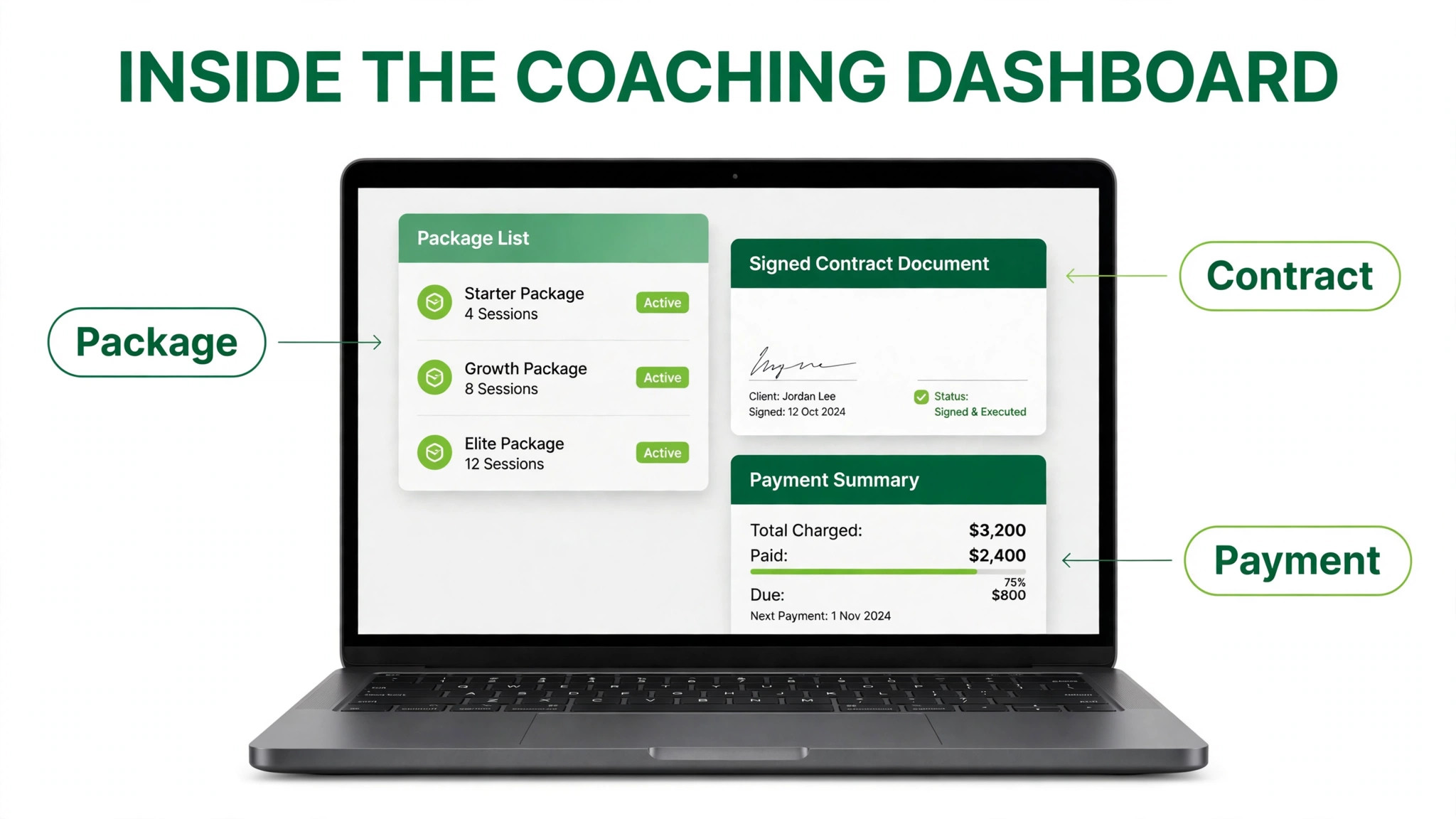
Paperbell is the only tool in this list built specifically for coaches, and it shows in the feature set. A branded coaching website, scheduling, package sales, contracts, payments, and a client portal sit together in one flat plan, with no tiers, no transaction fees of its own, and unlimited clients. A coach can sell a six-session package from the website, collect payment, send the contract, and book the sessions without touching a second tool. Paperbell reports that coaches have collected more than 47 million dollars through its platform.

Pricing is the flag to watch. Paperbell’s own blog lists 97 dollars a month, or 970 dollars a year, while older published comparisons from April 2026 report 57 dollars a month. The 97 dollar figure is the current one from the vendor, so use it and check the vendor pricing page before budgeting. A free account is available to start, with no credit card required. Paperbell suits a solo coach who wants the whole business in one place.
2. Acuity Scheduling
Acuity Scheduling, owned by Squarespace, is the upgrade pick when a coaching business has products, not just appointments. Clients self-book while you sell packages with payment plans, memberships, classes, and gift certificates, all from the same scheduler. Intake forms, automated reminders, and payment collection at booking cover the full client journey, and a HIPAA business associate agreement is available on Premium for coaches who need it.
Pricing starts at 20 dollars a month billed monthly, or 16 dollars a month billed annually, for Starter. Standard costs 34 dollars a month and adds more features, and Premium is the top tier. There is no free plan, only a 7-day free trial of any plan, so a coach must pay to test it properly. SMS reminders cost extra from 34 dollars a month on some plans, which is worth checking before you budget. Acuity suits coaches who sell packages and classes and want deep customization.
3. Cal.com
Cal.com has the most generous free tier in this list, which is why so many solo coaches start here. The free plan for one user includes unlimited event types, unlimited calendar connections, email notifications, and Stripe and PayPal payments, which is a combination no rival matches at zero cost. A coach can take paid bookings, sell packages, and run video calls without paying anything, which makes it the best free start in this guide.
Pricing for teams is 12 dollars per user per month billed annually, with Organizations at 28 dollars per user per month billed annually adding HIPAA, SAML single sign-on, and compliance features. Some published comparisons report Teams at 16 dollars a month, which conflicts with the 12 dollar figure from the vendor page, so check the vendor pricing page. The second flag is structural. Cal.com’s hosted product went closed source in April 2026, and the free open-source self-hostable option is now a separate project called Cal.diy, a community edition not recommended for production use.
4. TidyCal
TidyCal is the cheapest long-term option in this list, because it sells lifetime access instead of a monthly subscription. The free plan takes payments and sells packages, which is rare at zero cost, and the Individual Lifetime deal costs 29 dollars once, with an Agency Lifetime deal at 79 dollars. A solo coach who takes bookings for years can pay less in total than a single month of Paperbell, which is the whole pitch.
The catch is the 1 percent platform fee on Stripe payments on the free and lifetime plans. A coach who takes 1,000 dollars a month through Stripe pays 120 dollars a year in platform fees, which is more than some monthly subscriptions. Higher tiers reintroduce a monthly Pro plan, so the lifetime deal is not the whole story. TidyCal suits a budget coach who wants a low, non-recurring cost and accepts the payment fee.
5. SimplyBook.me
SimplyBook.me is a full booking website, not just a link, and it suits coaches who want deposits, memberships, and many booking channels in one system. It covers scheduling, payments, deposits, memberships, a booking website, and a marketplace of add-on features, with hosting in the EU. A group coach who runs workshops and memberships alongside 1 to 1 sessions will find more depth here than in a simple scheduler.
Pricing is by bookings and providers rather than by people. A free plan covers 50 bookings and one provider. Basic costs 11.90 a month billed annually for 100 bookings, Standard costs 24.90 for 500, and Premium costs 49.90 for 2,000. Prices are listed in euros on the vendor site, and some US comparisons report 13.90 dollars a month for Basic, so check the vendor pricing page for your currency. The booking caps tighten fast, so a busy month costs more, which is the main drawback against a flat-priced rival.
6. Calendly
Calendly is the tool clients already know, and that familiarity is its strength. Share a booking link, clients pick a time from your real availability, and confirmations and reminders go out automatically. It syncs across Google, Outlook, Exchange, and iCloud, and it is the fastest route from zero to a live booking link in this list. For a coach who only needs discovery calls and simple 1 to 1 bookings, Calendly is often enough.
Pricing starts free for one event type and one calendar connection. Standard costs 10 dollars per seat per month billed annually, or about 12 dollars monthly, and adds multiple event types, automated reminders, and integrations with Zoom, Google Meet, and Stripe. Teams costs 16 dollars per seat per month annually.
7. Setmore
Setmore is the free-plan pick for new coaches. Its free plan covers up to 4 users with unlimited appointments, which is the most generous free team plan in this list, and it includes booking pages, calendar sync, and reminders. A new coach with a small team can run the whole booking operation at zero cost, which is a real advantage in the first year.
Paid plans start at 5 dollars per user per month billed annually for Pro, which adds more features and removes limits. That price undercuts every other paid plan in this list, but the paid features are thin for package sales and contracts, so a coach who grows into selling programs will outgrow Setmore. Setmore suits a new coach who wants a free plan with unlimited appointments and a small team. A coach who sells packages or needs contracts should test Paperbell or Acuity, and a solo coach who wants pro features free should compare Cal.com.
8. YouCanBookMe
YouCanBookMe builds booking pages on top of your existing calendar connections, with a focus on a clean, professional booking experience. It covers booking pages, calendar sync, reminders, and payments, and it suits a coach who wants a branded booking page without rebuilding the whole business around a new platform. The setup is fast, and the booking page looks good on a phone, which is where most clients will open it.
Pricing starts with a free plan covering one calendar connection and one booking page. Paid plans start at 8.10 dollars a month billed annually for Individual, with Professional at 13 dollars a month billed monthly and Team at 18 dollars per member per month billed monthly, with 10 percent off yearly. SMS costs extra on every plan, which is worth checking before you budget, because reminder texts are a core coaching need. YouCanBookMe suits a coach who wants a simple booking page on a familiar calendar. A coach who sells packages should test Acuity or Paperbell first, because package sales are not its strength.
9. CoachAccountable
CoachAccountable is a coaching delivery platform first and a booking tool second. It covers session scheduling, client worksheets, goal tracking, habit tracking, session notes, and progress reporting, which suits a coach whose value lives in the work between sessions. The booking layer exists, but the delivery layer is the reason to choose it, because no generic scheduler tracks client progress the way CoachAccountable does.
Pricing starts at 20 dollars a month in published comparisons, which is low for the depth of coaching tools included. Check the vendor pricing page for the current tiers, because CoachAccountable prices by client count and the rate changes as the roster grows. The booking features are thinner than Paperbell or Acuity, so a coach who needs package checkout and contracts should pair it with a booking tool or choose a platform that covers both. CoachAccountable suits a coach who prioritizes delivery and tracking. A coach who prioritizes package sales should test Paperbell first.
10. Satori
Satori is a coaching business management platform covering booking, packages, contracts, invoicing, and client management in one system built for coaches. It sits between the simple schedulers and the full all-in-ones, with enough coaching depth to run a real practice without the price of Paperbell. A solo coach who wants package-based booking, intake forms, and session tracking in one login will find Satori a sensible middle option.
Pricing starts at 39 dollars a month in published comparisons, which is less than half the current Paperbell rate. Check the vendor pricing page for the current tiers and limits, because Satori is a smaller vendor and its pricing is reported less often than the leaders. The smaller size is also the risk, with fewer integrations and a smaller user community than Calendly or Acuity.
11. Simply.Coach
Simply.Coach is a coaching platform for growing practices, covering booking, payments, contracts, programs, and client management in one system. It suits a coach who has outgrown a simple scheduler and wants a real practice platform without paying Paperbell prices. The entry price is the lowest among the coaching-native tools in this list, which makes it an easy first step into a full platform.
Pricing starts at 9 dollars a month, with a 14-day trial and no free plan. The entry plan covers only 3 clients, so a coach with a larger roster will need a higher tier quickly, and the real price depends on client count. Check the vendor pricing page for the tier boundaries before budgeting, because a 3-client limit is easy to outgrow in a good month. Simply.Coach suits a new coach with a small roster who wants a full platform cheaply. A coach with twenty or more clients should compare Paperbell, whose flat price has no client cap.
12. vCita
vCita is a scheduling plus back-office platform, covering booking, CRM, invoicing, payments, and marketing in one subscription. It suits a coach who wants the business admin handled alongside the booking, without buying a separate CRM. The breadth is the draw, because a solo coach can run scheduling, client records, invoices, and email campaigns from one login instead of four.
Pricing starts at 29 dollars a month for solopreneurs in published comparisons, with no free plan advertised. Check the vendor pricing page for the current tiers, because vCita pricing is reported less often than the leaders and the plan names change. The booking depth is thinner than Acuity, so a coach who sells complex packages should compare Acuity first.
13. CoachVantage
CoachVantage is a coaching platform for coaches who sell programs and contracts alongside 1 to 1 sessions. It covers booking, program sales, contracts, payments, and client management in one system, with a focus on the package and program workflow that generic schedulers miss. A group coach who sells a twelve-week program with contracts and payment plans will find more depth here than in a simple booking tool.
Pricing starts at 26 dollars a month billed annually, with a 14-day free trial. That price undercuts Paperbell by a wide margin while covering similar coaching ground, which makes it a strong value pick. The drawback is name recognition, with a smaller vendor and a smaller user community than the leaders, so support and integrations are less proven.
14. Delenta
Delenta is a coaching platform with AI note-taking built in, covering booking, payments, client management, goal tracking, and session summaries. The AI features draft session notes and summaries automatically, which suits a coach who spends too much time on admin after each session. It is the only tool in this list where AI notes are a core feature rather than an add-on.
Pricing starts at 29 dollars a month in published comparisons, which is low for a platform with AI features included. Check the vendor pricing page for the current tiers, because Delenta is a newer platform and its pricing is reported less often than the leaders. The newer status is also the risk, with a smaller community and fewer integrations than Acuity or Calendly. Delenta suits a coach who wants AI notes and a full platform at a low price. A coach who wants proven depth and a large community should test Paperbell or Acuity first.
How to choose booking software for your coaching practice
Start with your coaching model, because that choice filters the best booking software for business coaches faster than any feature table. A one-on-one coach needs package sales, intake forms, and contracts. A group coach needs cohort booking, memberships, and program delivery. A corporate coach needs team billing, reporting, and a professional client experience. Write that model down before any demo, and score each tool against it.
Next, separate the booking job from the business job and judge each on its own. The booking job covers the link, the calendar, reminders, and rescheduling. The business job covers packages, contracts, payments, and session notes. A tool that excels at one and ignores the other is still useful, but only if you have a second tool for the gap and you have priced the pair.
Finally, price the second year, not the first month. Add payment processing, platform fees, SMS costs, extra seats, and any per-client tier jumps, and model the price at your expected client count. Ask about contract length, notice period, and data export, because switching tools later is far harder than choosing well now. A short contract with clean data export is worth more than a small first-month discount.

What coaching booking software really costs
The best booking software for business coaches ranges from zero to 97 dollars a month in this list, which is a wider spread than most coaches expect. Free tools such as Cal.com and TidyCal cover booking and payments at zero subscription cost, while coaching-native platforms such as Paperbell charge 97 dollars a month for the full business layer.
Three pricing models dominate this market. Flat pricing, used by Paperbell, gives one price for everything with no client cap. Per-seat pricing, used by Calendly and Cal.com Teams, scales with team size and suits a solo coach better than a team. Per-client pricing, used by Simply.Coach and CoachAccountable, scales with roster size and punishes a growth month. Compare all three models at your real client count, including your busiest quarter, not your quietest.
Platform fees are the hidden cost to watch. TidyCal charges 1 percent on Stripe payments on free and lifetime plans, which costs 120 dollars a year on 1,000 dollars a month of payments. Every tool in this list also passes Stripe or Square processing of about 2.9 percent plus 30 cents per transaction to you or your client. Confirm who absorbs the processing fee before you set package prices, because the fee comes out of your margin either way.

Setup checklist for your first booked week
Use this sequence when you move to the platform you chose, and do not skip the payment test.
- Export your current client list, active packages, and outstanding balances, and clean duplicate client records before import.
- Build your package catalog first, including session counts, prices, expiry rules, and payment plans.
- Set up your intake forms and contract templates next, including the questions you ask every new client.
- Connect payments and run a test purchase with a real card, then refund it, to confirm the full payment flow.
- Build your booking page with real availability, buffer times, and cancellation rules, and test it on a phone.
- Invite a small group of current clients to book, pay, and reschedule in the new system before a full launch.
- Keep the old system read only for one full month, so no payment or session record is lost in the move.
A careful switch protects trust. Clients forgive a new booking page quickly if payments are correct and rescheduling is easy. They do not forgive a lost payment, a double charge, or a session that disappears from the calendar. Test payment and rescheduling twice, and launch only when both are clean.

Mistakes that cost coaches money
The first mistake when shopping for the best booking software for business coaches is buying a calendar when you needed a business platform. A free scheduler handles discovery calls, but it cannot sell a package, collect a deposit, or send a contract, so the coach ends up doing that work by hand.
The second mistake is ignoring the platform fee. A lifetime deal that charges 1 percent on every payment can cost more in a year than a monthly subscription with no fee, once payment volume grows. Model the fee at your real monthly revenue, not at zero, and compare the total against a flat-priced rival before you commit.
The third mistake is skipping the reschedule test. Clients reschedule constantly, and a tool that makes rescheduling hard will cost you sessions and goodwill. Test a reschedule, a cancellation, and a no-show during the trial, including the reminder that follows each one, because those three cases happen every week in a real practice.
The fourth mistake is forgetting the between-session work. Coaching value lives in the intake, the notes, the goals, and the follow-up, not only in the hour on the call. A tool that handles booking beautifully and ignores the rest will leave you running the real work in spreadsheets. Judge the platform on the full client journey, not only on the booking link.

Related Guides
Keep exploring with these guides on Stratilyze:
- Fix Acuity Booking Page Not Loading for a Small Business
- Calendly to YouCanBookMe, a Small Business Booking Move Done Carefully
- AI Tools for Voice Coaches at a Small Business
Frequently Asked Questions
How much does the best booking software for business coaches cost
Most coaches pay between zero and 97 dollars a month. Free tools such as Cal.com and TidyCal cover booking and payments at zero subscription cost, mid tools such as Acuity and Satori run 16 to 39 dollars a month, and the full coaching platform Paperbell costs 97 dollars a month. Add payment processing of about 2.9 percent plus 30 cents per transaction, and any platform fee, before comparing prices.
Can a free scheduler handle coaching packages
Partly. Cal.com and TidyCal both take payments and sell packages on their free plans, which is rare and valuable for a new coach. Neither one handles contracts, session notes, or program delivery the way a coaching-native platform does, so a coach who sells multi-week programs will still need more.
What is the difference between Paperbell and Acuity Scheduling
Paperbell is built for coaches, with a branded website, package sales, contracts, payments, and a client portal in one flat 97 dollar a month plan with no client cap. Acuity Scheduling is a general scheduler owned by Squarespace, with deeper customization for packages, memberships, and classes, starting at 16 dollars a month billed annually. Choose Paperbell for the coaching business in one place, and Acuity for booking depth at a lower price.
Should a new coach pay for booking software
Not at first. Cal.com gives a solo coach unlimited event types, Stripe payments, and video calls free, and TidyCal gives a lifetime deal for 29 dollars once. Pay for a coaching platform when you start selling packages regularly, when contracts and intake forms eat your week, or when missed payments cost more than the subscription.
How long does it take to switch booking software
Most coaches can switch in one to two weeks, including data import, package setup, payment testing, and client onboarding. Avoid switching in the middle of a group program launch, because live clients add pressure to an already busy period. Plan the switch for a quiet gap, and keep the old system read only until the first payment cycle on the new platform is clean.
Do I need contracts and intake forms in my booking tool
Yes, once you sell packages rather than single sessions. A package is a commitment, and the contract, the intake form, and the payment plan protect both you and the client. Tools such as Paperbell, CoachVantage, and Simply.Coach bundle those pieces into the booking flow, while simple schedulers such as Calendly do not. If you sell packages, judge the tool on the contract and intake flow, not only on the booking link.
Picking the system that fits how you coach
One-on-one coaches looking for the best booking software for business coaches should test Paperbell first, with Acuity Scheduling as the lower-priced alternative. Group coaches should test SimplyBook.me first, with CoachVantage as the coaching-native alternative. Corporate coaches should test Acuity Scheduling first, with vCita as the back-office alternative. In every case, the deciding test is a real package purchase, a real reschedule, and a real payment, plus a client journey your next referral will actually enjoy. The platform that handles that chain cleanly, at a written total cost you can defend, is the right buy for your coaching practice.