

A kayak outfitter loses money in a very specific way. The phone rings, the launch site is busy, a group of eight wants boats at 10am, and nobody can say with confidence how many tandem kayaks are still free, whether the shuttle can carry them, or whether their waivers are signed. By the time the office has checked the whiteboard, the spreadsheet, and the guide rota, the group has booked with a competitor. That lost booking is the problem the best booking software for kayak rental outfitters exists to solve.
Kayak rental is not a simple appointment. A booking ties together boats, paddles, life jackets, a launch window, a return time, a shuttle seat, and a signed waiver, and all of it changes when the weather turns. A generic booking tool can reserve a time slot. It cannot easily stop a customer booking a tandem that is already on the water, or warn that a group needs two shuttle runs instead of one. Those details are the business, and a system that misses them creates work at the dock on the busiest mornings.
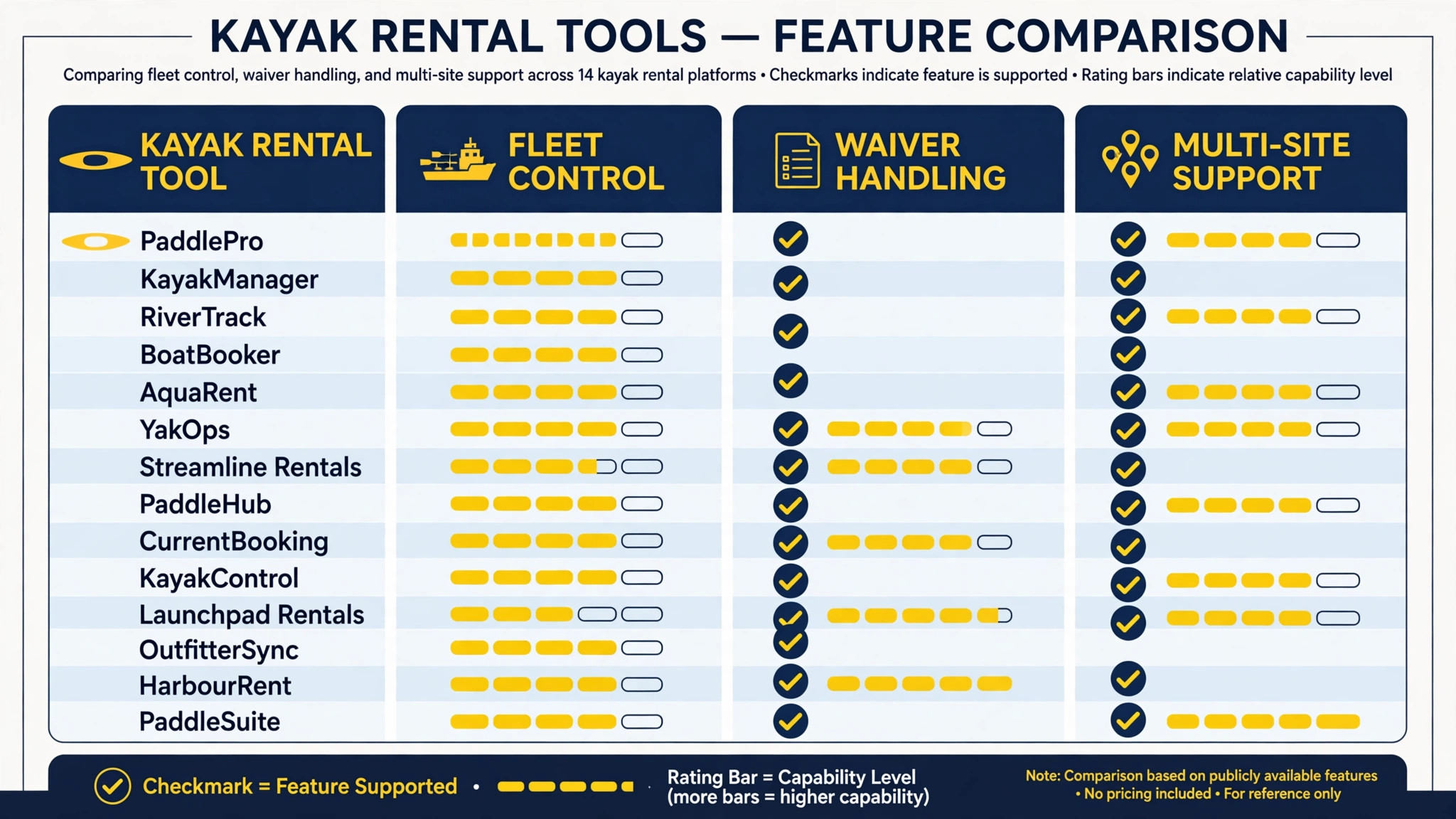
This guide compares fourteen tools, from tour booking platforms built for activities to general booking systems that outfitters adapt. Prices are starting prices where published. Where a price is not confidently known, the note reads Check the vendor pricing page, because per booking fees, monthly tiers, and payment rates change often enough that a stale figure would mislead a buyer.
Why Kayak Bookings Break a Normal Booking Form
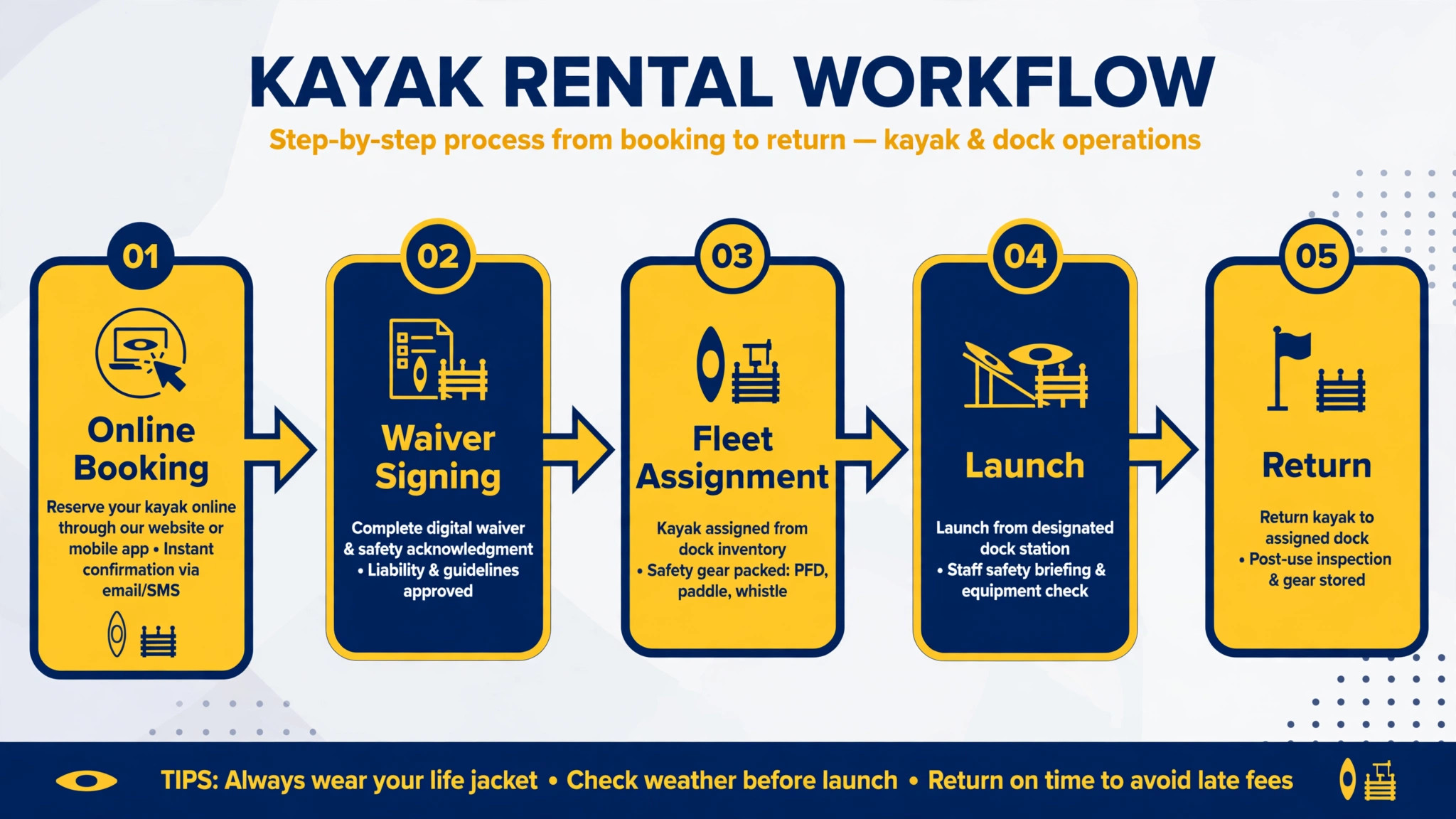
A kayak booking is a bundle, not a slot. The customer books a boat type, a size, a launch time, and a trip length, and the outfitter must also provide the right paddle, the right life jacket size, and a shuttle plan that gets everyone back. A normal booking form collects a name, a date, and a time, and leaves the rest to a phone call. That phone call is where double bookings, wrong boat sizes, and missed shuttles begin, especially on a Saturday when three groups arrive at once.
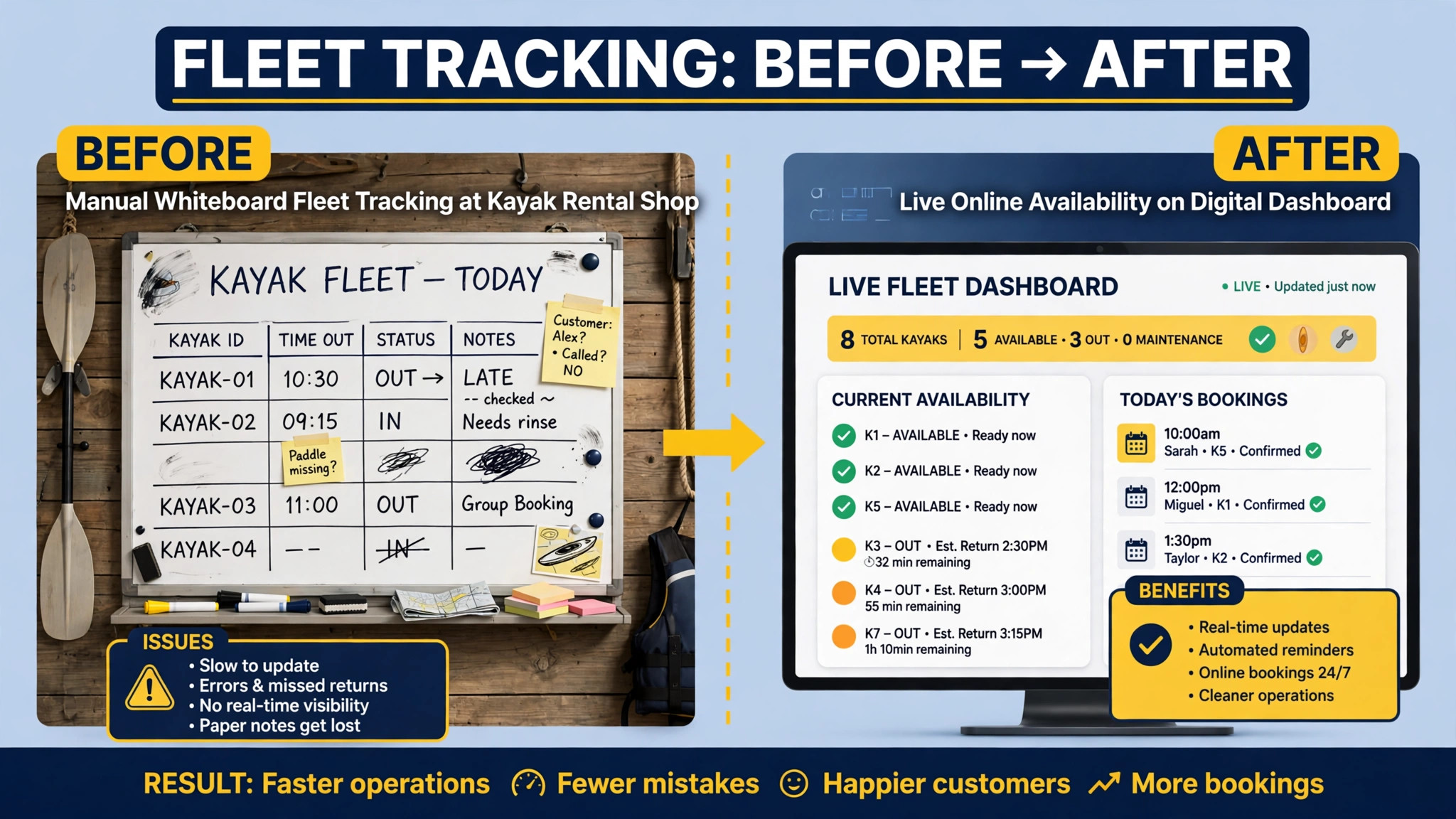
Fleet availability is the hardest part. Kayaks are not identical units that can be swapped freely. A tandem, a single, a fishing kayak, and a kids kayak are different stock, and a booking for two tandems cannot be filled with four singles without changing the trip. A good system tracks each boat type separately, shows real availability by launch window, and blocks a booking when the requested boats are already out. A system that only tracks total boat count will look available when the specific boats a customer wants are gone.
Waivers and weather add two more constraints. A waiver must be signed before launch, ideally before arrival, so the dock team is not chasing signatures while boats should be leaving. Weather can close a launch site, shorten a trip, or move a group to another day, and the system must let staff contact every affected booking at once. A booking tool that handles fleet, waivers, and mass changes well will save more dock time than a tool that only looks good as a calendar.
The 14 Tools at a Glance
| Tool | Starting price | Best for | Outfitter depth |
|---|---|---|---|
| FareHarbor | Check the vendor pricing page | Tour and activity bookings at scale | Strong |
| Peek Pro | Check the vendor pricing page | Guided tours with online booking | Strong |
| Checkfront | Check the vendor pricing page | Rental inventory with booking | Strong |
| Rezdy | Check the vendor pricing page | Tour operators with distribution | Good |
| Xola | Check the vendor pricing page | Activity bookings with gift sales | Good |
| Bookeo | Check the vendor pricing page | Small outfitters wanting class style booking | Good |
| SimplyBook.me | Check the vendor pricing page | Simple bookings with packages | Good |
| Bokun | Check the vendor pricing page | Tours with marketplace reach | Good |
| Regiondo | Check the vendor pricing page | European tour and activity bookings | Good |
| Zaui | Check the vendor pricing page | Multi site tour operators | Good |
| TripWorks | Check the vendor pricing page | Tour operators wanting full management | Good |
| WaveRez | Check the vendor pricing page | Rental businesses with online booking | Good |
| RocketRez | Check the vendor pricing page | Attractions and rental bookings | Good |
| Ventrata | Check the vendor pricing page | High volume attractions and tours | Good |
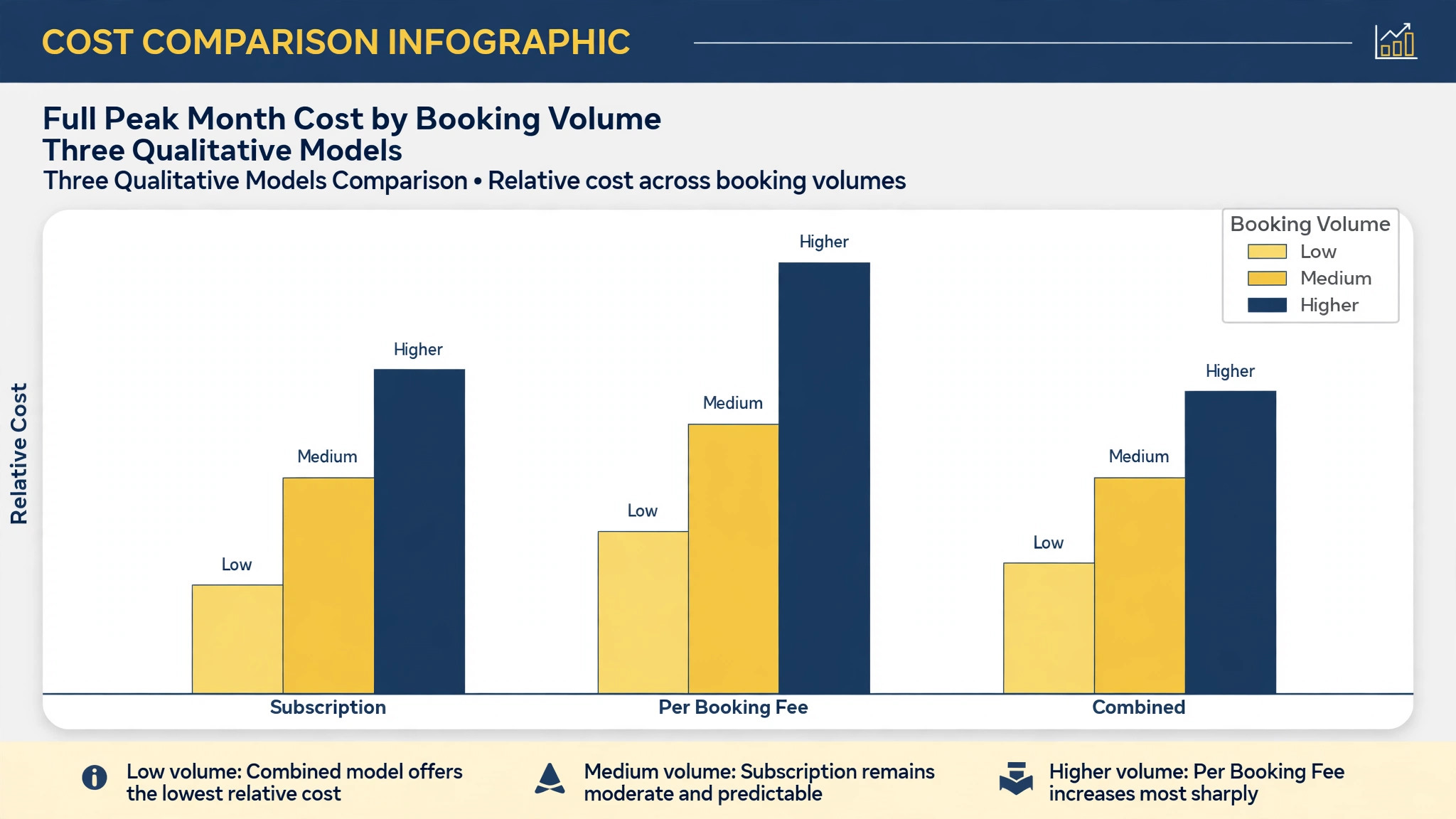
Booking fees deserve as much attention as monthly prices in this market. Some platforms charge per booking, some charge a monthly subscription, and some combine both, so a platform that looks cheap at twenty bookings a month can become expensive at two hundred. That is why a comparison of the best booking software for kayak rental outfitters should be priced on a full peak month, including booking fees and card rates, rather than on a headline monthly figure alone. Ask each vendor for a written quote for your real peak booking volume before comparing totals.
Best Pick by Job
| Job type | First pick | Why it fits | Watch out for |
|---|---|---|---|
| Single launch site | Checkfront | Rental inventory with real availability | Confirm waiver workflow in trial |
| Multi site outfitter | FareHarbor | Scale, availability, and reporting across sites | Booking fee model at volume |
| Guided tour outfitter | Peek Pro | Tour scheduling with guide and group handling | Confirm fleet tracking depth |
| Budget start | Bookeo | Simple booking with low setup effort | Limited rental inventory depth |
| Distribution led outfitter | Rezdy | Reach through resellers and marketplaces | Commission and fee terms |
The job type that matches most of your trips should decide the shortlist for the best booking software for kayak rental outfitters. A single launch site that buys a large tour platform will pay for distribution and reporting it never uses. A multi site outfitter that buys a simple booking form will struggle with fleet sharing, shuttle planning, and reporting across sites. Match the system to the job first, then compare price within that shortlist.
Waiver and Fleet Checklist
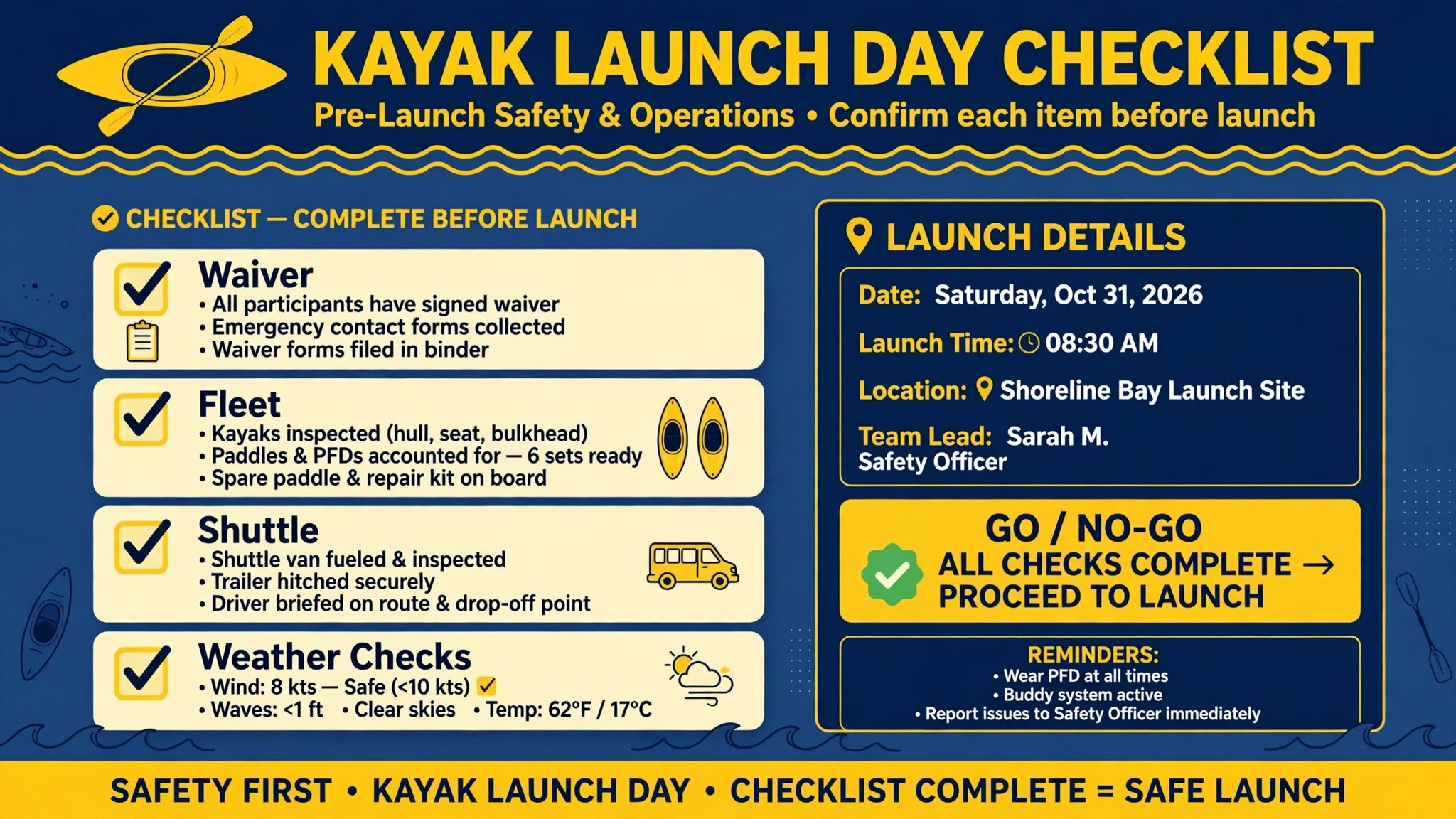
Use this checklist on the morning of a busy launch day. It turns booking data into dock readiness, rather than leaving readiness to a whiteboard.
– Confirm every booking in the first launch window has a signed waiver, and chase unsigned waivers before boats leave. – Check fleet availability by boat type for each launch window, not only total boat count. – Confirm paddle and life jacket sizes for groups with kids or larger paddlers. – Check that shuttle capacity covers every group in each window, including return trips. – Confirm guide assignments for guided trips, and that guide count matches group size rules. – Check weather and water conditions for each launch site, and note any window that must move. – Prepare a contact list for every affected booking in case a window must be rescheduled. – Reconcile online bookings with phone bookings in one calendar, so no boat is promised twice. – Record damage or maintenance holds on any boat before it is offered for booking. – Review end of day returns against bookings, so missing boats are noticed the same day.
Software helps this checklist only if waivers, fleet by boat type, shuttle capacity, and guide assignments live in one booking record. If waivers live in email, fleet lives on a whiteboard, and bookings live in a calendar, the checklist becomes a manual hunt on the busiest morning of the week.
The 14 Tools in Detail
1. FareHarbor
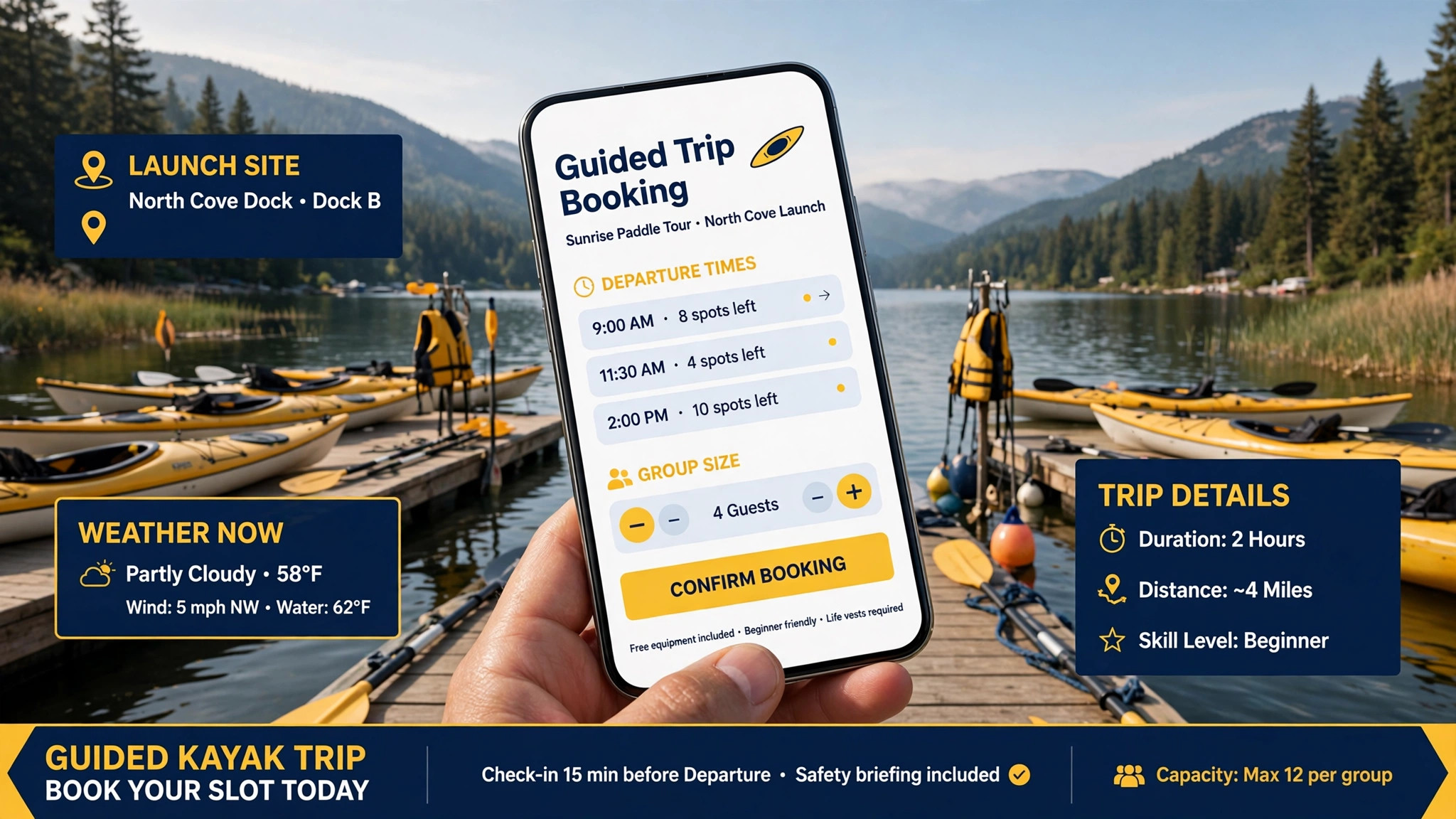
FareHarbor is a booking platform built for tour and activity businesses, and it is one of the most common choices for outfitters with real volume. It handles online bookings, availability by time slot, group bookings, and reporting, and it is designed for businesses where many customers book the same activity at set times. That structure maps well to launch windows and guided trips.
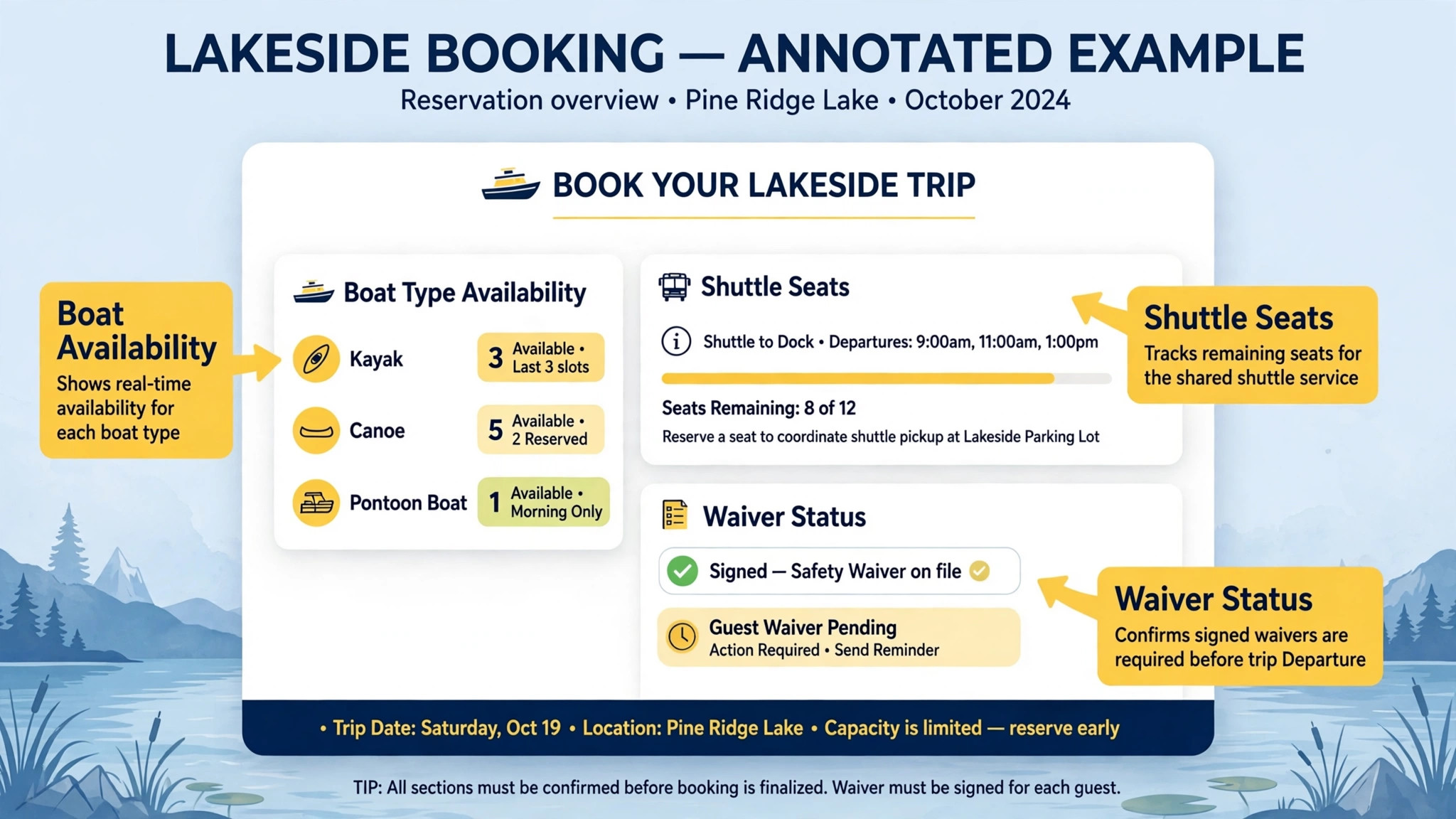
The strength is scale and availability control. An outfitter can set capacity per launch window, sell online around the clock, and see bookings across sites in one dashboard. The limit is the fee model, which must be modelled at peak volume, plus the need to confirm fleet by boat type in the trial.
Best for a multi site outfitter or a busy single site with high online volume. Check the vendor pricing page for booking fees and payment terms at your peak month volume.
2. Peek Pro
Peek Pro is a booking system for tour and activity operators, with online booking, group management, and tools for selling tours and rentals through a website. It suits a guided tour outfitter because it handles scheduled departures, group sizes, and guide facing schedules alongside customer bookings. Customers can book, pay, and receive confirmations without a phone call.
The strength is the guided trip workflow. Departure times, group limits, and guide assignments sit close to the booking. The limit is fleet depth. An outfitter that rents many boat types should test tandem, single, fishing, and kids kayak availability separately.
Best for a guided tour outfitter that also rents boats, and that wants strong online tour booking. Check the vendor pricing page for the tier that includes the group and reporting features needed.
3. Checkfront
Checkfront is a booking platform with strong rental inventory features, which is why it leads the single launch site pick here. It tracks inventory items, availability by date and time, and bookings in one system, and it can handle rentals that run for hours or days rather than fixed tour slots. That rental logic fits kayak hire better than a pure tour slot system.
The strength is inventory truth. A boat type that is booked is unavailable for the next booking in the same window, and staff can see that availability without checking a separate fleet list. The limit is waiver handling, which must be confirmed in the trial, including whether waivers can be collected at booking and linked to each booking record. Confirm that workflow before signing.
Best for a single launch site outfitter that rents boats by the hour or day. Check the vendor pricing page for inventory and booking tiers.
4. Rezdy
Rezdy is a booking platform for tour and activity operators with a focus on distribution through resellers, agents, and marketplaces. An outfitter can sell direct bookings and also accept bookings from partners, with availability shared across channels. That reach suits an outfitter near a tourist area where hotels and marketplaces drive many bookings.
The strength is reach. A single availability calendar can feed direct sales and partner sales at once, which reduces the risk of a boat being promised twice through different channels. The limit is fee and commission terms, which must be read carefully, since distribution sales often carry costs that direct sales do not. Model a peak month with both direct and partner bookings before comparing totals.
Best for a distribution led outfitter that relies on resellers and marketplaces. Check the vendor pricing page for booking fees and partner commission terms.
5. Xola
Xola is a booking platform for activity businesses, with online booking, gift cards, and tools for selling trips and rentals through a website. It suits an outfitter that sells gift bookings, seasonal passes, or packages alongside hourly rentals, since those products can be sold from the same booking page. The customer experience is clean, with real availability and instant confirmation.
The strength is product breadth. Rentals, guided trips, gifts, and packages can sit in one booking system, which helps an outfitter that earns from several product types. The limit is rental fleet depth, which again needs a trial with real boat types. Test a mixed group booking with tandems, singles, and kids kayaks to see whether availability is controlled at boat type level.
Best for an outfitter that sells gifts and packages alongside rentals. Check the vendor pricing page for the features included on the chosen tier.
6. Bookeo
Bookeo is a class based online booking system that small outfitters adapt to kayak rentals and guided trips. It supports availability by time slot, group bookings, and automated confirmations and reminders, and it can sell single trips, multi trip packages, and gift bookings. That simplicity suits a small outfitter with one launch site and a small team.
The strength is low setup effort. An outfitter can be taking online bookings quickly, with reminders that reduce no shows and a calendar the whole team can read. The limit is rental inventory depth. Bookeo controls time slots well, but a fleet with many boat types, shuttle limits, and maintenance holds needs careful setup, and a busy outfitter may outgrow it as fleet complexity grows.
Best for a budget conscious small outfitter starting with online bookings. Check the vendor pricing page for the tier that includes reminders and package sales.
7. SimplyBook.me
SimplyBook.me is a general online booking system that outfitters can adapt to kayak rentals, with a booking website or widget, payments, deposits, coupons, and memberships. It suits an outfitter that wants a simple booking page and payment handling without a full tour platform implementation. Customers can book, change, or cancel from any device.
The strength is booking and payment breadth for the price. Deposits, coupons, gift cards, and package sales are available on a general platform that is quick to set up. The limit is activity depth. Fleet by boat type, shuttle capacity, waivers, and guide scheduling need careful setup, and an outfitter should test those workflows on real trips rather than assuming they work from a generic booking form.
Best for a small outfitter that wants simple online booking and payments. Check the vendor pricing page for tier dependent features.
8. Bokun
Bokun is a booking platform for tour and activity operators, with marketplace reach and tools for selling through partners as well as direct. An outfitter in a tourist market can list trips and rentals where travellers already search, while keeping direct bookings on its own website. Availability is shared across channels, which protects fleet accuracy.
The strength is marketplace reach combined with central availability. Partner bookings and direct bookings draw from the same fleet, which reduces double booking risk. The limit is fee terms and the learning curve of a marketplace system. An outfitter should confirm commission, payout timing, and how cancellations from partner channels are handled before relying on that channel.
Best for an outfitter that wants marketplace reach alongside direct sales. Check the vendor pricing page for marketplace and booking terms.
9. Regiondo
Regiondo is a booking system for tour and activity operators, with a strong presence in European markets and tools for online booking, distribution, and reporting. It suits an outfitter that sells to international visitors, or that operates in a market where Regiondo partners already drive bookings. The system handles scheduled activities, capacity, and group bookings.
The strength is distribution in its core markets. An outfitter that already receives partner bookings can manage them alongside direct bookings in one calendar. The limit is fit outside those markets, where partner reach may be thinner and the fee model still needs modelling. A North American outfitter should test direct booking depth first, rather than buying for distribution reach it may not use.
Best for an outfitter in Regiondo core markets, or one selling heavily to international visitors. Check the vendor pricing page for regional fee terms.
10. Zaui
Zaui is a booking and management platform for tour operators, with multi site and multi product support. An outfitter with more than one launch site, or with rentals, guided trips, and shuttle services as separate products, can manage them in one system. Reporting across sites helps an owner compare launch site performance and fleet use.
The strength is multi site and multi product control. Availability, pricing, and reporting can be managed centrally instead of across separate site calendars. The limit is implementation effort. A multi product setup rewards careful configuration, and a single site outfitter may find that depth unnecessary. Trial it with two sites and a shared fleet before judging it.
Best for a multi site outfitter with several product types. Check the vendor pricing page for a quote based on site and product count.
11. TripWorks
TripWorks is a booking and management platform for tour operators, covering online booking, customer records, and operational reporting. It suits an outfitter that wants booking plus business management in one system, rather than a booking page plus separate spreadsheets for customers and reports. Guided trips, rentals, and packages can be managed together.
The strength is operational breadth. Booking, customer history, and reporting sit in one place, which helps an owner see repeat customers and seasonal patterns. The limit is rental fleet specificity, which must be tested with real boat types and shuttle limits.
Best for an outfitter that wants booking plus management reporting in one system. Check the vendor pricing page for included reporting features.
12. WaveRez
WaveRez is a booking platform aimed at rental businesses, with online booking and inventory handling for equipment rentals. That rental focus suits a kayak outfitter better than a pure tour system, because rentals run on inventory availability rather than fixed departure capacity. Customers can book boats for a chosen window and receive confirmations and reminders.
The strength is rental logic. Inventory by item type, booking windows, and availability control match how kayak hire works. The limit is scale and distribution depth compared with larger tour platforms, so a reseller reliant outfitter should confirm distribution features in the trial.
Best for a rental focused outfitter with limited guided tour volume. Check the vendor pricing page for rental inventory tiers.
13. RocketRez
RocketRez is a booking platform for attractions and rental businesses, with ticketing, online booking, and group handling. It suits an outfitter that runs a larger site, perhaps with a shop, a cafe, or other attractions alongside kayak hire, since tickets and rentals can be sold from one system. Group bookings and capacity control are central features.
The strength is combined ticketing and rental selling. A visitor can book a kayak and another attraction in one transaction, which helps a larger site sell a full day out. The limit is kayak specificity. Fleet by boat type, waivers, and shuttle planning still need a trial, since a general attraction system may control total capacity without controlling boat type availability.
Best for a larger site that combines kayak hire with other attractions. Check the vendor pricing page for ticketing and rental tiers.
14. Ventrata
Ventrata is a booking platform for high volume attractions and tour operators, with distribution, capacity control, and reporting built for large visitor numbers. An outfitter with very high summer volume, multiple sites, and many partner channels can use it to keep availability accurate across all channels at once. That accuracy matters most when a single Saturday can produce hundreds of bookings.
The strength is volume handling. High booking counts, partner channels, and central availability are the core design. The limit is fit for a small outfitter, which will pay for scale it does not need unless growth or partner volume justifies it.
Best for a high volume outfitter with multiple channels and sites. Check the vendor pricing page for a volume based quote.
How Weather Changes Should Be Handled
Weather is the one variable a kayak outfitter cannot control, and the booking system must make weather changes fast rather than painful. When a launch site closes, staff need to find every booking in the affected windows, contact those customers, and offer a move or a refund, all before those customers drive to the site. A system that lets staff filter by site and window, message the whole group at once, and move bookings in bulk will turn a bad weather morning into a manageable one. A system that requires editing bookings one by one will still be editing when customers arrive.
The same logic applies to partial changes. A morning window may close while the afternoon stays open, or one river section may be unsafe while another is fine. The system should move only the affected bookings, keep the rest intact, and record what was offered to each customer. That record protects the outfitter in a refund dispute, and shows how much revenue weather cost in a season.
Communication timing matters as much as the move itself for any buyer comparing the best booking software for kayak rental outfitters. Customers who learn about a closure the night before can plan a different day. Customers who learn at the car park will leave angry, however good the refund is. A booking system with automated messages, templates for weather closures, and a clear customer contact list is therefore a revenue tool, not only an admin tool. Test the weather change workflow in the trial with a real affected window, not only on a demo calendar.
How to Choose the best booking software for kayak rental outfitters
Start with a fleet test, not a feature list. Take a real Saturday, with tandems, singles, and kids kayaks, two launch windows, and a shuttle limit, and enter it in the trial. Book a mixed group, then try to overbook a tandem that is already out. If the system allows that overbooking, it will allow it on a real Saturday too, and the dock team will pay for it.
Next, test the waiver journey from booking to launch. Can a customer sign a waiver at booking, can staff see unsigned waivers before launch, and can a group waiver cover every paddler in the group. Count the dock touches required on arrival. A system that still needs paper waivers at the dock has not solved the morning queue, even if online booking looks good.
Then test a weather change. Close one launch window, message every affected booking, move half of them to another day, and refund the rest. Check that fleet availability updates correctly after each move, and that no boat is promised twice in the shuffle. That test reveals more about a system than any feature page, because weather changes are when an outfitter most needs the system to be reliable.
Finally, price a peak month in full. Add booking fees, card rates, and any partner commission to the subscription, and model the result at your busiest month volume, not your average month. A platform that is cheap in winter and expensive in summer will surprise an outfitter exactly when cash flow should be strongest. Get the peak month total in writing before comparing tools.
Common Mistakes When Buying Kayak Booking Software
The first mistake is buying a calendar and calling it a fleet system. A calendar shows time slots. A kayak booking system controls boats by type, shuttle seats, and guide numbers. Test boat type availability, not only time slot availability, before signing.
The second mistake is ignoring waivers until launch day. Waivers collected at the dock slow every departure and create a queue at the exact moment boats should leave. Waiver collection at booking, with a clear unsigned list before launch, should be a required feature, not a later addition.
The third mistake is pricing on an average month. Kayak businesses are seasonal, and a per booking fee that looks small in winter becomes a large cost in a peak summer month. Model fees at peak volume, and confirm whether fees apply to refunds and reschedules as well as new bookings.
The fourth mistake is running online and phone bookings on separate lists. Phone bookings that are not entered in the same calendar will double book boats that online customers already hold. One calendar for every channel is a core requirement, not a preference.
The fifth mistake is forgetting the shuttle. A booking system that sells boats without checking shuttle capacity will sell trips the outfitter cannot run. Shuttle seats, return times, and driver availability should be part of the booking check, or at least visible to staff before confirmation.
Frequently Asked Questions
What is the best booking software for a single kayak launch site?
For many single launch sites, Checkfront is a strong starting point, because it controls rental inventory by item type and booking window in one system. Bookeo is the budget alternative for a small site that wants simple online booking with low setup effort. The right choice depends on whether fleet control or simplicity matters more for your site.
Can kayak booking software handle waivers?
Yes, on most tour and rental platforms in this guide, though depth varies. The reliable test is to book a group, send waivers to every paddler, and check the unsigned list before launch. If staff can see at a glance who has not signed, the system handles waivers well enough to trust on a busy morning.
How does kayak software prevent double booking boats?
It tracks availability by boat type and launch window, and blocks a booking when the requested boats are already out in that window. That only works if every channel, including phone bookings, is entered in the same calendar. A system that tracks total boats but not boat types can still double book a tandem while singles sit free.
Should a kayak outfitter charge booking fees to customers?
Many outfitters pass a booking fee to customers, absorb it, or split it depending on channel and margin. The decision should follow a peak month model, not a guess. If the fee at peak volume would eat a large share of margin on a low priced rental, a subscription model may cost less overall, even with a higher monthly figure.
How do kayak outfitters handle weather cancellations?
They close the affected launch window, message every affected booking at once, and offer a move or a refund from the booking record. The best booking software for kayak rental outfitters makes that bulk change fast, updates fleet availability after each move, and records what was offered to each customer, so disputes and repeat contacts stay low.
What is the difference between tour booking software and rental booking software?
Tour booking software controls capacity for a scheduled departure, such as twenty seats on a guided trip. Rental booking software controls inventory, such as how many tandems are free in a window. Kayak outfitters often need both, since guided trips need departure capacity and rentals need boat type inventory, and the trial should test both workflows.
A Shortlist to Take to Trial
Start with Checkfront for a single launch site, FareHarbor for a multi site outfitter, and Peek Pro for a guided tour outfitter, and trial two of them on a real Saturday fleet. Run a tandem overbooking test, a waiver chase, and a weather window closure, and let the dock team judge ease of use under pressure. The system that keeps fleet, waivers, and shuttles accurate on that Saturday is the best booking software for kayak rental outfitters for your operation, even if it is not the cheapest option on the list. A kayak business earns its season in a few busy months, and the booking system must be reliable in exactly those months.
More Reading on Stratilyze
– Best Booking Software for RV Rental Businesses – Best Booking Software for Boat Rentals – Best Rental Software for Party Rental Companies – Best Booking Software for Outdoor Rental Businesses – Best Booking Software for Driving Schools