
PlanSwift is the best construction takeoff software pick for most estimators who want measuring and pricing in one desktop tool, because its Essential plan costs 2,000 dollars per seat per year and covers general contractors and specialty trades alike. STACK is the pick for teams that need cloud collaboration, with takeoff and estimating from 249 dollars per user per month on annual billing. The fifteen tools below compare price, platform and trade fit, so an estimator can pick the tool that matches the plans on the desk today.
A takeoff decides whether a bid wins or loses money. Measuring by hand from printed plans takes days, and a missed quantity on a single trade can erase the margin on the whole job. On screen takeoff cuts that work to hours, and the better tools carry the quantities straight into an estimate with live pricing.
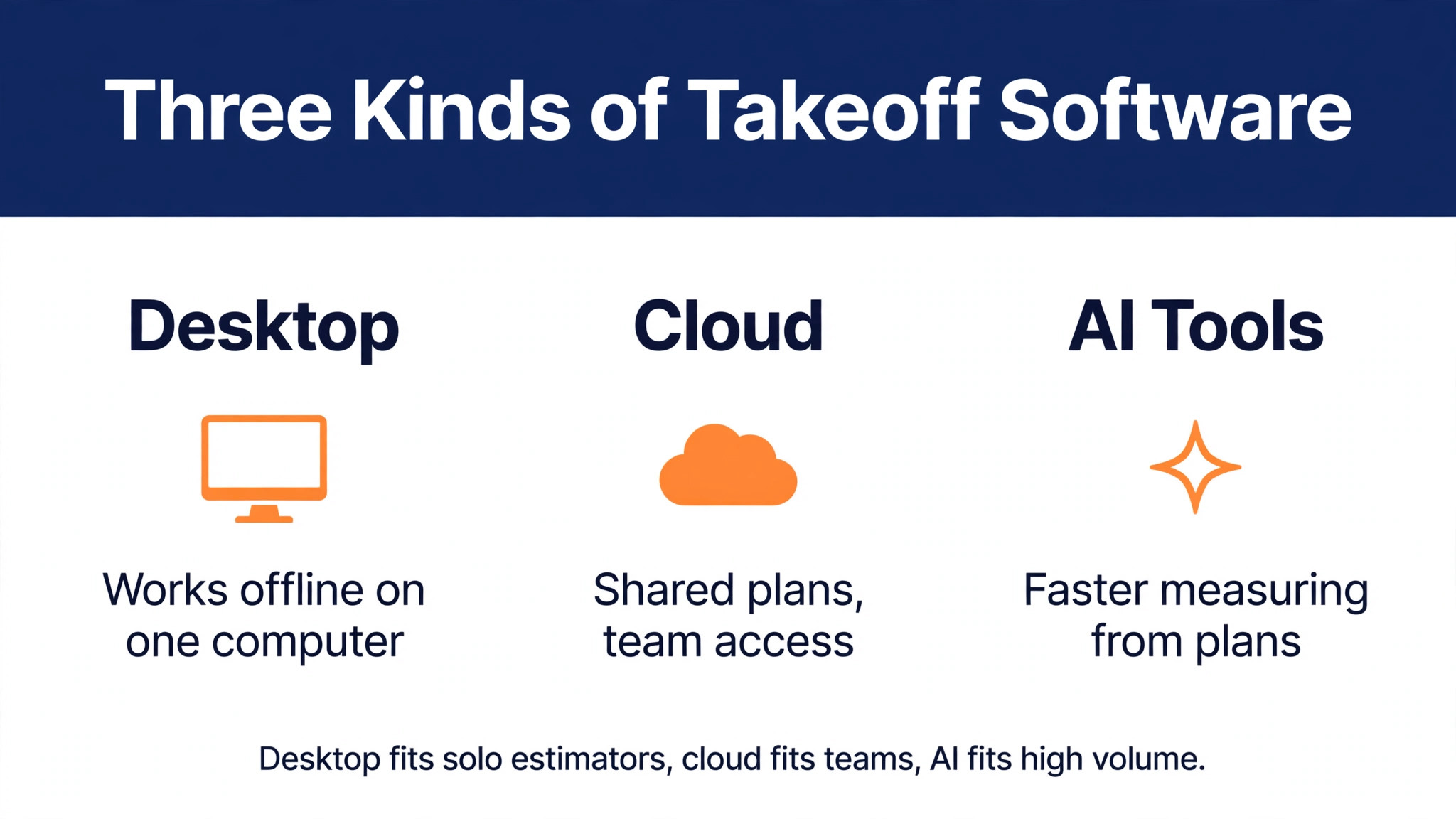
The market splits three ways. Desktop tools like PlanSwift are fast and deep but live on one machine. Cloud tools like STACK let a whole team work the same estimate at once. AI tools like Togal.AI draw the quantities for the estimator, which saves hours on a big plan set but needs a careful check before the numbers go into a bid.
The 15 Tools at a Glance
| Tool | Main job | Best for | Starting price |
|---|---|---|---|
| PlanSwift | Takeoff and estimating | General contractors, all trades | 2,000 dollars a seat a year |
| STACK | Cloud takeoff and estimating | Estimating teams | 249 dollars a user a month |
| Bluebeam Revu | PDF markup and measuring | Plan markup teams | 260 dollars a user a year |
| Togal.AI | AI takeoff | Big plan sets | 299 dollars a user a month |
| Kreo | Cloud takeoff with AI | Budget cloud takeoff | 100 dollars a user a month |
| Autodesk Takeoff | 2D and 3D quantities | Autodesk shops | 108 dollars a month |
| Clear Estimates | Remodel estimating | Remodelers | 59 dollars a month |
| Plankore | AI takeoff and estimating | Small firms | 49 dollars a user a month |
| Buildxact | Estimating and job management | Residential builders | 199 dollars a user a month |
| On-Screen Takeoff | On screen measuring | Commercial estimators | Quote-based |
| Esticom | Electrical estimating | Electrical contractors | Quote-based |
| Countfire | Cloud takeoff | Small trade teams | Quote-based |
| ProEst | Estimating and takeoff | Mid size contractors | Quote-based |
| Square Takeoff | Simple takeoff | Solo estimators | 49 dollars a month |
| Easy Takeoffs | Free takeoff | First time users | Free |
Entry prices run from free to 2,000 dollars a seat per year, and the spread reflects depth rather than quality. A remodeler measuring kitchens needs a different tool than a general contractor pricing a hospital, and the cheapest tool that measures accurately beats the most expensive tool that nobody on the team opens.
Best Pick by Job
| Job type | First pick | Second tool | Why this pair works |
|---|---|---|---|
| General contractor, all trades | PlanSwift | STACK | PlanSwift measures deepest, STACK adds cloud teamwork |
| Cloud estimating team | STACK | Kreo | STACK leads on collaboration, Kreo costs less |
| PDF markup and review | Bluebeam Revu | PlanSwift | Bluebeam owns markup, PlanSwift owns estimating |
| AI takeoff on big sets | Togal.AI | Plankore | Togal.AI automates most, Plankore costs far less |
| Remodeler or small builder | Clear Estimates | Buildxact | Clear Estimates is cheapest, Buildxact manages the job too |
PlanSwift wins the general pick because it pairs on screen measuring with a full estimating database in one Windows program. The Essential plan at 2,000 dollars per seat per year includes takeoff, estimating, pre built assemblies and AI tools for auto count, auto scale and auto bookmark, plus two hours of live training. A 14 day free trial needs no credit card, so an estimator can test it on a live bid before paying.
STACK wins for teams because it is fully cloud based, with estimators working the same numbers in real time from any device. The Takeoff and Estimate plans start at 249 dollars per user per month on annual billing for Premium and 299 dollars for Pro, and a free version of takeoff and estimating is offered. That cloud model is the reason a multi office firm should look here first, and it is the sharpest contrast in this look at the best construction takeoff software for a team that bids together.
Which Takeoff Tool Works Best for a Small Estimating Team?
STACK is the best pick for a small estimating team, because the whole team works one live estimate instead of passing files around. Two estimators can measure different trades on the same plan set at the same time, the numbers update for everyone at once, and the project manager sees the bid taking shape without waiting for a file to arrive. The Premium plan at 249 dollars per user per month on annual billing is expensive, but it replaces the file shuffling that costs a team hours every week.
Kreo is the better pick for a small team on a tight budget. Its cloud takeoff starts at 100 dollars per user per month on annual billing, it carries AI detection on plan sets, and a 7 day free trial lets a team test it on a real job. The trade off is depth, because Kreo has fewer assemblies and fewer integrations than STACK, and a team that prices complex commercial work will feel the gap.
Plankore is the third option for a small firm that wants AI takeoff at the lowest seat price. Pro costs 49 dollars per user per month, or 499 dollars per user per year, with a 14 day trial. The traceable takeoff keeps every quantity linked to the drawing, which helps when a client asks where a number came from.
How to Choose the Best Construction Takeoff Software
Start with the trade. An electrical contractor needs Esticom or ConEst style assemblies for wire, conduit and fixtures, a drywall contractor needs area and linear measures with waste factors, and a general contractor needs assemblies across every trade. A tool built for the wrong trade will measure slowly and price badly, no matter how good its interface looks.
Next, decide desktop or cloud. A single estimator at one desk works fastest on PlanSwift or Bluebeam, because desktop tools open big plan sets without waiting on a connection. A team spread across offices needs STACK, Kreo or Countfire, because cloud tools keep one live estimate. Ask where the estimators sit before asking what the tool costs.
Then check the plan format. Most tools read PDF plans well, while CAD and BIM files need Autodesk Takeoff or a tool with a dedicated importer. A firm that receives DWG files weekly should test the importer on a real file during the trial, because a failed import costs more time than any feature saves.
Finally, run a live bid through the trial. Measure one real plan set, price it, and compare the result with the last hand measured bid for the same job. The trial that proves accuracy on a real job is worth more than any demo, and the tool that wins that test is the one to buy.
The 15 Tools in Detail
The fifteen tools below cover desktop depth, cloud teamwork and AI automation. Each one is judged on measuring speed, estimating depth, price and trade fit, so this roundup of the best construction takeoff software stays honest about the cost of each seat and the work each tool does best.
1. PlanSwift
PlanSwift is takeoff and estimating software for estimators from general contractors to specialty trades, with point and click measuring on PDF, CAD and image plans. The Essential plan costs 2,000 dollars per seat per year and includes takeoff, estimating, pre built assemblies and AI tools for auto count, auto scale and auto bookmark. Core costs 3,000 dollars per seat per year and adds the Takeoff BOOST suite with auto takeoff.
The drawback is the platform, because PlanSwift is Windows only and desktop only, so there is no real time collaboration and no Mac version. The price is also the highest per seat in this guide for a single estimator. It suits estimators who want measuring and pricing in one deep desktop tool and who work mostly alone.
2. STACK
STACK is a cloud takeoff and estimating platform that lets a team work the same estimate in real time from any device. The Takeoff and Estimate plans start at 249 dollars per user per month on annual billing for Premium and 299 dollars for Pro, with a free version offered. The platform adds plan viewing, punch lists and daily reports in its Build and Operate tier from 49 dollars per user per month.
The cost is the drawback, because 249 dollars per user per month is the most expensive cloud seat in this guide, and a team of five pays more than 14,000 dollars a year. The depth is also shallower than PlanSwift on custom assemblies. It suits subcontractors and general contractors bidding commercial work as a team.
3. Bluebeam Revu
Bluebeam Revu is PDF markup software with solid measurement, trusted by more than a million AEC professionals. The annual per user plans run from Basics at 260 dollars, which covers simple length and area measuring, to Core at 330 dollars, Complete at 440 dollars and Max at 590 dollars as an introductory price with AI features. The markup, document comparison and collaborative review tools are the best in this guide.
The limit is that Bluebeam is not a dedicated takeoff tool, because it has no estimating database and no assemblies, so quantities must be exported to Excel or another estimator. A team that only needs measuring and markup will love it, while a team that needs pricing must pair it with something else. It suits estimators who live in PDFs and review plans all day.
4. Togal.AI
Togal.AI is the AI first takeoff tool in this guide, drawing quantities from plan sets automatically instead of asking the estimator to trace every line. The Growth plan is listed at 299 dollars per user per month on annual billing, and the platform targets commercial estimators with large plan sets. The time saving on a big set is the selling point, because a takeoff that took days can take hours.
The drawback is the price and the check time, because 299 dollars per user per month is steep, and every AI drawn quantity still needs a human review before it enters a bid. A small firm will find the cost hard to justify, while a firm pricing large commercial jobs will recover it in one bid. It suits estimators with big plan sets and tight bid deadlines.
5. Kreo
Kreo is cloud takeoff with AI detection at a lower budget than STACK or Togal.AI. The price starts at 100 dollars per user per month on annual billing, with a 7 day free trial. The platform covers 2D takeoff with AI assisted counting and a clean cloud workspace, and it suits teams that want cloud collaboration without the STACK price.
The limit is maturity, because Kreo has a smaller user base, fewer integrations and fewer pre built assemblies than the leaders. Support and training material are thinner, so a team should test it on a real job during the trial. It suits small trade teams moving from desktop to cloud takeoff.
6. Autodesk Takeoff
Autodesk Takeoff is the 2D and 3D quantity tool inside Autodesk Construction Cloud, built for teams already on Autodesk products. The price starts at 108 dollars per month with a 30 day free trial, and the tool reads model data as well as flat plans. The integration with Autodesk Docs and Build keeps quantities tied to the project record.
The drawback is the ecosystem lock, because the tool makes most sense inside an Autodesk shop, and a firm on other software gains little from it. The per month price also climbs with the Autodesk stack around it. It suits general contractors and design build firms already running Autodesk Construction Cloud.
7. Clear Estimates
Clear Estimates is estimating software for remodelers, with a template driven approach that turns measurements into a client ready proposal. The Standard plan costs 59 dollars a month on annual billing, which makes it the cheapest paid estimating tool in this guide. The templates cover kitchens, bathrooms, basements and additions with parts and labour priced in.
The limit is scope, because Clear Estimates is built for residential remodel work and does not fit commercial takeoff or heavy civil jobs. The measuring tools are simpler than PlanSwift or STACK. It suits remodelers and small residential builders who want a fast proposal rather than a deep takeoff.
8. Plankore
Plankore is a newer AI takeoff and estimating tool with traceable quantities at the lowest AI seat price in this guide. Pro costs 49 dollars per user per month, or 499 dollars per user per year, with a 14 day trial. Every quantity links back to the drawing it came from, which helps when a client or a partner questions a number.
The drawback is the young product, because the assembly library and the integration list are smaller than the established tools. A firm with unusual trades should test its assemblies during the trial. It suits small firms that want AI takeoff without paying 299 dollars a seat.
9. Buildxact
Buildxact combines estimating with job management for residential builders, covering takeoff, quoting, scheduling and ordering in one cloud tool. Paid plans start at 199 dollars per user per month, and the platform targets custom home builders and renovators who manage the job after winning it. The estimating templates are built for residential work.
The drawback is the price for takeoff alone, because a firm that only needs measuring pays for job management it may not use. The commercial depth is also thinner than PlanSwift or STACK. It suits residential builders who want one tool from first measure to final invoice.
10. On-Screen Takeoff
On-Screen Takeoff, known as OST, is a long standing desktop takeoff tool for commercial estimators, with strong condition based measuring and integration with Quick Bid estimating. Pricing is quote based, so an estimator must ask, and the tool is sold by ConstructConnect. The depth on commercial conditions and assemblies is among the best in this guide.
The drawback is the sales process and the Windows only desktop model, because there is no published price and no cloud collaboration. A solo commercial estimator will find it powerful, while a team will find it slow to share. It suits commercial estimators who measure complex conditions daily.
11. Esticom
Esticom is estimating software for electrical and low voltage contractors, with a cloud platform that covers takeoff, pricing and proposal building for electrical work. Pricing is quote based, and the tool carries electrical assemblies, wire and conduit calculations and a material database built for the trade. The cloud model lets office and field staff share the same estimate.
The limit is the trade focus, because Esticom does not fit general contractors or other trades. The quote only pricing also makes budgeting harder without a sales call. It suits electrical contractors who want a trade specific estimator rather than a generic takeoff tool.
12. Countfire
Countfire is cloud takeoff software for small trade teams, with a simple interface for counting and measuring from PDF plans. Pricing is quote based, and the platform focuses on fast symbol counting and area takeoff for electrical, mechanical and fire protection trades. The learning curve is short, and a new estimator can measure a plan set on day one.
The drawback is the narrow scope, because Countfire does not carry a full estimating database, so quantities must be priced elsewhere. The quote only pricing hides the cost until a sales call. It suits small trade teams that need fast counting rather than full estimating.
13. ProEst
ProEst is estimating and takeoff software for mid size contractors, with a cloud platform that covers digital takeoff, cost databases and bid management. Pricing is quote based, and the tool is sold as part of the ConstructConnect family, which adds bid and project data. The estimating depth suits firms that price many jobs a month.
The drawback is the enterprise feel, because ProEst needs setup and training before it pays off, and the quote only price makes it hard to compare. A small firm will find it heavy, while a mid size contractor will find the bid management worth the effort. It suits firms that run a formal estimating department.
14. Square Takeoff
Square Takeoff is a simple takeoff tool for solo estimators who want fast measuring without a big platform. Paid plans start at 49 dollars a month, with a clean interface for length, area and count takeoff on PDF plans. The tool exports quantities to Excel, which keeps the pricing step in the estimator hands.
The limit is depth, because Square Takeoff has no estimating database, no assemblies and no team features. It is a measuring tool, not an estimating system, and the estimator must price the quantities elsewhere. It suits a solo estimator or a small firm that already prices in Excel.
15. Easy Takeoffs
Easy Takeoffs is a free takeoff tool for first time users who want to try on screen measuring without paying. The free plan covers basic length, area and count takeoff on PDF plans, with no credit card needed. The tool is a genuine starting point for an estimator who has only ever measured by hand.
The limit is the feature set, because the free tool has no estimating, no assemblies and no collaboration. It is a way to learn on screen takeoff, not a tool to run a bidding business on. It suits a student, a new estimator or a small firm testing whether digital takeoff fits at all.
PlanSwift vs STACK, Desktop Depth Against Cloud Teamwork
The platform is the first difference. PlanSwift is a Windows desktop program that opens big plan sets fast and works without an internet connection, while STACK runs in the browser and lets a whole team edit one live estimate from any device. An estimator working alone in one office will feel faster on PlanSwift, while a team spread across two offices will feel faster on STACK.
The estimating depth is the second difference. PlanSwift carries pre built assemblies, a full estimating database and AI tools for auto count and auto scale inside the same program, so the quantities flow straight into a priced bid. STACK covers takeoff and estimating well, but its assembly library is shallower, and complex custom pricing needs more manual work.
The deciding factor is the team shape. A single estimator or a small shop at one desk should take PlanSwift, because the depth repays the 2,000 dollars per seat per year. A team of three or more estimators bidding together should take STACK, because the shared live estimate saves more hours than the depth costs. That split is the cleanest way to read the best construction takeoff software when the choice narrows to these two.
How Much Should a Contractor Budget for Takeoff Software?
A solo estimator can start free or near free. Easy Takeoffs costs nothing, Square Takeoff starts at 49 dollars a month, and Plankore Pro costs 49 dollars per user per month. A year of Plankore costs 499 dollars per user, which is less than a single day of estimating time on most commercial bids, and that low entry cost is why the best construction takeoff software for a solo estimator is rarely the most expensive seat.
A small team of three should budget 5,000 to 12,000 dollars a year. Three seats of Kreo at 100 dollars per user per month cost 3,600 dollars a year, three seats of STACK Premium at 249 dollars cost nearly 9,000 dollars a year, and three seats of PlanSwift at 2,000 dollars each cost 6,000 dollars a year. The cheapest team option is not always the cheapest bid, because the tool that measures fastest saves the most labour.
A mid size firm should budget for training as well as seats. PlanSwift includes two hours of live training in the Essential plan, while STACK and ProEst need onboarding time that costs staff hours even when the vendor charges nothing. A firm that budgets 10 percent of the seat cost for training in year one will adopt the tool faster and measure more accurately than a firm that buys seats and hopes for the best.
How Do I Test a Takeoff Tool on a Real Bid?
Pick one recent bid with a known result, and measure it again in the trial tool. Use the same plan set, the same quantities and the same pricing, then compare the trial result with the bid that was actually submitted. A tool that lands within a few percent of the real bid is measuring accurately, while a tool that lands far off is either missing quantities or double counting them.
Time the work as well as the numbers. Record the hours the trial takeoff takes, and compare them with the hours the original hand takeoff took. A tool that saves half the time on a 40 hour takeoff pays for a year of seats in a single bid, while a tool that saves nothing is a cost with no return.
Check the export before deciding. Send the quantities to Excel or to the estimating system the firm already uses, and confirm the numbers arrive cleanly with no manual retyping. The export test is where many trials fail, because a tool that measures well but exports badly creates a second job for the estimator.
A Two-Week Trial Routine That Proves a Takeoff Tool
Week one is the setup. Import a real plan set, build the assemblies for the two trades the firm prices most, and measure a small job end to end. Note every place where the tool slows down, because those friction points are the ones that will cost hours on a live bid.
Week two is the live test. Measure a real bid in the trial tool alongside the normal method, and compare the quantities line by line. The comparison shows whether the tool finds quantities the hand method missed, and whether it counts anything twice. A tool that finds a missed quantity on the first live bid has already paid for itself, and that result is the proof a manager needs to approve the purchase of the best construction takeoff software for the firm.

Frequently Asked Questions
Is PlanSwift still the best takeoff software?
For a single estimator who wants measuring and pricing in one desktop tool, yes. PlanSwift Essential costs 2,000 dollars per seat per year and carries the deepest assembly library in this guide. A team that needs cloud collaboration should look at STACK instead, because PlanSwift has no real time shared estimating, and that team test is the first filter when owners compare the best construction takeoff software.
Does STACK have a free plan?
Yes. STACK offers a free version of its Takeoff and Estimate product, though the pricing page does not list its limits. The paid Premium plan starts at 249 dollars per user per month on annual billing, and Pro costs 299 dollars per user per month.
Can Bluebeam Revu do a full estimate?
No. Bluebeam Revu measures and marks up plans well, with Basics at 260 dollars per user per year, but it has no estimating database and no assemblies. Quantities must be exported to Excel or another estimator, so Bluebeam suits teams that measure and mark up rather than teams that price.
Is AI takeoff accurate enough for a real bid?
Mostly, with a human check. Togal.AI and Plankore draw quantities automatically, and estimators report big time savings on large plan sets. Every AI drawn quantity still needs review before it enters a bid, because a missed room or a wrong scale will cost more than the time saved.
What is the cheapest serious takeoff tool?
Plankore Pro at 49 dollars per user per month, or 499 dollars per user per year, is the cheapest AI takeoff seat in this guide. Clear Estimates at 59 dollars a month is the cheapest estimating tool for remodelers. Easy Takeoffs is free, but it has no estimating, so it suits learning rather than bidding.
Do I need a Windows computer for takeoff software?
For PlanSwift and On-Screen Takeoff, yes, because both are Windows only. STACK, Kreo, Countfire and Plankore run in the browser on Mac and Windows alike, so a firm with Macs should shortlist the cloud tools and skip the desktop only options.
Pick the Tool That Matches Your Plan Set
A solo estimator should take PlanSwift, because the depth and the assemblies repay the seat price on the first few bids. A team should take STACK, because the shared live estimate saves more hours than any single feature. A firm with big plan sets and tight deadlines should trial Togal.AI, because AI takeoff is the fastest way through a large set.
Run one real bid through the trial before paying. The best construction takeoff software is the one that measures the plans on your desk accurately and quickly, and a single live bid proves that better than any demo or review.