
A small business rarely loses money because a contract was badly written. It loses money because a renewal slipped past unnoticed, a signed agreement sat in an inbox nobody could find, or a sales contract took three weeks to get signed. The market for fixing that is now worth a projected 5.37 billion dollars in 2026, growing at 15.3 percent a year. The best contract management tools for small business are the ones that stop those quiet losses without charging enterprise prices for the privilege.
This guide compares 11 tools, from PandaDoc at 19 dollars per user a month to Ironclad at a reported 40,000 dollars a year median. Only two tools here publish full plan prices, PandaDoc and Concord, and that fact alone tells you most of what you need to know about this category. The rest quote custom prices, which means your budget conversation starts with a sales call, not a pricing page.
The tools split into three groups. Document tools such as PandaDoc and Oneflow get contracts signed fast. Full lifecycle platforms such as Concord, Juro and Ironclad manage contracts from draft to renewal. Repository tools such as ContractWorks and ContractSafe make sure you can find every contract and never miss a deadline. Most small businesses need the first group, some need the third, and very few need the second. Pick the group first and the choice gets much easier.
Why Small Businesses Lose Money on Contracts
The losses are small, regular and mostly invisible, which is why they survive for years. A software renewal auto-renews at a higher price because nobody diaried the notice date. A supplier agreement with a price rise clause goes unnoticed until the invoice arrives. A sales contract waits a week for a signature because the PDF went to the wrong inbox. None of these is a crisis. Together they cost a small business thousands a year.
The second problem is that contracts live everywhere. Some are in email, some in a shared drive, some in a sales rep laptop, and some only as a paper copy in a drawer. When a dispute or a renewal question arrives, staff spend hours hunting. A searchable repository with deadline alerts is not a luxury feature. It is the difference between answering a question in two minutes and spending an afternoon on it.
The third problem is speed. A sales contract that takes three weeks to sign loses deals to competitors who sign in a day. E-signature, templates and automated reminders cut that cycle to hours, and the revenue effect is larger than any subscription saving. The best contract management tools for small business win on speed and on never missing a date, and those two jobs are worth more than any feature list.
The 11 Tools at a Glance
| Tool | Main job | Best for | Watch out for |
|---|---|---|---|
| PandaDoc | Sales contracts | Sales-led teams | Light on legal approvals |
| Ironclad | Full lifecycle | Enterprise legal | About 40,000 dollars a year median |
| Juro | Contracts, unlimited users | Growing teams | Custom quote from 18,000 dollars a year |
| Concord | Full lifecycle | Small teams | 499 dollars a month for 5 users |
| DocuSign CLM | Full lifecycle | DocuSign users | Enterprise pricing only |
| ContractWorks | Repository and search | Renewal tracking | 700 to 2,000 dollars a month |
| SpotDraft | Repository and clauses | Small business AI | Custom pricing |
| ContractSafe | Repository and alerts | Renewal tracking | No drafting features |
| Agiloft | Full lifecycle | Complex workflows | Enterprise pricing only |
| Oneflow | Contracts and e-sign | European teams | Smaller US presence |
| Contractbook | Templates and extraction | Small teams | Custom pricing |
The table shows the real divide in this category. PandaDoc and Oneflow publish prices a small business can budget from. Ironclad, DocuSign CLM and Agiloft do not, because they are not built for small businesses at all. Concord sits in the middle with published pricing for a full lifecycle. Start your shortlist on the left of that divide and only cross it when legal, not sales, demands it.
Best Pick by Job
| Job type | First pick | Second tool | Why this pair works |
|---|---|---|---|
| Sales contracts | PandaDoc | Oneflow | Fast signing plus low entry price |
| Full lifecycle, small team | Concord | SpotDraft | Complete lifecycle plus AI repository |
| Finding old contracts | ContractWorks | ContractSafe | Search depth plus flat pricing |
| Enterprise legal | Ironclad | Juro | Workflow depth plus unlimited users |
| European team | Oneflow | PandaDoc | Local data handling plus transparent pricing |
A sales-led small business choosing the best contract management tools for small business should start with PandaDoc, since 19 dollars per user a month buys templates, e-signatures and CRM integration with same-day set-up. A team that keeps missing renewals should start with ContractWorks or ContractSafe instead, because the repository job is the one costing money today. An enterprise legal team should start with Ironclad, and a small business should not start there at all.
How to Judge the Best Contract Management Tools for Small Business
Start with your contract volume and your pain, not with a feature tour. Count how many contracts you sign a month, how many renewals you track, and how many hours staff spend hunting for agreements. A business signing five contracts a month needs templates and e-signature. A business tracking two hundred renewals needs a repository and alerts. Those are different tools, and buying the wrong one wastes the subscription.
Next, test the signing experience as a customer would. Send yourself a contract, sign it on a phone, and time the whole path. If it takes more than a few minutes or needs an account creation, your customers will stall too. PandaDoc and Oneflow win here because the signing path is short. Enterprise tools often fail this test, because their signing flow was designed for legal teams, not customers.
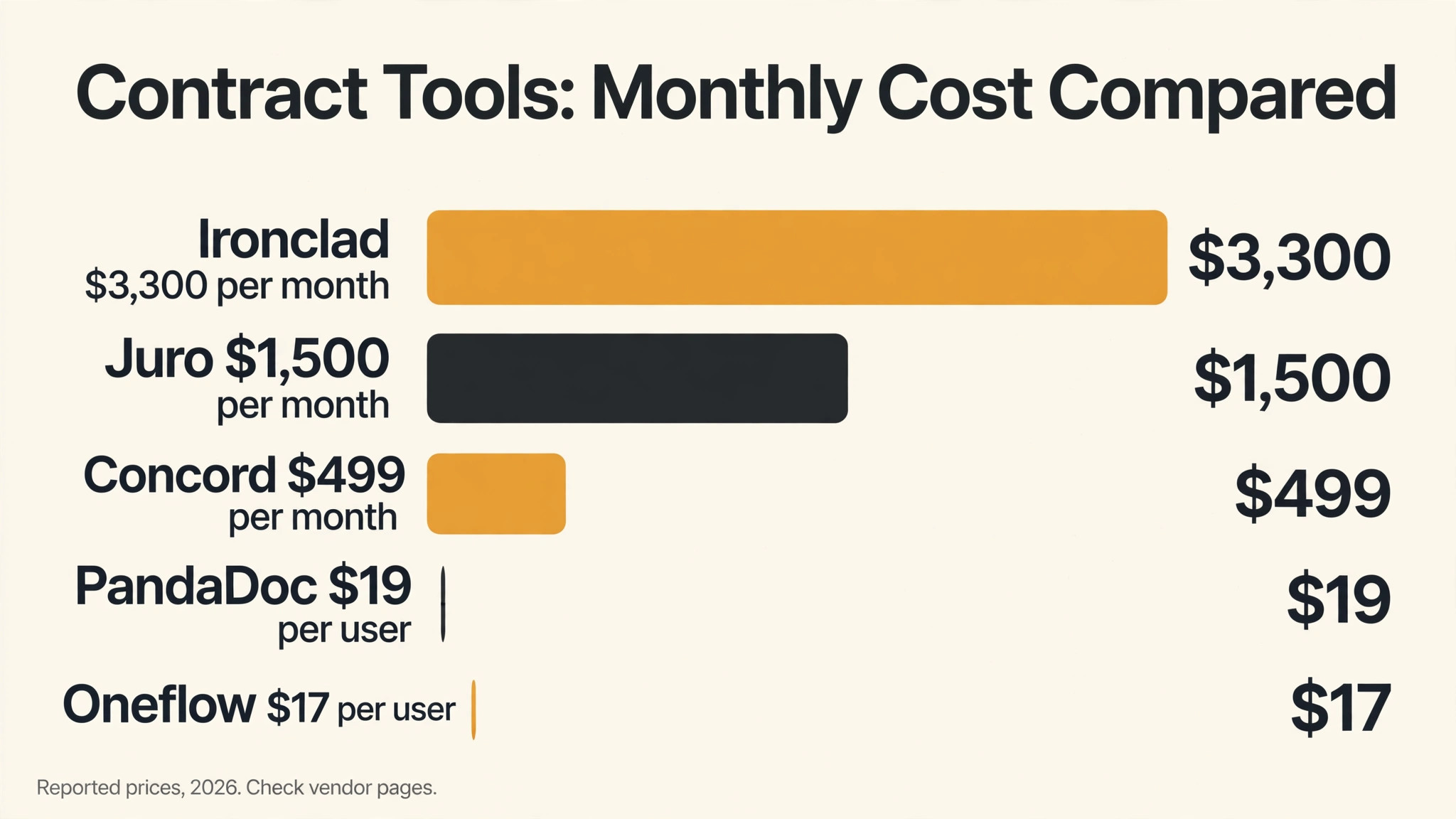
Then check the total cost at your real user count. PandaDoc at 19 dollars per user a month costs 95 dollars for five users. Concord at 499 dollars a month includes five users. Juro at a reported 18,000 dollars a year costs 1,500 dollars a month before add-ons. Work the maths with your own team size, because per-seat pricing punishes wide teams and platform pricing punishes small ones. The best contract management tools for small business are the ones whose pricing model matches how many people actually touch contracts.
The 11 Tools in Detail
1. PandaDoc
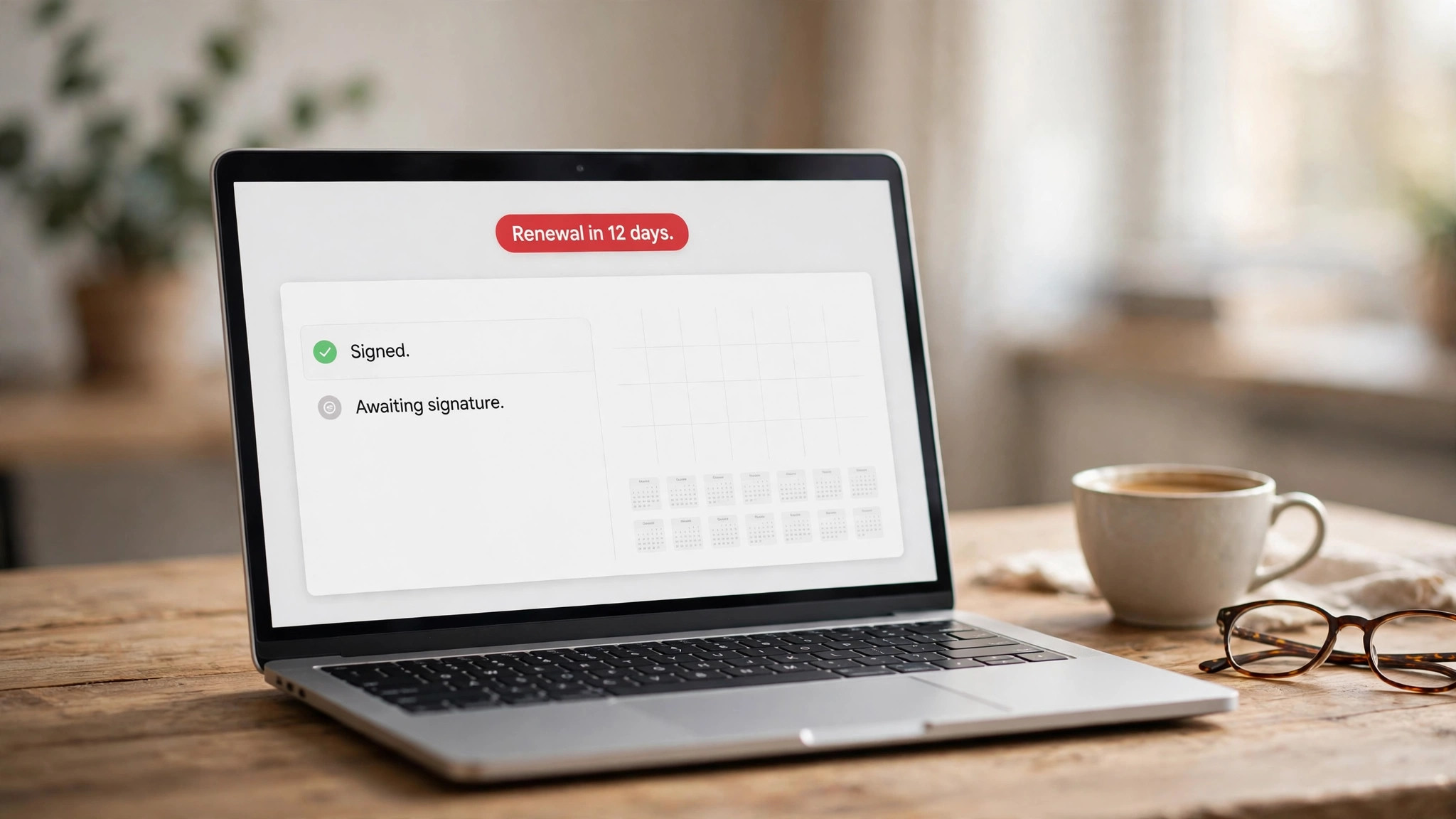
PandaDoc is a document automation platform for sales contracts, proposals and quotes, with templates, e-signatures, CRM integrations and analytics in one flow.. It suits small businesses whose contracts are mostly sales agreements, MSAs, NDAs and offer letters that need a signature and a template, not a legal department. Pricing starts at 19 dollars per user a month for Starter on annual billing, with Business at 49 dollars, and a free tier covering 60 documents a year. It was rated number one for SMB contract management by G2 in Spring 2026, and it is the only tool here with fully transparent pricing and same-day set-up.
The trade off is it is lighter on clause playbooks, multi-step legal approvals and post-signature obligation tracking than full CLM platforms. The default pick for most small businesses. Start here unless legal, not sales, owns your contracts.
2. Ironclad
Ironclad does one job well. a contract lifecycle management platform for legal teams, with workflow automation, AI-assisted clause review, compliance tracking and analytics. It suits companies where legal, procurement and sales all touch contracts and need approvals, playbooks and a searchable repository. Pricing is custom and quoted through sales, with third-party estimates of a 15,000 dollar annual minimum and a median buyer paying around 40,000 dollars a year. Its AI modules for review and drafting are add-ons that typically raise the base cost by 15 to 40 percent.
Watch out for the price, the implementation time and a three to six month rollout, which first-year totals commonly push to 80,000 dollars or more. Excellent product, wrong price for a small business. Buy it when you have in-house counsel, not before.
3. Juro
Start with what Juro actually does. a contract platform that prices on a platform fee rather than per seat, with unlimited users, templates and workflows, plus AI-powered review. It suits growing teams where many people request contracts but few draft them, since unlimited users remove the per-seat tax on collaboration. Pricing is custom, with third-party estimates starting around 18,000 dollars a year. It integrates with HubSpot, Salesforce and Workday, which covers the CRMs most small businesses actually run.
Where it falls short: the custom quote and enterprise-leaning price, which is a step up from PandaDoc for a small team. The right answer once you have in-house counsel or a legal-ops person, typically Series A onward. Too much for a ten-person team.
4. Concord
Concord earns its place here because it is the simplest full-lifecycle option a small team can actually afford. an all-in-one contract platform covering drafting, negotiation, e-signing and storage, built for small and mid-size teams that want the full lifecycle without enterprise pricing. It suits small teams that want one place for the whole contract life, from first draft to renewal reminder, without hiring a legal-ops specialist. Essentials starts at about 499 dollars a month billed annually with 5 users included, and a free tier is available on some plans.
The honest limit is it has no dedicated AI extraction or drafting features, so review work stays manual. A strong middle pick. Choose it when PandaDoc feels too sales-led and Ironclad feels too expensive.
5. DocuSign CLM
For teams that need lifecycle management on top of DocuSign, DocuSign CLM is the shortlist entry to test first. the contract lifecycle arm of the best-known e-signature brand, with deep workflow builders, clause libraries and Salesforce integration. It suits companies already standardised on DocuSign e-signature that want lifecycle management from the same vendor. Pricing is unpublished and enterprise only, with third-party estimates around 10,000 to 50,000 dollars a year even for small deployments. The e-signature itself is excellent, and existing DocuSign customers get a shorter learning curve than with a new vendor.
It is not perfect. unpublished enterprise pricing and a heavy implementation for what a small business actually needs Skip the CLM and keep DocuSign for signatures only. A small business does not need this tier.
6. ContractWorks
ContractWorks sits in a different lane from most tools here. a contract repository and management platform with AI-driven document tagging for search and clause location, plus automated alerts and custom reporting. It suits teams whose main pain is finding contracts and tracking renewals, rather than drafting new ones. Third-party comparisons report pricing from 700 to 2,000 dollars a month on annual billing, with unlimited users. Unlimited users at a flat monthly price makes it cheap per head for a team that only needs storage, search and alerts.
Before you buy, check it is weaker on drafting and negotiation than PandaDoc or Juro, so it complements a drafting tool rather than replacing one. Buy it for the repository job. Pair it with PandaDoc for drafting and you cover the full life for less than one enterprise platform.
7. SpotDraft
SpotDraft is a contract platform for small businesses with an AI-powered repository, clause insertion, automated reminders and a template library.. It suits small businesses that want AI help with their repository and clauses without paying enterprise prices. Pricing is custom and quoted by the vendor, though it positions itself as cost-effective for small teams. Implementation and data migration are included in every plan, with a go-live path of roughly six weeks.
The trade off is custom pricing means you cannot compare it on a price list, and it is less known than PandaDoc or Concord. Worth a quote if Concord feels too plain. Ask for the full price in writing before the trial ends.
8. ContractSafe
ContractSafe does one job well. a simple contract repository with unlimited users, deadline alerts, keyword search and AI-assisted organisation. It suits small teams that mainly need to stop missing renewals and to find any contract in seconds. Third-party comparisons report pricing around 5,400 to 9,780 dollars a year for unlimited users. The flat annual price with unlimited users is easy to budget, and there is no per-seat surprise as the team grows.
Watch out for it does not draft or negotiate contracts, so drafting still needs another tool or a template set. A good repository-only buy. Do not expect it to run your drafting workflow.
9. Agiloft
Start with what Agiloft actually does. an enterprise contract lifecycle platform with a deep no-code workflow builder, clause management and obligation tracking. It suits larger organisations with complex approval chains and compliance needs that off-the-shelf tools cannot model. Pricing is custom and quoted through sales, in the enterprise bracket. Its no-code builder lets legal-ops teams model unusual workflows without developer help, which is rare in this category.
Where it falls short: enterprise pricing and a long implementation that a small business cannot justify. A capable enterprise platform. Small businesses should not even take the sales call.
10. Oneflow
Oneflow earns its place here because it is the cheapest credible full platform for small teams. a European contract platform with e-signatures, templates, workflow automation and CRM integrations, priced per user. It suits small businesses, especially in Europe, that want an affordable contract platform with strong HubSpot, Salesforce and Dynamics integrations. Pricing starts from about 17 euros per user a month, one of the lowest entry points here.
The honest limit is it is less known in the US market, and its AI review features trail Ironclad and Juro. A genuine budget alternative to PandaDoc for European teams. US teams should compare support hours before committing.
11. Contractbook
For teams that need templates plus searchable contract data, Contractbook is the shortlist entry to test first. a contract platform for small teams combining templates, e-signatures and AI data extraction from signed contracts. It suits small teams that want templates plus the ability to pull key dates and terms out of signed contracts automatically. Pricing is quoted by the vendor, with a 14-day free trial to test the extraction features. Data extraction turns a pile of signed PDFs into searchable contract data, which is the step most small teams skip.
It is not perfect. custom pricing and a smaller user community than PandaDoc, so peer reviews are thinner Trial the extraction on your own contracts. If it reads your templates accurately, it earns its place.
What to Test in a Free Trial
A trial is only useful if you test your real contracts, not the vendor demo documents. Upload three of your own agreements, a sales contract, an NDA and a supplier agreement, and run each through the full path. Draft from a template, send for signature, track the reminder, store the signed copy and search for it a week later. If any step feels slow or confusing, it will feel worse when a customer is waiting.
Test the renewal alert system with real dates. Enter five contracts with renewal dates in the next ninety days and check whether the alerts arrive, who receives them, and whether they are clear enough to act on. A reminder that lands in one inbox and says nothing useful is not a system. ContractWorks and ContractSafe earn their price here, and a trial is the only way to prove it.
Test the search with a vague query. Ask a colleague who has never used the tool to find a contract by a supplier name or a clause, and time them. AI tagging and extraction sound impressive in a demo, but the test is whether a new hire can find an agreement in under a minute. If the trial cannot pass that test, the repository will not get used, and an unused repository is just another subscription.
How Contract AI Actually Helps (and Where It Does Not)
AI features are the loudest selling point in this category in 2026, and the most often oversold. Ironclad and Juro lead on AI-powered review, flagging risky clauses and suggesting safer language before a contract goes out. SpotDraft and Contractbook use AI to search a repository and pull key dates and terms out of signed PDFs. Those are real jobs, and they save real hours when the AI reads your actual contract types accurately.
The limit is accuracy on your documents, not on the vendor demo documents. AI clause review works well on standard agreements it has seen thousands of times, such as NDAs and simple sales contracts. It works less well on unusual supplier terms, custom service agreements and contracts with local legal quirks. Trial the AI on your own contracts and count how many flags are useful versus how many are noise. A review tool that flags everything teaches staff to ignore it.
The second limit is that AI does not replace legal judgement. A flagged clause still needs a human to decide whether the risk is acceptable, and a suggested rewrite still needs a lawyer to approve it for your jurisdiction. The best contract management tools for small business use AI to speed up the first pass, not to sign off the final version. Budget for that human step, and the AI becomes a genuine time saver instead of a source of false confidence.
The practical test is simple. Take five of your recent contracts, run them through the AI review or extraction, and measure two things. How long did the first pass take compared with doing it by hand, and how many of the AI suggestions would you actually accept. If the time saving is real and the acceptance rate is high, the AI feature is worth paying for. If either number is low, buy the tool for its templates and signing speed instead, and treat the AI as a bonus.
The Real Monthly Cost, Worked Honestly
The honest cost of a contract tool has four parts. The subscription is the first and the most visible. Implementation and migration is the second, and SpotDraft is unusual in including it, while enterprise tools charge for it separately. Training is the third, because a tool only pays off when staff actually use it. The fourth is the cost of the contracts you still miss, which is the number the tool is supposed to reduce.
Work an example with real numbers. A five-person team on PandaDoc Starter pays 95 dollars a month. The same team on Concord pays 499 dollars a month. The same team on Juro pays a reported 1,500 dollars a month. The question is not which is cheapest. It is which one stops the losses that cost you money today. If missed renewals cost you 500 dollars a month, Concord pays for itself. If slow signing costs you one deal a quarter, PandaDoc pays for itself many times over.
The rule that holds is to buy the cheapest tool that solves your actual pain, not the cheapest tool overall. A free tier that nobody uses costs more than a paid tool that everyone uses, because the losses continue either way. The best contract management tools for small business are the ones your team opens every day, and a trial tells you that faster than any pricing page.
Mistakes Small Businesses Make With Contracts
The first mistake is buying an enterprise platform for a small-business problem. Ironclad is an excellent product, and it is the wrong purchase for a team signing twenty contracts a month. The implementation alone costs more than a year of PandaDoc, and the team will use a tenth of the features. Match the tool to the volume, not to the brand.
The second mistake is storing contracts without setting up alerts. A repository without renewal reminders is a tidy filing cabinet that still lets dates slip past. Set the alerts on day one, assign an owner to each renewal, and test that the alerts actually arrive. The best contract management tools for small business only work when the reminder loop is closed.
The third mistake is letting sales keep signing outside the system. If half the contracts still go out as email attachments, the repository is incomplete and the search cannot be trusted. Make the tool the only path to a signature, and the repository becomes the single source of truth within a month. The best contract management tools for small business fail when the team works around them, not when the software fails.
Rollout Checklist
Use this checklist when you move your contracts to a new tool, and keep a copy where the whole team can see it.
1. Count monthly contracts, renewals and hours spent hunting for agreements. 2. Gather every existing contract into one folder before migration. 3. Set renewal alerts and an owner for every contract on day one. 4. Build templates for your five most common agreements first. 5. Test the full signing path on a phone with a real customer in mind. 6. Train every person who sends or signs contracts, not just the admin. 7. Make the tool the only path to a signature from launch day. 8. Review missed renewals and signing speed monthly for the first quarter.

Related Guides
Keep exploring with these guides on Stratilyze:
- Best Contract Management Software for Small Businesses (8 Tools)
- Best Social Media Management Tools for Small Business
- Best Project Management Tools for Small Business
Frequently Asked Questions
What is the best contract management tool for a small business?
PandaDoc is the best starting point for most small businesses, at 19 dollars per user a month for Starter, with templates, e-signatures and CRM integrations and same-day set-up. Concord at 499 dollars a month is the better pick when you need the full lifecycle including renewals. Ironclad is for enterprise legal teams, not small businesses.
How much does contract management software cost?
Small-business tools start at 19 dollars per user a month for PandaDoc and about 17 euros per user a month for Oneflow. Concord costs about 499 dollars a month for five users. Enterprise platforms such as Ironclad and Juro start around 18,000 to 40,000 dollars a year. Only PandaDoc and Concord publish full prices, so check the vendor page before budgeting.
Do small businesses need full contract lifecycle management?
Most do not. A small business signing a few dozen contracts a month needs e-signature, templates and a searchable folder. Full lifecycle management pays off when legal needs approvals, playbooks and obligation tracking, which usually means in-house counsel. Buying Ironclad at seed stage is a classic waste of money.
What is the difference between PandaDoc and Ironclad?
PandaDoc is a document automation tool for sales contracts, priced from 19 dollars per user a month with same-day set-up. Ironclad is a full contract lifecycle platform for legal teams, with custom pricing around 40,000 dollars a year median and a multi-month rollout. PandaDoc gets contracts signed fast. Ironclad manages complex legal workflows.
Can contract software track renewal dates automatically?
Yes, and that is one of its most valuable jobs. Concord, ContractWorks and ContractSafe all send deadline reminders and track renewals. Set the alerts and an owner for every contract on day one, and test that the alerts arrive, because a reminder that nobody sees is not a system.
Is there a free contract management tool for small business?
PandaDoc has a free tier covering 60 documents a year with basic e-signatures. Concord also offers a free tier on some plans. Free tiers work for very low volume, but a business signing more than a few contracts a month will outgrow them fast and should budget for a paid plan.
A Final Word Before You Choose
There is no universal winner among these 11 tools, because a sales team and a legal team buy different products. A sales-led small business should start with PandaDoc at 19 dollars per user a month. A team that keeps missing renewals should start with Concord or ContractWorks. A European team should compare Oneflow. An enterprise legal team should start with Ironclad, and a small business should not. Whichever you choose, count your contracts first, test the signing path on a phone, set renewal alerts on day one, and judge the tool on deals signed faster and renewals never missed. The best contract management tools for small business are the ones your team actually opens every day.