

Ten years ago an insurance agency ran on a filing cabinet, a shared inbox and one producer who remembered every renewal date in his head. Today the book of business is bigger, the carriers send data in five formats and the client expects a reply before lunch. The best crm software for insurance agencies exists to close that gap, because the agency that still tracks renewals on a spreadsheet will lose clients to the agency that sends the right reminder at the right moment without anyone having to remember it.
Moving from a generic contact list to an insurance-specific system changes the daily work in a visible way. A producer used to open four tabs to answer one client question about a policy, a payment and a renewal date. With the right system in place, that same question takes one search, and the answer sits next to the carrier download, the commission record and the last three emails.
The stakes are higher than in most industries. A missed renewal is not a lost sale, it is a client driving uninsured or a business operating without cover. A commission error is not a rounding mistake, it is a producer paid wrong for six months before anyone notices. That is why this guide weighs policy tracking, carrier downloads and commission handling as heavily as sales features, and why a tool that looks strong on paper can still fail an agency that writes complex commercial lines.
What Changed in the best crm software for insurance agencies Market
The biggest change is that the line between a CRM and an agency management system has blurred. Five years ago an agency bought one system for policies and another for sales, then paid someone to keep the two in sync. Now the leading platforms cover both jobs, and the choice is less about which category a tool belongs to and more about which half of the job it does best. A life and health agency needs commission splits and Medicare workflows. A property and casualty agency needs carrier downloads and comparative rating. The same tool rarely leads on both.
The second change is the price spread. A solo agent can now run a real insurance CRM for under 50 dollars a month, while a mid-size agency with twenty producers can pay more than 200 dollars per user a month for an enterprise platform with implementation fees on top. The gap is so wide that a price quoted without context is meaningless. This guide gives the starting figure for every tool and says plainly when that figure is reported rather than published, because an agency that budgets on a headline number and discovers the real one in month three has already lost the negotiation.
The third change is the rise of the sales-first CRM inside insurance. Tools built for general sales now ship insurance templates, and some agencies run them alongside a management system instead of replacing it. The tools below are ranked with that tension in mind, and the verdict names the setup that fits each agency size.
Why Renewals Decide the Winner
Renewal work is where an insurance agency makes or loses its money. A new policy pays once, while a renewal pays every year, and the cost of keeping a client is a fraction of the cost of winning one. The best crm software for insurance agencies in this guide was judged first on how it handles the renewal cycle, because a system that cannot surface an expiring policy ninety days out will cost the agency more in a single quarter than the software saves in a year.
Carrier downloads sit at the centre of that test. When a carrier pushes policy data straight into the system, the renewal list builds itself and the producer works from facts instead of memory. The platforms in this guide differ sharply here, and the detail sections name the ones that treat carrier connectivity as a core feature rather than an add-on.
Commission handling is the other half of the renewal story. A system that tracks splits, hierarchies and missed payments turns commission from a monthly argument into a report the agency can trust. A system that leaves commissions to a spreadsheet leaves the agency exposed to the exact errors that destroy producer trust. The tools that lead this guide treat commissions as a first-class record, and the ones that do not are flagged clearly in their sections.

The 10 Tools at a Glance
| Tool | Main job | Best for | Starting price |
|---|---|---|---|
| AgencyBloc | Life and health AMS with CRM | Life and health agencies | 109 dollars a user a month, reported |
| Applied Epic | Enterprise agency management | Large P and C agencies | Custom, reported 200 to 400 dollars a user a month |
| AMS360 | Agency management with accounting | Agencies needing strong accounting | Custom, reported 200 to 400 dollars a user a month |
| EZLynx | P and C management with rating | Independent P and C agencies | Reported from 150 dollars a user a month |
| HawkSoft | Independent agency management | Small to mid-size independents | Reported from 89 dollars a user a month |
| Salesforce Financial Services Cloud | Enterprise CRM for insurance | Large agencies with an admin | Reported from 225 dollars a user a month |
| HubSpot | General CRM with insurance use | Small agencies starting free | Free, paid from 20 dollars a seat a month |
| Zoho CRM | Low cost general CRM | Budget agencies | 14 dollars a user a month |
| Radiusbob | Budget insurance CRM | Solo agents and small teams | 43 dollars a month, reported |
| NowCerts | Cloud agency management | Agencies leaving legacy systems | 99 dollars a month, reported |
Best Pick by Job
| Job type | First pick | Second tool | Why this pair works |
|---|---|---|---|
| Life and health book | AgencyBloc | Radiusbob | AgencyBloc handles commissions and Radiusbob covers the budget fallback |
| Large P and C agency | Applied Epic | AMS360 | Applied Epic scales widest and AMS360 adds stronger accounting |
| Small independent agency | HawkSoft | EZLynx | HawkSoft is easier to run and EZLynx adds comparative rating |
| Starting free | HubSpot | Zoho CRM | HubSpot scales free and Zoho CRM costs little when the team grows |
| Budget solo agent | Radiusbob | HubSpot | Radiusbob is built for insurance and HubSpot adds free prospecting |
The book shapes the tool, not the other way round. Life and property books are different businesses wearing the same word insurance. Buying for the wrong half of the market means paying for features the agency never opens while going without the ones it needs every day.
Size decides the second cut. A solo agent needs a tool that works on day one without an implementation project, while a twenty-person agency needs roles, permissions and reporting that a solo tool cannot provide. The best crm software for insurance agencies is the one that matches the agency’s book and headcount today, with a clear path to the next size up when the team grows.
How to Judge the best crm software for insurance agencies
Start with a real renewal list, because that is the test that separates insurance systems from generic CRMs. Take thirty policies that expire in the next ninety days and check whether the tool surfaces them, shows the carrier, the premium and the last contact, and lets the producer act without leaving the record. A tool that cannot do that cleanly will fail the agency in its busiest quarter, no matter how good its sales dashboard looks.
Next, test the carrier download with a live carrier the agency actually writes. Ask the vendor to show a download flowing into the system and watch what arrives, because a download that drops half the fields is worse than no download at all. It creates the illusion of a current record while the team works from stale data. The best crm software for insurance agencies proves the download on the agency’s own carriers before the contract is signed.
Then check the commission math on a real split. Give the vendor a policy with two producers, a hierarchy and a missed carrier payment, and ask for the report. If the numbers come out clean, the system understands the agency’s money.
The 10 Tools in Detail
The order below follows the agency’s book, so the life and health leader opens the list and the enterprise platforms follow.
1. AgencyBloc
AgencyBloc is the default choice for life and health agencies, and its commission handling is the reason. The platform tracks policies, carriers, commissions and clients as first-class records, so a Medicare agency can follow an enrollment from first call to renewal without leaving the system. The AMS+ Grow tier is reported at 109 dollars a user a month, with higher Accelerate and Elevate tiers priced by quote, and the free trial lets a team test the real workflow before committing.
The drawback is the price and the narrow focus. At 109 dollars a user a month, a ten-person agency pays more than a thousand dollars a month before add-ons, and the commissions module is priced separately by volume. The platform is built for life, health and benefits, so an agency that writes any property and casualty business will need a second system for it.
AgencyBloc suits mid-size life and health agencies with five or more producers. It fits a Medicare agency managing enrollment seasons, a benefits broker tracking group census data, and an agency whose biggest pain is commission reconciliation rather than prospecting. The commission processing is the feature that matters, because it handles splits and hierarchies that would otherwise live in a spreadsheet.
Book a demo with your own commission statement in hand and ask the vendor to reconcile it live. If the splits come out right and the missed payments surface, AgencyBloc will carry the agency’s money work.
2. Applied Epic
Applied Epic is the enterprise standard for property and casualty agencies, and its depth is the reason. The platform handles complex commercial lines, carrier relationships at scale and integrations with virtually every major carrier system, and it functions as a single source of truth for sales, servicing and accounting. Pricing is custom and reported in the range of 200 to 400 dollars a user a month, with implementation fees that can run from 20,000 dollars to more than 100,000 dollars depending on agency size.
The drawback is the cost and the time to value. Implementation takes six to twelve months, and the agency needs staff who can run the project while still serving clients. A team without a dedicated administrator will struggle to get value from the depth it is paying for.
Applied Epic suits mid-size to large agencies running property and casualty and benefits in one system. It fits a brokerage with complex commercial accounts, an agency with dozens of producers and a team that needs the deepest carrier connectivity available. The scale is the feature that matters, because a large book needs a system that does not bend under its own weight.
Ask for a reference agency of similar size and book mix before signing. If that agency reports a clean migration and a working renewal cycle, Applied Epic is the right platform for the large agency.
3. AMS360
AMS360 from Vertafore is the agency management system for agencies that care most about accounting, and its integrated accounting module is the reason. The platform handles commission splits and AI carrier statement matching, and it reconciles direct bill commissions without a second tool. Pricing is custom and reported in the range of 200 to 400 dollars a user a month, with implementation costs that vary by agency size.
The drawback is the age of the platform and the learning curve. AMS360 was built over decades, and the interface shows it, with more menus and screens than a small team needs. The platform also demands a serious implementation effort, and a team that rushes it will pay for the shortcuts later.
AMS360 suits established independent agencies that need strong accounting alongside policy management. It fits an agency with a complex commission structure, a team that reconciles carrier statements every month and an owner who wants the accounting and the policy data in one place. The accounting module is the feature that matters, because it removes the second system most agencies run for commissions.
Run a month of carrier statements through the system during the trial. If the reconciliation matches and the splits are clean, AMS360 will carry the agency’s financial work.
4. EZLynx
EZLynx is the property and casualty platform for agencies whose day is built around comparative rating, and its rating engine is the reason. A producer enters the risk once and shops it across carriers, which saves hours on every new quote and keeps the agency competitive on price. Pricing is reported from around 150 dollars a user a month, with the rater bundled into the platform.
The drawback is the narrow fit. EZLynx serves independent property and casualty agencies well and serves captive agencies badly, since a captive agent cannot shop a risk across carriers. The platform is also quote-based, so the agency will not know its real price until it negotiates.
EZLynx suits independent agencies that quote personal lines every day. It fits a small to mid-size agency competing on price, a producer who writes auto and home policies in volume and a team whose bottleneck is quoting speed rather than lead generation. The rating engine is the feature that matters, because it turns a thirty-minute quote into a five-minute one.
Time five real quotes through the rating engine during the trial. If the carrier results come back fast and accurate, EZLynx will pay for itself in quoting time alone.
5. HawkSoft
HawkSoft is the sweet spot for independent agencies with three to twenty staff, and its usability is the reason. The platform combines agency management with basic CRM features at a price that makes sense for a small agency, and it reports 97 percent first-call resolution on support with an average customer tenure of eighteen years. Pricing is reported from around 89 dollars a user a month, with some reports putting the figure higher, so confirm the quote before budgeting.
The drawback is the ceiling. HawkSoft is built for small to mid-size agencies, and a team that grows past twenty staff may outgrow it. An agency that needs advanced automation or deep analytics will find the limits quickly.
HawkSoft suits small to mid-size independent agencies that want a system the whole team will actually use. It fits a family agency with a handful of producers, a team that values support over features and an owner who wants the renewal cycle to run without constant supervision. The support record is the feature that matters, because a small agency cannot afford a week of downtime.
Call support during the trial with a hard question about a carrier download. If the answer is fast and accurate, HawkSoft will serve the agency well for years.
6. Salesforce Financial Services Cloud
Salesforce Financial Services Cloud is the enterprise CRM for agencies that want the deepest customisation available, and its platform depth is the reason. The system handles householding, financial accounts, referrals and forecasting at a scale no insurance-specific tool matches, and the AppExchange adds thousands of extensions. Pricing is reported from around 225 dollars a user a month, with implementation costs that can add 50,000 to 150,000 dollars for insurance-specific customisation.
The drawback is the cost and the build. Financial Services Cloud is a platform, not a finished insurance system, and the agency pays an implementation partner to shape it into one. The project takes months, and a team without an administrator will struggle to keep it current.
Salesforce Financial Services Cloud suits large agencies and brokerages with an admin and a complex book. It fits an enterprise with hundreds of producers, a team with custom objects and workflows and an agency that already runs Salesforce elsewhere. The platform depth is the feature that matters, because a complex book needs a system that can be shaped to fit it.
Pilot the platform with one team and one book of business before committing. If the pilot proves the workflows and the forecast is honest, Salesforce is the right tool for the enterprise agency.
7. HubSpot
HubSpot is the cheapest way into a real CRM for an insurance agency, and its free tier is the reason. The free plan covers unlimited users with contact management, deal tracking and basic email, and Starter begins at 20 dollars a seat a month. The platform is easy to learn, and a small agency can start tracking prospects the same day it signs up, then add sales automation as the pipeline grows.
The drawback is the missing insurance logic. HubSpot does not track policies, carrier downloads or commissions, so an agency that buys it as a full replacement for an agency management system will be disappointed. A team that outgrows Starter will pay significantly more than the headline suggests.
HubSpot suits small agencies that need prospecting and follow-up rather than policy management. It fits a startup agency building its first book, a team that wants to start free and scale without switching and an agency that already runs an agency management system and needs a sales layer on top. The free tier is the feature that matters, because a team can prove the CRM works before paying anything.
Set up a pipeline with twenty real prospects and work it for two weeks. If the team updates it daily and the follow-up happens on time, HubSpot will carry the agency’s sales work.
8. Zoho CRM
Zoho CRM is the best value general CRM for a budget agency, and its price is the reason. Standard costs 14 dollars a user a month billed annually, with Professional at 23 dollars and Enterprise at 40 dollars, and the free tier covers three users. The platform covers contact management, deal tracking, automation and reporting, and it works well alongside other Zoho products.
The drawback is the missing insurance depth. Zoho CRM does not handle policies, carrier downloads or commissions, so it serves as a sales tool rather than a full agency system. A team that runs a different marketing tool will find the integrations thinner.
Zoho CRM suits budget agencies under ten people that need a real CRM without a big bill. It fits a small agency that wants the most CRM per dollar, a team already using Zoho products and an owner who wants a functional Standard tier without paying for Enterprise. The Standard tier is the feature that matters, because it is genuinely functional at 14 dollars a user a month.
Build a pipeline with your real prospects and test the automation on them. If the follow-up fires on time and the price holds, Zoho CRM will carry the small agency.
9. Radiusbob
Radiusbob is the cheapest insurance-specific CRM on the market, and its price is the reason. The Basic plan is reported at 43 dollars a month, with an AMS tier at 78 dollars a month that adds VoIP, and the platform covers contacts, policies, tasks and a basic pipeline built for insurance. A solo agent can run the whole book on it without paying enterprise prices.
The drawback is the depth. Radiusbob is thinner than AgencyBloc or HawkSoft on automation, reporting and integrations, and a team that grows past a handful of producers will outgrow it. A team that needs advanced commission handling will find the limits quickly.
Radiusbob suits solo agents and small teams on a tight budget. It fits a new agent building a first book, a one-person shop that needs insurance fields without enterprise cost and an owner who values a low monthly bill over deep features. The price is the feature that matters, because 43 dollars a month buys a real insurance CRM.
Move your real book into Radiusbob and work it for a month. If the renewals surface on time and the price holds, Radiusbob will carry the solo agency.
10. NowCerts
NowCerts is the cloud agency management system for agencies leaving a legacy platform, and its modern interface is the reason. The platform covers policies, clients, tasks and renewals in a browser-based system that a team can learn quickly, and it is the name agencies mention most often when they say they want an alternative to the enterprise platforms. Pricing is reported at around 99 dollars a month, with the final figure depending on agency size.
The drawback is the maturity. NowCerts is newer than HawkSoft or AMS360, and its ecosystem of integrations is smaller. A team that needs deep carrier connectivity should test it carefully before committing.
NowCerts suits agencies moving off a legacy system that want a modern cloud platform without enterprise cost. It fits a small to mid-size agency that values a clean interface, a team that wants to migrate without a year-long project and an owner who wants the renewal cycle visible on day one. The modern interface is the feature that matters, because a team that can learn the tool in a week will use it the same month.
Migrate a slice of the book first and run both systems in parallel for a month. If the renewals match and the team prefers the new workflow, NowCerts is the right platform for the move.
Switching Without Losing the Book
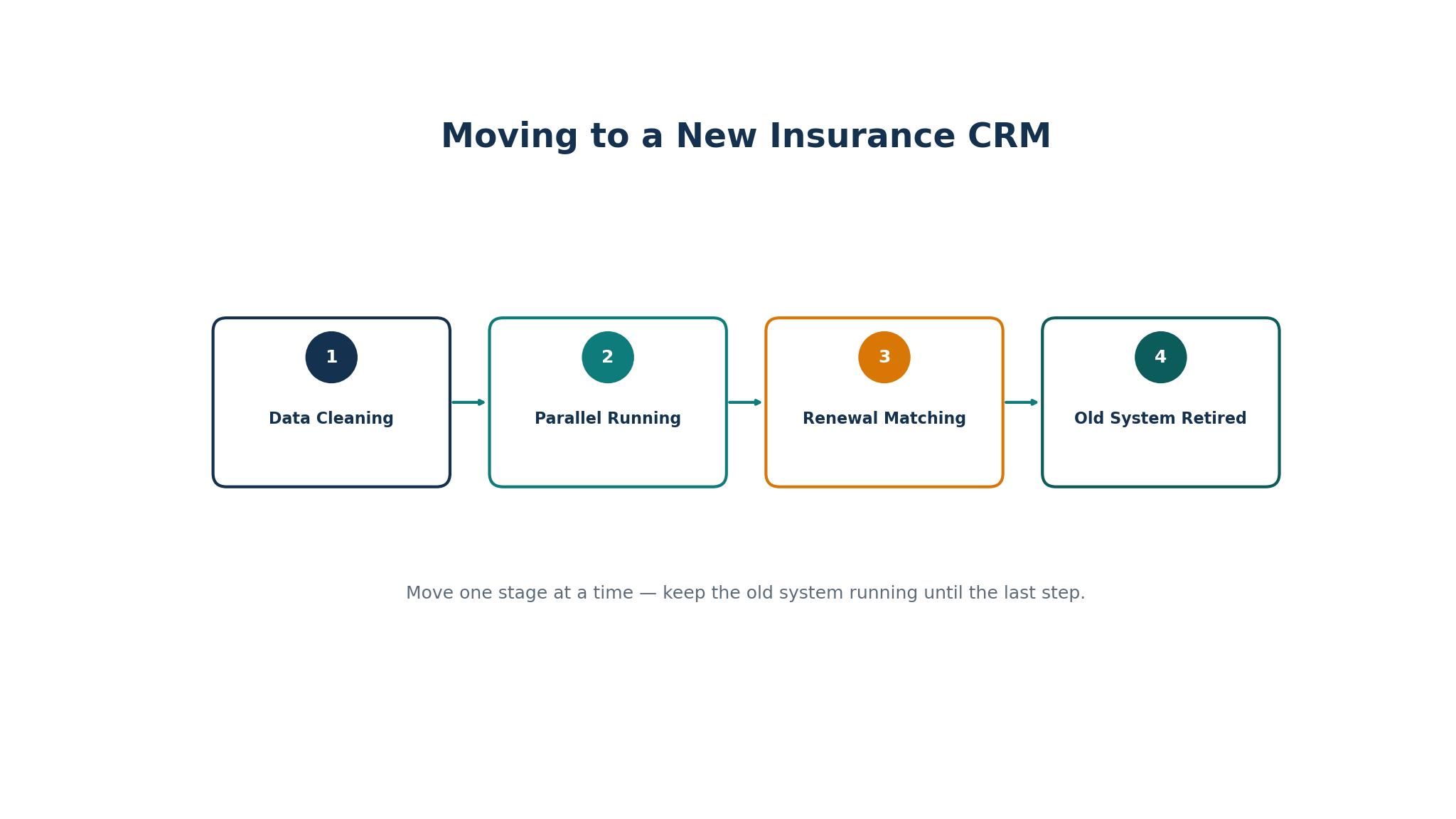
A migration fails in a specific way. The agency exports its data, imports it into the new system and discovers that half the policies have no carrier attached and a third of the clients have no renewal date. The team then works from two systems for six months, and the new one gets blamed for the old one’s mess.
The second failure is a producer who never adopts the new tool. The agency buys the system, trains the team once and assumes the work is done, while the top producer keeps a private spreadsheet and the renewal list splits in two. Adoption needs a named owner, a weekly check on who is actually logging activity and a willingness to retire the old spreadsheet on a fixed date.
The trial should run on real data, with real carriers and real commissions, and the contract should follow the trial, not precede it. An agency that signs a three-year deal after a sales demo has handed the vendor its bargaining power, and the vendor has no reason to fix the problems that surface in month two.
Mistakes That Cost Agencies Clients
The most expensive mistake is buying for the agency the owner wishes he ran instead of the one he runs. A two-person agency does not need Applied Epic, and a fifty-person brokerage does not need a free contact manager that cannot report on the pipeline.
A second mistake is ignoring the per-seat bill. A 109 dollar plan looks manageable until the agency adds ten seats and a commissions add-on, and the monthly bill doubles without any new feature being used. Ask for the full-stack quote before committing, and include the add-ons the team actually needs. The cheapest headline plan is often the most expensive stack, and the best crm software for insurance agencies are judged here on the full cost, not the entry price.
Frequently Asked Questions
Which CRM is best for a small insurance agency?
HawkSoft is the best starting point for a small independent agency, because it combines agency management with CRM features at a price a small team can afford, and its support record is the strongest in the category. Radiusbob is the better pick for a solo agent on a tight budget, since it costs a fraction of the enterprise platforms and still tracks policies. A team of three to twenty should test HawkSoft first, while a solo agent should test Radiusbob first.
How much does insurance CRM software cost per user per month?
Insurance CRM software costs between 14 and 400 dollars per user a month, with most agencies paying 70 to 200 dollars. Zoho CRM costs 14 dollars a user a month, Radiusbob is reported at 43 dollars a month, AgencyBloc is reported at 109 dollars a user a month, and Applied Epic and AMS360 are reported at 200 to 400 dollars a user a month.
Do insurance agencies need an AMS or a CRM?
Most agencies need both jobs done, and the question is whether one platform covers both. Life and health agencies often find that AgencyBloc covers both jobs in a single system. Property and casualty agencies usually run an agency management system for policies and layer a sales CRM on top for prospecting. The right answer depends on the book, and an agency should decide which half of the job matters more before it buys.
Is HubSpot good for insurance agencies?
HubSpot is good for the sales half of an insurance agency and weak for the policy half. It tracks prospects, deals and follow-up well, and its free tier is genuinely useful for a small team. It does not track policies, carrier downloads or commissions, so an agency that needs those features should pair HubSpot with an agency management system rather than using it alone.
What is the cheapest good insurance CRM?
Radiusbob is the cheapest good insurance-specific CRM, with a Basic plan reported at 43 dollars a month. Zoho CRM at 14 dollars a user a month is cheaper, but it is a general CRM without insurance fields. A solo agent on a tight budget should start with Radiusbob, while a team that only needs sales tracking should start with Zoho CRM or HubSpot Free.
Can an agency switch CRM without losing client data?
Yes, if the data is cleaned before the move and both systems run in parallel until the renewal list matches. Export the book, check that every policy has a carrier and a renewal date, and migrate a slice first. Run the old and new systems together for a month, compare the renewal lists weekly, and retire the old system only when the lists agree. A migration without a parallel run is the one that loses data.
The Verdict on Insurance Agency CRM Software
AgencyBloc takes the top spot for life and health agencies, because its commission handling is the strongest in the guide and its renewal workflows match the way those agencies actually work. The price is high, but the cost of a commission error is higher, and the platform pays for itself in the first enrollment season.
HawkSoft is the pick for small independent property and casualty agencies, Applied Epic is the pick for large brokerages, and Radiusbob is the pick for a solo agent on a budget. The best crm software for insurance agencies is not the one with the longest feature list, it is the one that surfaces renewals on time, reconciles commissions cleanly and costs less than the clients it helps keep.
Choose by the book first, the team size second and the price third. Run a trial on real data, measure the renewal list and the commission math, and set a review date.