
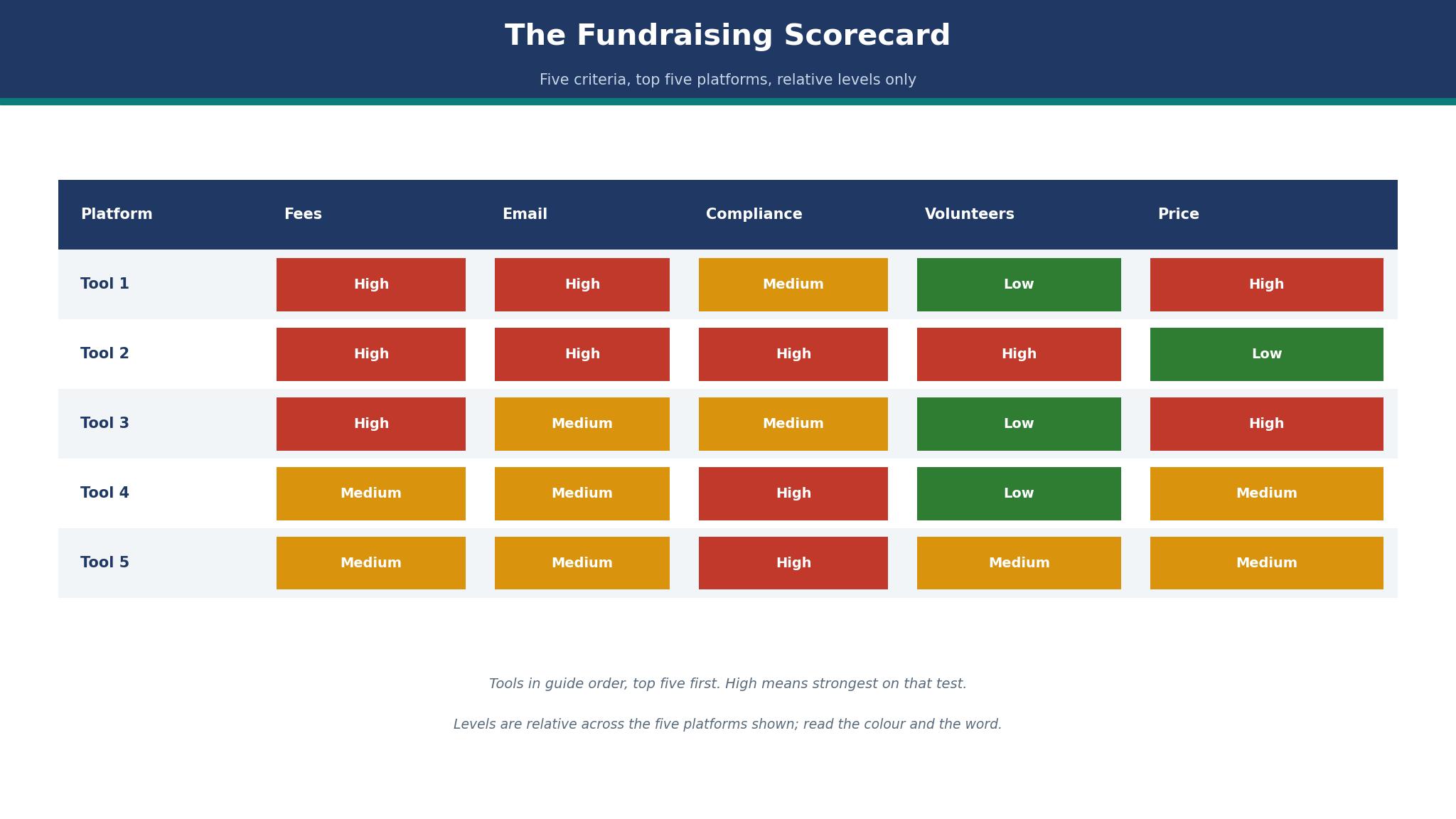
The scorecard below rates each platform on five tests, and the best fundraising software for political campaigns is the one that passes the tests your race actually faces. ActBlue leads for eligible Democratic campaigns, because its donor network turns an email into a gift faster than any rival. NGP VAN leads where field work and fundraising must share one voter record.
How the Scorecard Works
The scorecard below is the whole method of this guide, so it is worth sixty seconds before the table. Each platform earns a score out of five on donation fees, email tools, compliance, volunteer tracking and price, and the scores come from the published fee, the feature list and the way campaigns actually use the tool in the final month.
The 15 Tools at a Glance
The scorecard drives this whole guide, so read the table first and the detail second. That is how the best fundraising software for political campaigns earns its place here, on evidence rather than on brand alone. Each tool below carries a score out of five on donation fees, email tools, compliance, volunteer tracking and price, and the scores come from the published fee, the feature list and the way campaigns actually use the tool. A high score on fees means little if the platform cannot take gifts from your voters, so eligibility sits beside every score.
| # | Tool | Starting price | Best for |
|---|---|---|---|
| 1 | ActBlue | 3.95% per donation | Democratic campaigns of any size |
| 2 | NGP VAN | Quote-based, from about $45 a month reported | Democratic campaigns that need voter data and fundraising together |
| 3 | WinRed | 3.94% per donation, 3.2% over $500 | Republican campaigns and conservative groups |
| 4 | Anedot | 4.0% + $0.30 per gift for campaigns | Nonpartisan and cross-party campaigns |
| 5 | DonorPerfect | From about $99 a month reported | Campaigns that also run a donor database year round |
| 6 | EveryAction | Quote-based | Progressive organisations with advocacy and fundraising together |
| 7 | NationBuilder | From $29 a month reported | Campaigns that want a website, email and fundraising in one place |
| 8 | Givebutter | No platform fee, tips optional | Small campaigns that want free fundraising pages |
| 9 | Fundraise Up | Quote-based, from about 4% reported | Campaigns that want smart donation forms and upsells |
| 10 | Qgiv | From $25 a month reported | Campaigns that run auctions and peer-to-peer events |
| 11 | Bloomerang | From $119 a month reported | Campaigns that prize donor retention data |
| 12 | Donorbox | 1.5% platform fee + card processing | Small campaigns that want a simple embeddable form |
| 13 | Classy | Quote-based | Larger campaigns with peer-to-peer and events |
| 14 | Rally | From $0, fees per gift reported | Campaigns that want text-to-give fast |
| 15 | Mobilize | Quote-based | Campaigns that need volunteers as much as money |
Fees decide how much of each gift reaches the campaign, and the best fundraising software for political campaigns is rarely the cheapest on paper alone. A platform with a low percentage but no donor network can cost more in lost gifts than a platform with a higher fee and a familiar checkout. The table below lines up the published fee, the strongest feature and the flaw to check before you sign anything.
| Tool | Price | Standout strength | Watch out |
|---|---|---|---|
| ActBlue | 3.95% per donation | Largest small-dollar donor network in Democratic politics | Democratic and progressive committees only |
| NGP VAN | Quote-based, from about $45 a month reported | Voter file, field tools and fundraising in one system | Quote-based pricing and a learning curve |
| WinRed | 3.94% per donation, 3.2% over $500 | The dominant small-dollar network on the Republican side | Republican and conservative committees only |
| Anedot | 4.0% + $0.30 per gift for campaigns | Works for candidates of any party and for nonprofits | Higher fee than the partisan platforms |
| DonorPerfect | From about $99 a month reported | Donor management, receipts and reporting in one place | Older interface and add-on pricing |
| EveryAction | Quote-based | Advocacy, email and fundraising on shared donor records | Quote-based and built for larger teams |
| NationBuilder | From $29 a month reported | One system for website, CRM, email and donations | Fees on top of payment processing |
| Givebutter | No platform fee, tips optional | Free pages funded by optional donor tips | Tip income varies and support is lighter |
| Fundraise Up | Quote-based, from about 4% reported | Checkout optimisation, upsells and donor-covered fees | Quote-based and best with volume |
| Qgiv | From $25 a month reported | Auctions, text giving and peer-to-peer in one suite | Add-ons push the price up |
| Bloomerang | From $119 a month reported | Retention scores and donor engagement tracking | Priced for nonprofits rather than short races |
| Donorbox | 1.5% platform fee + card processing | Quick setup, embeddable forms and recurring gifts | Platform fee on every gift |
| Classy | Quote-based | Peer-to-peer, events and crowdfunding at scale | Quote-based and built for bigger teams |
| Rally | From $0, fees per gift reported | Text giving and quick mobile donation pages | Narrower feature set than full platforms |
| Mobilize | Quote-based | Volunteer events, shifts and sign-ups tied to supporters | Fundraising is secondary to volunteer tools |
Two numbers in that table deserve a second look. ActBlue lists 3.95% as its flat fee, while a separate October 2026 source reports 3.7% plus $0.23, so the figure is reported as a conflict and a treasurer should confirm the current rate on the vendor page before launch. NGP VAN Payments at 3.25% is the newer figure, and it is the one that changes the maths for a campaign raising six figures online.
Best Pick by Job
Different races need different platforms, and the best fundraising software for political campaigns changes with the job in front of you. A school board race with 400 donors has little in common with a congressional race that knocks 40,000 doors, so the table below picks by job rather than by brand.
| Job | Pick | Why |
|---|---|---|
| Democratic candidate, any level | ActBlue | Largest donor network and simplest page |
| Campaign with field and fundraising together | NGP VAN | One voter record for doors, calls and gifts |
| Republican candidate | WinRed | Dominant network on the Republican side |
| Nonpartisan race | Anedot | No party test and donor-covered fees |
| Small campaign, no budget | Givebutter | Free pages funded by donor tips |
| Campaign with live events | Qgiv | Auctions and text giving in one suite |
The 15 Tools in Detail
The sections below work through the scorecard in order, scoring every platform on the same five tests, and the best fundraising software for political campaigns is the one that passes the tests your race actually faces. I checked every price below against a vendor page or a reported source in November 2026, and I marked the ones where sources disagreed. Give the first three tools a careful read, and use the rest as a reference for the job that matches yours.
1. ActBlue
ActBlue processes online gifts for Democratic candidates and progressive groups, and its donor network is the reason most campaigns start here. A supporter who gave to another candidate last year can give again in a couple of clicks, because the card details and the habit already exist. The published fee is 3.95% of each donation, with no monthly charge for the standard donation pages.
The trade-off is eligibility. ActBlue accepts Democratic candidates and progressive organisations only, so a Republican, Libertarian or nonpartisan campaign cannot use it at all. A campaign that later needs a full voter file and field tools will also need a second system, since ActBlue is a fundraising platform rather than a complete campaign CRM.
Worked example. A city council campaign that raises $40,000 online through ActBlue pays $1,580 in fees at 3.95%, and keeps $38,420 before any bank timing. If 200 of those gifts arrive at $25 each, the fee on each gift is about 99 cents. That maths is easy to explain to a treasurer, and it is one reason small campaigns trust the platform with their first big email push.
I would start here for any eligible Democratic campaign, from school board to Congress, and I would keep the donation page simple. One ask, one amount grid, one thank-you page that invites a monthly gift. ActBlue wins on donor familiarity, and familiarity is worth more than a slightly lower fee from a platform nobody recognises.
2. NGP VAN
NGP VAN pairs a voter file with canvassing, phone banking, email and fundraising, so a campaign can see the same voter in every channel. A field organiser marks a door as a strong supporter in the morning, and the evening email goes to that household with a donation ask matched to its record. NGP VAN Payments, launched in 2024, charges 3.25% on donations, which undercuts ActBlue by 0.70 points.
The cost is harder to pin down than a flat fee. Pricing is quoted per campaign, and third-party reports put entry plans from about $45 a month, with larger campaigns paying far more for data and seats. A first-time candidate with one staffer can find the setup heavy, and training time should be counted in the budget alongside the subscription.
Worked example. On $100,000 raised online, NGP VAN Payments at 3.25% costs $3,250, against $3,950 at ActBlue, a saving of $700 on that volume alone. That saving grows with every email push, yet it only matters if the campaign also uses the voter file. A campaign that buys VAN for payments alone is paying for a system it barely touches.
Pick NGP VAN when the campaign already plans to knock doors and call voters, because the fundraising then rides on data the team is already collecting. Skip it for a single-issue committee that only needs a donation page. The platform earns its keep when field and fundraising share one record, and it drags when they do not.
3. WinRed
WinRed is the Republican counterpart to ActBlue, built for Republican candidates, conservative organisations and right-leaning committees. Its donor network works the same way, with saved payment details and one-click giving that shortens the path from an email to a completed gift. The fee is 3.94% on most donations and 3.2% on gifts over $500.
Eligibility is the mirror image of ActBlue. A Democratic or nonpartisan campaign cannot raise through WinRed, so the choice between the two platforms is made by party, not by features. WinRed also charges a $15 dispute fee, and its $99 a month charge for super PACs is a line item a treasurer should spot before launch.
Worked example. A state senate campaign that raises $60,000 online, with $10,000 of it in gifts over $500, pays about $1,970 in fees at the blended rates. The same campaign on a flat 4% platform would pay $2,400, so the lower rate on large gifts is worth roughly $430 here. That gap widens in a race where a few large online gifts arrive late.
For a Republican campaign, WinRed is the default in the same way ActBlue is the default for Democrats, and fighting that default costs donations. The donor network matters more than any single feature on the comparison page. Use it, keep the page fast, and spend the saved argument on the message instead.
4. Anedot
Anedot serves candidates, churches, schools and nonprofits without a party test, which makes it the natural home for a nonpartisan race. A city council candidate who cannot use ActBlue or WinRed can still run donation pages, text-to-give and event tickets from one account. The campaign fee is 4.0% plus $0.30 per gift, with no monthly charge, and donors can choose to cover the fee themselves.
The fee is the drawback. On a $25 gift, 4.0% plus $0.30 takes $1.30, an effective rate of 5.2%, against about 99 cents on ActBlue. A campaign that raises mostly small gifts feels that difference in every weekly report. Anedot also lacks the huge donor network of the partisan platforms, so each gift depends more on the campaign’s own list.
Worked example. A nonpartisan campaign raising $25,000 in 1,000 gifts of $25 pays $1,300 in fees, and keeps $23,700. If half the donors cover the fee, the campaign keeps about $24,350 instead. That donor-cover option is worth promoting on the page, because it turns a cost problem into a choice the donor makes willingly.
5. DonorPerfect
DonorPerfect is a donor management system that handles online gifts, receipts, acknowledgements and donor records for campaigns and nonprofits. A campaign that keeps giving through the off year gets more from it than a campaign that only needs a page for eight weeks. Starting prices are reported from about $99 a month, with higher tiers for more records and features.
6. EveryAction
EveryAction, part of Bonterra, combines fundraising with advocacy, email and donor records for progressive organisations. A petition signer can become a donor without re-entering details, and a donor can become a volunteer with one more click. That shared record is the point, and it matters most for organisations that run campaigns between elections as well as during them.
Pricing is quoted, and the platform is aimed at teams rather than a lone candidate with a laptop. A small campaign should ask for the full first-year figure, including data and onboarding, before comparing it with a flat-fee page. The tool is strong where advocacy and fundraising overlap, and heavy where they do not.
7. NationBuilder
NationBuilder gives a campaign a website, a supporter database, email and donation pages in one account. A candidate who wants to launch fast can publish a site, collect emails and take gifts without stitching four tools together. Entry pricing is reported from $29 a month, with higher tiers for larger lists and more features.
Payment processing sits on top, so the subscription is not the whole cost. A campaign should add the card fee to the monthly figure before judging the price, and check which features sit on the higher tiers. NationBuilder suits a campaign that values one login over best-in-class tools in each job.
8. Givebutter
Givebutter charges no platform fee on its fundraising pages, and asks donors for an optional tip instead. A small campaign can launch a page, run a peer-to-peer push and take event tickets without a monthly bill. Card processing still applies through the payment provider, so the free label covers the platform, not the whole transaction.
The tip model is the risk. Tip income varies by audience, and a campaign cannot budget on a figure it does not control. Givebutter also offers lighter support than the big campaign platforms, so a team that needs hand-holding at 9 p.m. on a filing deadline should weigh that before launch.
9. Fundraise Up
Fundraise Up builds donation forms that test amounts, suggest upgrades and invite donors to cover fees. A campaign that already has traffic gets more from each visit, because the form does the asking that a volunteer cannot. Pricing is quoted, with third-party reports putting the platform fee from about 4%, plus card processing.
The tool earns its keep on volume. A campaign with a small list and little traffic will not see enough gifts to measure the optimisation, and the quote may look steep for the return. Ask for a trial on a real email push, and judge it on completed gifts rather than on the demo.
10. Qgiv
Qgiv covers online gifts, text giving, peer-to-peer pages and auctions, which suits a campaign that raises money at events as well as online. A dinner auction and a year-end email push can live in the same account, with one donor record behind both. Entry pricing is reported from $25 a month, with higher tiers for the fuller suite.
Add-ons lift the real price, and a campaign should price the exact bundle it needs rather than the entry tier. The auction tools are the strongest part of the suite, while a campaign that never runs an event will pay for features it never opens.
11. Bloomerang
Bloomerang tracks donor retention, engagement and giving patterns, and shows a campaign which donors are drifting away. A committee that raises between cycles can use that picture to plan the next ask, instead of starting each race from a cold list. Entry pricing is reported from $119 a month, with higher tiers for more records.
The retention focus suits a long-lived organisation more than a one-off race. A candidate who will not exist as a committee in two years gains less from the engagement scores, and should weigh the monthly cost against a cheaper page. Bloomerang is a donor database first, and a campaign page second.
12. Donorbox
Donorbox puts a donation form on a campaign website in minutes, with recurring gifts, donor-covered fees and simple reporting. A candidate with a site already built can add giving without rebuilding anything, and the 1.5% platform fee sits on top of card processing. That clarity helps a treasurer forecast costs without a sales call.
The platform fee applies to every gift, so a campaign with large volume pays more than on a flat-fee page. Donorbox also offers fewer campaign-specific tools than the partisan platforms, with no voter file and no field module. It is a form and a database, not a campaign system, and it should be judged as one.
13. Classy
Classy, now part of GoFundMe, runs peer-to-peer fundraising, events and crowdfunding for larger organisations. A campaign with volunteers who each run their own page gets a structure that small tools cannot copy, with leaderboards and team totals that keep people giving. Pricing is quoted, and the platform is aimed at teams with real volume.
A small race will find Classy heavy. The quote, the onboarding and the feature set all assume a team that fundraises year round, and a short campaign may never reach the volume that justifies it. Use it where peer-to-peer is the strategy, not where a single donation page would do.
14. Rally
Rally focuses on text-to-give and mobile donation pages, so a supporter can give from a rally, a doorstep or a television ad without finding a website. A campaign that raises at live events gets a short code and a page that loads fast on a phone. Pricing starts free, with fees per gift reported by the vendor.
The feature set is narrower than a full campaign platform. Rally handles the gift well and leaves the voter file, the email and the field work to other tools. A campaign should pair it with a database, and treat it as a fast front door rather than a whole house.
15. Mobilize
Mobilize organises volunteer events, shifts and sign-ups, and it connects those volunteers to the campaign’s supporter record. A canvass shift and a donation ask can reach the same person on the same day, which is how a small campaign turns enthusiasm into money. Pricing is quoted, and the platform is used widely across Democratic and progressive campaigns.
Fundraising is secondary here. Mobilize does not replace a donation platform, and a campaign that buys it for giving alone will be disappointed. Its value is the volunteer pipeline, and the money follows when volunteers are asked well and thanked quickly.
How to Choose the Best Fundraising Software for Political Campaigns?
Start with eligibility, because it removes half the list in one question. ActBlue and WinRed serve one side of American politics, and a campaign that picks the wrong one cannot take a single gift. Anedot, Donorbox and Givebutter serve any candidate, so a nonpartisan race starts there and works down. Ask the vendor in writing who it accepts, and keep the answer with the treasurer’s file.
Then count the fee on your real gift size, not on a $100 example. A $25 gift loses a larger share to a fixed per-gift charge than a $250 gift does, so a campaign that raises mostly small gifts should favour a low fixed charge over a low percentage. Worked example. A campaign raising $50,000 in 2,000 gifts of $25 pays $2,600 in fees at 4.0% plus $0.30, but only $1,975 at a flat 3.95%, a gap of $625 that buys a week of digital ads.
Check the compliance trail before the first gift. A platform should produce donor records, receipts and export files that a treasurer can hand to the election authority without rebuilding them by hand. Ask for a sample export during the trial, and open it in a spreadsheet. If the file hides the donor’s employer or the gift date, the platform will cost hours at every filing deadline.
What I would do with a new campaign is simple. I would pick the platform my voters already trust, set the suggested amounts around the median gift from the last race, and turn on donor-covered fees on day one. Then I would test the page on a phone, on a slow connection, with a card I have never used on that platform. If the gift takes more than a minute, I would shorten the form before I send a single email.
ActBlue vs NGP VAN: Which One Raises More?
ActBlue and NGP VAN answer different questions, and the head-to-head turns on whether the campaign needs a voter file. Both sit near the top of any honest list of the best fundraising software for political campaigns, yet they win for different reasons. ActBlue wins on donor familiarity, because millions of Democratic donors have already saved a card there, and a first-time giver faces no new form. NGP VAN wins on the record behind the gift, because the donation lands on a voter file that the field team already uses.
The fee gap is real but small. On $100,000 raised online, NGP VAN Payments at 3.25% costs $3,250 against $3,950 at ActBlue, a saving of $700. That saving only matters if the campaign pays for VAN anyway, because the subscription can swallow the fee saving in a month. A campaign that buys VAN for payments alone has bought a field system to do a checkout job.
The honest trade-off is speed against depth. ActBlue launches in an afternoon and needs almost no training, while NGP VAN needs setup, data and a team that will use it daily. A short race with one staffer should take the speed. A long race with a field programme should take the depth, and let the fundraising ride on the same record.
Worked example. A congressional campaign that knocks 20,000 doors and raises $200,000 online saves $1,400 on fees with NGP VAN Payments, and gains a voter file that targets the next email push. A school board campaign that raises $8,000 online saves $56, and loses a week to setup. The same two platforms, two very different answers.
Frequently Asked Questions
Which raises more for a small campaign, ActBlue or NGP VAN?
ActBlue raises more for a small Democratic campaign, because its donor network turns a first email into gifts with less friction. NGP VAN raises more for a campaign that also runs a field programme, because the voter file targets each ask. A small race without door knocking should pick ActBlue, and a race with a field team should pick NGP VAN.
Can a nonpartisan candidate use ActBlue or WinRed?
No. ActBlue serves Democratic and progressive committees only, and WinRed serves Republican and conservative committees only. A nonpartisan candidate should use Anedot, Donorbox or Givebutter, which accept candidates of any party. Check eligibility in writing before building a page, because a page built on the wrong platform cannot take a single gift.
How much do donation fees cost on a $25 gift?
A $25 gift costs about 99 cents at a flat 3.95%, and $1.30 at 4.0% plus $0.30, so the fixed charge matters more than the percentage on small gifts. Donor-covered fees can remove that cost entirely when the donor agrees to pay it. Set the suggested amounts around your median gift, and test the fee on your real gift size before launch.
Do I need a voter file to raise money online?
No, a donation page alone can raise money, and ActBlue proves it every cycle. A voter file helps when the campaign also knocks doors and calls voters, because the gift lands on a record the field team already uses. A campaign that only needs a page should not pay for a voter file it will not open.
What happens when a donor gives twice by mistake?
A good platform flags the duplicate, refunds it in one click, and adjusts the totals and the donor record automatically. A weak platform leaves the treasurer to spot it in a spreadsheet. Test a refund before launch, and put one person in charge of duplicate gifts in the final month.
How fast should a donation page load on a phone?
A donation page should complete a gift in under a minute on a phone, on a slow connection, with a card the donor has never used there. Every extra field costs gifts, so ask for the minimum the law requires and nothing more. Test the page yourself before the first email goes out.
What Happens When a Donor Gives Twice by Mistake?
Every campaign meets the donor who taps twice, or whose card is charged twice by a slow connection. The best fundraising software for political campaigns catches that duplicate before the receipt goes out, and the weaker tools leave it for the treasurer to find. The good platforms catch the duplicate before the receipt goes out, and they make the refund a one-click job rather than a phone call to the payment provider. The weak ones leave the treasurer to spot the duplicate in a spreadsheet, days later, after the donor has already written an angry email.
Refunds matter more in politics than in retail, because a duplicate gift can breach a contribution limit or trigger a compliance question. A platform should show the refund in the donor record, adjust the totals automatically, and keep the audit trail intact. Test this before launch by making a small gift yourself, refunding it, and checking that the totals move.
What I would do is put one person in charge of refunds, with a daily check in the final month. That person watches for duplicate names, duplicate amounts and gifts that arrive seconds apart. A refund handled in an hour earns a donor for the next race, while a refund handled in a week loses one, and the platform either helps that person or stands in the way.

Where the Money Should Go First
ActBlue is the pick for an eligible Democratic campaign, and NGP VAN is the pick where field work and fundraising share one record. WinRed holds the same place for Republican campaigns, and Anedot is the honest answer for a nonpartisan race. The best fundraising software for political campaigns is the platform your donors already trust, with a fee your treasurer can explain in one sentence.
What I would do is launch the donation page before the first big email, test a gift and a refund on a phone, and turn on donor-covered fees on day one. Then I would watch the first 100 gifts for duplicates, slow loads and abandoned forms, and fix the form before the next push. The platform matters, but the page the donor sees matters more, and it is the part the campaign controls.