

7 a.m., and the best hotel management software for bed and breakfasts has one job, which is to get breakfast right while the bookings sort themselves out. My pick is Little Hotelier, because it is built for properties under 30 rooms, and its Basics plan is reported from $39 a month plus 1 percent of booking value. The day below follows one owner from breakfast to the guest who needs an early check-in.
The Guest Who Books at 11 p.m.
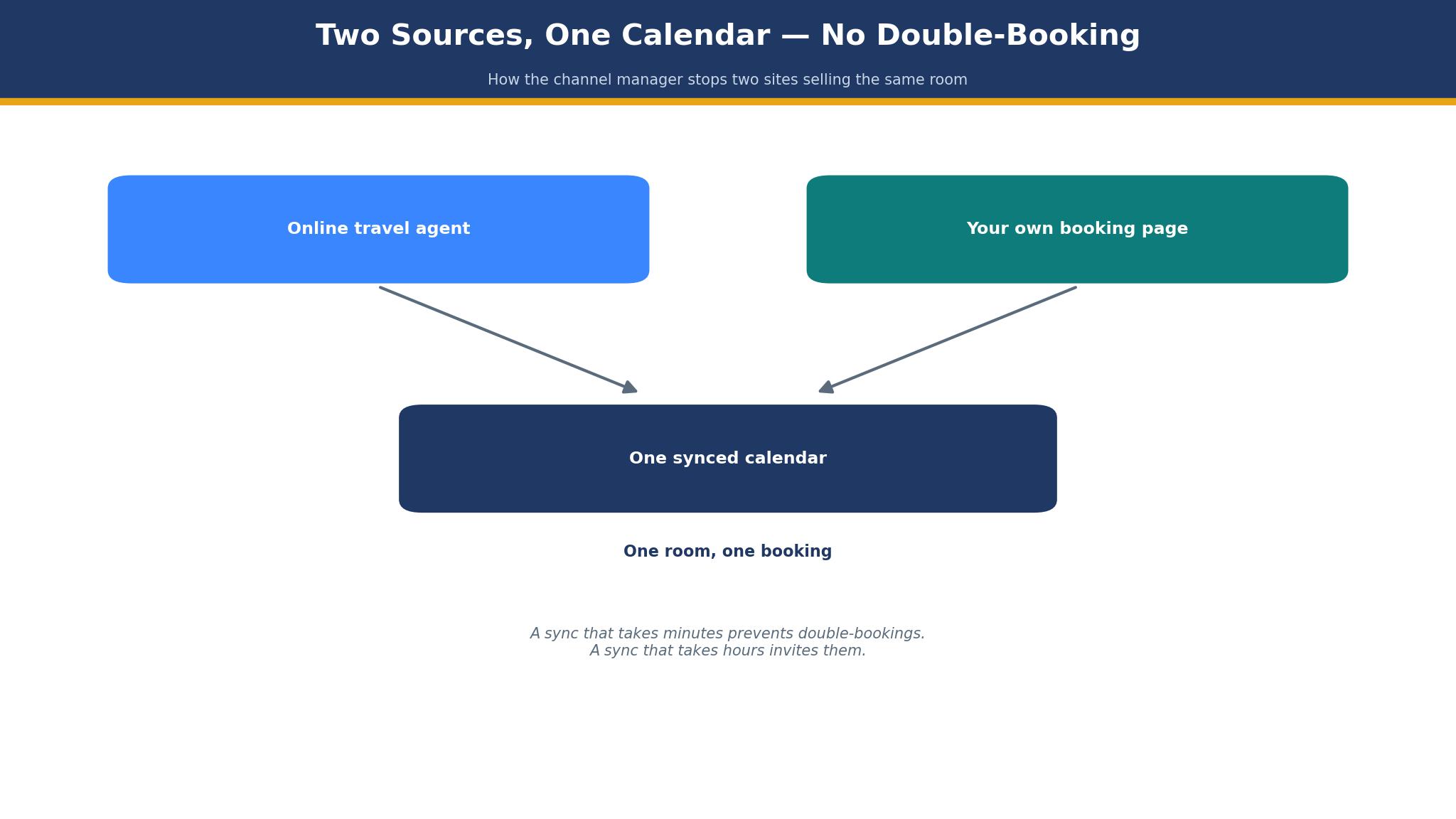
The guest books at 11 p.m., and the room is already sold. That is the double-booking that every B&B owner fears, and it happens when two sites sell the same room on the same night. The owner wakes up to two confirmations, one room, and a guest who has already paid. The tool that prevents this is the one that syncs the channels in minutes, not hours.
Little Hotelier handles this with a channel manager that updates the booking sites as soon as a room sells, and Cloudbeds does the same at a bigger scale. The tools that fail here are the ones that sync once a day, because a room can sell twice in the hours between syncs. A channel manager that syncs daily is a channel manager that double-books weekly.
Here is the worked example. A B&B with eight rooms at $120 a night takes $960 a night when full. A double-booking that forces a guest into another property costs the $120 night, plus a refund, plus a review that costs the next ten bookings. A tool that prevents one double-booking a year has paid for itself, and a tool that prevents one a month has paid for itself twelve times over..
Anyone weighing best hotel management software for bed and breakfasts should test Little Hotelier on the exact job above, because the test shows the difference faster than any feature list.
The 10 Tools at a Glance
The table below is the 7 a.m. view, with each tool judged on the same question, which is whether a small property can run the day without a front desk team. Prices are the reported figures checked in November 2026, with Little Hotelier Basics reported from $39 a month plus 1 percent, and Cloudbeds reported from about $180 a month.
| Tool | Starting price | Best for |
|---|---|---|
| Little Hotelier | Basics from $39 a month plus 1 percent of booking value, reported; Pro from $109 a month, reported | B&Bs and guesthouses under 30 rooms |
| Cloudbeds | quote only, reported from about $180 a month | properties that want the biggest integration marketplace |
| Sirvoy | from about $15 a month, reported | very small properties that want low cost |
| Beds24 | from about $10 a month, reported | properties that want a channel manager first |
| Hotelogix | from about $8 to $18 per room a month, reported | budget operators with many rooms |
| Mews | from about 7.01 euros per room a month, reported | properties that want a modern platform |
| RoomRaccoon | quote only | small hotels that want automation |
| eZee Absolute | quote only | small hotels that want a full PMS |
| Inn Style | from about $35 a month, reported | B&Bs that want simplicity |
| WebRezPro | quote only | small hotels and inns that want cloud PMS |
How to Choose the Best Hotel Management Software for Bed and Breakfasts
Start with the room count, because the price is per room on some tools and per property on others. Little Hotelier Basics costs $39 a month plus 1 percent of booking value, reported, while Cloudbeds is reported from about $180 a month. A four-room B&B taking $5,000 a month in bookings pays $39 plus $50 in fees on Little Hotelier Basics, which is $89 a month, while the same property on Cloudbeds pays about $180.
Then check the channel sync speed. Ask the vendor how fast a sold room disappears from the booking sites, and test it with a real booking during the trial. A sync that takes minutes prevents double-bookings, and a sync that takes hours invites them. The sync speed is the feature that matters at 11 p.m.
Finally, check the direct-booking math. A booking through an online travel agent costs 15 to 18 percent in commission, while a direct booking through your own site costs the card fee only, near 2.9 percent plus 30 cents. A $120 night costs $18 to $22 in commission through an agent, and about $3.78 direct. A tool with a good booking engine pays for itself on the direct bookings alone..
Best Pick by Job
The table below matches each job to its pick, and Little Hotelier leads the list for the most common job in this guide.
| Job | Pick | Why |
|---|---|---|
| A four-room B&B | Little Hotelier | built for under 30 rooms |
| A property that wants integrations | Cloudbeds | 400-plus integrations |
| A one-room property | Sirvoy | free single-unit tier |
| A budget operator | Hotelogix | $8 to $18 per room |
| A property that wants automation | RoomRaccoon | automation and revenue tools |
The 10 Tools in Detail
The ten tools below are ranked by the property they fit, from a four-room B&B to a small hotel, and the best hotel management software for bed and breakfasts order puts room count and the working day first, not the feature list.
1. Little Hotelier
Little Hotelier costs Basics from $39 a month plus 1 percent of booking value, reported; Pro from $109 a month, reported, and it is built for B&Bs and guesthouses under 30 rooms. Time the first bookings in Little Hotelier, where Basics starts at $39 a month plus 1 percent of booking value, and see whether the front desk moves faster or slower, since slower work means an owner drops the tool by month two.
What stands out is Front desk, channel manager, booking engine and payments share one simple system, and the trial lasts 30 days. Run a real week of front-desk work, channel updates and bookings through Little Hotelier and the single simple system shows its worth, helped by a 30-day trial long enough to test properly.
The trade-off is The Basics plan charges 1 percent on every booking, and the property size is capped near 30 rooms. That is the price of the low cost of Little Hotelier, and a Little Hotelier buyer who accepts it knowingly will be happy, while a buyer who discovers it later will not.
Picture a B&B running ten bookings a week through Little Hotelier and saving 20 minutes on each one. Ten bookings a week through Little Hotelier, each twenty minutes quicker, frees most of two working days every single month. Twenty minutes back on ten weekly bookings is the gain that must cover the 1 percent charge.
For a buyer whose work matches B&Bs and guesthouses under 30 rooms, Little Hotelier is worth a trial. The price of Little Hotelier is Basics from $39 a month plus 1 percent of booking value, reported; Pro from $109 a month, reported, the core job is solid, and the trial will show whether the limit matters to your work.
2. Cloudbeds
Cloudbeds is the properties that want the biggest integration marketplace option in this list, at quote only, reported from about $180 a month. Cloudbeds brings the biggest integration marketplace in this list, and a new user can finish a first real task on day one even at roughly $180 a month.
The best part is PMS, channel manager, booking engine and payments sit in one bill, with 400-plus integrations. Cloudbeds puts PMS, channel manager, booking engine and payments in one bill with more than 400 integrations, and that daily saving builds into real hours across a month.
The catch is The price is quote only, and the entry plan does not bundle the channel manager or booking engine, reported. Trial Cloudbeds with the bundle in mind, because the entry plan leaves out the channel manager and booking engine, and a week-one limit is a small fix while a month-three limit means a migration.
Work a small example with Cloudbeds. Cloudbeds saving 30 minutes a day, five days a week, means 150 minutes a week back, and 10 hours a month a small property can spend on guests rather than admin. At $25 an hour, that is $250 a month with Cloudbeds, which is more than the subscription for most teams in this list.
Cloudbeds earns its place for properties that want the biggest integration marketplace. At quote only, reported from about $180 a month Cloudbeds is fair value, and the trial is the right way to test Cloudbeds, because a week of real work says more than any review.
3. Sirvoy
At from about $15 a month, reported, Sirvoy suits very small properties that want low cost. Sirvoy keeps its screens clear and its main features easy to find, which suits a very small property paying from about $15 a month.
Here Sirvoy shines, because The entry price is the lowest in this list, and the free single-unit tier suits a one-room property. Sirvoy’s lowest entry price in this list and its free single-unit tier for a one-room property are why it belongs here, so try it before picking a rival.
The shortfall is The feature set is lighter than Little Hotelier, and the support is thinner. Sirvoy’s lighter feature set beside Little Hotelier and its thinner support are a reason to test the exact booking job that strains it before paying, not a reason to drop it.
Here is a worked example for Sirvoy. Ten bookings a week on Sirvoy, each done 15 minutes sooner, frees 150 minutes a week, or close to 10 hours a month. Sirvoy’s saving works out to a day and a quarter of work, which is more than a day of labour saved for a very small property.
If your work is very small properties that want low cost, put Sirvoy on the shortlist at from about $15 a month, reported. Run ten bookings through Sirvoy at $15 a month first, then test its edge before choosing.
4. Beds24
Beds24 at from about $10 a month, reported is aimed at properties that want a channel manager first. Beds24 covers the channel-manager essentials from about $10 a month, and a busy owner can rely on it without stopping to think about the software.
The clear win is The channel manager is strong, and the price is low for a small property. The first channel update that flows through Beds24 without manual work shows the benefit plainly, with no sales call needed.
The limit is The PMS side is thinner than Little Hotelier, so the front desk work needs another tool. Beds24’s thin PMS side beside Little Hotelier means a property needing full front-desk work should check the gap first, since a low price cannot fix a missing front desk.
- Beds24 fits a small property that wants its channel manager running without a long setup before the next booking arrives.
- Put Beds24 through one booking week during the trial, and check the PMS gap after.
- Beds24’s deal is a low price for strong channel management, suiting an owner who values that over a deep PMS.
5. Hotelogix
For budget operators with many rooms, Hotelogix at from about $8 to $18 per room a month, reported is a solid choice. Hotelogix pairs a low per-room price with 24/7 support, so a budget operator with many rooms settles into the daily work and keeps using it.
The strength is The per-room price is low, and the support is 24/7. Hotelogix earns its price in the daily front-desk routine at a low per-room price with 24/7 support behind it, so judge it on the job you run most often.
Ten front-desk sessions a week in Hotelogix, each 20 minutes shorter, is the saving a budget operator should count. A month at that rate with Hotelogix returns more than 13 hours, most of two working days a budget operator gets back from manual room work. Two working days a month back is what Hotelogix gives a budget operator.
Would this suit a small team?
Yes, Hotelogix needs no project plan to start, since the setup is short and the per-room price is low for a small team.
What should I test first?
Try a real front-desk task in Hotelogix first, then test the tool at its edge, because a low per-room price usually hides its weakness at the limit.
6. Mews
Mews costs from about 7.01 euros per room a month, reported, and it is built for properties that want a modern platform. Put a few real guest stays through Mews and watch the clock: if the modern platform does not make payments and guest work faster, a small property will drop it by month two.
What stands out is The platform is modern, and the marketplace covers payments and guest tools well. Put real guest stays and payments through Mews for a week and the modern platform and its marketplace show whether they fit a small property better than any brochure can.
If your work is properties that want a modern platform, put Mews on the shortlist at from about 7.01 euros per room a month, reported. Run real guest stays and payments through Mews for a week, then test its edge before choosing.
7. RoomRaccoon
RoomRaccoon is the small hotels that want automation option in this list, at quote only. RoomRaccoon is built for small hotels that want automation, and a new user can complete a first real task on day one without a manual.
The best part is Automation, revenue tools and the PMS share one system, and the design is clean. RoomRaccoon’s automation, revenue tools and PMS share one clean system, and the minutes saved on each booking add up to hours by the end of the month.
For a buyer whose work matches small hotels that want automation, RoomRaccoon is worth a trial. RoomRaccoon’s price is by quote, the automation core is sound, and a trial is the way to learn whether its limits touch your hotel’s work.
8. eZee Absolute
At quote only, eZee Absolute suits small hotels that want a full PMS. eZee Absolute gives a small hotel a full PMS in a plain layout, with the front-desk features up front and nothing in the way once the work starts.
Here eZee Absolute shines, because The PMS is deep, and the channel manager and booking engine are included. That is the reason eZee Absolute sits in this list, and it is the reason a buyer should test it before choosing a rival.
eZee Absolute earns its place for small hotels that want a full PMS. eZee Absolute’s quote-only price is fair value for a full PMS aimed at small hotels, and a trial week of real front-desk work says more than any review.
9. Inn Style
Inn Style at from about $35 a month, reported is aimed at B&Bs that want simplicity. It covers the essentials with Inn Style, and it does them in a way that a busy team can rely on without thinking about the tool itself.
The clear win is The system is simple, and the price is low for a small property. Inn Style’s appeal is obvious the first time a B&B owner opens the simple system at from about $35 a month, with no sales call needed at all.
If your work is B&Bs that want simplicity, put Inn Style on the shortlist at from about $35 a month, reported. Open Inn Style as a busy B&B owner would, run one booking end to end, and keep it if nothing needs a manual.
10. WebRezPro
For small hotels and inns that want cloud PMS, WebRezPro at quote only is a solid choice. WebRezPro’s cloud PMS is solid and its support is known to be good, so a small hotel or inn can settle into the daily work and keep using it after week one.
The strength is The cloud PMS is solid, and the support is known to be good. For WebRezPro the same daily test applies to the cloud PMS routine a small inn repeats every day, since a solid system with good support is one the team keeps.
For a buyer whose work matches small hotels and inns that want cloud PMS, WebRezPro is worth a trial. WebRezPro prices by quote, the cloud PMS is solid, and a trial shows whether the limits affect the work your inn does day to day.
Frequently Asked Questions
These answers cover the questions buyers ask most often about best hotel management software for bed and breakfasts, and the numbers above are the ones to check on the vendor page before buying.
Is Cloudbeds or Little Hotelier better for a B&B?
Little Hotelier is better for a B&B under 30 rooms, because it is built for small properties and its Basics plan is reported from $39 a month plus 1 percent. Cloudbeds is better for a property that plans to grow, because it has 400-plus integrations and a bigger marketplace. The room count decides.
How much does hotel software cost a four-room B&B?
Little Hotelier Basics costs $39 a month plus 1 percent of booking value, reported, so a property taking $5,000 a month pays about $89 a month. Pro is reported from $109 a month. Cloudbeds is reported from about $180 a month, which is more than double for a small property.
What is a channel manager, and do I need one?
A channel manager keeps your rooms in step across every booking site, so a room that sells on one site disappears from the others. A B&B listed on two or more sites needs one, because without it the same room can sell twice on the same night.
How much commission does an online travel agent take?
An online travel agent typically takes 15 to 18 percent, so a $120 night costs $18 to $22 in commission. A direct booking through your own site costs the card fee only, near 2.9 percent plus 30 cents, which is about $3.78. A good booking engine pays for itself on direct bookings.
Can I run a B&B without hotel software?
Yes, for one or two rooms, but the bookings, the channels, and the housekeeping soon outgrow a spreadsheet. A tool that syncs the channels and shows the housekeeping status saves the owner hours a week, and it prevents the double-booking that costs a night and a review.
What happens when two sites sell the same room?
The owner has to move one guest, refund one booking, and explain it to a guest who has already paid. The cost is the night, the refund, and the review that follows. A channel manager that syncs in minutes prevents this, while one that syncs daily invites it.
Can I Switch to Little Hotelier Without Losing My Work?
A staged move to Little Hotelier starts with exporting every booking and guest record before the trial, then shifting rooms across a few at a time. Before cancelling anything, pull every booking, guest record and rate out of the old system and check the export against Little Hotelier, so no reservation is lost in the move.
The second step is to run Little Hotelier on one live job, not on a demo, and to keep the old tool running beside it for a week. If the live job works on Little Hotelier, move the next job, and if it does not, the old tool is still there. A switch to Little Hotelier that moves one job at a time is a switch that cannot fail all at once.
10 a.m., Checkouts and the Room That Is Not Ready
10 a.m. is checkout time, and the room is not ready. The guest left late, the cleaner is on another floor, and the next guest arrives at 2 p.m. The tool that helps here is the one that shows the housekeeping status in real time, so the owner knows which room is ready and which one needs help, without walking the corridor.
Little Hotelier and Cloudbeds both show housekeeping status beside the booking, so the owner can move a guest to a ready room instead of making them wait. The tools that fail here are the ones that keep housekeeping on paper, because the paper is on the cleaner’s trolley and the owner is at the desk. A status that lives on paper is a status nobody can see.
Work the numbers on a late checkout. A room that turns over in 45 minutes instead of 90 minutes saves 45 minutes, and a property with eight rooms saves 6 hours a day on a full turnover. That is most of a working day, saved by a housekeeping view that works. The housekeeping screen is not a luxury, it is a working day..
A buyer comparing best hotel management software for bed and breakfasts should ask Little Hotelier this question on the demo, because the answer reveals how the tool handles real work.

What Should I Test Before I Pay for Little Hotelier?
Push one real booking through Little Hotelier, from arrival to checkout, and a busy weekend of channel updates before paying. Run one real booking from arrival to checkout in Little Hotelier using real guest data, time it end to end, and compare that figure with the old system’s time for the same stay. A test of Little Hotelier on a demo account hides the problems that a real job reveals.
Then test the limit of Little Hotelier, because every tool in this guide has one, and the limit is where a buyer gets surprised. The Little Hotelier job to stress-test is a busy weekend of channel updates; try it, see whether the workaround is acceptable, and ask the vendor the price of removing the limit. A limit of Little Hotelier tested in week one is a small problem.
Cloudbeds vs Little Hotelier
Cloudbeds wins the scale round. It serves properties in more than 150 countries, it has 400-plus integrations, and it bundles the PMS, the channel manager, the booking engine and payments in one bill. A property that plans to grow into a small hotel will feel the headroom.
Little Hotelier wins the B&B round. It is built for properties under 30 rooms, its Basics plan is reported from $39 a month plus 1 percent, and its Pro plan is reported from $109 a month. The trade-off is size, because a property that grows past 30 rooms will outgrow it, and the Basics fee takes 1 percent of every booking.
What I would do is pick Little Hotelier for any B&B under 15 rooms, and Cloudbeds for a property that plans to grow past that. The trade-off is simplicity against scale, and a four-room B&B that buys scale it never uses has bought a heavier system for a lighter job..
That is why the best hotel management software for bed and breakfasts decision comes down to Little Hotelier for most buyers, with the runner-up winning only when its strength matches the job.
How Much Will Little Hotelier Cost in Year Two?
Little Hotelier’s second year is the honest price, since the first-year discount, onboarding fee and introductory rate have all run out by then. Little Hotelier’s renewal, its rate as rooms or staff grow, and which add-ons the Basics or Pro plan includes are three things to get in writing before signing.
A buyer who budgets year two of Little Hotelier at the year-one price will be surprised, and a buyer who asks for the renewal of Little Hotelier in writing will not. A B&B owner should see Little Hotelier’s second-year invoice before signing, since the Basics from $39 a month plus 1 percent of booking value can look very different beside the year-one total.
What Survived the Day
Little Hotelier survived the day. It handled the 7 a.m. breakfast, the 10 a.m. checkouts, the 2 p.m. booking from nowhere, and the 6 p.m. guest who needed an early check-in, and it did it at a reported $39 a month plus 1 percent on Basics. A four-room B&B pays about $89 a month at $5,000 in bookings, which is less than one night’s room rate.
Cloudbeds is the runner-up for a property that plans to grow, and Sirvoy is the pick for a one-room property that wants the lowest cost. Hotelogix is the pick for a budget operator with many rooms. Each one earns its place, and none of them is wrong for the right property.
What I would do is start on Little Hotelier Basics for a month, watch the 11 p.m. bookings, and count the double-bookings. If the count is zero, the channel manager is working, and the move to Pro at $109 a month, reported, is worth it when the 1 percent fee passes $70 a month. The tool that prevents one double-booking has already paid for itself..
That is the short version of this whole best hotel management software for bed and breakfasts comparison, and Little Hotelier is the name to remember from it.
One More Thing to Check Before You Buy Little Hotelier
One more check before buying Little Hotelier is the support, because a tool is only as good as the help behind it when something goes wrong. While trialling Little Hotelier, ask support a genuine question about a booking or a channel sync and time the answer, since a reply that only links to a help page says a lot about the support behind the tool. A support team for Little Hotelier that answers in hours is worth more than a feature that looks good on paper.
Another check on Little Hotelier is the exit, because every buyer leaves a tool one day, and the exit should be planned before the entry. Export a sample of your work from Little Hotelier during the trial, open it outside the tool, and check whether it is usable. An export from Little Hotelier that works is a safety net, and an export that fails is a warning.