

Will this actually save me admin time. That is the first question a solo therapist asks, and it is the right one to start this search for the best mental health practice management software. My pick is TherapyNotes, because it costs $69 a month for a solo practitioner, it includes phone support, and it charges 14 cents per claim instead of 39 cents.
The 15 Tools at a Glance
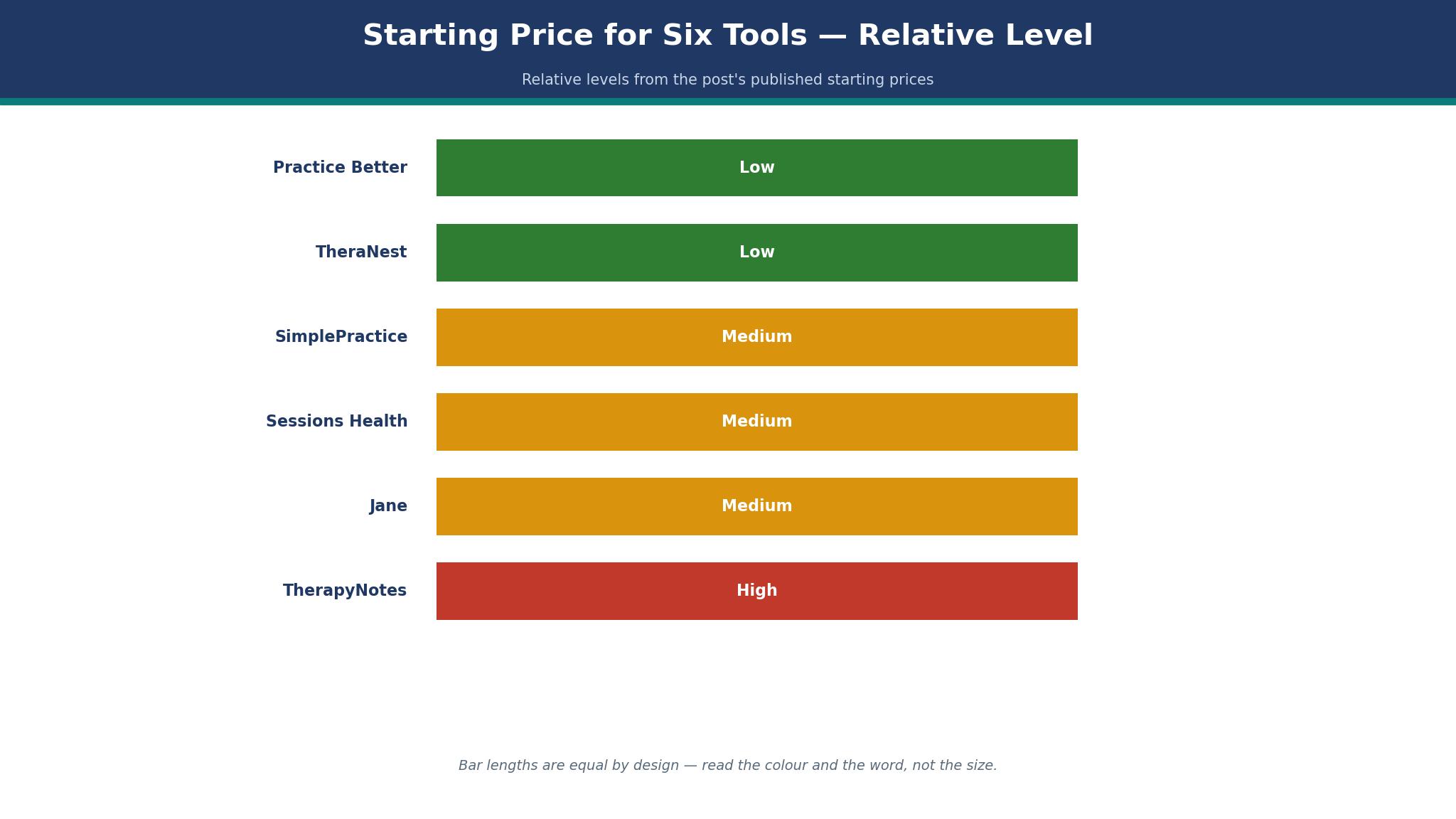
The table below answers the first question with numbers, because admin time is the product. Prices are the published figures checked in November 2026, with TherapyNotes at $69 a month solo, SimplePractice at $49 to $99 a month, reported, and TheraNest at $29 a month.
| Tool | Starting price | Best for |
|---|---|---|
| TherapyNotes | $69 a month solo; group $79 plus $50 per added clinician | solo and group practices that bill insurance |
| SimplePractice | $49 to $99 a month, reported | solo therapists who want polish |
| TheraNest | $29 a month Essentials, $59 Advanced, $89 Premier; now Ensora Mental Health | practices that want the lowest entry price |
| Jane | from about $54 a month, reported | practices that want scheduling plus notes |
| Practice Better | from about $25 a month, reported | nutrition and wellness practices |
| Sessions Health | $49 a month, reported | solo practices that want simple billing |
| Zanda | from about $49 a month, reported | practices that want a clean modern tool |
| Carepatron | free; paid from about $12 a month, reported | small practices starting out |
| Healthie | quote only | practices that want client engagement |
| Alma | quote only | therapists who want insurance help |
| Headway | free for therapists, reported | therapists who want insurance without admin |
| Owl Practice | from about $60 a month, reported | practices in Canada and the US |
| Noterro | from about $25 a month, reported | small practices that want low cost |
| CharmHealth | from about $25 a month, reported | small practices that want an EHR |
| TheraPlatform | from about $49 a month, reported | practices that want telehealth plus notes |
What Happens to My Notes If I Leave
What happens to my notes if I leave. That is the question nobody asks on a demo, and it is the question that matters most. A therapist who has written two years of notes in a tool has to know whether those notes leave with them, in what format, and whether the new tool can read them. A tool that locks the notes in is a tool that owns the practice.
TherapyNotes and SimplePractice both export notes and client data, but the format and the completeness vary, and the export should be tested during the trial. The tools that fail here are the ones that export a PDF and call it done, because a PDF is not a record the next tool can use. A note that cannot move is a note that has to be rewritten.
Here is the worked example. A therapist with 30 clients, each with 40 sessions of notes, holds 1,200 notes. If each note takes 10 minutes to rewrite, that is 200 hours, which is five working weeks. A tool that exports cleanly saves five weeks, and a tool that does not costs five weeks. The export question is not a detail, it is five weeks of work..
Anyone weighing best mental health practice management software should test TherapyNotes on the exact job above, because the test shows the difference faster than any feature list.
Best Pick by Job
The table below matches each job to its pick, and TherapyNotes leads the list for the most common job in this guide.
| Job | Pick | Why |
|---|---|---|
| A solo therapist billing insurance | TherapyNotes | $69 a month, 14-cent claims |
| A solo therapist who wants polish | SimplePractice | best mobile app, $49 to $99 |
| A practice on the lowest budget | TheraNest | $29 a month Essentials |
| A wellness practice | Practice Better | client tools for wellness |
| A practice starting free | Carepatron | free tier, paid from $12 |
The 15 Tools in Detail
The fifteen tools below are ranked by the practice job they fit, from a solo therapist billing insurance to a wellness practice, and the best mental health practice management software order puts admin time saved first, not the prettiest screen.
1. TherapyNotes
TherapyNotes costs $69 a month solo; group $79 plus $50 per added clinician, and it is built for solo and group practices that bill insurance. Watch the clock on the first notes and claims in TherapyNotes at $69 solo: if the daily work slows down, a practice will quietly stop using it by the second month.
What stands out is Notes, scheduling, billing and telehealth sit in one price, with 24/7 phone support and 14-cent claims. Put real notes, scheduling, billing and telehealth through TherapyNotes for a week and the single price, 24/7 phone support and 14-cent claims show whether the system fits a busy practice.
The trade-off is The interface is plain beside SimplePractice, and the mobile app is simpler. TherapyNotes’ plain interface beside SimplePractice and its simpler mobile app are the trade-off for its price, which is fine when known up front and a disappointment when found later.
Ten sessions a week in TherapyNotes, each 20 minutes shorter, is what a practice should picture. A month at that rate with TherapyNotes returns more than 13 hours, close to two working days a practice can spend with clients instead of paperwork. TherapyNotes returns two working days a month a practice can spend with clients.
2. SimplePractice
SimplePractice is the solo therapists who want polish option in this list, at $49 to $99 a month, reported. SimplePractice is built for solo therapists who want polish at $49 to $99 a month, and the first real task still takes a new user only a day-one effort.
The best part is The client portal, the mobile app, and the practice-growth tools are the most polished in this list. SimplePractice’s polished client portal, mobile app and practice-growth tools save a little time every day, and across a month that saving becomes real hours.
The catch is Claims now cost 39 cents each from October 2026, and the Plus plan at $99 is the one most practices need. Check the SimplePractice trial with real claims in mind, since claims cost 39 cents each and the $99 Plus plan is the one most practices need; a week-one limit is a small fix, a month-three limit a migration.
Work a small example with SimplePractice. Half an hour a day saved in SimplePractice comes to 150 minutes a week, which is 10 hours a month a practice can give back to clients instead of admin. At $25 an hour, that is $250 a month with SimplePractice, which is more than the subscription for most teams in this list.
3. TheraNest
At $29 a month Essentials, $59 Advanced, $89 Premier; now Ensora Mental Health, TheraNest suits practices that want the lowest entry price. TheraNest, now Ensora Mental Health, keeps its screens simple at $29 to $89 a month, and the tool stays out of the way once the work starts.
Here TheraNest shines, because The entry price is the lowest in this list, and the managed billing option suits a practice that wants help. TheraNest earns its place with the lowest entry price here and a managed billing option for practices that want help, so test it before choosing a rival.
The shortfall is Reviewers report support and stability problems since the 2025 rebrand, so the low price carries a warning. TheraNest’s low price carries a warning from reviewers who report support and stability problems since the 2025 rebrand, so test the job that strains it before paying rather than rejecting it outright.
Here is a worked example for TheraNest. TheraNest at 15 minutes faster on ten jobs a week saves 150 minutes weekly, which adds up to roughly 10 hours across a month. TheraNest hands a practice back a day and a quarter of work, which costs less than hiring someone for a day.
4. Jane
Jane at from about $54 a month, reported is aimed at practices that want scheduling plus notes. Jane covers scheduling, notes and payments from about $54 a month, and the friendly design means a practice uses it daily without a second thought.
The clear win is Scheduling, notes and payments share one clean system, and the design is friendly. Jane’s benefit is clear the first time scheduling, notes and payments share one clean screen, which explains the tool better than any sales call.
The limit is Insurance billing is thinner than TherapyNotes, so a US insurance-heavy practice will feel the gap. Jane’s insurance billing falls short of TherapyNotes, so a US practice heavy on insurance claims should weigh that gap before calling the price a bargain.
- Jane suits a practice that wants scheduling, notes and payments live before the first client books.
- Book one real client through Jane during the trial, and check the billing gap after.
- A practice that prefers Jane’s clean system from about $54 a month to pricier deeper billing takes Jane’s deal.
5. Practice Better
For nutrition and wellness practices, Practice Better at from about $25 a month, reported is a solid choice. Practice Better’s client tools are strong for nutrition and wellness work from about $25 a month, and the short learning curve keeps the team using it after week one.
The strength is The client tools are strong for wellness work, and the price is low. For Practice Better the daily test is the wellness client tools a practice uses every day, since a low-priced tool handling that work well is one the team keeps.
Ten sessions a week in Practice Better, each 20 minutes shorter, is the weekly saving a wellness practice should expect. Twenty minutes saved on each of ten weekly sessions adds up to most of two working days with Practice Better. Most of two working days a month back is the return on the $25 plan.
Would this suit a small team?
Yes, Practice Better’s short setup and its price from about $25 a month mean a small team can begin without a project plan.
What should I test first?
Take one real wellness client through Practice Better, from intake to follow-up, and watch whether the client tools hold up once the caseload grows past a handful.
6. Sessions Health
Sessions Health costs $49 a month, reported, and it is built for solo practices that want simple billing. A real billing week in Sessions Health tells the story quickly: if the simple billing does not speed up the 40-claim month, a solo practice will move on by the second month.
What stands out is The billing is simple, and the lowest bill for a solo practice filing 40 claims a month is $49 here. A solo practice filing 40 claims a month learns the most from a real billing week in Sessions Health, where the simple billing and the $49 lowest bill either fit the workload or they do not.
7. Zanda
Zanda is the practices that want a clean modern tool option in this list, at from about $49 a month, reported. Zanda is a clean modern tool from about $49 a month, and a new user can complete a first real scheduling or notes task on day one without training.
The best part is The interface is modern, and the scheduling and notes are easy to use. Zanda’s modern interface makes scheduling and notes easy, and the minutes saved on each client add up to hours by the end of the month.
8. Carepatron
At free; paid from about $12 a month, reported, Carepatron suits small practices starting out. Carepatron’s screens are clear and its main features easy to find, which suits a small practice starting out on a free tier or from about $12 a month.
Here Carepatron shines, because The free tier is real, and the paid tier is the cheapest in this list. Carepatron’s real free tier and the cheapest paid tier in this list are why it is here, so try it before choosing a rival.
9. Healthie
Healthie at quote only is aimed at practices that want client engagement. Healthie gives a practice the client-engagement essentials it needs, in a form a busy team can use daily without pausing to work out the software.
The clear win is The client app and the engagement tools are strong, and the platform suits a growing practice. Healthie’s value appears the first time client engagement runs through one system, which tells a practice more than any sales call could.
If your work is practices that want client engagement, put Healthie on the shortlist at quote only. Run one real client’s whole engagement journey through Healthie first, then test its edge before choosing.
10. Alma
For therapists who want insurance help, Alma at quote only is a solid choice. Alma pairs its platform with insurance panel help, so a therapist joining panels settles into the daily work and keeps using it after the first week.
The strength is It pairs the platform with insurance panel help, which suits a therapist joining panels. Alma’s panel help earns its price in the daily routine of a therapist joining insurance panels, so judge it on that work, the job you do most often.
For a buyer whose work matches therapists who want insurance help, Alma is worth a trial. Alma gives its price on request, the insurance-help core is sound, and a trial reveals whether its limits matter to your practice’s work.
11. Headway
Headway costs free for therapists, reported, and it is built for therapists who want insurance without admin. Try a week of insurance verification in Headway and time it: if the admin does not shrink, a therapist will quietly stop using it by the second month.
What stands out is It handles insurance verification and billing, so the therapist does less admin. Run a week of real insurance verification through Headway and the admin saving shows up fast, since the therapist does less chasing and the billing sits in the same flow.
Headway earns its place for therapists who want insurance without admin. At free for therapists, reported Headway is fair value, and the trial is the right way to test Headway, because a week of real work says more than any review.
12. Owl Practice
Owl Practice is the practices in Canada and the US option in this list, at from about $60 a month, reported. Owl Practice serves practices in Canada and the US from about $60 a month, and a new user can finish a first real task on day one without a manual.
The best part is The notes and scheduling are clean, and the price is mid-range. Owl Practice’s easy scheduling and notes save a few minutes on each client, and a practice in Canada or the US sees those minutes become hours by month’s end.
If your work is practices in Canada and the US, put Owl Practice on the shortlist at from about $60 a month, reported. Book one client in Owl Practice, from scheduling to notes, and see if saved minutes show up by month’s end.
13. Noterro
At from about $25 a month, reported, Noterro suits small practices that want low cost. Noterro’s layout is plain and its main features sit close at hand, so a small practice that wants low cost can start work without hunting through menus.
Here Noterro shines, because The price is low, and the scheduling and notes cover the basics well. Noterro’s low price and scheduling and notes covering the basics are why it made the list, so test it before settling on a rival.
For a buyer whose work matches small practices that want low cost, Noterro is worth a trial. The price of Noterro is from about $25 a month, reported, the core job is solid, and the trial will show whether the limit matters to your work.
14. CharmHealth
CharmHealth at from about $25 a month, reported is aimed at small practices that want an EHR. CharmHealth gives a small practice an EHR from about $25 a month, covering the essentials without asking a team to learn a bigger system.
The clear win is The EHR tools are broad, and the price is low. CharmHealth proves itself the first time a small practice opens its EHR from about $25 a month and finds the essentials already there, no sales call required.
CharmHealth earns its place for small practices that want an EHR. At from about $25 a month, reported CharmHealth is fair value, and the trial is the right way to test CharmHealth, because a week of real work says more than any review.
15. TheraPlatform
For practices that want telehealth plus notes, TheraPlatform at from about $49 a month, reported is a solid choice. TheraPlatform puts telehealth, notes and billing in one plan from about $49 a month, and the daily work is plain enough that a practice keeps using it.
The strength is Telehealth, notes and billing sit in one plan, and the price is mid-range. For TheraPlatform the daily test is the combined telehealth, notes and billing routine, because a plan handling all three well is one a practice will stay with.
If your work is practices that want telehealth plus notes, put TheraPlatform on the shortlist at from about $49 a month, reported. Run one real telehealth visit from notes to billing in TheraPlatform first, then test its edge.
SimplePractice vs TherapyNotes
SimplePractice wins the polish round. The mobile app, the client portal, and the practice-growth tools are the most polished in this list, and a solo therapist who wants the practice to look superb will feel the difference. The trade-off is price, because the Plus plan at $99 is the one most practices need, and claims now cost 39 cents each.
TherapyNotes wins the value round. It costs $69 a month for a solo practitioner, it includes 24/7 phone support, and it charges 14 cents per claim. The trade-off is an interface that is plain beside SimplePractice, and a mobile app that is simpler.
What I would do is pick TherapyNotes for a practice that bills insurance every week, and SimplePractice for a therapist whose first job is to look polished and grow. The trade-off is value against polish, and a practice that files 200 claims a month saves $600 a year on claims alone with TherapyNotes..
That is why the best mental health practice management software decision comes down to TherapyNotes for most buyers, with the runner-up winning only when its strength matches the job.
Can I Switch to TherapyNotes Without Losing My Work?
Move to TherapyNotes in stages: export every record from the old system before the trial starts, then bring clients across a few at a time. Export every client note, schedule and claim from the old system, check the files against TherapyNotes, and only cancel the old subscription once the records are safe.
Next, try a live week in TherapyNotes with the old system still running beside it, so real notes and real claims are compared against real notes and real claims. Run one live week in TherapyNotes while the old system stays open, then move the next week over only if the first went well. Bringing clients across to TherapyNotes a few at a time keeps the old system open as backup.
Frequently Asked Questions
These answers cover the questions buyers ask most often about best mental health practice management software, and the numbers above are the ones to check on the vendor page before buying.
Which mistake do therapists make most often when choosing practice software?
Choosing on the monthly price and ignoring the per-claim fee is the mistake that costs most. TherapyNotes charges 14 cents per claim, while SimplePractice charges 39 cents from October 2026. A practice filing 200 claims a month pays $600 a year more on SimplePractice, which is more than the plan difference.
Can I move my notes to another tool later?
Yes, if the tool exports properly. Test an export of ten client records during the trial, and check whether the notes arrive in a format the next tool can read. A PDF export is not a real export, because the next tool cannot use it as a record.
How much admin time does practice software save?
A therapist who spends 5 hours a week on admin and cuts it to 3 hours saves 104 hours a year, which is two and a half working weeks. The saving comes from online booking, automated reminders, and billing that does not need retyping.
Does TherapyNotes include telehealth?
Yes, basic one-to-one telehealth is included in the $69 a month solo price. Premium telehealth with more participants costs extra. SimplePractice includes telehealth too, while TheraNest charges extra for it on the lower tiers.
Is SimplePractice or TherapyNotes cheaper for a solo practice?
TherapyNotes is cheaper for a practice that bills insurance, because it costs $69 a month with 14-cent claims. SimplePractice Essential costs $79 a month with 39-cent claims, so a practice filing 40 claims a month pays $94.60 against $80.20 on TherapyNotes.
What should I check before I sign a contract?
Check the export, the per-claim fee, the telehealth cost, and the renewal price. Ask for the claim fee in writing, test an export during the trial, and confirm whether the price rises in year two. A clear answer on all four is a good sign.
How to Choose the Best Mental Health Practice Management Software
Start with the claim count, because the per-claim fee is the quiet cost. TherapyNotes charges 14 cents per claim, while SimplePractice charges 39 cents per claim from October 2026. A practice filing 40 claims a month pays $5.60 on TherapyNotes and $15.60 on SimplePractice, which is $10 a month, or $120 a year, on claims alone. A practice filing 200 claims a month pays $28 against $78, which is $600 a year.
Then count the admin time. A therapist who spends 5 hours a week on admin spends 260 hours a year, which is more than six working weeks. A tool that cuts that to 3 hours a week saves 104 hours a year, which is two and a half working weeks. The admin saving is worth far more than the subscription price, and it is the number to test in the trial.
Finally, check the telehealth. TherapyNotes includes basic one-to-one telehealth, SimplePractice includes it too, and TheraNest charges extra for it. A practice that sees half its clients online needs telehealth in the base price, not as an add-on that appears on the first invoice..
Can a Client Book Without Calling Me
Can a client book without calling me. That is the question that decides whether the phone stops ringing, and the answer is yes on most tools in this list, but the quality varies. A client who can book online, fill in the intake form, and pay before the session saves the therapist three phone calls, and the therapist who still takes bookings by phone spends the morning on the phone instead of with clients.
SimplePractice and TherapyNotes both handle online booking well, with intake forms and reminders built in. The tools that fail here are the ones that take the booking but lose the intake form, because the therapist still has to call the client to finish the paperwork. A booking without the intake is a booking that creates a phone call.
Work the numbers on the phone. A practice with 30 clients a week, each needing one call to book, makes 30 calls a week. If each call takes 5 minutes, that is 150 minutes a week, or 130 hours a year. A tool that moves booking online saves most of that time, which is three working weeks a year. The booking page is not a convenience, it is three weeks of work..
A buyer comparing best mental health practice management software should ask TherapyNotes this question on the demo, because the answer reveals how the tool handles real work.

What Should I Test Before I Pay for TherapyNotes?
Start with the daily notes, scheduling and billing in TherapyNotes, since the rest counts for little if that work feels slow. Take one real client from booking to billed claim in TherapyNotes, time the whole run, and put that number beside the time the old system needed. TherapyNotes demo data never shows the awkward claim, so only a real caseload reveals those problems.
After the live week, probe where TherapyNotes strains, because that edge is where a practice usually gets its surprise, and finding it early costs nothing. Push TherapyNotes at its weakest point, a heavy claims week or a group billing edge, and ask what it costs to lift that limit. Finding TherapyNotes’ weak spot in week one costs a practice nothing.
How Much Will TherapyNotes Cost in Year Two?
TherapyNotes in year two costs what it really costs, because the first-year discount, the onboarding fee and the introductory rate are all gone by then. Put three questions to TherapyNotes in writing: what the renewal costs, whether the per-clinician rate climbs as the group grows, and which add-ons are included in the base plan.
TherapyNotes’ second year can surprise a practice that budgeted at the first-year rate, so get the renewal figure in writing and plan around that number instead. Before signing, get the year-two invoice in writing and compare it with the year-one total; that jump decides whether the solo $69 or group $79 plus $50 per clinician rate works.
Three Questions to Ask Before You Pick a Practice Tool
TherapyNotes is the pick. It costs $69 a month for a solo practitioner, it includes phone support, and it charges 14 cents per claim. A practice filing 40 claims a month pays $80.20 a month in total, against $94.60 on SimplePractice Essential, and the gap grows with every claim.
SimplePractice is the runner-up for polish, and TheraNest is the pick for the lowest entry price at $29 a month, with a warning about support since the rebrand. Sessions Health is the pick for a solo practice that wants the lowest bill at 40 claims a month, at $49. Each one earns its place, and none of them is wrong for the right practice.
What I would do is ask three questions on the demo. Can I export my notes in a format another tool can read. What does a claim cost, and what does telehealth cost. Can a client book without calling me. If the answers are clear, the tool is honest, and if they are vague, the invoice will be vague too. TherapyNotes answers all three clearly, which is why it wins..
That is the short version of this whole best mental health practice management software comparison, and TherapyNotes is the name to remember from it.