
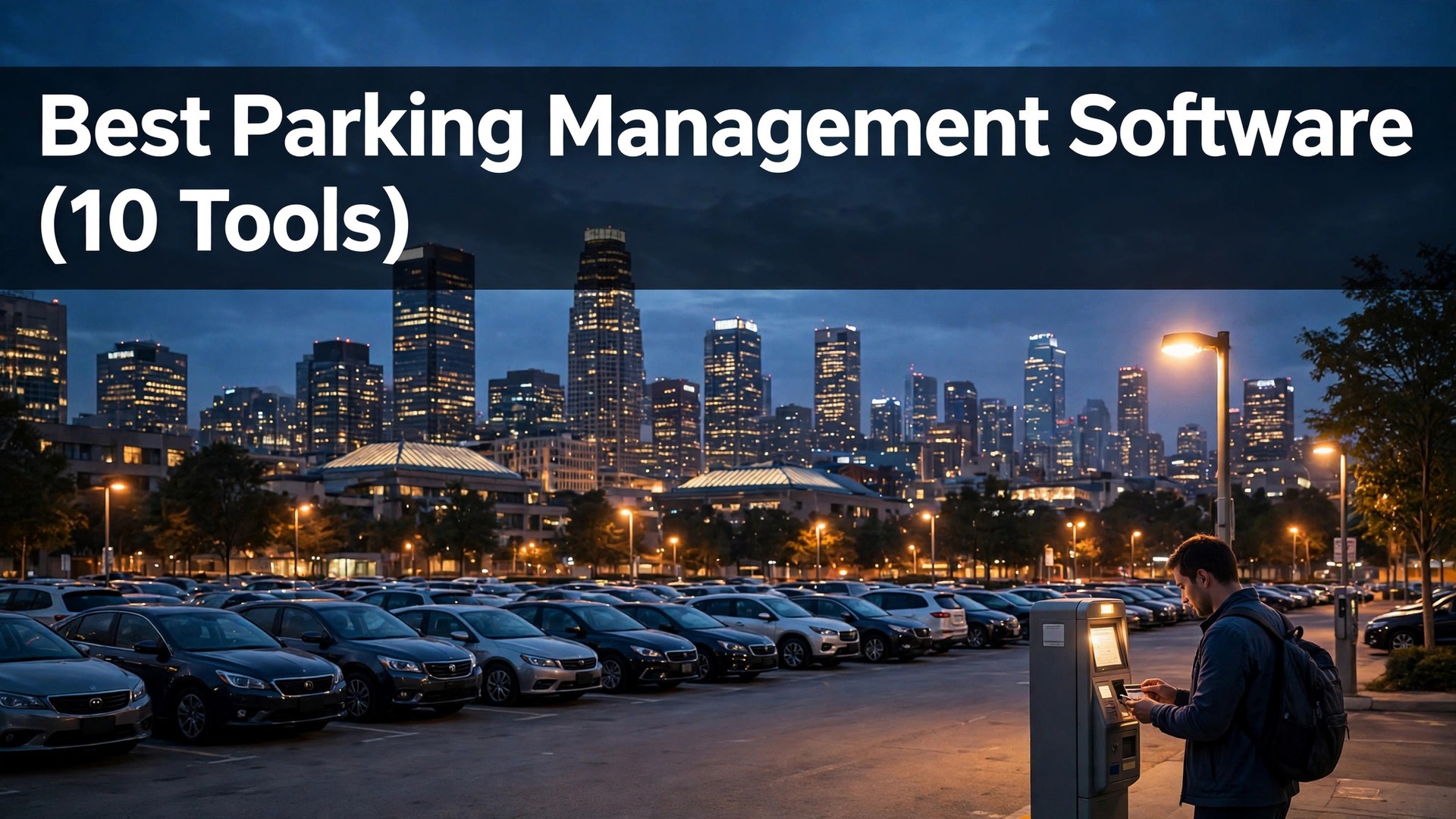
Twenty years ago the curb was a coin meter and a chalk mark on a tyre. Today that same stretch of asphalt takes phone payments, sells permits, books event spaces and sends a fine to a driver who never met a warden. The best parking management software is the system that holds all of that together for the people who run the lot, the city and the venue, and the tools in this guide differ mainly in which piece of the curb they were built to serve.
So the honest way to read this guide is by the job, not by the brand. Start with the curb you actually run. A 20 space lot behind a shop, a 500 space garage at an airport, a university campus with 10,000 permits and a stadium that fills up twenty nights a year are four different businesses that happen to share the word parking. Buy the tool that was built for your version of it, and the rest of the comparison falls into place.
The Curb Is the Busiest Real Estate in the City
A city block has more claims on it than a shopping centre has tenants. Residents want a space near their front door. Shops want short stays and quick turnover. Delivery drivers want ten minutes with the hazards on. The council wants the money, the clean air and the quiet streets, all at once, and the evening crowd wants somewhere to leave the car while they eat. Every one of those claims is reasonable, and every one of them conflicts with the next.
This table lines up the ten tools on the numbers that decide a purchase, so the price model and the fit are visible before the detail begins. It is a quick way to see why the best parking management software for a city looks nothing like the best one for a 20 space lot, and why the cheapest start in the guide is also the one with the narrowest job.
| Tool | Main job | Best for | Starting price |
|---|---|---|---|
| Passport | City parking platform | Cities and large operators | Quote based |
| Flowbird | Meters and pay stations | Cities with street parking | Quote based |
| T2 Systems | Permits and enforcement | Universities and municipalities | Quote based |
| ParkHub | Event and venue parking | Stadiums and venues | Quote based |
| SpotHero | Reservation marketplace | Drivers booking ahead | Commission per booking |
| ParkMobile | Consumer parking app | On street and garage payments | 0.35 dollars per transaction reported |
| Park Graph | QR payment for small lots | Small lots, no hardware | Free, 10 percent per payment |
| SKIDATA | Access and barriers | Garages and airports | Quote based |
| Parkable | Workplace parking | Offices and staff parking | 49 dollars a month reported |
| ParqEx | Private lot rentals | Owners renting out spaces | Quote based |
Who Pays, Who Enforces, Who Complains?
Every parking system has three people in it, and they want different things. The driver wants to pay fast and forget about it. The operator wants the money collected and the spaces full. The city or the landowner wants the rules followed and the complaints kept low. A platform that serves only one of the three will feel broken to the other two, and the complaints will tell you which one it forgot.
The driver is the easiest to please and the easiest to lose. A driver who can pay in thirty seconds on a phone will pay. A driver who has to download an app, create an account, verify an email and then find the zone number will often walk away and risk the fine instead. That is why the driver base matters so much in this market. ParkMobile wins work because drivers already have it on their phones, and Park Graph wins work because a driver can scan a sign and pay on the web without installing anything at all.
Enforcement is where the money leaks out. A lot that takes payments but never checks them teaches drivers that payment is optional, and the lesson spreads fast. One street of unpaid cars becomes two, and the honest drivers start asking why they bother. The platforms that do enforcement well keep a clean record from plate to payment to notice to appeal, so a driver who was wrongly fined can prove it and a driver who never paid cannot argue. That record is worth more than the fine itself, because it is what keeps the system trusted.

ParkHub vs Passport: Events Against Cities
The first difference is the day that matters. ParkHub is built for event day, when a stadium needs to move thousands of cars through the gates in an hour, and its mobile point of sale and fast entry lanes are the whole product. Passport is built for every day, when a city needs payments, permits, enforcement and citations to run for years without a crisis. A venue should weigh ParkHub more heavily, and a city should weigh Passport more heavily.
That split is the cleanest way to read the best parking management software when the choice narrows to two. A stadium that fills up twenty nights a year should buy ParkHub. A city that manages parking every day of the year should buy Passport. A large operator with both jobs should own both, with ParkHub on the venue and Passport on the streets, because no single tool does both days well.
Permits: The Paperwork Nobody Sees
Nobody buys parking software for the permits. They buy it for the payments, and then the permits arrive as the second job and quietly take over. A university with 10,000 permit holders, a city with residents bays on every street and a hospital with staff, visitor and contractor permits all run on the same unglamorous work. Somebody has to issue the permit, check it is still valid, renew it, replace it when a car changes and cancel it when a student leaves. That work is invisible when it runs well and a scandal when it does not.
The shape of the problem is the lifecycle. A permit is not a single sale. It is a record that lives for a semester or a year, changes hands, gets suspended during a road closure and needs an appeal route when it is wrongly cancelled. T2 Systems built its name on exactly this lifecycle, handling the student who buys a semester permit, the officer who writes a citation and the appeal that follows, all in one record. Passport does the same work inside a bigger city platform, so a city can issue a permit and a citation from the same dashboard.
The 10 Tools in Detail
The ten tools below are grouped by the city problem they solve, because the job is what decides the fit. City platforms come first, then event tools, then the apps drivers carry, then the hardware, then the workplace and private tools. Each one is judged on price, hardware needs, driver experience and enforcement depth, so this roundup of the best parking management software stays honest about what each tool actually does.
City platforms — payments, permits, enforcement and citations for places that manage parking every day of the year.
1. Passport
Passport is the city parking platform trusted by more than 800 North American cities and parking operators, and it covers payments, permits, enforcement and citations in one system.
Drivers pay in the Passport Parking app or on the web, cities issue permits and citations in the same platform, and the whole operation runs from one dashboard. Passport quotes each city, and public records show Providence, Rhode Island paying about 50,000 dollars a year under a five year contract.
The breadth is the core strength. A city that buys Passport gets the payment app, the permit system, the enforcement tools and the citation processing in a single contract, which is why large cities choose it.
The platform integrates with more than 35 other parking providers, so a city can keep its existing meters and gates instead of ripping them out on day one.
If I were running a city parking department with permits, citations and street payments to manage, I would start here and make the other vendors beat it. A city or a large operator that wants one platform for everything should buy it. A small lot should buy Park Graph instead, and be glad the choice is that clear.
2. Flowbird
Flowbird is the meter and pay station platform for cities with street parking, and it is the hardware side of the parking world. It covers smart meters, pay by phone, permits, enforcement and back office management, with hardware that runs on solar power and connects over the mobile network. Flowbird sells on quotes alone.
The hardware depth is the core strength. Flowbird builds the meters and the pay stations as well as the software, so a city gets one vendor for the whole street, and the back office shows every meter, every payment and every violation in one place. The solar powered meters cut the installation cost, because no power cable is needed for each bay.
3. T2 Systems
T2 Systems is the permit and enforcement platform for universities and municipalities, and it is the tool campuses have used for decades. It covers permits, citations, enforcement, appeals and payment processing, with a focus on the university and city workflow. T2 Systems prices each deal by quote.
The permit depth is the core strength. T2 handles the full permit lifecycle, from the student who buys a semester permit to the officer who writes a citation to the appeal that follows, and the system keeps the records clean across thousands of permits. A university with 10,000 permit holders needs that depth, and a prettier tool without it will drown in the paperwork by the second semester.
Event and venue tools — built for the hour when ten thousand people arrive at once.
4. ParkHub
ParkHub is the event and venue parking platform, built around throughput on event day. It covers mobile point of sale, pre paid parking, reservations, reporting and coordination with the venue team, so a stadium can move thousands of cars through the gates in an hour.
ParkHub sets the price per venue, and publishes no rate card.
The event focus is the core strength. ParkHub is built for the day a venue fills up, with mobile payment terminals, fast entry lanes and real time reporting on how many cars have arrived.
A venue that runs concerts and games needs that speed, because a slow gate means a late crowd and a bad night, and the crowd will remember the gate longer than the show.
Here is the money question for a venue manager. ParkHub is reported from 500 dollars a month, which sounds like a lot for a car park until you count the event nights. A stadium that fills up twenty nights a year pays about 300 dollars per event night at that rate, and one night of gridlocked entry costs more than that in refunds, complaints and lost concessions. The tool pays for itself the first time a full house gets in without a queue spilling onto the road.
5. SpotHero
SpotHero is the reservation marketplace for drivers, and it is the tool that fills a lot before the cars arrive. Drivers search, book and pay for a space in advance, and the operator sees the bookings on a dashboard and knows how full the lot will be. SpotHero charges a commission per booking, with no monthly fee.
The pre booking is the core strength. A lot near a stadium, a theatre or a hospital fills up before the event starts, because drivers book the space from home and drive straight to it. The operator gets the money in advance and the driver gets a guaranteed space, which is a better deal than circling the block for twenty minutes.
Driver apps — the tools the public actually touches.
6. ParkMobile
ParkMobile is the consumer parking app owned by Arrive, and it is the tool drivers already have on their phones. It covers on street payments, garage payments, reservations and permits in hundreds of cities, and drivers pay by zone number or by scanning a sign. The reported on street rate starts at 0.35 dollars per transaction, with operator pricing set per contract.
The driver base is the core strength. A lot that lists on ParkMobile gets found by drivers who search for parking before they leave home, and the app handles the payment, the timer and the extension without the driver walking back to a meter. That convenience fills spaces that a cash only lot leaves empty, and it does it without the operator buying any hardware.
7. Park Graph
Park Graph is the hardware free payment tool for small lots, and it is the cheapest start in this guide. The Starter plan costs nothing a month and takes 10 percent of each payment, with a minimum of 0.75 dollars, for up to three lots. The Pro plan costs 499 dollars a month plus 5 percent, and Enterprise costs 4,950 dollars a month plus 3.3 percent. The operator prints a QR sign and the lot takes payments the same afternoon.
The zero hardware start is the core strength. A small lot can take payments today with a printed sign, no meter, no barrier and no installation, and the fee only applies when a driver actually pays. That model fits a lot that is empty half the week, because the cost follows the revenue instead of arriving as a monthly bill for empty spaces.
Run the numbers on a small lot to see why the percentage model wins at this size. A 20 space lot charging 10 dollars a day that fills half its spaces takes about 3,000 dollars a month. On Starter, Park Graph takes 10 percent, which is about 300 dollars, and nothing when the lot is empty. The Pro plan at 499 dollars a month plus 5 percent would cost about 649 dollars on the same revenue, so a small lot should stay on Starter until the revenue grows past the point where the maths flips.
Access and hardware — bought once and lived with for a decade.
8. SKIDATA
SKIDATA is the access and barrier platform for garages, airports and large facilities, and it is the hardware heavyweight of this guide. It covers barriers, ticket machines, licence plate recognition, access control and the software that runs the whole garage, with installations at airports and stadiums around the world. SKIDATA quotes per installation under enterprise contracts.
The access control is the core strength. SKIDATA runs the barrier, reads the plate, takes the payment and opens the gate, all in seconds, and the system handles season tickets, staff access and visitor parking in one installation. An airport garage that moves thousands of cars a day needs that reliability, and a cheap barrier that fails at 6 a.m. on a Monday will cost more in one morning than the better system costs in a year.
Workplace and private tools — where the customer is an employer or a building owner with spaces to fill.
9. Parkable
Parkable is the workplace parking platform from New Zealand, and it is the tool for offices that never have enough spaces. It covers staff booking, fair allocation, visitor parking, guest registration and paid public parking for spare spaces, with gate and single sign on integrations. The Essentials plan is reported from 49 dollars a month.
The fair sharing is the core strength. Parkable lets staff book spaces in advance, resolves conflicts automatically, and opens unused spaces to visitors or the public for paid hourly or daily parking, so a lot with 100 spaces and 150 staff still works. The single sign on integration keeps the staff list in sync with the company directory, so a leaver loses their space on the day they leave.
What the staff can do on it is the whole pitch, and it is short enough to list.
- Book a space in advance, so the morning is not a race to the car park
- Share an unused space with a visitor, so guests are not left circling
- Open spare spaces to the public for paid hourly or daily parking
- Register a guest at the gate, so security knows who is coming
10. ParqEx
ParqEx is the private parking marketplace, and it is the tool for an owner who wants to rent out spaces. It covers listings, bookings, payments, access control and enforcement for private lots, garages and driveways, so a building owner can turn empty spaces into income. ParqEx quotes by booking, taking a share of each one.
The rental model is the core strength. ParqEx lets an owner list a space, set the price and the hours, and take bookings from drivers who need parking near an office, a stadium or a hospital. The platform handles the payment and the access, so the owner does not need a gatehouse or a cash box.
Does it work for a lot nobody has heard of? Only near a busy destination. ParqEx needs drivers who know the platform, so a lot in a city where nobody uses it will sit empty, while a lot beside a hospital or a stadium can fill steadily. And what does the owner actually do each week? Almost nothing beyond checking the bookings and the payouts, which is the point of a marketplace. An owner with spaces near a busy destination should list on it. An operator who wants to run the lot directly should buy Park Graph instead.
How to Choose the Best Parking Management Software
Start with the job the lot actually does. A city needs permits, enforcement and citations, so Passport or T2 Systems fits. A stadium needs fast entry and mobile payments on event day, so ParkHub fits. A workplace needs fair sharing of limited spaces, so Parkable fits. A small private lot needs payments with no hardware, so Park Graph fits. A tool built for a different job will fight the operator every day, and no amount of training fixes a tool that was built for someone else.
Next, check the hardware question before you check the price. SKIDATA and Flowbird need barriers, meters and pay stations, which means an installation budget and a maintenance contract on top of the software. Park Graph needs a printed QR sign and nothing else, while ParkMobile and SpotHero need no hardware at all because the driver pays in the app. A lot that cannot afford hardware should rule out the hardware tools first, because the cheapest software quote in the world is expensive once it needs a meter on every bay.
Then look at the real cost per space per month. A quote based platform may cost 300 to 2,000 dollars a month per facility, which is fine for a 500 space garage and ruinous for a 20 space lot. A percentage based tool such as Park Graph costs nothing when the lot is empty and 10 percent when it is full, which is the fairest deal for a small operator. Ask every vendor for a written quote at the real space count before deciding, and ask whether the price includes hardware, installation and maintenance, because those three lines are where the surprises live.
- Count the spaces, the entries and the peak hours before calling any vendor
- Ask whether the price includes hardware, installation and maintenance
- Test the driver payment flow on a phone, because most drivers pay by phone
- Check the enforcement tools, because a lot that cannot enforce cannot collect
- Ask for a written quote at the real space count, not the headline rate
What Does Parking Software Cost a 100 Space Lot?
A 100 space lot that charges 10 dollars a day and fills half its spaces earns about 15,000 dollars a month in gross revenue, and the best parking management software for that lot is the one whose cost follows the revenue it protects. Park Graph on Starter takes 10 percent of each payment, which is about 1,500 dollars a month at half occupancy, with no monthly fee. Parkable at a reported 49 dollars a month costs almost nothing against that revenue, but it is built for workplaces rather than public lots, so the cheap number answers the wrong question.
| Tool | 100 space lot, monthly | Model |
|---|---|---|
| Park Graph Starter | About 1,500 dollars at half occupancy | 10 percent per payment, no monthly fee |
| Parkable | 49 dollars reported | Flat monthly, workplace focus |
| ParkMobile | 0.35 dollars per transaction reported | Per transaction fee |
| ParkHub | Quote based, reported from 500 dollars a month | Quote, event venues |
| Passport | Quote based, about 50,000 dollars a year for a city | Quote, cities and large operators |
| SKIDATA | Quote based, enterprise | Hardware plus software |
Can a Small Operator Run Parking Software Without Hardware?
Yes, and Park Graph proves it. The operator prints a QR sign, the driver scans and pays, and the lot takes payments the same afternoon with no meter, no barrier and no installation. ParkMobile and SpotHero also need no hardware, because the driver pays in the app, and ParqEx needs nothing more than a listing and a sign. The best parking management software for a small lot is often the one that needs no hardware at all, because the first payment matters more than the perfect system.
The second reason is the cost shape. A hardware free tool charges a percentage of the payments it collects, so the cost follows the revenue, and a lot that is empty half the week pays nothing for those days. A hardware tool charges a monthly fee whether the lot is full or empty, which is the wrong shape for a small operator, and the installation bill arrives before the first driver ever pays.
Best Pick by Job
The pattern across this list is that the job decides the pick, and the pick is different for a city, a stadium, a workplace and a 20 space lot behind a shop. The best parking management software is not one tool. It is the right tool for the curb you run, and the table below names it for each of the five jobs in this guide. ParkMobile is cheaper to start, but you lose the driver relationship, and if owning the driver matters more than the reach, sell direct with Park Graph.
| Job type | First pick | Second tool | Why this pair works |
|---|---|---|---|
| City or large operator | Passport | Flowbird | Passport covers permits and citations, Flowbird covers meters |
| Stadium or venue | ParkHub | SpotHero | ParkHub runs entry, SpotHero fills the lot early |
| Workplace parking | Parkable | ParqEx | Parkable shares staff spaces, ParqEx rents the spare ones |
| Small private lot | Park Graph | ParkMobile | Park Graph needs no hardware, ParkMobile brings drivers |
| University campus | T2 Systems | Passport | T2 runs permits, Passport runs payments |
Frequently Asked Questions
Can drivers pay for parking without an app?
Yes. Park Graph lets a driver scan a QR sign and pay on the web with no app download, and many pay stations take a card at the machine. Flowbird meters and SKIDATA ticket machines both accept cards on site. The app is faster for a regular driver, but a first time visitor should always have a way to pay without installing anything.
Is Passport good for small lots?
No. Passport is built for cities and large operators, with permits, enforcement and citations in one platform trusted by more than 800 North American cities. A small lot will find the sales process long and the price high. A small private lot should buy Park Graph, which takes payments with a printed QR sign and no hardware, and list on ParkMobile to bring in drivers.
How much does parking management software cost?
Most parking software is quote based, with published reports putting typical operator spend at 300 to 2,000 dollars a month per facility. The best parking management software for a small operator is the one with a published price, and Park Graph is the exception, with a Starter plan at no monthly fee and 10 percent per payment. Parkable Essentials is reported from 49 dollars a month, and ParkHub is reported from 500 dollars a month. A city contract such as Passport in Providence runs about 50,000 dollars a year.
What is the difference between ParkMobile and SpotHero?
ParkMobile is a payment app for on street and garage parking, where the driver pays by zone number or by scanning a sign, with a reported rate from 0.35 dollars per transaction. SpotHero is a reservation marketplace, where the driver books and pays for a space in advance and the operator pays a commission per booking. A lot that wants walk up payments should list on ParkMobile, and a lot near a venue that wants to fill early should list on SpotHero.
How do parking operators enforce payment?
Enforcement runs on licence plate recognition, patrols and citations. SKIDATA and Flowbird read plates at the gate, T2 Systems and Passport run the citation workflow from the plate to the appeal, and Park Graph relies on patrols that check the payment record. A lot that takes payments but never enforces will teach drivers that payment is optional, so the enforcement step matters as much as the payment step.
What Software Cannot Fix
Software cannot make a driver honest, a city generous or a lot bigger than it is. A platform can take the payment, record the violation and show the operator which spaces are empty, but it cannot create a space where the street has none, and it cannot make a resident accept a visitor in the bay outside their front door. The arguments at the curb are about who gets to use a scarce piece of a city, and no dashboard settles that argument. It only makes the decision visible.
Count the spaces, test the payment flow on a phone, and ask every vendor for a written quote at the real space count. That single test tells an operator more than any demo, and it is the only honest way to choose. The curb will keep changing, and the tool that changes with it is the one worth keeping.