
On Turo 2026 plans, the platform keeps 10 to 30 percent of every booking. That single figure explains why so many small rental operators move to direct bookings. A fleet of ten cars earning 40 dollars a day can lose thousands of dollars a year to marketplace commission, and the operator still owns the cars, the insurance, and the cleaning. The best rental software for small car rental companies exists to take that margin back, by letting customers book direct, sign agreements online, and pay without a middleman taking a cut.
A small rental company runs on availability, agreements, and vehicle condition. Customers need to see real cars, real prices, and real dates. The counter needs contracts, deposits, damage photos, and maintenance alerts in one place. A spreadsheet can hold ten cars for a month, but it cannot send a booking confirmation at midnight or block a car that is in the shop.
This guide compares 13 tools across online booking, fleet calendars, agreements, damage checks, payments, maintenance, and total cost. Prices come from vendor pages and recent published comparisons, and they change often, so check the vendor pricing page before you sign. Test each shortlisted tool with your real week, including a multi day booking, a late return, and a damage claim.
Why the best rental software for small car rental companies pays for itself
A small rental company loses money in small, quiet ways. A car sits unbooked because the website shows the wrong availability. A damage dispute drags on because nobody took photos at handover. A maintenance deadline slips and a car is pulled from service on a busy weekend. None of these problems feels dramatic on its own, yet together they eat the margin a small fleet depends on.
Direct booking is the clearest return. A booking website with live availability and online payment turns searchers into renters at any hour, without a marketplace taking 10 to 30 percent. Automated reminders cut late returns, and damage photo workflows protect the deposit. A company that fixes those leaks often covers the monthly software cost from one extra direct booking a week.
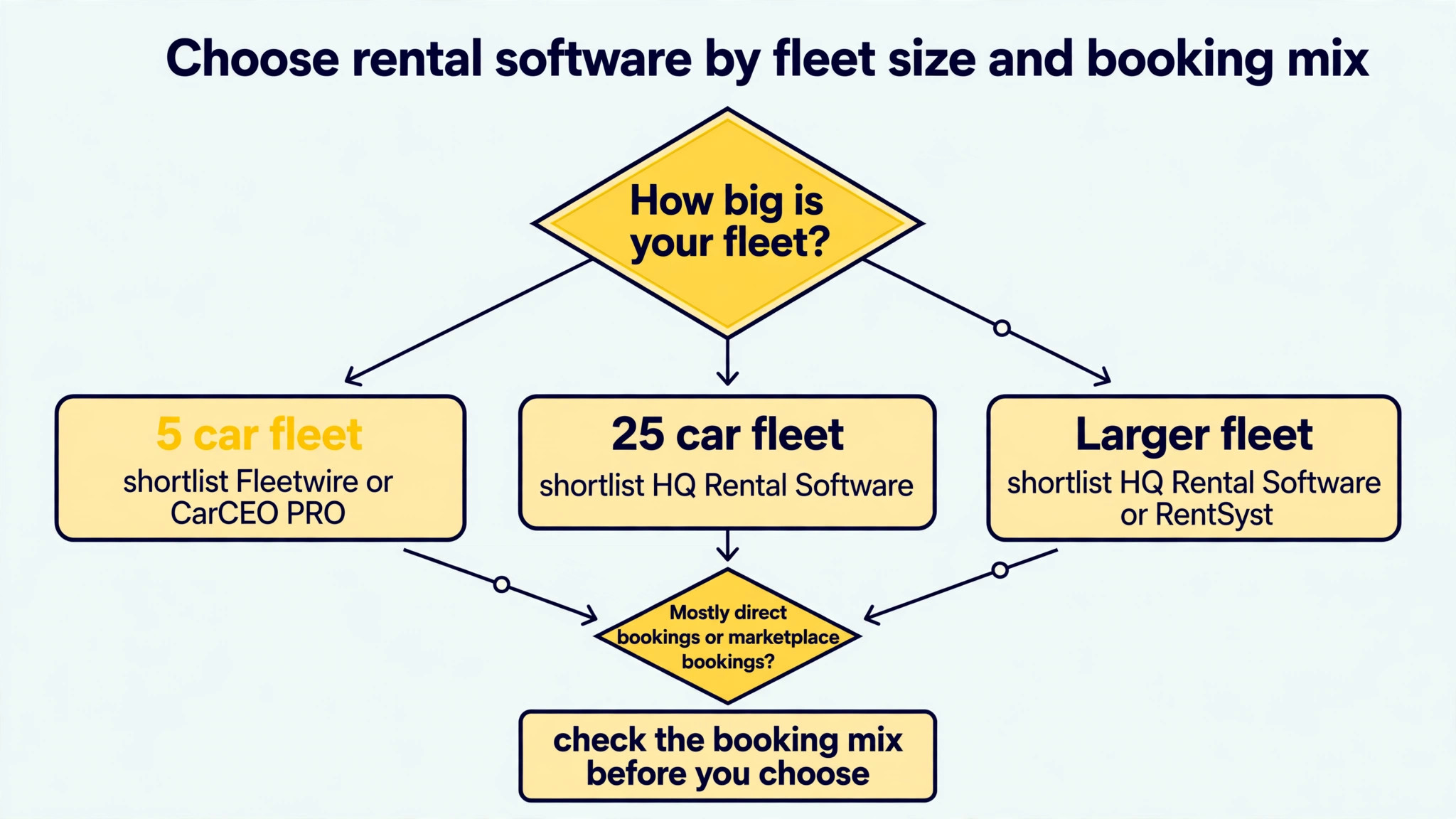
Fleet size changes the maths. A five car operator needs a cheap start and a simple diary. A 25 car operator needs rate rules and reporting that shows which cars earn money. A peer to peer host needs calendar sync and a fee calculator. Judge every tool on your fleet size first.
The 13 tools at a glance
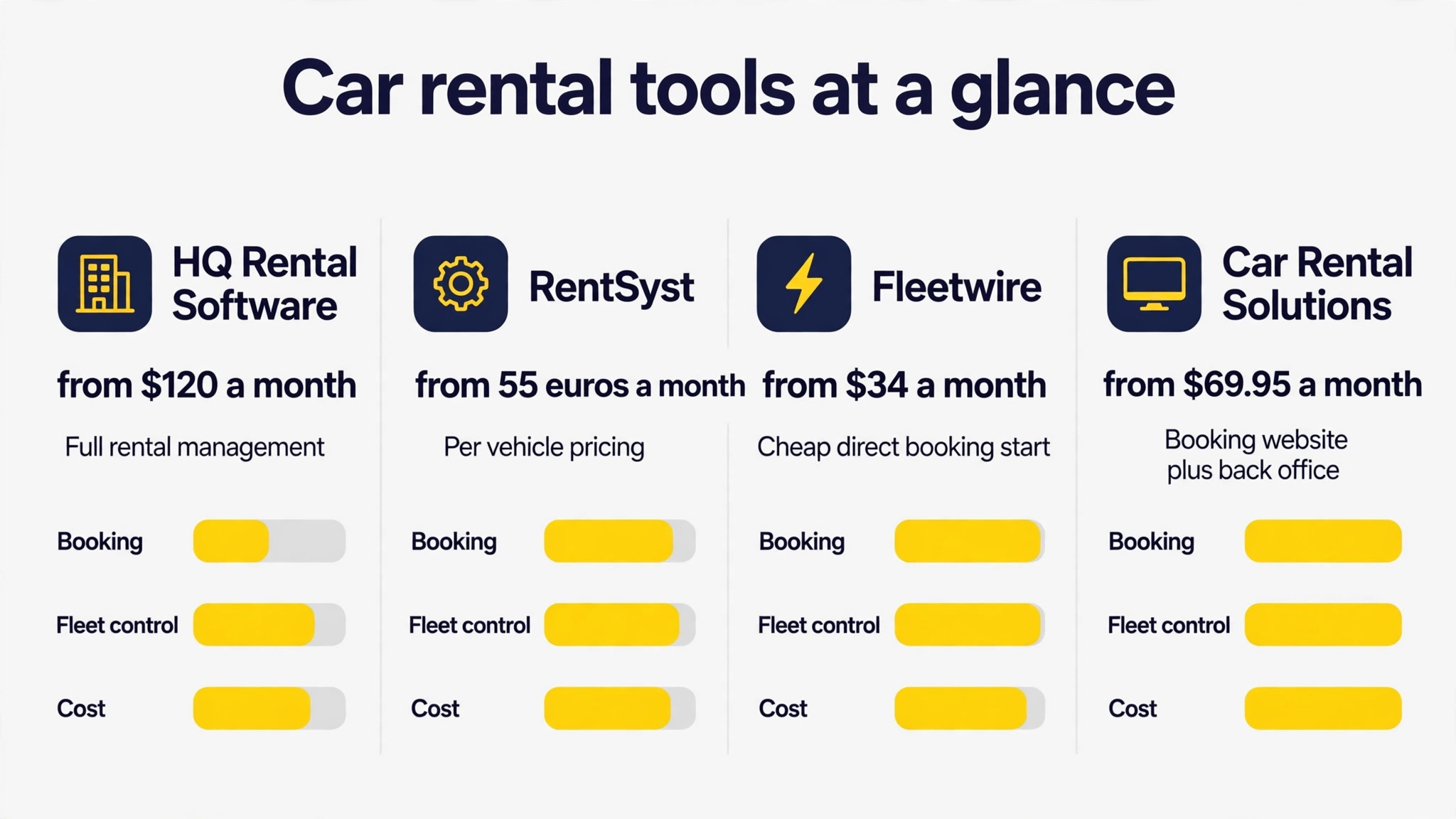
Use this table to shortlist three tools. Price notes are starting points from published sources, and the vendor pricing page is the final word.
| Tool | Main job | Starting point | Watch out for |
|---|---|---|---|
| HQ Rental Software | Full rental management | From 120 dollars a month | Onboarding fee is extra |
| RentSyst | Per vehicle pricing | From 55 euros a month | Prices are in euros |
| Fleetwire | Cheap direct booking start | From 34 dollars a month | Tiers climb by vehicle band |
| Car Rental Solutions | Booking website plus back office | From 69.95 dollars a month | Setup fee of 197 dollars |
| RENTALL | Enterprise rental platform | Quote only | No public price |
| Rent Centric | Loaner and multi type fleets | Quote only | Least pricing transparency |
| TSD RENTAL | Dealership loaner programs | Quote only | Built for larger operations |
| Booqable | Mixed car and equipment rental | From 35 dollars a month | No fines or inspection workflow |
| Nomora | All in one for independents | From 40 euros a month | Young product in some markets |
| CarCEO PRO | Free start for tiny fleets | Free up to 2 vehicles | Small review base |
| VEVS | Website plus rental software | From 80 euros a month | Prices are in euros |
| Rently Soft | All in one rental operations | Contact vendor | No published price |
| Fleetio | Maintenance heavy fleets | Check the vendor pricing page | Maintenance first, rental second |
A company comparing the best rental software for small car rental companies should price the whole year, not the first month. Add card processing, ID verification fees, onboarding, and any per vehicle or per location charge. A tool that looks cheap at entry level can become the most expensive option once your fleet grows past its first band.
Best pick by job
Shortlisting the best rental software for small car rental companies by fleet type keeps the choice practical, because a tool that fits an airport operator may frustrate a peer to peer host.
| Segment | First pick | Second tool | Why this pair works |
|---|---|---|---|
| Airport rentals | HQ Rental Software | Rent Centric | Depth plus multi location control |
| Local rentals | Car Rental Solutions | Fleetwire | Website plus back office, or cheap start |
| Peer to peer fleets | Fleetwire | CarCEO PRO | Calendar sync plus low cost start |
Airport rentals need depth. HQ Rental Software handles rate rules, multi location reporting, tolls, and API access on upper plans, while Rent Centric adds mobile self service and support for 40 plus currencies.
Local rentals need a different strength. Booking must be simple, the website must convert, and the back office must stay cheap. Car Rental Solutions gives a booking website and back office from one vendor, while Fleetwire gives the cheapest self serve start.
Peer to peer fleets need calendar sync and fee control. Fleetwire syncs with Turo calendars and includes a fee calculator, which helps a host keep direct and marketplace bookings from clashing. CarCEO PRO is the second pick here because it is free up to two vehicles.

The 13 tools in detail
Each section below judges the tool on rental specific jobs, so you can see where the best rental software for small car rental companies earns its price and where it does not.

1. HQ Rental Software
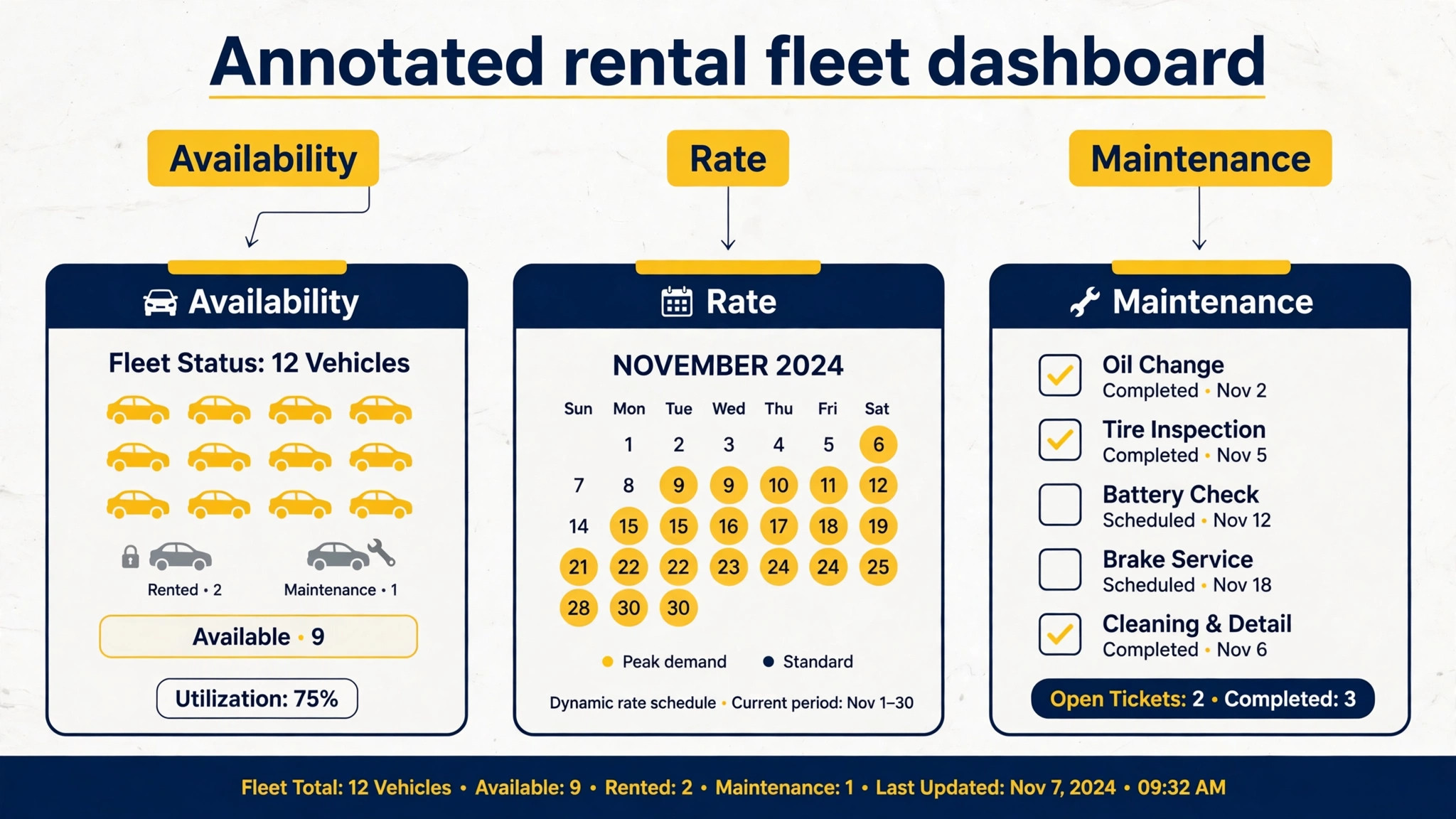
HQ Rental Software is the most reviewed platform in this list, with 316 Capterra reviews at 4.9 stars in published counts, and its depth shows in daily counter work. It covers reservations, a fleet calendar, rate and season management, online booking, a customer portal, digital agreements, payments, maintenance tracking, and multi location support. Tolls and API access sit on upper plans.
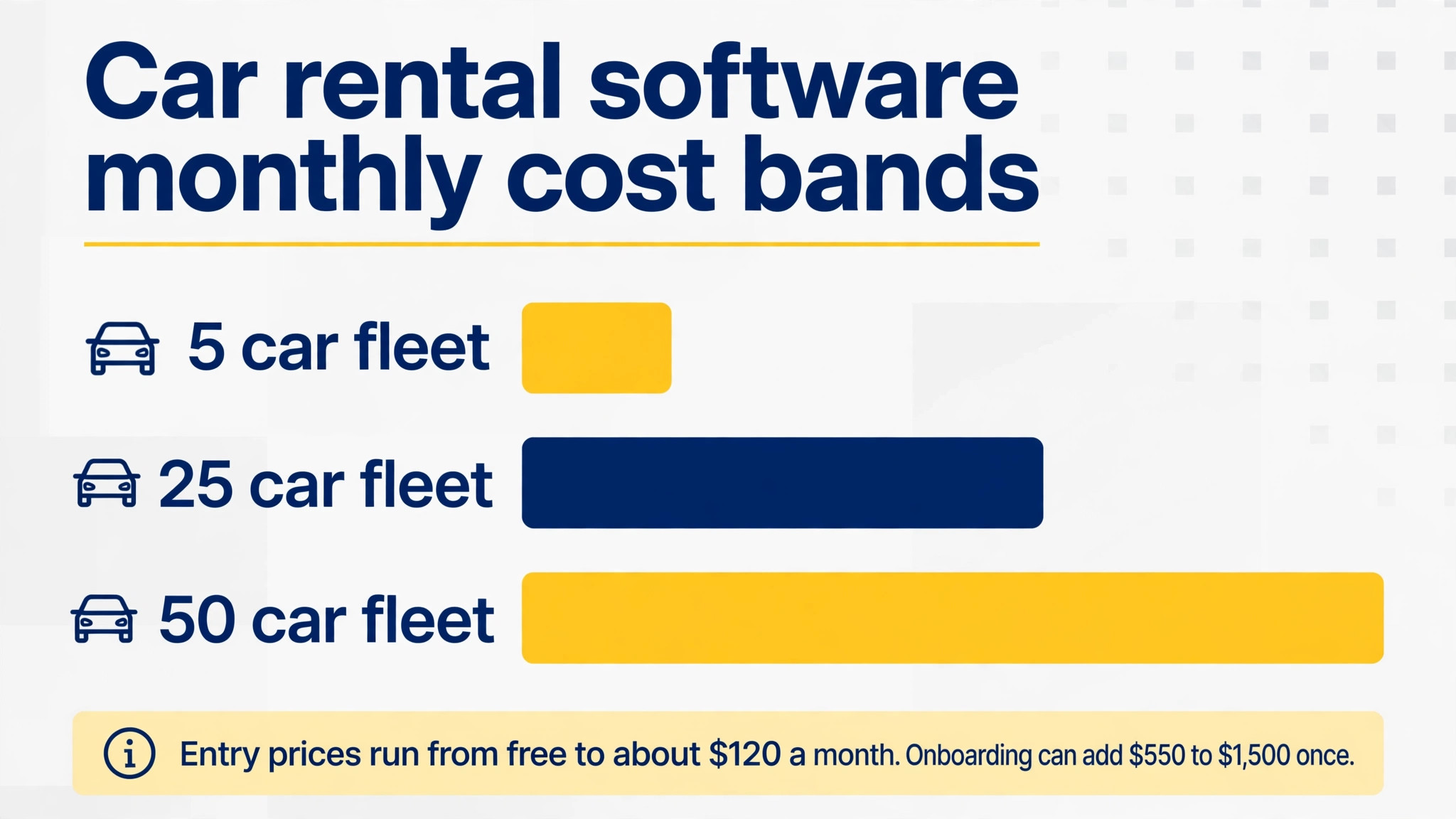
Pricing is the complication. HQ publishes no price on its own website, and the numbers everywhere come from directories. GetApp pins the entry tier at about 120 dollars a month for up to 10 vehicles, with mid tiers around 175 dollars for 25 vehicles and 250 dollars for 50, plus a one time onboarding fee reported from about 550 to 1,500 dollars.
HQ suits a small to mid fleet that wants depth and reporting and will pay a setup fee once. A five car operator will find Fleetwire cheaper and faster to start.
2. RentSyst
RentSyst is the per vehicle pricing option in this list, and its model suits operators who think in cars rather than tiers. It covers reservations, fleet management, online booking, agreements, payments, damage tracking, and multi branch views, with a VOS OBD-II telemetry option for fuel, mileage, and violation data. That telemetry is rare at this price and helps a multi branch operator keep track of cars that travel far.
Pricing is in euros. The Beginner plan is about 55 euros a month for up to 15 vehicles, then about 3 euros per vehicle, falling to 2 euros at 201 to 400 vehicles, with no setup fee in published listings. A US operator should allow for currency conversion and for support hours that may sit in a European time zone.
RentSyst suits a multi branch operator who prefers per vehicle pricing and wants telemetry without an enterprise bill. A US single lot operator should compare it against Fleetwire first.
3. Fleetwire
Fleetwire is the cheapest self serve start in this list, and its speed is the selling point. It covers online booking, a fleet calendar, reservations, agreements, payments, and Turo calendar sync, with a fee calculator that shows what a marketplace booking really costs. A solo operator can sign up and take direct bookings the same day, without a demo or a sales call.
Pricing is published as about 34 dollars a month for up to 5 vehicles, 89 dollars a month for up to 15, and 279 dollars a month for 150, with lower prices on annual billing and a 14 day trial. Stripe processing and roughly 1 to 2 dollars per premium ID check sit on top of the subscription.
Fleetwire suits a five car operation taking direct bookings and a peer to peer host who needs Turo sync. A 20 car fleet sits just above the 89 dollar band, so confirm the next tier price before committing.
4. Car Rental Solutions
Car Rental Solutions is the booking website plus back office option for US independents, and its flat tiers make budgeting simple. It covers online reservations, a bilingual reservation website, rate charts with duration based pricing, seasonal rates, underage driver fees, fleet management, contracts, payments, and API access on every plan. Option B adds three languages and deeper operations, and Option C adds a full custom website.
Pricing is published as Option A at 69.95 dollars a month plus a 197 dollar one time setup fee, Option B at 99.95 dollars a month, and Option C at 179.95 dollars a month. The flat tiers suit a US agency with under 75 cars that wants its booking website and back office from one vendor, without per vehicle maths.
Car Rental Solutions suits a US independent agency that needs a website that converts. A European operator should compare RentSyst and Nomora first.
5. RENTALL
RENTALL is the new name for Navotar, after Navotar, Bluebird Auto Rental Systems, and Thermeon merged and rebranded. It is an enterprise grade rental platform covering reservations, fleet management, agreements, rates, reporting, and dealership loaner programs, with deep reporting that suits larger fleets and repeat customer operations. Existing Navotar customers moved onto this brand, so the product is established even though the name is new.
Pricing is quote only, with no public price in current listings, and a setup fee reported near 650 dollars. G2 lists its plans as custom quote available, so a small operator cannot budget it without a sales conversation. That alone removes it from a shortlist where price transparency matters.
RENTALL suits a larger fleet or an existing Navotar customer staying put. A small company choosing its first platform should pick a tool with a published price.
6. Rent Centric
Rent Centric is a cloud platform for loaner, car sharing, and multi vehicle type operators, and its flexibility is its main strength. It covers online reservations, billing, rate management, maintenance tracking, mobile access, and self service for customers, with support for more than 40 currencies. That currency depth suits an operator near an airport or a border who rents to international customers.
Pricing is by quote, per vehicle or per user, with a 15 day trial in published listings. It has the least pricing transparency of the tools in this list, so a small operator should get a written quote at the real fleet size before comparing it against published price tools. The trial helps, because the operator can test the mobile self service flow before any money moves.
Rent Centric suits a tech forward operator with mixed vehicle types or international customers. A single lot local operator will usually find Fleetwire cheaper and simpler.
7. TSD RENTAL
TSD RENTAL is the dealership loaner platform in this list, built for larger rental operations and dealer groups. It covers reservations, loaner scheduling, fleet management, rate control, and online booking, with a focus on the loaner workflow where a dealer lends a car while a customer car is in service. That workflow differs from a retail rental, because the loaner is tied to a service appointment rather than a holiday booking.
Pricing is by quote, with no published price in current listings. That is normal for this category, because dealer groups negotiate on volume and integration, but it means a small independent cannot budget it from a web page. A demo is the only way to see the real number.
TSD RENTAL suits a dealership loaner program or a larger rental operation. A small independent company should not shortlist it.
8. Booqable
Booqable is the generalist rental platform in this list, and its strength is renting anything with a calendar and a price. It covers online booking, real time availability, contracts, pricing rules, subscription billing, and a polished storefront builder, with cars sitting alongside bikes, cameras, and party equipment in the same system. That breadth suits a business that rents cars as one line among several.
Pricing is published from about 35 dollars a month, with tiers at 87 and 187 dollars a month, and multi location support only on the top tier. A 14 day trial is available. The weakness for car rental is the missing depth, with no fines or photo inspection workflow advertised, so a company that lives on damage claims should test that gap carefully.
Booqable suits a mixed rental business where cars are only part of the inventory. A pure car rental company will get more value from HQ Rental Software or Fleetwire.
9. Nomora
Nomora is a modern all in one platform for growing independent rental companies, and its flat pricing is its main appeal. It covers reservations, fleet management, online booking, agreements, payments, and reporting, with no per booking commission and no per vehicle surcharge on the entry tier, so a busy month does not inflate the bill. That matters for a small company whose best month should be its most profitable, not its most expensive.
Pricing is flat and all inclusive from 40 euros a month on annual billing, with no per booking fees in published listings. Nomora ranks itself first in its own comparison content, so test the product on your own fleet before deciding.
Nomora suits a growing independent company that wants one flat bill and no commission. A US operator should check support hours and currency handling first, because the product is European in origin and the euro pricing needs converting.
10. CarCEO PRO
CarCEO PRO is the free start in this list, and it is the cheapest way to test direct booking. It covers reservations, a fleet calendar, a double entry ledger, agreements, payments, and Turo host tools, with an AI assistant built in. The ledger is a genuine differentiator, because most rental tools leave accounting to a separate system.
Pricing is free up to 2 vehicles, then flat tiers at 29, 129, and 399 dollars a month in published listings. The product was founded in 2024, so it is young and its review base is still small, which is the honest risk to weigh. A free tier with two cars lets a host test the whole flow before paying anything.
CarCEO PRO suits a tiny fleet or a peer to peer host with two cars who wants to test direct booking at zero cost. A larger fleet should compare it against Fleetwire first.
11. VEVS
VEVS is a rental website and management platform in one setup, built for small operators who need a website that takes bookings. It covers online reservations, vehicle management, customer records, online payments, and rate adjustment, with real time availability and vehicle status shown to the customer. The website and the software arrive together, so the operator does not need a separate web build.
Pricing is reported at 80 euros a month in published listings, so check the vendor page for current plans and currency. That price sits above Fleetwire and Booqable, and the value depends on how much the bundled website is worth to the operator. A company that already has a good website will pay for a feature it does not need.
VEVS suits a small operator that needs a rental website and management in one purchase. An operator with a working website should compare Fleetwire first.
12. Rently Soft
Rently Soft is an all in one rental operations platform, and its pitch is centralised daily workflows. It covers booking management, financial control, mobile check in, pricing intelligence, availability, maintenance, contracts, and vehicle status in one system. Pricing intelligence is the feature that stands out, because it helps a small operator set rates that reflect demand rather than guessing.
Pricing is contact vendor only, with no published price in current listings. That makes it hard to shortlist against tools with published prices, and a small operator should get a written quote early rather than investing trial time first. The all in one pitch is common in this category, so test whether the pricing intelligence actually changes your rates.
Rently Soft suits a fragmented operation that wants bookings, finances, and maintenance in one place. A small lot that only needs booking and agreements will find a published price tool simpler.
13. Fleetio
Fleetio is a fleet management platform built around maintenance, and it earns its place here for maintenance heavy rental fleets. It covers maintenance scheduling, inspections, fuel tracking, vehicle records, and reporting, with a depth of maintenance workflow that rental first tools cannot match. A rental company whose cars spend more time in the shop than on the road needs this depth.
Pricing is per vehicle per month, so check the vendor pricing page for your fleet size before budgeting. Fleetio is maintenance first and rental second, so it does not replace a booking engine. The sensible setup is Fleetio for maintenance alongside a rental booking tool, not Fleetio alone.
Fleetio suits a rental company with a maintenance heavy fleet. A small lot that mainly needs bookings should pick Fleetwire first, and add Fleetio only when maintenance becomes the bottleneck.
How to judge a rental tool before you pay
Start with your fleet size and your booking mix, because those two numbers filter the best rental software for small car rental companies faster than any feature table. A five car lot needs a cheap start and a simple diary. A 25 car lot needs rate rules and reporting. A peer to peer host needs marketplace sync. Write those numbers down before any demo, and score each tool against them.
Next, run a realistic trial week. Take a multi day booking online, apply a seasonal rate, record damage photos at handover and return, and handle a late return. Then run the invoice and check that the agreement, the deposit, and the payment all agree.
Finally, price the second year, not the first month. Add processing fees, ID verification costs, onboarding, and any per vehicle or per location charge, and model the price at your expected fleet size. Ask about contract length, notice period, and data export, because switching tools later is far harder than choosing well now. A short contract with clean data export is worth more than a small first month discount.
Setup checklist for the first rental week
Use this sequence when you move to the best rental software for small car rental companies you chose, and do not skip the payment test.
1. Export your current fleet list, customer records, rates, and outstanding balances, and clean duplicate customer records before import. 2. Build your rate structure first, including daily, weekly, and seasonal rates, mileage limits, and underage driver fees. 3. Set booking rules next, including deposit amounts, cancellation windows, late return fees, and damage photo requirements. 4. Connect payments and run a test booking with a real card, then refund it, to confirm the full payment flow.
5. Photograph every car and record its condition in the new system before the first live booking. 6. Invite a small group of regular customers to book and pay in the new system before a full launch. 7. Train counter staff on agreements, damage photos, and late returns, because those three jobs cause most disputes. 8. Keep the old diary read only for one full month, so no booking or payment record is lost in the move.
Customers forgive a new booking page quickly if deposits are correct and cars are ready on time. They do not forgive a double booking or a lost deposit. Test availability and payments twice before launch.
Mistakes that cost rental companies bookings
The first mistake is choosing on subscription price alone. A tool at 35 dollars a month that charges per ID check, takes a marketplace commission, and lacks damage photos can cost more in a year than a tool at 120 dollars a month with those workflows built in. Model the full year at your real fleet size and booking volume, including processing, verification, and onboarding, before deciding.
The second mistake is skipping the damage photo test. Damage disputes are the most expensive problem in rental, because a claim without photos is a claim you will usually lose. Test photo capture during the trial, and confirm it works on a phone at the kerb.
The third mistake is ignoring maintenance alerts. A car that misses a service deadline or an insurance renewal can be pulled from service on a busy weekend, and the lost bookings cost more than the service would have. Check that maintenance dates, mileage triggers, and renewal reminders work automatically before signing, and confirm the alerts reach the right person.
The fourth mistake is buying an enterprise platform for a small fleet. A quote only tool built for a hundred car operation will charge a small lot for depth it never opens, and the onboarding alone can exceed a month of revenue. Shortlist published price tools first, and only move to a quote only platform when fleet size or reporting depth forces the change.
What rental software really costs
Entry prices in this guide run from free to about 120 dollars a month, but the subscription is only part of the bill. Card processing usually adds around 2.9 percent plus a per transaction fee, ID verification can add 1 to 2 dollars per premium check, and onboarding can add 550 to 1,500 dollars once. Marketplace commission, where it applies, can take 10 to 30 percent of a booking, which dwarfs any subscription in this list.
The honest way to compare the best rental software for small car rental companies is to build a one year model for your fleet. Take your monthly booking count, your average ticket, your fleet size, and your share of direct bookings, then run each shortlisted tool through those numbers. A five car lot will usually find Fleetwire or CarCEO PRO cheapest in year one. A 25 car lot will usually find HQ Rental Software cheapest once reporting and rate control are priced in, because the onboarding fee is paid once and the depth earns it back.
Before signing, ask for a written total that covers the subscription, processing, ID verification, and onboarding. Ask how the price changes when you add five cars or open a second branch.
Related Guides
Keep exploring with these guides on Stratilyze:
- Best Rental Software for Party Rental Companies (14 Tools)
- How to Switch from Salesforce to HubSpot for Small Business
- How to Switch from Monday to ClickUp for Small Teams
Frequently Asked Questions
These answers cover the questions rental owners ask most when they compare the best rental software for small car rental companies.
How much should a small car rental company pay for rental software?
Most small companies pay between zero and 120 dollars a month for a solid tool, with larger platforms from 175 dollars a month once multi location, tolls, and advanced reporting are added. Price the tier you need at your real fleet size, and add card processing, ID verification, and onboarding. A tool at 35 dollars a month that fits your fleet beats a tool at 250 dollars a month whose extra features stay unused.
Does rental software handle damage photos and deposits?
Yes, when online booking, deposits, and photo capture are all turned on. Customers can book, pay a deposit, and have handover and return photos stored against the agreement, which ends most damage disputes before they start. Test the full flow during a trial, including a damage claim and a deposit refund, because a photo setting that looks simple in a demo can still fail at the kerb.
Can rental software sync with Turo and other marketplaces?
Some tools can. Fleetwire syncs with Turo calendars, and CarCEO PRO includes Turo host tools, while most rental first platforms focus on direct booking and leave marketplace sync to a separate step. If marketplace bookings are a large share of your revenue, put calendar sync on the shortlist criteria before price, because a double booking costs more than any subscription saving.
What is the difference between per vehicle pricing and tiered pricing?
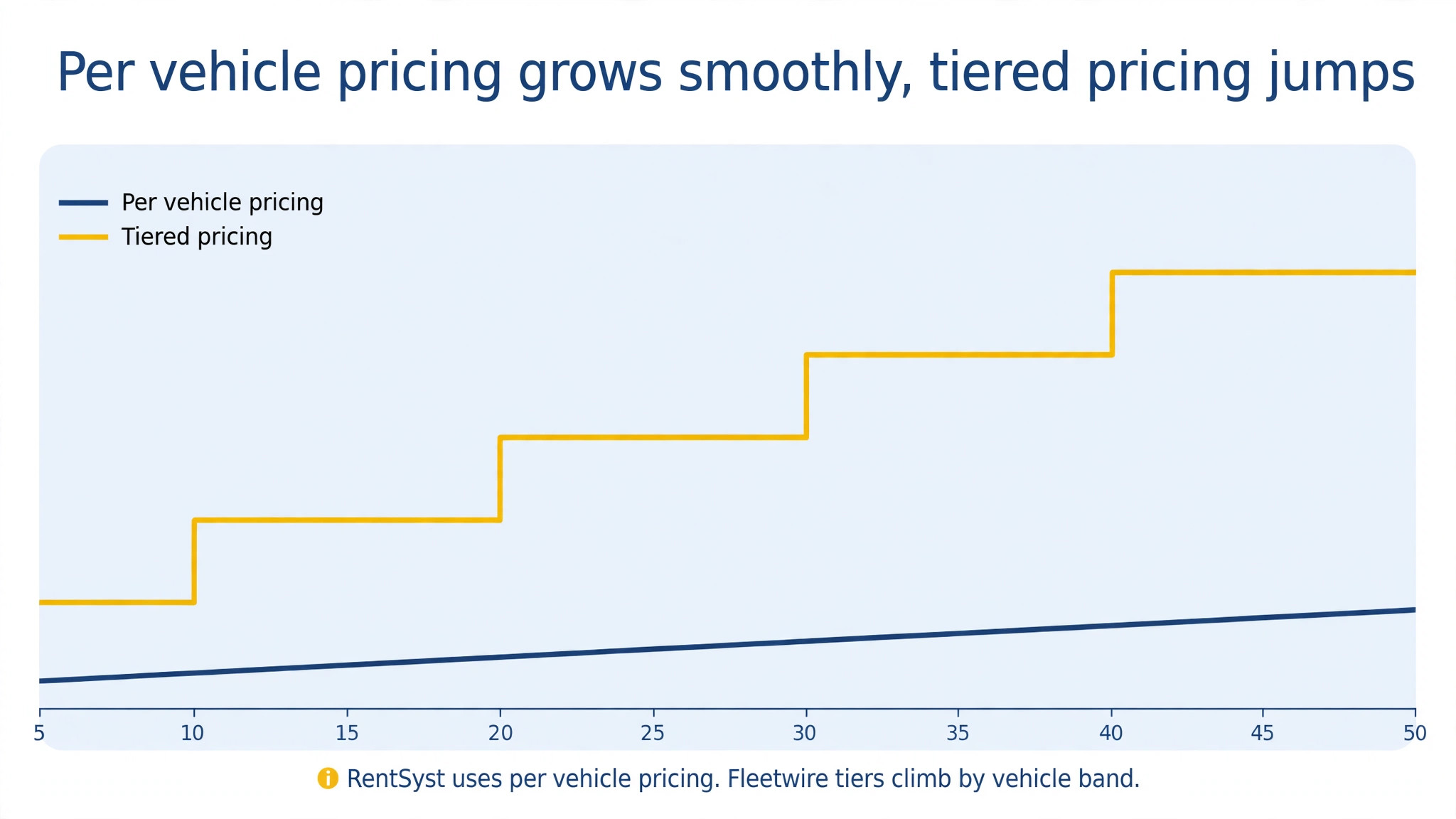
Per vehicle pricing, used by RentSyst, charges a set amount for each car, so the bill grows smoothly with the fleet. Tiered pricing, used by HQ Rental Software and Fleetwire, charges a flat amount up to a vehicle band, so the bill jumps when you cross a band. A fleet that grows one car at a time usually prefers per vehicle pricing, while a stable fleet usually prefers a tier that fits it exactly.
Should a new rental company choose a free tool or a paid platform?
A new company should usually choose a tool that fits its current fleet and can grow for two years, rather than the largest platform on day one. CarCEO PRO, Fleetwire, and Booqable give a new company structure at a low price. Move to a larger platform when fleet size, multi branch control, or deep reporting becomes a real need, not only a future hope.
How long does it take to switch rental software?
Most small companies can switch in two to four weeks, including data import, rate setup, and payment testing. A multi branch operator should allow four to eight weeks. Keep the old system read only until the first full week of bookings is clean.
The rental shortlist, by fleet size
The strongest all round choice for a local rental company is Car Rental Solutions, because a booking website and a back office arrive from one vendor at a flat published price. HQ Rental Software is the better pick for an airport or multi location operator that needs rate control, reporting, and depth, and will pay an onboarding fee once. Fleetwire is the better pick for a five car operator or a peer to peer host that wants the cheapest self serve start with Turo sync.
Do not choose on price alone. Choose on the fleet size you run today, the booking mix you actually carry, and the fleet size you expect in two years. Shortlist three tools, run the trial week described above, and pick the tool your counter team can actually run on a busy Friday. That practical test will tell you more than any sales page, and it will save your company from a costly switch later.