
Ahrefs at 129 dollars a month and a rival rank tracker at 29 dollars a month look like different products at different prices, and in one sense they are. The cheaper tool may track rankings and check a handful of pages. Ahrefs opens competitor backlink data, keyword research, site audits, and content research for any site, not just the sites the buyer owns. The comparison that matters for a small business is not headline price against headline price. It is what each tool returns for the research hours the team actually spends, and the cost of Ahrefs for small business monthly only makes sense once that research workload is clear.
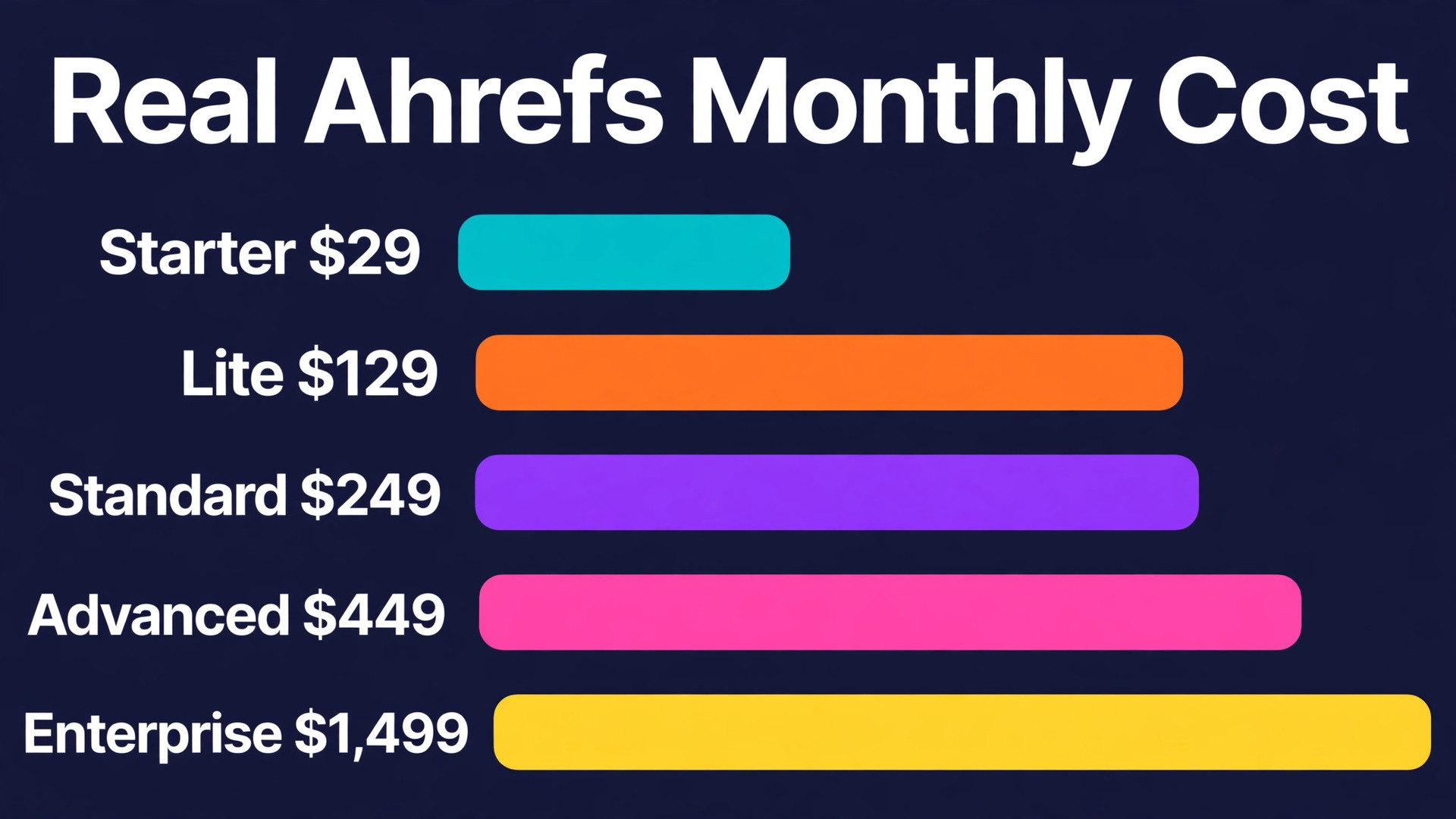
Ahrefs sells five paid tiers, according to its own pricing guide and pricing coverage checked in October 2026. Starter costs 29 dollars a month, Lite costs 129 dollars a month, Standard costs 249 dollars a month, Advanced costs 449 dollars a month, and Enterprise costs 1,499 dollars a month on an annual commitment. Every tier except Starter can be bought on monthly or annual billing, with annual billing advertised as two free months, which works out to roughly a 17 percent saving. Starter is monthly only, with no annual discount.
That tier spread is the first warning against budgeting from a single number. A solo owner who only needs rank tracking and basic research may fit Starter or Lite, while a small agency that runs client research daily will need Standard or Advanced. The gap between Lite and Standard alone is 120 dollars a month on monthly billing, which is 1,440 dollars a year before a single extra user is added. The rest of this guide prices each tier honestly, adds the extra user fees that turn a headline price into a team price, and shows where add-ons push the bill higher still.
The tiers behind the cost of Ahrefs for small business monthly
The table below sets out the five tiers on monthly billing, with the annual billing equivalent where annual billing exists. Annual equivalents are calculated from the published annual totals, which charge ten months for twelve months of access on Lite, Standard, and Advanced. All figures are in United States dollars before tax, from Ahrefs pricing pages and pricing coverage checked in October 2026.
| Tier | Monthly billing | Annual billing equivalent per month | Annual total |
|---|---|---|---|
| Starter | 29 dollars | No annual billing published | Check the vendor pricing page |
| Lite | 129 dollars | 107 dollars and 50 cents | 1,290 dollars |
| Standard | 249 dollars | 207 dollars and 50 cents | 2,490 dollars |
| Advanced | 449 dollars | 374 dollars and 17 cents | 4,490 dollars |
| Enterprise | 1,499 dollars on an annual commitment | 1,499 dollars on an annual commitment | Check the vendor pricing page |
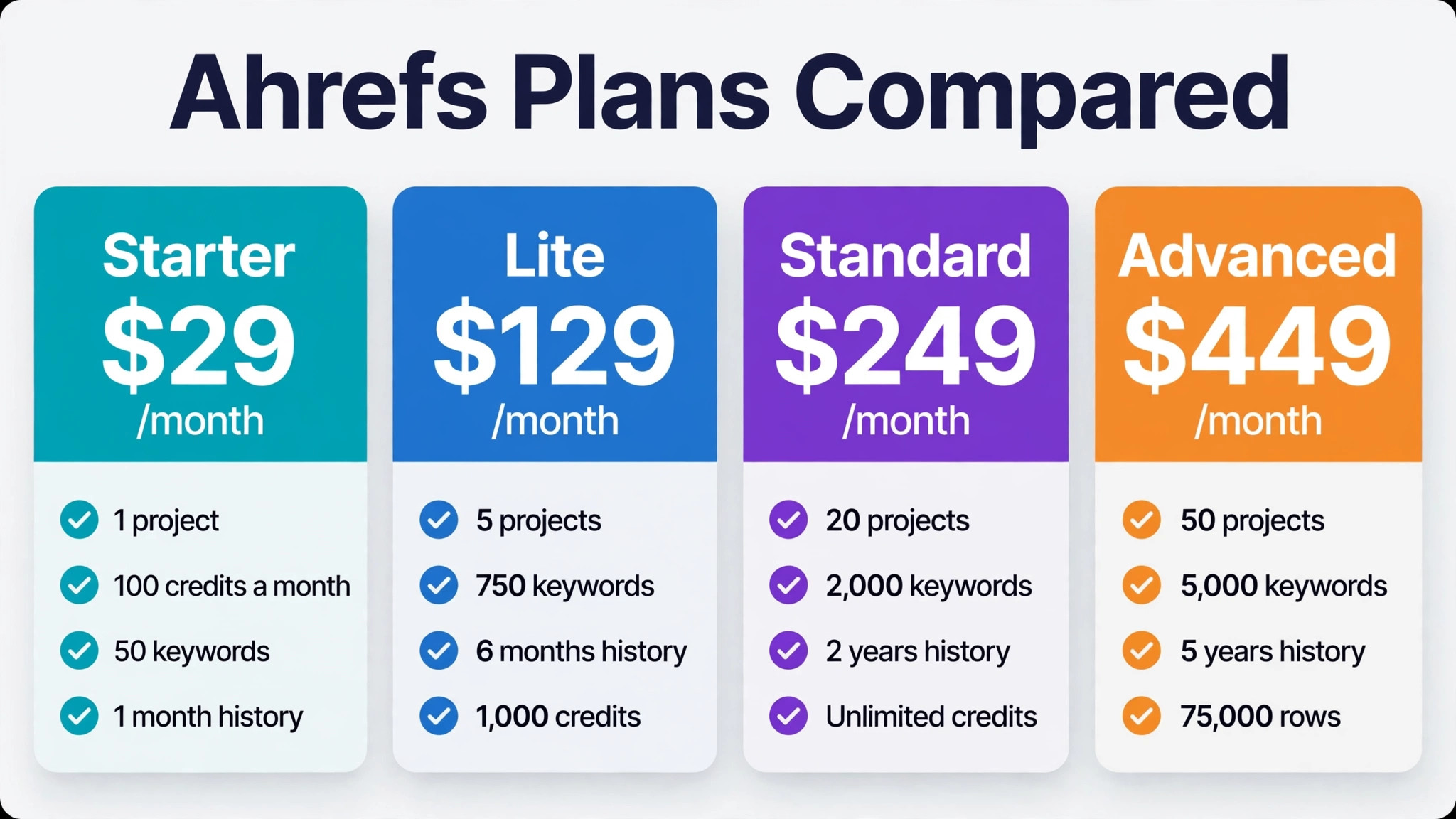
Starter is deliberately narrow. Pricing coverage describes it as covering one unverified project, 100 credits a month, 50 tracked keywords in Rank Tracker, and one month of history. That suits a solo owner checking one site and a small keyword set. It does not suit a business that researches competitors weekly, because competitor research needs the project depth and history that start at Lite.
Lite raises the limits to five projects, 750 tracked keywords, six months of history, and API access, with 1,000 credits per user per month and 2,500 rows per report. Standard moves to 20 projects, 2,000 tracked keywords, two years of history, and unlimited credits, with 30,000 rows per report. Advanced reaches 50 projects, 5,000 tracked keywords, five years of history, and 75,000 rows per report. Enterprise adds unlimited history and 150,000 rows per report on an annual commitment. Those limits decide the tier more reliably than any feature list, because a team that hits a keyword or project cap every month has bought the wrong tier even if the feature names looked right.
Ahrefs also offers a free tier for verified site owners, with limited access to core tools for sites the owner verifies. That free access covers Site Explorer overviews, Site Audit, and Web Analytics for owned sites, but it does not open competitor data for any site. A business that only needs to monitor its own site can start there at no cost. A business that needs to research rivals, suppliers, or client competitors must pay, and that distinction should be settled before any tier is chosen.
Real monthly totals by team size
Ahrefs plans include one user in the headline price on Lite, Standard, and Advanced, with Enterprise including three users according to agency pricing coverage. Extra users are paid add-ons, and the extra user price rises with the tier. Lite allows up to two extra users at 40 dollars a month each, Standard allows up to five extra users at 60 dollars a month each, Advanced allows up to ten extra users at 80 dollars a month each, and Enterprise charges 100 dollars a month per additional user.
That structure means the team price is never the headline price once a second person needs access, and the cost of Ahrefs for small business monthly for a team must be calculated as base price plus extra users.
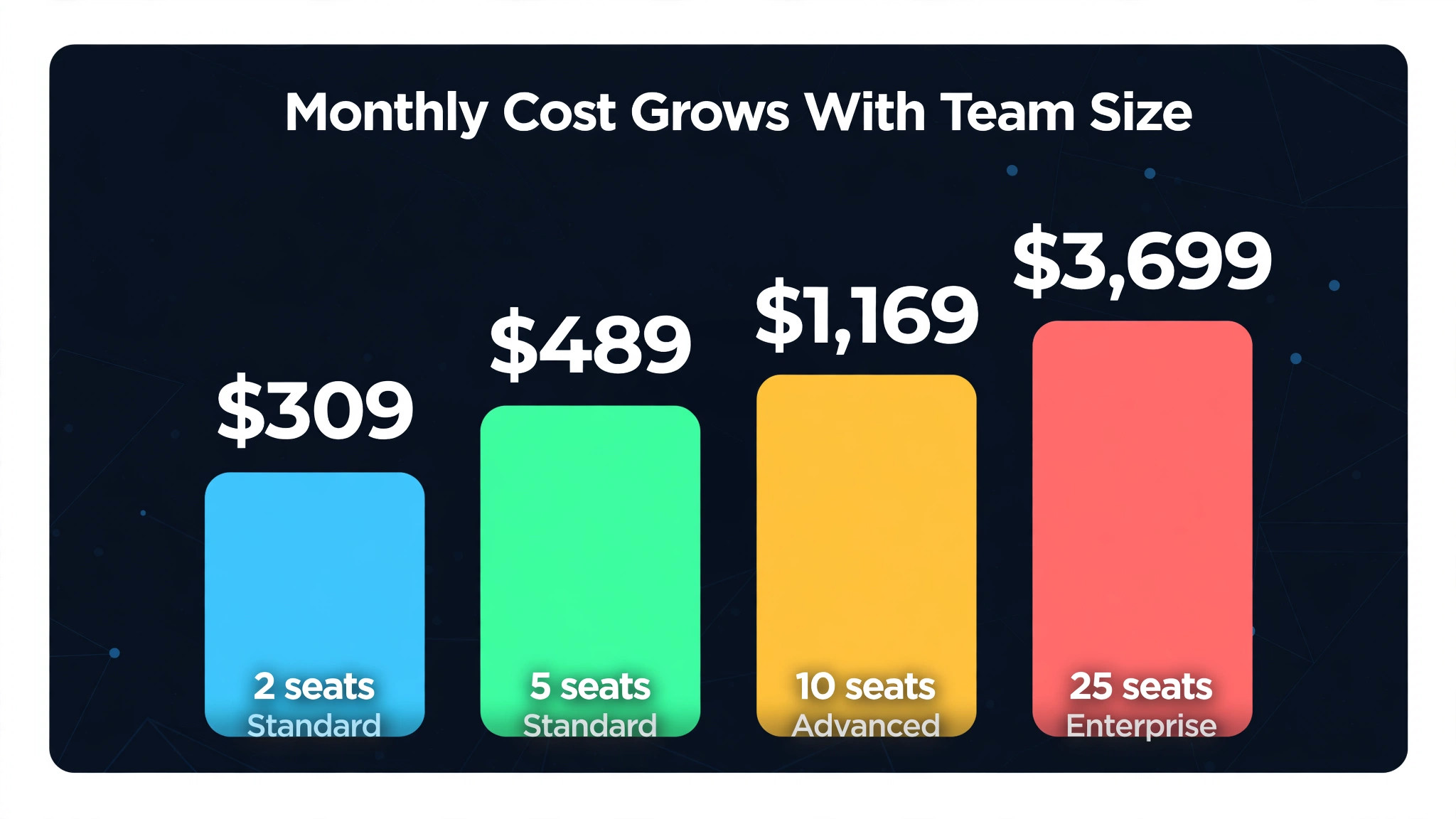
| Seats | Plan that fits | Monthly billing total | Annual billing equivalent per month |
|---|---|---|---|
| 2 | Standard | 309 dollars | 257 dollars and 50 cents |
| 5 | Standard | 489 dollars | 407 dollars and 50 cents |
| 10 | Advanced | 1,169 dollars | 974 dollars and 17 cents |
| 25 | Enterprise | 3,699 dollars | 3,699 dollars on an annual commitment |
A two seat team on Standard pays 249 dollars for the base seat plus 60 dollars for one extra user, which totals 309 dollars a month on monthly billing. On annual billing, the same two seats work out to 257 dollars and 50 cents a month on an equivalent basis, because both the base price and the extra user fee follow the two free months pattern in this calculation. Confirm the extra user annual treatment at checkout, since pricing pages present the annual saving on the plan price and buyers should verify that it applies identically to extra users.
A five seat team on Standard pays 249 dollars plus four extra users at 60 dollars, which totals 489 dollars a month on monthly billing, or 407 dollars and 50 cents on an annual equivalent. That five seat total is nearly double the 249 dollar headline price, which is why a team that budgets from the pricing card alone will be surprised by the first invoice. Standard caps extra users at five, so a six seat team is the largest Standard team possible, with one base user plus five extra users at 549 dollars a month on monthly billing.
A ten seat team cannot stay on Standard, because Standard allows only five extra users. Advanced at 449 dollars plus nine extra users at 80 dollars totals 1,169 dollars a month on monthly billing, or 974 dollars and 17 cents on an annual equivalent. A 25 seat team cannot stay on Advanced either, because Advanced allows only ten extra users, for a maximum of eleven seats. Enterprise at 1,499 dollars plus 22 additional users at 100 dollars totals 3,699 dollars a month on an annual commitment, and at that size a written Enterprise discussion is essential rather than a self serve checkout.
A cheaper Lite path exists for small teams that can live inside Lite limits. Two seats on Lite cost 129 dollars plus 40 dollars for one extra user, which totals 169 dollars a month on monthly billing, or about 140 dollars and 83 cents on an annual equivalent. Three seats is the Lite maximum, at 209 dollars a month on monthly billing. A team that chooses Lite purely to save money, then hits the 1,000 credit cap or the 750 keyword cap every month, has not saved money at all, because the research it cannot do still needs doing somewhere else.
Add-ons that change the Ahrefs bill
Add-ons are where an Ahrefs bill quietly grows past the team total above. Pricing coverage checked in October 2026 lists several paid extras, and each one should be treated as optional until the team has a concrete use for it. Content Kit is listed from 99 dollars a month, Report Builder is listed at 99 dollars a month, Brand Radar AI is listed from 199 dollars a month, prompt packages are listed from 50 dollars to 250 dollars, and Project Boosts are listed at 20 dollars or 200 dollars per project. Confirm every add-on price at checkout, because add-on pricing changes more often than core tier pricing.
Content Kit and Report Builder matter most for teams that produce client reports or content briefs regularly. A small agency that reports to clients monthly may find Report Builder worth its fee, because it turns research into presentable reports without manual copying. A business that only checks its own rankings has no need for either add-on, and paying for them from day one is waste, not investment. Brand Radar AI suits teams tracking brand mentions across AI search results, which is a newer need that many small businesses do not yet have.
Project Boosts deserve a careful read, because they add capacity to a single project rather than to the whole account. A team with one unusually large project may prefer a boost to a full tier upgrade, while a team with several large projects will find tier upgrade cheaper. Prompt packages follow the same logic for AI assisted research, where heavy users pay more and light users should not. The rule for every add-on is the same. Buy it after the need appears in real work, not at signup when the need is only imagined.
Credit packs are a related cost on Lite, where each user gets 1,000 credits a month. Standard and above offer unlimited credits, which removes that meter entirely. A Lite team that burns through credits early in the month faces a choice between waiting, buying extra capacity, or upgrading to Standard. That choice should be made with a month of real usage data, not with a guess at signup. If credits run out in week two, Standard is probably the right tier, and the upgrade cost is easier to justify with that evidence.
When a lower tier is enough, and when it is not
Lite is enough when the research workload is narrow and regular. A business tracking one website, a few hundred keywords, and a small set of competitors will fit inside five projects and 750 keywords comfortably. A local service business, a single product store, or a solo consultant usually fits that shape. The credit cap is the main risk, so a Lite buyer should track credit use in the first month and check whether research habits stay inside 1,000 credits per user.
Standard is the right tier when research becomes a weekly habit across several projects. Twenty projects and 2,000 tracked keywords cover a small agency with several clients, or a growing business with multiple product lines and local markets. Unlimited credits remove the meter that makes Lite teams ration research, and two years of history lets the team show trends rather than snapshots. For many small businesses, Standard is the first tier where Ahrefs feels like a research system rather than a research ration.
Advanced earns its price when project count, keyword count, or history depth becomes the constraint. Fifty projects and 5,000 tracked keywords suit an agency with many clients, a publisher with many content areas, or a business running research across many locations. Five years of history matters for long term trend work and for businesses that need to show what changed since a redesign or a major algorithm update. A team that does not hit Standard limits should not pay the 200 dollar monthly jump to Advanced for features it will not use.
Enterprise is a different kind of purchase, not simply a larger Advanced. It suits organisations that need unlimited history, the highest report row limits, and an annual commitment structure, with many additional users. A 25 seat team on Enterprise is paying for scale and for account structure, and the 3,699 dollar monthly figure in the table above shows why that decision belongs with finance, not with a single researcher. Small businesses should treat Enterprise as out of scope unless headcount or history needs force the move.
A worked month for a five seat research team
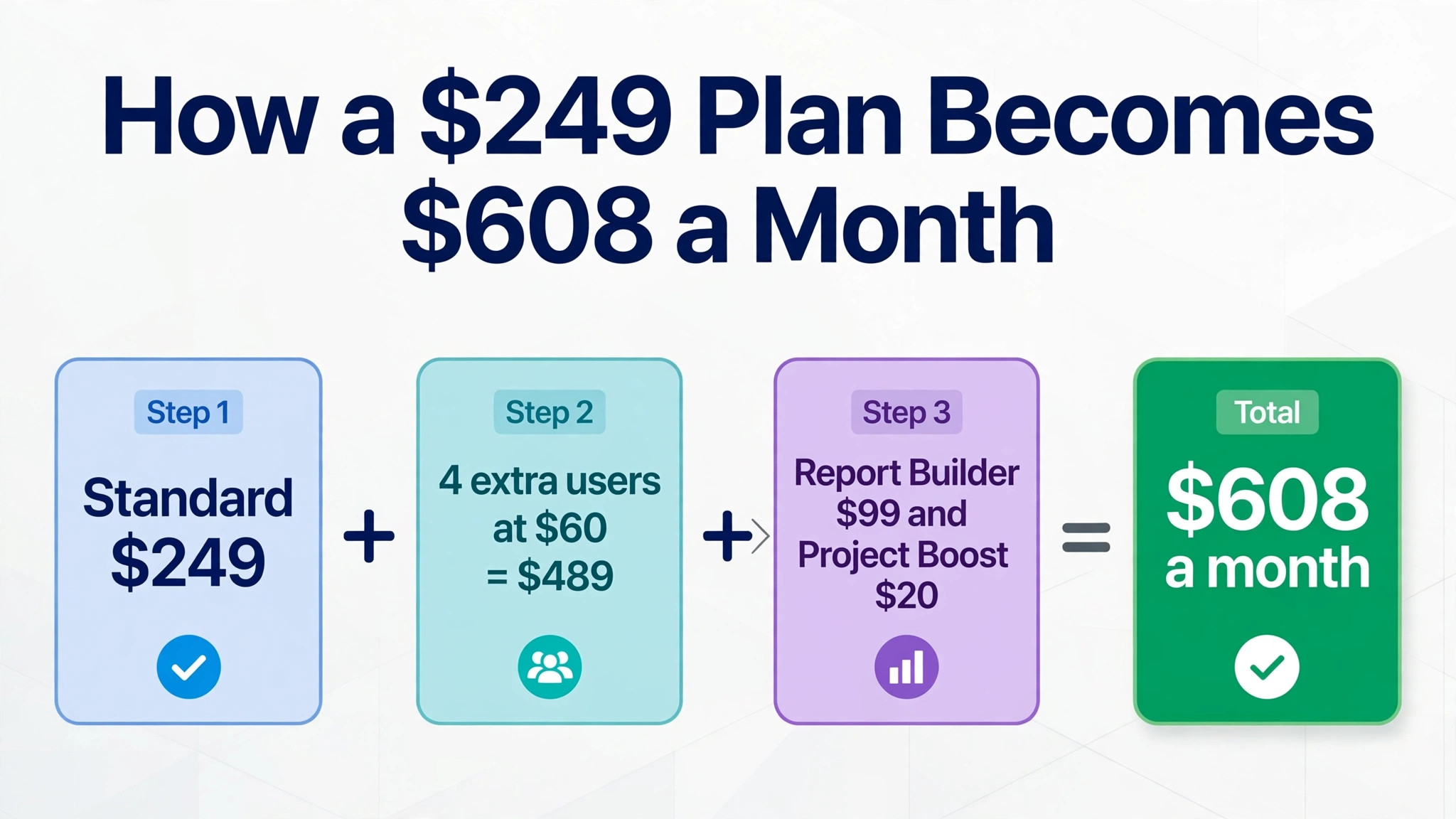
Take a five person team on Standard with annual billing. The team pays 407 dollars and 50 cents a month on an annual equivalent, which is 4,890 dollars for the year on that basis, against 489 dollars a month or 5,868 dollars a year on monthly billing. The billing choice alone saves 978 dollars a year for the same five seats, which is more than three months of a single extra user. That saving is the reason annual billing deserves a decision in writing, not a default at checkout.
That worked total is the baseline for the cost of Ahrefs for small business monthly at five seats on Standard.
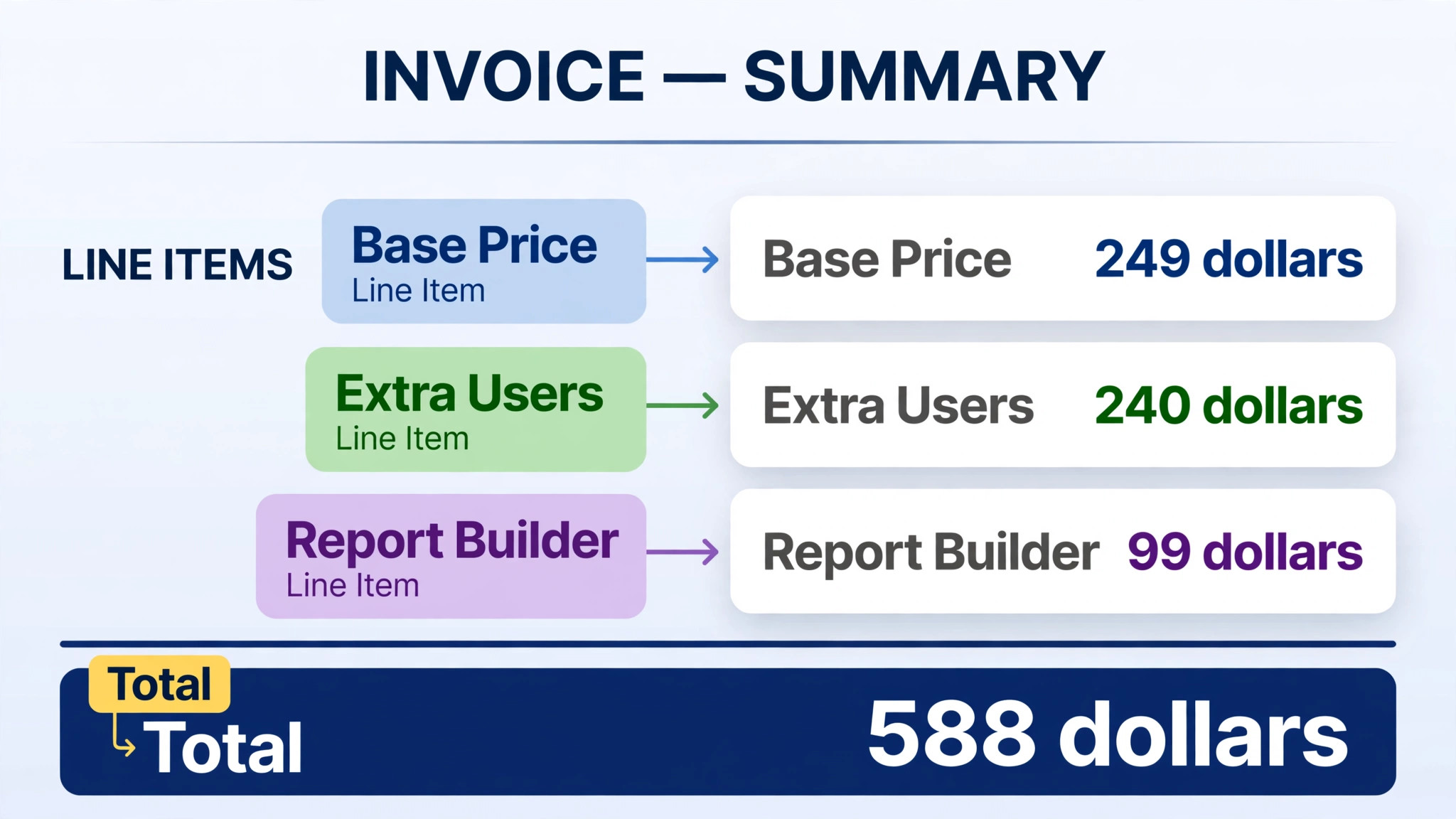
Now add one realistic extra. If the team adds Report Builder at 99 dollars a month, the monthly billing total rises from 489 dollars to 588 dollars, and the annual equivalent rises by the same add-on amount unless the add-on carries its own annual terms. Confirm add-on billing terms separately, because assuming an add-on follows the plan annual discount can understate the bill. If the team also adds one Project Boost at 20 dollars, the monthly billing total reaches 608 dollars. Those two extras together add 1,428 dollars a year to a Standard team bill, which is larger than the annual billing saving itself.
The worked month also shows the cost of a wrong tier choice. A five seat team on Lite cannot exist, because Lite allows only two extra users, so a five seat team that tries to save money on Lite will discover the seat cap at signup. A five seat team on Advanced would pay 449 dollars plus four extra users at 80 dollars, which totals 769 dollars a month on monthly billing, or 280 dollars a month more than Standard for limits the team may not need. Tier choice, seat count, and add-ons together decide the bill, and no single figure captures all three.
For a solo researcher, the decision is simpler. One Lite seat costs 129 dollars a month on monthly billing or 1,290 dollars for the year on annual billing. One Standard seat costs 249 dollars a month or 2,490 dollars for the year. A solo owner who researches daily and values unlimited credits should weigh Standard seriously, while a solo owner who checks rankings weekly and researches occasionally will likely fit Lite, with Starter as a cheaper test for the first month.
How to keep the Ahrefs bill under control
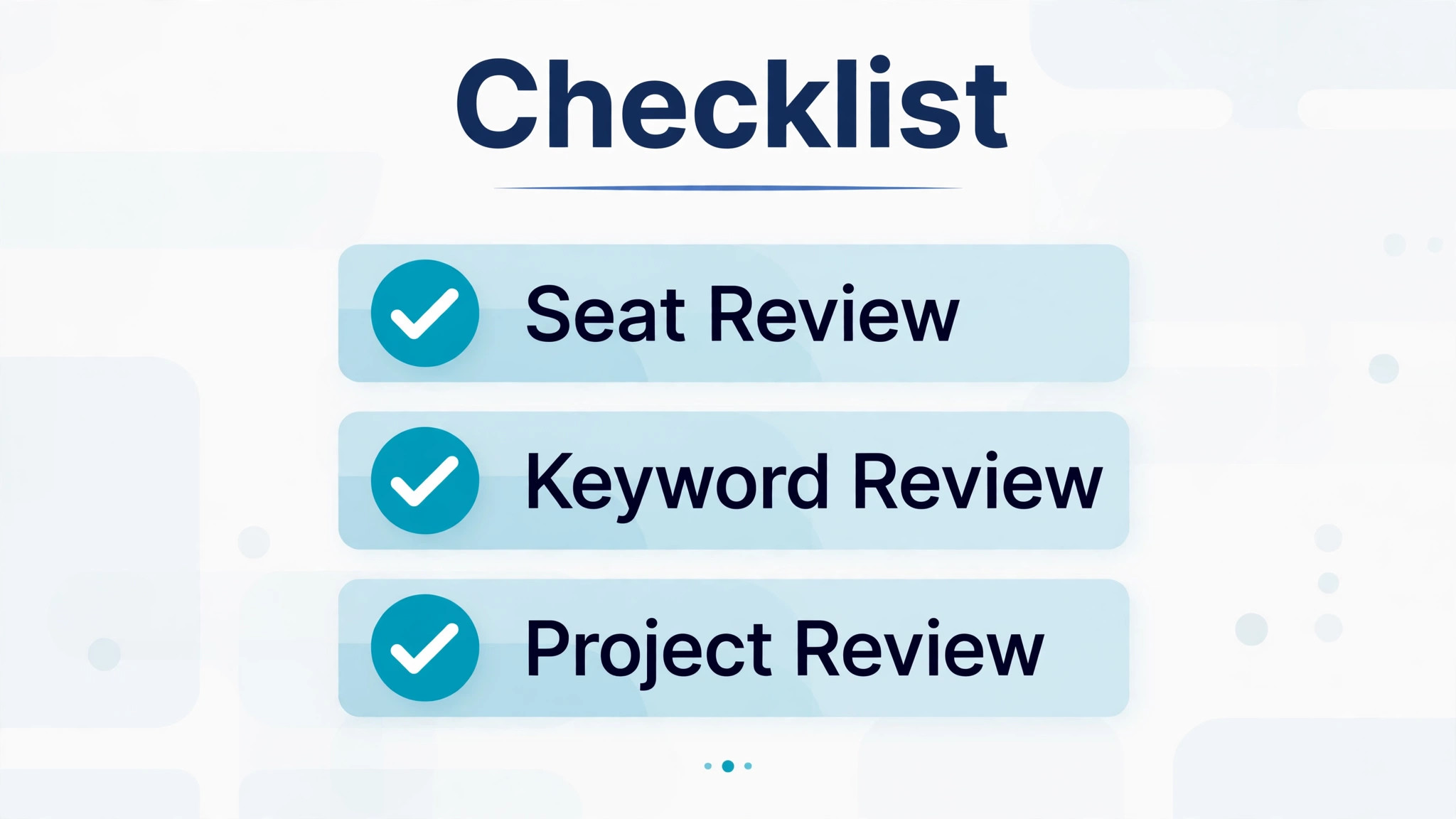
The first control is seat discipline. Ahrefs charges for each user beyond the included seat, so a seat given to a manager who reads one report a month costs 60 dollars on Standard for almost no research output. Share reports as exports or scheduled sends where possible, and reserve seats for people who run research themselves. A five seat Standard team that drops to three real researchers saves 120 dollars a month on monthly billing without losing any research capacity.
The second control is keyword and project hygiene. Tracked keywords and projects accumulate over time, and a team that never removes dead keywords or closed projects will hit tier limits and feel pressure to upgrade. Review the keyword list quarterly, remove keywords for discontinued products or closed locations, and archive finished projects. That housekeeping can delay a tier upgrade by months, which is a larger saving than any discount.
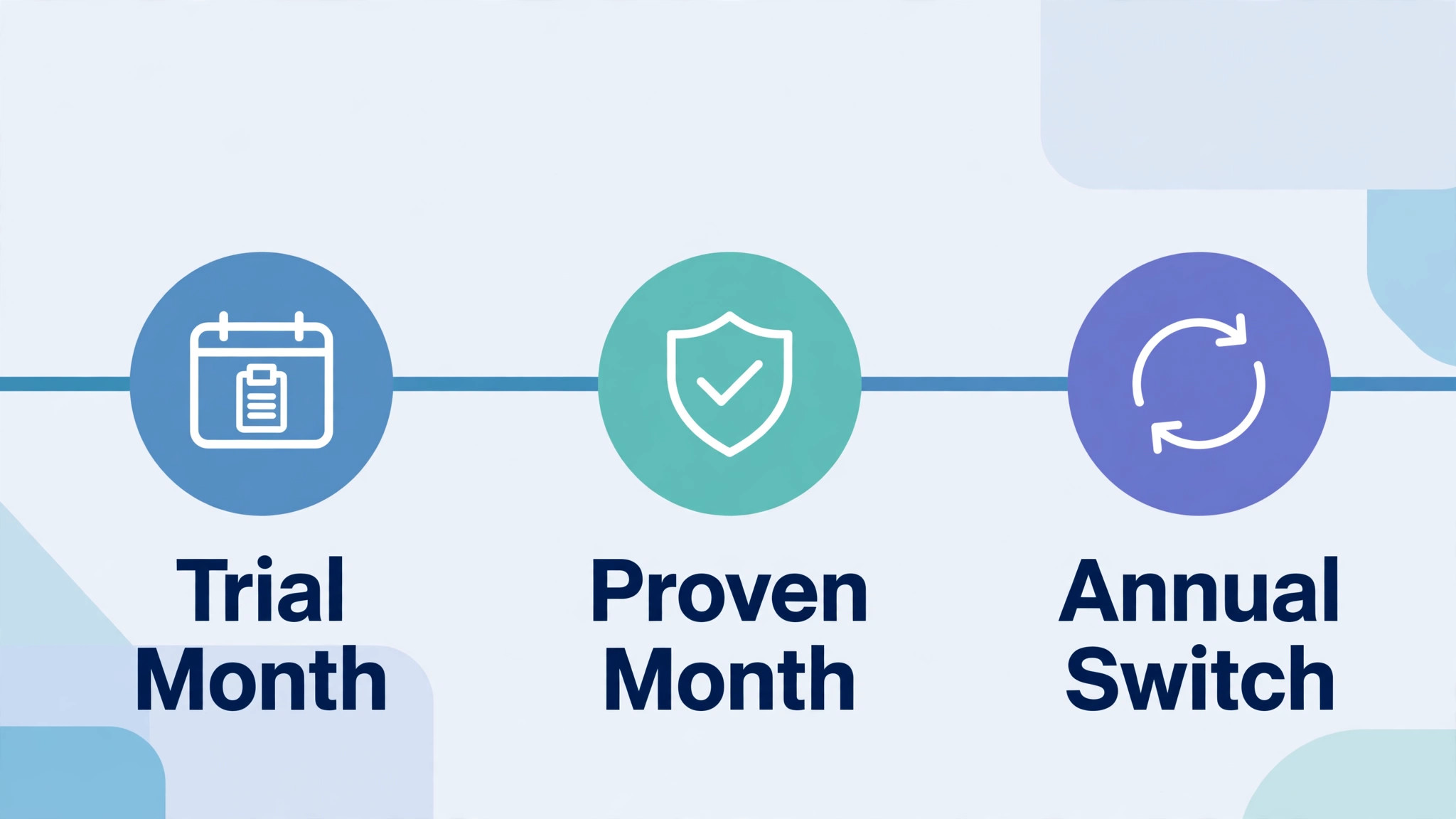
The third control is annual billing timed correctly. Switch to annual billing after a month or two of proven use, not at signup, because annual billing locks the team into a tier and seat count for a year. A team that grows from three to five seats mid year will pay for the extra seats anyway, but a team that shrinks after an annual purchase will pay for seats it no longer uses. The 17 percent saving is real, but it rewards commitment, not optimism.
The fourth control is add-on restraint. Buy Report Builder, Content Kit, or Brand Radar AI only after a repeated manual task proves the need. A team that buys all three at signup adds at least 397 dollars a month on listed starting prices, which is more than a Lite subscription on its own. Add-ons should be approved one at a time, with a named task each one removes, so the bill grows only when the workload grows.
Finally, use the free tier for owned site monitoring before paying for anything. A business that only needs to watch its own site, run site audits, and check basic analytics can start free and learn the interface without spending. That free experience also clarifies which paid limits matter, because the team will know which competitor data it actually misses before it pays for it.
Mistakes small teams make with Ahrefs pricing
The first mistake is budgeting the cost of Ahrefs for small business monthly from the headline tier price and forgetting extra users. A team of five that budgets 249 dollars for Standard will face a 489 dollar invoice, and the surprise will damage trust in the tool even though the tool itself is working. Always budget base price plus extra users, and write that total down before approval.
The second mistake is choosing a tier by feature names instead of by limits. A team that buys Lite for its price, then discovers the 750 keyword cap or the 1,000 credit cap mid month, has bought frustration. Count projects, keywords, and expected research volume before choosing, and pick the tier whose limits sit comfortably above real use, not exactly at it.
The third mistake is paying for Enterprise scale before the team needs it. Advanced already covers 50 projects and 5,000 keywords, which exceeds most small business needs by a wide margin. Enterprise makes sense for large seat counts and unlimited history, not for a small team that wants the biggest tier as a safety blanket. Safety blankets at 1,499 dollars a month are expensive.
The fourth mistake is ignoring tax and add-on billing terms at checkout. Published Ahrefs figures exclude tax, so the invoiced total will be higher in regions where tax applies. Add-ons may also bill on different terms from the plan itself. Record the checkout total, including tax and add-ons, as the budget figure, so finance approves the real number.
The fifth mistake is letting tracked keywords and dormant seats accumulate. Both grow silently, and both push a team toward a higher tier or a higher seat count without any increase in research output. A quarterly review of seats, keywords, and projects is the cheapest cost control available, and it takes less than an hour.
How Ahrefs compares with doing research without it
A team without Ahrefs can still research keywords and backlinks, but the work is slower and more scattered. Free tools, search results, and manual checks can answer single questions, yet they rarely join keyword data, backlink data, and site health into one view. A researcher who pieces those answers together from several free sources will spend more hours per question, and the answers will be harder to compare over time. That time cost is the real rival to the subscription price.
The comparison should therefore be hours, not headlines. If a researcher saves four hours a month by running keyword, backlink, and audit checks in one place, the value of those hours usually exceeds a Lite subscription, even before better decisions are counted. If the same researcher only runs one check a month, the saving is small, and the free tier or Starter may cover the need. The cost of Ahrefs for small business monthly looks high only when research hours are low, and it looks modest when research is a weekly habit.
A second comparison is decision quality. A business that picks content topics, outreach targets, or product pages from guesswork will waste effort on pages nobody searches for and links nobody values. Research data reduces that waste, but only when someone acts on it. A subscription that nobody opens is a cost with no return, while a subscription that shapes a monthly content plan can pay for itself through fewer wasted articles. Judge Ahrefs by the decisions it changes in a quarter, not by the reports it can generate in a day.
Frequently Asked Questions
How much is Ahrefs Lite per month?
Lite costs 129 dollars a month on monthly billing, or 1,290 dollars for the year on annual billing, which works out to 107 dollars and 50 cents a month on an equivalent basis. Lite includes one user, five projects, 750 tracked keywords, six months of history, and 1,000 credits per user per month. Extra users cost 40 dollars a month each, up to two extra users.
How much does Ahrefs cost for a team of five?
For the cost of Ahrefs for small business monthly at five seats, Standard is the fitting tier at 489 dollars a month on monthly billing, or 407 dollars and 50 cents a month on an annual equivalent. That total is the 249 dollar base price plus four extra users at 60 dollars each. Lite cannot cover five seats, because it allows only two extra users.
Is there a free Ahrefs plan?
Yes, Ahrefs offers a free tier for verified site owners, with limited access to core tools for sites the owner verifies. That covers overviews, site audits, and analytics for owned sites, but it does not open competitor data for any site. Businesses that need competitor research must use a paid tier.
How much do extra Ahrefs users cost?
Extra users cost 40 dollars a month each on Lite up to two extra users, 60 dollars a month each on Standard up to five extra users, 80 dollars a month each on Advanced up to ten extra users, and 100 dollars a month each on Enterprise. Those fees are the main reason a team bill runs well above the headline tier price.
Does Ahrefs offer an annual discount?
Yes, Lite, Standard, and Advanced offer annual billing advertised as two free months, which is roughly a 17 percent saving against monthly billing. Starter is monthly only, with no annual discount published. Enterprise requires an annual commitment. Confirm extra user and add-on annual treatment at checkout before budgeting.
What add-ons increase the Ahrefs bill?
Pricing coverage lists Content Kit from 99 dollars a month, Report Builder at 99 dollars a month, Brand Radar AI from 199 dollars a month, prompt packages from 50 dollars to 250 dollars, and Project Boosts at 20 dollars or 200 dollars per project. Each add-on should be bought only after a repeated task proves the need, because together they can add several hundred dollars a month.
Is Ahrefs worth it for a small business?
It depends on research volume. A business that researches competitors, keywords, and backlinks weekly will likely recover a Lite or Standard subscription in better content and outreach decisions. A business that only checks its own rankings monthly may fit the free tier or Starter, and should not pay for Standard limits it never approaches.
Verdict
For most small businesses, the sensible Ahrefs answer is Lite for narrow research or Standard for regular multi project research, with annual billing after a proven month or two. Lite at 129 dollars a month suits a solo owner or a small team that fits inside its project, keyword, and credit limits. Standard at 249 dollars a month suits a team that researches weekly across several projects and needs unlimited credits. The cost of Ahrefs for small business monthly in either shape should be budgeted as base price plus extra users, with add-ons approved separately.
Start with the tier whose limits sit above real use, keep seats only for real researchers, review keywords and projects quarterly, and switch to annual billing once use is proven. Do that, and Ahrefs becomes a predictable research cost. Budget from the headline price alone, buy add-ons at signup, and let seats accumulate, and the same tool will cost nearly double the expected amount for the same research.
More Reading on Stratilyze
– Cost of Grammarly for a Small Business, Monthly – Cost of Zapier for a Small Business, Monthly – Best Website Builder for Wedding Photographers (12 Tools) – Best Inventory Software for Plant Nurseries (15 Tools) – Best Quote Software for Landscaping Companies (9 Tools)