
For most solo owners running a low risk service business, the honest verdict is to start as a sole proprietor while testing the idea, then form a limited liability company once revenue is steady or risk appears. For owners with employees, client site work, or physical products, the verdict shifts, and the limited liability company becomes the starting point rather than the upgrade. For owners planning to raise outside investment, a corporation is the structure investors expect. This guide explains how to choose a business structure small business owners can defend with numbers and facts, comparing liability, tax treatment, and admin burden across the main options.
Structure is a legal and tax decision, not a branding decision. It decides whether your personal assets are exposed to business debts, which tax return you file, how much paperwork you maintain, and how easily you can bring in partners or investors. Getting it wrong rarely destroys a business overnight, but it can cost real money in tax, expose personal savings to a claim, or block a funding round at the worst moment. Getting it right early is cheaper than fixing it later, though changing structure later is possible and common.
This guide covers United States federal treatment, since that is where most of the published guidance sits, and it flags where state rules change the answer. State filing fees, annual taxes, and naming rules vary widely, so confirm the figures for your state on the state filing office site before you file. Where a figure is given as a range, treat it as a planning range, not as a quote, and confirm the current amount for your state and entity type.
How to Choose a Business Structure Small Business Owners Get Right First Time
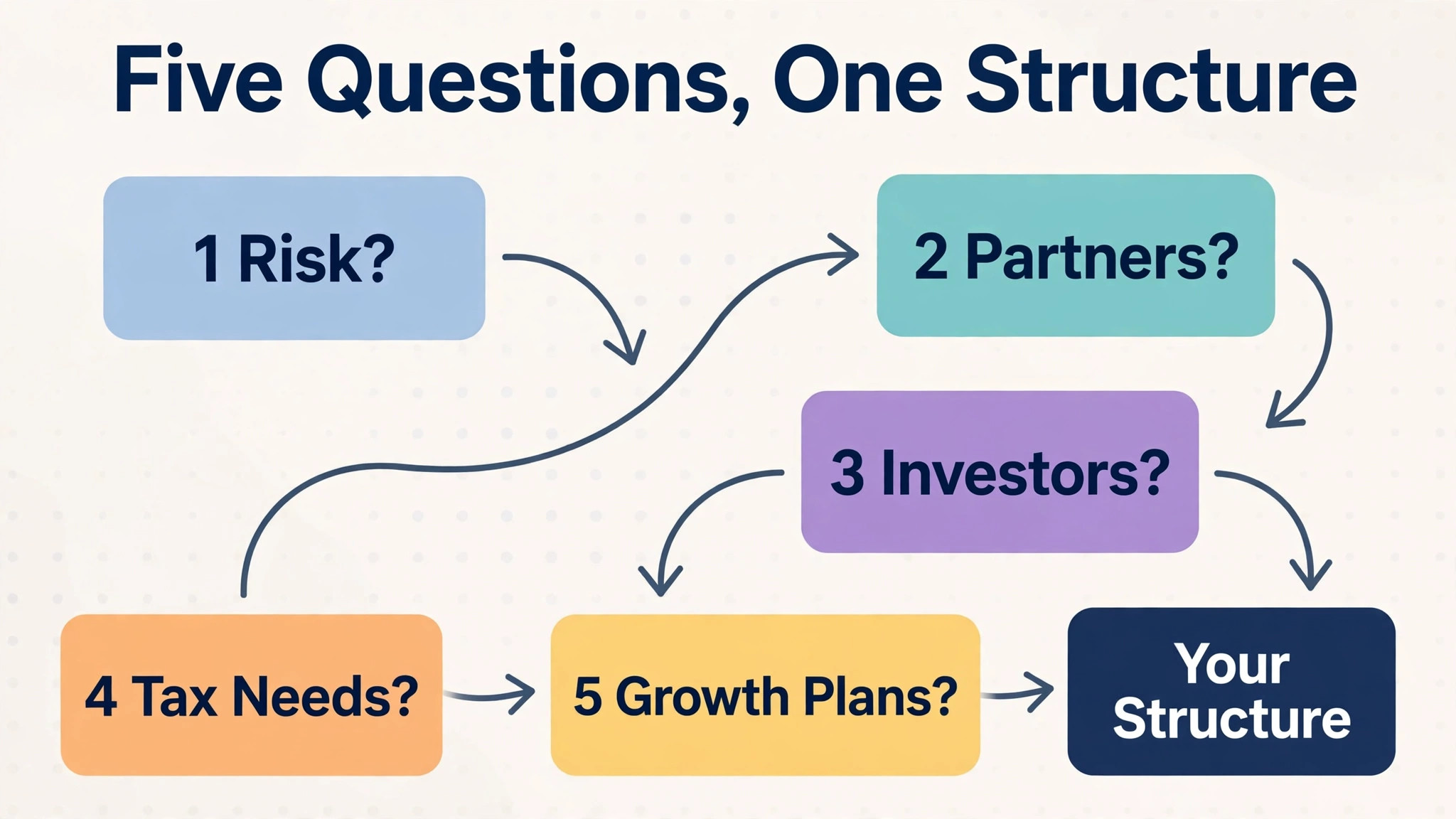
The decision becomes manageable once you answer five questions from your own facts. First, what liability risk does the work create. A consultant working from home faces less risk than a contractor working on client property with staff and equipment. Second, how many owners are there, and will there be more. A solo owner has different options from a two founder team. Third, how much profit do you expect in the next two years, since profit level changes the tax analysis. Fourth, do you plan to raise outside investment or offer equity to staff. Fifth, how much admin are you willing to maintain every year, including filings, meetings, and separate records.
Answer those five questions before comparing entities, because the comparison only makes sense against your facts. An owner with low risk, solo operation, and modest profit has little reason to carry corporation admin. An owner with staff, contracts, and growing profit has strong reasons to separate personal and business liability early. Write your answers down, and use them to test each structure in the table below. The structure that fits all five answers is usually the right one, even if it is not the structure a friend chose for a very different business.
A common misunderstanding deserves clearing up at the start. An S corporation is not a separate legal entity. It is a tax election that a qualifying corporation or limited liability company can make with the Internal Revenue Service. Your legal entity is the limited liability company or the corporation. Your tax treatment can then be standard pass through treatment, S corporation treatment, or, for a corporation, C corporation treatment. Keeping those two layers separate prevents the most common confusion in this whole topic.
The Decision Table That Does Most of the Work
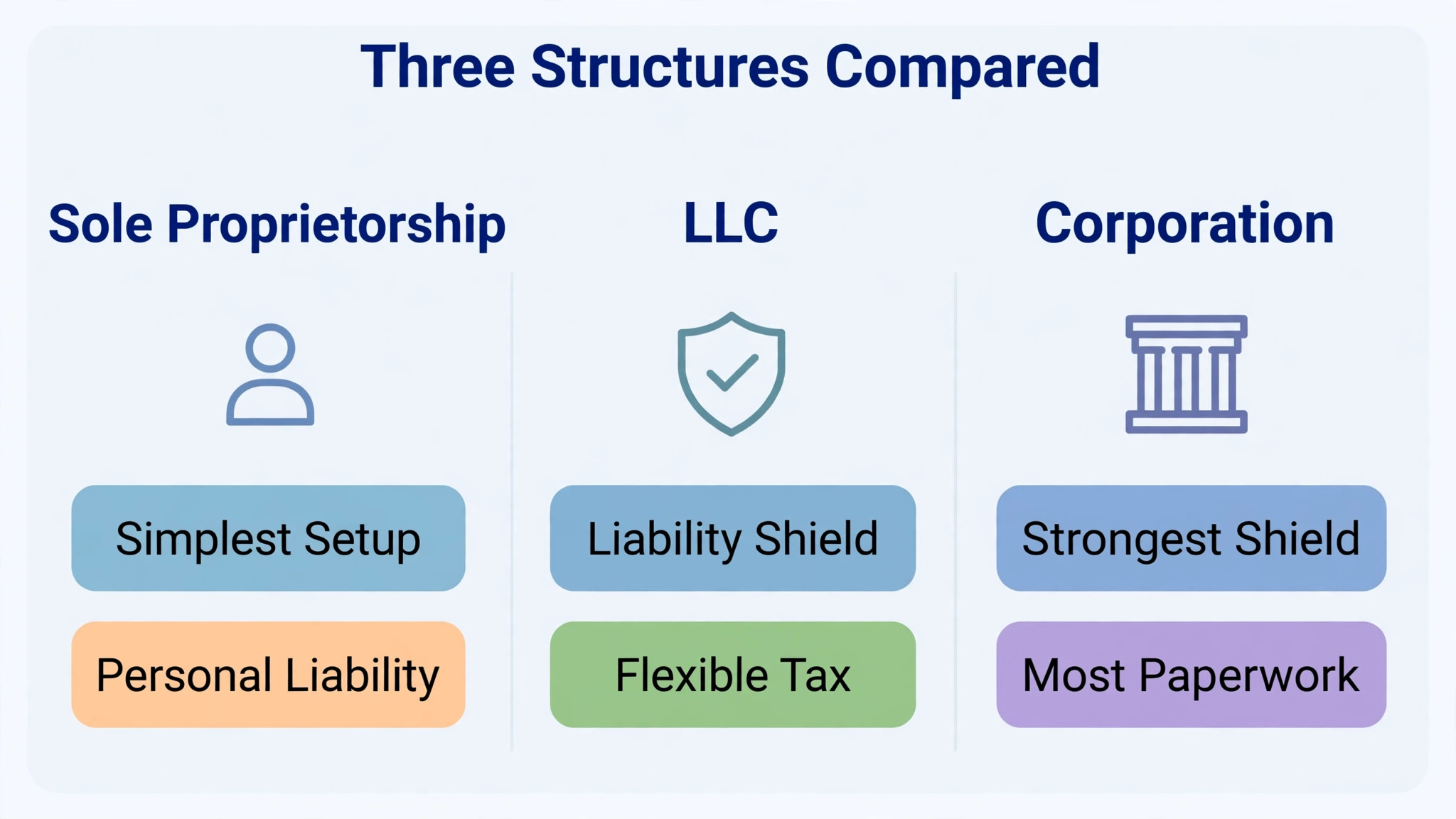
The table below compares the three structures most small businesses actually choose, plus the partnership that multi owner firms without a formal entity fall into by default. Read across each row for one structure, then read down each column to see how liability, tax, and admin differ. The right row for you is the one whose trade offs you accept most easily, not the one with the longest list of benefits, since every structure trades something away. Working through the table this way is the practical core of how to choose a business structure small business owners can apply without a law degree.
| Structure | Liability for owners | Federal tax treatment | Admin burden |
|---|---|---|---|
| Sole proprietorship | Unlimited personal liability | Pass through on Schedule C, self employment tax on profit | Lowest, no formation filing |
| General partnership | Unlimited personal liability for partners | Pass through on partnership return | Low, but needs a written agreement |
| Limited liability company | Limited, if formalities are maintained | Pass through by default, S or C election possible | Medium, state filing plus operating agreement |
| C corporation | Limited, if formalities are maintained | Corporate tax, then tax on dividends | Highest, board, meetings, separate returns |
| S corporation election | Limited, through the underlying entity | Pass through, salary plus distributions | High, payroll, salary rules, shareholder limits |
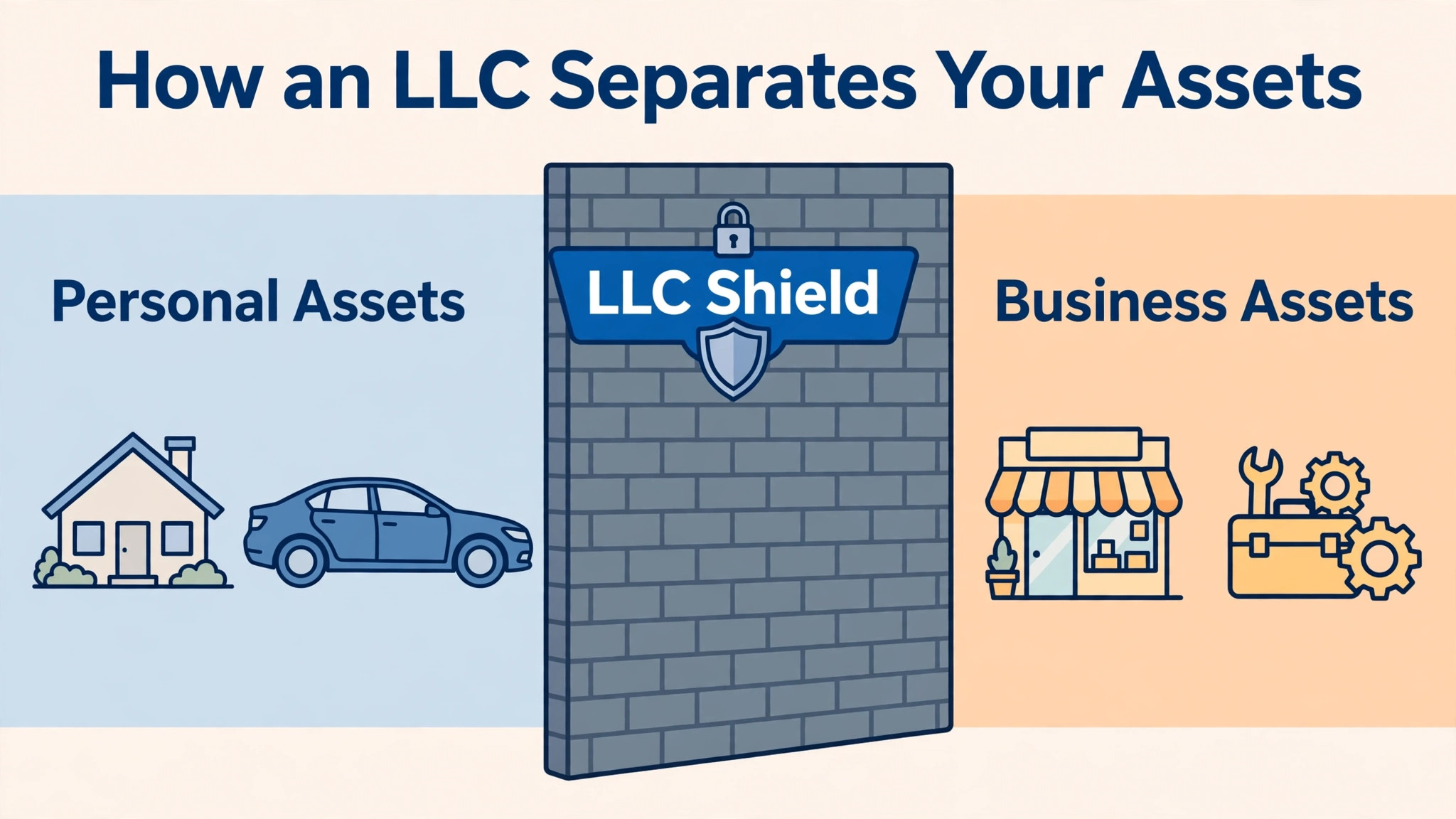
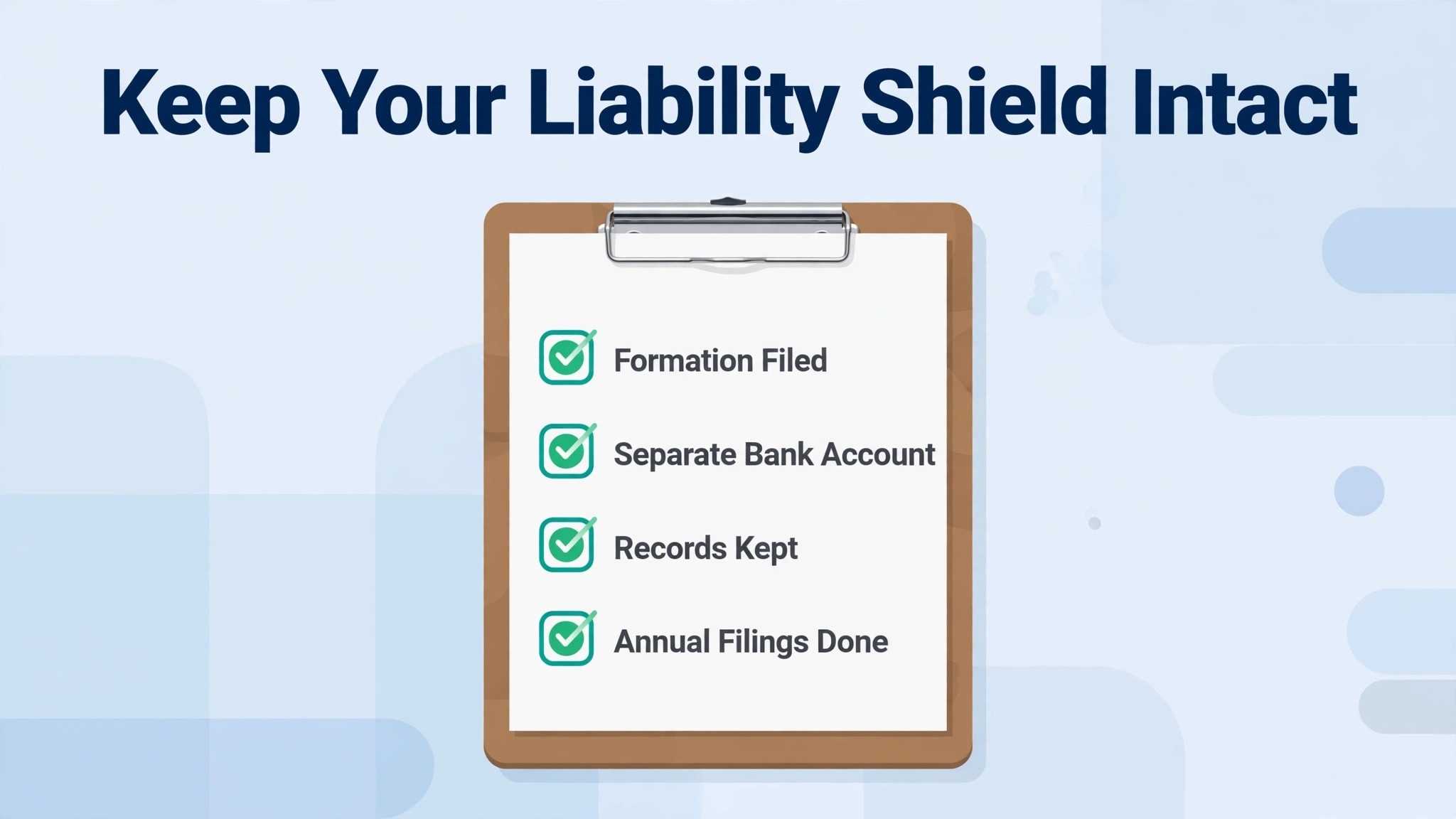
Liability protection in this table comes with a condition that matters. A limited liability company or corporation protects owners only if the owner maintains the separation, keeps business money apart from personal money, signs contracts in the business name, and avoids personal guarantees. Mixing funds, signing personally, or committing wrongful acts can weaken or remove the protection. The entity gives you a shield, but your habits decide whether the shield holds.
Tax treatment follows a similar pattern. Pass through structures tax profit once, at the owner level. A C corporation taxes profit at the corporate level, and then taxes dividends again when profit reaches shareholders, which is why the C corporation suits firms that retain profit for growth or plan to raise investment, rather than firms that distribute most profit to owners each year. The S corporation election keeps pass through treatment while changing how owner income is split, which is where its tax benefit comes from.
Sole Proprietorship, the Default Starting Point
A sole proprietorship is what you are by default when you start doing business on your own without registering another structure. You do not file a formation document to create it, and the Small Business Administration describes it as the simplest structure with the fewest regulations. That simplicity is its main advantage, and it suits testing an idea, freelancing part time, or running a low risk service with no staff and no significant contracts.
The cost of that simplicity is unlimited personal liability. You and the business are the same legal person, so business debts and claims reach your personal assets. For a low risk service with no employees, no premises open to the public, and no physical products, that risk may be acceptable for a testing period. For work involving client property, physical products, food, children, health, or staff, the risk grows quickly, and the testing period should be short.
Tax treatment is straightforward. You report business income and expenses on Schedule C attached to your personal return, and net earnings are generally subject to self employment tax at 15.3 percent on 92.35 percent of net earnings, plus income tax. That means you pay self employment tax on essentially all profit, which becomes expensive as profit grows. Keep clean records from day one, set aside money for tax with each payment received, and pay estimated tax where required, since a sole proprietor has no employer withholding tax for them.
Move on from a sole proprietorship when any of three triggers appears. Revenue becomes steady rather than occasional, a contract or client requires a formal entity, or the work creates liability that could reach personal assets. Many owners make the move when annual profit passes the range where the tax and liability analysis starts to favour a limited liability company, which the next section covers in detail. Recognising those triggers early is part of how to choose a business structure small business owners revisit as the business grows, rather than deciding once and never looking again.
Limited Liability Company, the Flexible Middle
A limited liability company creates a legal separation between you and the business, so owners, called members, are generally not personally liable for business debts and claims, provided formalities are maintained. You register with your state by filing articles of organisation, and the filing fee varies widely by state, commonly from around 50 dollars to several hundred dollars, with some states charging an annual tax regardless of income. California, for example, has a well known minimum annual franchise tax of 800 dollars, so confirm your state position before assuming the cost is small.
Tax treatment by default is pass through, which keeps the simplicity of the sole proprietorship while adding liability protection. A single member company is taxed like a sole proprietorship unless it elects otherwise. A multi member company is taxed as a partnership unless it elects otherwise. That default is why many advisers describe the limited liability company as the best starting entity for a growing small business. You gain the shield without changing your tax return in the first year.
The company also offers tax flexibility later. A limited liability company can elect S corporation tax treatment when profit reaches the level where the election saves more than it costs, which the tax section below explains. It can also elect C corporation treatment if the growth plan changes. That flexibility means the entity you form at 40,000 dollars of profit can still serve you at 200,000 dollars of profit, with a tax election change rather than a full restructuring.
Admin is real but manageable. Keep a written operating agreement even if your state does not require one for a single member company, because it records ownership, decision rights, and what happens if a member leaves. Keep a separate business bank account, sign contracts in the company name, and file the state annual report and fee on time. Those four habits are what keep the liability shield credible, and they cost far less than the protection they preserve. Owners learning how to choose a business structure small business advisers recommend often start here, since the limited liability company gives the most protection for the least extra paperwork.
Corporations and the S Corporation Election
A corporation is a separate legal person owned by shareholders, run by directors and officers, and governed by bylaws, board meetings, and minutes. That formality is a burden for a small firm, but it is also the reason investors and larger partners prefer it. Shares can be issued, ownership can be transferred cleanly, and the governance structure is familiar to banks, investors, and acquirers. A corporation suits a business that plans to raise outside capital, offer equity to key staff, or grow into a larger organisation with formal governance.
A C corporation pays tax at the corporate level, and shareholders then pay tax on dividends, which creates two layers of tax on distributed profit. That double layer makes the C corporation a poor choice for a small firm that distributes most profit to owners each year. It becomes attractive when the firm retains profit to fund growth, when it plans to raise venture investment, or when it expects to be acquired, since buyers and investors understand the structure and the tax treatment is predictable at scale.
The S corporation election changes the tax picture without changing the legal entity. A qualifying corporation or limited liability company can elect S treatment, under which profit passes through to owners, but owner employees must be paid a reasonable salary, with remaining profit available as distributions. Salary is subject to payroll taxes, while distributions are not subject to self employment tax, which is where the saving comes from. The election also brings limits, including a cap of 100 shareholders, one class of stock, and eligible shareholder rules, so it suits domestic small firms with a simple ownership structure.
Choosing the election is a numbers decision, not a status decision. The saving must exceed the added compliance cost, which commonly runs from around 1,500 dollars to 3,000 dollars a year for payroll, an extra tax return, and accounting support. Many advisers use a rough threshold of around 60,000 dollars of annual profit before the election typically pays, with the range of 40,000 to 60,000 dollars as the zone where the calculation should be run properly.
Confirm the figures for your own profit, salary, and state with your accountant, since the threshold moves with your facts. This calculation is where guidance on how to choose a business structure small business owners find most useful turns into a personal answer, because the same profit figure produces a different result in different states and salary situations.
Partnerships, and Why a Written Agreement Matters
Two or more people running a business without registering an entity form a general partnership by default, whether they intended to or not. That default carries unlimited personal liability for the partners and pass through taxation on a partnership return. It also carries a serious practical risk, because each partner can bind the partnership, and disputes over money, decisions, and exits have no written rules to resolve them. A partnership without an agreement is a common source of expensive conflict.
A written partnership agreement, or a limited liability company operating agreement for a multi member company, should cover capital contributions, profit splits, decision rights, what happens if a partner leaves or dies, and how disputes are resolved. Those clauses feel awkward to discuss at the start of a friendly venture, and they are exactly the clauses that save the venture when circumstances change. Take legal advice on the agreement before money and clients are involved, not after a disagreement has started.
Limited partnerships and limited liability partnerships add liability variations for specific situations, particularly professional firms in states that permit them. A limited partner who does not manage the business can have limited liability, while a general partner retains management and liability. Professional firms should check their state licensing and liability rules, since the right partnership form varies by profession and by state. For most small multi owner service firms, a multi member limited liability company with a strong operating agreement is the simpler and more protective route.
The Tax Picture in Plain Numbers
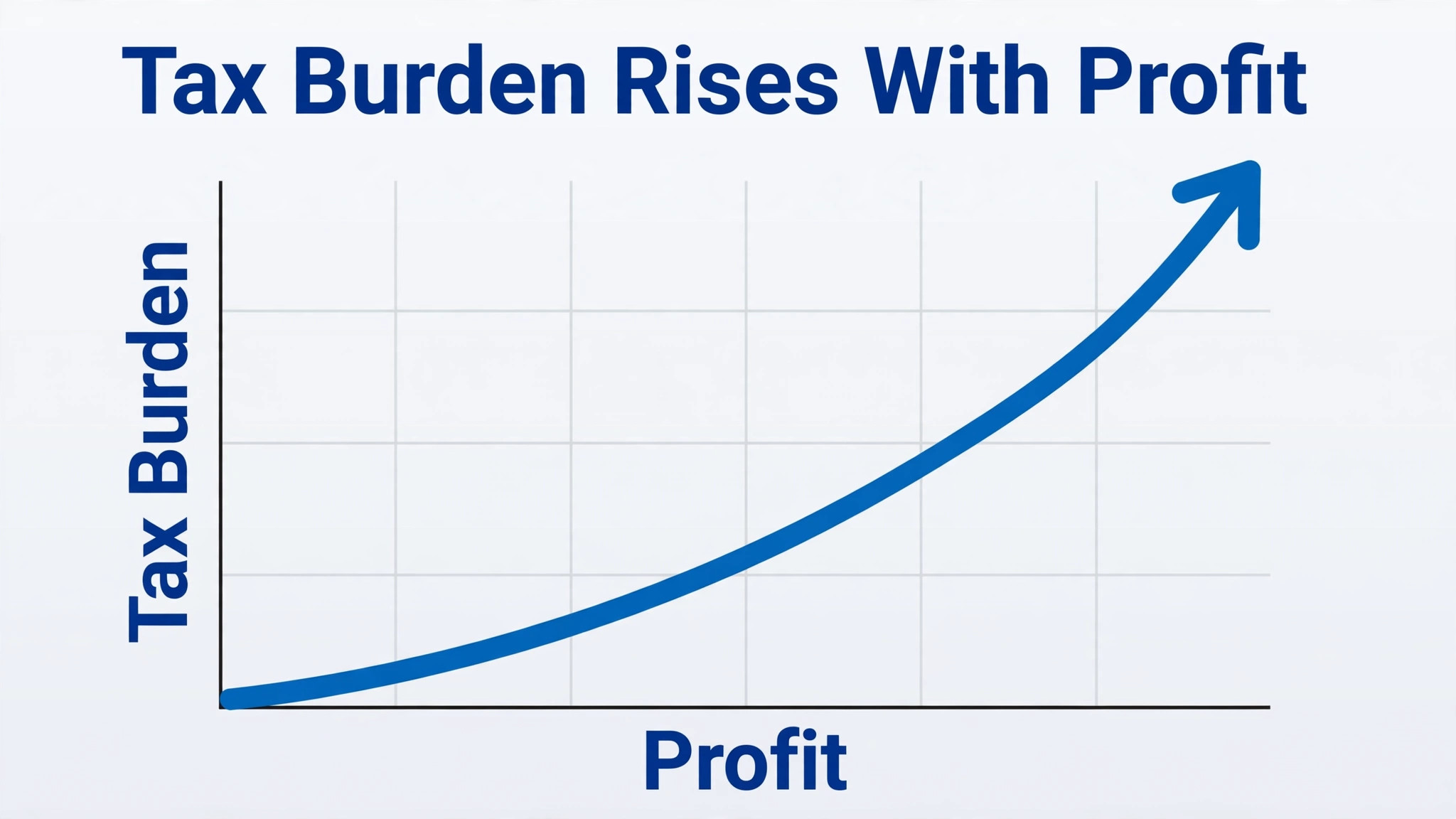
Tax is where structure choices show up in real money, so work through the picture with your own figures rather than copying a threshold from a guide. As a sole proprietor or a default limited liability company member, you pay self employment tax on profit, which at 15.3 percent on 92.35 percent of net earnings works out to roughly 14.1 percent of profit before income tax. On 60,000 dollars of profit, that is roughly 8,500 dollars of self employment tax, plus income tax on the profit. That burden is the reason profitable owners look closely at the S corporation election.
Under an S corporation election, only the salary portion is subject to payroll taxes, while distributions escape self employment tax. Suppose the same 60,000 dollar profit business pays a reasonable salary of 45,000 dollars and distributes 15,000 dollars. Payroll taxes apply to the 45,000 dollar salary, not to the full 60,000 dollars, which saves payroll tax on 15,000 dollars. That saving must then be set against payroll service costs, an extra tax return, unemployment insurance, and accounting fees. At lower profit levels, the costs can exceed the saving, which is why the election is usually a later step rather than a day one step.
State taxes can change the answer again. Some states impose an entity level tax, a franchise tax, or a minimum annual fee that applies regardless of profit, and those charges fall hardest on small firms. Others impose no such charge. Before you form an entity, check your state filing office and your state tax authority for the current fee, the annual report requirement, and any minimum tax, and include those figures in your comparison. A structure that looks cheap federally can be expensive in a particular state, and a structure that looks expensive federally can be cheap where you actually operate.
Keep the tax decision separate from the liability decision. Forming a limited liability company protects personal assets even if you keep pass through taxation, and electing S corporation treatment changes tax without changing liability. Owners sometimes delay forming an entity because they think it complicates tax, when in fact the default tax treatment is unchanged. Form for liability when the risk appears, then revisit tax when profit reaches the level where an election pays. Separating those two decisions is a habit worth building into any approach to how to choose a business structure small business owners can maintain year after year.
Admin Burden, and What You Actually Maintain Each Year
Admin burden is the ongoing cost of a structure, and it is easy to underestimate when you focus only on the formation fee. A sole proprietorship needs a tax return schedule, estimated tax payments, and good records, but no state entity filing. A limited liability company adds a state annual report and fee, an operating agreement to maintain, and separate accounts to keep clean. A corporation adds board meetings, minutes, shareholder records, and a separate corporate tax return, plus payroll if it elects S treatment.
Build a simple annual calendar for whichever structure you choose. Note the state filing deadline, the estimated tax deadlines, the annual report fee, and the date your accountant needs records for the return. Missing a state filing can lead to penalties or loss of good standing, which can weaken the liability position and complicate banking, contracts, and a future sale. A calendar with four or five dates a year prevents most of those problems, and it costs nothing to maintain.
The burden grows with people, not only with entity type. Hiring employees adds payroll tax filings, workers compensation, and employment records under any structure. Taking on partners adds agreement maintenance and profit allocation records. Opening a second location adds registrations and tax accounts in the new jurisdiction. Judge admin burden at the size you expect to be in two years, not only at the size you are today, so the structure still fits after the growth you are planning for.

When to Change Structure, and How to Do It Cleanly
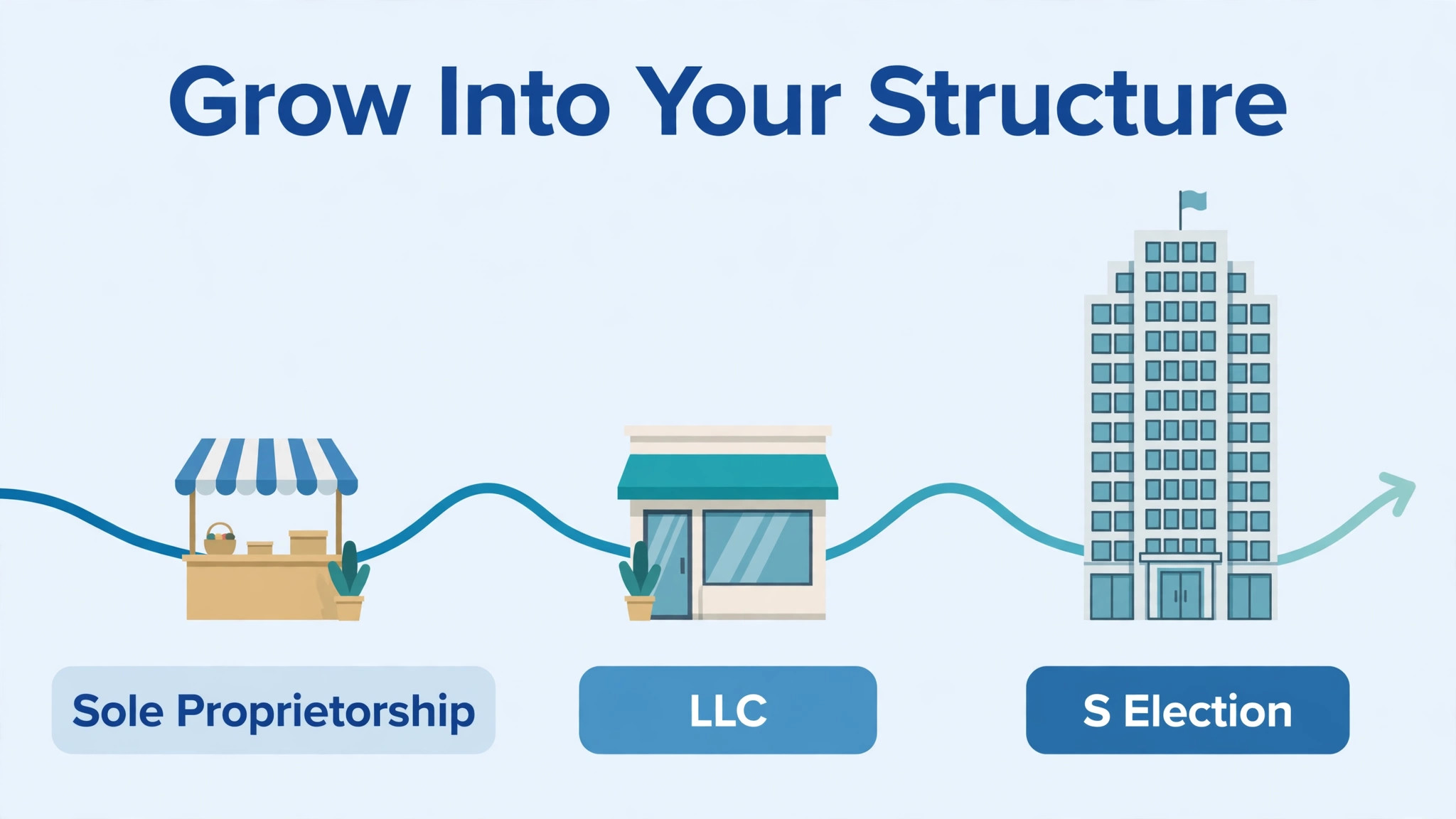
Most businesses change structure at least once, and a change is a sign of growth rather than a mistake. Common triggers include profit passing the S corporation threshold, bringing in a partner or investor, hiring staff for higher risk work, signing a lease or contract that requires a formal entity, or preparing for a sale where buyers prefer a particular entity form. Review your structure once a year with your accountant, and treat the review as routine maintenance rather than a crisis response.
Changing structure has tax and legal steps that need professional advice. Converting a sole proprietorship to a limited liability company is usually straightforward, involving a state filing, a new employer identification number where required, new bank accounts, and updated contracts. Converting to a corporation, or making an S corporation election, involves Internal Revenue Service forms, timing rules, and state filings that must be completed correctly. The election, for example, has a deadline tied to the tax year, so missing it can delay the benefit by a full year.
Update everything else when the structure changes. Notify your bank, your insurers, your key customers and suppliers, and your licensing authorities, and reissue contracts in the new entity name where required. Keep the old records accessible, since tax returns, loan documents, and contracts from the earlier structure may still be needed. A clean change, documented as it happens, protects the liability shield and prevents the administrative gaps that cause problems during a later sale or financing. Planning the change this carefully is part of how to choose a business structure small business owners get right over the life of the business, not only on day one.
Mistakes That Cost Small Business Owners Real Money
The first mistake is choosing on tax alone and ignoring liability. An owner who stays a sole proprietor to avoid a state fee, while doing work that could produce a large claim, risks personal savings to save a few hundred dollars. Liability protection is the reason to form an entity, and tax optimisation comes second. Reverse the order and the saving looks small against the risk it leaves open.
The second mistake is forming an entity and then ignoring it. Owners who mix personal and business money, sign contracts personally, or skip annual filings weaken the very separation they paid to create. A limited liability company that behaves like a sole proprietorship may be treated like one when it matters. The entity is a habit as much as a filing, and the habit is what a court, a lender, or a buyer will examine.
The third mistake is electing S corporation treatment too early, or paying yourself an unreasonably low salary after electing it. An election that costs more in compliance than it saves in tax is a loss, and a salary set artificially low to maximise distributions invites scrutiny from the tax authority. Run the numbers honestly, set a defensible salary from market evidence, and revisit the election each year as profit changes. The right election at the wrong profit level is still the wrong decision.
The fourth mistake is skipping the written agreement in a multi owner business. Friends and family ventures feel too close for formal documents, until a departure, a divorce, a disability, or a disagreement forces the question of who owns what. An operating agreement or partnership agreement written at the start, when everyone is optimistic, is far cheaper than a dispute resolved after trust has broken down. Treat the agreement as part of forming the business, not as an optional extra.
Frequently Asked Questions
Can I start as a sole proprietor and change later?
Yes, and many owners do exactly that. Starting as a sole proprietor costs nothing in formation fees and suits a testing period, then forming a limited liability company when revenue steadies or risk appears is a routine step. The change involves a state filing, updated bank accounts and contracts, and advice on tax timing. The key is to make the move when a trigger appears, rather than drifting for years in a structure that no longer fits the risk. That trigger based approach is the simplest version of how to choose a business structure small business owners can actually follow without overthinking the first step.
Does a limited liability company reduce my taxes?
Not by itself. A single member limited liability company is taxed like a sole proprietorship by default, so the tax bill does not change on formation. What changes is liability protection and flexibility, including the option to elect S corporation treatment later when profit justifies it. Owners who form a company expecting an automatic tax saving are often disappointed, so separate the liability benefit from the tax decision in your planning.
What salary should I pay myself under an S corporation election?
Pay a reasonable salary for the work you actually do, based on market evidence for a similar role in your industry and area. The tax authority expects owner employees to receive reasonable compensation, and a salary set artificially low to maximise distributions invites scrutiny. Gather salary survey data or recruiter estimates, document the basis for your figure, and review it annually as the role and profit change. When in doubt, ask your accountant to test the figure before you rely on it.
Do I need a lawyer to form a limited liability company?
You can file the state form yourself in many states, and the filing itself is straightforward. Legal advice becomes valuable for the operating agreement, for multi owner arrangements, for licensed professions, and for any business with significant contracts or liability exposure. A short legal review of the agreement and the key contracts often costs less than fixing a gap later, so weigh the review against the complexity of your situation rather than treating it as always required or always unnecessary.
How does structure affect raising investment?
Investors generally prefer corporations, because shares, governance, and exit mechanics are standardised and familiar. A limited liability company can raise investment, but the paperwork and tax treatment are less standard, which can slow a deal. If raising outside capital is a realistic goal in the next two years, discuss entity choice with a lawyer and an adviser before you form, since converting later is possible but adds cost and delay at the moment you can least afford it.
How often should I review my business structure?
Review it once a year with your accountant, and again whenever a major trigger occurs, such as bringing in a partner, hiring staff, passing a profit threshold, or planning a sale. Annual review keeps the structure aligned with the business you actually run, rather than the business you ran when you first filed. Owners who review structure as routine maintenance avoid the rushed, expensive changes that happen when a bank, an investor, or a buyer forces the question.
More Reading on Stratilyze
– How to Choose a Business Bank Account as a Small Business – How to Write a Scope of Work as a Small Business – How to Write a One-Page Business Plan as a Small Business