

You have more work than one person can do, and every week you delay the hire, the backlog grows and the quality of the work slips. The question is not whether to get help. The question is which kind of help fits the work, the budget and the risk you are willing to carry. Learning how to hire first employee vs contractor small business starts with that distinction, because the two routes differ in cost, control, paperwork and freedom to change course.
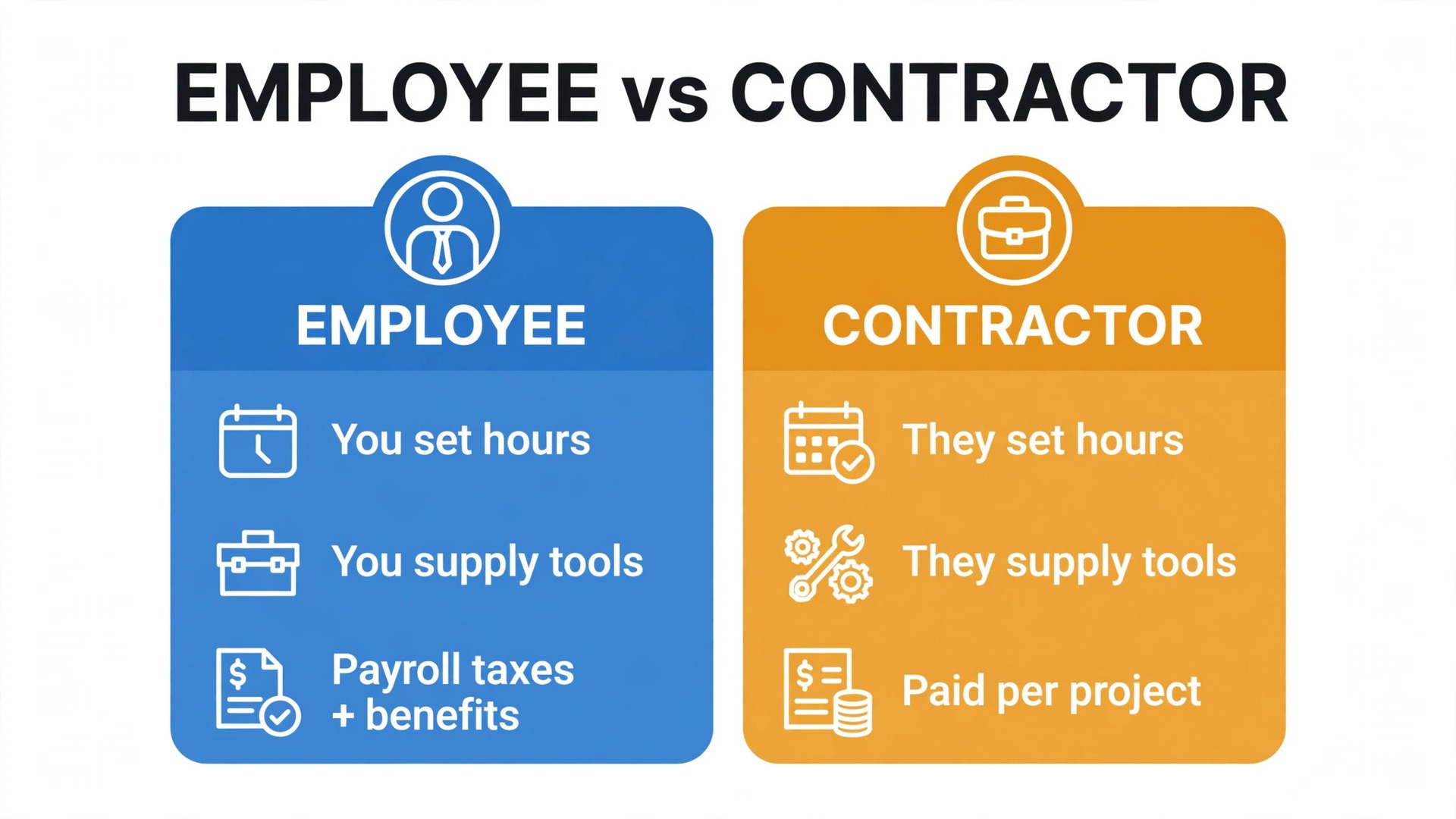
An employee joins your team. You set the hours, you train them in your methods, you supply the tools, and you carry payroll taxes, benefits and legal duties that come with employment. A contractor runs their own business and sells you a result. You agree the outcome, the deadline and the fee, and they decide how the work gets done. Both routes are legitimate. The expensive mistake is choosing one while managing the person as if they were the other.
This guide works through the choice in the order a small owner should make it. First the workload pattern, then the true cost of each route, then the classification rules that limit your freedom, then the hiring steps for each route, and finally the point at which a contractor should become an employee. Worked figures use United States federal rules and published rates at writing time, and state rules can be stricter, so confirm the details for your state before you sign anything.
The Real Difference Between an Employee and a Contractor
The legal difference turns on control. An employee works under your direction. You can tell them when to work, where to work, in what order to do tasks and which tools to use, and you can change those instructions as the work develops. A contractor keeps control of the method. You can specify the result and set quality standards, but the contractor chooses the hours, the sequence and the tools, and may work for other clients at the same time.
The financial difference follows the same line. An employee is paid for time, usually by the hour or by salary, whether the week is busy or quiet, and the business pays the employer share of Social Security and Medicare, federal unemployment tax and usually state unemployment insurance and workers compensation. A contractor is usually paid by the project or by an agreed deliverable, invoices you for the fee, and handles their own taxes, insurance and retirement saving. That is why a contractor day rate often looks higher than an employee hourly wage while the total cost to the business can still be lower.
The commitment difference matters just as much. An employee relationship is open ended and built for ongoing, core work that repeats every week. Ending it involves notice, final pay rules and sometimes unemployment claims. A contractor engagement has a defined end, a defined scope and a clean exit, which suits a spike in work, a specialist task or a trial period before a permanent hire. Flexibility is the contractor route’s main gift, and continuity is the employee route’s main gift, and most hiring regrets come from wanting both at once.
How to Hire First Employee vs Contractor Small Business by Workload Pattern
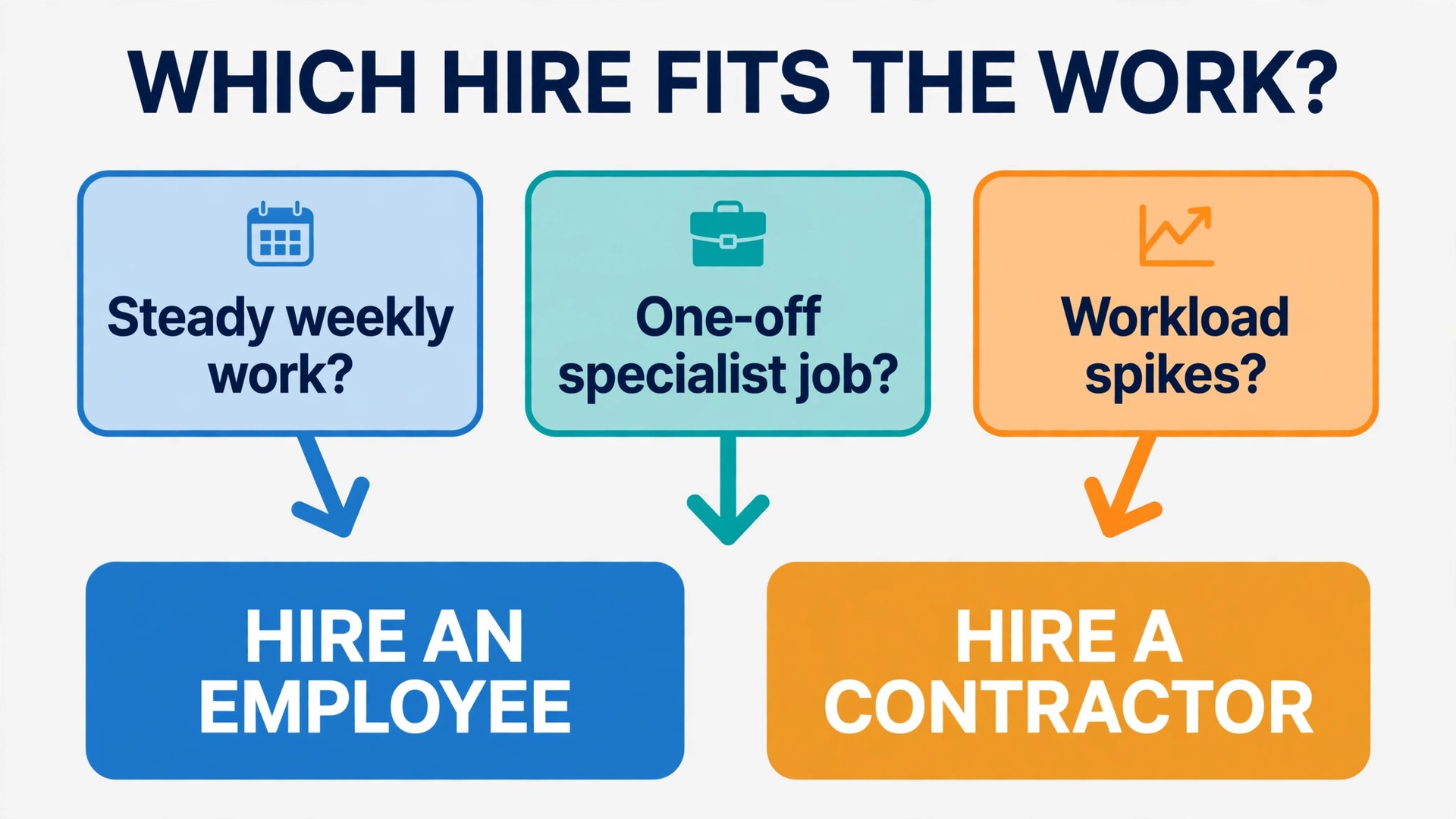
Start from the work, not from the job title. Write down the tasks you need covered over the next six months, how many hours each week they take, whether the volume is steady or seasonal, and whether the work sits at the heart of what you sell. That short inventory answers most hiring questions before any legal analysis begins, and it is the honest basis for learning how to hire first employee vs contractor small business for your own situation rather than copying another owner’s choice.
Steady, core, repeating work points to an employee. If a task needs forty hours every week, must be done in your systems, in your hours and to your standard, and the business stops when it is not done, that is an employee job in practice even if the contract calls the person a contractor. Hiring them as a contractor in that shape does not remove the employment duties. It only hides them until a tax authority, a labour agency or the worker themselves raises the question.
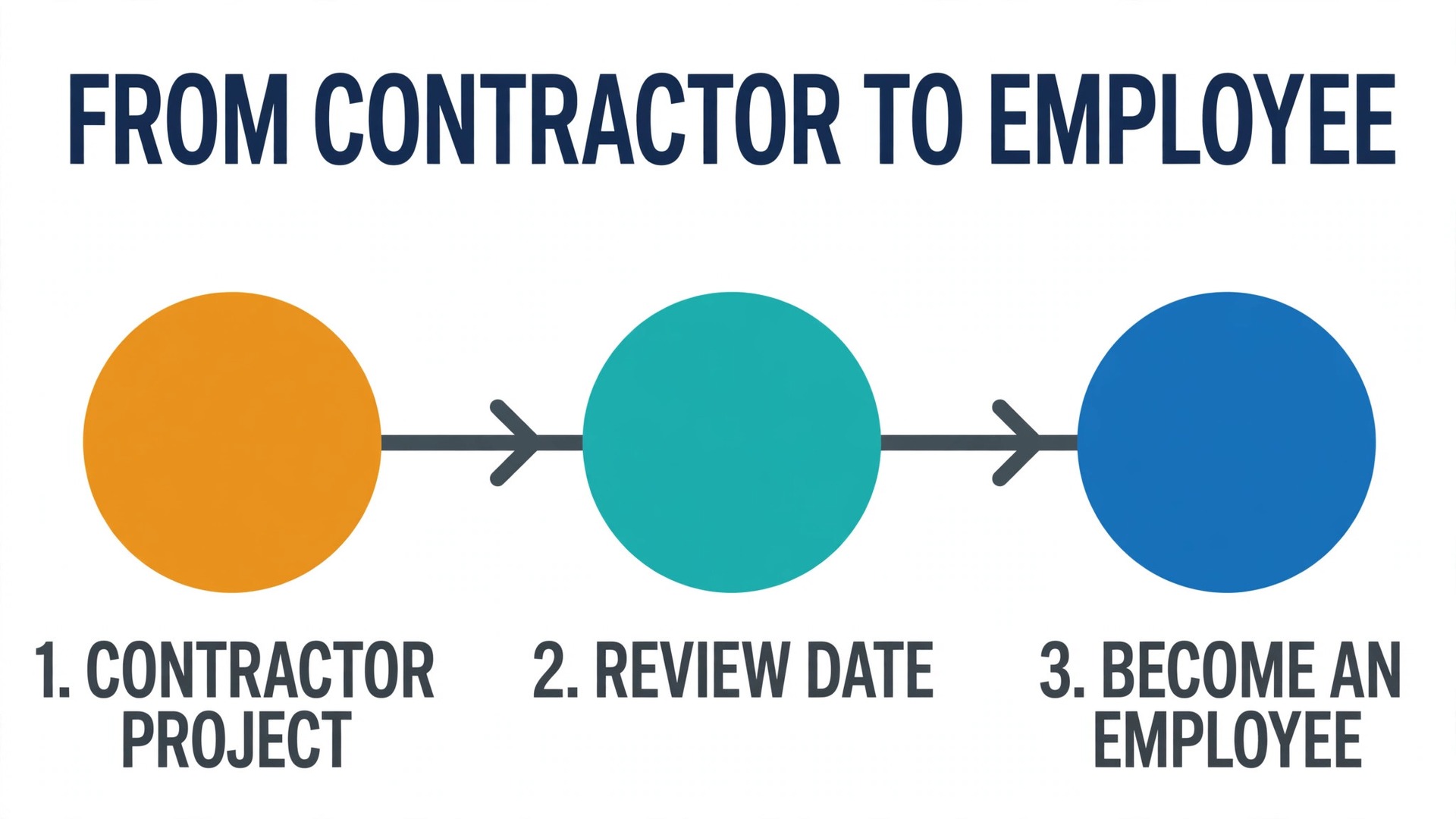
Variable, specialist or project shaped work points to a contractor. A website rebuild, a tax return season, a product launch, a design refresh or a surge of customer support after a promotion all have a natural end and a measurable result. A contractor can start fast, bring specialist skill you do not need full time, and step away when the project ends without a redundancy process. The same logic covers a trial. A three month contractor project that tests both fit and demand is a sensible step before a permanent hire.
Seasonal work sits between the two and deserves a deliberate choice. A business that doubles for four summer months can use seasonal employees for front line roles that need training and supervision, and contractors for specialist peaks such as extra delivery capacity or event support. The deciding test is control. If the seasonal worker must follow your rota, wear your uniform and use your process, the employee route fits the reality, and the seasonal contract should say so plainly.
| Workload pattern | Better route | Why it fits |
|---|---|---|
| Steady core work, 30 plus hours a week | Employee | Ongoing need, your systems, your hours |
| Short project with a clear result | Contractor | Defined scope, defined end, specialist skill |
| Seasonal surge, supervised front line roles | Seasonal employee | Rota control and training matter most |
| Seasonal surge, specialist capacity | Contractor | Extra capacity without permanent headcount |
| Uncertain demand, testing a new service | Contractor first | Trial the demand before a permanent commitment |
| Growing steadily past the trial stage | Employee | Continuity, training investment and loyalty pay off |
What Each Route Costs in the First Year
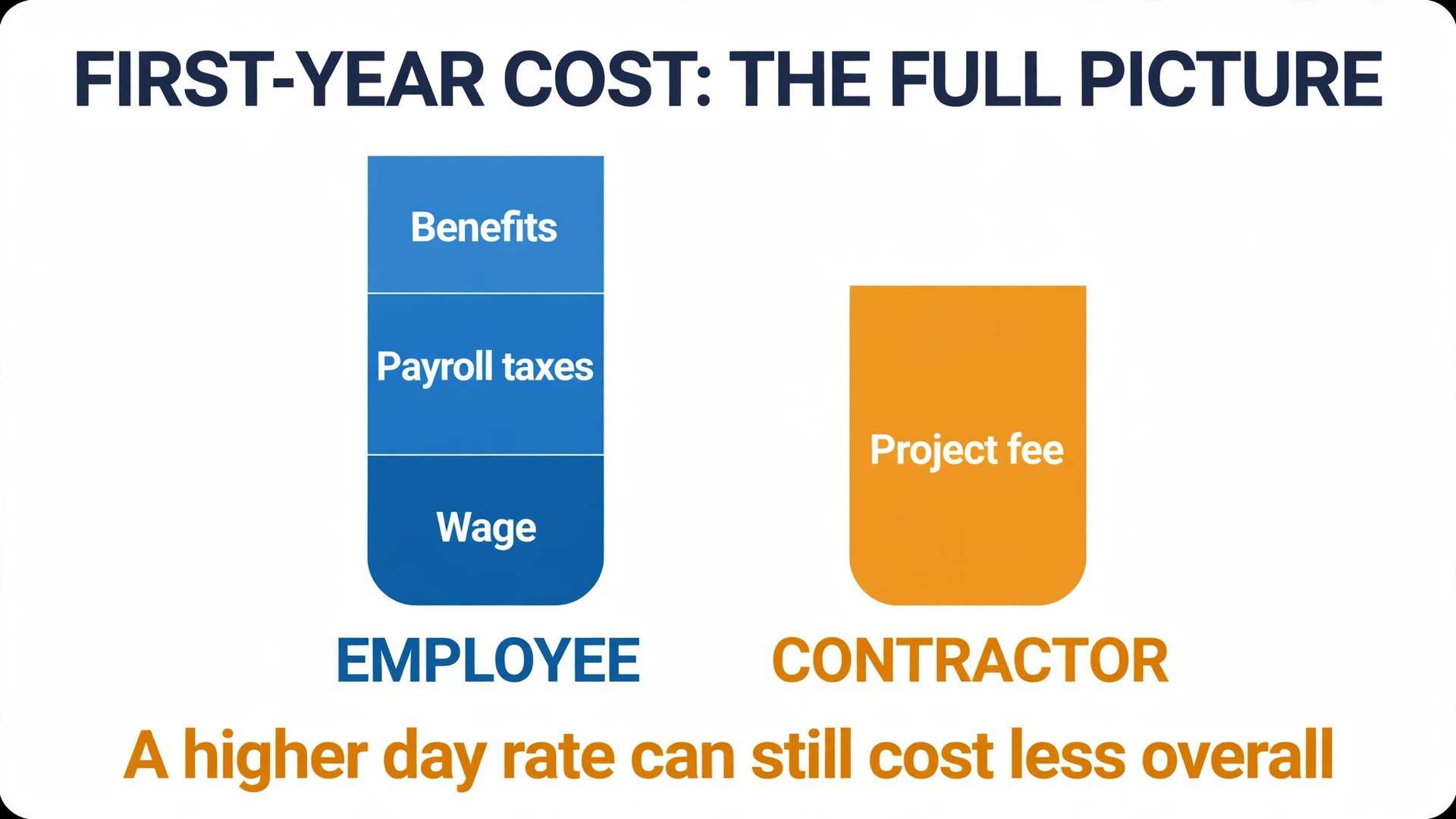
The contractor quote usually looks simple. You agree a fee, you pay the invoice, and there is no payroll run, no benefits administration and no employer tax deposit. The employee cost looks larger because it arrives in more lines, and owners who compare a contractor day rate with an employee hourly wage without adding the employer lines will misread the comparison badly.
Take a worked example. An employee paid 25 dollars an hour for 40 hours a week earns 52,000 dollars a year. The employer share of Social Security and Medicare adds 7.65 percent, which is about 3,978 dollars. Federal unemployment tax at the net 0.6 percent rate on the first 7,000 dollars of wages adds 42 dollars, and state unemployment insurance, workers compensation and any benefits or paid leave add further amounts that vary by state and industry. A realistic loaded cost for that employee therefore lands in the region of 58,000 to 65,000 dollars before equipment, training and management time, and you should confirm the state figures for your own case.
A contractor doing similar work might charge 50 to 75 dollars an hour, which sounds far higher, yet the business pays only for hours actually delivered, with no payroll taxes, no paid leave and no benefits. At 20 hours a week for 40 weeks, a contractor at 60 dollars an hour costs 48,000 dollars, which is less than the loaded employee cost, but the business gets half the hours and no cover for absence. At 40 hours a week for 48 weeks, the same contractor costs 115,200 dollars, which is far more than the employee. The comparison only works when you price the same hours, the same weeks and the same output.
Hidden costs sit on both sides, and a careful reading of how to hire first employee vs contractor small business must price them on both routes. An employee needs recruitment, onboarding, training, equipment, software seats and management time, and a bad hire costs months of salary before the problem is faced. A contractor needs briefing, review and coordination time, and a contractor who juggles several clients may be unavailable in your busiest week. Price the management hours honestly on both routes, because a cheap hire that eats ten owner hours a week is not cheap.
The Classification Tests That Decide the Answer
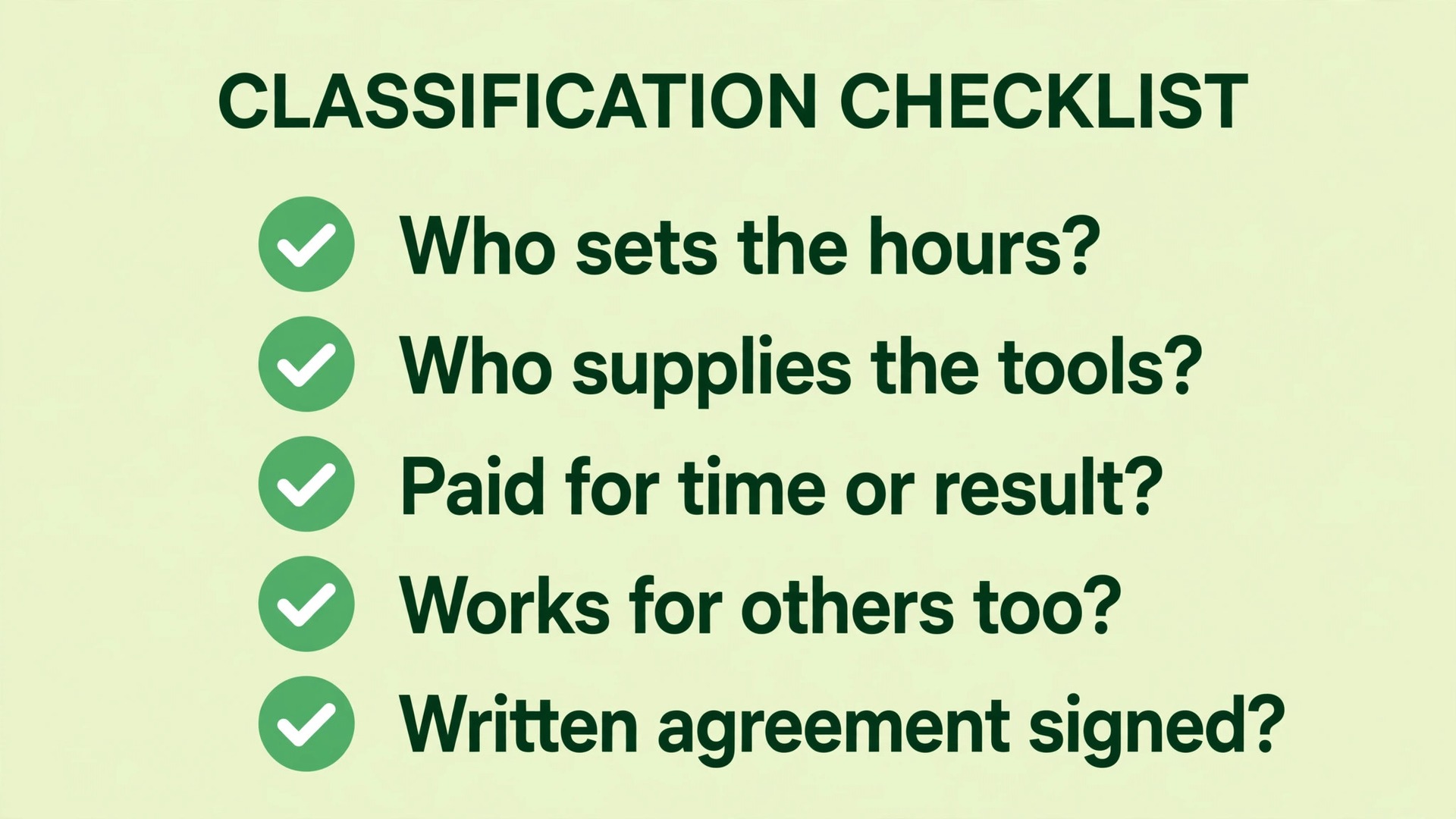
You do not get to choose a worker’s status by writing a label on a contract. Tax authorities look at the reality of the working relationship, and the contract is only one piece of evidence. In the United States the Internal Revenue Service applies a common law test with three categories of evidence, and getting any one of them badly wrong can reclassify the worker.
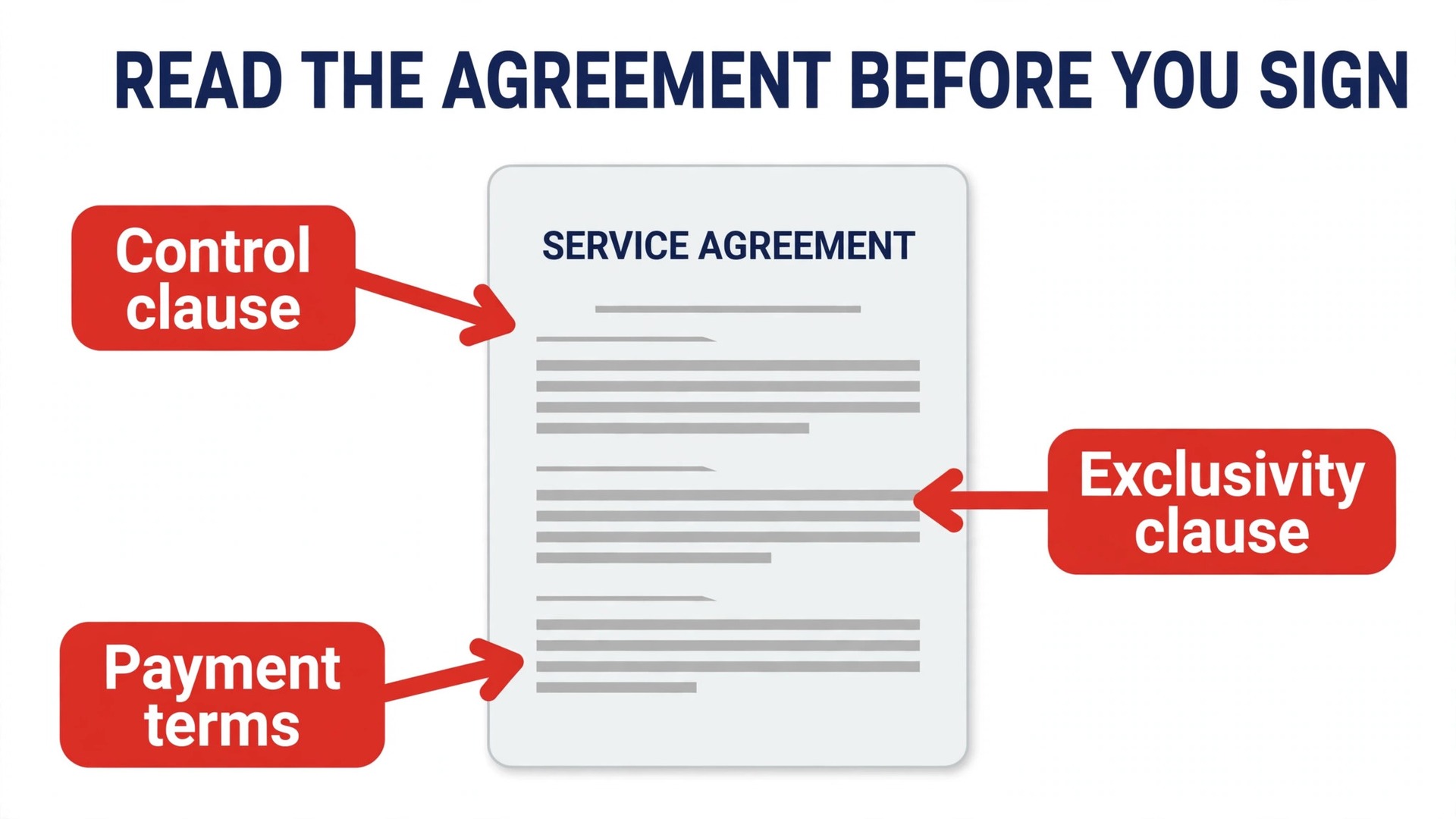
Behavioral control asks who directs how the work is done. Detailed instructions on when, where and how to work, required training in your methods, a set sequence of tasks and tools you supply all point to employment. A contractor relationship points the other way when the worker sets their own methods, works to a result rather than a process, and uses their own judgment and equipment. The right to control matters even if you rarely use it, so a contract that reserves detailed control while calling the person a contractor is a risk, not a protection.
Financial control asks who carries the economic risk. Payment by the hour or by salary points to employment, while payment by the project, with the worker able to profit from efficiency or lose money from overruns, points to contracting. A worker who invested in their own equipment, advertises to the public, serves several clients and bears unreimbursed expenses looks like an independent business. A worker who uses only your tools, has no other clients and is paid regardless of result looks like an employee.
The type of relationship asks what the arrangement means in practice. Written contracts help, but benefits such as paid leave or health cover, an open ended engagement and work that sits at the core of the business all point to employment. The Department of Labor applies its own economic reality test for wage and hour law, and several states apply stricter ABC tests that presume employment unless the business proves all three parts, which are freedom from control, work outside the usual course of the business, and an independently established trade. A worker can therefore pass one test and fail another, so check federal, state and wage rules together.
The cost of getting this wrong is real, and it is the risk that makes learning how to hire first employee vs contractor small business worth the effort. A business that treats an employee as a contractor without a reasonable basis can be liable for the employment taxes it should have withheld, plus interest.
State agencies can add unemployment contributions and penalties on top of the federal bill. When the answer is genuinely unclear, either side can file Form SS-8 and ask the Internal Revenue Service for a determination, although that process can take six months or more. A business that wants to correct past treatment can look at the Voluntary Classification Settlement Program, which offers partial relief on federal employment taxes for reclassifying workers as employees. Take professional advice before filing anything, because the filing itself creates a record.
Control, Compliance and Flexibility Compared
The decision table below is the heart of this guide. Read it row by row against your workload inventory, and notice where your situation pulls in two directions at once. A row that points to employee while your budget points to contractor is not a contradiction to ignore. It is the tension you must resolve deliberately, either by reshaping the work so the contractor route is genuine, or by accepting the employee cost for the control you need.
| Factor | Employee | Contractor |
|---|---|---|
| Cost shape | Salary or hourly pay plus employer taxes and benefits | Project or deliverable fee, no payroll taxes |
| Control over method | Full direction on hours, sequence and tools | Control over result and quality standards only |
| Compliance load | Payroll, withholding, unemployment, workers compensation | Invoice, year end information return, contract |
| Flexibility to scale down | Notice periods, final pay rules, morale cost | Engagement ends at scope or term end |
| Continuity and loyalty | Training investment stays in the business | Knowledge leaves when the engagement ends |
| Availability in a crisis | Rota and duty expectations apply | Depends on the contract and other clients |
| Best workload fit | Steady core work | Projects, peaks and specialist tasks |
Compliance load deserves a plain warning. Payroll is a repeating duty with deadlines, and missing a deposit or a filing creates penalties that dwarf the saving from doing it late. Contractor administration is lighter, but it is not zero. Payments of 2,000 dollars or more in a year to a contractor for 2026 work trigger a 1099-NEC information return under the new threshold reported for 2026, and the threshold rises with inflation from 2027, so track contractor payments through the year rather than reconstructing them in January. Keep contracts, invoices and payment records for every contractor, because those records are your evidence if status is ever questioned.
Flexibility also cuts both ways. A contractor can be engaged in days, while a good employee search takes weeks, and that speed matters when a project deadline is near. Yet a contractor can also leave at the end of the term, taking knowledge and client familiarity with them, while an employee who grows with the business becomes more valuable every year. Businesses that need speed now and continuity later often start with a contractor project and convert the role to employment once demand proves steady, which is a legitimate path when the conversion is genuine and documented.
Hiring Steps for the Employee Route
Start with a written role description that states the job, the hours, the place of work, the pay and the outcomes that define success in the first ninety days. A vague role attracts vague applicants and makes a fair probation review impossible. State the must have skills separately from the nice to have skills, because a long wish list screens out good candidates who could learn the smaller items on the job.
Run a structured hiring process even for a first hire. Screen for the must have skills, interview with the same core questions for every candidate, check references, and use a short paid work trial only where it is lawful and genuinely representative of the job. Keep notes on why the chosen candidate won, because a documented process protects the business if a rejected applicant ever questions the decision, and it gives you a template for the second hire.
Set up payroll before the first day, not after the first week, because this administrative step is where learning how to hire first employee vs contractor small business meets reality. That means an employer identification number where required, state tax and unemployment registrations, a payroll system or provider, workers compensation cover, and the new hire forms your state requires, including federal Form W-4 and Form I-9. Agree the pay date, the pay method and the overtime rules in writing, and put the probation terms, notice period and leave entitlements in an offer letter or employment agreement. A first payroll run done calmly before work starts sets the tone for the whole employment.
Onboarding is where a first employee decides whether they joined a real business or a chaotic one. Prepare the equipment, the accounts and the access before day one, plan the first week as training rather than firefighting, and assign a named person for questions even if that person is you. Review progress at thirty, sixty and ninety days against the outcomes in the role description, and say plainly what is working and what must change. Early honesty is kinder and cheaper than a difficult conversation six months late.
Hiring Steps for the Contractor Route
A contractor engagement starts with a scope document, not a handshake. Write the result you need, the deliverables, the deadlines, the fee and payment milestones, who supplies what, how revisions work, and what happens if the work is late or below standard. Add ownership of the work product, confidentiality where it matters, and a clear end date or termination clause. A scope document that both sides sign prevents most contractor disputes before they start, because disputes usually come from different memories of the same conversation.
Choose the contractor on evidence of similar work, not on price alone. Ask for examples, speak to a past client, and run a small paid pilot where the work allows it. A pilot that mirrors the real job reveals communication habits, reliability and quality faster than any sales call, and it gives both sides a low risk way to test fit. Agree the communication rhythm in advance, meaning a weekly update, a shared task list or a short call, so progress is visible without daily supervision that would blur the contractor line.
Protect the contractor status by managing the result, not the method, which is the daily discipline behind how to hire first employee vs contractor small business done properly. Do not set their working hours, do not require attendance at internal team meetings that are really about supervision, do not supply all their tools as a matter of routine, and do not forbid other clients without a genuine confidentiality reason. You can require quality standards, deadlines and progress reporting, and you should. The line is between judging the work and directing the worker, and staying on the right side of it is what keeps the engagement lawful.
Pay on the agreed milestones and keep the paper trail complete. Every invoice should match a deliverable or a milestone, every payment should be recorded against the contractor, and the year end information return should follow from records kept during the year. Review the engagement at its end date and make a deliberate decision to extend, close or convert the role, rather than letting a contractor drift into permanent, supervised, core work by inertia. Drift is how a lawful contractor engagement quietly becomes a misclassification problem.

When to Switch From Contractor to Employee
Conversion is a success signal, not a failure. It usually arrives when the work that started as a project has become a repeating core function, when the hours have grown steady and full time, when you need to direct the method rather than only judge the result, or when the contractor is effectively working only for you and has stopped serving other clients. Any one of those shifts is a reason to review the arrangement, and two together are a strong case for conversion.
Handle the switch as a new chapter, not as a paperwork trick. Tell the contractor plainly why the role is changing, offer the employment terms in writing, and agree a start date that gives both sides time to set up payroll and close the contractor engagement cleanly. Keep the contractor records separate from the employment records, and do not backdate employment or rewrite history. A clean conversion protects the worker too, because employment brings paid leave, unemployment cover and workplace protections that contracting does not.
Some owners resist conversion because the employee cost looks higher, and sometimes the numbers genuinely favour keeping the role contracted. In that case the honest response is to reshape the work so the contractor route stays genuine, by narrowing the scope, restoring the contractor’s control over method, or splitting the work between a contractor project and a part time employee role. What you cannot do is keep full control, steady full time hours and core work while paying contractor rates and hoping nobody notices. The saving is temporary, and the correction, when it comes, arrives with interest and penalties attached.
Mistakes That Turn a Contractor Into an Employee Problem
The most common mistake is writing “independent contractor” on a contract and then managing the person like staff. Required hours, daily supervision, mandatory training in your methods, company email and systems for everything, and exclusivity without a genuine reason all point to employment regardless of the contract title. If you need that level of control, hire an employee and accept the cost, because the control is what you are actually buying.
The second mistake is paying by the hour indefinitely for core work. Hourly pay for open ended, repeating tasks, with no project end and no deliverable milestones, looks like wages in everything but name. If the work has no natural end, define one, or convert the role. The third mistake is letting an engagement drift. A three month project that quietly extends to eighteen months, with the contractor now attending team meetings and following your rota, has changed its nature even though nobody signed anything new. Put a review date in every contractor agreement and honour it.
The fourth mistake is skipping the records, and it is the easiest one to avoid once you understand how to hire first employee vs contractor small business as a documented process. No contract, no scope document, no invoices tied to deliverables and no payment tracking leaves the business with nothing to show an authority except a bank transfer and a hope. Records are cheap insurance, and they also make the business easier to run, because a contractor with a clear scope and a clear payment record is a contractor who can be managed without daily supervision. Keep the file complete from day one, and the classification question, if it ever comes, has an answer supported by evidence.
Frequently Asked Questions
Can I hire someone as a contractor first and decide later?
Yes, and it is often the sensible route when demand is uncertain. Agree a defined project with a result, a deadline and an end date, manage the result rather than the method, and review the arrangement at the end date. If the work has become steady, core and supervised, convert the role to employment rather than extending the contractor terms indefinitely, because drift is what creates classification risk.
How much does a first employee really cost beyond salary?
Beyond gross pay, budget the employer share of Social Security and Medicare at 7.65 percent, federal unemployment tax at the net 0.6 percent rate on the first 7,000 dollars of wages, plus state unemployment insurance, workers compensation and any benefits or paid leave you offer. For a 52,000 dollar salary, a realistic loaded cost lands in the region of 58,000 to 65,000 dollars before equipment and training, and state figures vary, so confirm them for your state.
Does a written contractor agreement protect me from reclassification?
It helps, but it does not decide the matter on its own. Authorities look at the reality of the relationship, including control over method, payment structure, exclusivity and whether the work is core to the business. A strong agreement that matches a genuinely independent working pattern is good evidence. An agreement that says contractor while the daily reality says employee will not protect the business.
What is the difference between the IRS test and state tests?
The Internal Revenue Service applies a common law test based on behavioral control, financial control and the type of relationship. The Department of Labor applies an economic reality test for wage and hour law, and several states apply stricter ABC tests that presume employment unless the business proves freedom from control, work outside the usual course of the business, and an independently established trade. A worker can pass one test and fail another, so check all three layers.
When should I take professional advice on a hire?
Take advice before the hire when the role is borderline, when the worker will be based in a state with a strict ABC test, when the engagement is high value or long term, or when you are correcting a past classification. Advice before signing is far cheaper than advice after an agency inquiry, and a short review of the contract and the working pattern usually settles the question quickly.
Can a contractor work only for my business?
A contractor who serves only one client for a long period looks more like an employee, especially when combined with set hours and close supervision. Exclusivity is not fatal on its own, and a genuine confidentiality or non compete reason can justify limits, but a contractor with no other clients, no independent business presence and no control over method will struggle to pass a classification test. If exclusivity is essential, employment is usually the honest route.
The Decision to Make This Week
For most small businesses, the rule is simple. Steady, core, supervised work deserves an employee, and the cost of payroll, taxes and benefits is the price of control, continuity and loyalty. Project shaped, specialist or genuinely variable work deserves a contractor, and the higher day rate is the price of speed, flexibility and a clean exit. The wrong choice in either direction costs more than the right choice, because a contractor managed like staff creates legal risk, and an employee hired for a short project creates fixed cost without lasting need.
Write the workload inventory today, price both routes for the same hours and the same output, and check the classification reality honestly rather than by contract label. That short exercise is the practical core of learning how to hire first employee vs contractor small business, and it turns a stressful guess into a decision you can explain to an accountant, an agency or yourself. Hire the help the work actually needs, document the arrangement properly, and review it when the work changes, because the right structure today may need converting tomorrow as the business grows.
More Reading on Stratilyze
These related guides cover the payroll, scheduling and proposal tools that sit around a first hire.
– Cost of Gusto for a Small Business Monthly – Best Employee Scheduling Software for Restaurants – Best Proposal Software for Freelancers