
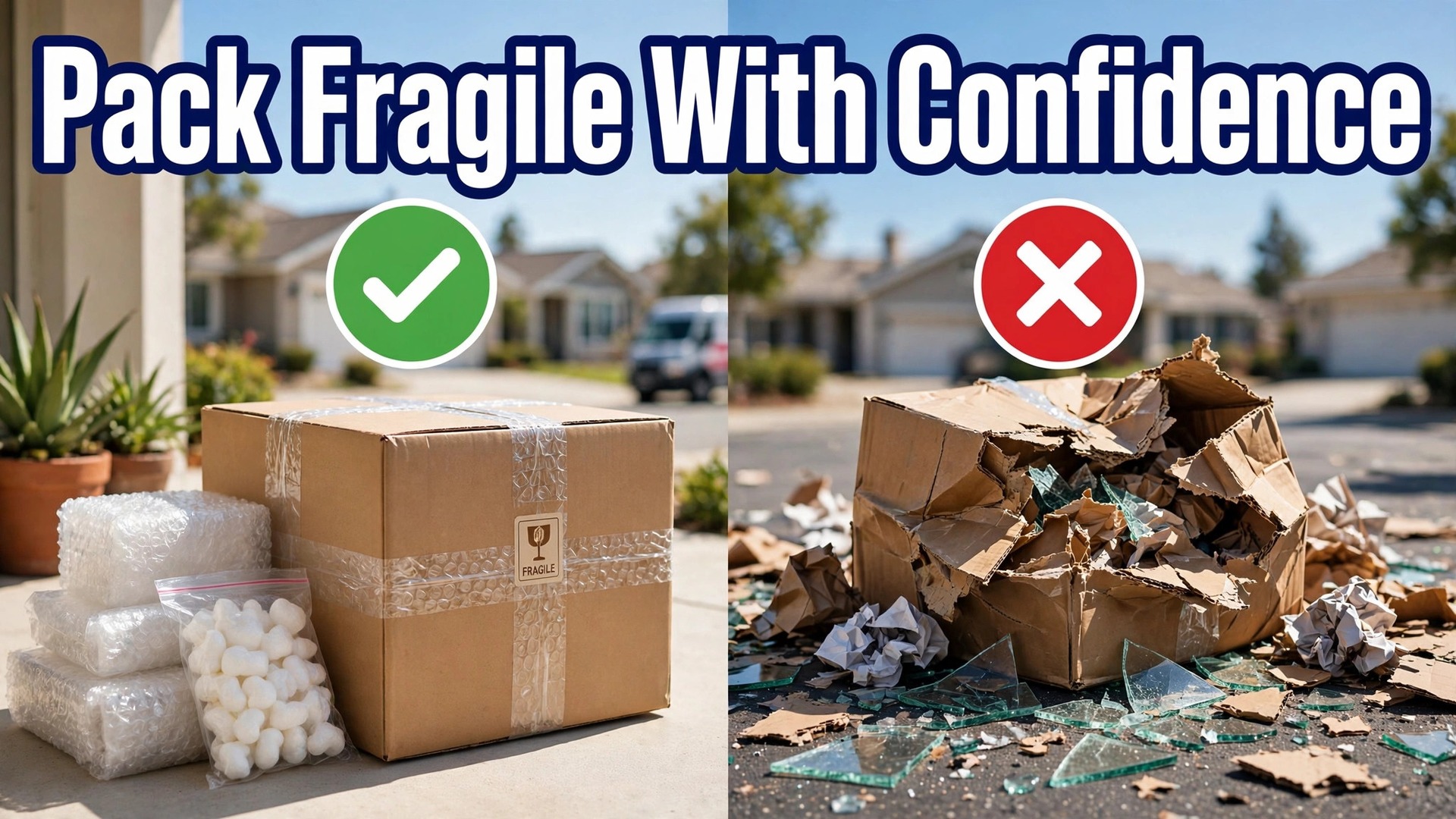
Two parcels leave the same small shop, both containing glass. One arrives intact because it was wrapped individually, floated in three inches of cushioning, double boxed, and taped in an H pattern. The other arrives broken because it was wrapped together with a second item, placed in a box only slightly larger than the glass, and filled with a handful of loose paper that left the item free to move. The difference was never the fragile label, because handlers cannot protect a parcel whose packing already allows movement. If you want to learn how to ship fragile items small business customers trust you with, pack for movement, flex, and impact, not for the label.
Fragile shipping fails in three predictable ways, and a good packing method addresses all three at once. First, the item moves inside the box, so it strikes the wall or another item during handling. Second, the box flexes or crushes, so force reaches the item even when the item itself did not move. Third, the cushioning is thinner than the carrier packing guides ask for, so a normal drop or stack overwhelms the protection. Fix those three failures, and most breakage disappears, even without expensive materials or a professional packing service.
This guide shows how to ship fragile items small business owners can pack, giving you a complete fragile shipping method for a small business. It covers the core packing method, a packaging specification by item type, labelling and carrier choices, liability and insurance limits as reported in guides, photo evidence, and a claims file that makes a damage claim worth filing. Where a figure is reported from a third party guide rather than a carrier page, this guide says so plainly, and carrier rules should be confirmed on the carrier page before you ship, because rules and limits change.
How to Ship Fragile Items Small Business Owners Can Pack With Confidence
The method below works for most fragile parcels, and the item specific section that follows adjusts it where a product needs different protection. Learn the core method first, because a shop that masters it can pack a new product type safely by changing one or two details, rather than inventing a new method for every order.
- Protect the surface first where bubble wrap should not touch it directly, using a cover sheet, a sleeve, or a film layer as the item requires.
- Wrap every piece individually in bubble wrap, with the flat side against the item where applicable, and tape the wrap to itself rather than to the piece.
- Place the wrapped item in a sturdy box with two to three inches of firm cushioning on every side, including top and bottom, and fill every void so nothing shifts.
- Close the box, shake it gently, and listen. If anything moves or rattles, open the box and add cushioning until the parcel is silent and firm.
- Double box anything you would be sorry to lose, placing the wrapped inner box inside a larger outer box with three inches of cushioning all the way around.
- Tape the centre seam and both edge seams in an H pattern with wide packing tape, place the label on the largest face away from the seams, and place a second label inside the box.
That sequence is short enough, in learning how to ship fragile items small business packing benches must follow, to teach to a new packer in one shift, and it is strict enough to catch the errors that cause most claims. A packing station that follows it, with the right box sizes and cushioning within reach, will produce consistent parcels, while a packing station that relies on each packer judgement will produce a different standard on every shift.
Why Fragile Parcels Break
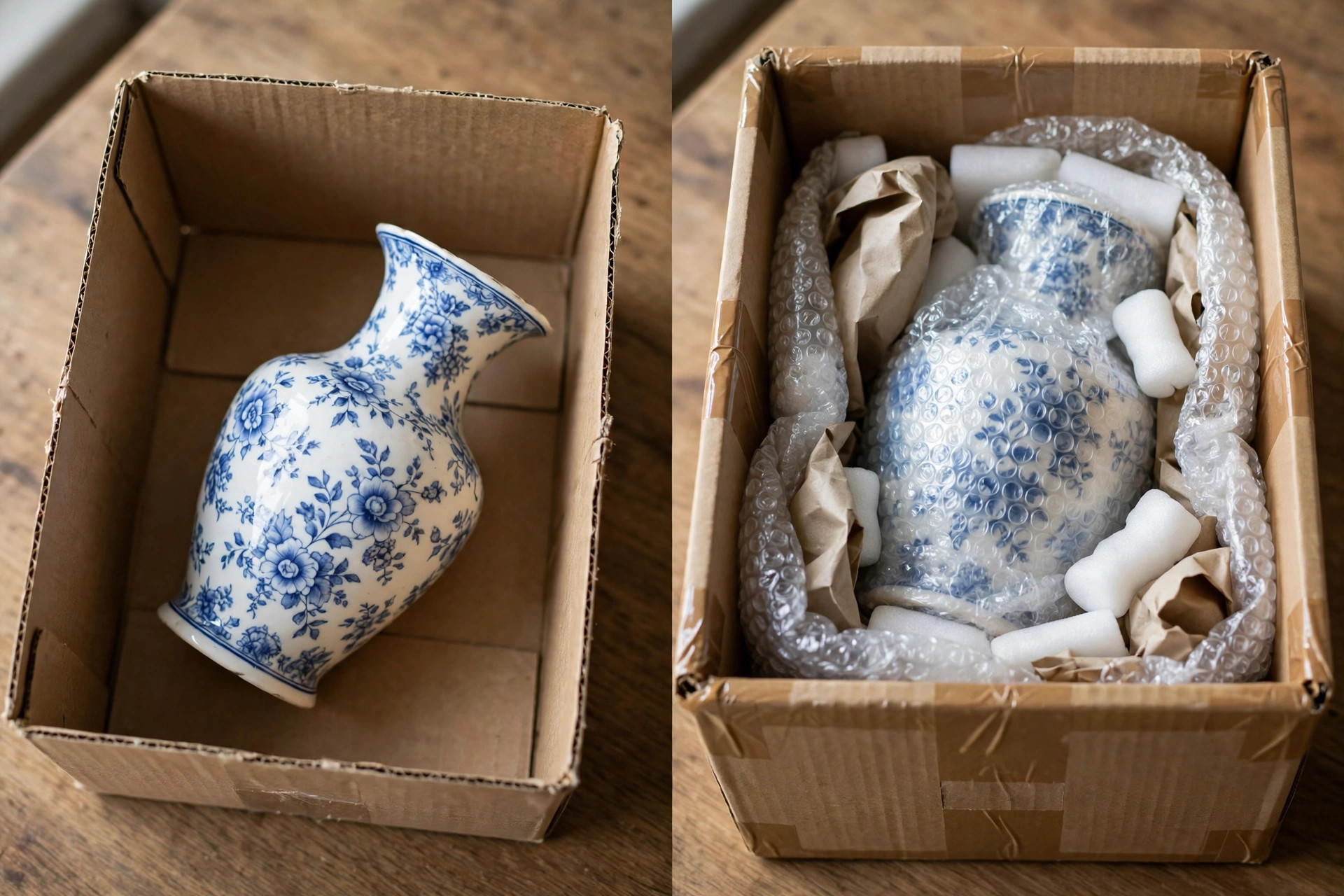
Box strength and cushioning thickness
Box flex is the second failure, and it happens when a single wall box is used for a heavy or high value fragile item, or when a used box with weakened flaps is reused for a shipment it can no longer protect. Use a new, sturdy box for fragile shipments, and use a double wall box for heavier items, for items over about ten pounds, and for any parcel that will be stacked under other parcels in transit.
Carrier guides commonly recommend two to three inches of cushioning on all sides for fragile items, and FedEx packing guidance reported in guides asks for three inches of cushioning in and around a smaller box when double boxing, so treat three inches as your standard for high value items rather than as an optional extra.
Cushioning choice matters as much as thickness. Bubble wrap protects against impact and surface damage, foam sheets and foam inserts hold an item in place, and loose fill or crumpled paper fills voids but can settle during transit and leave gaps. Use bubble wrap or foam as the primary protection around the item, and use loose fill only to fill remaining voids after the item is already wrapped and centred. Do not use newspaper alone around a finished surface, because print can transfer, and do not use shredded paper as the only cushioning for glass, because it compresses and allows movement that foam would have prevented.
The fragile label is not protection
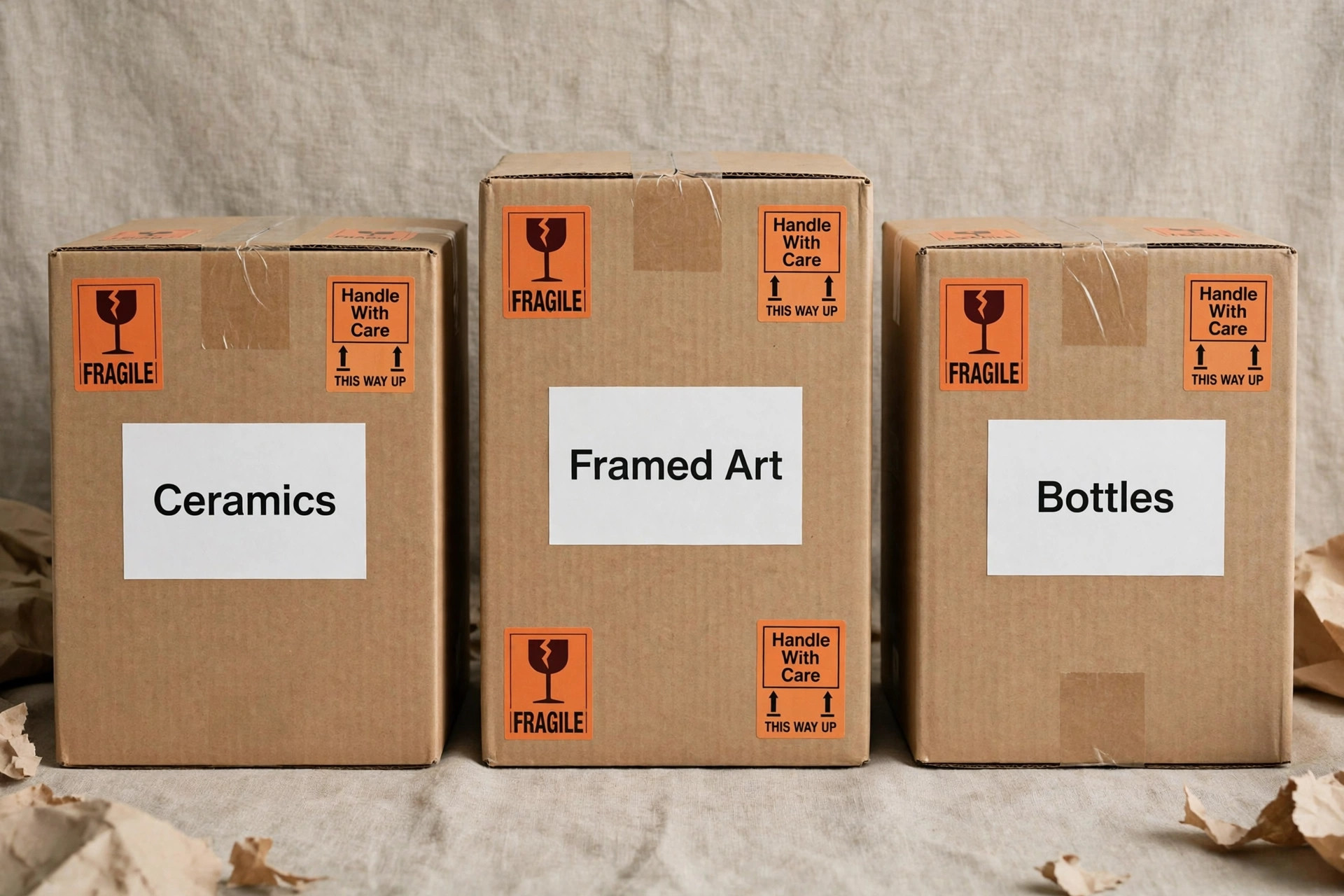
A fragile label alerts handlers, but it does not change how a parcel is sorted, stacked, or dropped, and it must never be treated as a substitute for packing. Place fragile and orientation labels on all sides where they help, and add this side up arrows where orientation matters, but pack the parcel as if no one will read the label, because in a busy sorting hub that is often close to the truth. A parcel packed to survive without its label will also survive with it, while a parcel that depends on its label will fail the first time a handler misses it.
The Core Packing Method in Detail
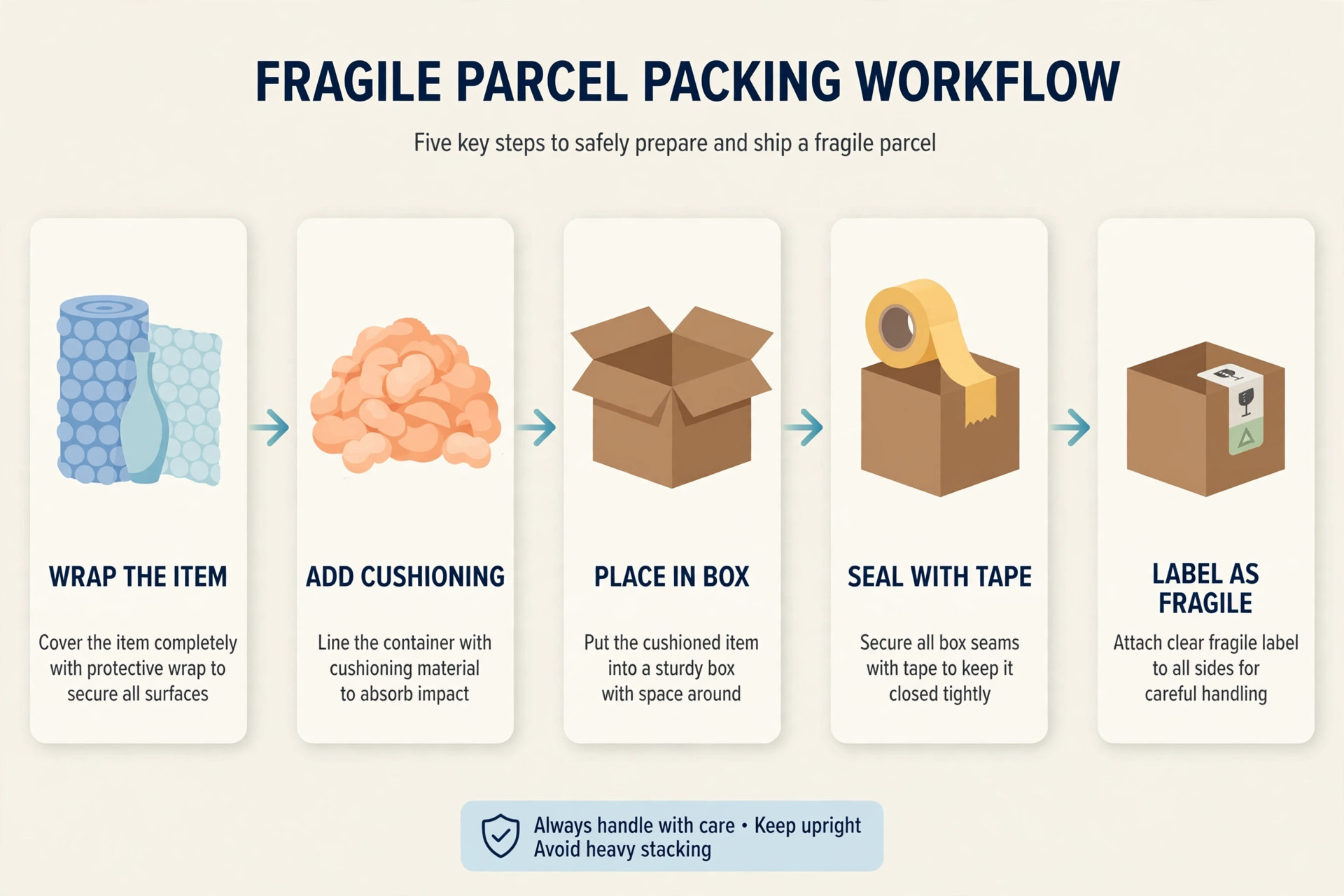
Wrap, centre, fill, and test
Wrap each piece individually, even when two pieces belong to the same set, because pieces that touch each other in transit will chip, scratch, or break each other. For glass and ceramic, use at least two layers of bubble wrap, with the bubbles facing inward for maximum cushioning as commonly advised in packing guides, and tape the wrap closed so it cannot unwind during transit. Place a layer of cushioning in the bottom of the box, centre the wrapped item, fill the sides with cushioning, add a top layer, and close the flaps without forcing them down, because flaps forced over an overfilled box will split under stacking pressure.
Test the parcel before taping it fully. Close the flaps, shake the box gently in each direction, and listen for movement. If you hear shifting, open the box and add cushioning, because a parcel that rattles on your bench will rattle far more violently in a delivery vehicle. If the box bulges, repack it in a larger box, because a bulging box tells every handler that the parcel is overfilled and invites crushing. The shake test takes ten seconds, and it catches more packing errors than any other single check a small shop can adopt.
Tape, label, and add an inner label
Tape with wide packing tape, at least two inches wide as carrier guidance commonly requires, and use the H method, taping the centre seam and both edge seams on top and bottom. Do not use cellophane tape, masking tape, string, or duct tape for the main seal, because those materials fail under the strain of handling and temperature change, and a failed seal is a failed parcel. Place the shipping label on the largest face of the box, away from seams and edges, so it can be scanned without handling the parcel awkwardly, and remove or cover any old labels from a reused box, although fragile shipments should use a new box wherever possible.
Place a second label inside the box, with the recipient and sender addresses, because an outer label that is damaged or torn off leaves the carrier with no way to deliver or return the parcel. That inner label costs nothing, takes seconds to add, and has saved many parcels that would otherwise have been lost. Add any required handling labels after the shipping label is placed, so the shipping label remains the most visible marking on the parcel, and photograph the finished parcel before it leaves the shop, for the claims file described later in this guide.
Packaging Specification by Item Type
This table is the overview proof element for this guide to how to ship fragile items small business packers can use. Use it as the packing specification at the bench, and adjust only the cushioning thickness upward for higher value items, never downward to save material. The specifications below follow carrier packing guidance as reported in reputable guides, and they should be confirmed on the carrier page for your service before you rely on them for a high value shipment.
| Item type | Wrap | Cushioning | Box | Label |
|---|---|---|---|---|
| Ceramics | Bubble wrap each piece | Three inches all sides | Double wall, double box high value | Fragile all sides |
| Glassware | Bubble wrap each piece | Three inches all sides | Double wall, double box | Fragile, this side up |
| Framed art | Cover glass, corner guards | Foam, three inches | Flat, double wall | Fragile, this side up |
| Canvas and prints | Sleeve, flat wrap | Foam board, two inches | Flat, rigid outer | Do not bend, fragile |
| Electronics screen | Anti static wrap | Foam inserts, three inches | Double wall, snug fit | Fragile, this side up |
| Bottles liquids | Seal, bag, wrap | Dividers, three inches | Double wall, upright | This side up, fragile |
Check the specification against the item in front of you before you pack it, because a specification is a starting point, not a guarantee for an unusual shape or weight. A heavy ceramic vase needs more protection than a light ceramic mug, even though both appear in the same row, and a large framed piece needs corner protection and a flat box that a small frame does not. When the item falls between two rows, use the stronger specification, because the cost of extra cushioning is small beside the cost of a broken item, a refund, and a lost customer.

Item by Item Packing Notes
Each product type below follows the core method, in learning how to ship fragile items small business packers must adjust, with one or two changes that matter for that material. Keep these notes beside the specification table at the bench, so a packer does not have to remember the detail for a product the shop ships only occasionally.
Ceramics and glassware
Ceramics and glassware break from impact and from contact with each other, so individual wrapping is the whole method. Wrap each piece in bubble wrap, place a layer of cushioning in the box, and pack pieces upright with dividers or separate wrapping so they cannot touch. Fill every void, including the space inside a hollow item where a rolled cushion can prevent crushing, and double box any piece that is high value, irreplaceable, or heavier than a few pounds. For a set, pack each piece as if it were shipping alone, because a set packed together without separation will arrive as a set of broken pieces that match.
Framed art, canvas, and prints
Framed art needs protection for the glass, the corners, and the frame finish, in that order. Cover the glass with a protective sheet or tape in a cross pattern as advised in packing guides, so broken glass, if it does break, stays in place rather than scratching the artwork, then add corner guards, then wrap the whole frame in bubble wrap.
Pack flat in a box that fits the frame with cushioning on all sides, or use a purpose built art box for larger pieces, and mark the orientation clearly. Canvas without glass needs a different care, because pressure on the canvas face can dent or stretch it, so protect the face with a rigid board before wrapping, and never pack anything on top of a canvas face inside the same box.
Prints need flat, rigid protection more than thick cushioning. Place the print in a sleeve, back it with rigid board, wrap it flat, and pack it in a flat rigid mailer or box, with do not bend marking on the outside. Rolled prints should be rolled with the image outward as commonly advised, placed in a sturdy tube with end caps secured, and filled at the ends so the print cannot slide and crease. A print shipped in a soft envelope, even a padded one, will bend in sorting equipment, and no fragile label will prevent that.
Electronics and bottles with liquids
Electronics with screens need anti static protection and a snug fit, because a screen that moves inside a loose box will crack at the corner first. Wrap the device in anti static bubble wrap or foam, use foam inserts that hold it centred, and fill voids so the device cannot shift. Remove batteries where the carrier requires it, and check the carrier rules for lithium batteries before shipping, because battery rules vary by service and destination and a parcel refused for a battery issue costs both time and customer trust.
Bottles with liquids need leak protection before impact protection, because a broken bottle that leaks will damage the box, the label, and any other parcel it touches. Seal each bottle, place it in a leak proof bag, wrap it in bubble wrap, and pack bottles upright with dividers so they cannot strike each other. Use a box that can contain a leak, add absorbent material where the carrier guidance asks for it, and mark the parcel this side up. Check the carrier rules for the liquid itself, because alcohol, chemicals, and some cosmetics have shipping restrictions that vary by carrier and destination, and a restricted liquid shipped without the correct service may be refused or returned.
Labelling, Carrier Choice and Liability
Carrier choice matters less than packing quality, in learning how to ship fragile items small business carrier choices must weigh, but it matters for speed, tracking, insurance, and the claim process when a parcel does break. Compare carriers on the service your customer actually needs, including delivery speed, tracking quality, pickup options, and the claim process, rather than on price alone, because the cheapest service that leaves a customer without tracking for a week is not cheap once support time is counted.

What carriers cover, as reported in guides
Standard liability for UPS and FedEx domestic parcels is commonly reported as 100 dollars per package unless additional coverage is purchased, and that figure is reported in several packing guides, so confirm it on the carrier page for your service before you rely on it. UPS is reported in guides as requiring double boxing for fragile items over ten pounds, and as offering additional coverage up to a much higher limit, while FedEx is reported as offering additional coverage as well, with limits that vary by service.
USPS is reported in guides as offering insurance coverage up to 5,000 dollars based on declared value, and as having discontinued special fragile handling in 2022, so a USPS fragile parcel relies on packing and insurance, not on special handling.
Declare the full value on any parcel worth more than the included liability limit, and purchase additional coverage where the value justifies it, because an undeclared high value parcel that breaks will be compensated only up to the included limit, if at all. Keep the declared value honest, because overstating value to obtain a larger claim is fraud, and understating value to save on coverage leaves you unprotected.
For very high value or irreplaceable items, consider a specialist art or fragile shipper, or a packing service at a carrier location, where the packing itself is covered by the service guarantee, as both UPS and FedEx offer professional packing at their retail locations according to guides.
Choose the service, then pack for it
Choose a service with tracking for every fragile parcel, because tracking is the first thing a customer asks for, and the first thing a claim investigator asks for. For a high value parcel, choose a service with signature on delivery, so the parcel is not left unattended, and tell the customer that signature will be required, so the delivery does not fail for lack of a recipient. For an international fragile parcel, check customs, import, and carrier rules for the destination before packing, because a parcel packed perfectly but refused at customs for a documentation error still arrives broken in the eyes of the customer who never receives it.
Photo Evidence and the Claims File
A claims file is the difference, in learning how to ship fragile items small business claims files must prove, between a damage claim that is paid and a damage claim that is denied for lack of evidence, and it costs only a few minutes per high value parcel. Photograph the item before wrapping, photograph the wrapped item in the box with cushioning visible, photograph the sealed box with the label visible, and keep those photographs with the order record, the tracking number, and the declared value. That set of photographs proves the item left in good condition, proves the packing method, and proves the label, which are the three questions a claim investigator asks first.

What to photograph and what to keep
Photograph the item from more than one angle, including any existing marks, so a claim cannot be confused with pre existing damage. Photograph the packing steps, not only the finished parcel, because a photograph of a sealed box proves nothing about the cushioning inside it. Keep the photographs, the receipt for materials where relevant, the carrier receipt, and the tracking record together in the order file, and keep them until the claim period has passed, because a claim filed weeks after delivery still needs the same evidence.
Tell the customer, in the shipping email and in your returns policy, to keep the box and all packing material until a damage claim is settled, and to photograph the damage as received before repacking or discarding anything. Guides report that USPS denies a claim when the packaging is gone, and that FedEx also asks for the packaging to be kept, so that instruction protects the customer claim as well as your own.
When a customer reports damage, respond promptly, apologise for the experience, ask for photographs of the item, the box, and the packing, and file the claim with the carrier at once, while offering the customer a replacement or refund under your own policy without waiting for the carrier decision, where your margin allows it.
Tools and Supplies for a Small Packing Bench
A small packing bench needs fewer supplies than most shops buy, but it needs the right sizes, kept in stock, because a packer who runs out of the correct box will use the wrong box rather than delay the order. Stock new double wall boxes in three sizes that fit your common products with room for cushioning, bubble wrap in two sizes, foam sheets and inserts for screens and art, corner guards for frames, leak proof bags for bottles, wide packing tape, and fragile and orientation labels. Buy from a packaging supplier that can deliver consistently, and keep a minimum stock level for each material, so a busy week does not force a compromise on packing quality.
ShipStation is commonly used by small businesses to compare carrier rates, print labels, and send tracking updates across channels, and it helps a fragile shipper because it keeps the label, tracking, and customer notice in one workflow.
Shippo is commonly used by small shops for a similar purpose, with rate comparison and label printing that suits a shop shipping a modest volume across carriers. ULINE is commonly used as a packaging supplier for boxes, cushioning, tape, and labels in a wide range of sizes, and it suits a shop that wants one supplier for bench materials.
Arka is commonly used for custom printed packaging, including branded boxes that still meet the strength and cushioning requirements in this guide, and it suits a shop that wants branded packaging without sacrificing protection. Confirm current features and prices on each vendor page before you buy, and test any new box or material with a shake test and a trial shipment before you use it for customer orders.
Costs, Sustainability and Common Mistakes
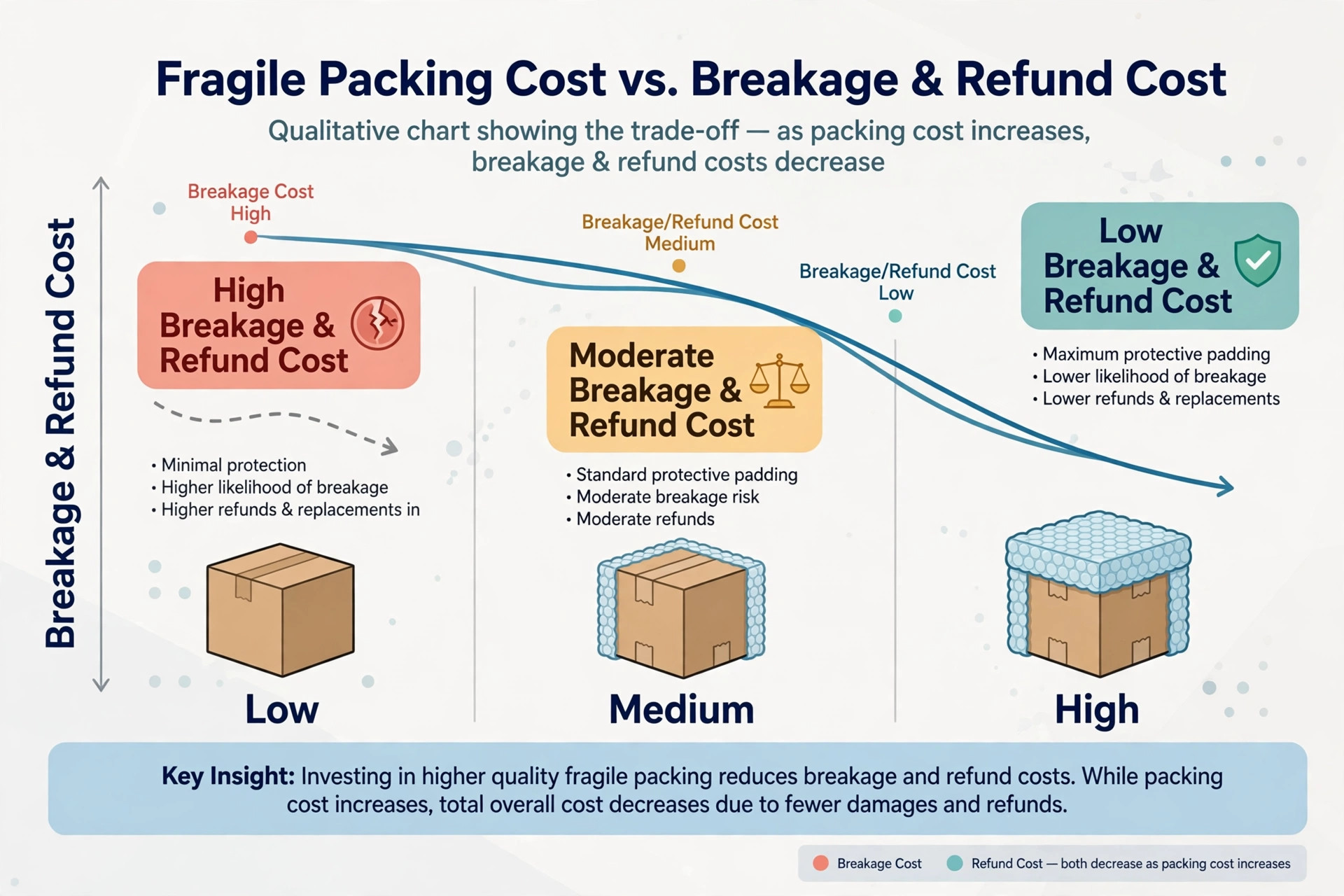
Fragile packing costs more than standard packing, in learning how to ship fragile items small business shipping prices must reflect, in materials, in box size, and in dimensional weight, and that cost should be reflected in your shipping price rather than absorbed silently until it erodes margin. Dimensional weight, where the carrier charges by parcel size rather than actual weight for a large light parcel, affects double boxed shipments in particular, because the outer box is larger than a single box would be.
Price fragile shipping honestly, using the actual box size and weight, and state the shipping cost at checkout, because a customer who discovers a high shipping cost after ordering is more likely to cancel than a customer who saw the cost and chose to proceed.
Pack sustainably without weakening protection
Sustainability and protection can coexist, but protection must come first for a fragile item, because a broken item shipped twice has a far larger footprint than a well packed item shipped once. Use recyclable boxes and paper based cushioning where they provide the same protection as plastic for that item, reuse incoming boxes only for non fragile shipments, and avoid overboxing a small item in a huge box filled with loose material. Tell customers how to recycle the packaging, and offer a take back or reuse note where that suits your shop, but do not reduce cushioning thickness to meet a sustainability goal, because the resulting breakage defeats the goal.
The common mistakes are easy to list and easy to avoid once the bench method is written down. The first is wrapping items together instead of individually. The second is using a box with no room for cushioning. The third is leaving voids unfilled, so the item moves. The fourth is reusing a weakened box for a fragile shipment. The fifth is relying on the fragile label instead of packing. The sixth is shipping without tracking, insurance, or photographs, so a breakage becomes an unprovable loss. A bench card with the core method, the specification table, and the shake test prevents all six, and a weekly check of the first parcels of the week keeps the standard from drifting.
Frequently Asked Questions
How much cushioning do fragile items need
Carrier guidance as reported in guides commonly asks for two to three inches of cushioning on all sides for fragile items, and three inches in and around the inner box when double boxing. Use three inches as your standard for high value items, and never use less than two inches for any fragile parcel, because a thin layer compresses under stacking and leaves the item effectively unprotected. Fill every void after wrapping, and use the shake test before sealing, because a parcel that rattles on your bench has already failed the cushioning test.
Is double boxing always necessary for fragile items
No, not for every fragile item, but it is necessary for high value, irreplaceable, heavy, or very breakable items, and it is reported in guides as required by UPS for fragile items over ten pounds. A light, low value ceramic mug packed well in a double wall box with three inches of cushioning may ship safely in a single box, while a heavy vase, a large framed piece, or a valuable glass item should be double boxed. When in doubt, double box, because the extra material cost is small beside the cost of a breakage, a refund, and a lost customer.
Should I write fragile on the box
Yes, mark the parcel fragile on all sides, and add this side up arrows where orientation matters, but pack as if no one will read the label. The label alerts handlers and helps a careful handler choose the right handling, but it does not change sorting or stacking, and it cannot protect a parcel whose packing allows movement. A well packed parcel with a fragile label is the correct combination, while a poorly packed parcel with a large fragile label is still a poorly packed parcel.
What if a fragile item arrives broken despite good packing
Respond promptly, ask the customer to keep the box and all packing material, ask for photographs of the item, the box, and the packing as received, and file a claim with the carrier at once, using the photographs from your claims file. Offer the customer a replacement or refund under your own policy without waiting for the carrier decision where your margin allows it, because the customer relationship is worth more than the claim timeline. Review the packing photographs and the returned box if possible, because a breakage that repeats for one product type usually reveals a packing detail that needs changing.
Does insurance cover a fragile item packed by the shop
Insurance covers a fragile item only when the packing meets the carrier requirements, which is why the specification table and the photographs in this guide matter. A claim for an item packed in a thin box, with no cushioning, or with items touching each other, is likely to be denied as insufficient packing, even when insurance was purchased. Pack to the carrier standard, declare the full value, photograph the packing, and keep the carrier receipt and tracking record, so the claim file proves the packing met the standard.
How do I ship fragile items internationally
Check the destination customs rules, the carrier rules for the item type, and any restrictions on liquids, batteries, or artwork before packing, because a parcel refused at customs for a documentation error never reaches the customer. Pack to a higher standard than for a domestic shipment, because international parcels face more handling and longer transit, double box high value items, use tracking and signature on delivery, and declare the full value for customs and insurance. Tell the customer that delivery times are estimates, and that customs duties, where they apply, are the recipient responsibility unless your shop has agreed otherwise.
More Reading on Stratilyze
For related shop operations, read best online ordering software for bakeries and best point of sale system for coffee shops. For store and payment fixes, see switch Squarespace to Wix for a small store and fix Square card reader not connecting for a small business.