
Shopify is the top 10 ecommerce platforms for furniture stores pick for most furniture sellers, because its Basic plan costs 29 dollars a month on annual billing and its app ecosystem covers the delivery, financing and 3D room tools that furniture needs. BigCommerce is the pick for large catalogues, with the same 29 dollar entry price and stronger built in variant tools. The ten tools below compare price, catalogue depth and furniture specific features, so a store can pick the platform that sells sofas rather than just listing them.
Furniture is the hardest product to sell online. A sofa has size, colour, material and finish options, it needs delivery scheduling rather than a parcel label, and the customer cannot sit on it before buying. A platform that handles t-shirts well can fail on furniture, because the variant grid, the shipping rules and the returns process are all different.
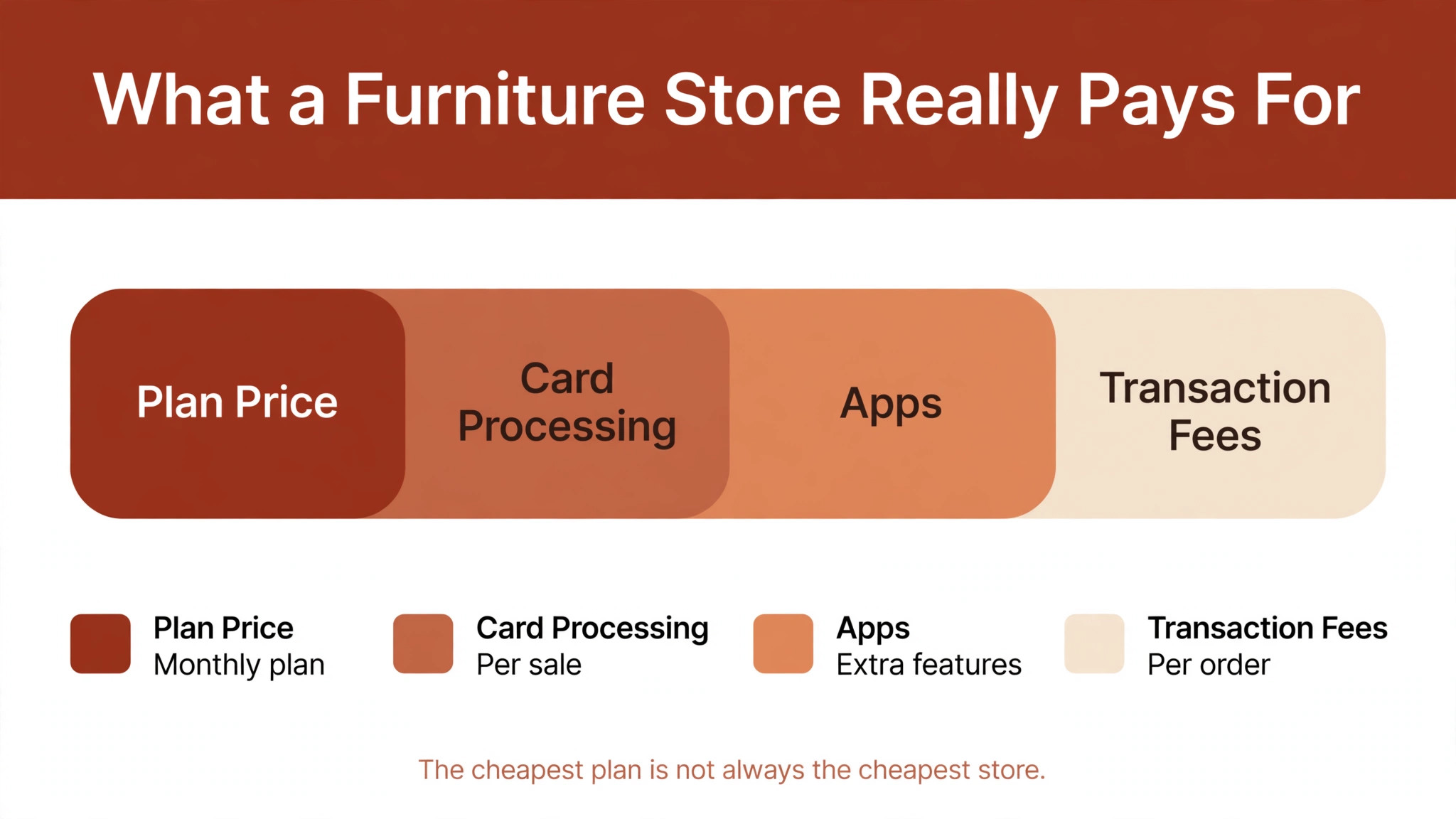
The buying problem is the hidden cost. The plan price is only the start, because card processing takes about 2.9 percent plus 30 cents on every sale, apps add monthly fees, and some platforms charge extra when a payment provider other than their own is used. This guide counts those costs, so the platform that looks cheapest is compared on what a furniture store actually pays.
The 10 Tools at a Glance
| Tool | Main job | Best for | Starting price |
|---|---|---|---|
| Shopify | Online stores | Most furniture stores | 29 dollars a month |
| BigCommerce | Large catalogues | Big variant grids | 29 dollars a month |
| Wix | Small shops | Small furniture boutiques | 29 dollars a month |
| Squarespace | Design led stores | Visual furniture brands | 19 dollars a month |
| WooCommerce | WordPress stores | Full control, low software cost | Free plugin |
| Square Online | Counter plus online | Shops with a showroom | Free |
| Ecwid | Add a store anywhere | Small catalogues | 15 dollars a month |
| Shift4Shop | Budget full features | Low platform fees | Free with Shift4 |
| Adobe Commerce | Enterprise stores | Large furniture chains | Quote-based |
| PrestaShop | Open source stores | Custom builds | Free |
Entry prices run from free to 29 dollars a month on annual billing, and the free options still charge card processing on every sale. A store selling a 3,000 dollar sofa pays about 87 dollars in card fees on that single order, so the processing rate matters more than the plan price for high value furniture.
Best Pick by Job
| Job type | First pick | Second tool | Why this pair works |
|---|---|---|---|
| General furniture store | Shopify | BigCommerce | Shopify has the apps, BigCommerce has built in depth |
| Large catalogue, many variants | BigCommerce | Shopify | BigCommerce handles variants natively, Shopify adds apps |
| Small boutique, few products | Wix | Squarespace | Wix is easiest, Squarespace looks best |
| WordPress site already | WooCommerce | PrestaShop | WooCommerce fits WordPress, PrestaShop is standalone |
| Showroom plus online | Square Online | Shopify | Square links the counter, Shopify scales online |
Shopify wins the general pick because its app ecosystem covers the furniture specific jobs that other platforms leave to the owner. Delivery scheduling, white glove options, financing, 3D room views and augmented reality all exist as apps, and the checkout is the most tested in the industry. The Basic plan costs 29 dollars a month on annual billing, or 39 dollars month to month, with unlimited products and up to 2,048 variants per product.
BigCommerce wins for large catalogues because its variant and filtering tools are built in rather than added as apps. The Core plan also costs 29 dollars a month on annual billing, and it charges no extra fee on orders through an embedded payment provider, which keeps more margin on a high value sofa. That built in depth is the reason a store with hundreds of products should look here first, and it is the sharpest contrast in this look at the top 10 ecommerce platforms for furniture stores for a seller whose catalogue keeps growing.
Which Platform Handles Big Furniture Catalogues Best?
BigCommerce is the best pick for a big furniture catalogue, because its filtering, variant and B2B tools are built into the platform rather than sold as apps. A sofa with six sizes, four fabrics and three leg finishes creates 72 variants, and BigCommerce handles that grid natively with rules for pricing and stock. The Core plan costs 29 dollars a month on annual billing, with Growth at 79 dollars and Scale at 299 dollars for larger volumes.
Shopify is the better pick when the catalogue needs apps more than built in tools. Its app store covers 3D product views, room visualisers, delivery scheduling and financing, and the Basic plan at 29 dollars a month on annual billing gives access to the whole app world. The catch is the app bill, because five paid apps can cost more than the plan itself, so a store should count the apps before choosing.
Adobe Commerce is the third option for a large furniture chain. The platform is quote based and needs developers, but it handles multi store, multi warehouse and B2B catalogues that the hosted platforms cannot. A chain with several showrooms and a central warehouse should talk to Adobe, while a single store should not.
A fourth path suits a store already on WordPress. WooCommerce is free as a plugin, and the hosting often costs 10 to 50 dollars a month, so the software cost is the lowest in this guide. The trade off is the work, because the owner runs hosting, updates and security, and a furniture store with a developer behind it will find that trade worth making.
How to Choose the Top 10 Ecommerce Platforms For Furniture Stores
Start with the catalogue size. A boutique with fewer than 100 products fits Wix or Squarespace, because the editor is simple and the catalogue is small. A store with hundreds of products and complex variants needs Shopify or BigCommerce, because the variant limits and the filtering tools decide whether customers can find the right sofa. Count the variants per product before choosing, because a platform that caps variants will force a painful rebuild later.
Next, check the delivery job. Furniture needs scheduled delivery, room of choice and sometimes white glove assembly, which is a different job from shipping a parcel. Shopify and BigCommerce both cover delivery scheduling through apps or built in tools, while the simpler builders need workarounds. Ask how delivery is booked and charged before paying.
Then count the real monthly cost. Add the plan price, the card processing at about 2.9 percent plus 30 cents per sale, the platform transaction fee, and the paid apps. Shopify Basic adds a 2 percent fee when a third party payment provider is used, Squarespace Basic charges 2 percent on store sales, and BigCommerce charges no extra fee on embedded payments. On 10,000 dollars of monthly sales, those fees decide the ranking more than the plan price does.
Finally, test the product page with a real sofa. Add the sizes, the fabrics and the finishes, upload the photos, and check the page on a phone. A furniture product page that hides the options or crops the photos will lose the sale, and the platform that shows the product best is the one to buy.
One more check matters for a store that sells in person too. Ask whether the platform links the showroom stock to the website stock, because a sofa sold in the showroom should leave the website at once. Square Online does this natively, Shopify does it through its point of sale tools, and the simpler builders need a manual stock check.
The 10 Tools in Detail
The ten tools below cover hosted platforms, WordPress stores and open source options. Each one is judged on catalogue depth, delivery tools, price and furniture fit, so this roundup of the top 10 ecommerce platforms for furniture stores stays honest about fees, caps and app bills.
1. Shopify
Shopify is the strongest all round platform for furniture stores, with the deepest app ecosystem and the most tested checkout in the industry. The Basic plan costs 29 dollars a month on annual billing, or 39 dollars month to month, with unlimited products and up to 2,048 variants per product. The app store covers delivery scheduling, financing, 3D room views and augmented reality, which are the furniture specific tools that matter most.
The drawback is the app bill, because the apps that make Shopify great for furniture are mostly paid, and five apps can cost more than the plan. The 2 percent third party transaction fee on Basic also adds up on high value orders. The platform suits most furniture stores, from a single brand to a multi channel retailer, and the 3 day trial plus 1 dollar a month promo makes testing cheap.
It suits a growing furniture store that will use apps. Start with the trial, install the delivery and 3D apps, and judge the total monthly bill after a month of real sales.
2. BigCommerce
BigCommerce is the platform for large furniture catalogues, with variant, filtering and B2B tools built in rather than added as apps. The Core plan costs 29 dollars a month on annual billing, Growth costs 79 dollars and Scale costs 299 dollars, and the plans were renamed in June 2026 from Standard, Plus and Pro. The platform charges no extra fee on orders through an embedded payment provider, which keeps more margin on high value furniture.
The catch is the sales cap, because Core covers up to 30,000 dollars a year in online sales and Growth up to 100,000 dollars, with automatic upgrades beyond those limits. The theme and app world is also smaller than Shopify, so custom design needs a developer more often. It suits stores with large catalogues, complex variants and B2B customers.
3. Wix
Wix is the easiest platform for a small furniture boutique, with a drag and drop editor and a simple store setup. Selling starts on the Core plan at 29 dollars a month on annual billing, with Business at 39 dollars and Business Elite at 159 dollars for larger stores. The editor keeps the store looking like the rest of the site, and the setup takes an afternoon.
The limit is scale, because product and variant management is weaker than Shopify or BigCommerce once the catalogue passes a few hundred items with complex options. Wix suits a small boutique with fewer than 100 products that values ease of setup over catalogue depth. It suits a furniture maker selling a small range direct to customers.
4. Squarespace
Squarespace is the design led store in this guide, with beautiful templates that show furniture at its best. The Basic plan costs 19 dollars a month on annual billing, Core costs 29 dollars, and the templates handle large photography well. The platform suits a visual brand where the look of the site sells the product as much as the price does.
The drawback is the selling depth, because Squarespace Commerce is thinner than Shopify or BigCommerce on variants, discount rules and delivery options. The Basic plan also charges a 2 percent fee on product sales, which adds up on high value orders. It suits a design heavy furniture brand with a small catalogue and a strong visual identity.
5. WooCommerce
WooCommerce is the free WordPress plugin that turns a WordPress site into a store, with full control and the lowest software cost in this guide. The plugin itself is free, while hosting, security and updates are the owner responsibility, with hosting often costing 10 to 50 dollars a month. The plugin world is the largest in ecommerce, covering delivery, financing and 3D views.
The trade off is the work, because the owner runs hosting, updates and security, and a broken plugin can take the store down. The platform suits a business that already runs WordPress and wants full control without a monthly platform fee. It suits a furniture store with a developer or an agency behind it.
6. Square Online
Square Online is the store for a furniture shop with a physical showroom, because it links the counter and the website in one system. The free plan covers a basic online store, and Plus costs 49 dollars a month per location, with the online card rate at 3.3 percent plus 30 cents on the free plan. Stock, orders and customers stay in sync between the showroom and the site.
The limit is the online depth, because Square Online is thinner than Shopify or BigCommerce on variants, apps and marketing tools. It suits a local furniture shop whose showroom is the main sales channel and whose website supports it. It suits a store that takes most orders in person.
7. Ecwid
Ecwid adds a store to any existing website, with a free plan for a small catalogue and paid plans from 15 dollars a month for the Venture tier. The store can sit inside a WordPress site, a Wix site or a plain HTML page, which suits a furniture maker whose website already exists. The setup is quick, and the catalogue tools cover the basics well.
The drawback is the depth, because Ecwid is a store widget rather than a full platform, and the variant, delivery and marketing tools are thinner than Shopify or BigCommerce. It suits a small catalogue on an existing site that needs selling without rebuilding the website. It suits a maker with a handful of products.
8. Shift4Shop
Shift4Shop is the budget full featured platform in this guide, with a free plan when the store uses Shift4 payment processing, and paid plans from 41 to 229 dollars a month otherwise. The platform covers the full store feature set at no platform fee on Shift4, which suits a furniture store that wants built in features without an app bill.
The catch is the payment lock, because the free plan requires Shift4 processing, and the theme and app world is smaller than Shopify. The platform suits a budget conscious store that is happy with Shift4 as its payment provider. It suits a store that wants full features without paying for apps.
9. Adobe Commerce
Adobe Commerce, formerly Magento, is the enterprise platform for large furniture chains, with multi store, multi warehouse and B2B catalogues that the hosted platforms cannot match. Pricing is quote based, and the platform needs developers to build and run. The customisation is unlimited, because the store is built rather than configured.
The drawback is the cost and the complexity, because a small store will pay far more in development and hosting than on any hosted platform. It suits a large furniture chain with several showrooms, a central warehouse and a development team. A single store should not consider it.
10. PrestaShop
PrestaShop is the free open source store platform for custom builds, with no monthly platform fee and a large module marketplace. The software is free, while hosting, security and updates are the owner responsibility, and the module costs add up for the features that hosted platforms include. The platform suits a store that wants full control and has a developer.
The trade off is the work, because the owner runs the server and the updates, and a bad module can break the store. PrestaShop suits a furniture store with a developer who wants a custom build without a monthly platform fee. It suits a business that values ownership over convenience.
Shopify vs BigCommerce, App Depth Against Built-In Power
The catalogue is the first difference. BigCommerce handles complex variants natively, with rules for pricing and stock across a large grid, while Shopify handles variants well but needs apps for the deepest catalogue work. A store with hundreds of products and 72 variants per sofa will feel the difference daily, because the built in tools save clicks on every product.
The second difference is the fee model. Shopify Basic charges 2 percent when a third party payment provider is used, while BigCommerce charges no extra fee on orders through an embedded payment provider. On a 3,000 dollar sofa, the Shopify fee is 60 dollars when an outside provider is used, which is more than two months of the Basic plan. A store that uses its own payment provider should weigh that fee heavily.
The deciding factor is the app habit. A store that loves apps and wants the newest delivery, financing and 3D tools should take Shopify, because the app store is the largest in the industry. A store that wants the features built in and the fee model simple should take BigCommerce, because the platform ships more in the box. That split is the cleanest way to read the top 10 ecommerce platforms for furniture stores when the choice narrows to these two.
A third difference is the sales cap. BigCommerce Core covers up to 30,000 dollars a year in online sales and Growth up to 100,000 dollars, with automatic upgrades beyond those limits, while Shopify has no sales limit on any plan. A fast growing store should weigh that cap, because an automatic upgrade in a busy month is a surprise bill the owner did not plan for.
What Does a Furniture Store Pay Beyond the Monthly Plan?
The card processing is the largest extra cost. Every platform charges about 2.9 percent plus 30 cents on an online card sale, so a 3,000 dollar sofa costs about 87 dollars in processing, and a 500 dollar chair costs about 15 dollars. A store doing 20,000 dollars a month in online sales pays about 580 dollars a month in processing alone, which is far more than the plan price, and that is the number most buyers of the top 10 ecommerce platforms for furniture stores miss first.
The apps are the second extra cost. Shopify apps for delivery scheduling, financing, 3D views and reviews typically cost 10 to 50 dollars a month each, and five apps can add 100 to 200 dollars a month to the bill. BigCommerce needs fewer apps, which is why its total cost is often lower even though the plan price is the same. A store should list the apps it needs and add their prices before choosing.
The platform transaction fee is the third extra cost. Shopify Basic adds 2 percent on outside payment providers, Squarespace Basic charges 2 percent on store sales, and BigCommerce adds nothing on embedded payments. On 10,000 dollars of monthly sales, a 2 percent fee costs 200 dollars a month, which is more than six months of the plan price difference between the cheapest and dearest options.
How Do I Price Delivery for Furniture?
Start with the delivery types the store actually offers. A parcel courier suits small items like lamps and cushions, a scheduled van delivery suits sofas and tables, and white glove delivery with assembly suits high value pieces. Each type needs a different price, because a van with two people costs far more than a courier label.
Next, set the delivery zones. A local delivery within 20 miles can be flat rated, a regional delivery needs a distance based price, and a national delivery needs a freight quote. The platform should support zone pricing and scheduled slots, because a customer who cannot pick a delivery day will abandon the checkout.
Then check the returns. Furniture returns are expensive, because the item must be collected and resold, so the returns policy should be clear before the first sale. Some stores charge a restocking fee, others offer free returns on small items only, and the platform should support the policy the store chooses. A clear delivery and returns page sells more furniture than a discount, because it removes the fear of buying a sofa unseen.
A Furniture Store Launch Checklist, From Photos to First Order
Photos come first, because furniture sells on images. Shoot every product from the front, the side and the back, add a lifestyle shot in a real room, and show the fabric close up. A product with three photos sells better than a product with one, and a product with a room shot sells better than a product with a studio shot alone.
Next, build the variant grid. Add every size, colour, material and finish as a variant, set the price and stock for each, and check that the options make sense together. A sofa that offers a fabric in a size that does not exist will create orders the store cannot fulfil, so the grid needs a careful check before launch.
Then set up delivery, payment and returns. Add the delivery zones and prices, connect the payment provider, and write the returns policy in plain language. Test the checkout with a real order, check the delivery slot picker on a phone, and confirm the order email arrives. A store that passes its own checkout test is ready for its first customer, and that test is the step most rushed launches skip, which is why the top 10 ecommerce platforms for furniture stores all reward a careful launch more than a fast one.

Frequently Asked Questions
Is Shopify good for furniture stores?
Yes. Shopify is the best all round platform for furniture stores, with the deepest app ecosystem for delivery scheduling, financing and 3D room views. The Basic plan costs 29 dollars a month on annual billing, with unlimited products and up to 2,048 variants per product, though the app bill and the 2 percent third party fee add to the total, which is the honest answer for anyone comparing the top 10 ecommerce platforms for furniture stores.
Does BigCommerce charge a transaction fee?
No, on embedded payment providers. BigCommerce charges no extra fee on orders through one of its embedded payment providers, which keeps more margin on high value furniture. It does charge an open payment provider fee of 2 percent on Core, 1 percent on Growth and 0.6 percent on Scale when an outside provider is used.
Can I sell furniture on Wix?
Yes, for a small boutique. Selling starts on the Wix Core plan at 29 dollars a month on annual billing, and the editor is simple. The variant and catalogue tools are weaker than Shopify or BigCommerce, so a store with hundreds of products and complex options should look elsewhere.
What is the cheapest way to start a furniture store online?
WooCommerce and PrestaShop are free as software, with hosting often costing 10 to 50 dollars a month. Square Online has a free plan, and Shift4Shop is free when the store uses Shift4 processing. The cheapest start is not always the cheapest store, because card processing at about 2.9 percent plus 30 cents applies on every platform.
Do furniture stores need 3D or augmented reality?
It helps, but it is not required to start. A 3D room view or an augmented reality preview lets a customer see the sofa in their own room, which reduces returns. Shopify and BigCommerce both support these tools through apps, while the simpler builders do not, so a store that wants them should shortlist the two leaders.
How much does card processing cost on a sofa?
About 2.9 percent plus 30 cents per sale on most platforms, so a 3,000 dollar sofa costs about 87 dollars in processing. The rate falls slightly on higher Shopify and BigCommerce plans, and the platform transaction fee on top of processing is the cost to watch, because it varies from zero to 2 percent by platform and plan.
Build for the Sofa, Not the Homepage
A general furniture store should take Shopify, because the app ecosystem covers delivery, financing and 3D tools that furniture needs. A large catalogue store should take BigCommerce, because the built in variant tools and the zero fee on embedded payments keep more margin. A small boutique should take Wix or Squarespace, because ease and design matter more than catalogue depth at that size.
Test the product page with a real sofa before paying, count the apps and the fees, and launch with good photos and clear delivery. The top 10 ecommerce platforms for furniture stores all sell furniture, but only the platform that fits the catalogue, the delivery job and the budget will sell it well. A store that gets those three right will spend less time fighting its platform and more time selling furniture.