

Most tutors do not lose money because they teach badly. They lose money because the price was set in a hurry, the package promised too much for too little, and sessions paid for teaching time but not for preparation, messages, rescheduling or tax. A tutor who charges a fair hourly rate can still end the month short if sessions cancel or a monthly plan quietly turns into unlimited help for a fixed fee. Setting tutoring business pricing packages that hold up in real life means deciding what each package includes, what it excludes, how cancellations work, and what happens when a student needs more help than the package covers.
This guide compares the three models tutors actually use. Hourly, monthly and results-based pricing each suit a different stage, subject and student. You will see published rate ranges, a direct comparison table, a package builder you can work through with your own numbers, and the hidden costs that turn a good rate into a thin margin. Prices come from published guides checked in October 2026, and they vary by subject, level and region, so treat them as ranges to test in your market and check the final total at checkout before you buy or sell a package based on them.
Why Most Tutors Underprice Their First Year
New tutors usually start with a number they saw on a marketplace profile, then discover that the number was never the whole story. A marketplace rate often sits beside a platform fee, and preparation time is not billed at all. A private tutor who sets the same headline rate keeps the full fee but also carries marketing, scheduling, materials and payment chasing. The two numbers look identical and behave very differently.
Underpricing also comes from counting only the lesson. A one hour session often needs 15 to 30 minutes of preparation for a new student, plus messages during the week and marking after the session. If you charge for 60 minutes and work for 90, your real hourly rate falls by a third before tax or software. Experienced tutors are not charging more for the same hour. They are charging for the full job.
A third trap is saying yes to every request in the first months. Extra exam week sessions, homework messages at night, and a trial lesson that stretches into a free second lesson each train the client to expect unpaid help. Packages fix this only if boundaries are written down. Four sessions, one progress note a month, and replies within one school day is a service. Ongoing support with no limits is an open tab.
Start by working out your floor. Add up the hours you will actually work in a week, including preparation and admin, then divide the income you need by the billable hours you can realistically sell, not by 40. Most solo tutors sell 15 to 25 billable hours in a strong week. If your floor sits above the going rate in your subject, you need a narrower subject, a stronger result to sell, or a group format that pays more per hour.
Hourly Pricing, and When It Still Wins
Hourly pricing is the simplest model to explain and the easiest to start with. A client pays for each session, there is no commitment, and either side can stop. That simplicity makes it the right choice for trial students, short term help before an exam, adult learners with irregular schedules, and tutors who are still testing demand in a new subject. It also suits students who need help with one topic rather than a full term of support.
Published guides put the spread wide, and that spread is the point. InvoiceFly lists new tutors at about 20 to 35 dollars an hour, experienced private tutors at about 40 to 70 dollars an hour, and certified or test preparation tutors at about 70 to 120 dollars an hour or more. A separate 2026 guide puts online rates for core school subjects at about 27 to 55 dollars an hour and in person rates at about 35 to 68 dollars an hour. Wyzant reports an average of about 35 to 60 dollars an hour, plus a student service fee reported at about 9 percent on top of the lesson price.
Your rate should sit inside the range for your subject and experience, not at the average for every subject at once.
Hourly pricing has three real costs that tutors forget. Income is volatile, rising and falling with cancellations, holidays and exam seasons. Comparison shopping follows, because when the only number a parent sees is an hourly rate, the cheapest tutor wins the first conversation, even if that tutor needs twice as many sessions. And income stops when teaching stops, so holidays, illness and admin weeks pay nothing. For tutors comparing tutoring business pricing packages, hourly is the low commitment entry point, not the whole business.
Use hourly pricing with rules that protect it. Set a cancellation window, such as 24 or 48 hours, state whether preparation and marking are included, and offer a paid trial instead of a free lesson that turns into free teaching. Tutors who keep hourly long term usually pair it with packages for regular students.
Monthly Pricing, and What It Must Include
Monthly pricing turns tutoring into a subscription. A family pays a fixed amount each month for a set number of sessions plus defined extras, such as practice materials, a progress note, or message support between sessions. The tutor gets predictable income, the family gets a predictable bill, and the student gets a regular rhythm instead of sessions booked in a panic before a test.
Published monthly figures show how much the format matters. Sampled Mathnasium centres were listed at about 449 to 579 dollars a month plus an enrollment fee of about 149 to 199 dollars, typically for two one hour sessions a week in a centre setting. Mentomind puts monthly subscriptions more broadly at about 150 to 400 dollars a month. The gap reflects centre overheads, group size, subject level and what else is included. A solo online tutor selling four one hour sessions a month at 50 dollars an hour lands at 200 dollars before extras, which shows why a monthly price should be built from your hourly rate, not copied from a centre.
A monthly package needs five lines in writing. The number and length of sessions, the extras and their limits, the rollover rule, the cancellation and pause rule, and the renewal date. Rollover is where most disputes start. If unused sessions roll over forever, a family can bank a month of sessions and demand them in exam week when you have no capacity. A middle rule works well. One session rolls over for up to 30 days, the rest expire, and exam week extras are sold at the package rate rather than given free.
When families compare tutoring business pricing packages, monthly suits regular students with ongoing goals, such as building maths fluency across a term or preparing steadily for an exam. It suits tutors who want a stable base of 10 to 20 monthly clients. It does not suit short term or irregular students, and it fails when unlimited messaging or homework help is added without counting that time. Price the extras, cap them, and review the package after the first term.
Results-Based Pricing, and Where It Gets Risky
Results-based pricing ties part or all of the fee to an outcome, such as a grade improvement or a test score gain. It is the most persuasive model in marketing because it answers the question every parent is really asking, which is whether this will work. It is also the riskiest model to run, because outcomes depend on school teaching, student effort, exam difficulty and home support, none of which the tutor fully controls.
In practice, most honest results-based offers are hybrids, not pure pay for results. A common structure is a base programme fee plus a bonus or a partial refund tied to a defined result. TutorBase notes that outcome based pricing can command premiums of about 15 to 25 percent over hourly rates in test preparation and specialist segments. Mentomind lists one time programmes and bootcamps at about 500 to 2,000 dollars, while published comparisons put big provider packages at about 2,000 to 3,150 dollars for 10 to 18 hours. Those figures show what families will pay for a defined programme, but they do not prove that a solo tutor should promise the same outcome.
A results-based offer needs four safeguards. The result must be measurable in numbers, such as a score range on a named practice test, not a vague promise of improvement. The starting point must be measured with a diagnostic before teaching starts, so both sides agree on the baseline. Student conditions must be stated, such as attendance and homework completion, because a bonus tied to a result the student did not work for is a dispute waiting to happen. Payment terms must be clear about what happens if the result is missed for reasons outside the tutor’s control, such as illness on exam day.
Use results-based tutoring business pricing packages only where you have evidence. If you have taught the same exam for two or three cohorts and can show typical gains for students who completed the work, a premium programme with a defined bonus is credible. If you are new to the exam, sell a programme priced on hours and content, track results carefully, and add a results element later once you have data. A guarantee made before you have data is not marketing. It is a refund liability.
How Tutoring Business Pricing Packages Compare at a Glance
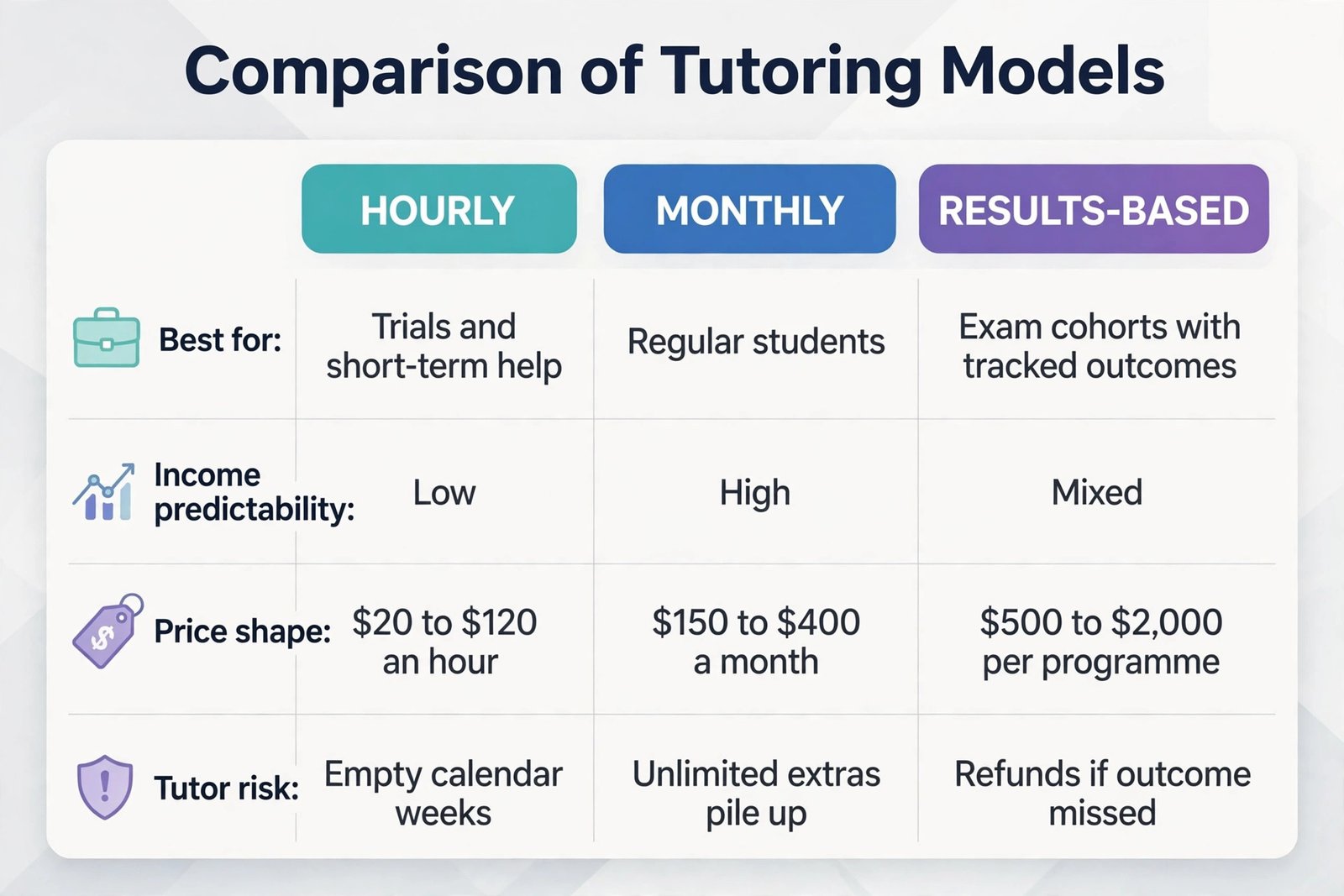
The table below puts the three models side by side on the questions that matter to a tutor deciding what to sell. Many tutors end up selling more than one model, with hourly for trials, monthly for regular students, and a results-linked programme for exam cohorts. Strong tutoring business pricing packages usually mix models by student type rather than forcing every student into one price.
| Question | Hourly | Monthly | Results-based |
|---|---|---|---|
| Best for | Trials, short term help, irregular schedules | Regular students, term long goals | Exam cohorts with tracked outcomes |
| Income predictability | Low, moves with cancellations | High, fixed monthly base | Mixed, base plus bonus or refund risk |
| Typical price shape | 20 to 120 dollars an hour by level | 150 to 400 dollars a month for solo online work, higher for centres | 500 to 2,000 dollars per programme, higher for large providers |
| Client commitment | None, pay per session | One term or rolling monthly | Full programme, often prepaid |
| Tutor risk | Empty calendar weeks | Unlimited extras and rollover pile up | Refunds if the outcome is missed |
| Admin load | Low, simple billing | Medium, needs rollover and pause rules | High, needs diagnostics and tracking |
| When to avoid it | As the only model for a full calendar | For irregular or short term students | When you lack outcome data for that exam |
Build Your Own Package With the Package Builder
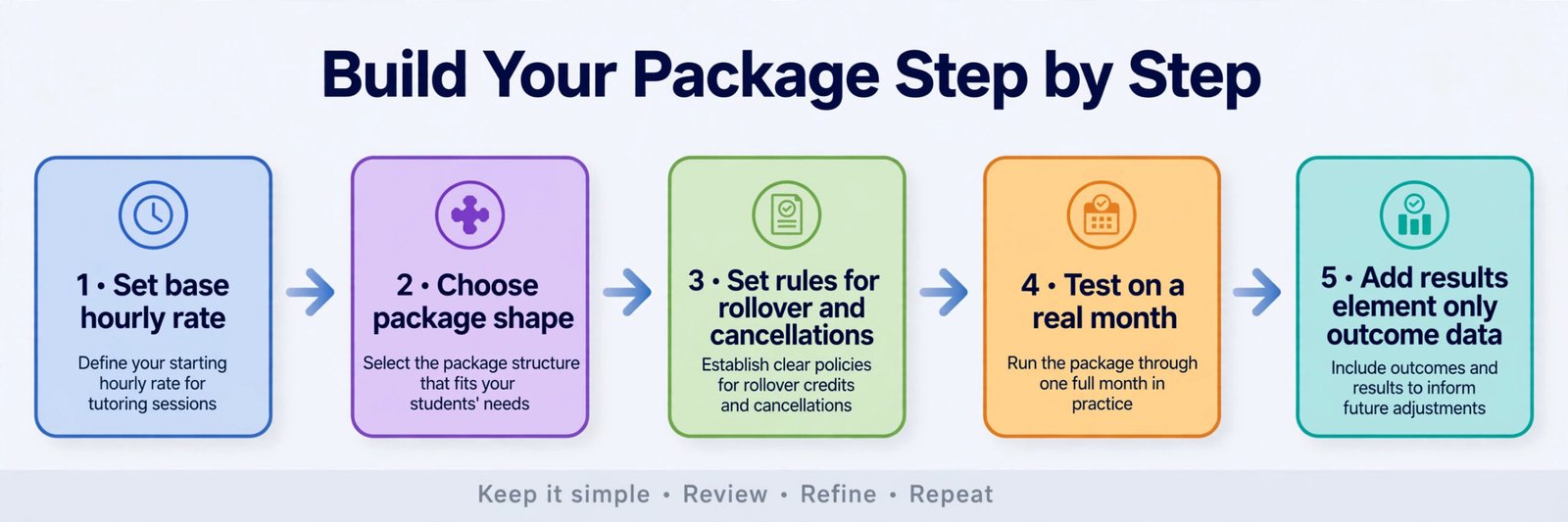
This package builder turns the comparison into numbers for your subject and your costs. Work through it in order, and you will have a package you can put on a pricing page without guessing. It works for a solo tutor and for a small team, with one adjustment for teams at the end.
Step one is to set your base hourly rate from evidence, not from hope. Find the published range for your subject and level, place yourself honestly inside it, and add a premium only if you have a credential, a specialism or a track record that justifies it. A new maths tutor might start at 30 to 40 dollars an hour, while an experienced test preparation tutor with documented gains might start at 80 to 120 dollars an hour. Then add preparation time. A 60 minute session at 50 dollars an hour with 20 minutes of preparation really pays 50 dollars for 80 minutes, which is 37 dollars and 50 cents per hour of work.
Price the package on the real hours, or shorten preparation with reusable materials.
Step two is to choose the package shape. For a monthly package, multiply sessions by your base rate, then add extras at a real cost. Four sessions at 50 dollars is 200 dollars, plus a monthly progress note and capped message support worth about 25 to 40 dollars if they take an hour a month, giving about 225 to 240 dollars before any discount. For a session pack, apply a modest discount. Published guidance suggests about 5 percent for five sessions, about 10 percent for ten sessions, and a maximum of about 15 percent for 20 or more sessions.
At 50 dollars an hour, a ten session pack at 10 percent off is 450 dollars instead of 500 dollars, a real saving without giving away a session free.
Step three is to set the rules that protect the price. Write the session length, the rollover rule, the cancellation window, the pause rule for holidays, and the price for extra sessions, stated in advance so exam week does not become a negotiation. Step four is to test the package on a real month. Count the sessions taught, the preparation hours, the messages and the cancellations, then apply the new package price to that month. If the package would have paid less than hourly for the same work, the discount is too deep or the extras are too generous.
Step five is to add a results element only if you have the data for it. A monthly package can carry a term review with a measured practice score, without promising a grade. A small team should also split the price between tutor pay, platform or room costs, and business margin, and check that tutor pay stays competitive after the discount. A package that leaves tutors underpaid will lose tutors, and that costs far more than a smaller discount.
What to Charge by Subject and Level
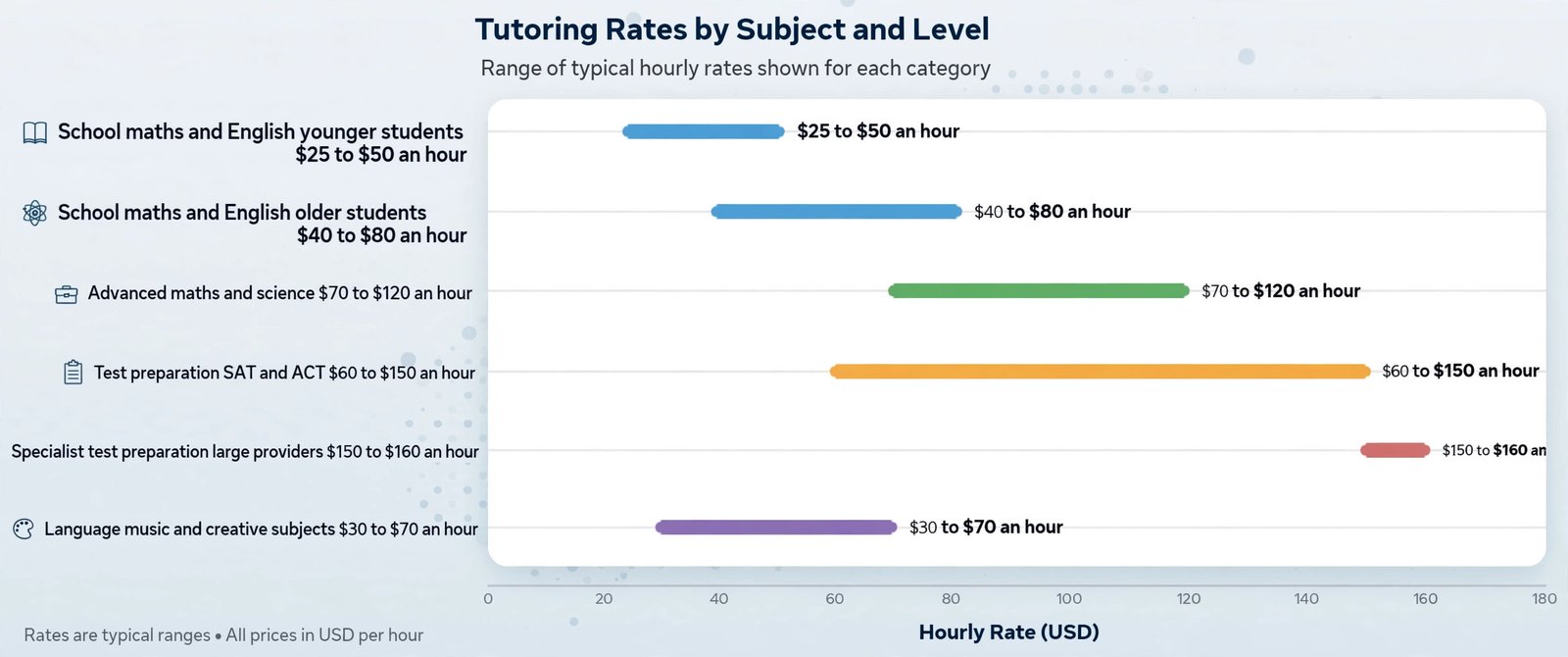
Rates move with stakes, scarcity and preparation load. A general homework tutor for younger students competes with many tutors and with free school help, so rates sit lower. A specialist for an advanced subject or a high stakes exam competes with fewer tutors and sells a result that affects university admission, so rates sit higher. The ranges below come from published guides and should be tested against local listings before you set a final price, and they are a useful input when you design tutoring business pricing packages for a new subject.
| Subject and level | Published range | What pushes the rate up |
|---|---|---|
| School maths and English, younger students | About 25 to 50 dollars an hour online | Experience, structured materials, progress reporting |
| School maths and English, older students | About 40 to 80 dollars an hour | Exam board knowledge, past paper practice, marking |
| Advanced maths and science, upper school | About 70 to 120 dollars an hour | Scarcity of specialists, longer preparation, lab style problems |
| Test preparation, SAT and ACT | About 60 to 150 dollars an hour | Proven score gains, timed practice, admissions knowledge |
| Specialist test preparation, large providers | About 150 to 160 dollars an hour in sampled listings | Brand, guarantee terms, intensive programme design |
| Language, music and creative subjects | About 30 to 70 dollars an hour in many listings | Performance experience, exam syllabus expertise, materials |
Subject is not the only driver. In person tutoring in a high cost city usually costs more than online tutoring for the same subject, because travel and local demand push rates up. Group tutoring can pay the tutor more per hour overall, because three students each paying 60 to 70 percent of the individual rate earn more than one student, while each family pays less. Groups work as a second offer for price sensitive families only when students are matched by level.
Level also changes the work between sessions. Advanced students need harder problems, detailed marking and exam technique coaching, which takes longer to prepare than a general homework session. Price advanced work higher, or sell it as a programme with marking included. The same logic applies to students with additional learning needs, where adapted materials and liaison with school take extra time that should be reflected in the package.
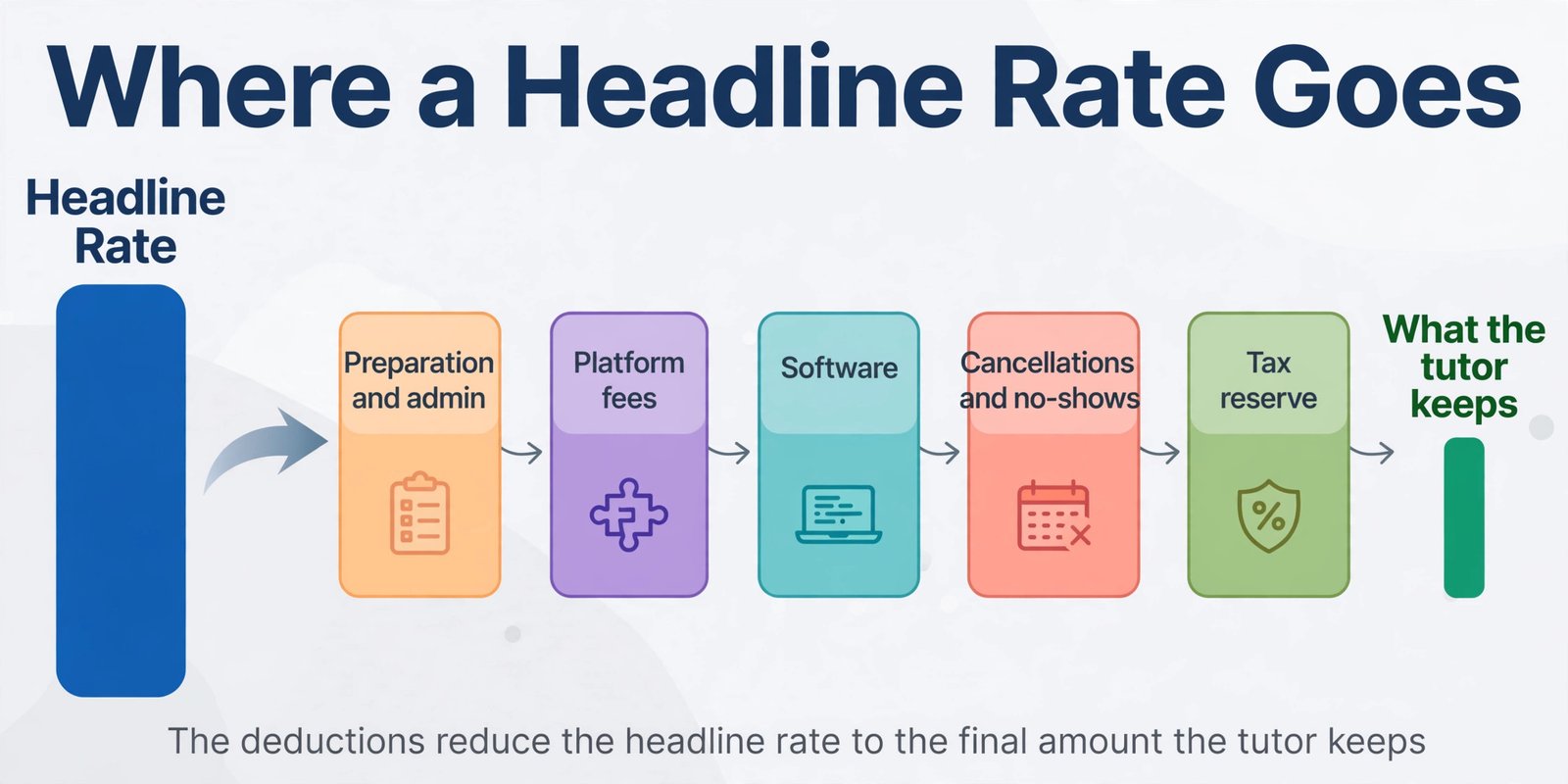
A tutoring price looks healthy until the costs behind it are counted. Marketplace and platform fees are the first. Wyzant adds a reported student service fee of about 9 percent on top of the lesson price, and other platforms take a share from the tutor side, so a headline platform rate is not the same as a private rate. Payment processing also takes a share, which hurts most on small single sessions and least on monthly packages paid in one transaction.
Preparation and admin are the second cost, and for most tutors they are the largest. Materials, lesson planning, marking, progress notes, scheduling messages and payment chasing all take time. If those hours are not priced into the package, they are paid for in unpaid evenings. Software is the third cost. Scheduling, video calls, whiteboards, practice banks and invoicing each cost a little, and together they reach a meaningful monthly total. A small team adds tutor pay, recruitment and cover for illness, so team packages must be priced from tutor pay upwards.
Cancellations and no shows are the fourth cost. A late cancellation leaves a gap that cannot always be filled, and a tutor with no rule absorbs that loss. A clear window, a reschedule option inside the same week, and a charge for late cancellations protect income without punishing genuine illness, provided the rule is applied with judgement and stated before the first session. Tax is the fifth cost. A gross rate is not take home pay, so build a tax reserve into the monthly plan, even if it is a simple percentage set aside from every payment.
Price from costs, not from competitors alone. If your cost based floor sits above the market range, cut costs, raise billable hours with group work, or move to a higher value subject.
How to Choose the Right Model for Your Stage
Choice depends on where the business is. A tutor in the first six months should start hourly for trials, add a small session pack once regular students appear, and move the steadiest students to monthly plans. Selling a results-based programme in month one, before any outcome data exists, puts the tutor in a promise that cannot yet be kept.
A tutor with a stable base of regular students should make monthly the core offer. Monthly plans smooth income across school breaks and reduce weekly scheduling messages. Hourly can stay as a trial and top up option at the full rate, so regular students have a reason to stay on a plan.
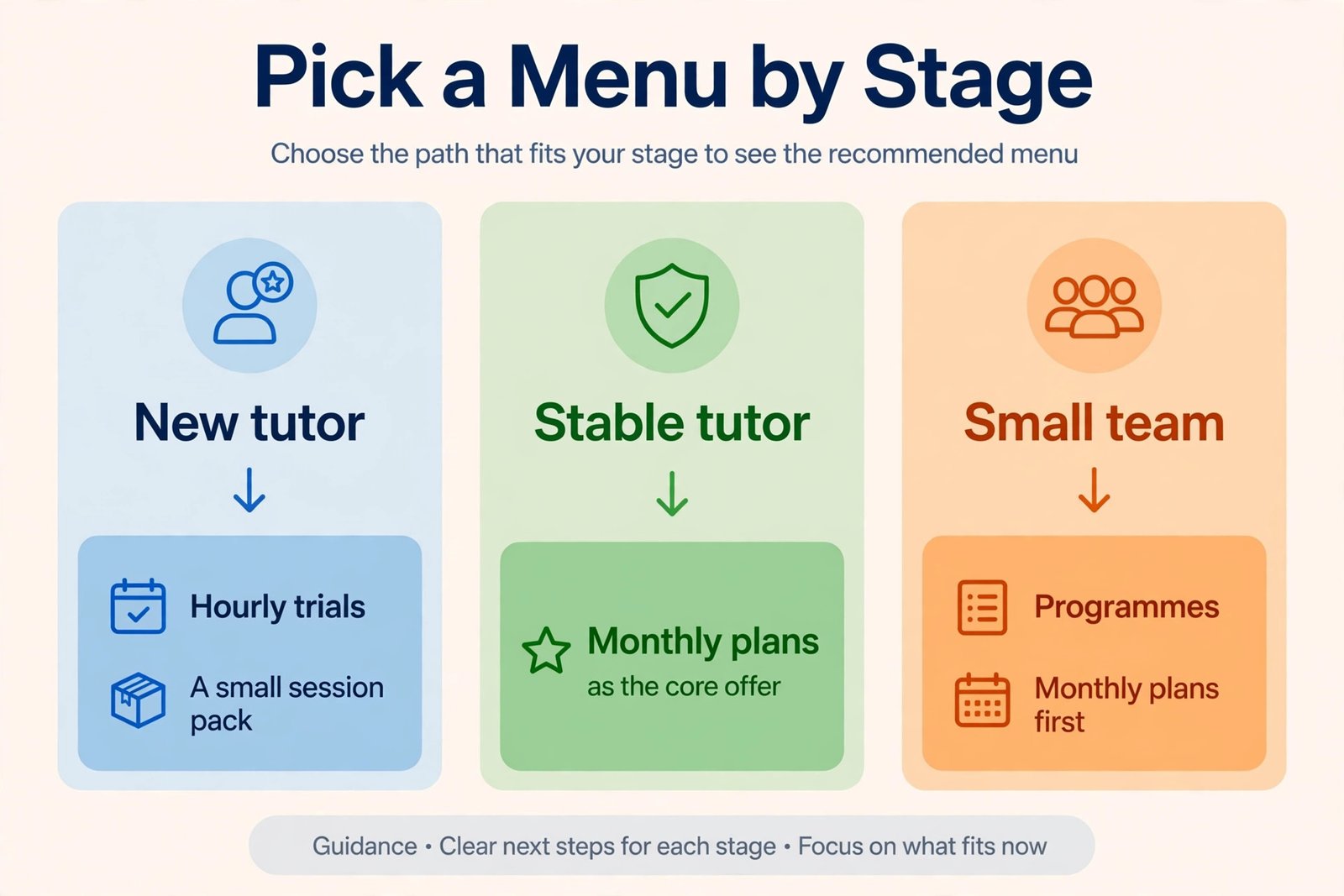
A small team or agency should sell programmes and monthly plans first, with hourly as a secondary option. Teams need predictable revenue to pay tutors and cover overheads, and hourly income that swings with cancellations makes staffing hard. Programmes also let a team standardise materials and progress reporting. Team packages need clear tutor pay rules, cover rules and quality checks, because a family buys the business promise, not just one tutor.
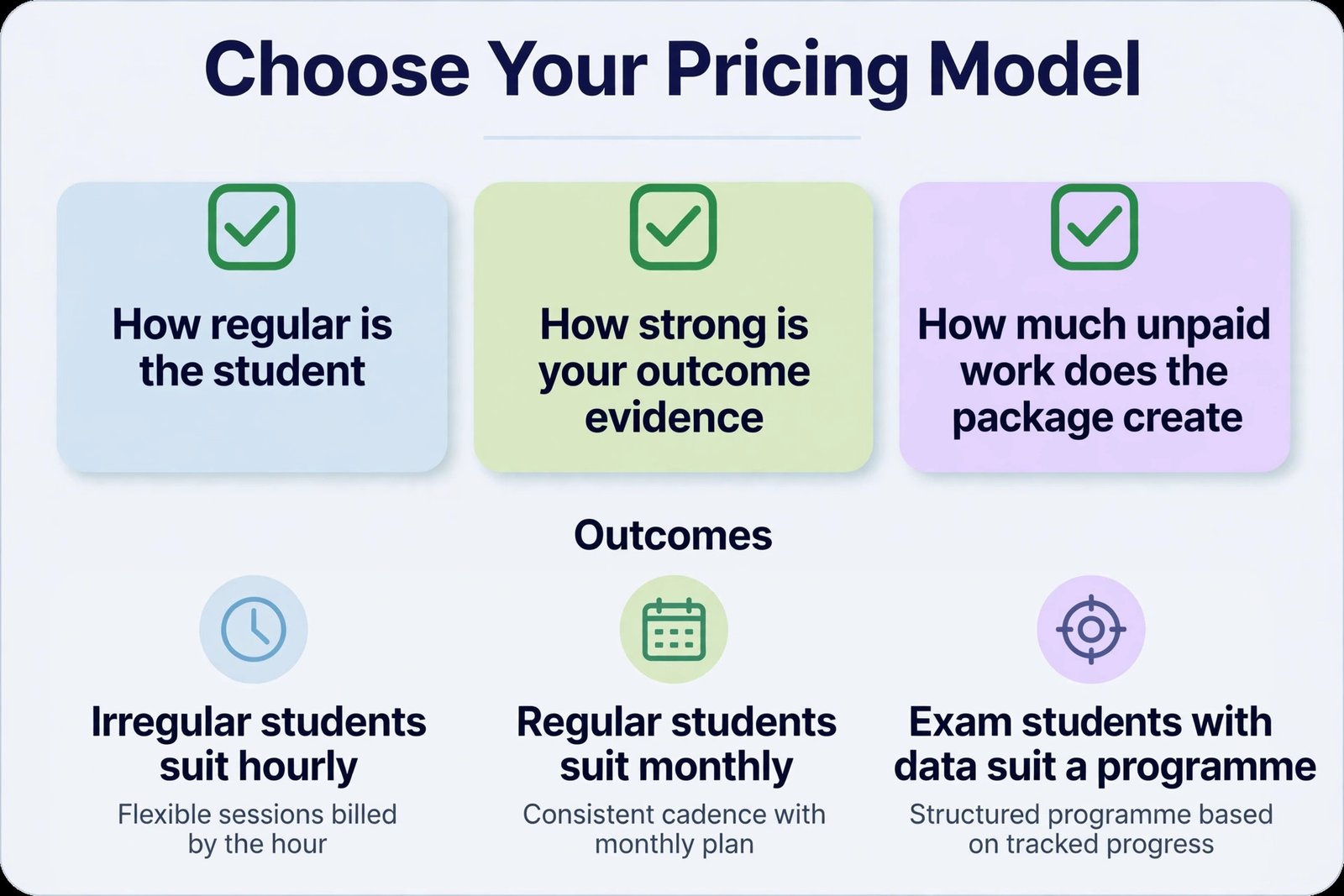
Ask three questions before you choose tutoring business pricing packages for a student. How regular is the student. How strong is your outcome evidence. And how much unpaid work does the package create between sessions. Irregular students suit hourly. Regular students with thin outcome evidence suit monthly. Regular students with a defined exam and outcome data suit a programme with a results element. Offer two or three clear packages, not ten confusing ones.
Mistakes That Quietly Shrink Tutoring Income
The first mistake is discounting too deeply to win the first client. A 30 or 40 percent discount sets the price the family expects forever, and raising it later feels like a price rise even if it is only a return to the normal rate. Published guidance caps sensible package discounts at about 15 percent for large packs for good reason. Beyond that, the tutor is giving away preparation and admin time for free. A better first client offer is a paid assessment or a short trial pack at the normal rate, rather than a deep discount on the core rate.
The second mistake is selling unlimited extras. Unlimited messaging, homework help, rescheduling and marking sound generous in a sales call and become unpaid work in week three. Cap each extra, state the cap, and sell extra help at a defined rate. Clear limits signal a professional service rather than a tutor who will burn out.
The third mistake is forgetting expiry and rollover. Packages with no expiry create a liability that grows every time a session is missed, and a tutor can end up owing dozens of sessions to families who return after a break. Set an expiry, such as 90 days for a pack and one month for a monthly plan with one rollover, and state it on the invoice. The fourth mistake is mixing prices for the same service. Keep a published price list, offer a small number of defined discounts, such as a sibling rate or a term prepay rate, and apply them consistently.
The fifth mistake is building tutoring business pricing packages around hours alone and never reviewing them. Costs rise and exam syllabuses change, so a package priced two years ago may now be too cheap for the work involved. Review prices once a year, or once a term for exam programmes. A small annual rise, explained with improved materials or results, is easier for families than a large rise after years of silence.
Raising Prices Without Losing Students
Raising prices feels risky, but keeping a price that no longer covers the work is riskier, because it leads to overwork and rushed preparation. Tutors who raise prices successfully give notice, explain the change in terms of value, and protect existing clients with a fair transition.
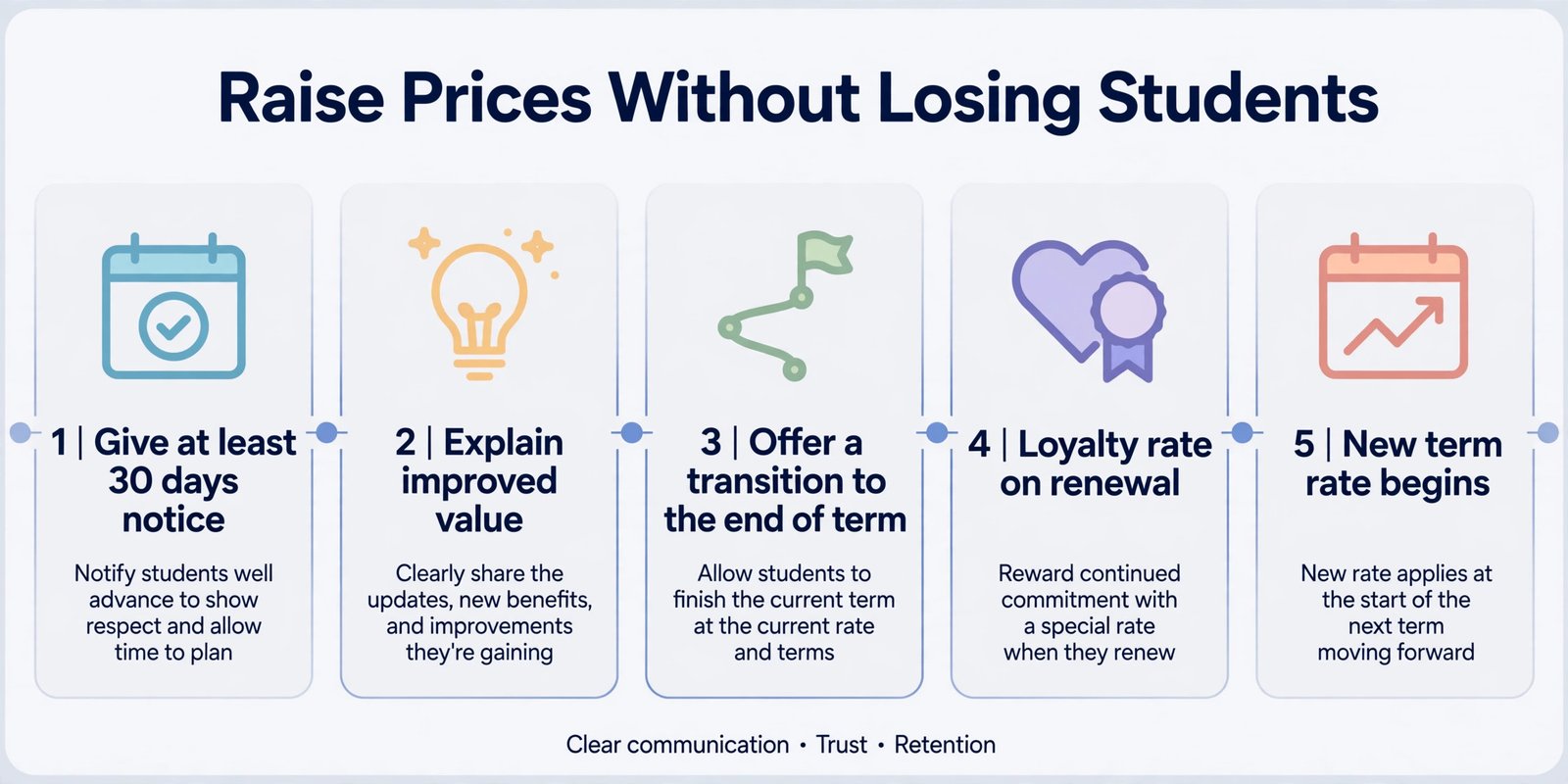
Give at least 30 days notice for a monthly change, and longer for a term programme, so families can plan. Explain what has improved, such as new practice materials or structured progress reporting, rather than only saying costs have risen. Offer a transition, such as holding the old rate until the end of the current term, or a loyalty rate on renewal for families who prepay. Most clients accept a rise of about 10 percent or less with proper notice.
Raise prices for new clients first if you are nervous. A new price list for new enquiries, with existing families moved at the next natural break such as a new term, lets you test the market without risking the whole calendar. Track enquiries and conversions at the new price for a month. If enquiries fall sharply, check whether the problem is price, positioning, or a weak offer page, before cutting the price back. Often the fix is a clearer package description, not a lower number.
Do not undo a rise with free extras. Pair it with defined value, such as a term progress report or a practice test review, and keep the limits in writing. Students who stay after a small, well explained rise are the base a stable business is built on.
Related reading for tutors includes best AI tools for tutors, AI tools for students, best AI tools for teachers and best scheduling apps, plus best CRM software for small business and how to get clients as a freelancer with AI for client tracking and enquiries.
Frequently Asked Questions
How much should a new tutor charge per hour?
A new tutor should start inside the published range for the subject and level, not at the top of the market. Published guides put new tutors at about 20 to 35 dollars an hour, with experienced tutors at about 40 to 70 dollars an hour and specialists higher. Start near the lower middle of your subject range, track preparation time and results for a term, then raise the rate for new clients as evidence grows.
Is a monthly package better than hourly tutoring?
A monthly package is better for regular students who need steady support across a term, because it gives predictable income and a predictable bill. Hourly is better for trials, short term help and irregular schedules. Many tutors sell both, with hourly for entry and monthly for regular students.
How large a discount should a tutoring package offer?
A modest discount rewards commitment without destroying margin. Published guidance suggests about 5 percent for five sessions, about 10 percent for ten sessions, and a maximum of about 15 percent for 20 or more sessions. Discounts beyond 20 percent usually give away preparation and admin time, and they make later price rises much harder.
Should I offer a money back guarantee tied to a grade?
Only if you can measure the starting point, define the result in numbers, state the student conditions, and afford the refund if the result is missed for reasons outside your control. A safer first step is a programme priced on teaching and materials, with a term review that measures progress.
What should a monthly tutoring package include?
A monthly package should state the number and length of sessions, the extras and their caps, the rollover rule, the cancellation and pause rule, and the renewal date. Common extras are practice materials, a monthly progress note and capped message support. Unlimited extras should be avoided, because they turn a fixed fee into open ended work.
How often should I review tutoring prices?
Review prices at least once a year, and once a term for exam programmes. Check costs, preparation time and local market rates, then make small, explained rises rather than waiting years and imposing a large rise at once. Give existing families notice and a fair transition at the next term break.
Price the Outcome, Protect the Calendar
The best tutoring price is not the highest number a family will accept once. It is the price that pays for teaching, preparation and admin, that families understand without a long explanation, and that still feels fair in exam week when everyone is tired. Hourly gives flexibility and a simple start. Monthly gives stability and a rhythm that helps students most. Results-based gives a powerful sales story, but only when the result is defined, measured and backed by evidence.
Build your menu around that truth. Offer hourly for trials and top ups, monthly for regular students, and a programme with a defined outcome for exam cohorts where you have data. Write the limits down, price the extras, set rollover and cancellation rules before the first session, and review the numbers every term. That promise keeps students, protects the calendar, and turns tutoring from paid hours into a business that can grow without burning out the tutor at the centre of it.