
Compare two HVAC shops at the end of spring. The shops that use AI for HVAC maintenance plan reminders well close that gap before the season starts. One shop has a full tune up diary, a plan book that renews on time, and technicians who arrive knowing the equipment history. The other shop has the same number of past customers, but half of them never heard about the spring tune up, a stack of lapsed plans nobody chased, and a summer diary filled with breakdown calls that could have been prevented. The difference is rarely the quality of the technical work. It is the reminder system, because maintenance revenue is won or lost in the weeks before the season changes.
HVAC maintenance plans fail quietly. A customer signs up, enjoys one tune up, forgets the renewal date, and drifts away without complaint. The shop notices only when the diary looks thin in April or October, by which time the customer has already booked a rival or decided to skip the tune up entirely. A reminder system that tracks every plan, every filter change, and every seasonal visit turns that drift into booked work, and it does so without adding office staff.
This guide builds a reminder workflow that keeps plans current, fills seasonal diaries early, and still leaves room for human judgment where it matters. It covers the plan structure that customers understand, the tools that handle agreement tracking well, the renewal and upsell rules that protect trust, and the measures that show whether the system is earning its keep. Prices quoted here come from vendor pricing pages and reputable comparison guides checked at writing time, so confirm the current price on the vendor page before buying.
Why HVAC Maintenance Plans Lapse
Most HVAC shops lose money in three quiet places, and none of them shows up as a single large bill. The first is the forgotten renewal. A plan that renews once a year has eleven months in which the customer can forget it, move house, change payment details, or simply lose the paperwork. Without a reminder sequence at ninety, sixty, thirty, and seven days, a large share of plans lapse by default rather than by decision, and the shop must win those customers back from scratch.
The second leak is the thin shoulder season diary. Spring cooling tune ups and fall heating tune ups cluster into a few weeks, so a shop that starts reminding customers only when the season arrives will find the diary already full on the best days and empty on the rest. A reminder system that starts forty five days before the season, segments customers by equipment type, and books early slots first spreads the work across the whole shoulder season instead of cramming it into two frantic weeks.
The third leak is the missed filter and the missed upsell. Filters need changing far more often than tune ups happen, and a customer who never hears about a filter change runs a system that works harder, costs more to run, and breaks sooner. Small add ons such as filter subscriptions, drain treatments, and surge protection are also missed when nobody reviews the equipment record at the right time. An automated system does not sell for the technician, but it does put the right customer, the right equipment note, and the right offer in front of the technician at the right visit.
How to Use AI for HVAC Maintenance Plan Reminders Without Sounding Like a Robot
The best way to use AI for HVAC maintenance plan reminders is to let software handle the timing and the record keeping, and keep people in charge of the message and the judgment calls. Software should track renewal dates, segment customers by equipment and last visit, send reminders, and book from live diary slots. A person should write the message voice, approve an upsell offer, handle a complaint, and judge whether a customer needs a call rather than another text. When that split is clear, customers get timely reminders and the shop keeps its reputation for care.
Start by defining what the system may send on its own. Standard seasonal reminders, filter change reminders, and renewal notices with published plan prices are safe to automate, because the facts and the price are known in advance. Anything outside that list, such as a customer with an unresolved repair, a disputed invoice, or an ageing system that needs a replacement conversation, should go to a human for a call before another automated message goes out. Customers accept automation when the message names their equipment, their last visit, and a real booking link, and they ignore automation that reads like a generic blast.
The Reminder Workflow, Step by Step
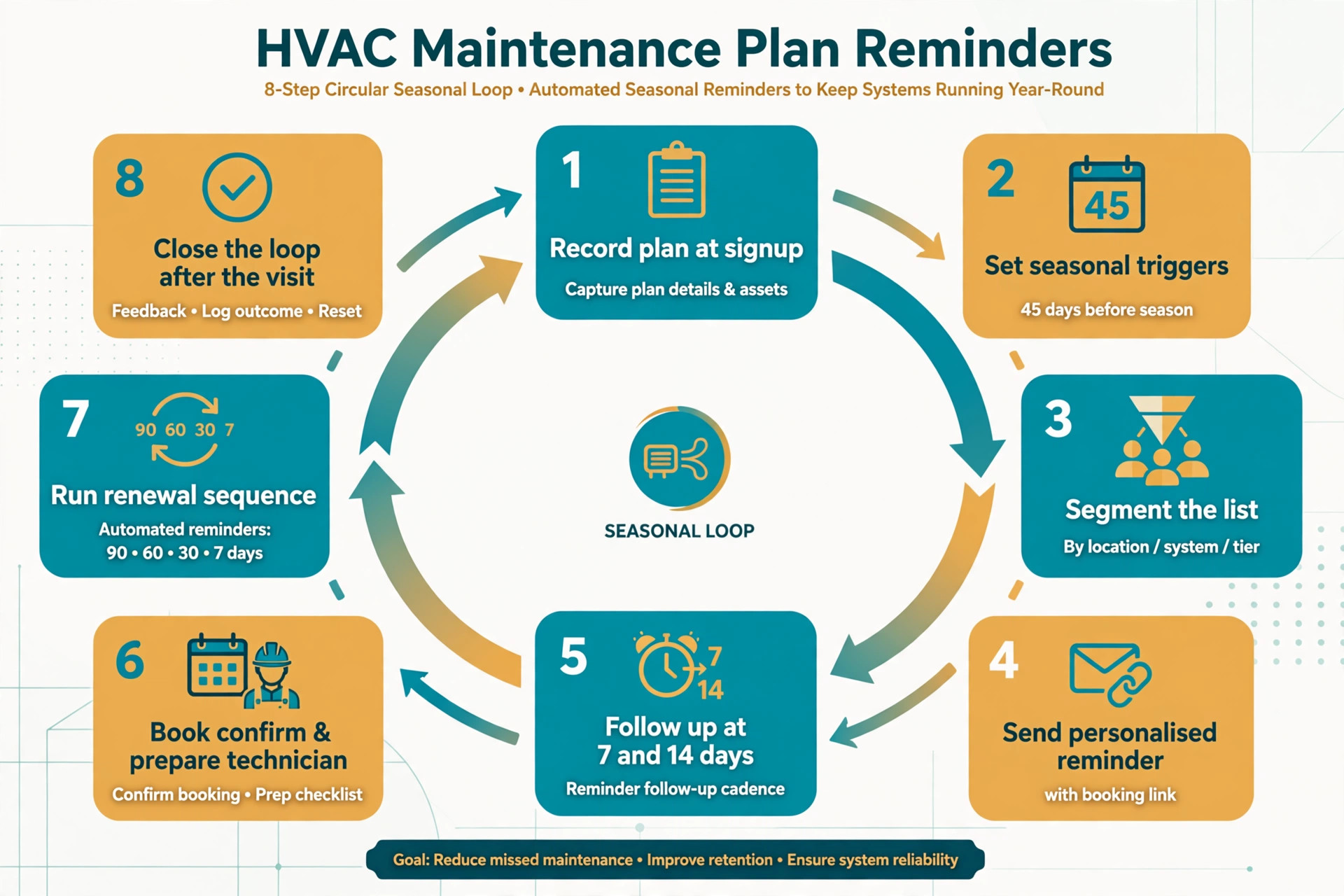
A strong reminder workflow moves a plan from signup to renewal and to the next seasonal visit in eight steps. Each step has one job, and skipping a step is what creates the lapses that empty a diary. The steps below work for a single truck shop and for a multi truck operation, and they work whether the first contact is a phone call, a website signup, or a visit sold at the kitchen table.
1. Record the plan properly at signup. Capture the customer, the equipment type and age, the filter size, the plan tier, the price, the payment method, and the renewal date before the technician leaves, so the record is complete while the details are fresh. 2. Set the seasonal triggers. Create spring cooling and fall heating campaigns that start about forty five days before each season in the service area, so reminders arrive while diary slots are still open. 3. Segment the list before sending. Group customers by equipment type, plan tier, last visit date, and overdue status, so a heating customer does not receive a cooling message and an overdue customer receives a different message from a current plan member. 4. Send a personalised reminder with a booking link. Name the equipment, state the last visit date, explain the seasonal benefit in one sentence, and link directly to live diary slots rather than to a general contact page. 5. Follow up non responders on a set rhythm. Send a second reminder after about seven days and a third after about fourteen days, with rising urgency about filling slots, and stop the sequence the moment the customer books. 6. Book, confirm, and prepare the technician. Send a confirmation with the visit window, attach the equipment record and the filter size, and flag any upsell check the technician should review on site. 7. Run the renewal sequence for expiring plans. Send notices at ninety, sixty, thirty, and seven days before expiry, offer card on file renewal with a retry sequence for failed payments, and route a failed renewal to a human call rather than another automated message. 8. Close the loop after the visit. Send a thank you, a visit summary, a request for a review, and the date of the next seasonal visit, so one tune up becomes a renewed plan rather than a one off job.
The Maintenance Plan Template
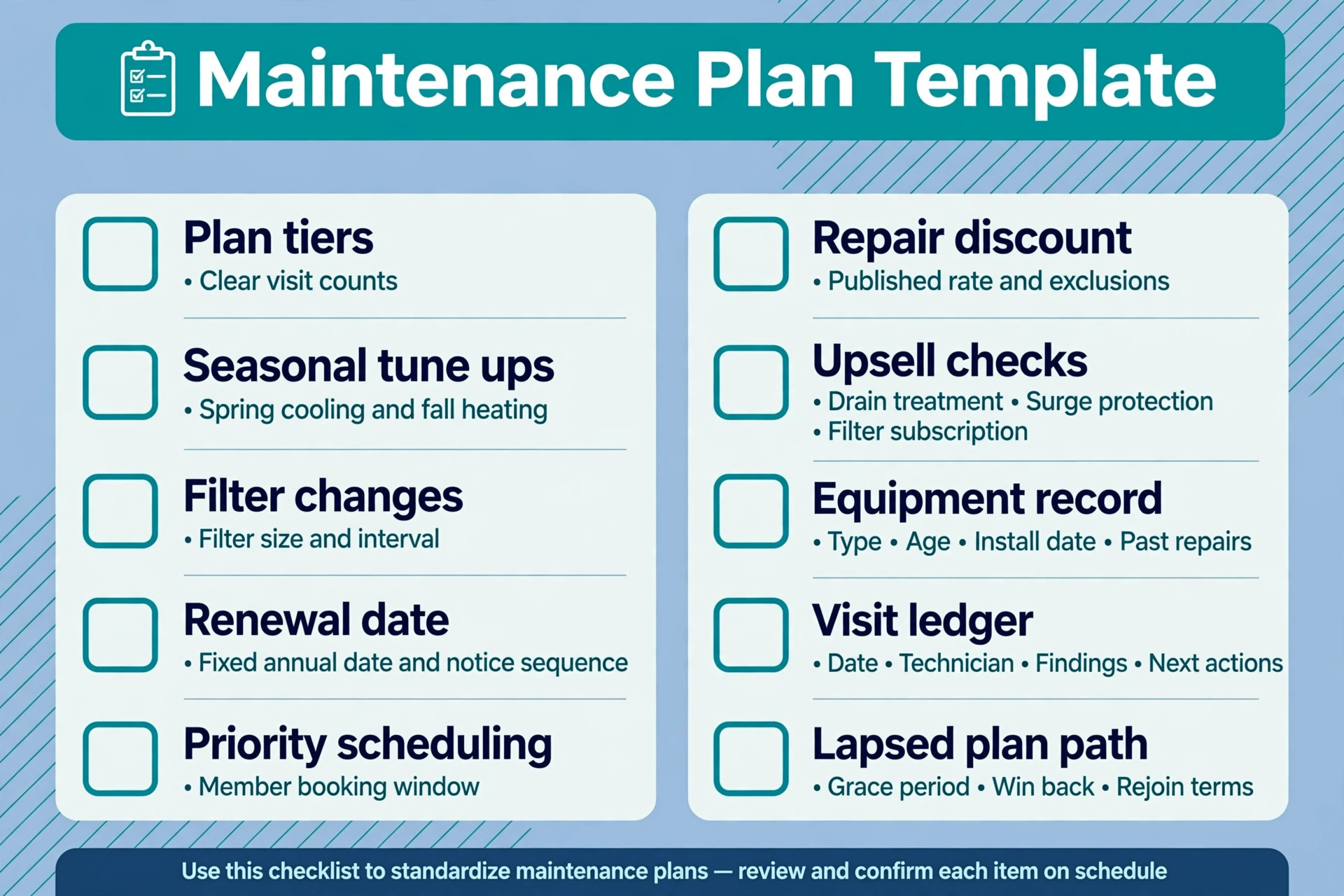
The maintenance plan template below is the heart of the system, because every row on it prevents a lapse or a missed visit. Use it as a plan builder, as a technician checklist, and as a renewal review sheet. If a row is blank, the plan is not ready to sell, and the system should chase it rather than leave it blank.
| Plan element | What to define | Why it keeps the plan alive |
|---|---|---|
| Plan tiers | Bronze, silver, gold or similar, with clear visit counts | Decides what the customer expects each year |
| Seasonal tune ups | Spring cooling visit and fall heating visit | Decides the two anchor bookings per year |
| Filter changes | Filter size, change interval, who supplies filters | Decides efficiency and breakdown risk |
| Renewal date | Fixed annual date, notice sequence, payment method | Decides whether the plan lapses by default |
| Priority scheduling | Member booking window before general customers | Decides why membership feels valuable |
| Repair discount | Published percentage, exclusions stated plainly | Decides whether members call the shop first |
| Upsell checks | Drain treatment, surge protection, filter subscription | Decides honest add on revenue at each visit |
| Equipment record | Type, age, install date, past repairs | Decides personalised reminders and replacement timing |
| Visit ledger | Date, technician, findings, next actions | Decides continuity when technicians change |
| Lapsed plan path | Grace period, win back offer, rejoin terms | Decides whether a lapse becomes a lost customer |
Plan Prices, Tune Up Costs and Renewal Maths
Maintenance plan pricing in recent guides shows a clear pattern. A single tune up is reported at about $129 on one contractor example, while a plan at about $19 a month includes two seasonal tune ups, a repair discount, and priority scheduling, which means the membership pays for itself on the tune ups alone before other benefits are counted. A higher tier at about $29 a month in the same example adds a larger repair discount, filter replacements, and a drain treatment. Those are single contractor examples, not a national price, so treat them as a shape for plan design and confirm local competitor prices before setting tiers.
Reminder software pricing follows a different shape, because it is priced by the size of the plan book rather than by seats in several specialist tools. One specialist tool reports an owner operator tier at about $45 a month for up to 300 active agreements, a growing shop tier at about $99 a month for up to 1,500 agreements, and a multi truck tier at about $229 a month for unlimited agreements, with renewal notices at ninety, sixty, thirty, and seven days.
Another specialist tool reports a flat $29 a month for agreement tracking with automatic reminders and AI written reminder emails. Those figures show why a small shop should price the tool against recovered plans, not against the subscription alone, because one recovered plan often covers a month of software.
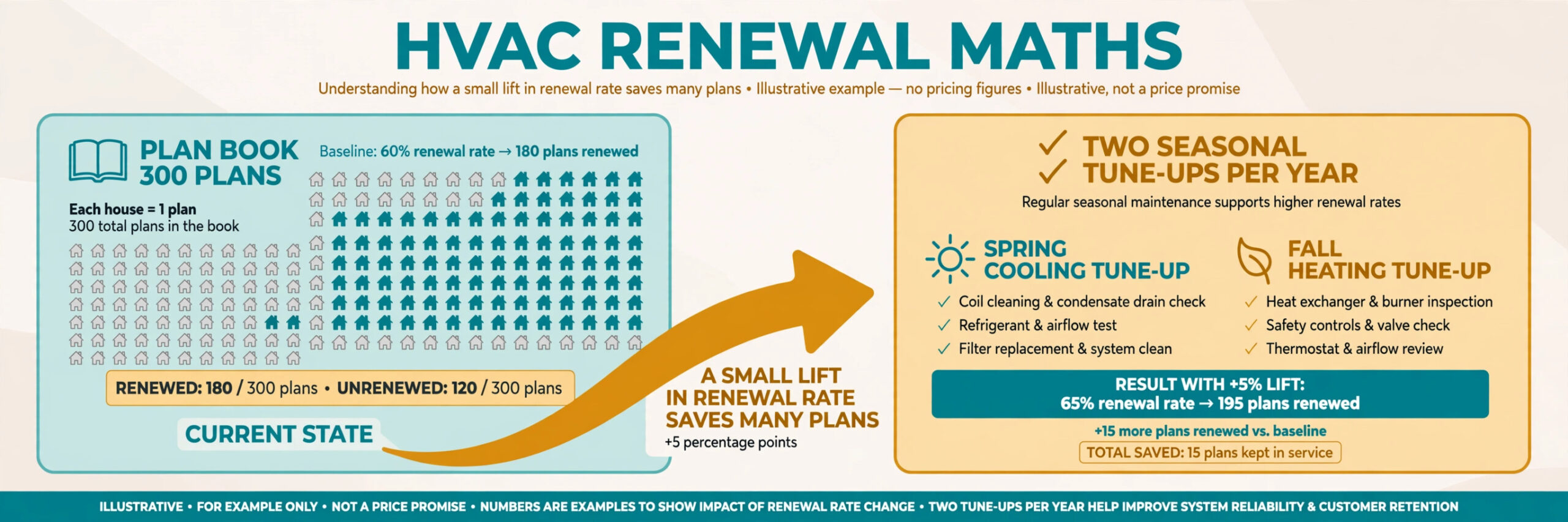
The renewal maths is simple enough to run on one plan book. Take a shop with 300 plans. If reminders lift the renewal rate by even ten points, thirty plans are saved, and thirty plans at a typical annual value represent a large multiple of the software cost. If reminders also fill shoulder season slots earlier, the shop gains steadier technician utilisation and fewer emergency breakdown calls in peak heat or cold. Price the tool against renewed plans and filled slots together, not against the subscription alone.
Tools Compared for HVAC Maintenance Plan Reminders
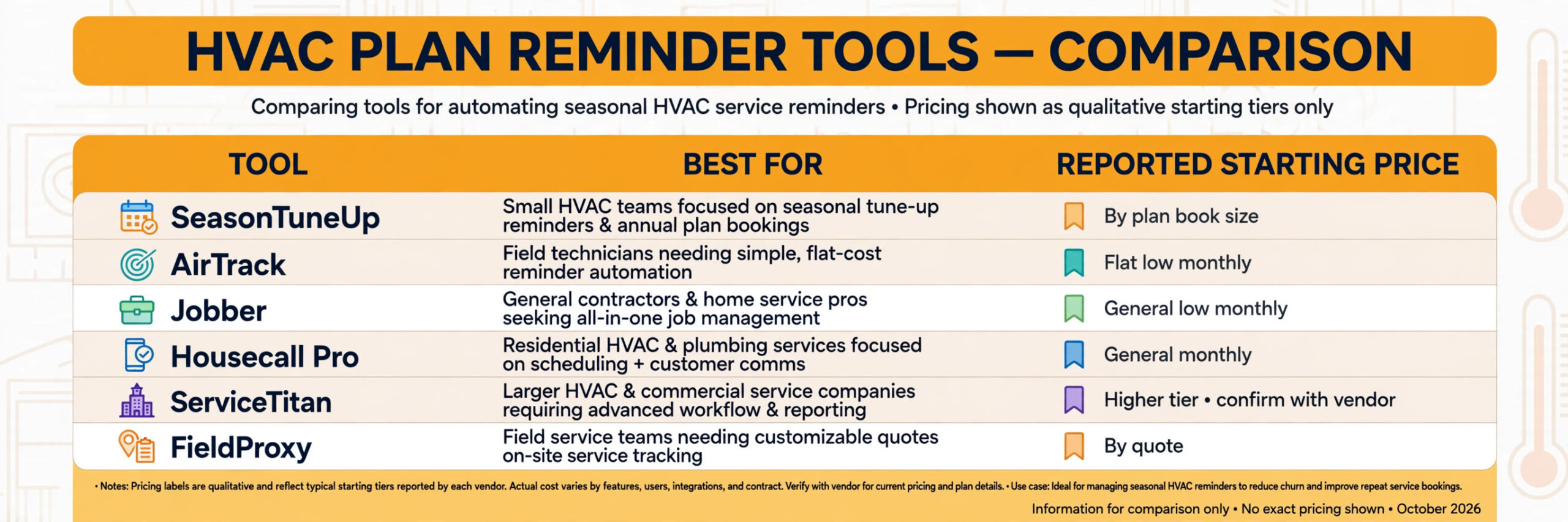
The tools below cover the main ways an HVAC shop can run plan reminders, from agreement specialists to general field service systems. Prices are reported from vendor pages and comparison guides, and they change, so confirm the current price on the vendor page before choosing. The right choice depends less on the feature list and more on whether the business needs agreement tracking, dispatch, invoicing, and payments in the same tool or only needs reminders that work.
| Tool | Best for | Reported starting price | Trade off |
|---|---|---|---|
| SeasonTuneUp | Shops wanting agreement tracking priced by plan book size | About $45 a month for up to 300 agreements reported | Agreement depth, but not a full dispatch system |
| AirTrack | Small shops wanting one flat price for reminders | About $29 a month reported | Cheap and focused, but less deep on dispatch |
| Jobber | Multi trade firms wanting reminders plus dispatch and invoicing | About $29 to $49 a month for one user on annual billing in recent guides | Strong all rounder, but agreement tracking needs setup |
| Housecall Pro | Mobile first teams wanting reminders plus payments | About $59 a month for one user on annual billing in recent guides | Easy field use, but advanced features sit on higher tiers |
| ServiceTitan | Larger shops wanting agreements tied to inventory and job costing | Higher tier pricing, confirm with the vendor | Deepest operations depth, but price and setup suit scale |
| FieldProxy | Shops wanting seasonal campaign automation by equipment segment | Pricing by quote in recent guides | Campaign depth, but quote based pricing slows comparison |
SeasonTuneUp
SeasonTuneUp suits a shop whose main problem is lapsed plans, because it tracks agreements to a renewal date, runs spring and fall campaigns, and sends email and text reminders with booking links. Its pricing by agreement count means the bill grows only when the plan book grows, which is the growth a shop actually wants. Choose it if renewal tracking is the daily headache. Skip it if the business needs full dispatch and invoicing in the same tool, because an agreement specialist is not a full operations platform.
AirTrack
AirTrack suits a small shop that wants automatic maintenance reminders, agreement renewal tracking, and AI written reminder emails for one flat price reported at about $29 a month, with unlimited customers and technicians. Choose it if the budget is tight and the reminder job is the priority. Skip it if the business needs deep dispatch, inventory, or job costing, because AirTrack is built for one job and does it narrowly.
Jobber
Jobber suits a business that runs HVAC work alongside other trades and wants one system for scheduling, invoicing, payments, and reminders. The trade off is that agreement tracking and renewal sequences must be built from recurring jobs and follow ups rather than used natively, so a pure HVAC shop should test whether the workaround holds up across a full renewal season. Choose Jobber if HVAC sits beside other trades. Skip it if plan renewals drive the business, because a specialist tracks agreements better.
Housecall Pro
Housecall Pro suits a team that works mostly from phones and wants customers to book, pay, and receive reminders from the same flow, with work templates that standardise recurring jobs. The trade off is that advanced automation sits on higher tiers, so the entry price does not buy the full reminder and follow up set. Choose it if mobile field use and payments matter most. Skip it if the business needs agreement renewal depth, because that logic lives in specialist tools.
ServiceTitan
ServiceTitan suits a larger shop that wants maintenance work orders linked to inventory parts, pricing, and job costing, so contract customers receive standardised coverage across technicians and branches. The trade off is price and implementation effort, which suit scale rather than a single truck shop. Choose it if the business is large enough to need inventory and costing depth. Skip it if the shop is small, because the platform will cost more in money and setup time than the reminder problem justifies.
FieldProxy
FieldProxy suits a shop that wants seasonal campaign automation with customer segmentation by equipment type and service history, reminders sent about forty five days before peak seasons, and follow ups at seven and fourteen day intervals for non responders. The trade off is quote based pricing, which slows comparison. Choose it if campaign structure is the weak spot. Skip it if the business needs a published price to budget quickly, because a demo quote is required first.
Pricing, Renewal and Upsell Rules
A business that decides to use AI for HVAC maintenance plan reminders still needs plan rules that customers can understand in one reading. Publish the tier prices, the visit counts, the repair discount, and the renewal date rule, with a note that filters and add ons are priced separately where they apply. Customers who can work out their own plan value before signing are more likely to renew, and less likely to dispute a renewal charge, because the value logic was visible from the start.
Renewal handling should be automatic and kind. When a card fails, the system should retry on a stated rhythm, notify the customer plainly, and offer an updated payment link, rather than silently cancelling the plan. When a customer cancels inside the grace period, the system should offer a pause or a lower tier immediately, rather than just confirming the cancellation and losing the customer. The goal is a plan book that renews itself, not a set of rules that punishes customers into never returning.
Handling Lapsed Plans, Moved Customers and Ageing Systems
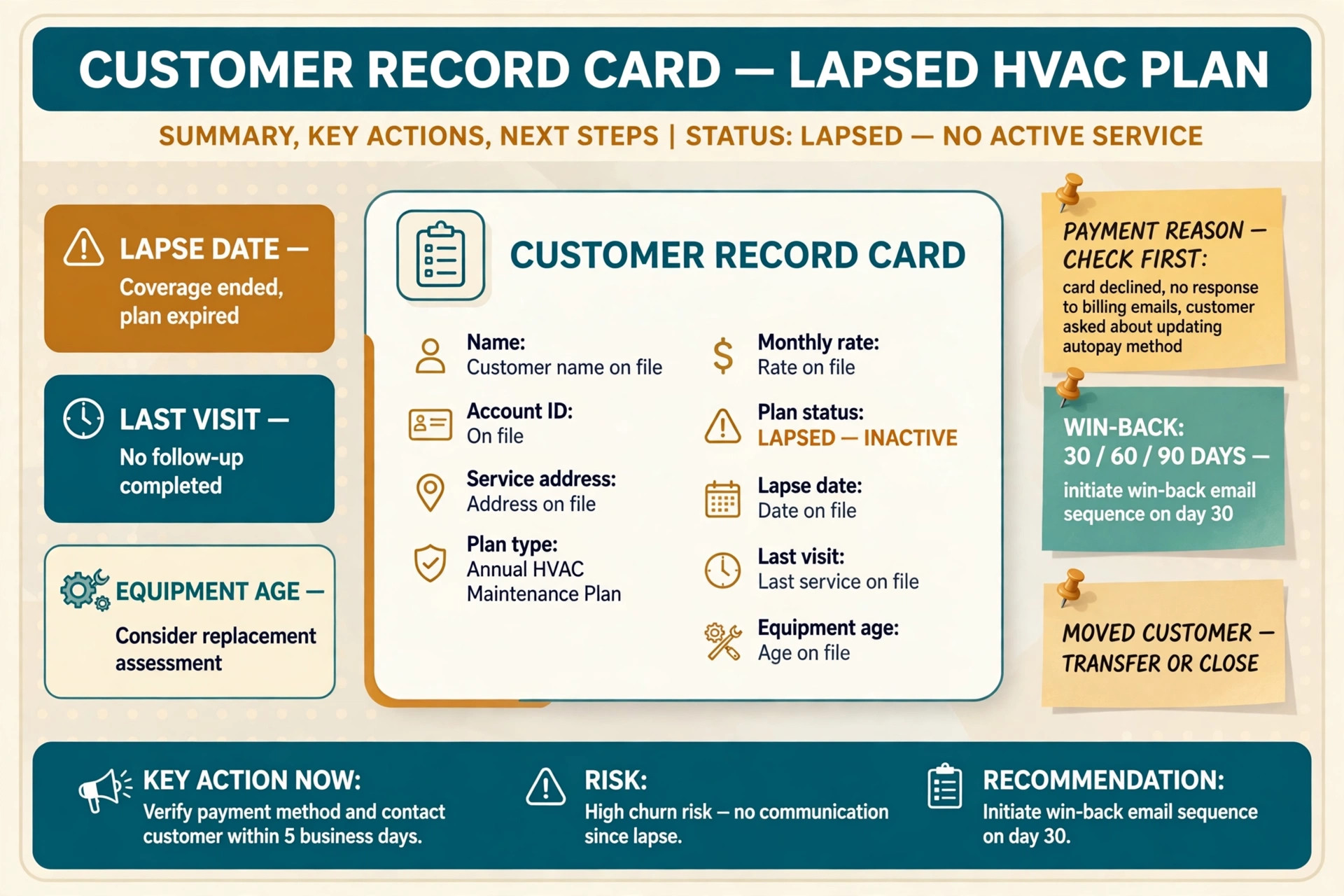
Lapsed plans change an HVAC diary more than any other single factor, and a business that decides to use AI for HVAC maintenance plan reminders must treat them as a normal part of the year rather than a failure. Keep a lapsed plan list with the lapse date, the last visit, and the equipment age, and let the system send a win back message with a clear rejoin offer at thirty, sixty, and ninety days. Some customers lapse because of a failed card, not because of dissatisfaction, so check the payment reason before sending a discount offer, because a payment fix costs less than a discount.
Moved customers are the second most common cause of a stale plan book. A customer who moves house leaves a plan tied to an old address and an old system, and reminders sent to the old record waste effort and annoy the new occupant. The booking form should ask about moves at every visit, and the reminder message should ask the customer to confirm that the address and equipment are still correct. For moved customers, use a clear transfer process that the customer agrees to in writing, including whether the plan moves to the new system or closes, rather than letting the record drift.
Ageing systems need a human decision before the next renewal. Systems past a certain age, with repeated repairs or rising energy complaints, should trigger a replacement conversation with a dispatcher or a senior technician, even if the customer has a plan that auto renews. The system should flag these cases automatically from the equipment record and hold the renewal message as provisional until a person reviews it. That pause costs a few hours, but it prevents a customer renewing a plan for a system that should be replaced, which is a trust problem no reminder can fix.
Measuring What Plan Reminders Earn
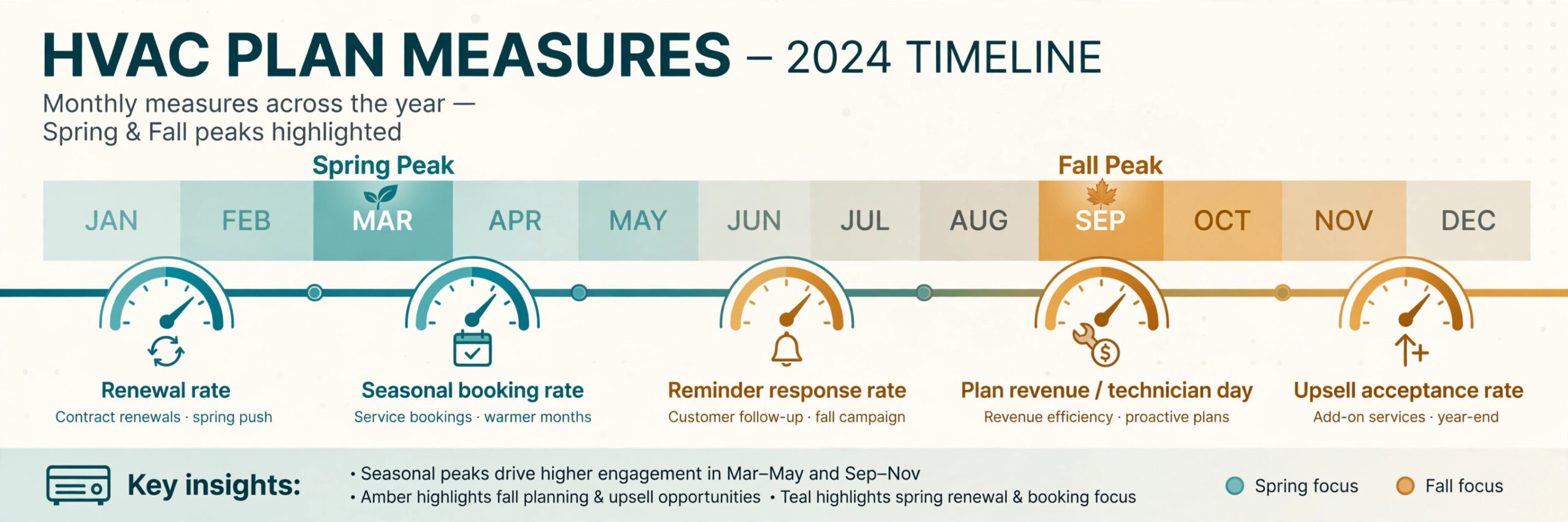
A reminder system should pay for itself in renewed plans and filled seasonal slots, and the only way to know is to measure a small set of numbers every month. Start with the renewal rate, meaning the share of expiring plans that renew on time, because that is the number that decides whether the plan book grows or shrinks. Then measure the seasonal booking rate, meaning the share of plan members booked before the season peak, and the reminder response rate, meaning the share of reminders that produce a booking or a reply.
Add two money numbers to those three service numbers. The first is plan revenue per technician day, which shows whether the diary is filling with planned work or with emergency calls that disrupt the schedule. The second is upsell acceptance rate, meaning the share of visit recommendations that customers approve, because honest recommendations that customers accept are a sign of trust. If the renewal rate rises but the seasonal booking rate does not, the problem is diary capacity or message timing, not the reminder itself. If the seasonal booking rate rises but upsell acceptance falls, the problem is recommendation quality, not demand.
Mistakes That Undo a Good Plan Setup
The most common mistake is launching the reminder campaigns before the equipment records are clean. Customers receive messages naming the wrong system, the wrong filter size, or a visit date that never happened, and the office spends the season apologising for a system that was supposed to save time. Finish the equipment records, the plan tiers, and the renewal dates first, test them with five real past customers, and only then turn on the campaigns. A week spent on records saves a month of trust repair.
The second mistake is letting the system message every customer the same way without limits. A business that sends the same blast to current members, lapsed members, and customers with unresolved repairs will receive complaints it cannot safely answer with automation, and the unsubscribe rate will climb. Limit automated messages to current members with clean records, and route everyone else to a human call with a clear time promise. When owners choose to use AI for HVAC maintenance plan reminders in this limited way, the system feels helpful rather than spammy, because it knows its own limits.
The third mistake is ignoring the technicians. If the technicians do not trust the visit notes, they will start calling the office to double check every plan job, and the office will have two reminder systems instead of one. Involve the technicians in designing the visit checklist, show them how equipment notes now arrive before the visit, and fix the first three record errors they report. A system the technicians trust is a system that actually gets used, and a system they work around is just an extra cost.
Verdict, Is It Worth It for a Small HVAC Shop
For a single truck shop or a small fleet, the case is strong, provided the setup is done in the right order. Fix the plan tiers, clean the equipment records, set the renewal sequence, and only then add automated campaigns and AI written messages. Done in that order, the system renews plans on time, fills shoulder season diaries early, and sends technicians out with the information they need to do the visit properly the first time. The monthly software cost is usually smaller than the value of a handful of recovered plans, and most shops lose more than a handful of plans a season to forgotten renewals alone.
The case weakens when the business wants software to replace judgment entirely. No automated system can judge an ageing system from a record alone, price a replacement from a photo, or calm an upset customer as well as a person can. The businesses that get the best return from this approach are the ones that use AI for HVAC maintenance plan reminders for timing and coverage, while keeping people in charge of renewals with problems, replacement conversations, and final offers. That split is not a compromise. It is the whole point, because timing wins the booking and judgment keeps the customer.
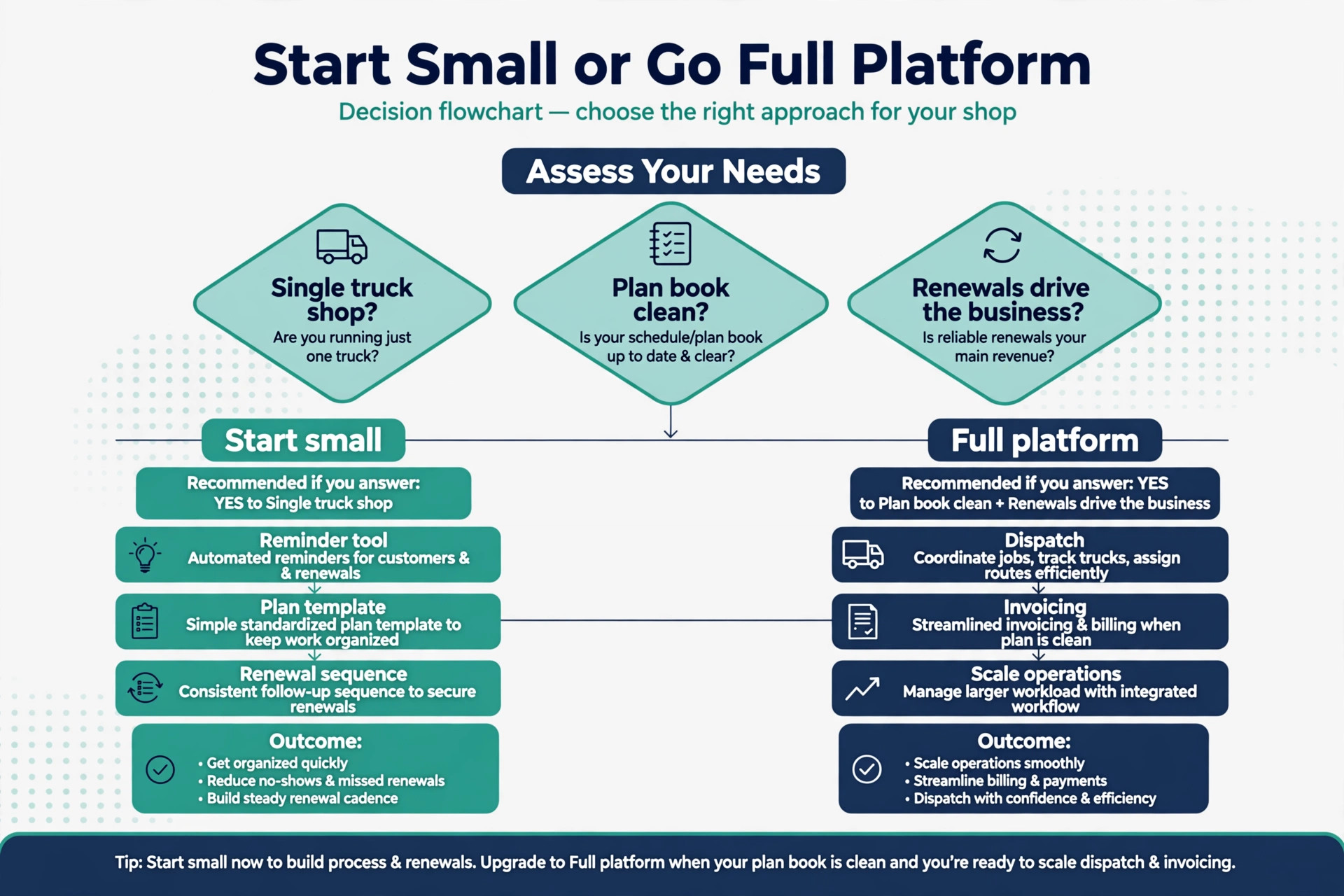
Start small if the budget is tight. A reminder tool with the plan template and the renewal sequence will already recover a large share of the losses, and a full dispatch platform can wait until the plan book is clean. Measure the five numbers from the earlier section for a month, compare them with the month before, and let the results decide the next spend. If the numbers move, expand. If they do not, fix the equipment records or the message timing before buying more software, because another tool will not fix a broken record.
More Reading on Stratilyze
For a related field service system, read best CRM for cleaning companies and best scheduling software for home care agencies. For a booking guide in a different trade, see use AI for carpet cleaning booking.
Frequently Asked Questions
How much does HVAC maintenance plan software cost
A small shop can start at about $29 to $45 a month with an agreement specialist in recent guides, while a full field service system with dispatch and invoicing typically starts around $29 to $59 a month for one user, before add ons. Agreement specialists priced by plan book size cost more as the book grows, which is the growth a shop wants. Confirm the current price on the vendor page before buying, because plans and add on prices change often.
How often should HVAC filters be changed
Filter change intervals depend on the filter type, the system use, pets, and dust levels, so the plan should record the filter size and the recommended interval for each customer rather than giving one universal answer. Many homes need a filter check every one to three months, with the plan visit confirming the size and condition. When owners choose to use AI for HVAC maintenance plan reminders, the system should send filter reminders on the interval recorded for that home, not on a generic schedule.
When should seasonal tune up reminders go out
Seasonal reminders work best when they start about forty five days before the peak season in the service area, so customers can book early slots before the diary fills. A spring cooling campaign and a fall heating campaign, each with follow ups at about seven and fourteen days for non responders, spreads the work across the shoulder season. Customers who book are removed from the sequence at once, so nobody receives a reminder for a visit already booked.
What should an HVAC maintenance plan include
A clear plan includes two seasonal tune ups, a published repair discount, priority scheduling, and a stated renewal date, with filter supply and add ons priced separately where they apply. Higher tiers may add filter replacements, drain treatments, and larger discounts. Keep the tier names plain and the benefits short enough to explain in one minute, because a plan customers cannot explain is a plan they will not renew.
How do I win back a lapsed maintenance plan customer
Check the lapse reason first, because a failed card needs a payment fix while dissatisfaction needs a human call. Send a win back message at thirty, sixty, and ninety days with a clear rejoin offer, and stop the sequence the moment the customer replies or books. A lapsed customer who returns on a clean record is worth more than a discount given to a customer who only needed a new card on file.
Can automated reminders work for a one truck HVAC shop
Yes, and it often helps a solo operator more than a larger team, because a solo technician misses the most office work while on jobs. A reminder tool plus a clean plan book can renew plans and fill seasonal slots without hiring office staff, and the equipment record means the technician arrives prepared instead of guessing. Start with reminders and renewals, add dispatch depth when the volume justifies it, and keep problem renewals on a personal call list.