
The problem is simple and expensive. A buyer fills in a form at 9 pm, asks about a house, and hears nothing until the next afternoon, by which time another agent has already booked the showing. Most agents do not lose leads because they are bad at selling. They lose leads because they are showing houses, driving, negotiating, or sleeping when the lead arrives, and no system answers in the gap. This guide shows how to use AI for real estate agent lead follow-up in a way that answers fast, stays personal, and hands the conversation to a human at the right moment.
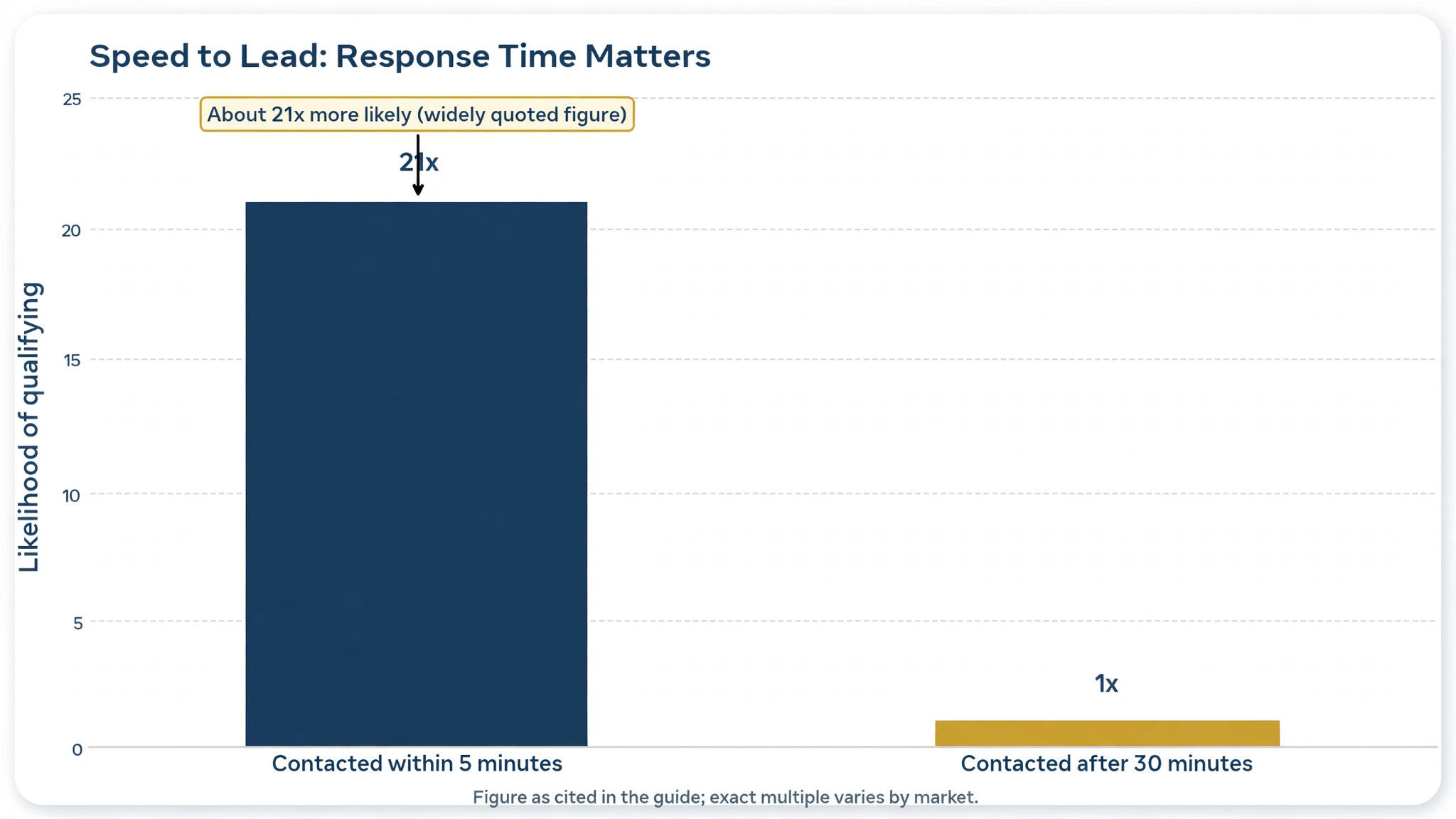
Speed is the core case, and the numbers behind it are striking. Published guides cite research showing that leads contacted within five minutes are far more likely to be qualified than leads contacted after thirty minutes, with one widely quoted figure putting the gap at about twenty one times. Even if the exact multiple varies by market, the direction is not in doubt. The first agent to answer helpfully usually wins the conversation, and AI is the only practical way for a solo agent or a small team to answer at midnight, on a Sunday, or during a showing.
AI follow-up works best for two jobs. It answers a new lead within a minute, and it keeps a conversation alive for months without getting bored or discouraged. It does not qualify deeply, it does not negotiate, and it does not close. A system built around those limits will feel helpful to leads and useful to agents. A system that pretends AI can close deals will produce generic messages, missed signals, and compliance trouble.
What Good AI Follow-Up Actually Does
Good AI follow-up starts with the lead, not with the tool. When a lead arrives from a portal, a website form, or an open house sign in sheet, the system should capture the name, the property or search area, the source, and the time of arrival, then send a first message that references that specific detail. A message that says you saw the inquiry about a three bedroom home in a named area reads as relevant. A message that says thanks for your interest reads as automated, and leads treat it that way.
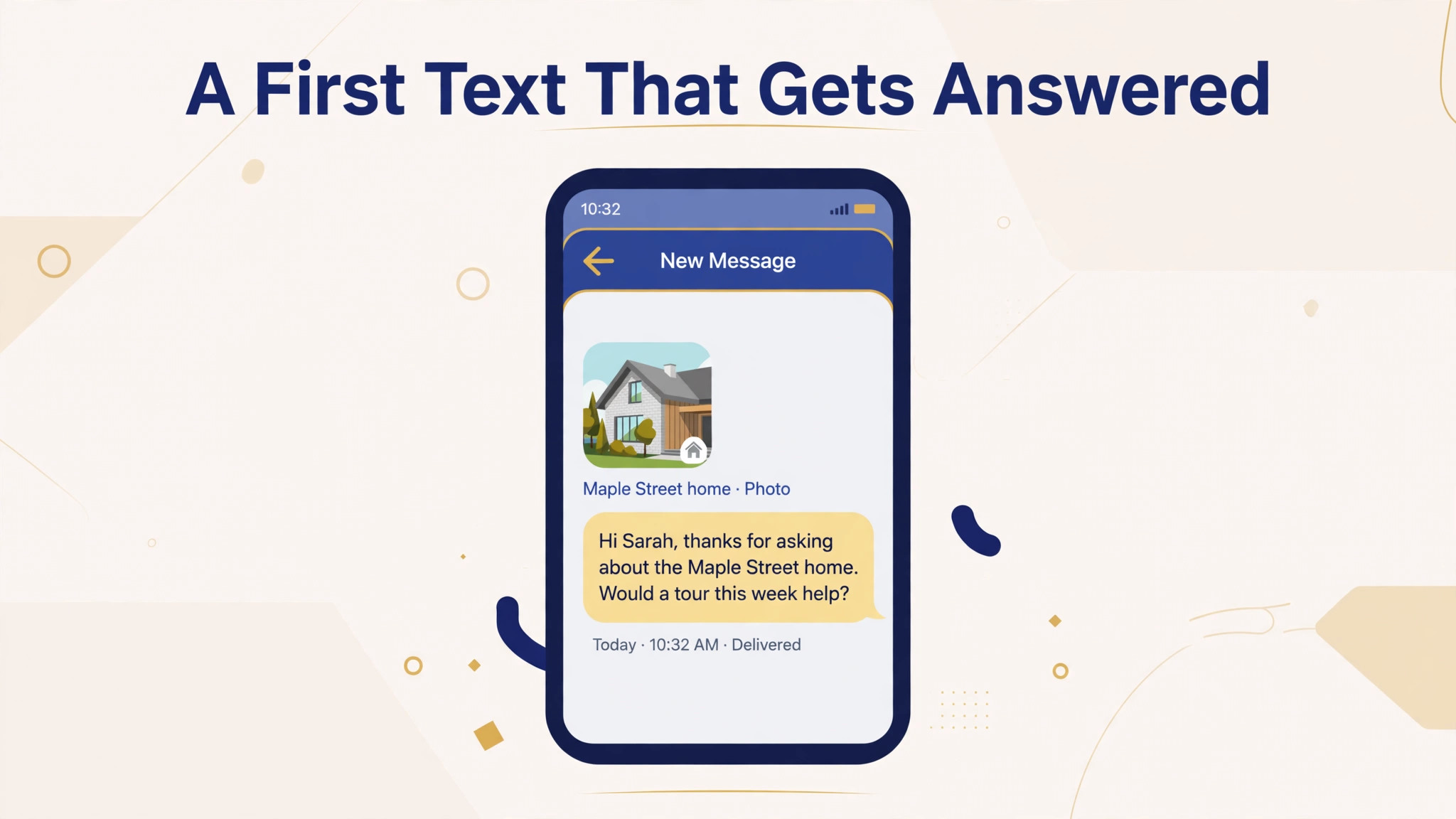
The first message should ask one useful question, not five. A question about timeline, such as whether the lead hopes to move in the next three months or is still exploring, sorts urgency without feeling like an interrogation. A question about a showing, such as whether a tour this week would help, moves a hot lead toward a booking. A message that asks for budget, pre approval, beds, baths, and neighbourhood in one go will get no answer, because it feels like a form wearing a chat costume.
Handoff is the most important design choice. AI should book, qualify lightly, and pass the lead to a human the moment the lead shows buying intent, asks a complex question, or expresses frustration. Set clear handoff triggers in advance, such as a request for a showing, a question about price or offers, or a reply that shows confusion. A lead who talks to AI for three days without a human call will assume the agent is not interested, even if the AI messages were polite.
Logging matters as much as messaging. Every AI touch should land in the CRM with the full text, the time, and the lead response, so the agent who picks up the conversation knows what was already said. A system that messages leads outside the CRM creates a second history that the agent cannot see, and the agent will repeat questions the lead already answered. That repetition is how a fast system still loses a lead.
Lead Scoring That Sorts the Queue Every Morning
Lead scoring turns a long list into a morning plan. Instead of calling leads in the order they arrived, the agent calls the leads most likely to transact first, while AI nurtures the rest. A simple scoring model beats a complex one, because the team must trust it and act on it daily. Start with behaviour, source, and timeline, and keep the model visible so the team can challenge it when it feels wrong.
Behaviour signals carry the most weight. A lead who saved a search, viewed the same property three times, opened emails, and clicked a listing shows intent that a single form fill does not. Assign points for repeat views, saved searches, email opens, and replies, and subtract points for long silence or bounced contact details. A lead who viewed a property page yesterday outranks a lead who filled a form three months ago and never returned, even if the older lead arrived first.
Source matters because not all leads are equal. A referral, a past client, or a direct website inquiry usually converts better than a cold portal lead, and the score should reflect that history. That does not mean portal leads are ignored. It means portal leads need more nurturing before a human call, while a referral deserves a human call within the hour. Agents who use AI for real estate agent lead follow-up well treat scoring as triage, not as a judgment about a person.
Timeline and readiness complete the picture. A lead who says they must move in sixty days, is pre approved, and has a price range that matches current listings scores high. A lead who says they are exploring for next year scores lower, but still deserves a monthly nurture message, because next year arrives faster than most agents expect. Review scores weekly, and adjust the weights when the team notices that high scoring leads are not converting or low scoring leads are.
| Signal | Example | Score direction |
|---|---|---|
| Repeat property views | Same listing viewed three times | Strong increase |
| Saved search or alert | New listing alert set up | Increase |
| Email or text reply | Lead answers a question | Strong increase |
| Showing request | Tour requested this week | Immediate human call |
| Long silence | No response for 60 days | Decrease, move to nurture |

Speed to Lead Texts That Get Answered
The first text is the highest value message in the whole system, so write it with care. It should arrive within a minute, reference the property or area, use the lead name, and ask one question. A strong first text might confirm the inquiry, mention the property, and ask whether a tour this week would help. A weak first text thanks the lead, lists services, and asks the lead to reply with a long list of details. Leads answer the first kind. They ignore the second.
Timing rules protect the system from feeling intrusive. AI can send the first text at any hour, because the lead chose to inquire at that hour, but later messages should respect local quiet hours and the lead preferred channel. If a lead replies by email rather than text, move the conversation to email. If a lead asks for a call, stop texting and call. Teams that use AI for real estate agent lead follow-up well respect channel choice from the first reply. A system that keeps texting a lead who asked for a call is not persistent. It is deaf.
Follow-up texts should add value, not just repeat the ask. A second message can share a similar listing, a price change on the viewed property, or a short market note for the area. A third message can ask whether the timing changed or whether a different area would suit better. Each message should give the lead a reason to reply beyond politeness, because politeness runs out after two messages. Value is what keeps a conversation alive for weeks.
Stop rules are as important as send rules. If a lead says stop, opts out, or asks not to be contacted, honour that immediately and record it in the CRM. Published guidance notes that since April 2025, consumers may revoke consent by any reasonable method, and agents must honour revocations within ten business days, with potential damages per message for automated marketing texts sent without proper consent. Keep consent records, use a registered messaging setup for deliverability, and never require a lead to reply with a specific word to opt out.
How to Use AI for Real Estate Agent Lead Follow-Up From Inquiry to Showing
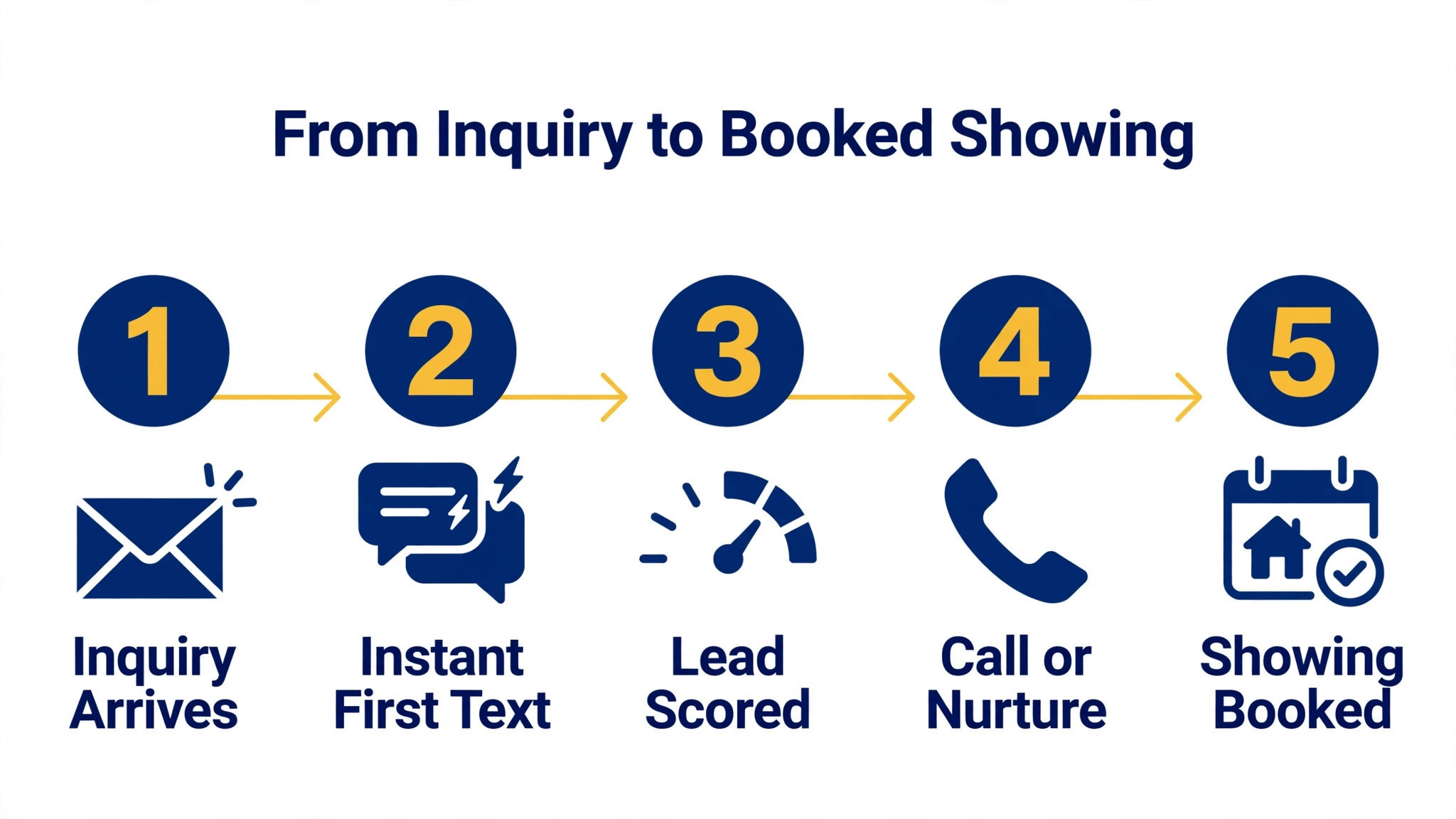
This workflow ties scoring, speed, drip, and handoff into one routine the team can run daily. Follow it in order, and review the results weekly rather than changing the workflow after one bad day.
- Capture every lead in the CRM the moment it arrives, with source, property or area, and arrival time attached. AI sends the first personalised text within sixty seconds, referencing the property and asking one timeline or showing question. The check is that no lead waits more than five minutes for a first touch, day or night.
- Score the lead from behaviour, source, and timeline, then route it by score. Hot leads go to a human for a call within five minutes during working hours, or first thing in the morning for overnight leads, with the AI conversation already logged. Warm leads enter a short sequence with a human call task on day two. Cool leads enter long term nurture with monthly value messages.
- Run a ten day sequence for warm leads that mixes channels and value. Day zero is the first text. Day one is an email with similar listings or a market snapshot. Day two is a human call to qualify timeline and budget. Day three is a softer text if the call did not connect. Day five is a new listing or price change alert. Day seven is a call or video message. Day ten is a direct question about whether the search is still active, with an easy opt out.
- Turn showing interest into a booked tour without delay. When a lead asks for a showing, AI should offer two or three specific times, confirm the booking, send calendar details, and remind the lead the day before and the morning of the tour. After the tour, AI should send a thank you message and ask for feedback, while the agent follows up personally within a day with next steps.
- Keep long term leads warm with monthly messages that reflect real behaviour, such as a new listing in a saved area, a price change on a watched property, or a market note for a searched neighbourhood. A lead who is not ready today may be ready in six months, and the agent who stayed helpful without pestering will be the first call when readiness changes.
- Reactivate past clients and old leads with a separate quarterly campaign, covered in detail later in this guide, rather than letting them sit untouched in the CRM. The check for the whole workflow is a weekly review of response time, reply rate, showing bookings, and handoff quality, with one change made per week based on what the numbers show.
Drip Sequences That Nurture Without Nagging
Drip sequences fail when they repeat the same ask every three days. They work when each message adds something the lead did not know before. Build sequences around behaviour, so a lead who viewed a new listing gets a message about that listing, while a lead who searched a new area gets a message about that area. Behaviour driven messages feel personal because they are personal, in the sense that they respond to what the lead actually did.
Separate sequences by intent. A plan to use AI for real estate agent lead follow-up should build one sequence per intent, not one sequence for everyone. Buyers need listings, price changes, and market notes. Sellers need valuation updates, recent sales in their street, and preparation tips. Investors need yield notes, rent estimates, and off market signals where available. A single generic sequence sent to all three groups will bore all three groups, because a buyer does not care about seller preparation tips and a seller does not care about a new listing alert.

Showing Follow-Ups That Turn Tours Into Offers
A showing is the moment a lead becomes a buyer in practice, and follow-up after a tour decides whether that momentum survives. AI should send a thank you message within an hour of the tour, ask what the lead liked and what concerned them, and log the answer for the agent. That feedback is gold, because it tells the agent whether to push for an offer, suggest a different property, or address a specific objection such as layout, price, or location.
The agent follow-up should happen within a day, and it should reference the feedback, not repeat a generic check in. Agents who use AI for real estate agent lead follow-up well treat tour feedback as the brief for that call. If the lead loved the kitchen but worried about the garden size, the agent should talk about the garden, not about the market in general. If the lead felt the price was high, the agent should bring comparable sales, not a new listing in a different area. Specific follow-up shows the agent listened, and listening is what converts tours into offers.
Lost tours also need a plan. If a lead tours a property and then goes quiet, AI should send a short check in after three days, a similar listing after a week, and a direct question after two weeks about whether the search criteria changed. Many quiet leads are not lost. They are busy, they are waiting on finance, or they liked the property but felt the price was wrong. A respectful check in that asks about the real blocker will surface the answer, while silence will not.
Past Client Reactivation Without Awkward Cold Messages
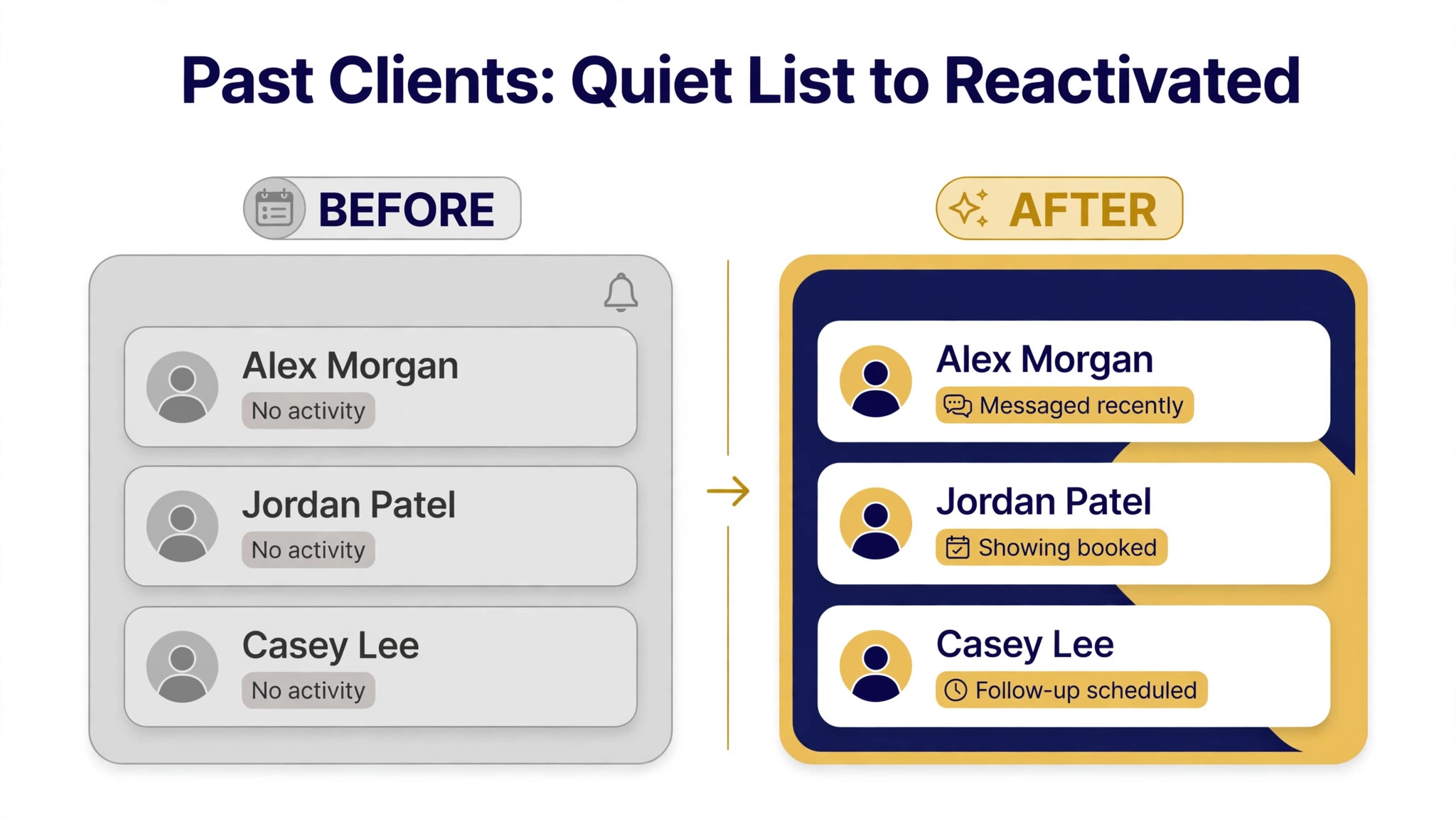
Past clients are the most underused asset in most agent CRMs. A client who bought three years ago may be ready to sell, may know someone who is buying, or may need a valuation for a remortgage, and a single helpful message can surface that need. Reactivation works when it offers value tied to the client home or area, not when it asks bluntly whether the client wants to sell. Agents who use AI for real estate agent lead follow-up for past clients should lead with a home value update, a recent sale nearby, or a market note for the street.
Segment past clients before messaging them. Recent buyers need different messages from sellers from five years ago, and landlords need different messages from owner occupiers. A buyer from last year might welcome a message about local price movement and a check in on the home. A seller from five years ago might welcome a current valuation and a note on what has sold nearby. Segmentation prevents the awkward message that treats every past client as if they bought yesterday.
Timing for reactivation should follow life events and market events, not a random calendar. Anniversaries of purchase, local price milestones, interest rate changes, and new developments nearby are all natural reasons to get in touch. AI can watch for those triggers and draft a personal message for the agent to approve, which keeps the message human while removing the manual work of watching hundreds of records. The agent should always approve reactivation messages before they send, because a past client relationship is too valuable to automate blindly.
Referral asks belong at the end of a helpful exchange, not at the start of a cold message. A client who just received a useful valuation update is open to a referral question. A client who received a blunt sales message is not. Build reactivation as a sequence of value first, then a soft referral ask, then a check in a few months later. That patience produces more referrals than a single aggressive ask, because it respects the relationship that made the client valuable in the first place.
Compliance, Consent, and Staying Human
Compliance is not a footnote in AI follow-up, it is a design constraint. Automated marketing texts to mobile numbers need prior express written consent in the United States, and published guidance warns of damages of 500 to 1,500 dollars per message for violations. That risk dwarfs any software saving, so consent must be captured, stored, and checked before the first automated text. A lead who filled a website form has not necessarily consented to automated marketing texts, and the distinction must be checked with legal advice for your market.
Revocation handling must be built into the system, not left to memory. Any reasonable method of opting out, including words such as stop, quit, end, revoke, opt out, cancel, or unsubscribe, should stop automated messages, and the CRM should record the revocation with a date. Staff should be trained to recognise an opt out in a free text reply, not only in a button click, because a lead who writes please stop texting me has opted out even if they did not use a keyword. A system that keeps messaging after that reply will damage trust and create legal exposure.
Human review protects both compliance and brand. AI drafts should be reviewed before sending for sensitive messages, such as pricing advice, offer guidance, or reactivation to past clients, and AI should never give legal or financial advice as if it were a licensed professional. Set a rule that AI informs and schedules, while humans advise and negotiate. That boundary keeps the system useful without letting it overreach into decisions that need a licensed agent.
Tools, Costs, and a 60 Day Pilot
Tool choice should follow the CRM, not the other way round. Most agents already use a CRM such as Follow Up Boss, kvCORE, or Wise Agent, and the best AI tool is usually the one that integrates cleanly with that CRM, logs every touch, and respects its stages. A standalone AI tool that messages leads outside the CRM will create duplicate histories and missed handoffs, no matter how good its messages sound in a demo. Test integration first, message quality second. Any tool chosen to use AI for real estate agent lead follow-up must log every touch in the CRM without manual work.
Costs vary widely, from a few hundred dollars a month for a small team AI texting add on to larger team plans with voice AI and predictive scoring, so confirm on the vendor page before you buy and budget for the CRM, messaging registration, and staff time as well as the AI subscription. A pilot should be judged on cost per booked showing and cost per closed deal, not on cost per message, because cheap messages that book no showings are not cheap. Track those two numbers from week one, and compare them with the pre pilot baseline.
Run the pilot for sixty days with one clear metric to watch, plus two supporting metrics. The clear metric is response time to new leads, because that is the job AI does best. Supporting metrics are reply rate and showing bookings, because they show whether fast replies turn into real conversations. Review weekly, change one variable at a time, and do not judge the pilot on a single week, because lead quality varies by season and by source. A sixty day pilot with weekly reviews gives a fair verdict without a year long commitment.
Start the pilot with new leads only, then expand to long term nurture, then to past client reactivation. That order limits risk, because new lead messaging is the most standardised job, while reactivation touches valuable relationships that deserve human approval. If new lead response time falls below five minutes and showing bookings rise, expand. If reply rates fall or complaints rise, pause, read the actual messages, and fix the copy before expanding. The messages themselves will tell you what is wrong, if you read them.
Mistakes That Make AI Follow-Up Feel Like Spam
The first mistake is sending the same generic message to every lead. A message that could have been sent to anyone will be treated as if it were sent to no one, and reply rates will show it. Personalise by property, area, and source, ask one question, and log the answer. Personalisation is not a first name merge field. It is evidence that the system knows what the lead actually asked about.
The second mistake is letting AI talk for too long without a human. A lead who exchanges ten messages with AI and never hears from an agent will conclude the agent is unavailable or uninterested. Set handoff triggers, call hot leads promptly, and make the human call the point of the system, not an afterthought. AI should open doors, not stand in them.
The third mistake is measuring message volume instead of conversations. A team that celebrates sending ten thousand texts while booking few showings has confused activity with progress. Measure reply rate, showing bookings, and closed deals, and retire messages and sequences that do not produce conversations. Volume without replies is spam by another name, and leads will treat it accordingly.
The fourth mistake is ignoring opt outs and quiet hours. A system that texts at midnight, texts after an opt out, or texts a lead who asked for a call will lose trust faster than any speed gain can recover. Build stop rules, quiet hours, and channel preferences into the system on day one, and audit them monthly. Trust is the asset AI follow-up is meant to protect, not spend.
A Weekly Routine That Keeps the System Honest
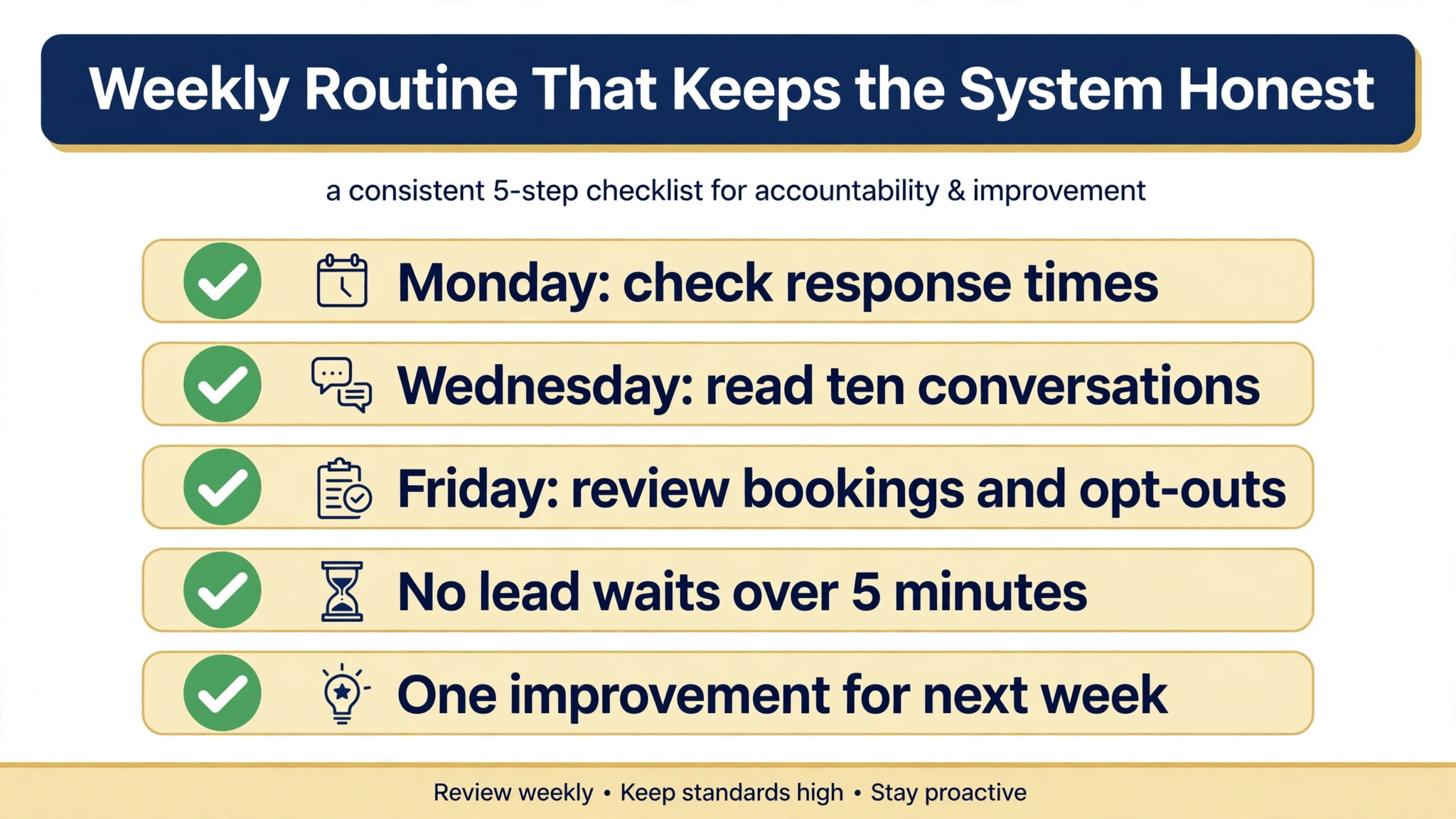
A follow-up system needs a weekly routine, or it will drift into autopilot and then into spam. Each Monday, review response times for the previous week, and check that no lead waited more than five minutes for a first touch. Each Wednesday, read ten AI conversations at random, and note where the copy felt generic, where handoff was slow, and where a human should have stepped in sooner. Each Friday, review showing bookings, reply rates, and opt outs, and make one change for the next week.
That routine takes about an hour a week for a small team, and it is the difference between a system that improves and a system that decays. A team that uses AI for real estate agent lead follow-up should protect that hour, even in a busy week. Without it, scoring weights go stale, sequences keep sending messages nobody answers, and AI copy drifts away from how the agent actually talks. With it, the team learns what leads respond to, what triggers a showing, and what messages should be retired. The routine is unglamorous, and it is the whole job.
Verdict on AI Follow-Up for a Busy Agent
AI follow-up earns its place for an agent who misses leads because of timing, not because of skill. If leads arrive outside working hours, during showings, or in volumes that one person cannot answer, AI closes the timing gap and books more showings from the same lead flow. The gain comes from speed, persistence, and logging, not from clever copy or from replacing the agent. An agent who already answers every lead within five minutes, day and night, needs AI less, and should spend the budget elsewhere.
The system works when AI answers fast, scores honestly, nurtures with value, and hands off promptly to a human who listens. It fails when AI sends generic messages, talks too long, ignores opt outs, or hides conversations outside the CRM. Build for the first pattern, audit for the second, and judge the pilot on booked showings rather than message volume. Done that way, AI follow-up is not a gimmick. It is the assistant that answers while the agent is busy doing the job only a human can do.
Frequently Asked Questions About AI Lead Follow-Up
How fast should AI answer a new real estate lead?
Within sixty seconds is the practical target, and within five minutes is the minimum standard most guides recommend. Leads contacted within five minutes are far more likely to be qualified than leads contacted after thirty minutes, so speed is the main job AI performs. A human call should follow promptly for hot leads, because AI opens the conversation rather than closing it.
Will leads know they are talking to AI?
Many will guess, and honesty works better than pretending otherwise. A first message that is helpful, specific, and quick will be welcomed even if the lead suspects automation, while a message that pretends to be a human agent and then fails a simple question will damage trust. Disclose AI use where required, keep messages specific, and hand off to a human at the first sign of buying intent or complexity.
What consent do I need before AI texts a lead?
Automated marketing texts generally need prior express written consent in the United States, and revocations by any reasonable method must be honoured promptly, so check the rules for your market with legal advice. Capture consent clearly, store it in the CRM, use a registered messaging setup, and build stop rules that work from any opt out wording, not only from a keyword.
Can AI qualify a lead on its own?
AI can qualify lightly, by asking about timeline, area, price range, and showing interest, and by scoring behaviour and source. It cannot qualify deeply, negotiate, or advise on price and offers as a licensed agent would. Treat AI qualification as triage that routes the lead to the right human conversation, not as a replacement for that conversation.
How long should a drip sequence run?
Plan for at least six to twelve months of light nurture for cool leads, with monthly value messages rather than weekly pressure. Many leads transact months after first inquiry, so a short sequence that stops at ninety days wastes the early effort. Review reply rates monthly, retire messages nobody answers, and move a lead to a human call the moment behaviour signals readiness.
Should AI handle past client reactivation alone?
No. Past client messages should be drafted by AI where helpful, but approved by the agent before sending, because the relationship is too valuable to automate blindly. Lead with value tied to the client home or area, such as a valuation update or a nearby sale, and ask for referrals only after a helpful exchange, not in a cold opening message.
More Reading on Stratilyze
– Best CRM for Real Estate Agents – Best AI Tools for Real Estate Agents – Best CRM for Real Estate Agents at a Small Brokerage – Best Email Marketing Software for Real Estate Agents – Best Website Builder for Real Estate Agents – Lead Nurture Sequences That Agents Actually Finish, plain text title, link not verified at writing time – Showing Feedback That Turns Tours Into Offers, plain text title, link not verified at writing time