
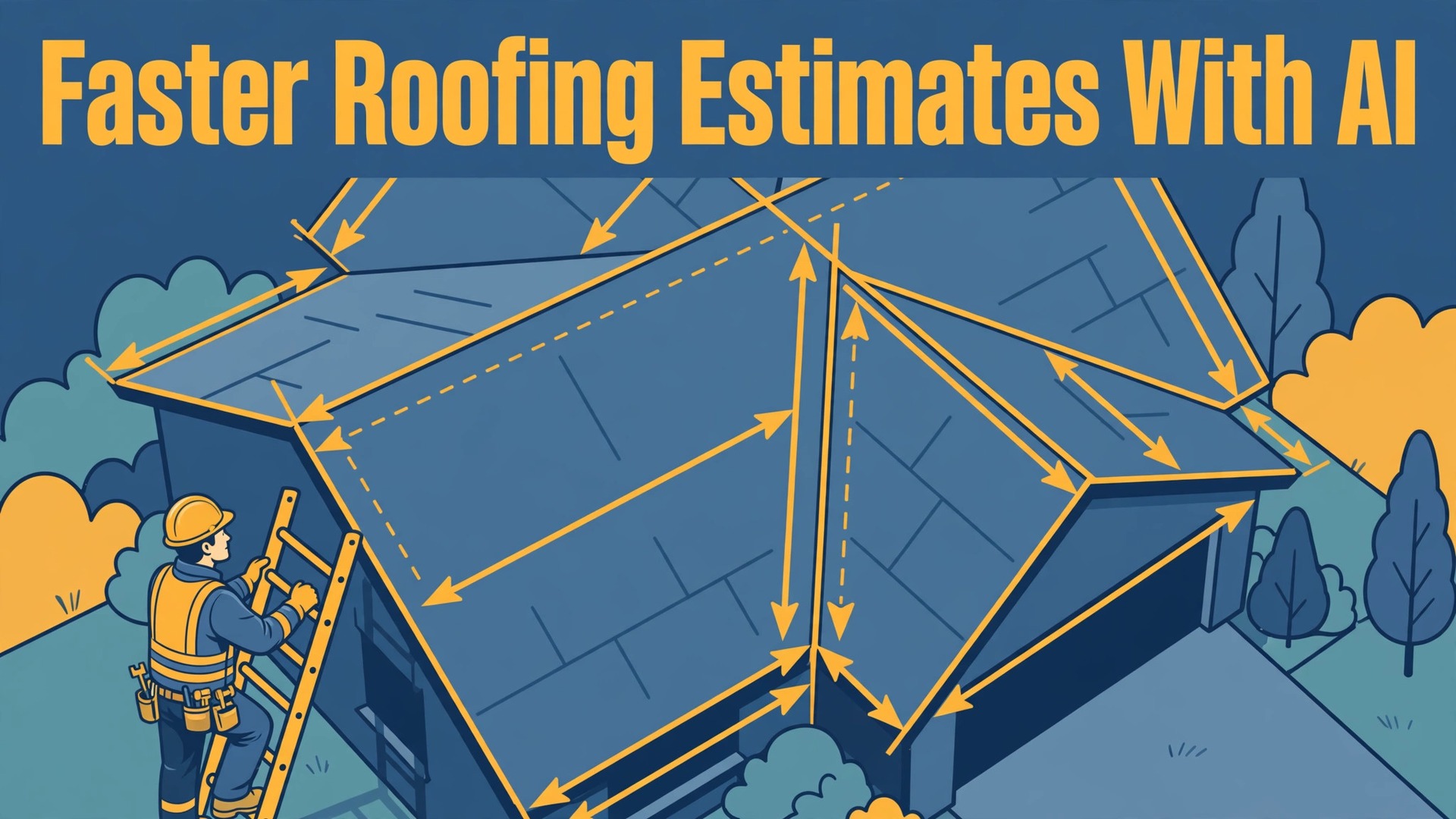
The verdict is plain. If your roofing estimates still depend on a ladder, a tape measure and a price worked out back at the office, you are losing jobs to companies that quote faster, and you are losing margin to measurement errors that only show up mid job. Owners who use AI for roofing company estimates are not buying magic. They are buying speed and consistency at the two steps where roofing estimates most often go wrong, which are measuring the roof and turning those measurements into a price a homeowner can say yes to.
That does not mean the estimator disappears. Aerial imagery can be out of date, a roof can hide damage that no photo shows, and a homeowner with a complex insurance claim needs a person who can explain what is covered and what is not. The companies that do this well use software to do the measuring and the arithmetic, then put a human in front of the homeowner to explain the options, check the tricky details and close the job. This guide follows that workflow in order, from measurement capture to material takeoff, price build, quote packet and the follow up sequence that turns a sent quote into a signed job.
How to Use AI for Roofing Company Estimates From First Call to Signed Quote
A roofing estimate has five jobs to do. It must measure the roof accurately, list the materials the job will actually need, price those materials plus labour at a margin the business can live with, present the result in a packet the homeowner understands, and follow up until the homeowner decides. Weakness in any one of those jobs either loses the sale or eats the profit, and Tools that help you use AI for roofing company estimates now touch all five, though they are strongest at the first three.
Most roofing companies arrive at this workflow from a familiar starting point. The estimator visits, climbs or walks the roof where safe, measures by hand, returns to the office, works out squares and materials, and sends a quote days later. In that gap, the homeowner often gets a faster quote from a rival, or the urgency fades. Aerial measurement and templated proposals shrink that gap to hours, and in some cases to the same visit. That speed is the main commercial prize, and it is worth more than any single feature on a vendor demo.
There are two kinds of measurement tool to understand, because vendors blur them together. Aerial measurement services, such as EagleView, produce a report from aerial imagery with roof area, pitch, valleys and related measurements, delivered as a detailed report the estimator uses to build the price. Smartphone photo tools, such as Hover, build a 3D model from photos taken on site and include material estimating for roof and exterior work. Aerial reports suit remote quoting and insurance work, while photo models suit on site remodels and sales presentations where the homeowner can see their own home visualised. Many companies use both, aerial for the first price and photos for the close.
Roofing Measurement Capture Without the Ladder Every Time
Measurement capture starts the moment the address arrives, not when the estimator parks outside. With an aerial service, the estimator orders a report for the property address and receives measurements, diagrams and imagery without climbing the roof. Published vendor descriptions say EagleView reports include top down imagery plus views from all four directions, full roof measurements and 3D diagrams, with a faster squares only option that can later be upgraded to full measurements. That structure gives a fast early figure and a detailed final price from one order.
Turnaround matters, and it varies by provider and report type. Third party roundups report aerial reports arriving in roughly a day to three days for full reports, with some providers faster for simpler reports, while photo based models typically return within about a day. Treat those figures as typical ranges, not promises, and check the current provider page before promising a homeowner a quote by a set time. A company that promises a same day quote on a report type that takes two days will break trust before the sales conversation even starts.
Aerial imagery has limits that an honest estimate must respect. Imagery can be months old, trees can hide sections, a recent extension may not appear, and storm damage is often invisible from above. That is why the workflow keeps a site check for jobs where the aerial view is unclear, the roof shape is complex, or the homeowner reports leaks or damage. The site check does not need to repeat every measurement. It needs to confirm the uncertain parts, photograph the damage, and note access and safety issues for the crew. Companies that skip that check on every job will eventually price a roof that no longer matches the property.
Photo capture on site deserves the same discipline. Take wide shots that show the whole elevation, close shots of flashing, valleys and penetrations, and shots of any damage with a clear reference for scale. Upload promptly, label by area, and keep the originals with the job file, because those photos become the evidence if the homeowner or an insurer questions the scope later. When you use AI for roofing company estimates, the system can organise and measure from those photos, but it cannot rescue a set of blurry, unlabelled images taken in poor light.

Roofing Material Takeoff That Matches the Real Roof
Material takeoff turns measurements into an order list, and this is where small errors compound. Roof area in squares, pitch, valleys, hips, ridges, flashing lengths, underlayment, ventilation and waste allowance all feed the list, and a missed valley or an underestimated waste factor means a second supplier run mid job. When you use AI for roofing company estimates, software helps by applying the same takeoff rules every time, so two estimators pricing the same roof produce the same material list, which is the consistency a growing company needs.
Waste allowance is the line owners should set deliberately rather than accept a default. Cut up roofs with many valleys and hips waste more material than a simple gable roof, and a flat percentage applied to both will under order on the complex job and over order on the simple one. Set waste bands by roof complexity, review them against actual usage each quarter, and let the system apply the band for the roof type in front of it. That single habit prevents more mid job shortages than any other takeoff change.
Supplier integration is the next step, and it is worth checking rather than assuming. Roofr describes material ordering through supplier integrations as part of its platform, alongside measurements, proposals and invoicing. EagleView reports feed into estimating workflows used by contractors, and some tools export measurements into estimating or Xactimate style workflows for insurance jobs, though integration depth varies by provider. Before buying, ask the vendor to show your own supplier catalogue in the takeoff, not a generic list, because a takeoff that names products you do not stock creates a translation step that eats the time saved on measuring.
Labour belongs in the takeoff conversation even though it is not a material. A steep roof, a two storey home, a roof with poor access, or a tear off with multiple layers all change crew time, and a system that prices materials perfectly but treats every roof as a one day job will mislead the homeowner on timing and the business on margin. Build labour tiers by pitch, storeys, access and tear off layers, and let the estimator adjust the tier on site evidence. The software suggests, the estimator confirms, and the crew plan reflects the real job.

Roofing Price Build With Good Better Best Options
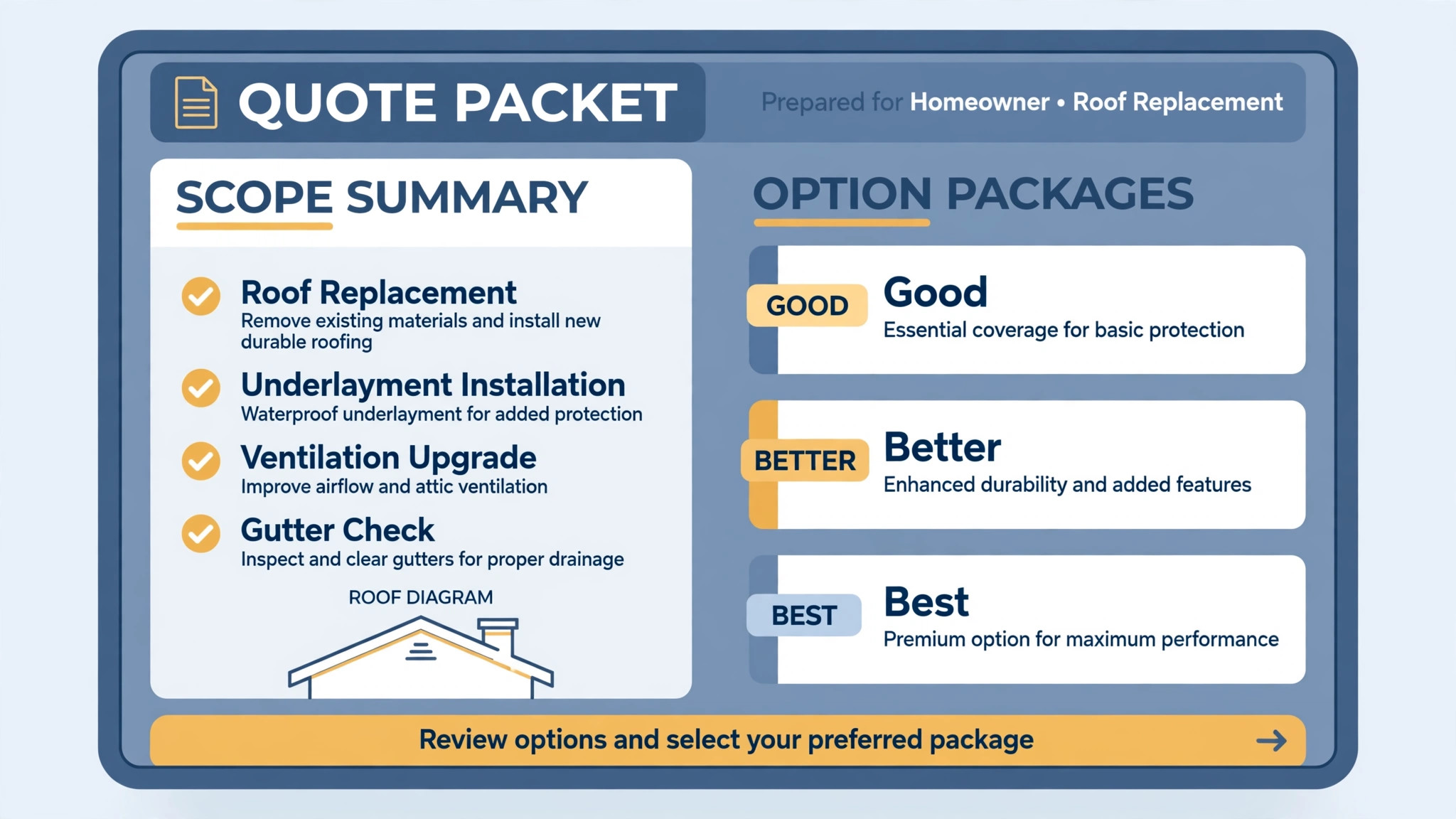
Price build is where measurements become money, and the structure of the quote matters as much as the total. Most successful roofing quotes now present options side by side, often called good, better and best, so the homeowner chooses a level rather than accepting or rejecting a single figure. Roofr proposal tools are described by reviewers as showing those options side by side with branding and e signatures collected from the homeowner phone, with measurement data flowing into the proposal without manual re-entry. That flow is the point. Every time a number is retyped, an error can enter, and a quote with a wrong total loses trust even if the error favours the homeowner.
Set the price tiers from real product differences, not from cosmetic changes. A basic tier might use a standard shingle with a standard warranty, a mid tier a thicker shingle with upgraded underlayment and ventilation, and a top tier a premium product with extended warranty and upgraded flashing. Each tier should state what changes, what warranty applies, and what is excluded, so the homeowner is comparing products, not guessing why one number is higher. If the tiers differ only by price, homeowners will pick the cheapest and wonder what the others were for.
Margin protection needs a rule, not a feeling. Decide the minimum margin per job type before the estimator opens the pricing tool, and flag any quote that falls below it for owner review. Discounts should come from a defined authority, such as a set amount the estimator can offer and a larger amount that needs approval, rather than from negotiation pressure on the doorstep. When you use AI for roofing company estimates, the system can warn when a discount breaks margin, but only the owner can decide whether a particular job is worth taking at a lower margin for a strategic reason, such as filling a crew gap week.
Payment terms belong in the price build, not as an afterthought. State the deposit, the payment on material delivery, and the final payment on completion, plus how card or bank payments are taken if the platform supports them. Roofr lists online invoices with card and bank payments as part of its platform, and other estimating tools link to invoicing in similar ways. A homeowner who understands the payment sequence before signing is far less likely to stall the final payment, and a crew that knows the deposit is secured can order materials without the owner carrying the risk.

Roofing Quote Packet That Homeowners Actually Read
A quote packet is a sales document, not a spreadsheet printout. It should open with the homeowner name, property address and a short scope summary in plain words, then show the roof measurements and a diagram or model image, then the options with prices, then warranty and exclusions, then the next step. Homeowners rarely read a packet top to bottom. They read the total, the options, and the part that tells them what happens next. Design for that reading pattern, with the total visible, the differences between options clear, and a single action, such as signing digitally or replying to approve, at the end.
Photos and diagrams earn their place by answering homeowner questions before they are asked. A diagram showing the roof planes helps a homeowner see why the price covers more than the visible front slope. A photo of damaged flashing explains why that line is in the scope. A 3D model helps a homeowner visualise a colour or product change, which matters on a purchase this large. Keep images labelled and tied to the scope lines they support, because an impressive image that does not connect to a price line feels like decoration.
Exclusions protect both sides and should be written in plain language. State what is not included, such as rotten decking replacement beyond a set allowance, gutter replacement unless listed, or interior repairs, and state how extras are priced if found during tear off. Homeowners accept extras far more calmly when the possibility was named in the packet than when it appears as a surprise mid job. Estimators sometimes avoid exclusions for fear of losing the sale, but a quote that hides likely extras loses the job later, with a dispute attached.
Digital signing closes the loop. A homeowner who can approve from a phone, pay a deposit and receive a confirmation in one flow is more likely to commit while the conversation is fresh. Check that the signature tool records who signed, when, and which version of the packet was approved, because version confusion is a real source of disputes when a packet is revised. Keep every version in the job file, approved version marked.
Roofing Follow Up Sequence That Turns Quotes Into Jobs
Follow up is where many roofing companies lose the sale they already earned, because the quote goes out and then nothing happens until the homeowner calls a rival. A follow up sequence should be planned at the moment the quote is sent, not invented a week later. Send the packet with a short message that names the next step and a date. Follow up within two business days to answer questions, not to pressure.
Follow up again a few days later with something useful, such as a photo of a similar completed roof or an answer to a question the homeowner asked. Set an expiry date for the price, and say so, because material prices move and an open ended quote becomes a liability.
When you use AI for roofing company estimates, follow up drafting is handled by the system, tracking which quotes were opened, and prompting the estimator at the right time, but the message should sound like the estimator, not like a broadcast. A short personal note referencing the homeowner roof, such as the valley repair discussed on site, beats a generic reminder every time. If the system can pull that detail from the job note, use it. If it cannot, write the note by hand, because a generic follow up to a homeowner who discussed a specific leak feels careless.
Know when to stop. A homeowner who has not replied after three useful contacts and a price expiry notice is unlikely to convert from a fourth identical nudge. Close the quote politely, leave the door open for a revised price later, and record the reason if known, such as price, timing or a rival quote. That record is valuable, because a pattern of lost jobs on price points to a pricing problem, while a pattern of lost jobs on timing points to a scheduling problem, and each needs a different fix.

Best Pick by Job for Roofing Estimating Tools
| Company shape | Best fit approach | Why it fits |
|---|---|---|
| Solo roofer or small crew | Roofr Starter style free entry plus pay per report | Low fixed cost, proposals and measurements in one place, easy to test coverage in your area |
| Growing sales team | Roofr subscription plus aerial reports | Faster turnaround and cheaper reports at volume, with proposal templates the whole team uses |
| Insurance heavy work | EagleView reports with estimating export | Detailed aerial reports built for claims workflows, with established estimating links |
| Design led remodels | Photo based 3D model tool | Homeowner can visualise the finished home, which helps close larger remodel scopes |
That table is a starting point, and coverage in your area decides more than the feature list. Aerial imagery quality varies by location, and a provider that is strong in one region may be weak in another, so test reports on real local addresses before committing. Price models also differ, with some providers charging per report and others charging a subscription with cheaper reports, and third party roundups report per report figures that vary widely by report type and provider. Get a current quote for your expected monthly report volume, and compare the total monthly cost at that volume, not the headline per report figure alone.
Watch for the mobile gap that reviewers flag for some platforms. One review notes Roofr runs through a mobile browser rather than a native app, which matters for field staff who work from phones all day. If your estimators live on their phones, test the browser experience on a real job, including uploading photos and getting a signature, before deciding. A tool that works beautifully on a desktop and awkwardly in the field will be abandoned by the people who need it most.

What to Automate and What to Keep Human in Roofing Estimates
When you use AI for roofing company estimates, automate the repeatable arithmetic and the routine messages. Measurement ordering, takeoff calculations from set rules, proposal formatting, option pricing from a pricebook, quote sending, follow up reminders and expiry notices all suit automation, because they are consistent and easy to check. Automating them frees the estimator to spend time on site, on the phone with homeowners, and on the jobs where judgment changes the outcome.
Keep a human on scope judgment, damage assessment, insurance conversations and price exceptions. Aerial imagery cannot confirm hidden deck damage, a photo cannot judge whether a flashing detail will hold, and an insurer negotiation needs a person who understands the claim. Price discounts below the set margin, scope changes found during tear off, and any homeowner dispute also stay human. AI can draft the wording, but the decision and the conversation belong to a person who can be held to account for them.
A sensible first rollout automates measurement and proposal formatting, keeps takeoff rules under estimator review for a month, and keeps follow up messages as drafts until the tone is right. That sequence builds trust inside the team, because estimators see the system save them hours before they are asked to trust it with customer facing words. Rollouts that start with fully automated customer messages often fail on tone alone, even when the numbers are correct.
Costs and Trade Offs of Roofing Estimating AI
Costs split into per report charges, subscriptions, and the estimator time spent learning the system and cleaning the pricebook. Per report pricing suits a company with uneven volume, because quiet months cost little, while a subscription suits steady volume, because the per report cost falls and the monthly total becomes predictable. Add on tools, such as instant estimators that give homeowners a preliminary figure from an address, or AI receptionist features, are often priced separately, so ask for the full stack price, not just the base plan.
The trade offs follow the measurement choice. Aerial reports save a site visit and speed up quoting, but they depend on imagery recency and coverage, and they cannot see hidden damage. Photo models give a current, visual record and help homeowners imagine the result, but they need a site visit and good photography, and turnaround still takes hours. A company that relies only on aerial reports will misprice some jobs, while a company that insists on a full site measure for every simple roof will lose speed. The balanced workflow uses aerial for the first price, photos for the close, and a physical check where the evidence is thin.
There is also a dependence trade off worth naming. A company that builds its whole estimating flow around one provider will feel any price rise, coverage change or turnaround slowdown sharply. Keep the pricebook and customer records in a system you control, export reports and proposals to the job file, and avoid letting the only copy of a signed scope live inside a vendor portal. That habit costs little and protects the business if a provider changes terms.
Common Mistakes in Roofing Estimating Automation
The first mistake is quoting from stale imagery without a check. A roof that gained an extension, lost trees, or suffered storm damage since the imagery was taken will not match the report, and the error surfaces mid job when materials run short or the homeowner disputes the scope. Build a recency check into the workflow, asking when the imagery was captured where the provider shows it, and flagging any job where the homeowner mentions recent changes for a site confirmation.
The second mistake is letting the system set the waste factor and the labour tier without review. Defaults suit average roofs, and roofing work is rarely average. Review waste bands by roof complexity each quarter against actual usage, and review labour tiers by pitch and storeys against actual crew days. Those two reviews, done quarterly, prevent the slow margin leak that owners notice only at year end.
The third mistake is sending a packet the homeowner cannot understand. A packet packed with measurement codes, abbreviations and line items without explanation looks thorough and reads as confusing, and confused homeowners delay. Test every packet on a non roofer before launch, and rewrite any line that person cannot explain back. Clarity is a sales feature, not a simplification.
The fourth mistake is treating follow up as pestering. Three generic reminders in a week will push a homeowner away, while two useful contacts that answer real questions will bring them back. Track reply rates and conversion by follow up type, and drop the message types that never get replies. Follow up should feel like help, because for the homeowner deciding on a major purchase, it is.
Roofing Estimating Checklist for the First Thirty Days
1. Order test reports on ten real local addresses and compare aerial measurements with a site check on the complex ones. 2. Set waste bands by roof complexity and labour tiers by pitch, storeys, access and tear off layers. 3. Build good, better and best tiers from real product and warranty differences, with exclusions in plain words. 4. Create a packet template that opens with scope, shows a diagram, lists options, and ends with one clear next step. 5. Set a minimum margin rule and a discount authority, with below margin quotes flagged for owner review. 6. Write the follow up sequence with an expiry date, and draft the first two messages in the estimator voice. 7. Run takeoff and pricing as estimator reviewed for a month before removing the check. 8. Record lost quote reasons, and review the pattern monthly to separate pricing problems from timing problems.
How to Measure Roofing Estimating Results
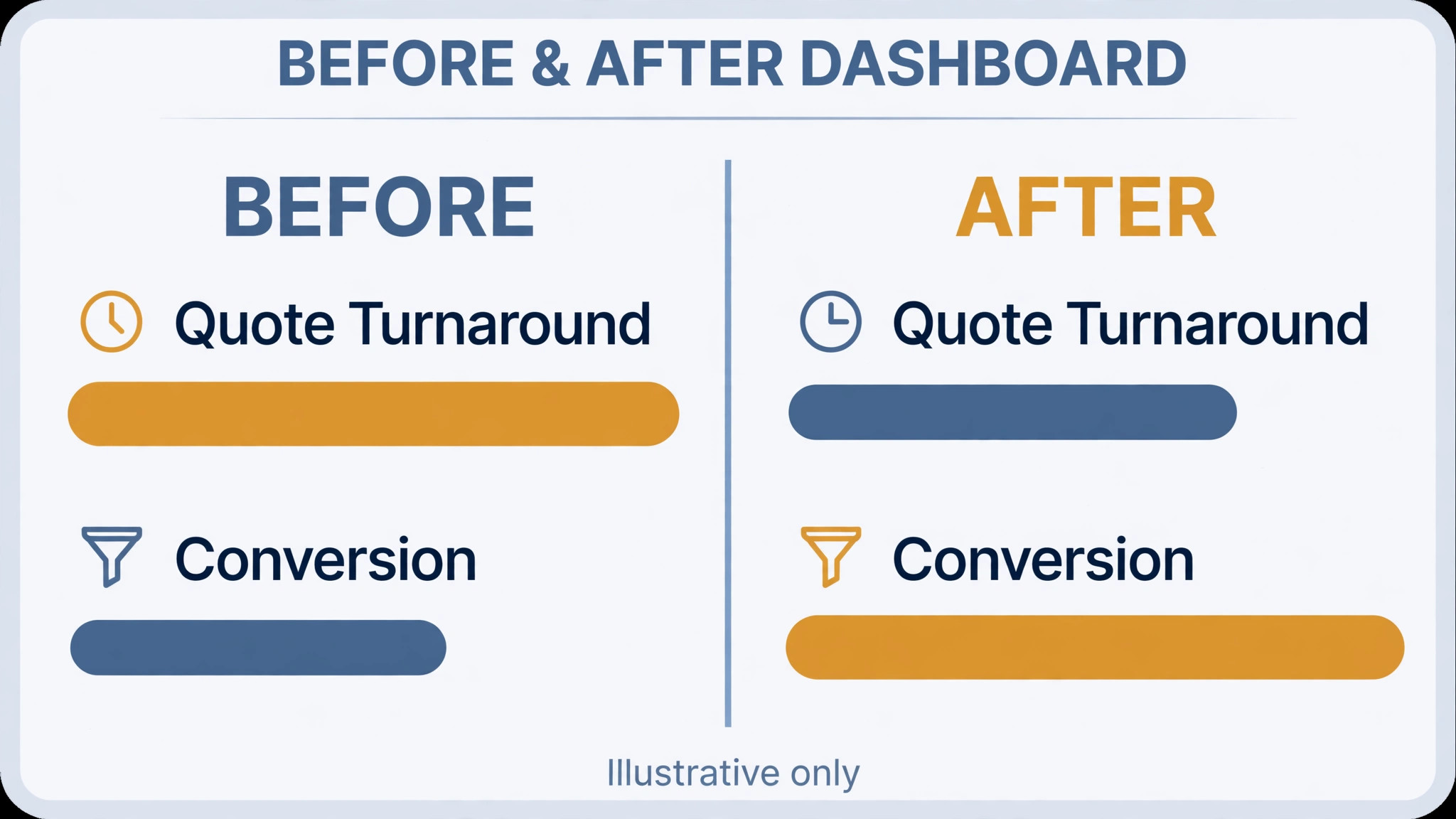
Start with four numbers measured on the old method for a month. Quote turnaround time, from first contact to sent packet. Quote conversion rate, meaning signed jobs divided by quotes sent. Margin accuracy, meaning quoted margin compared with actual job margin after materials and labour. And remeasure rate, meaning jobs where the scope or materials changed materially after the quote because the measurement was wrong.
After rollout, track the same four numbers, plus report cost per signed job, which is total measurement spend divided by signed jobs, because a fast quoting tool that costs more per win than it saves is not a gain. Track follow up response rate separately, since a packet that nobody replies to has a messaging problem, while a packet that gets replies but no signatures has a price or scope problem. Separating those two tells you where to fix.
Review the numbers by job type. Simple gable roofs should convert faster and with tighter margins than complex multi valley roofs, and insurance jobs will behave differently from retail replacements. A single company average hides those patterns, so split the review into at least retail, insurance and complex roofs. When a segment improves, note which workflow change likely caused it. When a segment worsens, check the evidence for that segment, such as imagery coverage or waste bands, before changing the whole system.
A Closing Word for Roofing Owners Weighing the Switch
Roofing estimates reward the company that is fast, clear and accurate, in that order, and software now helps with all three if the workflow around it is honest. Measure from the air where it is reliable, check on site where it is not, price from a clean pricebook with real product tiers, present a packet a homeowner can understand, and follow up with useful contacts until the price expires. That is the whole system, and none of it requires giving up estimator judgment.
It requires giving estimators better inputs and fewer repetitive tasks, so their judgment lands where it earns money, on scope, on price exceptions, and on the conversation that closes the job. Start with test reports on your own patch, prove the turnaround and the margin on real jobs, and then scale the workflow across the team.
Frequently Asked Questions
Can homeowners really measure a roof from photos?
Yes for most standard roofs, when the photos include wide elevation shots and close detail shots with a known reference for scale. Aerial imagery fills gaps where photos fall short, and the estimator still checks unusual features, such as steep pitches or multiple valleys, before finalising the price.
What if the AI price differs from my usual price?
Treat the difference as a prompt to check the takeoff, not as proof either figure is wrong. Compare squares, waste allowance, flashing lengths, and material grade line by line, since one missed valley or a different shingle tier explains most gaps. Adjust the takeoff, keep a note of the change, and use the comparison to sharpen future estimates.
Do I still need to visit the roof before quoting?
Visit complex, steep, or damaged roofs in person, and quote straightforward roofs from photos and aerial data with a clear site check clause. The clause should state that the price assumes the roof matches the photos, and that hidden damage found on site will be requoted before work starts.
How do I present three price tiers without confusing homeowners?
Keep each tier to one shingle, one warranty length, and one clear difference, such as upgraded underlayment or longer workmanship cover. Show the tiers side by side on one page, name the recommended tier plainly, and let the homeowner choose rather than pushing the top tier.
How fast should I follow up a roofing quote?
Send a thank you and a question call within one working day, then a short reminder before the quote expiry date. Most homeowners decide within a week, and a quote left silent for two weeks usually goes cold. Track every follow up in the same system as the quote, so no quote depends on one person’s memory.
More Reading on Stratilyze
– Use AI for Roofing Contractor Estimate Quotes – Best Estimating Software for Contractors – Best Quote Software for Trades Businesses – Best Website Builder for Tradespeople – Automate Small Business with AI