

Compare two window cleaning companies on a Monday morning. The first takes a call, promises to visit later in the week to count windows, drives out, counts, drives back, and sends a quote two days later, by which time the homeowner has already booked a rival. The second asks the caller for a few phone photos and the property address, returns a tiered quote the same day, and lets the homeowner pick a booking slot from the phone while the conversation is still fresh. Owners who want to use AI for window cleaning quote booking are choosing between those two Mondays, and the difference is rarely the cleaning quality. It is the speed and ease of saying yes.
Window cleaning quotes look simple and hide real complexity. Window count, size, storeys, access, frames, screens, tracks, hard water stains, conservatories, skylights and frequency all change the price, and a quote that ignores any of them either underprices the job or surprises the homeowner later. This guide follows the full workflow in order, from photo based sizing to quote tiers, booking slots, access notes and the reminder sequence that keeps the booking from slipping. It also covers what to automate, what to keep human, costs, mistakes and how to measure whether quoting is actually converting better.
How to Use AI for Window Cleaning Quote Booking From Photo to Confirmed Slot
A window cleaning quote booking system has five jobs. It must size the job from photos or property details, price it in tiers the homeowner can choose between, offer booking slots that fit real crew routes, record access details the crew will need, and remind the customer until the crew arrives. Each job can be partly automated, and the automation works best when the homeowner does a small part of the work, such as sending photos, in exchange for a faster quote.
The tools fall into three groups. General field service platforms, such as Jobber, cover quoting, scheduling, invoicing and payments for window cleaning alongside many other trades, and they suit solo operators and small teams that want one system. Specialist quoting tools, such as ResponsiBid, focus on customer self quoting with guided questions and pricing logic, though they need a separate system for scheduling and invoicing. Newer all in one platforms, such as QuoteIQ, combine AI photo estimating, satellite property measurement, scheduling, invoicing and payments, with a business phone and review tools built in. The right group depends on whether quoting is the bottleneck, or whether scheduling and payments need fixing at the same time.
Start with the homeowner experience, not the feature list. Ask a friend to request a quote through each system you are considering, using only a phone, and time how long it takes to reach a price and a booking slot. If the flow asks for an account, a long form, or a desktop only step, homeowners will abandon it, and the clever pricing logic behind it will never be seen. The best quoting tool is the one a busy homeowner finishes on a phone in a few minutes, because that is where most quotes are now requested.
Window Cleaning Photo Based Sizing That Homeowners Can Do
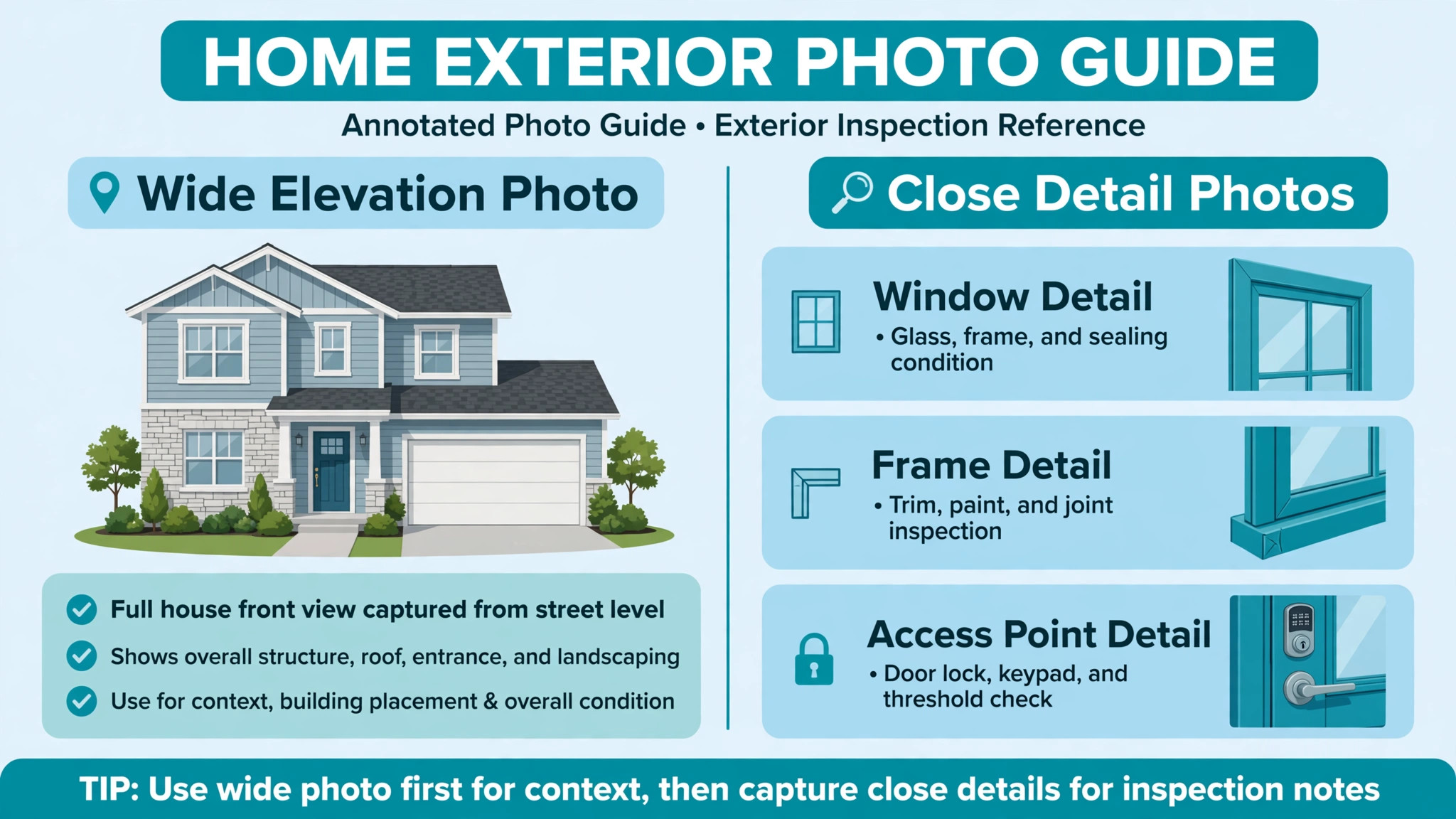
Photo based sizing asks the homeowner to show the property rather than describe it in words, which removes the most common quoting error, which is a window count that misses the back of the house. The request should be specific and short. Ask for one wide photo of each elevation, front, back and sides where accessible, plus close photos of any skylights, conservatories, or windows that look hard to reach, and a note on storeys and any windows above a conservatory or extension. That set gives an estimator enough to count and size without a visit for most standard homes.
When you use AI for window cleaning quote booking, photo estimating as described by newer platforms takes an uploaded photo and generates a market aware estimate, with vendors claiming it saves many minutes per quote compared with manual pricing. Treat that claim as a vendor claim to test, not a proven saving for your patch, because accuracy depends on photo quality, property complexity and how well your pricebook matches the vendor model. Test it on twenty past jobs where you already know the true window count and price, and compare the AI figure with the real figure before letting it quote customers directly.
If it is close on standard homes and weak on complex ones, use it for standard homes and keep human review for the rest.
Satellite measurement helps for larger properties and commercial work, where counting from the ground is slow and roof and ground layout matter for access planning. QuoteIQ describes satellite property measurement built into its estimate workflow for remote quoting, alongside photo estimating. Satellite views cannot count individual panes reliably on every property, and they cannot see screens, tracks or interior access, so treat satellite sizing as a supplement to photos, not a replacement, especially for homes with extensions, dormers or shaded elevations that hide windows from above.
Photo quality rules should be given to the homeowner in the request itself, not discovered after a poor set arrives. Ask for daylight photos, whole elevations in frame, and no close ups only, because a set of close ups without a wide shot cannot be counted. When photos arrive incomplete, the system should ask for the missing elevation specifically, such as a back elevation photo, rather than sending a generic request for more photos that the homeowner does not know how to satisfy. That specific follow up is where many photo quoting flows fail, and it is easy to fix with a template per missing view.
For homes where photos cannot size the job, such as large commercial buildings, properties with restricted access, or homes with extensive skylights and atriums, keep the site visit as a priced option rather than pretending photos suffice. Offer the visit quickly, with a firm time, and explain that the visit produces a fixed quote rather than an estimate range. Homeowners accept a visit when it is framed as accuracy, not delay, and a fixed quote after a visit converts better than a vague range that later rises.
Window Cleaning Quote Tiers That Help Homeowners Choose
Quote tiers turn a yes or no decision into a choice, which is why they convert better than a single price. A window cleaning tier structure usually runs exterior only, exterior plus screens, and full service including interior, screens and tracks, with frequency discounts for quarterly or monthly service. Each tier should state exactly what is included, what is excluded, and how the price changes with frequency, so the homeowner is not guessing what the middle tier adds.
Build tiers from your real costs, not from rival prices alone. Time per window varies by size, storey, access and condition, and a tier priced from a competitor sheet that ignores your crew speed will either lose money or lose jobs. Time a sample of past jobs by tier, including travel and setup, and set tier prices from those times plus materials, overhead and margin. When you use AI for window cleaning quote booking, the system can apply the tier logic consistently, but only the owner can set the tier prices from real job data, and those prices should be reviewed quarterly as crew speed and costs change.
Frequency pricing deserves a clear rule. A quarterly customer who books regularly costs less to serve per visit than a one off customer, because the windows stay cleaner, access is known, and the route is already planned. Reflect that in the tier, with a modest recurring discount that is stated openly, rather than a hidden discount offered only when a customer haggles. A stated recurring price also supports the reminder and rebooking sequence later, because the customer already knows the next visit price.
Ranges versus fixed prices need a decision per job type. Standard homes with good photos can receive a fixed price, which converts best. Complex homes with incomplete photos should receive a range with a clear statement of what would move the price to the top or bottom of the range, and a promise of a fixed price after a quick site check if needed. A range that is too wide, such as double the low figure, reads as guessing and pushes homeowners to a rival with a firmer number, so keep ranges tight and explain the variable that drives them.
Present the quote as a clean packet, not a text message with a number. Show the property summary, the window count or sizing basis, the tiers side by side, the frequency options, and one clear action, such as approving a tier and picking a slot. A homeowner who can see why the price is what it is, and who can act without calling back, is far more likely to book while the need is fresh. Include a short expiry for the price, because seasonal demand and crew availability change, and an open ended quote becomes a commitment the business cannot keep at peak times.

Window Cleaning Booking Slots That Fit Real Crew Routes
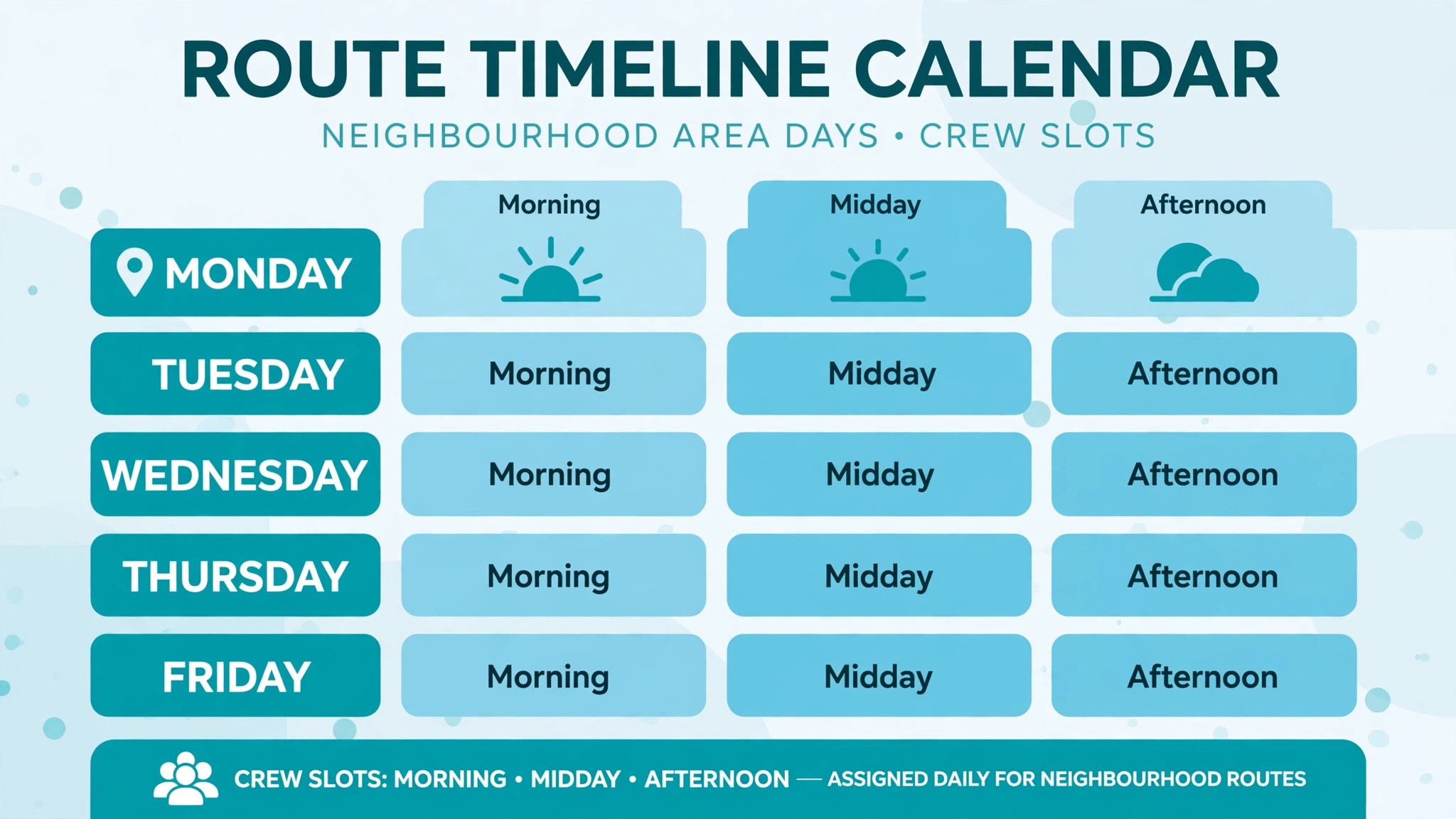
Booking slots are where quoting meets operations, and a slot offered without regard to routes creates a day of scattered jobs that no crew can complete. Slots should be offered by area day, so customers in the same neighbourhood are offered the same day, with arrival windows that reflect real crew speed. A homeowner offered Thursday morning because Thursday is the area day, with a firmer ETA text on the day, will usually accept, especially when the alternative is a vague slot later in the week.
When you use AI for window cleaning quote booking, scheduling matches the booked job to the crew and route that fits its duration, access and equipment needs. A two storey home needing ladder work and a water fed pole setup takes longer and needs a different crew profile than a ground floor flat, and a system that treats both as one hour jobs will overbook the day. Set durations by job type and storey, review them against actual times monthly, and let the system offer only slots where the route has real capacity. A slot that looks available but requires a crew to drive across town between jobs is not truly available.
Online self booking needs guardrails. Let homeowners pick from slots the system knows are feasible, rather than offering an open calendar where any time can be chosen and the office must then rearrange routes to accommodate it. Limit self booking to area days, cap the number of bookings per crew per day, and hold a buffer slot for weather moves and urgent work. Self booking without guardrails feels convenient to the customer and chaotic to the crew, which is the wrong trade.
Window Cleaning Access Notes That Prevent Wasted Visits
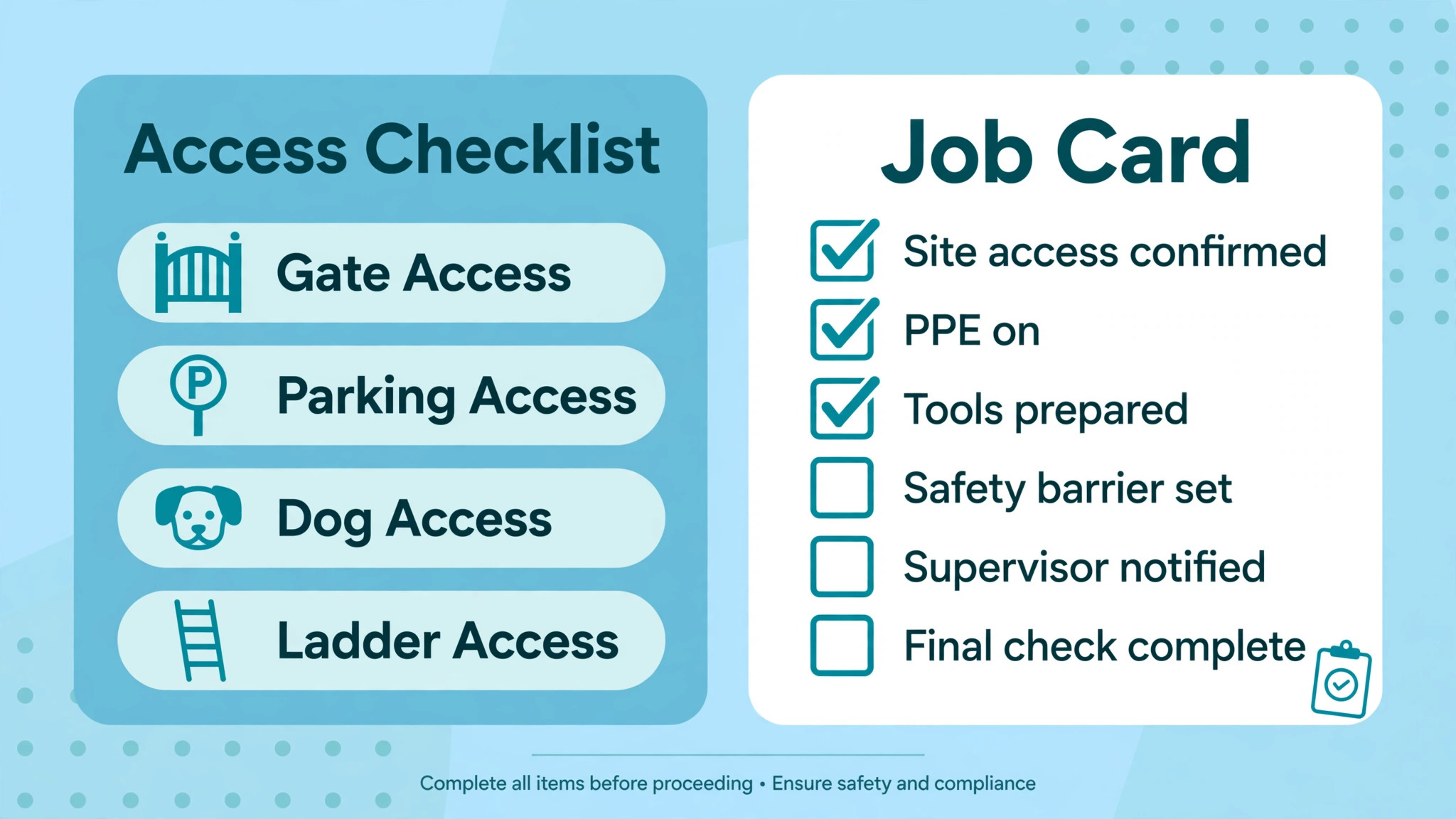
Access notes are the small details that decide whether a booked job completes or wastes a visit. Gate codes, side gate access, parking, dog notes, alarm notes, key holder details, windows above conservatories, fragile landscaping, and interior access for full service jobs all belong in the booking record, and each should be collected at booking, not discovered on arrival. The booking form should ask for access in short prompts, such as how the crew reaches the back windows, where to park, and whether a dog will be secured, rather than a single open box that homeowners leave blank.
When you use AI for window cleaning quote booking, the booking form prompts for the access detail that matches the job type. A two storey booking should prompt for ladder access and conservatory notes. An interior booking should prompt for who will be home and which rooms need access. A commercial booking should prompt for site contact and opening hours. Those prompts feel helpful to the homeowner, because they show the business has thought about their property, and they save the crew from arriving unprepared.
Update access notes on every visit, because gates, codes, pets and parking change. Make that update part of job close, with a single screen, and review access notes before dispatch each morning. A crew that arrives with last year gate code will waste the visit and the customer goodwill, while a crew that arrives with current notes completes the job and leaves a good impression. Access accuracy is a quiet measure of professionalism that customers notice only when it fails, which is why it deserves daily attention.
Window Cleaning Reminder Sequence That Keeps Bookings Firm
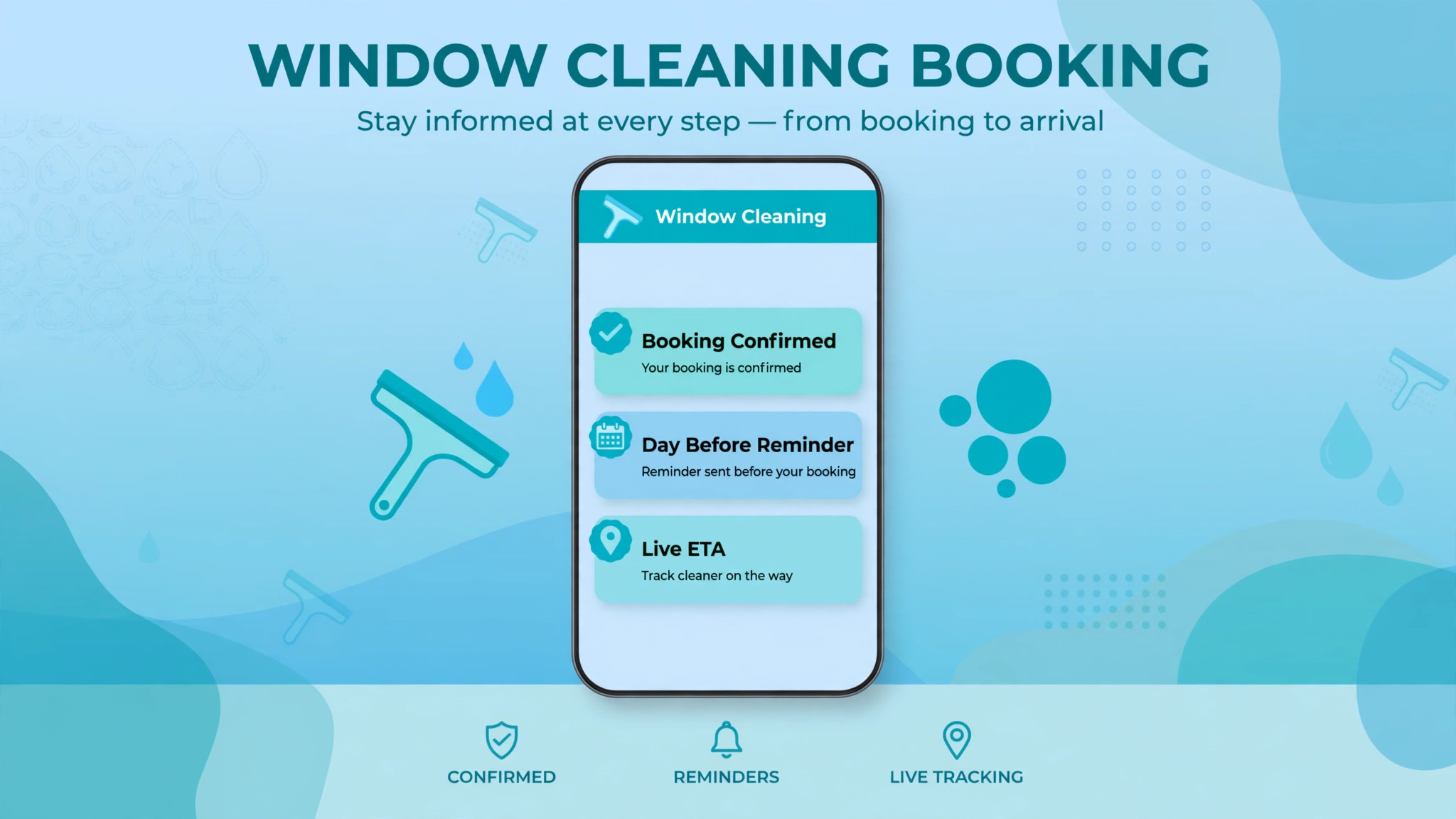
Reminders turn a booked job into a completed job, because window cleaning is often booked days or weeks ahead and forgotten. The sequence should be short and useful. A booking confirmation states the date, window, tier, price and preparation, such as clearing access and securing pets. A day before reminder repeats the window and preparation, with a simple reschedule option. A live ETA text on the day gives the crew arrival time and a contact for changes. A completion message confirms the work, states the next due date for recurring customers, and invites a review.
Recurring customers need a different reminder rhythm. A quarterly customer should receive a booking prompt before the due date, with the previous tier and price, plus a one tap confirm, rather than a cold sales message. That prompt converts far better than a generic offer, because it builds on a known service and a known property. Set the prompt timing from the service interval, such as two weeks before the quarterly due date, and let the customer pick from area day slots. A recurring base built this way fills routes months ahead and smooths seasonal peaks.
Reschedule handling should protect the route as well as the customer. Offer the next area day first for customer moves, and message weather moves early with a new area day date. When a customer reschedules twice, call rather than message, because repeated moves often signal a price, access or timing problem that a message will not solve. Track reschedule reasons, because a pattern of access related moves points to a booking form problem, while a pattern of price related moves points to a tier problem.
Best Pick by Job for Window Cleaning Quote Tools
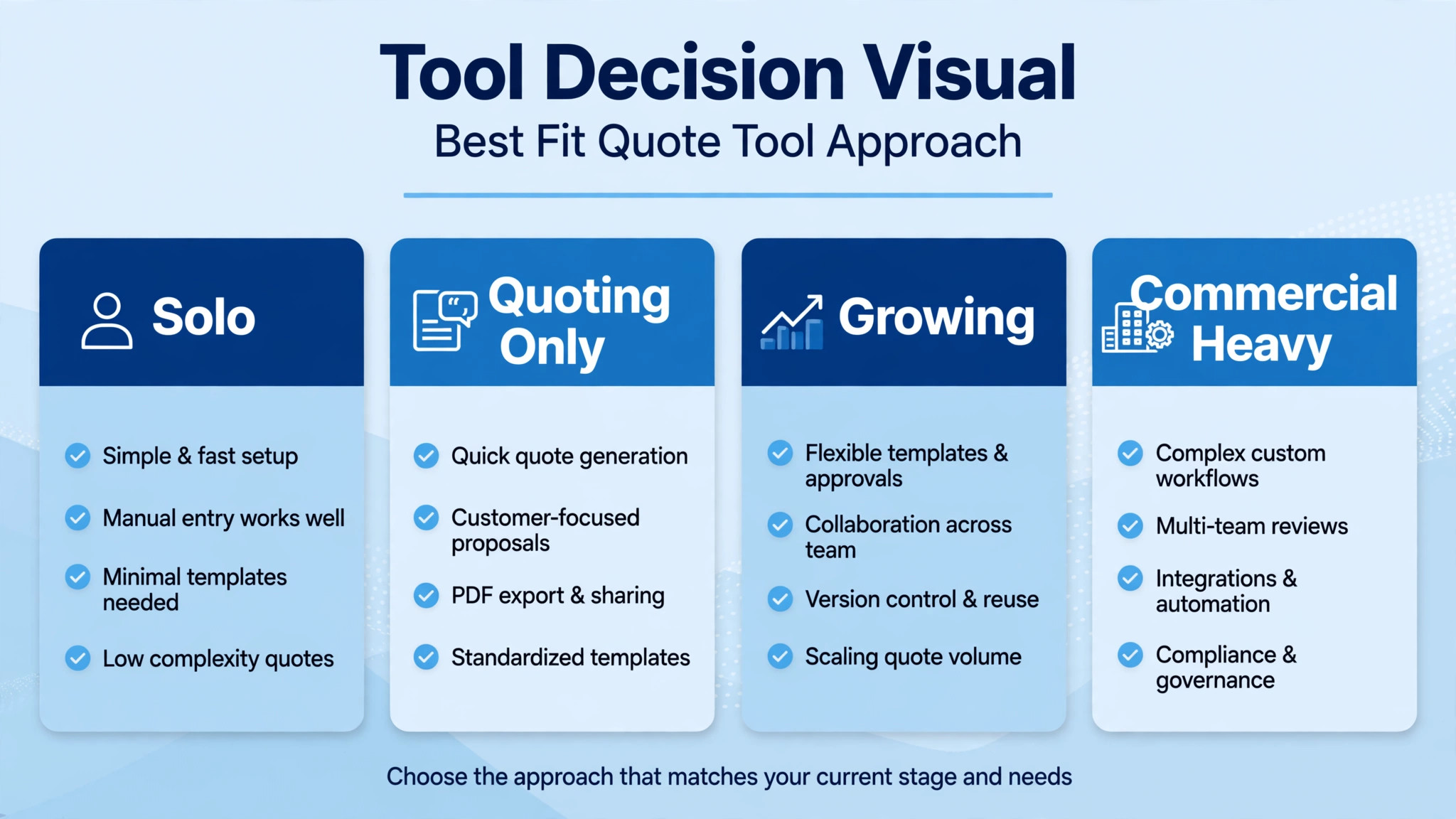
| Company shape | Best fit approach | Why it fits |
|---|---|---|
| Solo cleaner or small team | Jobber | Quoting, scheduling, invoicing and payments in one place, with a mobile app crews learn fast |
| Quoting bottleneck only | ResponsiBid style self quoting | Guided customer quoting with pricing logic, paired with a separate scheduling system |
| Growing team wanting photo quoting | QuoteIQ style all in one | Photo estimating, satellite measurement, scheduling and payments together, with review tools |
| Commercial heavy work | General platform plus site visit quoting | Fixed quotes after site checks suit large buildings where photos cannot size reliably |
Read that table with the pricing caution that applies across this market. Published figures vary by source and plan, with Jobber entry pricing reported differently across roundups and ResponsiBid reported with a monthly figure plus a setup fee in one comparison, while QuoteIQ publishes a higher all in one monthly figure in the same comparison. Treat those figures as starting points, get a written quote for your team size, and compare the total stack cost, because a quoting tool plus a scheduling tool plus a payment tool can cost more together than an all in one platform, even when each piece looks cheaper alone.
Test the homeowner flow before the price, because a tool that quotes accurately but loses homeowners at a long form will not pay for itself. Test photo upload on a phone, tier selection, slot picking, access prompts and the reminder sequence end to end, with a real homeowner style test, not just a staff demo. The tool that survives that test with the fewest drop offs is the tool to buy, even if another tool lists more features.
What to Automate and What to Keep Human in Window Cleaning Quotes
When you use AI for window cleaning quote booking, automate photo intake prompts, tier pricing from set rules, slot offers from real route capacity, confirmations, reminders, ETA texts and recurring booking prompts. Those steps are repeatable, they save office time daily, and a mistake is easy to spot, such as a wrong slot or a missing access prompt, before it reaches the customer.
Keep a human on complex properties, disputed counts, price exceptions, complaints and any quote where photos contradict the property description. A homeowner who sends photos of a small cottage while the address shows a large detached home needs a call, not an automated price, because the discrepancy may be a wrong address, an extension, or a misunderstanding that only a conversation resolves. The same applies to any job where the tier price would fall far outside the normal range for that property type, which usually signals a sizing error.
A good first rollout automates standard home quoting with human review, keeps complex homes fully human reviewed, and automates reminders and slot offers from day one. That split builds confidence, because the team sees standard quotes flowing faster while complex jobs still get expert eyes. Over time, as photo accuracy is proven on standard homes, review can narrow to exceptions, such as prices outside a set band or properties with skylights and conservatories that need a check.
Costs and Trade Offs of Window Cleaning Quote AI
Costs include the platform subscription, any quoting add on or setup fee, time to build the pricebook and tier rules, and time to test photo accuracy against past jobs. A general platform may be the cheapest starting point for a solo cleaner, while an all in one photo quoting platform costs more monthly but replaces several separate tools. Compare total monthly cost at your real job volume, including payment processing and any per user fees, rather than comparing headline monthly figures alone.
Trade offs follow the tool group. General platforms are simple and cover the whole job, but their quoting logic may be less specialised for window sizing than a dedicated tool. Specialist quoting tools quote well but need a separate scheduling and invoicing system, which adds logins and data transfer. All in one photo platforms promise the full flow, but their photo accuracy must be proven on your properties, and their monthly cost needs to be justified by quote volume, not by feature count. A business quoting five jobs a week needs a different tool than a business quoting fifty, even if both clean windows.
Photo quoting also carries a trust trade off. A fast photo quote wins speed, but a homeowner who receives a price that later rises after a site check may feel misled, even if the rise is justified by hidden windows. Protect trust by stating the sizing basis on the quote, such as photos provided, and by keeping any price change tied to a specific discovered fact, such as additional windows found on site, with photos as evidence. Transparency at quote stage prevents disputes at invoice stage.
Common Mistakes in Window Cleaning Quote Booking
The first mistake is quoting from poor photos without asking for the missing view. A quote built on front only photos will miss back windows, and the correction on site feels like a price rise to the homeowner, even when it is simply the real job. Ask for each elevation by name, and hold the fixed price until the set is complete, offering a range in the meantime with the reason stated.
The second mistake is offering slots the route cannot honour. A booking calendar that lets any customer pick any time creates scattered days, late arrivals and crew overtime, which then damage reviews and repeat bookings. Offer area day slots with real capacity, cap bookings per crew, and hold a buffer for weather moves. Convenience that breaks operations is not convenience.
The third mistake is collecting no access detail at booking. A crew that arrives to a locked side gate, an unsecured dog, or no parking wastes the visit and must reschedule, which costs more than the two minutes of booking prompts that would have prevented it. Build access prompts by job type, update them on every visit, and check them before dispatch.
The fourth mistake is forgetting recurring customers until they forget you. A quarterly customer who hears nothing between visits will book a rival when a flyer arrives, while a customer who receives a timely rebooking prompt with a known price and an easy confirm will stay. Recurring prompts are the cheapest growth a window cleaning business has, because the property, the price and the trust already exist.
Window Cleaning Quote Checklist for the First Thirty Days
1. Write the photo request with one wide photo per elevation plus close photos of skylights and hard to reach windows. 2. Test photo quoting against twenty past jobs with known counts and prices before quoting customers directly. 3. Build tiers from timed past jobs, with exterior only, exterior plus screens, and full service options. 4. Set durations by job type and storey, and offer booking slots only on area days with real capacity. 5. Build access prompts by job type and a job close step that updates access notes every visit. 6. Create the reminder sequence from confirmation to ETA to completion, plus a recurring prompt two weeks before due dates. 7. State the weather policy at booking and the price expiry on every quote. 8. Track quote conversion, photo accuracy, no access rate and reschedule reasons weekly.
How to Measure Window Cleaning Quote Results
Measure the old method for a month before changing it. Record quote turnaround time from first contact to sent quote, quote conversion rate from quotes sent to jobs booked, no access rate, price change rate meaning jobs where the final price differed materially from the quote, and repeat booking rate for recurring customers. Those five numbers show whether quoting is fast, convincing, accurate and retentive, which are different strengths that a single conversion figure hides.
After rollout, track the same numbers weekly, split by standard homes versus complex properties, because photo quoting should improve standard homes first and complex homes may need longer. Track photo accuracy separately, meaning how often the photo based count matched the on site count, and track drop off by flow step, meaning where homeowners abandon the quote request. A high drop off at photo upload points to a request problem, while a high drop off at tier selection points to a price or clarity problem, and each needs a different fix.
Set targets by segment. Standard home turnaround should fall to same day in most cases, conversion should rise as speed improves, and price changes should fall as photo completeness improves. Complex home turnaround may stay longer, and that is acceptable if conversion and accuracy improve there too. Review the numbers with crews, because they see the access and sizing problems first, and fix the top recurring cause each month rather than redesigning the whole flow at once.

A Final Word for Window Cleaning Owners
Window cleaning is a repeat service that lives or dies on easy quoting and reliable booking, and that is exactly where a photo to slot workflow pays off. Ask for good photos, price in clear tiers, offer slots that fit real routes, record access that crews can trust, and remind customers until the job is done and the next one is booked. Done well, when you use AI for window cleaning quote booking, the homeowner experience feels effortless, the crew day stays dense and predictable, and the business keeps the recurring customers who provide steady work through every season.
Start by testing photo accuracy on your own past jobs, prove the same day quote on standard homes, and then extend the workflow to the complex jobs that still deserve a human eye.
Frequently Asked Questions
Can homeowners take good enough photos for a quote?
Yes when the guide asks for wide elevation photos plus close shots of hard to reach windows, screens, and access points. A short photo guide with example images lifts photo quality fast, and the estimator should request extra photos rather than guessing when a view is unclear. Guessing window counts is how quotes go wrong.
Should I quote from photos without visiting?
Quote straightforward homes from photos, and visit large, commercial, or awkward access properties in person before pricing. State in the quote that the price assumes the home matches the photos, and that extra panes or access problems found on site will be requoted. That clause protects both sides without slowing every small quote.
How do I stop bookings from clashing with crew routes?
Offer only the slots that fit the crew area days, and let the booking tool hide days where no crew is nearby. Area day booking keeps drive time low and crews on familiar streets, while open booking across the whole week scatters the team. Confirm the slot in writing, then send a reminder the day before.
What access details should I collect at booking?
Ask about gates and codes, parking, dogs, ladder access, and windows above conservatories or extensions, since each one can turn a routine job into a wasted visit. Store the notes on the job card where the crew will see them, and update them after the visit if anything changed. Good access notes are worth more than a faster quote.
How fast should I send a window cleaning quote?
Send it the same day the photos arrive, while the homeowner is still thinking about clean windows. A quote sent within hours wins more jobs than a cheaper quote sent three days later, because most homeowners contact two or three cleaners at once. Track quote turnaround weekly, and treat any quote older than a day as overdue.
More Reading on Stratilyze
– Use AI for Window Cleaning Service Quote Scheduling – Best Quote Software for Trades Businesses – Best Website Builder for Tradespeople – Best Field Service Management Software for Electricians – Automate Small Business with AI