
Most sales teams do not have a lead volume problem. They have a prioritisation problem. Every lead gets the same follow up speed, the same sequence and the same rep attention, so the hot buyer waits behind ten cold names and buys from a competitor instead. The best AI lead scoring tools fix that ordering problem. They combine fit data, behaviour and intent signals into a ranking, so reps call the right leads first and marketing stops sending sales leads that were never going to buy.
This guide groups 12 tools by the scoring job each one does best: predictive scoring, behavioural and intent scoring, CRM-native scoring, enrichment-driven scoring, and scoring for small teams. Prices are October 2026 figures in US dollars. Where a vendor hides pricing or sources disagreed, the guide says check checkout rather than guessing.
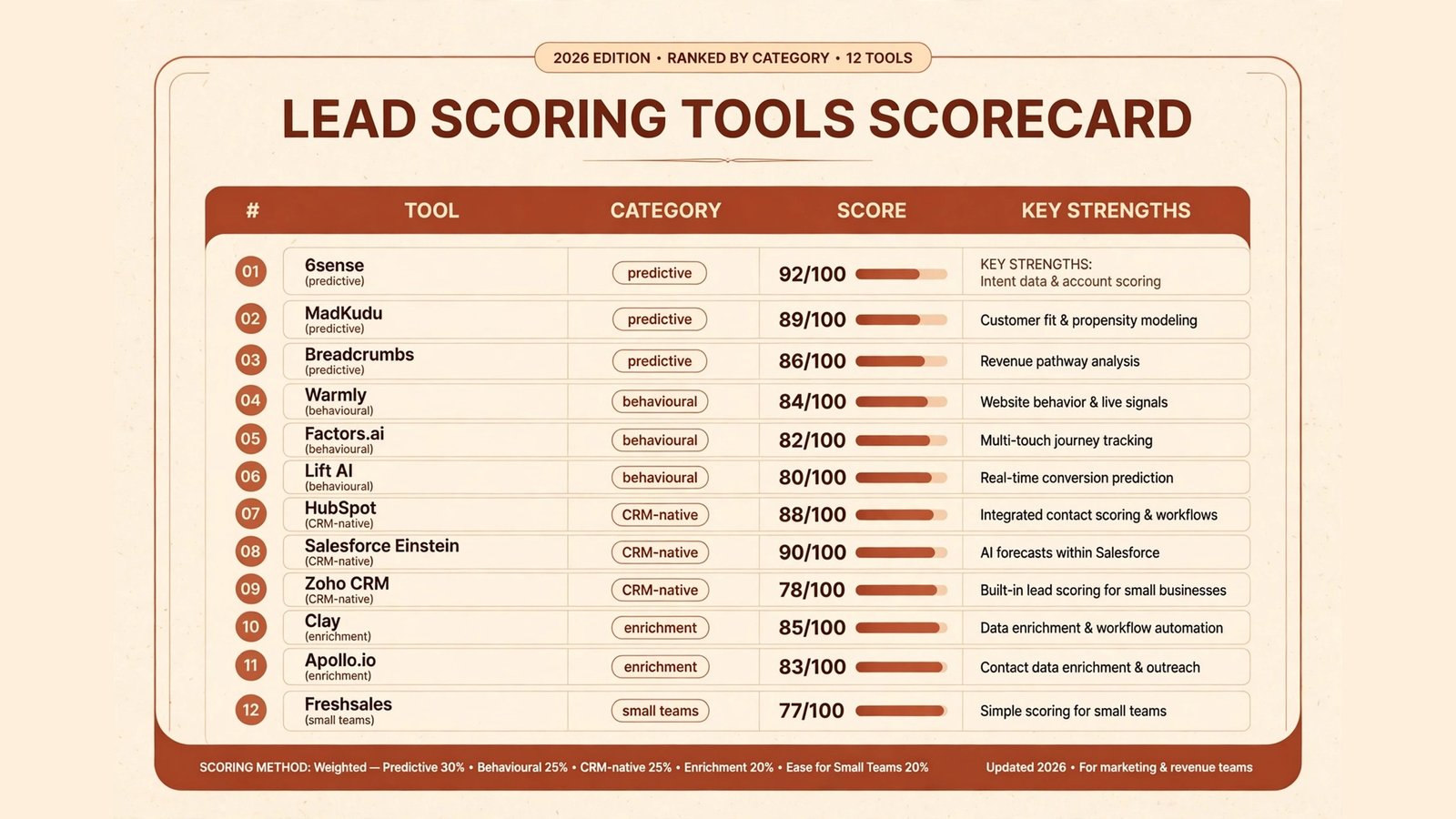
The 12 best AI lead scoring tools at a glance
| Tool | Best job | Free option | Paid from |
|---|---|---|---|
| 6sense | Predictive account scoring | Yes, limited | Custom, check checkout |
| MadKudu | Predictive lead scoring | No | Custom, check checkout |
| Breadcrumbs | Predictive scoring for SaaS | Yes | Around $400 per month |
| Warmly | Behavioural and intent scoring | No | Check checkout |
| Factors.ai | Behavioural and intent scoring | No | Check checkout |
| Lift AI | Website visitor scoring | No | Check checkout |
| HubSpot | CRM-native scoring | Yes | Predictive scoring on Enterprise, around $150 per seat per month |
| Salesforce Einstein | CRM-native scoring | No | Sales Cloud Enterprise, around $150 per user per month |
| Zoho CRM | CRM-native scoring | Yes | Zia scoring on Enterprise, around $40 per user per month |
| Clay | Enrichment-driven scoring | Yes | $185 per month |
| Apollo.io | Enrichment-driven scoring | Yes | $49 per user per month |
| Freshsales | Scoring for small teams | Yes | $9 per user per month |
Best pick by job
| Your job | Start with | If that fails, try |
|---|---|---|
| Score whole accounts, not just leads | 6sense | MadKudu |
| Score leads with a small data team | Breadcrumbs | MadKudu |
| Score website visitors in real time | Warmly | Lift AI |
| Score product and marketing behaviour | Factors.ai | Breadcrumbs |
| Score inside the CRM you already use | HubSpot | Salesforce Einstein |
| Score on a tight budget | Zoho CRM | Freshsales |
| Build scores from enriched data | Clay | Apollo.io |
| Score leads for a small team fast | Freshsales | HubSpot |
Predictive scoring: let the model find the pattern
Predictive scoring tools train on your closed won and closed lost history, then rank new leads by how closely they resemble past buyers. They work best when you already have hundreds of past deals to learn from. With too little history, the model guesses, and a simple rules based score beats it.
1. 6sense
6sense is the reference standard for predictive account scoring. It combines intent data from millions of B2B domains, firmographic fit, and your own CRM and website data into account scores and buying stage predictions. The output is a ranked account list with recommended next actions, not just a number on a lead record.
Pricing: No published price list. Paid licences are sold on annual contracts quoted by seat count, data credits and whether predictive AI is included. Third party trackers report a median contract of around $62,000 a year, with a wide range, so check checkout and expect a sales conversation. A limited free plan offers 50 data credits a month.
Best for: Mid market and enterprise teams running account based marketing, where ranking thousands of accounts by in market probability changes how the whole team spends its week.
Watch out for: Cost and credit expiry. Credits do not roll over, and using 6sense mainly as a contact database wastes the budget. It is also overkill for a five person team. Teams building their outbound list first should read our best AI sales prospecting tools guide before buying an enterprise scoring platform.
Try it at: 6sense.com

2. MadKudu
MadKudu is a dedicated predictive scoring platform that sits between your data sources and your CRM. It pulls product usage, CRM, marketing automation and enrichment data, builds a scoring model from your conversion history, and writes scores back to the CRM in real time. Its strength is transparency: reps and marketers can see which signals moved a score, which builds trust in the ranking.
Pricing: Custom only, sold as an annual subscription. MadKudu does not publish a price list, so check checkout and budget for an implementation phase as well as the licence.
Best for: SaaS and product led companies with real product usage data, where a lead who used a key feature is worth far more than one who only opened an email.
Watch out for: Data plumbing. MadKudu is only as good as the sources connected to it. If your CRM is messy and your product events are untracked, the first month is cleanup, not scoring.
Try it at: madkudu.com
Breadcrumbs is the smaller, more accessible predictive option, built specifically for SaaS teams. It combines product usage, marketing engagement and firmographic data into lead and account scores, and it ships with templates so a team can launch a first model without a data scientist. A free plan makes it the easiest predictive tool to test.
Pricing: Free plan available. Paid plans are reported from around $400 per month, so check checkout for the current tiers and scored record limits.
Best for: SaaS startups and scaleups that want predictive scoring without an enterprise contract, and teams whose product usage is the strongest buying signal they have.
Watch out for: Model depth. Breadcrumbs is simpler than 6sense or MadKudu by design, so teams with complex multi product data may outgrow it. It is also SaaS focused, and fits B2B services less well.
Try it at: breadcrumbs.io
Behavioural and intent scoring: score what buyers do right now
Fit tells you who could buy. Behaviour tells you who is buying now. These tools watch website visits, content engagement, product activity and third party intent, then score leads by recency and intensity of action. They are the fastest scoring tools to show value, because a visitor who returned three times this week is an obvious priority.
4. Warmly
Warmly identifies website visitors, scores them by intent signals, and routes hot accounts to sales in real time. It combines visitor identification, firmographic enrichment and buying signals into a single score, and it can trigger Slack alerts or route a lead to the right rep the moment the score crosses a threshold.
Pricing: No published price list. Warmly sells annual plans quoted by website traffic and seat count, so check checkout.
Best for: B2B teams whose website is their main lead source, and sales teams that want same day follow up on high intent visitors instead of next week batching.
Watch out for: Identification limits. Person level visitor identification is mainly a US capability, and company level coverage is stronger than person level elsewhere. If you sell into Europe, check the compliance position before relying on it.
Try it at: warmly.ai
5. Factors.ai
Factors.ai is an analytics and scoring platform for B2B marketing teams. It stitches together website, advertising, CRM and marketing automation data, attributes revenue to touchpoints, and scores accounts by engagement across the whole journey rather than by a single form fill.
Pricing: No published price list. Factors.ai sells annual plans quoted by traffic and features, so check checkout.
Best for: Marketing teams that need to prove which campaigns produce scored, sales ready accounts, not just clicks and form fills.
Watch out for: It is a marketing analytics tool first and a scoring tool second. Sales teams that want a simple lead ranking inside their CRM may find Factors.ai heavier than they need.
Try it at: factors.ai
6. Lift AI
Lift AI scores anonymous website visitors in real time and predicts their buying intent from behavioural patterns, without relying on form fills or cookies. Visitors above a threshold can be routed to sales chat, a demo booking flow or a priority queue, while low intent visitors get self serve content.
Pricing: No published price list. Lift AI sells annual plans quoted by traffic volume, so check checkout.
Best for: Teams with high website traffic and low form conversion, where most buyers never identify themselves until late in the journey.
Watch out for: It scores visitors, not named leads, so it pairs with an identification or CRM tool rather than replacing one. Results also depend on traffic volume, and small sites will see noisy scores.
Try it at: lift-ai.com
CRM-native scoring: score where reps already work
The cheapest scoring tool is often the one inside the CRM you already pay for. CRM-native scoring needs no integration project, scores update on the same record reps open every day, and routing rules can act on scores without a second system. The trade off is depth: native models are usually simpler than dedicated platforms.
7. HubSpot
HubSpot offers two scoring paths. Manual scoring lets teams assign points for form fills, page views, email engagement and firmographic fit. Predictive lead scoring, on Sales Hub Enterprise, uses machine learning on your HubSpot history to rank contacts and explain the drivers. Scores feed lists, workflows and lead rotation automatically.
Pricing: Free CRM available. Starter plans are low cost, Sales Hub Professional is reported at around $90 per seat per month billed annually, and predictive scoring sits on Sales Hub Enterprise at around $150 per seat per month billed annually. Higher tiers carry one time onboarding fees, so check checkout for the full first year cost.
Best for: Marketing led teams already on HubSpot, and any team that wants scoring, workflows and routing in one place without an integration project.
Watch out for: Tier jumps. Predictive scoring is an Enterprise feature, so a team on Professional pays a large step up for it. Manual scoring on lower tiers is often enough, and should be tested before upgrading.
Try it at: hubspot.com

8. Salesforce Einstein
Einstein Lead Scoring ranks leads from 1 to 99 based on how closely they resemble your past converted leads, using your Salesforce history. It adds opportunity scoring for close probability and Einstein activity capture, and scores update automatically as new data lands. It is the deepest scoring engine inside any CRM, and also the most demanding.
Pricing: Einstein Lead Scoring requires Sales Cloud Enterprise or above, reported at around $150 to $175 per user per month billed annually, with Unlimited higher again. Implementation and data cleanup are extra, so check checkout and budget beyond the licence.
Best for: Enterprises already deep in Salesforce with years of clean, consistent lead history and a data team to maintain it.
Watch out for: Data hunger. Einstein needs large volumes of clean historical data to produce reliable scores, and teams with messy or thin history often find the scores unconvincing. Implementation typically takes months, not days.
Try it at: salesforce.com
9. Zoho CRM
Zoho CRM includes Zia, its AI assistant, which scores leads and predicts deal outcomes on Enterprise plans. Zia also flags anomalies, such as a deal going quiet, and suggests next actions. For the price, it is the strongest native scoring option outside the big two CRMs.
Pricing: Free plan for up to 3 users. Paid plans start at around $14 per user per month billed annually, and Zia scoring sits on the Enterprise plan at around $40 per user per month billed annually, so check checkout.
Best for: Budget conscious mid market teams that want AI scoring without HubSpot Enterprise or Salesforce Enterprise pricing, and teams already using Zoho apps.
Watch out for: Ecosystem gaps. Live chat and advanced analytics live in separate Zoho products, and the interface feels dated compared with HubSpot. Score quality also depends on keeping Zoho data clean, which is a discipline, not a feature.
Try it at: zoho.com
Enrichment-driven scoring: score from better data
A score built on thin data is a guess with a decimal point. Enrichment-driven scoring tools fix the data first: they fill in company size, industry, tech stack, funding and contact details, then score on the enriched record. They suit teams whose CRM records are mostly blank fields.
10. Clay
Clay is an enrichment and automation platform that doubles as a scoring engine. Every column in a Clay table can fetch a fact, from headcount and funding to recent news and AI researched notes, and formula columns turn those facts into a custom score. Waterfall enrichment tries several providers in order until a field is filled, and the scored table syncs to a CRM or sequencer.
Pricing: Free plan with limited credits. Paid plans changed in March 2026: Launch starts from $185 per month and Growth from $495 per month, with older tiers retired for new customers. Credits split into data credits and platform actions, so check checkout and model your real per contact cost before buying.
Best for: RevOps teams and agencies that run scoring as a system, and any team whose list quality problem is bigger than its sending problem.
Watch out for: Complexity and cost creep. A badly built table burns credits fast, and building a good scoring model in Clay takes real setup time. Solo reps should start with a simpler tool and add Clay only when manual research becomes the bottleneck.
Try it at: clay.com

11. Apollo.io
Apollo.io combines a contact database of more than 240 million people with scoring signals: buying intent topics, job changes, funding events and engagement data. Scores and signals feed lists and sequences inside Apollo itself, so a team can build a list, score it and start outreach without a second tool.
Pricing: Free plan available with limits. Basic costs $49 per user per month billed annually, Professional costs $79, and Organization costs $119 with a three seat minimum. Paid seats include yearly credit allowances, and mobile numbers cost more credits than emails, so check the credit math before committing.
Best for: Small teams and solo reps who want data plus scoring plus outreach in one subscription, and startups that cannot justify an enterprise scoring contract yet.
Watch out for: Data depth outside North America. Coverage and phone accuracy are weaker in Europe, Asia Pacific and Latin America, so test a sample from your actual market before buying. Apollo scores are also simpler than a dedicated predictive model.
Try it at: apollo.io
Scoring for small teams: start simple, prove value fast
A small team does not need a predictive model. It needs a ranking it trusts, updated automatically, inside the tool reps already open. One strong option covers this job well enough that buying more would slow the team down, not speed it up.
12. Freshsales
Freshsales includes Freddy AI scoring on paid plans, ranking leads by engagement and fit signals, plus built in phone, email and deal insights. Setup takes hours rather than weeks, and the free plan lets a team test the CRM before paying. For a small team, that speed matters more than model sophistication.
Pricing: Free plan available. Paid plans start at around $9 per user per month billed annually, with higher tiers adding more AI features, so check checkout.
Best for: Startups and small sales teams that want scoring, calling and pipeline in one simple tool, and teams buying their first CRM with scoring included.
Watch out for: Depth limits. Freddy AI scoring is simpler than HubSpot predictive scoring or MadKudu, and large teams will outgrow it. Small teams should also check our best AI tools for small business guide for the wider stack around the CRM.
Try it at: freshsales.com
Pricing compared
| Tool | Free option | Paid from | Pricing note |
|---|---|---|---|
| 6sense | Yes, limited | Custom | Annual contract, credit pool, credits do not roll over |
| MadKudu | No | Custom | Annual subscription, implementation extra |
| Breadcrumbs | Yes | Around $400 per month | Check checkout for scored record limits |
| Warmly | No | Check checkout | Annual plan, quoted by traffic |
| Factors.ai | No | Check checkout | Annual plan, quoted by traffic |
| Lift AI | No | Check checkout | Annual plan, quoted by traffic |
| HubSpot | Yes | Predictive scoring around $150 per seat per month | Enterprise tier, onboarding fees apply |
| Salesforce Einstein | No | Around $150 per user per month | Enterprise tier, implementation extra |
| Zoho CRM | Yes | Zia scoring around $40 per user per month | Enterprise tier |
| Clay | Yes | $185 per month | Credits split into data and actions |
| Apollo.io | Yes | $49 per user per month | Annual billing, credit allowances apply |
| Freshsales | Yes | $9 per user per month | Annual billing |
A realistic starter stack costs $0 to $50 per month: Freshsales free or HubSpot free with manual scoring, plus Apollo free for enrichment. Add Breadcrumbs or Zoho Enterprise once volume justifies it, and reserve 6sense or MadKudu for the point where scoring quality, not lead volume, is the bottleneck. Stay on free tiers until a scored list provably changes rep behaviour.

How to choose
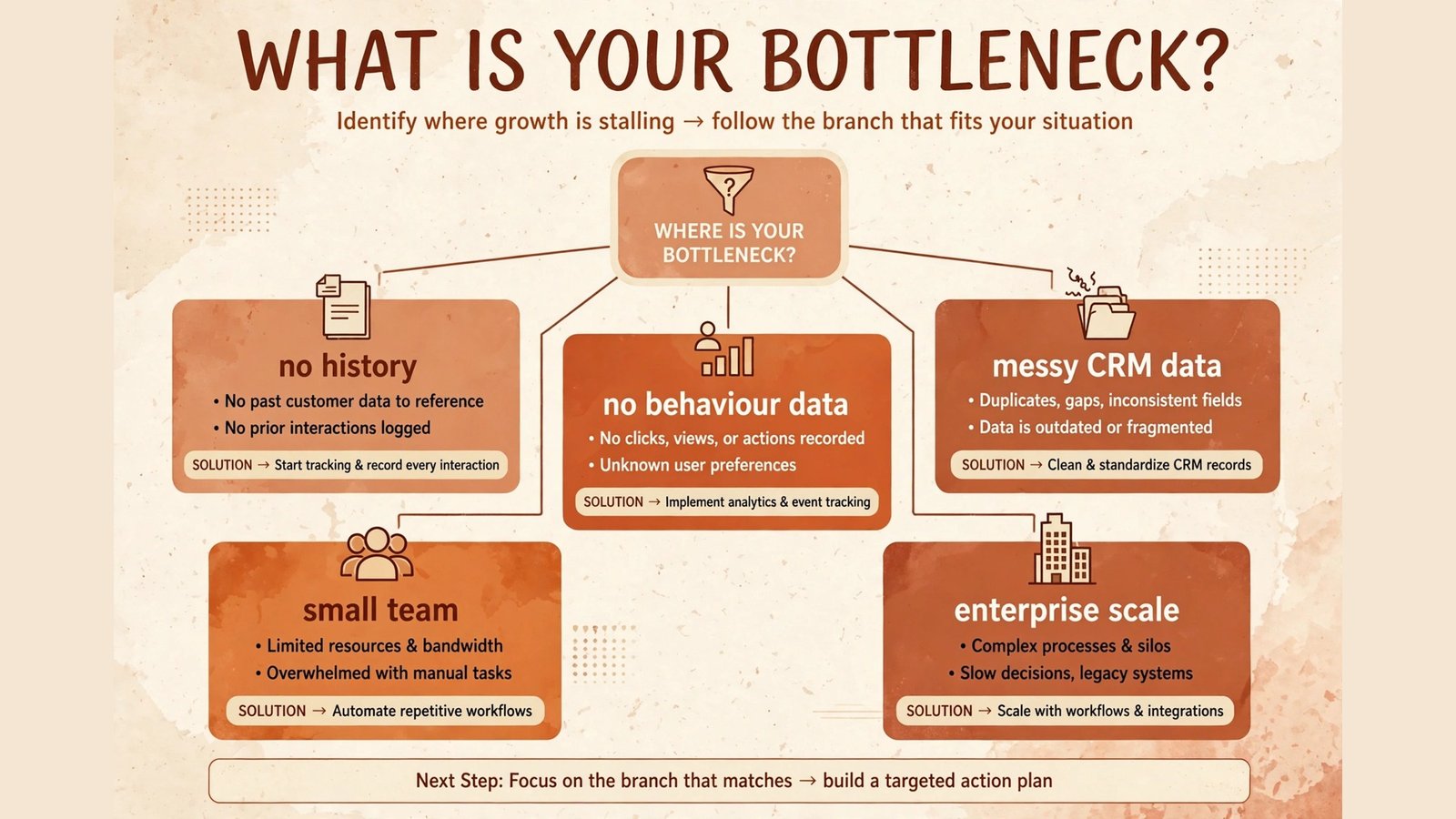
Start from your data, not from the tool list. If you have hundreds of past deals and clean CRM history, a predictive tool like MadKudu or 6sense earns its price. If your history is thin, start with behavioural scoring in Warmly or manual scoring in HubSpot, and let the model learn as data accumulates. If your CRM records are mostly blank, fix enrichment first with Clay or Apollo, because no model scores blank fields well.
Second, decide who owns the score. A score nobody trusts gets ignored, and a score nobody maintains goes stale. Pick one owner, review the top and bottom of the ranking weekly for the first month, and adjust the weights when reps report bad calls. If scored leads do not convert better than unscored ones within a quarter, change the model, not the reps.
Third, connect scoring to routing. A score that sits on a record and changes nothing is decoration. Route high scores to senior reps within minutes, send mid scores to a nurture sequence, and let low scores wait. Teams that also run phone outreach should check our best AI call centre software guide for routing scored leads to call teams. If you collect scored leads through your own site, our best AI form builders guide covers the form side of the pipeline.
Frequently asked questions
What is the difference between lead scoring and lead grading?
Scoring ranks how likely a lead is to buy, usually from behaviour and intent. Grading ranks how well a lead fits your ideal customer, usually from firmographics like size and industry. The best setups use both: grade for fit, score for timing, and prioritise leads that are high on both.
How much historical data does predictive scoring need?
A useful rule is at least a few hundred closed won and closed lost deals with consistent fields. With less history, a predictive model will overfit to noise, and manual or rules based scoring will beat it. Small teams should start simple and move to predictive scoring once the data exists.
Do I need a separate scoring tool if my CRM already scores leads?
Not at first. HubSpot, Salesforce and Zoho all score leads natively, and for most teams that is enough. Buy a dedicated tool when the CRM model misses your key signal, usually product usage or third party intent, and that miss costs real deals.
How often should scores update?
In real time or at least daily for behavioural signals, because intent decays fast. A lead who visited pricing three times this week and gets called next week is a different lead. Fit scores can update weekly, since company size and industry change slowly.
Can AI lead scoring replace manual qualification?
No. Scoring ranks leads so reps spend time well. It does not replace the discovery call, and a high score is not a closed deal. Teams that auto route every high score to a demo without qualification usually see no show rates climb.
Which single tool should a new team start with?
Freshsales, for most small teams, because scoring, calling and pipeline arrive in one cheap tool. Teams already on HubSpot should use its manual scoring first and upgrade to predictive scoring only when the volume justifies it. Content teams that score leads from inbound content can also see our best AI tools for content creators guide for the content side of the pipeline.
Conclusion
The best AI lead scoring tools do not create demand. They order it. 6sense, MadKudu and Breadcrumbs predict from history. Warmly, Factors.ai and Lift AI score from behaviour happening right now. HubSpot, Salesforce and Zoho score inside the CRM reps already use. Clay and Apollo score from richer data. Freshsales gives small teams a ranking they can trust on day one.
Start with your data. If it is thin, start simple. If it is rich, buy a model that can use it. Route high scores fast, review the ranking weekly, and keep only the tool whose scores change rep behaviour. The teams that win at lead scoring in 2026 are not the ones with the most sophisticated model. They are the ones whose best leads get called first, every time.