
The verdict is simple. Automate document collection, identity checks, and data entry, and keep every advice decision, risk conversation, and client meeting firmly human. That is the practical meaning of the decision to use AI for financial advisor client onboarding. Firms that automate the paperwork cut weeks of chasing from onboarding, while firms that try to automate the advice conversation lose the trust that brought the client in the first place. The firms that win are the ones that draw that line clearly and defend it, because clients notice both halves. They notice when paperwork is painless, and they notice when advice feels canned.
That verdict shapes everything in this guide. Onboarding is the first real experience a client has of a firm, and it is often the worst one. Forms arrive by email in separate messages, the same information is asked twice, documents go missing, and the client waits weeks while the firm waits on a custodian. Research from onboarding vendors describes prospects moving from first call to ready for proposal in under ten minutes with a fully digital flow, and while that figure is a vendor claim rather than an independent finding, it shows what the paperwork half can become. The gap between that experience and the usual email chase is the opportunity, and it is large.
This guide sets out a nine step workflow, a complete onboarding checklist, a comparison of real onboarding tools, and the compliance guardrails that keep an automated flow audit ready. Tool details come from vendor pages and comparison guides checked at writing time. Where a price or a feature is reported rather than published on the vendor’s own page, the text says so, and you should confirm the current position on the vendor page before buying.
Why Onboarding Loses Clients Before Advice Begins
Onboarding loses clients quietly, because a prospect who drifts away during paperwork rarely sends a farewell message. They simply stop replying to the third document request, or they accept a rival’s proposal while still waiting for yours. The cause is usually friction, not price or performance, because at onboarding stage the client has not yet seen any advice worth paying for. They have only seen the firm’s process, and a messy process reads as a preview of a messy service. Every extra form, every repeated question, and every week of silence lowers the chance the client ever becomes a client.
The internal cost is just as real. Advisers and paraplanners spend hours chasing documents, retyping statement data, and reconciling versions of the same form, and those hours come straight out of advice time. One vendor reports saving three to five hours per account by scanning brokerage statements automatically instead of entering holdings by hand, and while that saving will vary by firm, the direction is consistent across every onboarding tool reviewed here. Manual re entry is slow, error prone, and invisible in most firms’ reporting, which is why it survives far longer than it should.
There is also a compliance cost to messy onboarding. When documents live in email threads and shared drives, the audit trail is whatever someone remembers to save. When identity checks, risk questionnaires, and approvals live in one workflow with timestamps, the audit trail builds itself. Regulators and custodians do not ask for a perfect process, but they do ask for a complete record, and a firm that cannot produce one quickly will spend far more time on a review than a firm that can. Good onboarding is therefore not only a client experience project, and it is a risk project too.
How to Use AI for Financial Advisor Client Onboarding Without Compliance Risk
To use AI for financial advisor client onboarding safely, give the AI the jobs that are rules based and keep the jobs that need judgment with people. AI can read a brokerage statement and extract holdings, tickers, and cost basis. It can check that a document set is complete, flag a missing signature, send a polite reminder, and route a file to the right reviewer. It can prefill a form from data the client already gave, so the client never types the same address twice. Those jobs are high volume, low judgment, and exactly where automation earns its keep.
People keep the jobs where a wrong call costs a client or a licence. An adviser reviews the risk questionnaire with the client rather than letting a score decide the portfolio. A compliance reviewer approves higher risk profiles and complex entity structures rather than letting a workflow auto approve them. A human checks any identity flag, any sanctions hit, and any document that looks altered, because an automated pass on a suspicious document is worse than a slow manual check. Write that split into the workflow as a rule, not as a habit, and review any case where the AI recommendation was overturned, since overturns reveal either a bad rule or a gap in the data.
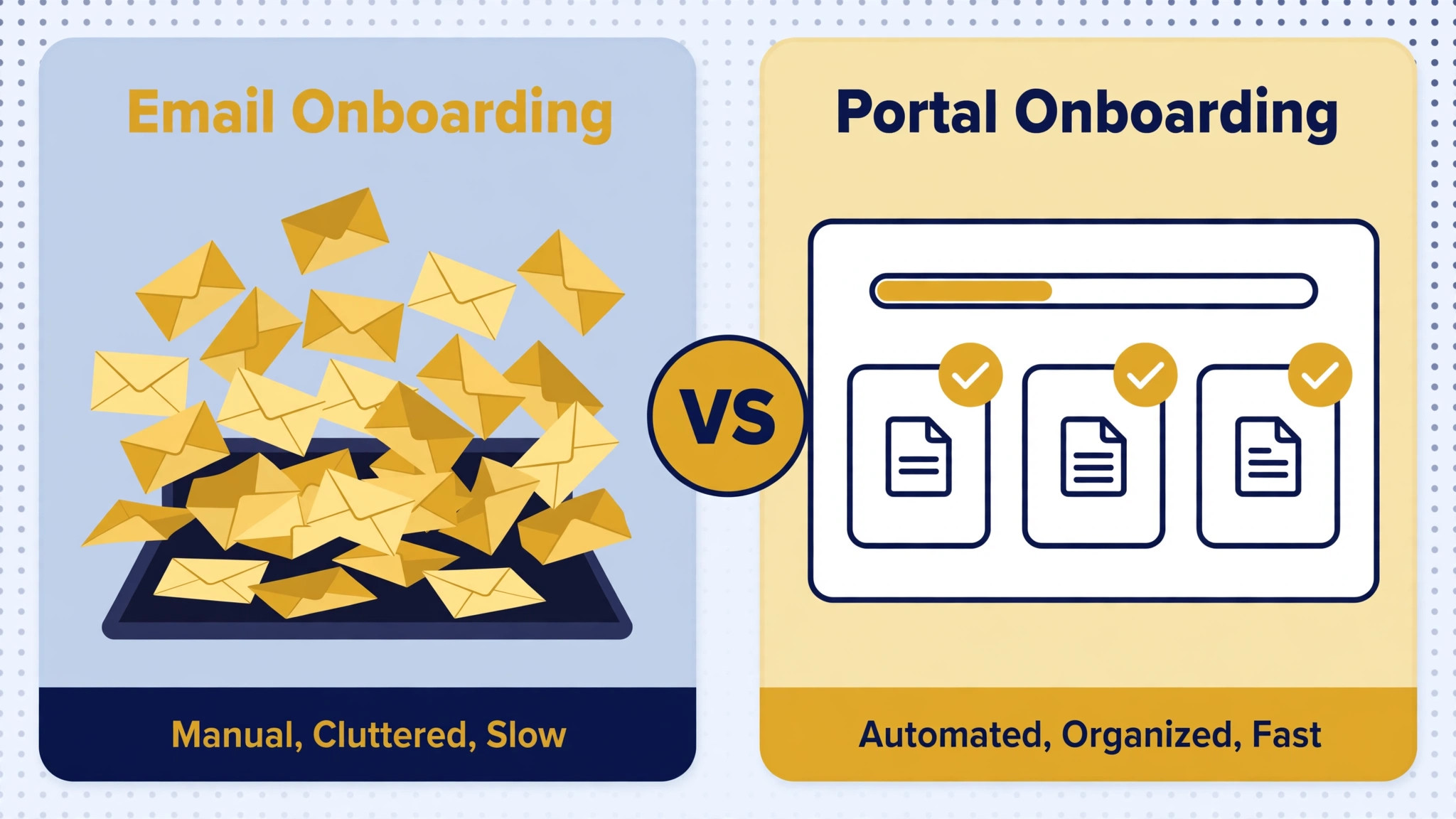
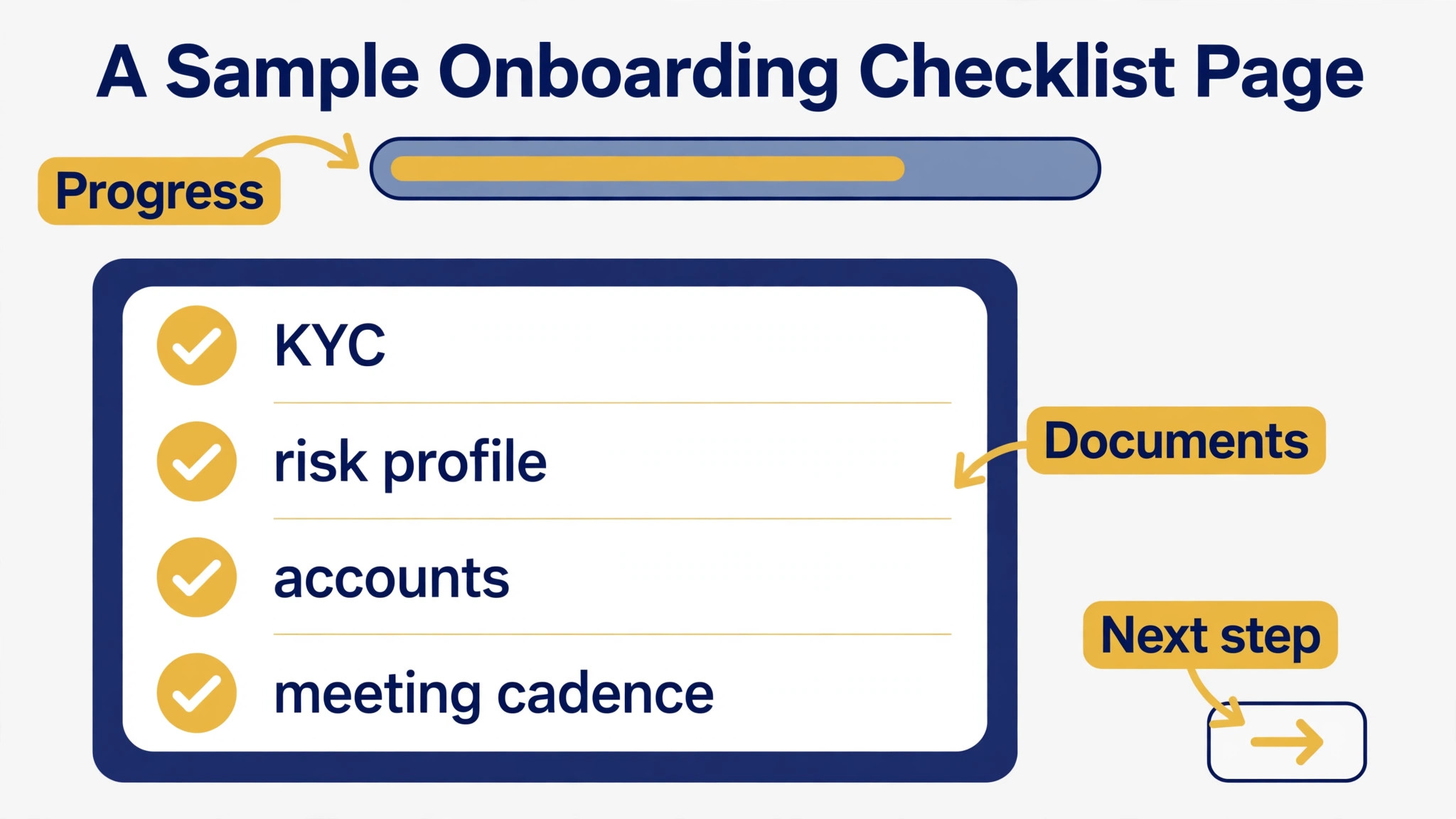
The third decision is the client facing experience. A single secure portal where the client sees a checklist, uploads documents by phone camera, signs electronically, and tracks progress will beat five email threads every time. The portal should show only the sections that client needs, based on their circumstances, rather than a fifty page pack where most pages do not apply. Vendors that do this well, such as Mako with its circumstance based forms, report higher completion rates, and the reason is obvious. Clients finish short relevant forms and abandon long irrelevant ones, whatever the firm’s intentions.
The Nine Step Onboarding Workflow
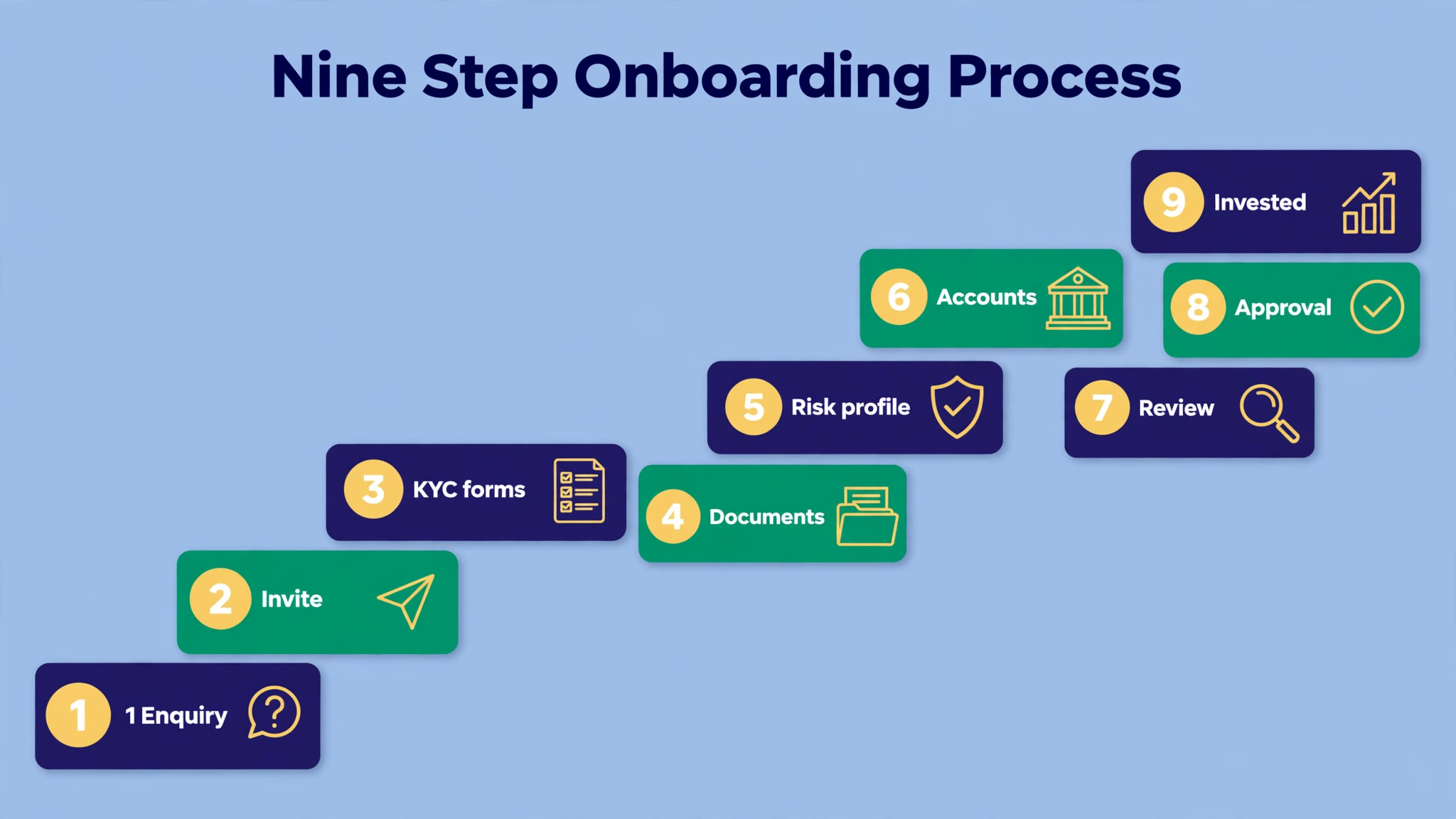
Firms that use AI for financial advisor client onboarding follow the same nine steps below, and the discipline that matters most is that no step starts before the previous step’s output is recorded. That discipline is what stops the classic onboarding failure, which is advice prepared from half a file.
- Agree scope and record it. At the first meeting, record the services agreed, the fee basis, the accounts in scope, and the people involved, including attorneys, trustees, or family members where relevant. Send a written scope summary the same day, and get the client’s acknowledgement before any paperwork is sent. Scope agreed late is the most common source of onboarding rework, because documents collected for one scope rarely fit another.
- Send one portal invitation, not a pack of emails. Invite the client to a single secure portal with a personal checklist, a short welcome message, and a named contact for questions. The checklist should show progress as items complete, so the client can see the finish line from the start. One invitation with a visible checklist beats ten attachments, because the client always knows what remains and what is already done.
- Collect identity and KYC documents through the portal. Ask for government identity, proof of address, and any entity documents where the client is a trust, company, or other structure, with phone camera upload and clear guidance on what counts as acceptable. Run identity verification and sanctions screening as documents arrive, not at the end, so problems surface while the client is still engaged. Any flag goes to a human reviewer at once, and the client is told plainly what else is needed.
- Capture the risk profile as a conversation, not a form alone. Send the risk tolerance questionnaire in advance, covering risk capacity, risk behaviour, and current portfolio risk, then discuss the result with the client before it is recorded as final. AI can score the questionnaire and flag inconsistencies, such as a client who claims high risk tolerance but holds only cash, but only the adviser can resolve that inconsistency in conversation. Record the agreed profile with the date and the discussion notes.
- Ingest statements and build the current portfolio picture. Upload brokerage and bank statements in any format, and let AI extraction pull holdings, values, and cost basis into a structured view, with a human check of totals against the original documents. Compare the current portfolio with the firm’s model portfolios, surfacing concentration, sector exposure, fees, and tax inefficiencies the client should see before any recommendation. That comparison is often the moment the client understands the value of advice, so present it clearly rather than burying it in an appendix.
- Draft agreements and account forms from collected data. Generate advisory agreements, custodian account forms, and any transfer paperwork prefilled from the portal data, so the client signs documents that already contain their correct details. Use electronic signature with a clear signing order where multiple signers are involved, and show the client only the sections they must complete. Prefilled forms cut signing errors sharply, and they cut the back and forth that happens when a client spots their own address spelled wrong on page nine.
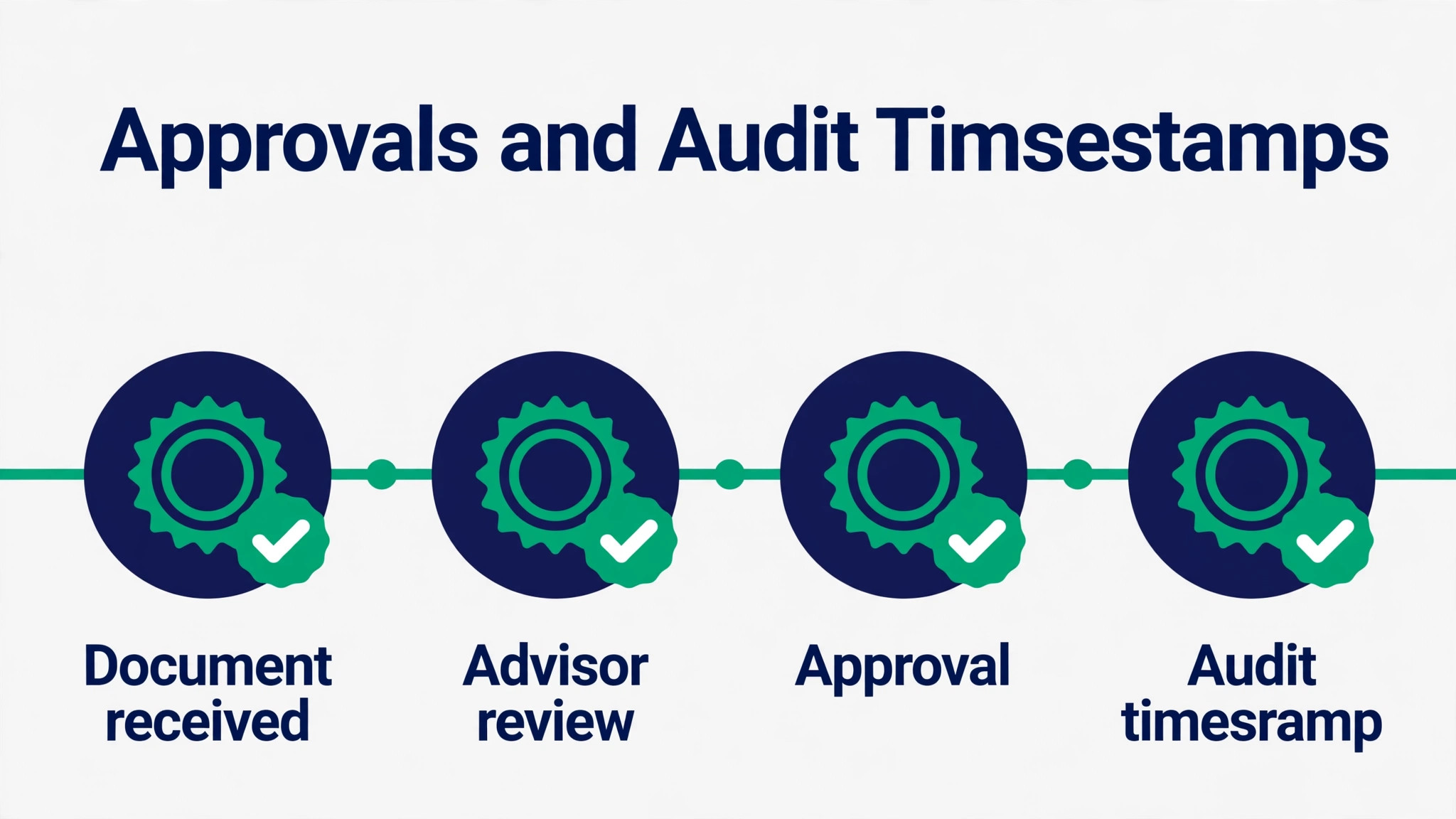
- Route approvals and open accounts. Route the completed pack to compliance review, with higher risk profiles and complex structures going to a senior reviewer, and record each approval with a timestamp. Submit custodian account opening and asset transfer requests only after approval, and track each request until the account shows as open. A request submitted before approval is a compliance finding waiting to happen, so the workflow should block it technically rather than relying on staff memory.
- Fund, invest, and confirm in writing. Once accounts open and assets arrive, implement the agreed portfolio, check that holdings match the recommendation, and send the client a written confirmation of what was invested, where, and why. Include the fee schedule, the reporting cadence, and the name of the person to contact with questions. Written confirmation at this point prevents the most common early complaint, which is a client who is unsure what happened to their money after transfer.
- Set the meeting cadence and the first review date. Agree how often the client will meet the adviser, what reporting they will receive between meetings, and the date of the first review, and put all three in the calendar before onboarding closes. A client who leaves onboarding without a next meeting date is a client who drifts, so the workflow should not allow closure until the cadence and the first review are booked. Close the onboarding file only when every checklist item is complete or formally waived with a reason recorded.
The Client Onboarding Checklist
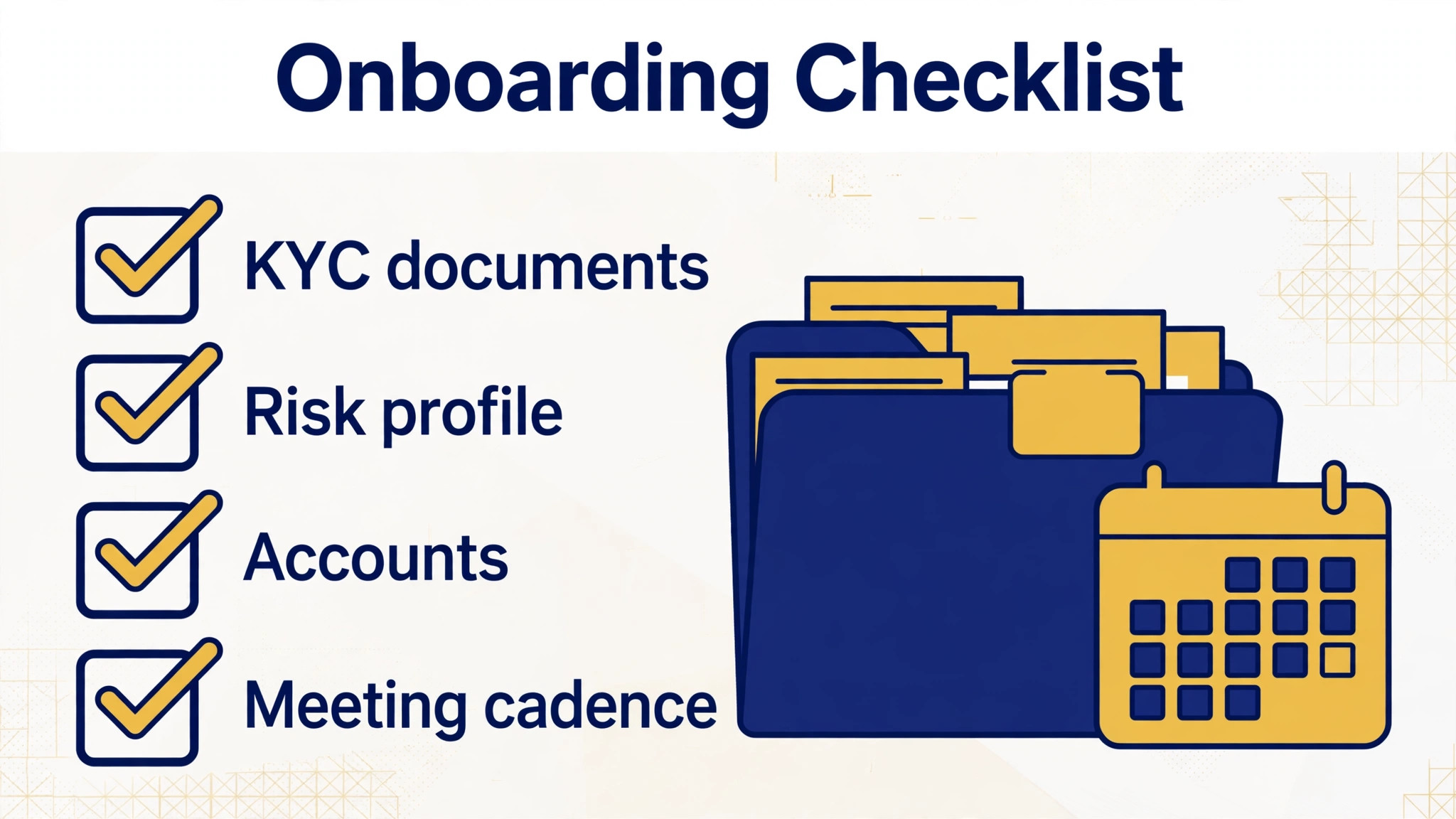
Use this checklist for every household, and do not close onboarding until every item is complete or formally waived. The checklist is the audit trail, so a waived item needs a reason, a name, and a date, not a blank box.
- KYC documents collected. Government identity and proof of address for each individual, plus entity documents, trust deeds, or company records where the client is not an individual.
- Identity verification and screening complete. Identity check passed, sanctions and watchlist screening run, and any flag reviewed and cleared by a named human reviewer.
- Risk profile agreed and recorded. Questionnaire completed, discussed with the client, inconsistencies resolved, and the agreed profile signed off with discussion notes attached.
- Financial picture complete. Income, assets, liabilities, tax position, and existing holdings captured, with statements ingested and totals checked against originals.
- Accounts identified and mapped. Every account in scope named, with custodian, account type, and transfer or new account decision recorded for each one.
- Agreements signed. Advisory agreement, fee agreement, and any custodian or transfer forms signed in the right order, with copies stored in the client file.
- Compliance approvals recorded. Standard approvals and any enhanced due diligence for higher risk profiles completed, with timestamps and reviewer names.
- Portfolio implemented and confirmed. Holdings checked against the recommendation, written confirmation sent, and fee schedule and reporting cadence confirmed to the client.
- Meeting cadence agreed. Review frequency, reporting between meetings, and the first review date booked and entered in the calendar.
- File closed with a complete record. Every checklist item complete or waived with a reason, and the full onboarding record available in one place for audit.
Run the checklist as a live document, not as a form filled in at the end. A firm that decides to use AI for financial advisor client onboarding should keep the checklist visible to everyone working the file, because a checklist updated as each item completes shows the firm, at any moment, exactly where every onboarding stands and what is blocking it.
Onboarding Tools Compared
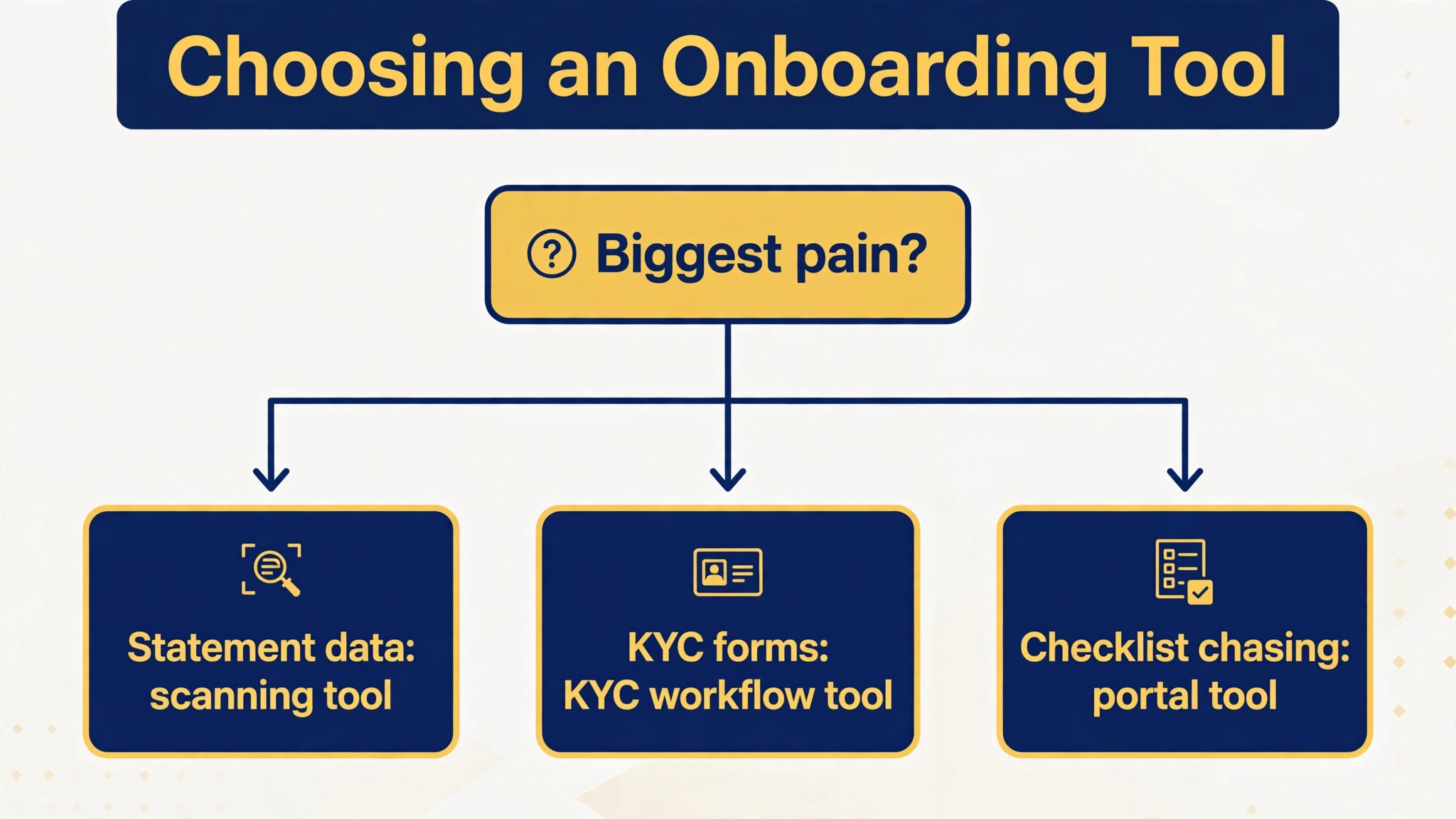
The tools below cover different slices of onboarding, from full workflow platforms to document collection specialists. A firm planning to use AI for financial advisor client onboarding should choose based on which slice causes the most pain, because the right choice depends on that pain rather than on any feature list.
| Tool | Main strength | Reported position | Best fit |
|---|---|---|---|
| Investipal | Statement scanning and portfolio proposals | AI statement scanner reported to save 3 to 5 hours per account | Firms that win clients on portfolio analysis |
| Mako Fintech | KYC forms and digital onboarding workflows | Identity validation through Equifax integration reported | Firms with heavy KYC and repapering work |
| InvestGlass | CRM plus onboarding plus compliance in one platform | Swiss hosted cloud platform with rules based checklists | Wealth managers with complex entities |
| Clustdoc | Guided checklists and audit trails | Strongest where compliance logic drives the choice | Firms that need ID verification plus approvals |
| Manual email and spreadsheets | No new cost, full control | Familiar but slow and hard to audit | Solo advisers with very low volume |
Investipal suits firms that compete on portfolio insight, because its statement scanner turns a pile of PDFs into a structured portfolio and a side by side proposal in minutes rather than days. The reported saving of three to five hours per account comes from the vendor, so treat it as a claim to test in a trial rather than a promise, and test it on messy real statements, including handwritten notes and scanned images, not only on clean PDFs. Its weakness is that it is strongest on the analysis half of onboarding, so a firm whose pain is KYC paperwork may still need a dedicated onboarding workflow alongside it.
Mako Fintech suits firms where KYC forms and compliance workflows dominate, because it prefills client information, shows each client only the sections that apply to them, and produces the required forms with built in electronic signatures. Its reported Equifax integration for automatic identity validation is useful for firms onboarding at distance, and its bulk repapering tools help firms moving a whole book to a new custodian. Pricing is not published in the material reviewed here, so confirm it on the vendor page and ask about per client versus per firm pricing before comparing it with a flat fee tool.
InvestGlass suits wealth managers with complex entity structures, because it combines CRM, digital onboarding, compliance workflows, portfolio management, and a client portal in one Swiss hosted platform.
Its rules based checklists, KYC and anti money laundering screening with configurable risk scoring, and approval automation with timestamped audit trails fit firms where every onboarding is different and every step must be evidenced. Clustdoc suits firms that want guided checklists, identity verification, and approval workflows without replacing their whole stack, and comparison guides rate it strongest where compliance logic drives the decision. Manual email and spreadsheets remain the baseline, and they are only defensible at very low volume, because they cannot produce an audit trail without extra work that nobody has time to do.
Compliance Guardrails for an Automated Flow
Automation makes compliance easier to evidence and easier to break at scale, so guardrails must be built into the workflow rather than added as a policy document nobody reads.
Firms that use AI for financial advisor client onboarding should treat guardrails as part of the workflow build, not as an afterthought, because a rule added later is a rule staff must be retrained to follow. First, every automated decision needs a human override path and a log of when it was used. If the system auto approves standard profiles, a reviewer must still sample those approvals, and any auto approval that is later found wrong should trigger a review of the rule, not only of the case. Sampling keeps the firm honest about whether its rules still fit its clients.
Second, data handling must be explicit. Client documents, identity data, and portfolio data are sensitive, and the firm should know where each tool stores them, how long they are kept, and who can access them. A portal hosted in one jurisdiction and a CRM in another can create a data map nobody can draw, so ask each vendor for hosting location, retention, and access controls before signing, and record the answers in the firm’s own compliance file. Clients rarely ask these questions, but regulators do, and the time to answer them is before the first document is uploaded.
Third, keep the advice record separate from the automation record. The workflow log proves what was collected and when, but the advice record proves what was recommended and why, including the risk discussion and the client’s objectives. AI can draft the advice summary, but the adviser must read it, correct it, and sign it, because a summary the adviser has not read is not evidence of advice given. That separation protects the client, who gets advice a human stands behind, and it protects the firm, which can show its reasoning years later.
What to Measure in the First 90 Days
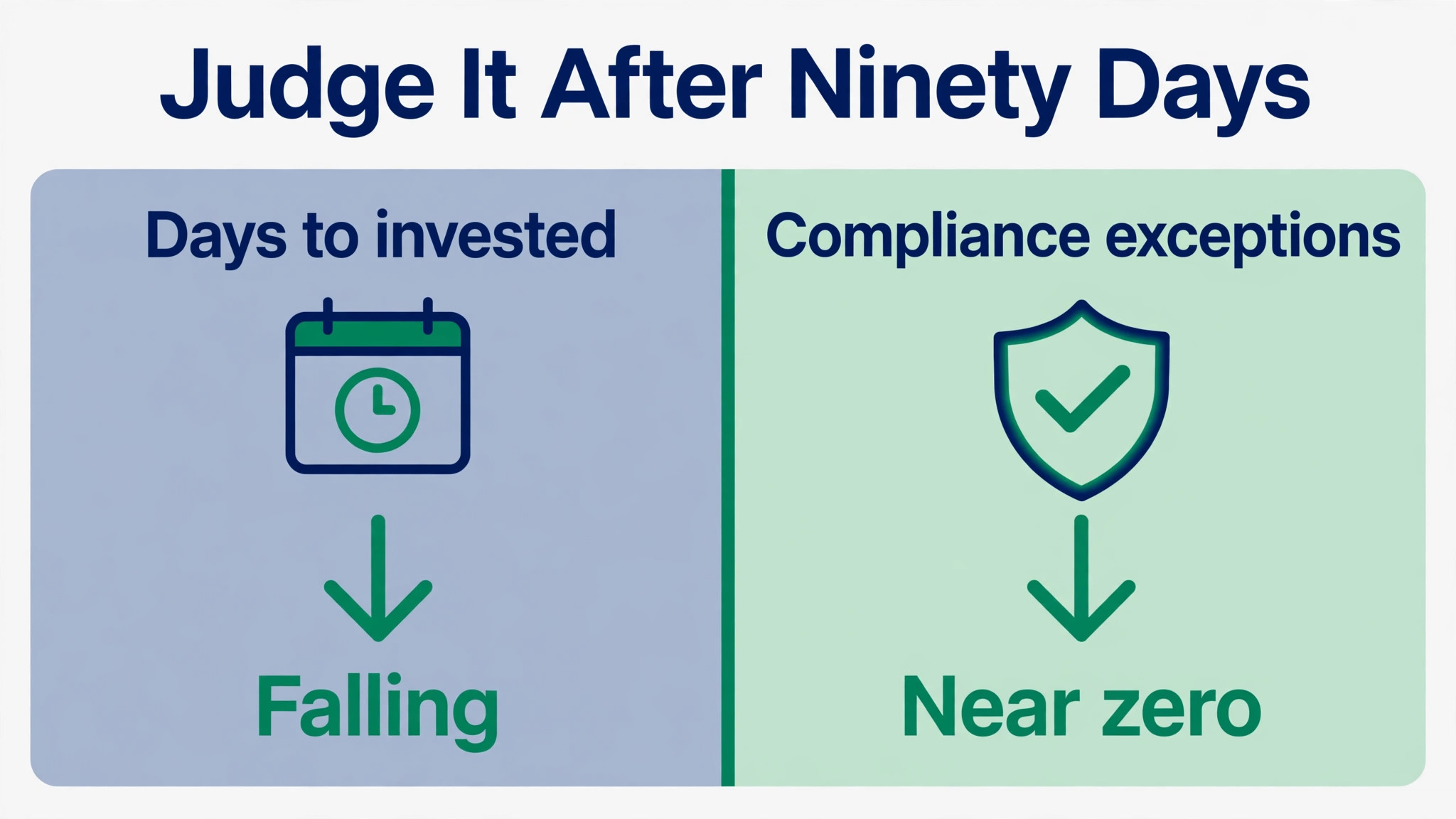
Four measures tell a firm whether onboarding automation is working, and all four should be tracked from the first week rather than guessed at the quarter end. A firm that decides to use AI for financial advisor client onboarding should set baseline numbers before launch, or it will never know whether the new flow actually improved anything.
| Measure | What good looks like | Where it comes from |
|---|---|---|
| Days from first meeting to invested | Falling steadily as document chasing shrinks | Workflow timestamps |
| Client completion rate | Share of invited clients who finish the portal flow rising | Portal reports |
| Staff hours per onboarding | Hours spent chasing and retyping falling | Time log or workflow tasks |
| Compliance exceptions | Missing documents and late approvals falling to near zero | Audit checklist |
Days to invested is the headline measure, because it captures the whole flow in one number the client also feels. Client completion rate shows whether the portal itself works, since a low rate usually means the checklist is too long or the instructions are unclear. Staff hours per onboarding shows whether the firm actually saved time or merely moved work from email to a new system. Compliance exceptions show whether the audit trail improved, and a firm should be worried if automation makes onboarding faster but exceptions rise, because that trade will not survive a regulatory review.
Common Onboarding Failures and How Automation Prevents Them
The most common failure is the duplicate request. A client sends a document, nobody logs it, and a second staff member asks for it again a week later. The client concludes the firm is disorganised, and the adviser loses credibility before giving any advice. A portal with a live checklist prevents this failure completely, because a received document shows as received to everyone on the team at once, and the system will not ask for it again.
The second failure is the silent stall. Onboarding stops because one document is missing, but nobody tells the client, so the client assumes the firm lost interest. Firms that use AI for financial advisor client onboarding avoid silent stalls with automated reminders that name the missing item, explain why it is needed, and give a one tap upload link. A reminder that names the item and the reason gets answered far faster than a generic message asking the client to get in touch.
The third failure is the transfer that starts too early. Assets move before agreements are signed or before compliance approval is recorded, and the firm must then unwind a transfer while explaining itself to a custodian. A workflow that blocks transfer submission until approval timestamps exist prevents this failure technically, rather than relying on staff to remember the order. Technical blocks beat policy reminders every time, because they work on busy days when memory does not.
The fourth failure is the onboarding that never formally ends. The client is invested, but no review date is booked, no reporting cadence is agreed, and the file stays open with three items unchecked for months. That drift costs retention, because a client without a next meeting is a client open to a rival’s call. Firms that use AI for financial advisor client onboarding should treat closure as a workflow gate, not as a tidy up task, and the file should not close until the review date and cadence are booked.
A Short Closing Note for Small Firms
Small firms sometimes assume onboarding software is for large firms, but the opposite is closer to true.
A firm that decides to use AI for financial advisor client onboarding at small scale gains the most, because a large firm can absorb messy onboarding with staff, while a small firm loses its scarcest resource, which is adviser time, to document chasing. Start with one tool that fixes the worst pain, whether that is statement ingestion, KYC forms, or checklist chasing, and add the next piece only when the first one is working. Keep advice human, keep approvals human, automate everything else, and review the four measures after ninety days. If days to invested fell and exceptions did not rise, the investment paid, and the firm can extend the workflow with confidence.
More Reading on Stratilyze
For a related client management comparison, read best CRM for cleaning companies and best client management software for nutritionists. For a different professional workflow, see best practice management software for therapists.
Frequently Asked Questions
How long should financial advisor onboarding take
A fully digital flow can move a straightforward prospect from first call to ready for proposal in under a day, and some vendors claim under ten minutes for the paperwork half, but a realistic target for most firms is one to two weeks from first meeting to invested. Complex entities, transfers from multiple custodians, and enhanced due diligence all add time, and a firm should quote a range rather than a single day count so clients are not disappointed by a normal delay.
What KYC documents does a new advisory client need to provide
Individual clients typically provide government identity and proof of address, while trusts, companies, and other entities provide their governing documents plus identity for controlling persons, with exact requirements varying by jurisdiction and custodian. The onboarding portal should ask only for the documents that client’s circumstances require, and the firm should tell the client at the start why each document is needed, since clients complete requests they understand far faster than unexplained ones.
Can AI replace the risk profiling conversation
No, and firms should not let it try. AI can score a questionnaire, flag inconsistencies, and draft a summary, but only an adviser in conversation can resolve a contradiction, such as a client who claims high risk tolerance while holding only cash, and record an agreed profile the client genuinely understands. A risk score without a conversation is a number without a client behind it, and it will not survive a complaint about suitability.
What is the biggest onboarding mistake small advisory firms make
Sending documents by email in separate messages with no single checklist and no visible progress is the mistake that costs the most clients. Prospects lose track of what remains, staff lose track of what arrived, and the audit trail becomes an email search. A single portal with a live checklist fixes all three problems at once, and it is the cheapest high impact change most small firms can make.
How do firms handle clients who will not use a portal
Keep a paper or assisted route open, but run it through the same workflow so the record stays complete. Staff can complete the portal steps on the client’s behalf during a meeting or a call, with the client’s signed acknowledgement, rather than running a parallel paper process that never reaches the file. A small number of assisted onboardings costs little, while a parallel process costs auditability for every client it touches.
Should a firm buy one onboarding platform or several specialist tools
Start with the slice that causes the most pain, and buy one tool that fixes it well, rather than buying a full platform whose onboarding half is weak. A firm drowning in statement data should trial a statement scanning tool first, while a firm drowning in KYC forms should trial a KYC workflow tool first. Add the next piece only when the first is working, and judge each addition on days to invested and compliance exceptions, not on feature count.