

A prospect asks for a price, the agency owner guesses, and the number is either so low that the work loses money or so high that the prospect walks away. That guessing is the problem this guide solves. It shows how to price social media management small agency owners can defend, using a real hourly floor, a clear scope, and retainer tiers that match deliverables to client size. Pricing is not a single number. It is a system that connects time, tools, margin, and the value a client receives, and a system can be tested and improved instead of guessed each time a quote is requested.
Small agencies fail on pricing in predictable ways. They price by copying a competitor, without knowing whether that competitor is profitable. They sell unlimited revisions, unlimited platforms, and unlimited community management for a flat fee, then discover the scope grows every month while the fee stays fixed. They forget tool costs, tax, holidays, and non billable time, so a rate that looked healthy on paper leaves nothing at month end. Each of those mistakes is fixable, and fixing them starts with one calculation, which is the lowest hourly rate the agency can accept before a job stops paying for itself.
This guide works through that calculation, then builds three retainer tiers, add on pricing, and a review routine that raises prices without losing good clients. Figures from published 2026 pricing guides are used as sanity checks, and where a figure comes from a third party guide rather than a vendor page, that is stated plainly, with advice to confirm current numbers on the vendor page before quoting them. The agency own tracked hours and costs remain the final authority, because market ranges describe other businesses, not this one.
Start With an Hourly Floor, Not a Competitor Price
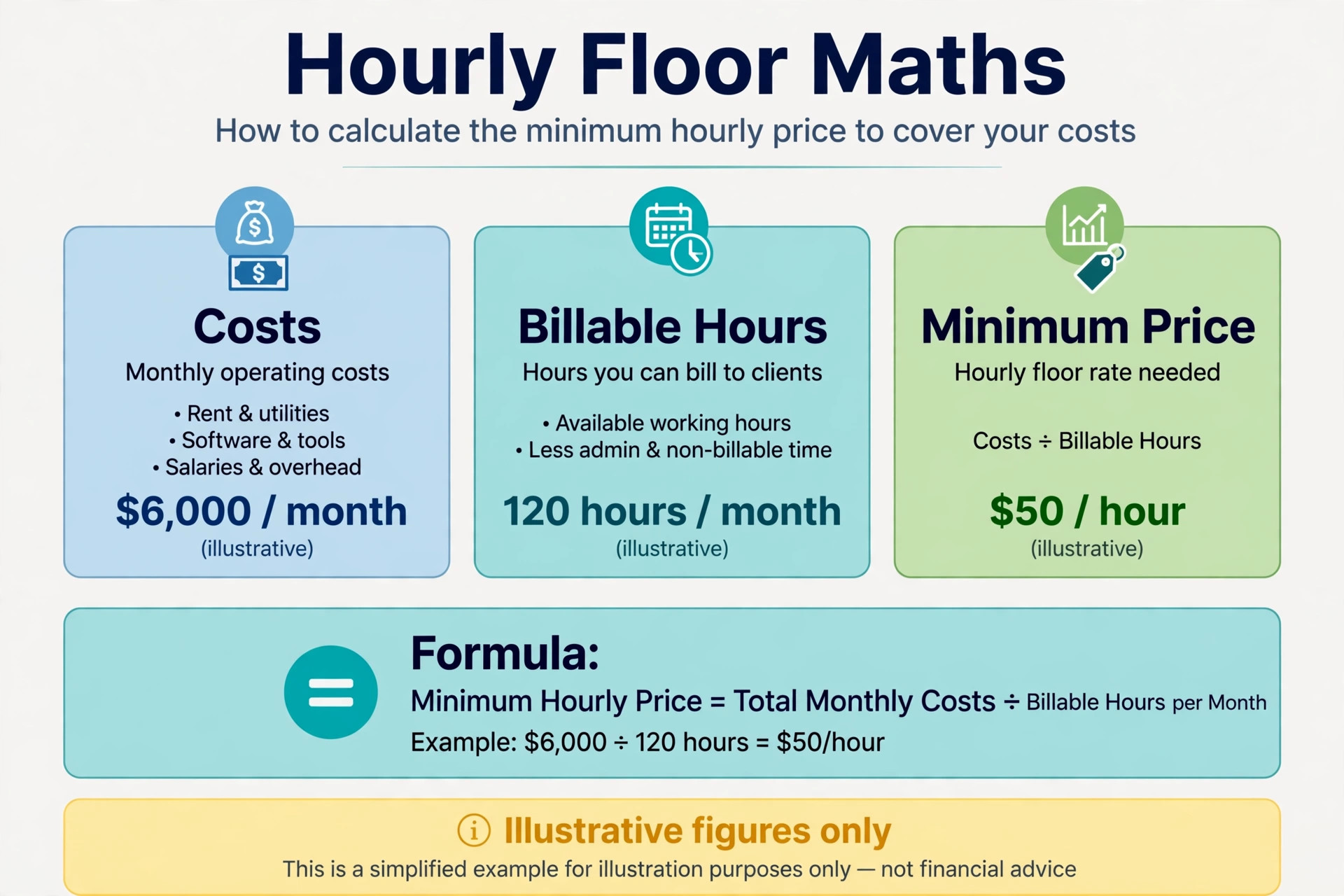
An hourly floor is the minimum the agency must earn per billable hour to cover costs and pay the owner fairly. Calculate it by listing monthly costs, including tools, contractors, tax provision, insurance, and a realistic owner salary, then dividing by the number of billable hours actually available in a month.
Billable hours are not the same as working hours. Meetings, proposals, admin, learning, and holidays all reduce billable time, and guides commonly assume only about two thirds of working hours can be billed, reported in a third party guide, so confirm that assumption against the agency own records. If the agency works 160 hours in a month but bills only 100, the floor must be based on 100, not 160.
Work a round example to see why this matters. Suppose monthly costs plus owner pay total 6,000 dollars, and billable hours total 100. The floor is 60 dollars per hour. A retainer that requires 20 hours of work per month must therefore cost at least 1,200 dollars before profit margin, tool costs per client, and any contractor fees. If the agency quotes 800 dollars for that scope, it loses money on every month of the contract, however busy it feels. Busy is not the same as profitable, and a full client list at losing prices is worse than a smaller list at sustainable prices.
What Counts in the Floor
Include every recurring cost that the agency would still pay if a client left, plus a provision for costs that arrive irregularly, such as annual software renewals and tax payments. Include contractor costs only where they are tied to delivery, and keep them separate from the floor, so a quote can add the actual contractor cost for that client. Exclude wishful income, such as hoped for bonuses or future upsells, because a floor built on hope will fail in a quiet month. Revisit the floor quarterly, because tool prices rise, tax rules change, and the owner salary target should grow as the agency grows.
Published guides give a useful range for comparison. One 2026 guide reports freelance hourly rates from 35 to 150 dollars, with mid level freelancers commonly around 50 dollars, and agency rates from 75 to 300 dollars or more, reported in a third party guide, so confirm current ranges on a vendor page before using them in a proposal. A small agency should sit above freelance rates, because it carries overhead, coordination, and accountability that a single freelancer does not. If the calculated floor lands far below the market range, check whether costs or billable hours are understated. If it lands far above, check whether the agency is carrying costs that clients do not value.
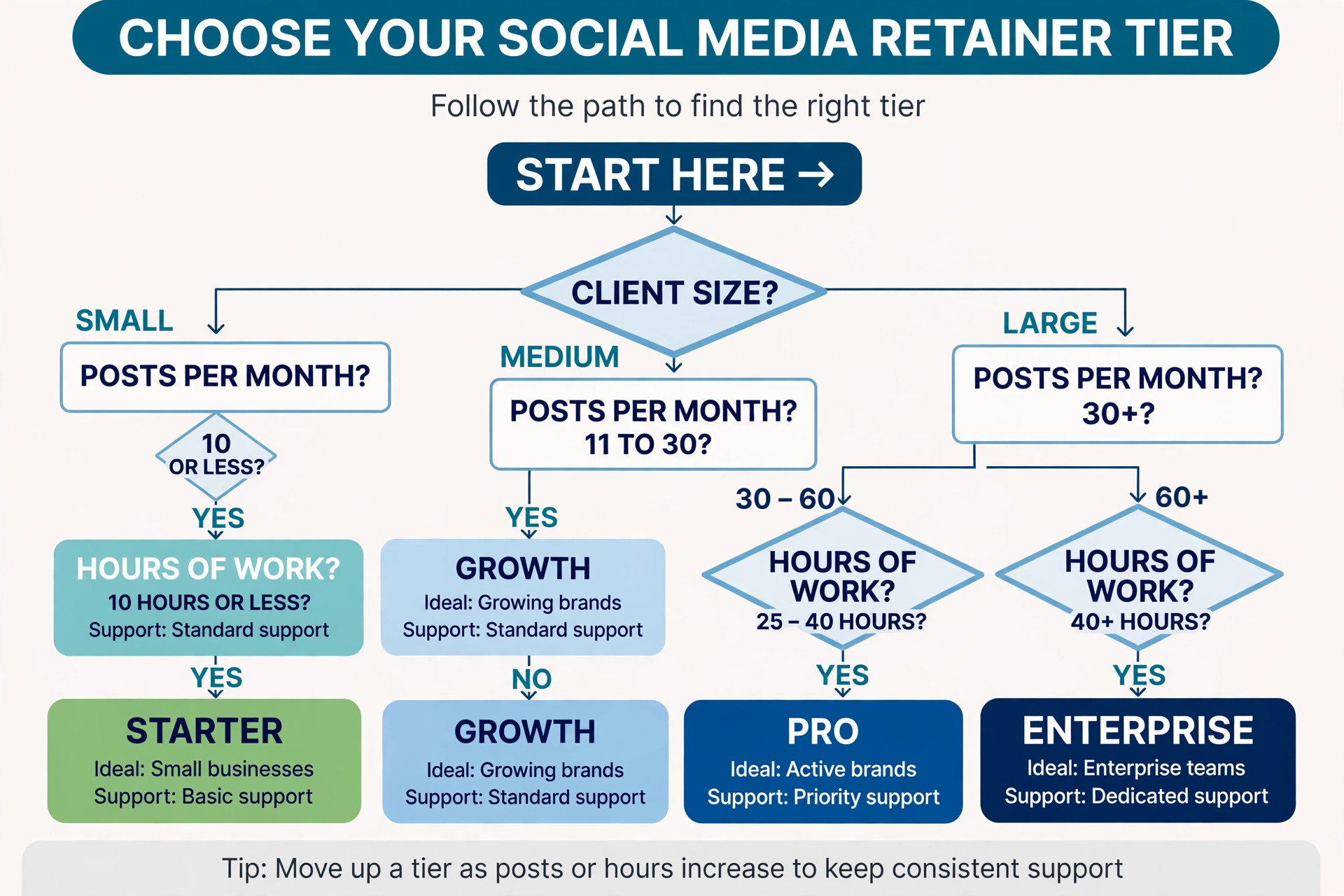
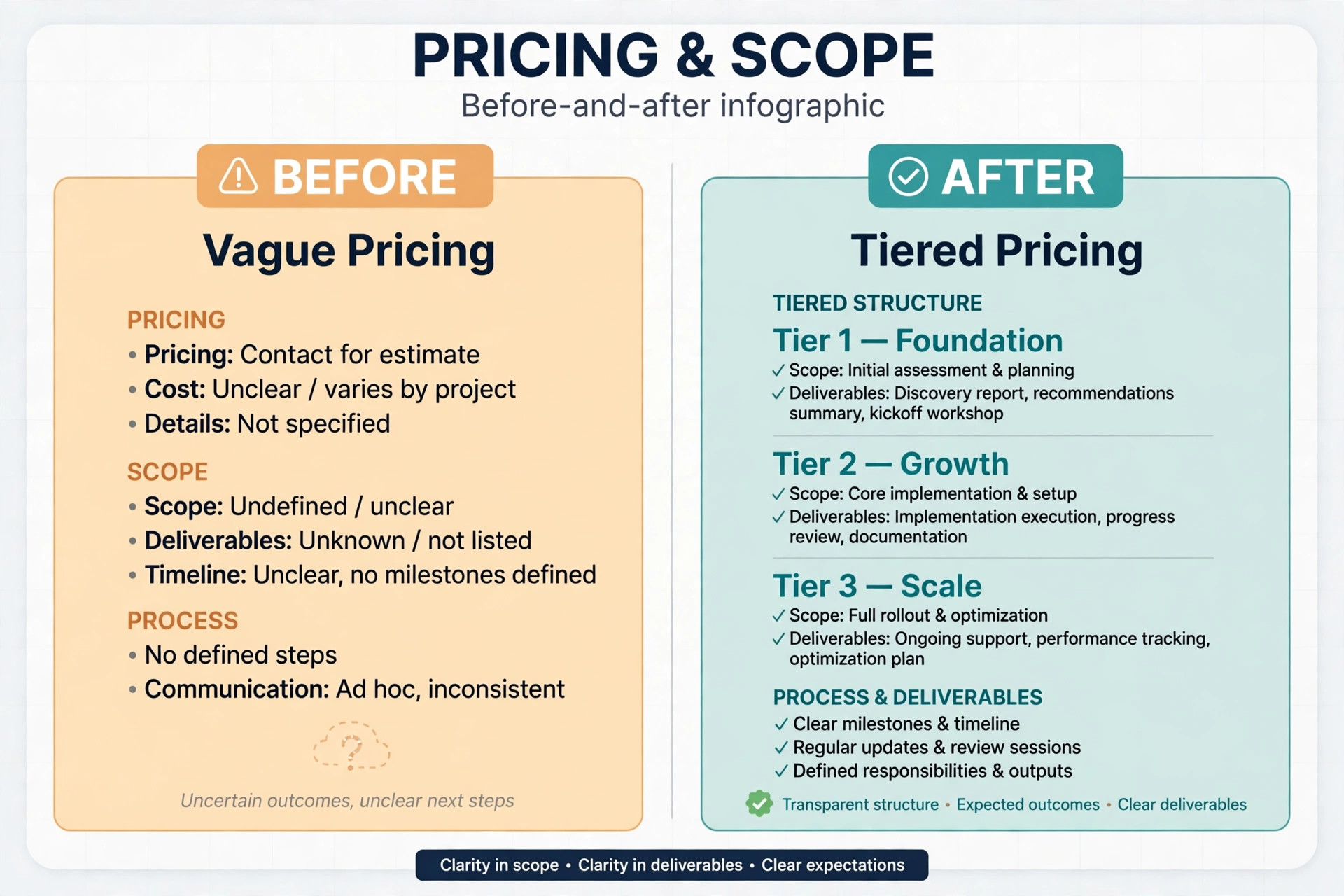
Retainer tiers turn custom quotes into products clients can understand. Each tier should state platforms, posts per month, content type, community management, reporting, and strategy time, so a client can compare tiers without guessing what is included. Three tiers work well for small agencies. Two tiers force clients into a poor fit, and five tiers create decision fatigue. Name tiers by outcome or client size, not by metal labels alone, so a prospect can see which tier fits their business without reading a feature matrix.
The table below is the decision core of this guide. Prices are drawn from published 2026 guide ranges, reported in third party guides, so confirm current ranges on a vendor page before adopting them, and adjust them to the agency hourly floor. A tier priced below its delivery hours at the floor rate is a loss, however attractive it looks in a proposal. Use the table as a starting shape, then replace each price with the agency own costed figure before publishing it.
| Tier | Monthly price | Platforms and posts | Hours and client fit |
|---|---|---|---|
| Starter | 800 to 1500 dollars | 1 to 2 platforms, 8 to 12 posts | 10 to 15 hours, single location small business |
| Growth | 1500 to 3500 dollars | 2 to 3 platforms, 15 to 25 posts | 20 to 30 hours, growing local business |
| Full service | 3500 to 7000 dollars | 3 to 5 platforms, daily posting | 35 to 50 hours, multi location or funded business |
Starter Tier Scope Rules
Starter suits a single location business that needs a consistent presence, not a growth campaign. Include scheduling, captions, basic graphics, and a monthly report, and exclude paid advertising management, video production, and daily community management. State the post count as a monthly total, not a weekly promise that breaks in short months. State who supplies photos and raw material, because a starter client that supplies nothing will need content creation time the tier does not include. Add that creation as a priced add on, rather than absorbing it silently and eroding the margin.
Starter clients often ask for one more platform as if it were free. It is not. Each platform adds formats, sizing, scheduling quirks, and another analytics dashboard, and guides price each added platform from 200 to 800 dollars per month, reported in a third party guide, so confirm current add on ranges before quoting. Publish the per platform add on price in the proposal, so the conversation becomes a clear choice rather than a negotiation about effort. Clients respect a price list more than a vague warning that extra work costs extra.
Growth and Full Service Tiers
Growth suits a business that needs content creation, active community management, and regular strategy input. Include a monthly strategy call, a content plan, caption writing, graphics, community replies on agreed hours, and a report every two weeks. Exclude paid advertising management from the base price, and price it separately as a management fee, because ad spend itself is paid to the platforms and should never be confused with agency fees. Guides commonly report ad management at 10 to 20 percent of ad spend with a minimum fee, reported in a third party guide, so confirm current practice on a vendor page before adopting that model.
Full service suits a business with multiple locations, a larger content need, or a launch campaign. Include strategy, custom content, video support where agreed, paid advertising management, weekly calls, and weekly reporting. Cap the scope even here, with stated limits on posts, revisions, and community hours, and a clear process for work beyond the cap. The largest tier is where scope creep does the most damage, because the client expects everything and the agency has the most hours at stake. A full service contract without caps is an open ended promise, and open ended promises are how profitable agencies become exhausted ones.
Pricing Models Compared
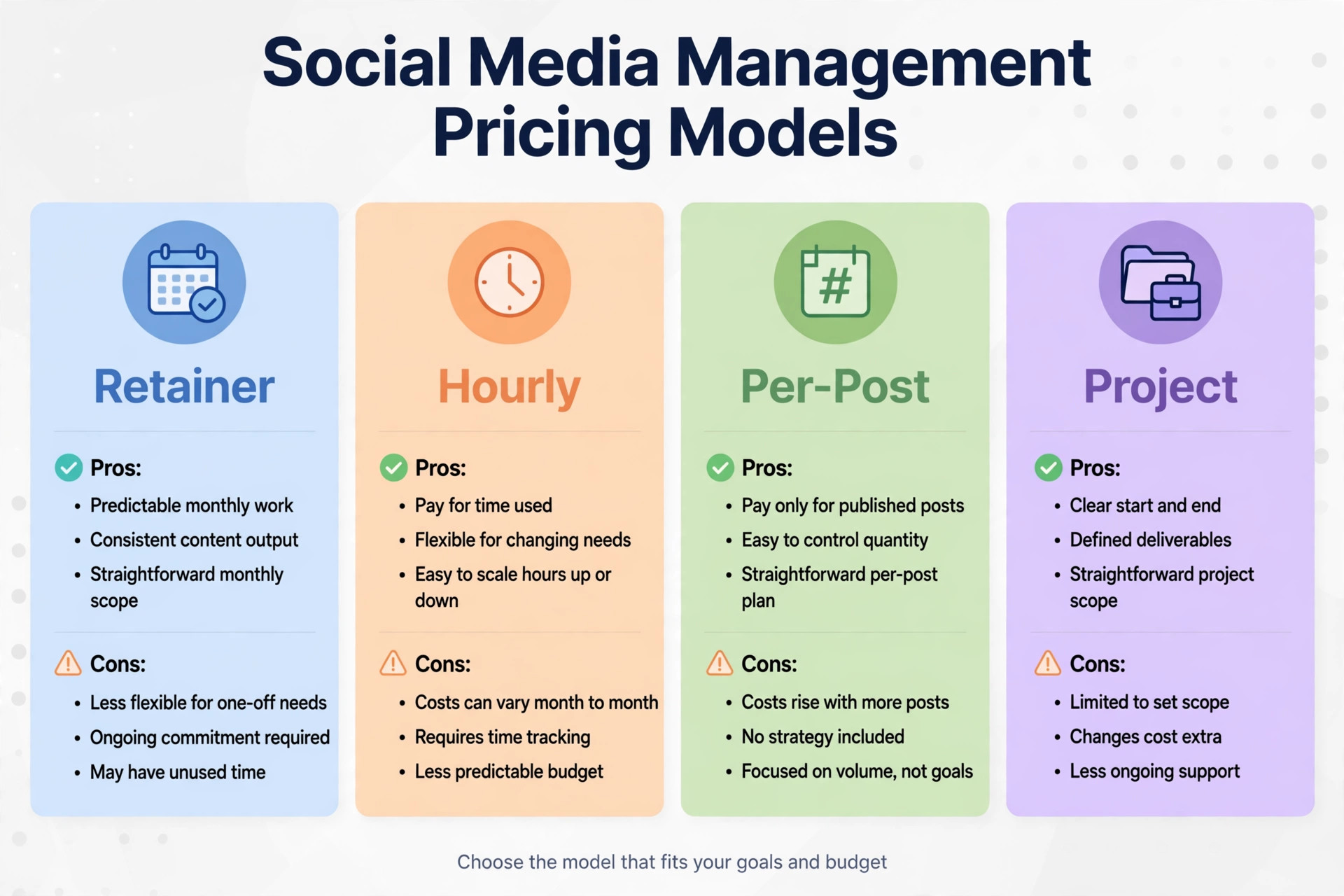
Retainers suit ongoing management, because they give the agency predictable revenue and the client a predictable cost. Hourly pricing suits consulting, cleanup work, and overflow tasks, where the scope is uncertain and a fixed price would be a guess. Per post pricing suits content only clients who post themselves, with guides reporting 50 to 150 dollars per post and 150 to 500 dollars per video, reported in a third party guide, so confirm current rates before quoting. Project pricing suits audits and strategy documents, with audits commonly reported at 300 to 1500 dollars and strategy documents at 500 to 2500 dollars in third party guides, so confirm those ranges too before using them.
Each model has a failure mode. Retainers fail when scope is vague. Hourly fails when clients fear an open ended bill, so cap hours or report weekly. Per post fails when quality needs strategy that no single post price covers, so pair it with a strategy fee. Project pricing fails when a project creates ongoing work that nobody priced, so state what happens after delivery. Most small agencies end up with retainers as the core offer, hourly for advice, and projects as a paid entry point that can convert to a retainer. That mix gives clients a low risk first step and the agency a paid way to prove value before a monthly commitment.
How to Handle Clients Who Want Everything for Starter Money
Some prospects will ask for full service work at a starter price, often by comparing the agency with a freelancer or a cheap tool. Answer with scope, not with defensiveness. Show the tier table, point to the hours and deliverables in each tier, and ask which deliverables the prospect would remove to fit the lower price.
That question moves the conversation from price haggling to scope choice, and it reveals whether the prospect values the work or only wants it cheap. If they choose a smaller scope honestly, the agency gains a viable client. If they insist on full scope at a low price, declining protects the agency from a losing contract and from a client who will demand more each month.
Never discount by quietly adding hours. Discount by reducing scope, shortening the contract review period, or removing an add on, and record the reduced scope in writing. A discount that keeps the full scope teaches the client that the original price was inflated, and it sets a precedent for the next negotiation. A scope reduction keeps the price honest and the relationship clear. Agencies that learn this distinction keep clients longer, because expectations match delivery from the first month.
Tools, Contract Terms, and Add On Pricing
Tools are a real cost in how to price social media management small agency work, and clients should not be expected to pay for the agency entire tool stack, but neither should the agency absorb tool costs that exist only for that client. Spread shared tool costs across the client base in the hourly floor, and charge separately for client specific tools, such as a dedicated scheduling seat or a premium design asset the client requested.
Buffer, Later, Metricool, and Hootsuite are names commonly mentioned for scheduling and reporting, but this guide does not quote their prices or feature lists, because those change, so check the current vendor page before choosing one or passing a cost to a client. Choose the tool that fits the reporting the agency actually sends, not the tool with the most dashboards.
Contract terms protect both sides. State the monthly deliverables, the revision limit, the community management hours, the reporting cadence, and the process for extra work. State the notice period for cancellation, commonly 30 days, and state what happens to content and accounts at exit, so a departing client does not create a dispute over assets. State payment terms clearly, including due date and what happens if payment is late, because an agency that is vague about payment will be paid last. A short clear contract signed before work starts prevents most pricing disputes, and it signals professionalism to clients who are used to informal arrangements.
Add Ons That Protect Margin
Publish add on prices for the work clients request most. Common add ons include paid advertising management, video editing, influencer outreach, extra platforms, additional posts beyond the tier, and a strategy refresh each quarter. Guides report advertising management add ons around 500 to 1000 dollars per month, influencer outreach around 750 to 1500 dollars, and design add ons around 300 to 800 dollars, all reported in third party guides, so confirm current ranges on vendor pages before adopting them.
Add ons let a starter client grow without renegotiating the whole contract, and they let the agency earn for work that would otherwise be absorbed. Review add on uptake quarterly, and promote the add ons that clients actually buy into a higher tier where they fit better.
Raising Prices Without Losing Good Clients
Prices must rise as costs rise and as the agency improves, and that is part of how to price social media management small agency retainers for the long term, yet many owners delay increases until resentment builds and then impose a large jump that shocks clients. A better routine is a small annual review, tied to a clear improvement in results or scope, and communicated well before it takes effect. Give at least 30 days notice, state the new price and the date it starts, and remind the client what the retainer includes and what results it has produced. Clients accept increases they understand. They resist increases that arrive without warning or explanation.
For existing clients below the current tier price, move them gradually rather than in one jump where possible. Offer a choice, such as the new price for the current scope, or a reduced scope at the old price, and let the client choose. That choice preserves the relationship and reveals how much the client values the work. For new clients, quote the current price without apology, and do not offer a legacy rate to win the deal, because that creates a second price list that is hard to unwind later. A single current price list, applied consistently, is easier to defend and easier to raise.
When to Raise Immediately
Raise immediately when scope has grown beyond the contract, when a client adds platforms or posts without a price change, or when tool or contractor costs for that client have risen sharply. In those cases, the conversation is not a general price rise. It is a scope correction, and it should be framed that way, with the current deliverables listed against the contracted deliverables. Show the gap, propose the corrected tier or add on, and agree the change in writing before delivering the extra work. Delivering extra work first and billing later creates a dispute, while agreeing first creates a clear record both sides can accept.
Also raise when the agency turns away work because it is full. A waiting list is evidence that prices are below market for the value delivered, and raising prices is a better response than overworking the team. Raise for new clients first, then bring existing clients up at renewal, so the agency captures the market signal without shocking loyal clients. Track the effect of each increase, including win rate on new proposals and retention of existing clients, so future increases are based on evidence rather than fear. Fear keeps prices low long after the market would accept more.
Quoting, Onboarding, and Proving Value
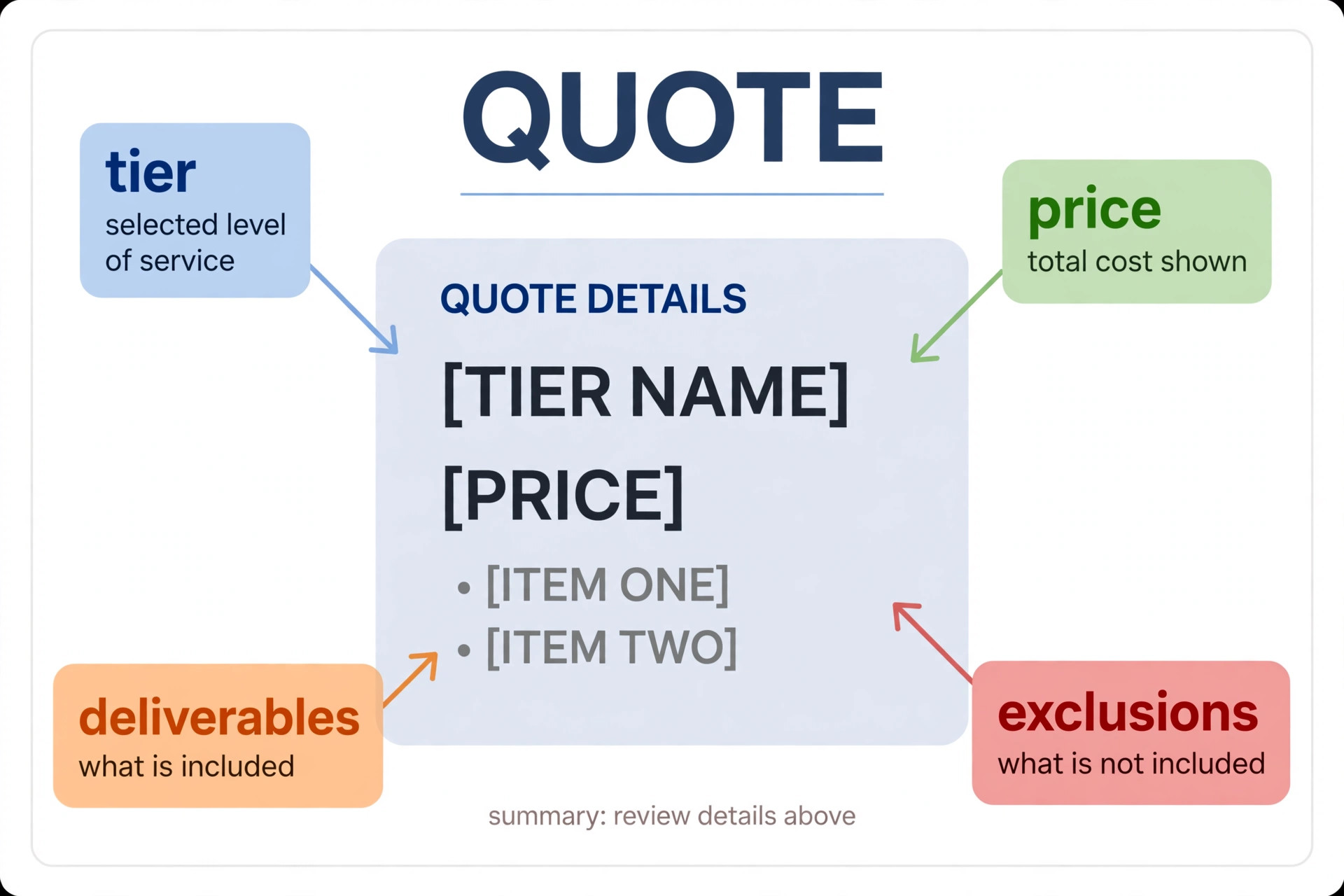
A quote should be a one page scope document, not a long sales letter. State the tier, the monthly price, the platforms, the post count, the content types, the community hours, the reporting cadence, and the add ons included or excluded. State the contract length and notice period, and state what the client must supply, such as photos, approvals, and access to accounts. A prospect who receives that document can compare it fairly with other quotes, and an agency that sends it looks organised. Vague quotes win deals that later become disputes, because each side remembers a different promise.

Onboarding should start with access, brand assets, and a short discovery conversation about customers, competitors, and past content that worked. Build a 90 day content plan before posting at full volume, so the first month has a direction rather than a scramble for ideas. Agree approval workflow early, including who approves posts, how quickly approvals arrive, and what happens if approval is late. Late approvals are a common hidden cost, because they compress production into fewer days and force rushed work. A stated approval window protects quality and keeps the monthly hours within the tier.
Reporting That Justifies the Retainer
Report on outcomes the client cares about, not on vanity metrics alone. Show posts delivered against the contracted count, engagement trends, follower growth where relevant, website clicks or enquiries where tracking allows, and the actions taken from the data. Keep the report short, with a summary at the top and detail below, so a busy owner can grasp it in minutes. End each report with one recommendation for the next month, such as a content type to repeat or a platform to test, because a report without a recommendation feels like a receipt rather than a service.
Link reporting to the quarterly review, where tier fit is checked. If a client consistently needs more posts, more platforms, or more community hours, propose the higher tier with evidence from the reports. If a client uses far less than the tier includes, propose a lower tier or a reduced scope, because keeping a client on an oversized tier feels like overcharging and eventually leads to cancellation. Honest tier reviews build trust, and trust is what makes a client accept a price increase later. This review habit is central to how to price social media management small agency retainers sustainably, because prices only stay right when they are checked against actual delivery.
Mistakes That Make Agency Pricing Fail
The first mistake in how to price social media management small agency work is pricing by post count alone, without accounting for strategy, community management, and reporting time. A post that took ten minutes to schedule is not the same as a post that required research, design, caption writing, and approval, and a price based only on count will underprice the second kind. The second mistake is unlimited revisions, which turn a fixed retainer into open ended work. Set a revision limit, such as two rounds per post, and price further rounds as an add on. Clients who know the limit give clearer feedback first time, which saves time for everyone.
The third mistake is forgetting non billable time in the floor calculation, which was covered earlier but bears repeating because it is the most common cause of burnout. The fourth mistake is discounting to win a client who will never be profitable, then trying to recover margin by cutting quality, which loses the client anyway. The fifth mistake is never reviewing prices, so a retainer set two years ago still charges for a scope and a cost base that no longer exist. A quarterly floor check and an annual price review prevent all five mistakes, and they take less time than fixing one bad contract.
A sixth mistake is hiding the price until late in the sales conversation, which wastes time on prospects who cannot afford the tier and creates suspicion about the final number. Publish starting prices or tier ranges on the website or in the first proposal, so prospects self select before a long sales process. Transparency does not lose good clients. It saves the agency from proposals that were never going to close, and it attracts clients who value clarity. Agencies that publish ranges report faster sales cycles, because the price conversation starts from a shared fact rather than a guess.
Set the Price, Then Prove It
Pricing well is a habit, not a one time decision. Calculate the hourly floor, build tiers from real deliverables and hours, publish add on prices, review scope quarterly, and raise prices in small explained steps. Clients will pay a fair price for clear scope, reliable delivery, and reporting that shows what their money bought. They will resist a vague price for vague work, however low it seems.
Start by costing one current client honestly against the floor, fix the tier or scope where the maths fails, and use that corrected offer for the next proposal. That single honest calculation often reveals more about the agency business than a year of guessing, and it is the foundation for how to price social media management small agency work profitably over time.
Frequently Asked Questions
Published 2026 guides place basic packages around 500 to 2000 dollars per month, mid tier retainers around 2000 to 5000 dollars, and full service work at 5000 dollars or more, reported in third party guides, so confirm current ranges on a vendor page before quoting. The agency own price must still be costed from its hourly floor and the deliverables in each tier, because a market range does not know the agency costs, hours, or client mix. Use the range as a sanity check, then set the price from the agency own maths.
Should I price by the hour, by retainer, or by post
Use retainers for ongoing management, hourly for consulting and cleanup work, per post for content only clients, and project fees for audits and strategy documents. Most small agencies combine these models, with retainers as the core offer and projects as a paid entry point. The right model depends on whether the work repeats, whether scope is certain, and whether the client fears an open ended bill. State the model and its limits in the quote, so the client understands what the price buys.
How do I price an extra platform a client requests
Price each added platform separately, using a published add on range as a starting point, reported in third party guides at 200 to 800 dollars per month, so confirm current add on ranges before quoting. Explain that each platform adds formats, scheduling, and reporting work, and record the added platform and price in writing before delivery. A clear add on price turns a difficult negotiation into a simple choice, and it protects the margin on the base retainer.
How often should a small agency raise its prices
Review the hourly floor quarterly and raise prices annually as a routine, with at least 30 days notice and an explanation tied to scope or results. Raise sooner when scope has grown beyond the contract or when costs for a specific client have risen sharply, framing that change as a scope correction rather than a general increase. Small regular increases are easier for clients to accept than a large jump after years of silence, and they keep the agency profitable as costs rise.
Include platforms, post count, content types, caption writing, graphics, community management hours, reporting cadence, strategy time, and revision limits, all stated in writing. Exclude paid ad spend itself, which the client pays to platforms separately, and price advertising management as a separate fee where offered. State what the client must supply, such as photos and approvals, and the process for work beyond the tier. A retainer that lists these items clearly is easier to sell, easier to deliver, and easier to defend when scope questions arise. This clarity is part of how to price social media management small agency offers that clients trust.
How do I stop scope creep on a fixed retainer
Set caps on posts, revisions, platforms, and community hours, publish add on prices for extra work, and agree scope changes in writing before delivering them. Review delivery against the contract monthly, and raise scope gaps at the quarterly review with evidence from reports. Clients who see the contract working fairly will accept add on pricing, while clients who were benefiting from vague scope will either pay fairly or move to a tier that fits. Either outcome protects the agency margin.
More Reading on Stratilyze
For related small business pricing and systems, read cost of FreshBooks for small business monthly and best CRM for cleaning companies. For customer growth, see how to ask customers for Google reviews as a small business. These guides connect agency pricing with invoicing, scheduling tools, and customer acquisition, so the pricing system fits the wider business. Note that this section supports how to price social media management small agency planning alongside tool and invoicing guides.