
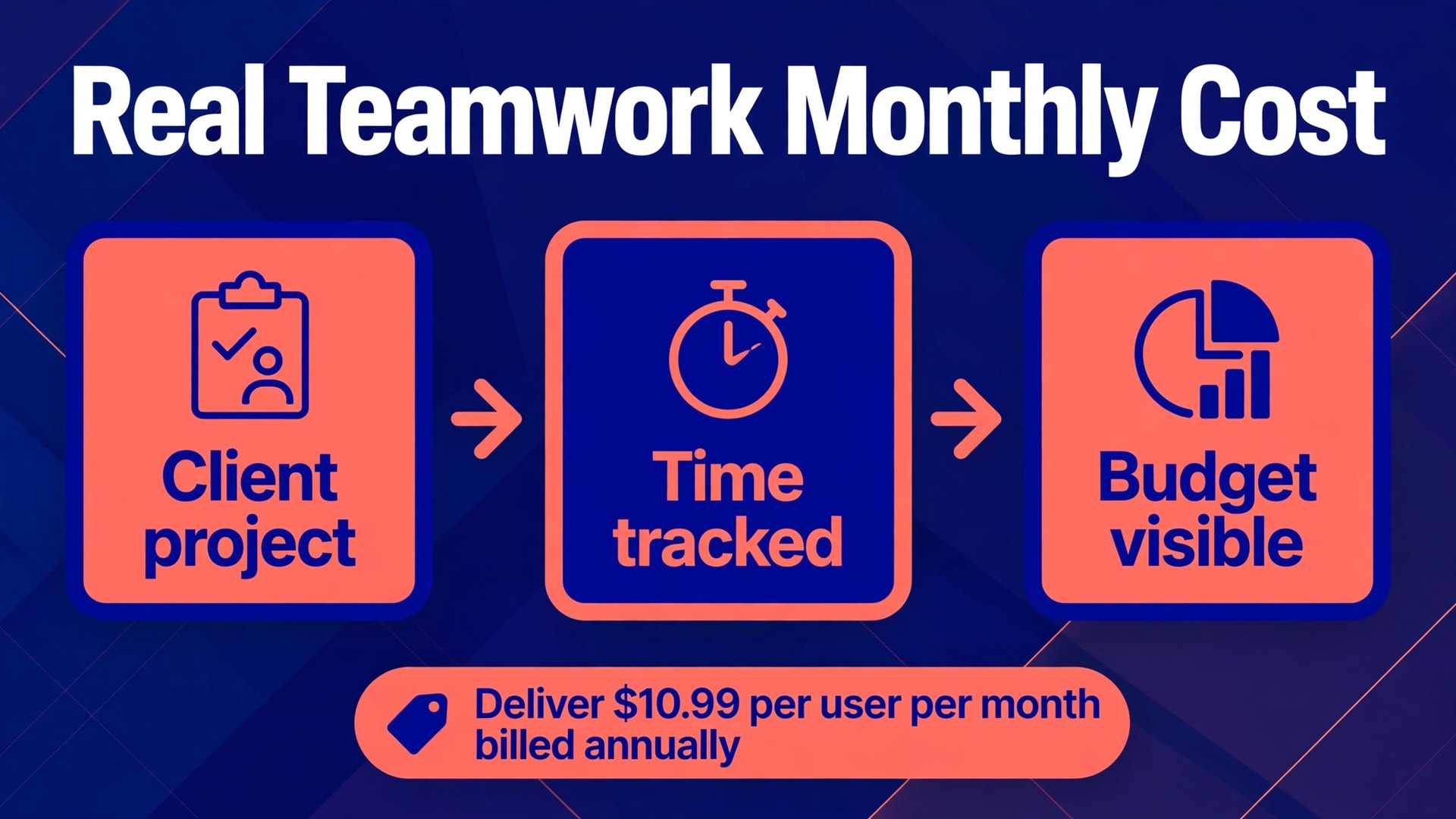
Verdict first on the cost of Teamwork for small business monthly planning. Most small client-facing teams should start on Deliver, move to Grow only when workload, budgeting, and reporting become weekly needs, and treat Scale as a quoted tier for larger operations rather than a target for a small team. Deliver covers the core client project job at a price that a small team can justify, while Grow adds the management layer that only matters once several projects and several people run at the same time. Starting on Grow for a team with two projects is paying for visibility that the team does not yet need to see.
Teamwork is built for client work, which shapes both its features and its pricing. Projects, tasks, milestones, time tracking, and client collaboration sit at the centre, with reporting and budgeting layered on top for larger teams. A service business, an agency, or a consultancy that delivers work for clients will recognise that pattern immediately, because client work brings its own pressures, including deadlines that clients set, budgets that clients question, and progress that clients want to see without chasing for updates. A team that manages only internal work may find Teamwork capable but more structured than it needs.
The pricing story for Teamwork has a complication that must be stated plainly before any figures. The shortlist names Starter, Deliver, and Grow as the tiers for this guide, but pricing guides checked in October 2026 list Free, Deliver, Grow, and Scale as the current range, with no paid Starter tier. The table below therefore gives Deliver and Grow with verified annual prices, and gives Starter as a tier to check on the vendor’s current pricing page, since no current paid Starter price could be verified. A buyer who finds an old Starter price in an older guide should not use it for a budget without checking the live page first.
How to Budget Cost of Teamwork for Small Business Monthly
Teamwork offers a free plan for up to five users, according to pricing guides checked in October 2026, which is a useful starting point for a very small team. Paid plans start with Deliver and continue with Grow, followed by Scale, which is priced by quote or by a higher published figure that varies between guides. Deliver requires a minimum of three users, and Grow requires a minimum of five users, according to the same guides. Those minimums matter, because they set a floor under the monthly total even for a team smaller than the minimum.
| Tier | Monthly price | What it includes | Best for |
|---|---|---|---|
| Starter | Check the vendor’s current pricing page | No current paid Starter price could be verified, and the free plan for up to 5 users is the current entry point | A very small team testing the tool |
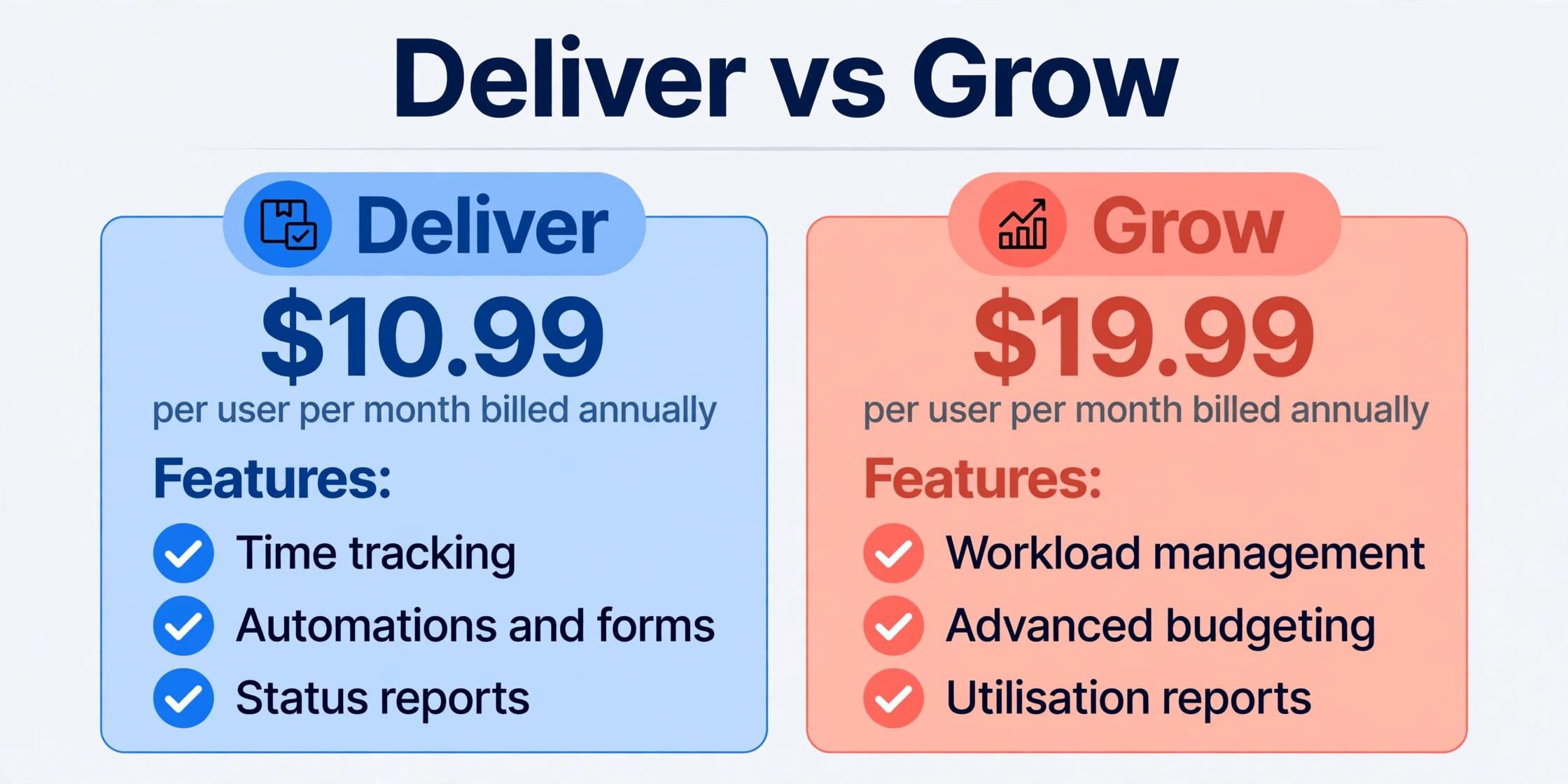
| Deliver | 10.99 dollars per user per month billed annually | Project and task management, time tracking, automations and forms, project status reports, team management | A small client team of 3 or more users |
| Grow | 19.99 dollars per user per month billed annually | Everything in Deliver plus workload and capacity management, advanced budgeting, utilisation and time reports, deeper reporting | A growing team of 5 or more users |
Monthly billing figures for Deliver and Grow conflict between guides, with one guide listing 13.99 dollars and 25.99 dollars per user per month, and older guides listing different monthly figures. Because of that conflict, this guide does not quote a monthly billing figure for either tier, and a buyer who needs monthly billing should check the vendor’s current pricing page for the figure that applies at checkout. The annual figures, by contrast, agree across several guides checked in October 2026, with Deliver at 10.99 dollars and Grow at 19.99 dollars per user per month billed annually, and those are the figures used for the totals below.
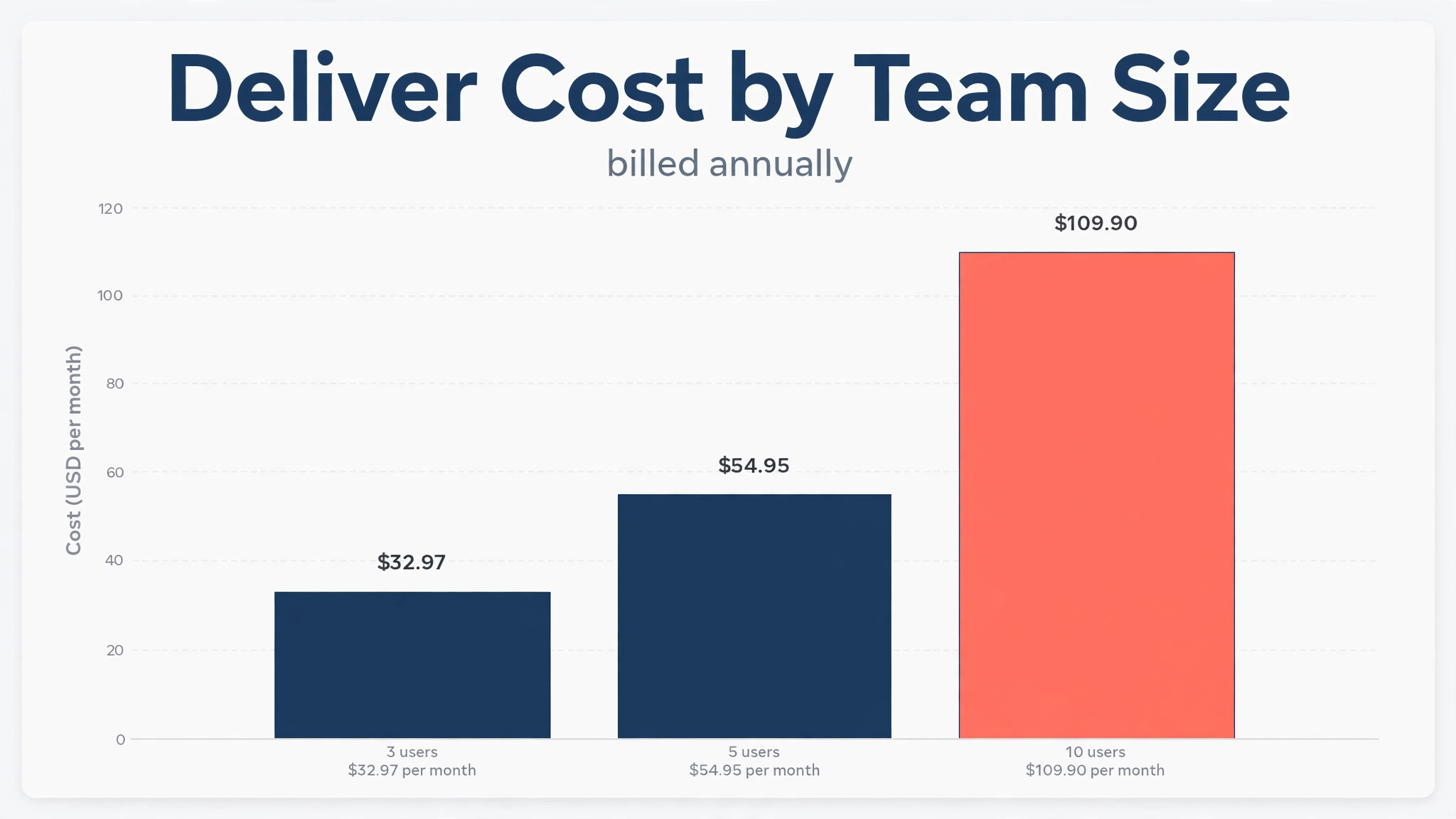
Annual totals for the minimum seat counts show the floor for each tier. Three users on Deliver cost 32.97 dollars per month billed annually, or 395.64 dollars for a year. Five users on Grow cost 99.95 dollars per month billed annually, or 1,199.40 dollars for a year. Five users on Deliver, for comparison, cost 54.95 dollars per month billed annually, or 659.40 dollars for a year. The Grow premium for five users is therefore 45 dollars per month, or 540 dollars per year, compared with Deliver, which must be justified by workload, budgeting, and reporting use rather than by a general wish for a higher tier.
Scale, the tier above Grow, is described in some guides as a quoted tier and in others with a published figure, which is another reason to treat Scale as a sales conversation rather than a budgeted number. A team that outgrows Grow should request a written Scale quote that states user count, included features, and contract terms, and should compare that quote with the Grow total of 19.99 dollars per user per month billed annually as a baseline. Until a quote is in hand, Scale should not appear in a small business budget as a fixed figure.
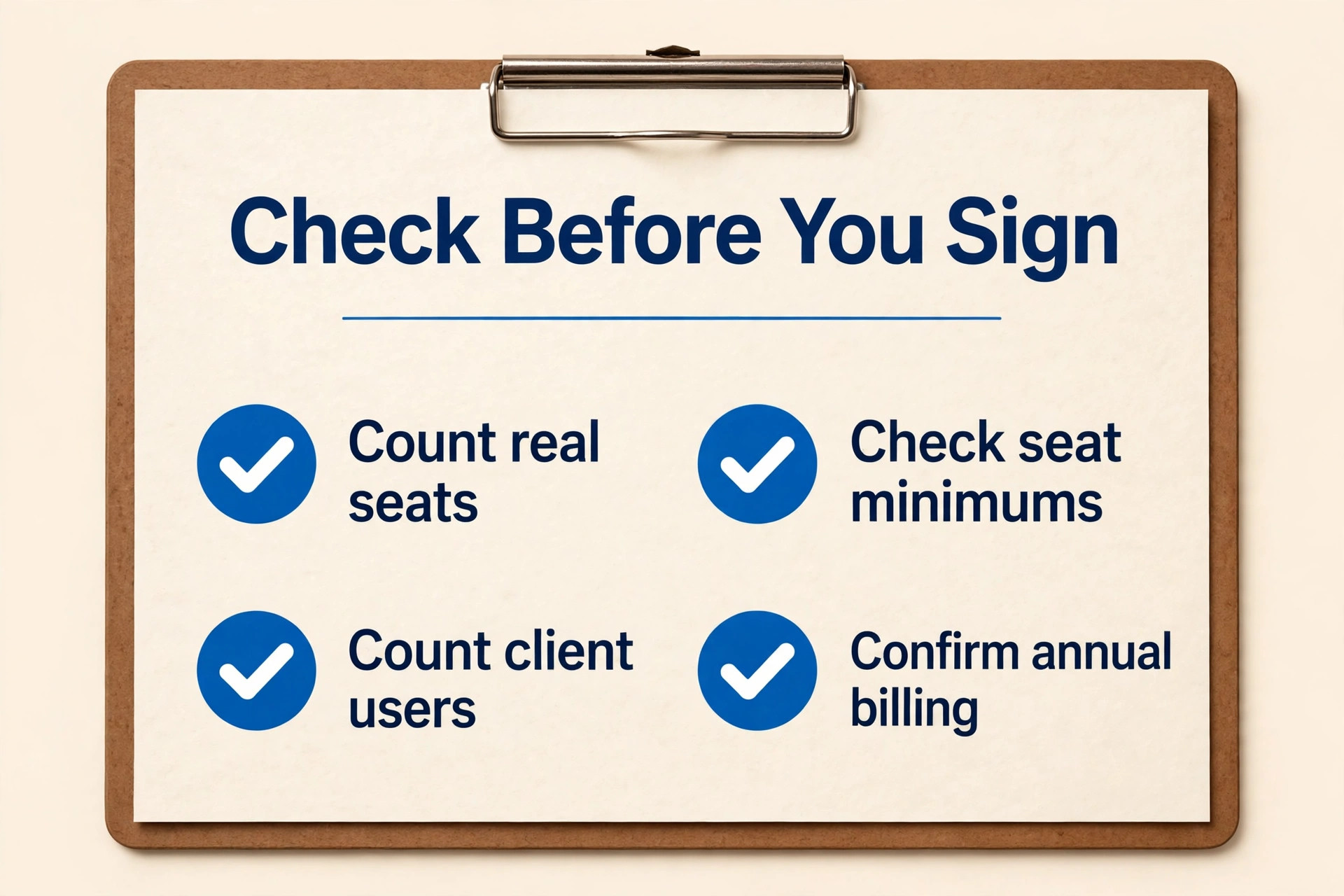
Seat minimums are the first hidden cost, because they create a floor that a small team cannot go below. Deliver requires at least three users, so a two person team that wants Deliver pays for three seats, which is 32.97 dollars per month billed annually rather than the 21.98 dollars that two seats would cost. Grow requires at least five users, so a four person team that wants Grow pays for five seats, which is 99.95 dollars per month billed annually rather than the 79.96 dollars that four seats would cost.
Those minimums are not large in absolute terms, but they change the value calculation for a team just below a threshold, and they should be priced as the minimum total rather than as a per-user price multiplied by actual headcount. That judgement belongs at the centre of any honest account of cost of Teamwork for small business monthly, because a price that looks small on a plan card can grow quickly once seats, usage, and add-ons are counted.
Project limits are the second cost to check, and they require care because the free plan and the paid plans differ in ways that guides describe inconsistently. The free plan is described as limited in projects and users, with up to five users, while Deliver and Grow are described as project tools for client work without a single agreed project cap in the guides checked. A team that runs many small projects at once should therefore confirm project limits for its tier on the live pricing page, and should test with its real project count during a trial, rather than assuming that paid plans remove all project limits.
A project limit that forces a team to archive active work or to combine separate client projects is a workflow cost, not just a number.
Time tracking is the third area to check, because it sits at the centre of Teamwork value for client work, but its depth varies by tier. Guides describe time tracking, timesheets, and billable time tracking as part of the free and Deliver experience, with deeper utilisation, budget, and time reports sitting in Grow. That means a team that only needs to log hours and invoice them may find Deliver sufficient, while a team that needs to see utilisation across people, or to compare time against budget by project, will need Grow.
The practical test is to run one month of time data through the tier being considered, and to see whether the reports answer the questions that managers actually ask in weekly meetings.
Client users are the fourth cost to check, and they can work in the team’s favour if the rules are understood. Guides describe unlimited client users on Deliver, which would make Teamwork attractive for agencies with many client contacts, since client access would not add a per-user charge in the same way that internal seats do. That description comes from third-party guides rather than a single vendor statement in the sources checked, so a team should confirm client user rules on the live pricing page before budgeting on that basis.
If unlimited client users are confirmed, an agency should count client contacts separately from internal seats, and should not budget a paid seat for every client who needs to view progress.

What the Price Buys on Deliver and on Grow
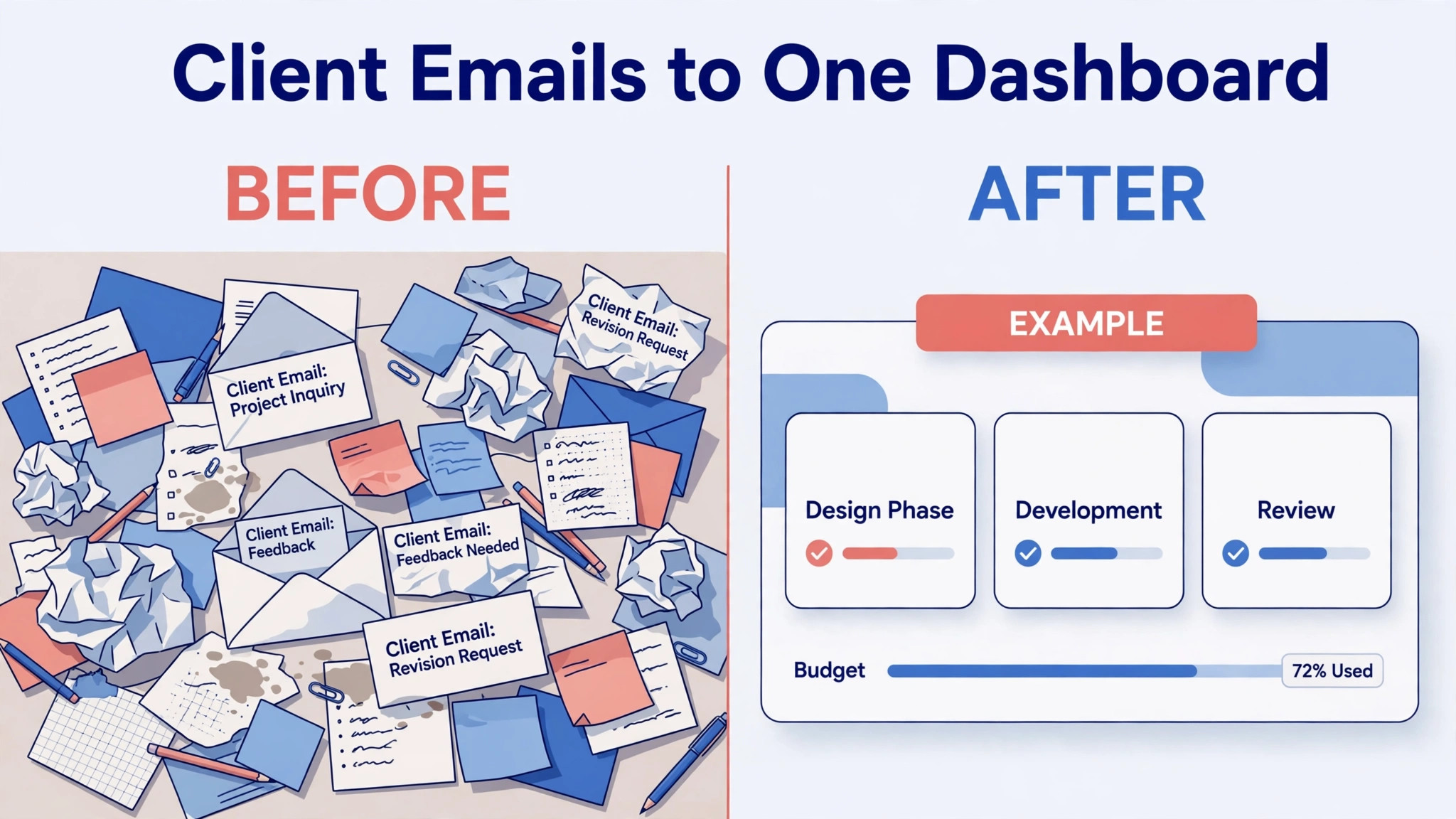
Deliver buys the client project job in full. Project and task management, with milestones and task lists, lets a team organise client work in a form that both staff and clients can follow. Time tracking and timesheets let a team record billable hours against the work that produced them, which is essential for a service business that bills by time or that needs to know whether a fixed-price project is still profitable. Automations and forms reduce manual intake work, so a new client request can enter the system without a person retyping it, and project status reports give clients a view of progress without a status meeting for every update.
That judgement belongs at the centre of any honest account of cost of Teamwork for small business monthly, because a price that looks small on a plan card can grow quickly once seats, usage, and add-ons are counted.
Grow buys the management view on top of that job. Workload and capacity management show whether people are overloaded or underused across projects, which is the view a manager needs when several client deadlines fall in the same week. Advanced budgeting lets a team set budgets by project, track spend against budget, and spot a project that is drifting over budget before the client receives an invoice that surprises them. Utilisation and time reports extend time tracking from a record of hours into a management tool, showing which people, projects, and clients consume time, and where pricing or staffing needs to change.
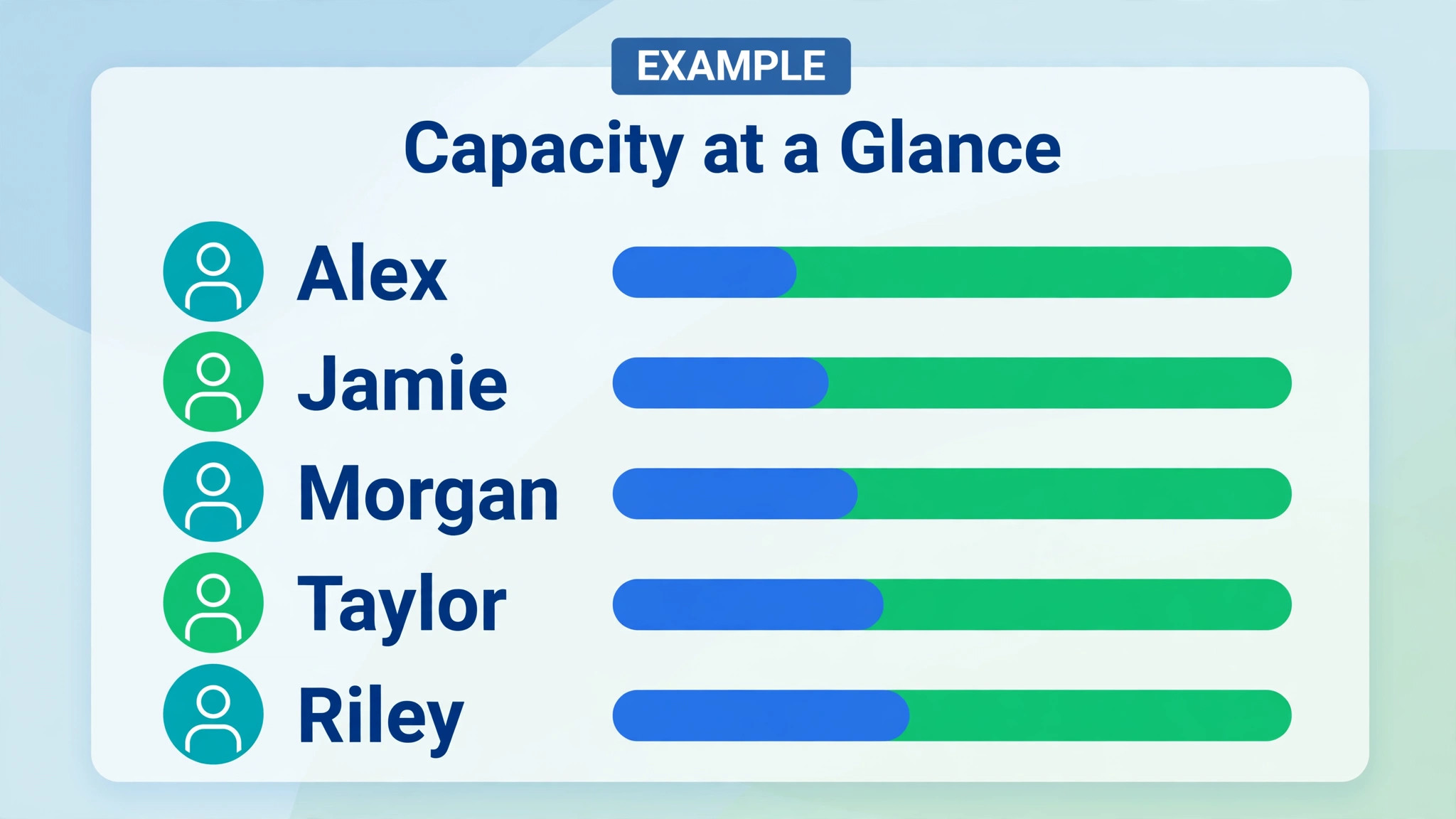
The difference between Deliver and Grow is therefore not project count alone, but management depth. A team with three projects and five people may manage workload in its head, or in a weekly meeting, without needing a workload chart. A team with fifteen projects and ten people cannot manage workload in its head, and a workload chart becomes a daily tool rather than a monthly report. That is the point at which Grow earns its premium, and a team should look for that point in its own work, rather than buying Grow because it is described as the tier for growing teams.
Scale, above Grow, adds retainer management, budget reallocation, unlimited custom reports, and a resource scheduler, according to guides checked in October 2026. Those features matter for larger agencies with retainer clients and complex resource planning, but they are rarely daily needs for a small team. A small team that is quoted Scale should ask which specific Scale feature drives the recommendation, because a single missing Grow feature may have a workaround, while a retainer management need may genuinely require Scale. That question alone can save a team from a tier jump it does not need.
A Small Agency Priced at Three, Five, and Ten Users
A three person agency on Deliver pays 32.97 dollars per month billed annually, since three users at 10.99 dollars each total 32.97 dollars, or 395.64 dollars for a year. That agency cannot buy Grow at its actual headcount, since Grow requires five users, so the Grow comparison for three people is a hypothetical five-seat total of 99.95 dollars per month. The practical choice for a three person agency is therefore Deliver, or the free plan if its project limits fit, rather than a forced move to Grow that would triple the monthly total for features the team may not yet need.
That judgement belongs at the centre of any honest account of cost of Teamwork for small business monthly, because a price that looks small on a plan card can grow quickly once seats, usage, and add-ons are counted.
A five person agency on Deliver pays 54.95 dollars per month billed annually, or 659.40 dollars for a year. The same agency on Grow pays 99.95 dollars per month, or 1,199.40 dollars for a year. The difference is 45 dollars per month, or 540 dollars per year, for workload management, advanced budgeting, and deeper reporting. For a five person agency running several client projects at once, that difference is often justified, because a single project that runs over budget by more than 540 dollars in a year will cost more than the Grow premium. For a five person agency with a handful of steady projects, Deliver remains the better value, and the saving can fund training or templates.
A ten person agency on Deliver pays 109.90 dollars per month billed annually, or 1,318.80 dollars for a year. The same agency on Grow pays 199.90 dollars per month, or 2,398.80 dollars for a year. The difference is 90 dollars per month, or 1,080 dollars per year. At ten people, workload and utilisation reporting become harder to manage without a dedicated view, and Grow is more likely to be justified than at five people. Even at ten people, though, the decision should follow evidence, such as managers asking weekly who is overloaded, or clients questioning budgets, rather than following the assumption that a larger team automatically needs a larger tier.
When It Is Worth It and When It Is Not
Teamwork is worth the price when a team delivers work for clients, when projects have deadlines and budgets that clients care about, and when time tracking feeds billing or profitability decisions. Those three conditions describe agencies, consultancies, and service businesses, and for those teams Teamwork replaces a patchwork of spreadsheets, time sheets, and status emails with a single client project system. The value is strongest when clients use the system too, because a client who can see progress without chasing for updates saves the team as much time as any internal feature.
That judgement belongs at the centre of any honest account of cost of Teamwork for small business monthly, because a price that looks small on a plan card can grow quickly once seats, usage, and add-ons are counted.
Teamwork is not worth the price when work is internal only, when projects are few and simple, or when the team already uses a project tool that covers the same job at a lower per-user price. A team with two internal projects and no client reporting needs may find Teamwork structured and priced above its needs, and a simpler task tool may serve it better. Teamwork also loses value when time tracking is not used consistently, because a time and budgeting system that only half the team fills in produces reports that nobody trusts, and untrusted reports are worse than no reports at all.
A practical test is to run one real client project through Teamwork for a month, including time logging, status reporting, and a budget check, and to see whether the team and the client both use the system without reminders. If time is logged daily, if status reports replace status meetings, and if the budget check catches a project drifting early, Teamwork has earned its price. If time logging is patchy, if status still happens by email, and if budgets are checked only at invoice time, the problem is adoption, and a higher tier will not fix it. Fix the habit first, then choose between Deliver and Grow.

How to Cut the Bill Without Losing Client Visibility
Start on Deliver, because the largest single saving in Teamwork is avoiding Grow when Deliver covers the work. A five person agency saves 45 dollars per month, or 540 dollars per year, by staying on Deliver, and a ten person agency saves 90 dollars per month, or 1,080 dollars per year. Those savings are available without losing any client project, task, or time tracking capability, since Deliver covers the core job. Move to Grow only when workload, budgeting, or reporting gaps appear repeatedly in weekly meetings, and can be named as specific questions that Deliver reports cannot answer.
That judgement belongs at the centre of any honest account of cost of Teamwork for small business monthly, because a price that looks small on a plan card can grow quickly once seats, usage, and add-ons are counted.
Use the free plan honestly for a very small team, because a team of up to five users can test Teamwork without paying, provided its project limits fit. A team that fits the free plan and does not yet need automations, forms, or status reports at Deliver depth should not rush to pay, since the free plan gives real experience with the project structure. The time to pay is when a free plan limit actually blocks work, such as a project count or a reporting need, rather than when a demo suggests that a paid tier would be nicer to have.
Audit seats and client users separately, because internal seats and client access follow different rules and different costs. Internal seats are charged per user, with minimums of three for Deliver and five for Grow, while client users are described in guides as unlimited on Deliver, subject to confirmation on the live page. A team that budgets a paid seat for every client contact will overstate its bill, while a team that gives paid seats to staff who only view work will also overstate its bill. Count internal daily users, confirm client rules, and price only the seats that the work actually requires.
Finally, confirm monthly billing before assuming it, because monthly figures for Deliver and Grow conflict between guides and cannot be quoted safely from those guides alone. A team that needs monthly flexibility should check the vendor’s current pricing page for the monthly figure that applies at checkout, and should compare the annual total against the monthly total over a full year. Annual billing on Deliver and Grow is the safer figure for budgeting, since it agrees across guides, while monthly billing should be treated as a figure to confirm, not as a figure to budget from a guide.
A renewal check belongs in every Teamwork budget, because a team that was three people at signup may be eight people at renewal, and that growth changes both the seat total and the tier that fits. Set a reminder for a month before renewal, count internal seats and client users separately, and compare the renewal total with the current tier price rather than with the price remembered from signup. A renewal that arrives as a surprise is a budgeting failure, since hiring is visible months in advance.
Migration deserves its own plan, because moving client projects from spreadsheets or another tool into Teamwork is where budget and time data get lost. Define project templates, time categories, and budget fields before moving any live work, move one real client project as a test, and only then move the remaining projects in batches. That test project will reveal template mistakes, time logging gaps, and reporting errors while they are still cheap to fix.
Adoption is the risk that most often decides whether Teamwork succeeds, and it deserves a measure rather than a hope. Track how often time is logged daily, how often status reports replace status meetings, and how often budgets are checked before invoice time. If those measures rise over the first month, adoption is working. If time logging stays patchy, reporting will not be trusted, and a higher tier will not fix a habit problem.
Client onboarding is a practical test that a team should run before a wider rollout, because clients judge a service partly by how easy its project system is to use. Invite a friendly client into a test project, ask them to find a deadline, check progress, and post a message without help, and note every point where they hesitate. A client system that confuses a friendly tester will confuse a real client, and a confused client emails for status instead of checking the dashboard.
Finally, keep a simple record of what Teamwork replaces, because that record is the evidence for renewal. Note the spreadsheets retired, the time sheets consolidated, and the status meetings shortened, and review that record at renewal time. If the record shows clear savings, renewal is easy to justify. If it shows only a new place to check tasks, the business can downgrade with confidence, knowing that the decision rests on evidence rather than on habit.
Frequently Asked Questions
How much does Teamwork cost per month for a small business?
Deliver costs 10.99 dollars per user per month billed annually, with a three user minimum, and Grow costs 19.99 dollars per user per month billed annually, with a five user minimum, according to pricing guides checked in October 2026. Three users on Deliver therefore cost 32.97 dollars per month billed annually, while five users on Grow cost 99.95 dollars per month billed annually. Monthly billing figures conflict between guides, so check the vendor’s current pricing page for a monthly figure. That judgement belongs at the centre of any honest account of cost of Teamwork for small business monthly, because a price that looks small on a plan card can grow quickly once seats, usage, and add-ons are counted.
What happened to the Starter tier?
Pricing guides checked in October 2026 list Free, Deliver, Grow, and Scale as the current range, with no paid Starter tier, while the shortlist names Starter, Deliver, and Grow. This guide therefore lists Starter as a tier to check on the vendor’s current pricing page, and treats the free plan for up to five users as the current entry point. Do not budget from an old Starter price without checking the live page first.
How many users are required for Deliver and Grow?
Deliver requires a minimum of three users, and Grow requires a minimum of five users, according to pricing guides checked in October 2026. A two person team that wants Deliver pays for three seats, and a four person team that wants Grow pays for five seats. Those minimums set a floor under the monthly total, so price the minimum seat count rather than actual headcount when the team sits below a threshold.
Does Teamwork charge for client users?
Guides describe unlimited client users on Deliver, which would mean client contacts do not add a per-user charge in the same way that internal seats do, but that description comes from third-party guides rather than a single vendor statement in the sources checked. Confirm client user rules on the live pricing page before budgeting on that basis, and count client contacts separately from internal seats when comparing tiers.
What is the difference between Deliver and Grow?
Deliver covers project and task management, time tracking, automations and forms, project status reports, and team management. Grow adds workload and capacity management, advanced budgeting, utilisation and time reports, and deeper reporting. The difference is management depth, not project count alone, so a team should move to Grow when workload, budgeting, or reporting questions become weekly needs that Deliver cannot answer.
Is there a free plan for Teamwork?
Yes. Guides checked in October 2026 describe a free plan for up to five users, with project and task management essentials, time tracking, and basic client work foundations. The free plan is useful for testing the project structure with a very small team, but its project limits and feature depth mean that a growing client team should budget for Deliver from the point where a free plan limit actually blocks work.
Can a team pay Teamwork monthly instead of annually?
Monthly billing figures for Deliver and Grow conflict between guides, with one guide listing 13.99 dollars for Deliver and 25.99 dollars for Grow per user per month, and older guides listing different figures. Because of that conflict, this guide does not quote a monthly figure, and a team that needs monthly billing should check the vendor’s current pricing page for the figure that applies at checkout, rather than budgeting from a guide figure.
When should a small agency move from Deliver to Grow?
Move to Grow when workload questions, budget drift, or utilisation questions appear weekly, and when Deliver reports cannot answer them. A five person agency pays 45 dollars per month more for Grow than for Deliver on annual billing, and a ten person agency pays 90 dollars per month more. If those questions do not arise weekly, Deliver remains the better value, and the saving can fund training, templates, or client onboarding instead.
Verdict
Deliver is the right starting tier for most small client teams, because 10.99 dollars per user per month billed annually buys project management, time tracking, automations, and status reports for a team of three or more, without paying for management depth that the team does not yet use. Grow earns its price at 19.99 dollars per user per month billed annually when workload, budgeting, and reporting become weekly management tools, and Scale remains a quoted tier for larger operations rather than a goal for a small team.
Check the Starter tier and monthly billing on the live pricing page, count seats against the minimums, and pilot one real client project before committing, and the monthly total will stay close to the figures in this guide. That judgement belongs at the centre of any honest account of cost of Teamwork for small business monthly, because a price that looks small on a plan card can grow quickly once seats, usage, and add-ons are counted.
More Reading on Stratilyze
– Best Proposal Software for Marketing Agencies – How to Write a Scope of Work for a Small Business – Switch Trello to Asana for a Small Team – Best Time Tracking Software for Creative Agencies – Recurring Revenue Strategy for Small Service Business