
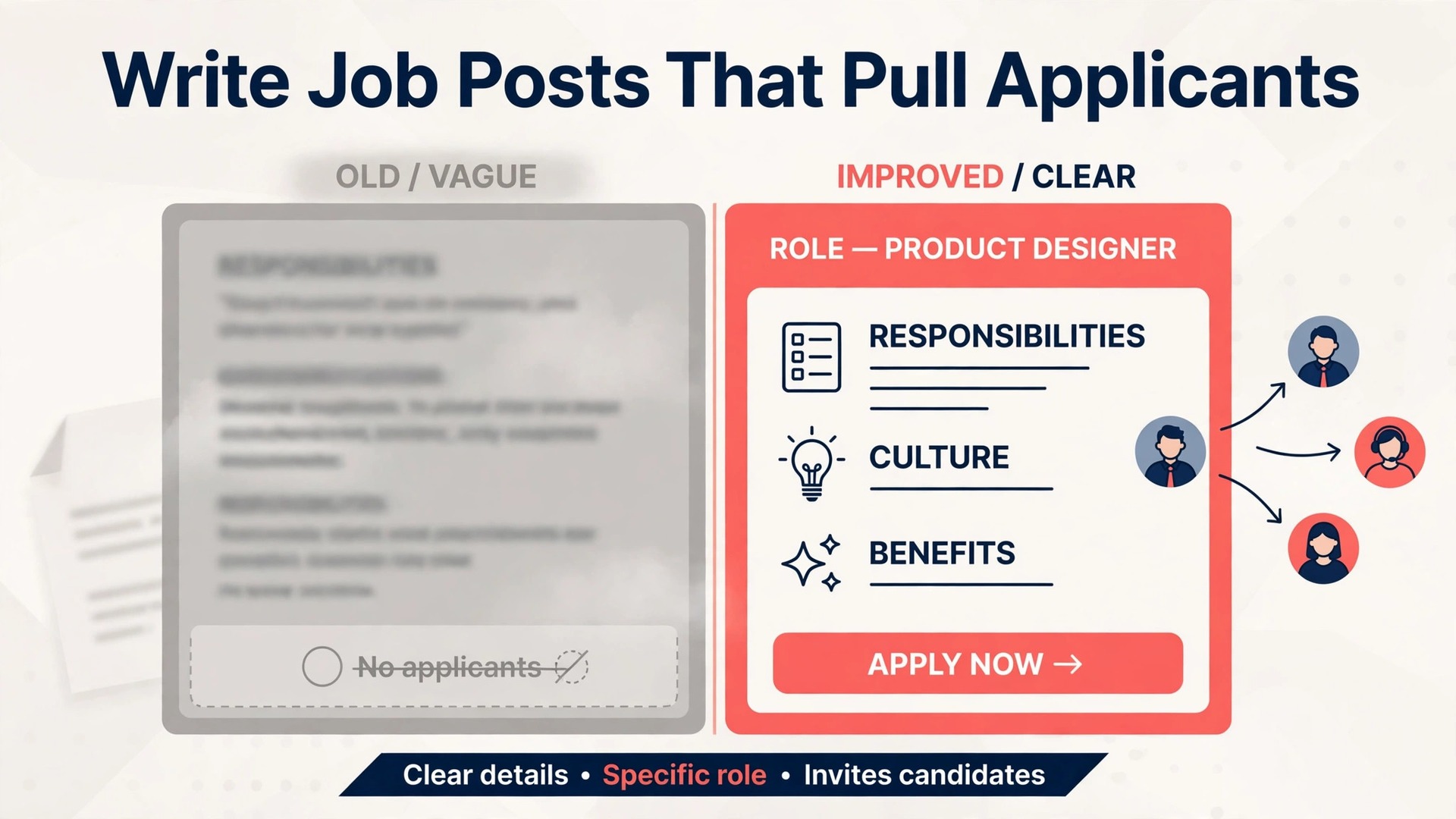
Your job post is getting views, but the applicants are wrong for the role, underqualified, or missing the one skill the job actually needs. This guide explains how to write a job post small business owners can use to attract the right applicants, screen them fairly, and hire faster, starting with the title and ending with a template you can copy.
That is not usually a hiring market problem. It is a writing problem, and it is fixable in a single rewrite. A vague title attracts vague applicants. A list of twenty requirements attracts nobody confident, because strong candidates rule themselves out while weak candidates apply anyway. A post with no pay range, no location clarity, and no honest picture of the day to day work attracts people who will leave within weeks, because the reality surprises them.
A job post and a job description are not the same document, although small businesses often treat them as one. A job description is an internal record of purpose, duties, and requirements. A job post is a public invitation, and it must sell the role honestly while giving applicants enough detail to self select correctly. The best posts do both jobs at once, because they describe real work in plain language, separate must have skills from nice to have skills, state pay and working arrangements clearly, and tell applicants exactly how to apply and what happens next. A post that does those four things will get fewer applicants, and better ones, which is the outcome a busy owner actually wants.
Small businesses have one advantage in hiring that large companies do not, which is that the owner can write like a person. A candidate can picture working for a real team, learning directly from the owner, and seeing the effect of their work quickly. A post that hides behind corporate language wastes that advantage. A post that names the team, the customers, the schedule, and the growth path, in plain words, will stand out in a feed full of generic listings, even without a large salary budget.
The Title Decides Who Even Clicks
Job titles are searched, not just read, and that fact shapes how to write a job post small business candidates can find. Candidates search for recognisable titles, such as shop assistant, bookkeeper, delivery driver, or marketing assistant, and a creative title that nobody searches for will be invisible. Keep the title simple, clear, and free of jargon, and put any internal grade or quirky name in the body, not in the title. A title such as senior customer happiness champion may feel distinctive inside the business, but it will not match what candidates type into a job board, and it will not tell them what the job actually is.
Location and working pattern belong near the title, not buried at the bottom. A candidate who needs on site work in a specific town should know at once whether the role fits, and a candidate who can work remotely should not have to guess. State the town or area, whether the role is on site, hybrid, or remote, and whether hours are full time, part time, or fixed term, in the first lines. That clarity saves both sides time, because applicants who cannot work the pattern will not apply, and applicants who can will apply with confidence.
Salary transparency is the third title area decision, and it matters more than most owners expect. Even a broad range helps, because it sets expectations early and builds trust. A post with no pay information attracts applicants who will drop out at offer stage, wasting interview time. A post with a genuine range attracts applicants who accept that range, which shortens the hiring cycle. If pay varies with experience, say so, and give the range that covers the role, rather than a single figure that misleads one end of the range. Where local rules require pay disclosure, follow them exactly, and check the current requirement before posting.
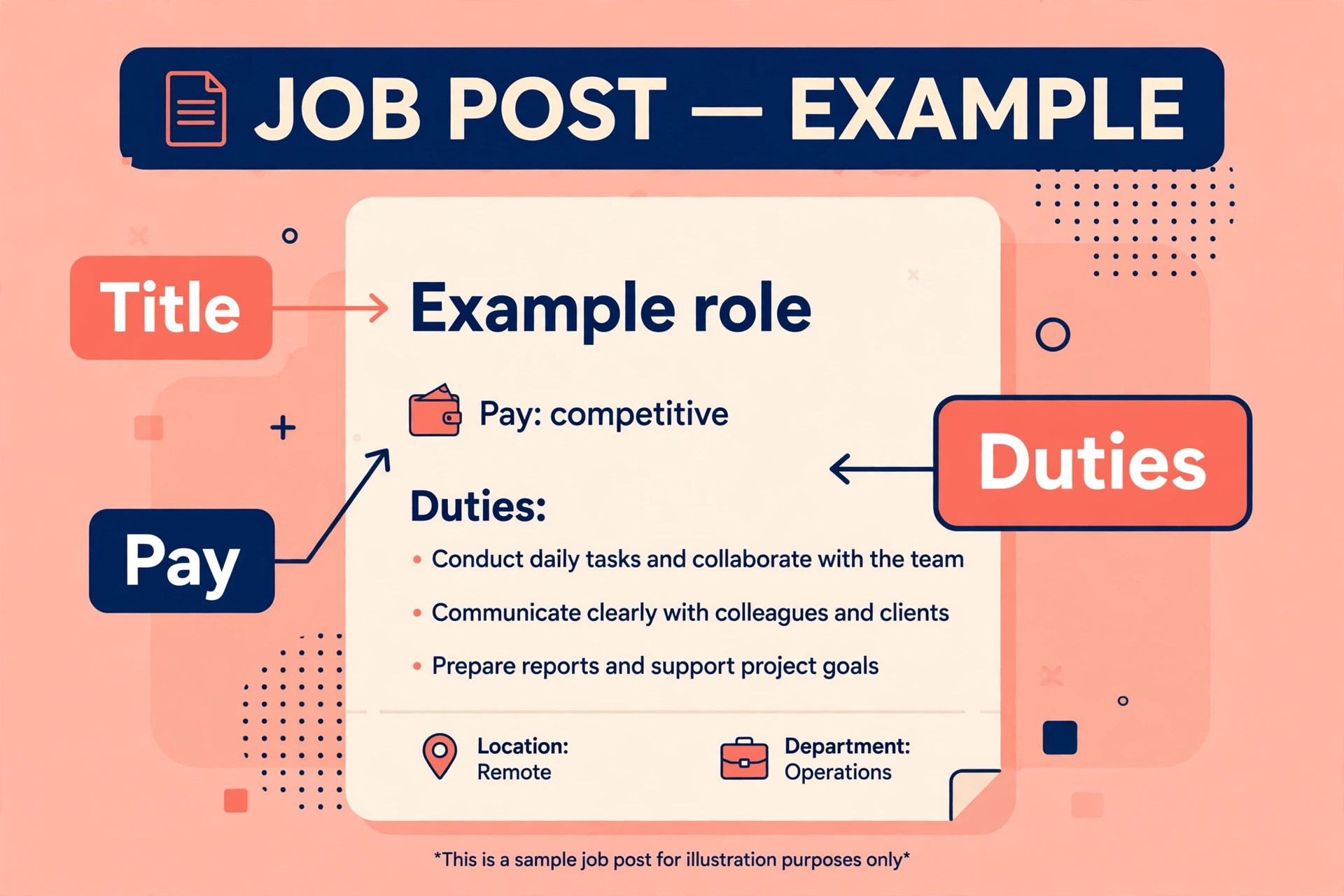
Structure That Candidates Can Scan in a Minute
Most candidates scan a post before reading it, on a phone, in under a minute. A post built as one long block of text will lose them, however good the role is. The structure below is the scanning order that works, and the template later in this guide follows it exactly.
First comes the summary, in two or three sentences, saying what the role is for, who the person will work with, and what success looks like in the first months, which is the core of how to write a job post small business applicants will actually read. That summary should be specific, not generic. A summary that says the role supports the team and helps the business grow could describe any job. A summary that says the role answers customer calls, books appointments, and keeps the diary full for a three person clinic tells a candidate exactly what the days will look like.
Second comes what the person will do, as a short list of essential duties, described as outcomes and activities, not as job titles or abstract qualities. List the main tasks in order of time spent, and include frequency and conditions where they matter, such as weekend work, travel, or physical tasks. A duty list that reflects real time spent will help a candidate self select, while a duty list copied from another post will attract candidates for a different job.
Third comes what the person needs, split clearly into essential and nice to have. Essential means the role cannot be done without it, or without training the business will provide. Nice to have means it helps but is not required. That split is the most important fairness step in the whole post, because an essential list of twenty items excludes strong candidates who could learn, while a short essential list plus a clear training offer widens the pool without lowering the bar. For each essential item, ask whether it is genuinely required on day one, or whether it could be learned in the first month with support.
Fourth comes pay, hours, location, benefits, and growth, stated plainly. Include the pay range, the schedule, the contract type, and any benefit that genuinely differentiates the role, such as training, flexible hours, or a clear path to a senior role. Avoid vague benefit claims that every post makes, and name the benefits that are real and specific to your business. A candidate who reads a specific benefit will remember it, while a candidate who reads a generic list will forget it.
Fifth comes how to apply, with a simple process and a clear next step. State whether applicants should send a CV, complete a short form, answer a few questions, or have an informal conversation, and state the closing date and when applicants will hear back. Offering an alternative to a CV only application, such as a short form or a practical task, can widen the pool, because some strong candidates have thin CVs but strong practical skills. Whatever the process, keep it short, because a long application process loses good candidates first.

Writing Duties, Skills, and Requirements Without Bias
Inclusive wording is not decoration, and it is a central part of how to write a job post small business hiring can be proud of. It changes who applies. Phrases that describe a person rather than a skill, such as young and energetic, or native speaker, can discourage qualified applicants and create legal risk. Replace person descriptions with skill descriptions. Instead of asking for a young and energetic team member, ask for someone who can work a busy Saturday shift at pace and stay friendly under pressure. Instead of asking for a native speaker, ask for the level of spoken and written language the job actually requires, and how it will be used.
Check every requirement against the real job. A degree requirement should only appear if the degree is genuinely needed, and if practical experience is an acceptable alternative, say so explicitly, with the phrase or equivalent practical experience. A driving requirement should only appear if driving is a real duty, and if public transport or a different arrangement could work, do not present driving as essential. Each unnecessary requirement is a filter that removes good candidates for no benefit, and each genuine requirement that is stated clearly helps the right candidates recognise themselves.
Language should be plain and accessible throughout. Company specific terms, acronyms, and internal system names confuse candidates outside the organisation, and they make a small business look closed rather than welcoming. Write the post as if explaining the job to a capable stranger, define any term that is not widely known, and read the post aloud once before publishing. A sentence that sounds awkward aloud will read awkwardly on screen, and a post that reads clearly aloud will usually scan clearly too.
A second reader check is worth the ten minutes it takes. Ask a colleague to read the post looking only for language that might deter a strong candidate, such as masculine coded words, age coded words, or requirements that are not truly essential. That reader should not be the hiring manager, because the hiring manager is too close to the draft to see its blind spots. A fresh reader will spot the requirement that was copied from an old post, the duty that no longer exists, and the phrase that sounds welcoming to the writer but exclusionary to a candidate.

Pay, Benefits, and Working Arrangements Done Honestly
Pay honesty starts with a genuine range and a clear basis, hourly or annual, and it continues with clarity about variable pay. If commission, bonuses, or overtime exist, state them separately from base pay, and state how they are earned, rather than folding them into a headline figure that nobody will actually receive. A candidate who discovers at offer stage that the advertised figure included unlikely commission will lose trust, and a candidate who sees a clear base plus a separate variable element will trust the post more.
Working arrangements need the same honesty. State the schedule, including evenings, weekends, or on call duties, the location, and any travel, in the post, not at interview. A candidate who learns about weekend work at interview has wasted an interview slot, and a candidate who sees it in the post and applies anyway has accepted it. That early honesty also protects retention, because a hire who knew the schedule before starting is far less likely to leave over it in the first month.
Benefits should be specific and verified. Name the training provided, the equipment supplied, the holiday allowance, and any flexibility that is real, and leave out benefits that are aspirational or dependent on a future decision. If training is a key selling point, say what training, who provides it, and when it happens, because a vague promise of training opportunities means little, while a named training plan means a great deal. If the role leads somewhere, say where, and what the path looks like in practice, rather than claiming unlimited growth.
Where to Post and How Long to Keep a Post Live
Posting in the right place matters as much as writing well, and it completes how to write a job post small business owners publish with confidence.
A local role is best posted where local candidates look, which may be a local job board, a community group, or a notice in the business itself, as well as a major board. A specialist role is best posted where specialists look, which may be an industry board or a professional group. Posting everywhere at once wastes time on duplicate applicants, while posting in one place that the right candidates never visit wastes the post entirely. Choose two or three channels that match the role, and track which channel produces the best applicants, so the next post starts with evidence rather than habit.
Timing also matters. A post that stays live for months without updates signals that the business is not really hiring, or that it has already hired and forgotten the post. Set a closing date, review applicants on a schedule, and close or refresh the post when that date passes. A closing date also creates a reason for candidates to apply promptly, and it gives the hiring manager a deadline to work to, which prevents a hiring process from drifting for weeks while good candidates accept other offers.
Track the basics for each post, because that record improves the next post. Note the channel, the number of applicants, the number shortlisted, the time to shortlist, and the reason the hired candidate stood out. That record, kept in a simple spreadsheet, will show which titles work, which channels work, and which requirements filter too aggressively. A small business that hires a few times a year can learn a great deal from just three or four tracked posts.

How to Write a Job Post Small Business Template
Replace every bracketed field, delete anything that does not apply, and confirm the details with the hiring manager before publishing. This template is the overview proof for this guide, because a post built from it cannot forget pay, location, duties, or next steps.
Job title, in plain searchable words. Location and working pattern, on site, hybrid, or remote, plus town or area. Contract type, full time, part time, or fixed term, plus hours and schedule. Pay, as a genuine range with hourly or annual basis, plus variable pay stated separately.
What this role is for. You will achieve a named outcome for named customers, team, or service, reporting to a named role, and success in the first months looks like a specific result.
What you will do. List essential duties as outcomes, with frequency and conditions where they matter. Include any weekend work, travel, or physical tasks honestly, so applicants can self select correctly.
What you need. List essential skills and credentials that are genuinely required, with acceptable evidence for each, and state or equivalent practical experience where experience can replace a qualification. List nice to have skills separately, clearly labelled as not required.
What we will teach you. List the skills, systems, and procedures the business will train, with when training happens and who provides it. This section widens the pool, because it tells candidates who can learn that they are welcome to apply.
What you will get. List pay again in brief, holiday, training, flexibility, equipment, and any specific benefit that is real and verified. State the growth path in practical terms, such as the next role and what leads to it.
How to apply. State the method, CV, short form, written questions, or informal conversation, the closing date, and when applicants will hear back. Add an inclusive statement in plain words, welcoming applicants from all backgrounds, and stating that applicants do not need to meet every nice to have item to apply. Add how to request an adjustment to the application process, where relevant.
Before publishing, run the template through a final check. Is the title searchable. Is the location and pattern in the first lines. Is pay stated. Are essential and nice to have separated. Are duties real and current. Is the application process short. Is there a closing date and a reply date. A post that passes that check is ready, and a post that fails any item should be fixed before it goes live, because each failure costs applicants.

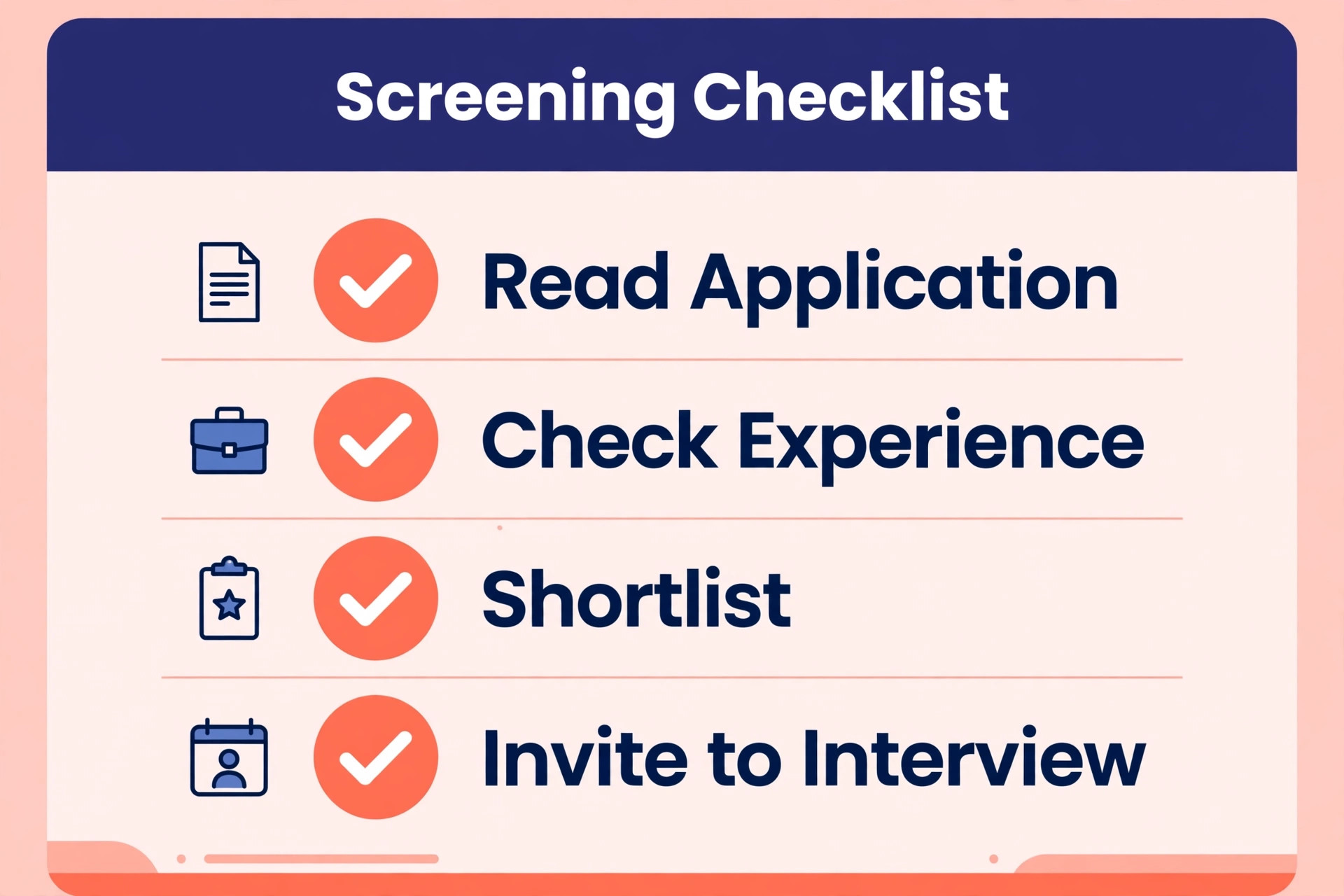
Screening Checklist
Use this checklist for every applicant pool after learning how to write a job post small business screening can rely on, so screening is consistent and fair, and so no candidate is rejected for a reason that was never in the post.
– Shortlist against the essential list only, and do not reject a candidate for missing a nice to have item. – Check that the candidate can work the stated schedule and location, or that an adjustment discussed is genuinely workable. – Score practical evidence, such as a task, a work sample, or a structured question, alongside CV history, so thin CVs are not automatically excluded. – Ask the same core questions of every shortlisted candidate, so comparisons are fair and defensible. – Record a brief reason for each shortlist decision, tied to the post, so the process can be explained later.
– Reply to every applicant by the date promised in the post, including a short rejection for those not shortlisted. – Move quickly once a strong candidate is identified, because good candidates accept other offers while a slow process drifts. – Check references and any required credentials before an offer, and confirm pay, schedule, and start date in writing. – Prepare onboarding before day one, including accounts, training, and a named first week contact. – Review the post after hiring, noting which channel and which wording produced the hired candidate, for the next post.
That checklist protects the business as well as the candidate. Consistent screening reduces bias, creates a record that can be explained, and prevents the common small business pattern of hiring the first available applicant because the process took too long. Speed matters, but speed without a checklist leads to rehiring, which is slower than a careful first hire.
Interviewing From a Good Post
A good post makes interviewing easier, because interview questions can follow the post directly. For each essential duty, prepare a question that asks for a real example, such as a time the candidate handled a busy shift, solved a customer problem, or learned a new system quickly. For each essential skill, prepare a practical check, such as a short task, a work sample, or a scenario question, rather than relying on self description alone. A candidate who describes a skill and a candidate who demonstrates it are different prospects, and a short task reveals that difference cheaply.
Keep interviews structured and short. A first interview of thirty to forty five minutes, with the same core questions for every candidate, gives a fair comparison and respects the candidate time. Tell candidates what the interview will cover, how long it will take, and who they will meet, because that transparency reduces anxiety and improves answers. Avoid questions about protected characteristics, personal circumstances, or topics unrelated to the role, and keep notes focused on evidence against the essential list.
Close the interview by explaining next steps, timing, and how the candidate will hear back, and then keep that promise. A candidate who is told they will hear back in a week and hears nothing for three weeks will assume the worst and accept another offer. A candidate who receives a prompt, respectful reply, even a rejection, will remember the business positively and may apply again. Reputation in a local hiring market is built one reply at a time, and a small business cannot afford a reputation for ghosting applicants.
Mistakes That Waste a Good Vacancy
The most expensive mistake in how to write a job post small business hiring is an inflated essential list. A post that demands five years of experience, a degree, and five specialist tools for a junior role will exclude the very candidates who could grow into it, while attracting applicants who exaggerate to match the list. Cut the essential list to what the role truly needs on day one, move the rest to nice to have or to the training section, and watch the applicant quality rise. That single edit often fixes a post that seemed to attract nobody suitable.
The second mistake is a hidden deal breaker. Weekend work, travel, a location change, or a physical demand that appears only at interview wastes interview time and damages trust. Put every deal breaker in the post, plainly, so applicants self select before applying. Honesty about hard parts does not reduce applications from suitable candidates. It reduces applications from unsuitable candidates, which is exactly the goal.
The third mistake is a slow process. A post with no closing date, a shortlist that waits weeks, and interviews scheduled one at a time will lose strong candidates to faster employers. Set a closing date, shortlist within days of closing, interview in a tight window, and decide promptly. A small business can move faster than a large employer, and that speed is a hiring advantage that should be used, not wasted.
The fourth mistake is never learning from a hire. A business that hires, forgets the post, and starts from a blank page next time will repeat the same errors. Keep the post, the applicant record, and a note on what worked, so the next post starts from evidence. Over three or four hires, that record becomes a hiring playbook, and each hire becomes easier than the last.

Frequently Asked Questions About Writing a Job Post
How long should a job post be
Long enough to answer the questions a good candidate will ask, and short enough to scan in a minute. In practice, that means a short summary, a duty list, a split essential and nice to have list, pay and arrangements, and application steps, usually fitting on one or two phone screens. A post that needs three screens of dense text should be cut, because candidates will not read it, and a post shorter than a summary plus duties will not let candidates self select.
Should I always include pay in the post
Yes, wherever possible, and always where local rules require it. A genuine range builds trust, sets expectations, and reduces dropouts at offer stage. If pay truly cannot be stated, explain why and give the earliest point at which pay will be discussed, but expect fewer and less committed applicants. Pay transparency is now expected by many candidates, and a post without it is at a disadvantage against posts that include it.
How many requirements should I list as essential
As few as genuinely required, usually between four and seven. Each essential item should pass the test of whether the role cannot be done without it on day one, or without training the business will provide. Items that fail that test belong in nice to have or in the training section. A short essential list is not a lower bar. It is a clearer bar, and it attracts candidates who meet it confidently.
What is the difference between a job post and a job description
A job description is an internal record of purpose, duties, and requirements, used for planning and performance discussions. A job post is a public invitation that presents the role to applicants, adding pay, arrangements, and application details. Check both before publishing, because an inviting post is little help if the internal description contains a requirement the post omitted, or vice versa.
How do I handle applications from candidates who meet only some requirements
Shortlist against the essential list, and treat nice to have gaps as learning opportunities, not rejections. If a candidate meets the essentials and shows willingness and ability to learn, they are a strong prospect, especially for a small business that can train directly. A candidate who meets every nice to have but misses an essential is a weaker prospect than a candidate who meets every essential and can learn the rest.
When should I close a post and start again
Close and rewrite a post when applicants are consistently wrong for the role, when the essential list is clearly too long or too vague, or when the closing date has passed without a shortlist. Do not simply repost the same text and hope for different applicants, because the text is usually the cause. Rewrite the title, clarify duties and pay, cut the essential list, and repost with a fresh closing date.
Once a hire starts, support their first weeks with a clear onboarding sequence, as in our guide to writing a welcome email sequence, and keep a clean handover record, as in our guide to creating a client offboarding checklist, so the next hire starts from a stronger base.
Write the Post the Right Candidate Recognises
A strong job post does not try to attract everyone. It tries to be recognised by the right person, who reads the duties, sees their own skills in the essential list, understands the pay and schedule, and thinks that this role sounds like their next job. That recognition happens when the title is searchable, the summary is specific, the duties are real, the essentials are honest, and the next step is simple. Get those five things right, and the applicant pool will improve without a larger advertising budget.
Start with the template in this guide, fill it with real duties and a genuine pay range, run the second reader check, and post it in the two or three channels where your candidates actually look. Shortlist against the essential list, interview with the same core questions, reply by the promised date, and review what worked after the hire. That cycle, repeated for each vacancy, is how a small business hires well, and it starts with a post written for the candidate, not for the filing cabinet.