

You spent months building a product, a service, or a new offer, and on launch day almost nobody shows up. The website is live, the announcement post goes out, and the response is a handful of polite likes and silence. That quiet launch day is the problem a launch marketing strategy small business owners need before they build, not after, because a launch without an audience is not a launch at all. It is a release, and releases do not sell themselves.
The painful part is that the product is often fine. The failure is timing. Launch marketing done only on launch day starts too late, because audiences, messages, and channels need weeks to warm up. People need to hear about a problem, recognise it as their own, and trust the business behind the solution before they buy. None of that happens in a single announcement, no matter how well written it is.
A launch strategy is therefore a plan for the weeks before, the day itself, and the month after. Before the launch, you build an audience and test your message. On launch day, you activate that audience in a planned sequence. After the launch, you turn early buyers into proof, referrals, and repeat customers. Each phase has a different job, and skipping the first phase is why most small business launches feel flat.
What Counts as a Launch
A launch is any moment when something new meets the market, and small businesses launch more often than they realise. A new product, a new service line, a new location, a seasonal offer, a rebrand, and a book or course are all launches, and each one deserves the same basic structure, scaled to its size. Treating only big product releases as launches is why smaller offers get announced once and then forgotten.
The size of the launch should match the size of the change for the customer. A small change, such as a new menu item or a new service add-on, needs a short runway of one to two weeks and a simple announcement to existing customers. A major change, such as a new flagship product or a new location, needs a runway of six to eight weeks, a waitlist, and a staged channel plan. Matching effort to importance keeps small launches cheap and big launches properly supported.
Every launch also needs a single clear goal. A launch that tries to win press, sales, sign-ups, and followers at once will win none of them, because each goal needs a different message and a different call to action. Pick one primary goal, such as a number of first orders, waitlist sign-ups, or bookings in the first week, and let every other result be a bonus. A single goal makes decisions easier all the way through, from channel choice to launch day timing.

The Three Phases in Plain Terms
Pre-launch is the audience and message phase, and it usually takes four to six weeks for a major launch. That long runway is the core of a launch marketing strategy small business owners can trust, because it builds proof before it asks for sales. During this phase you build a waitlist, publish useful content about the problem you solve, talk to early customers, and test which message gets replies. The output of pre-launch is not hype. It is a list of interested people and a message that has already been proven to work on real humans.
Launch day and launch week are the activation phase. You contact the waitlist first, then your existing customers, then communities and partners, in that order, so each wave builds on the last. Sequencing matters, because a launch day that starts with cold channels wastes the best moment on the least interested audience. Warm audiences first, cold audiences later, is the rule that protects launch momentum.
Post-launch is the proof and improvement phase, and it runs for at least 30 days. You collect early buyer feedback, fix the problems buyers report, gather testimonials, and turn early results into content for the next wave of buyers. Many businesses stop marketing the week after launch, which wastes the most valuable asset a launch creates, which is real buyers with real experiences to share.
Launch Marketing Strategy Small Business Launch Timeline Template
Use this eight-week template as your starting plan, and shrink it for smaller launches by cutting weeks, not by cutting the order of the work. The order matters more than the exact week count, because audience building must come before activation, and message testing must come before paid promotion.
| Phase | Timing | Main jobs | Done when |
|---|---|---|---|
| Foundation | Weeks 1 to 2 | Pick one goal, define the buyer, write the core message | Goal, buyer, and message are written down |
| Audience | Weeks 2 to 4 | Open the waitlist, publish problem content, join communities | Waitlist grows weekly without paid ads |
| Proof | Weeks 4 to 6 | Test the message, gather early users, prepare testimonials | Early users confirm the message in their own words |
| Preparation | Weeks 6 to 7 | Build launch day assets, brief partners, set up tracking | Every asset is ready a week before launch |
| Launch week | Week 8 | Activate waitlist, customers, communities, partners in order | Launch day sequence runs without improvising |
| Follow through | Weeks 9 to 12 | Collect feedback, fix issues, publish proof, invite referrals | Early buyers become the next wave of marketing |
Foundation work in weeks one and two decides everything that follows. Define the buyer in concrete terms, which are who they are, what problem they feel, and what they have already tried. Write the core message as one sentence that states the problem, the outcome, and who it is for, and test that sentence on five real people before you build anything around it. If those five people do not recognise their problem in the sentence, rewrite it until they do.
Audience work in weeks two to four is about earning attention, not buying it. Publish content that helps the buyer with the problem, even before your product is available, and end each piece with a waitlist invitation. Join the communities where your buyers already talk, contribute helpfully, and only mention your launch when it answers a question someone actually asked. A waitlist built from helpful content converts far better than one built from a single viral post, because its members already trust you a little.
Proof work in weeks four to six is the phase most small businesses skip, and skipping it is expensive. Give early access to a small group, watch how they use the offer, and listen to the words they use to describe it. Those words become your launch copy, because customer language persuades better than business language. If early users struggle, fix the offer or the explanation now, while the audience is small and forgiving, rather than on launch day when the audience is large and public.

The Channel Checklist
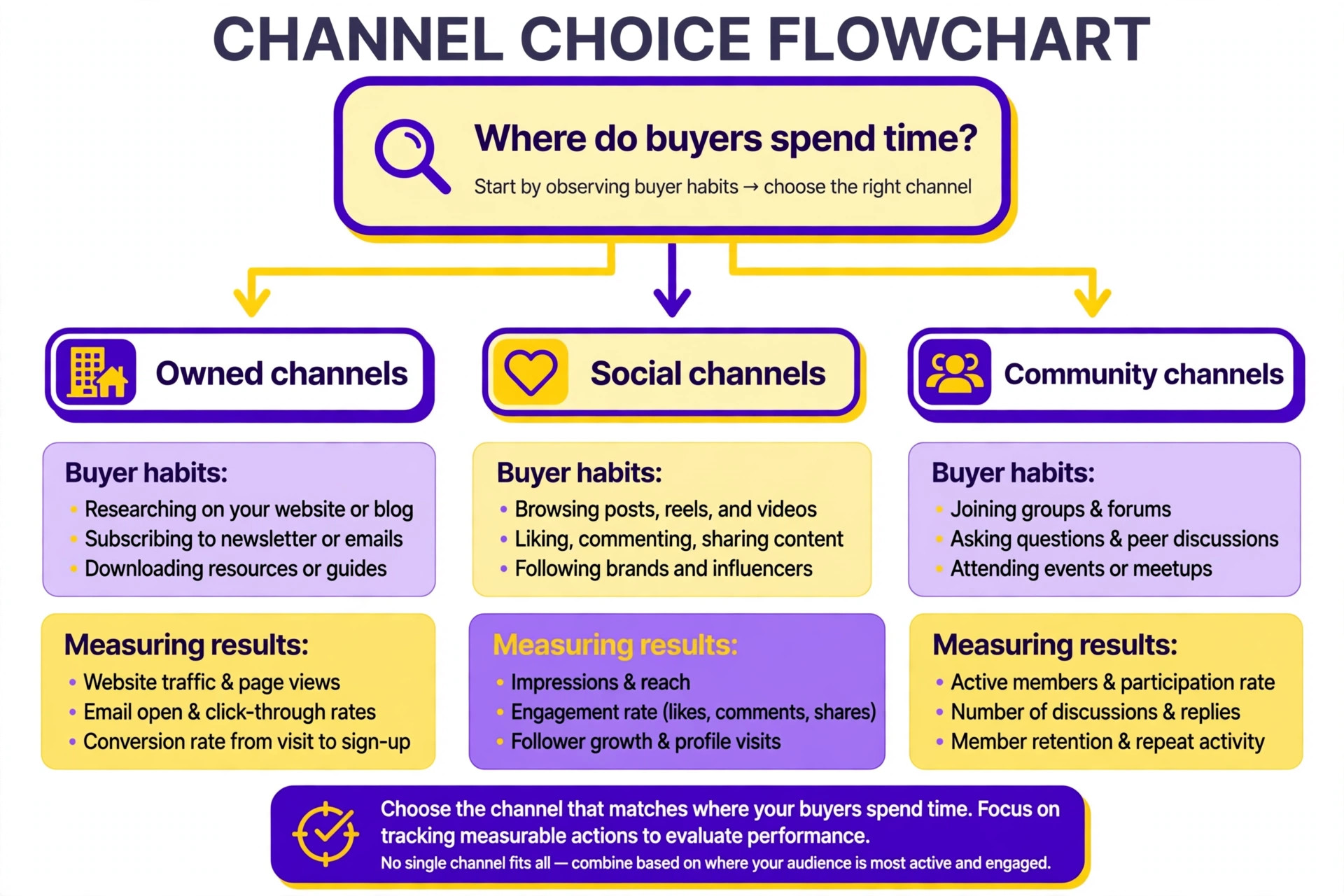
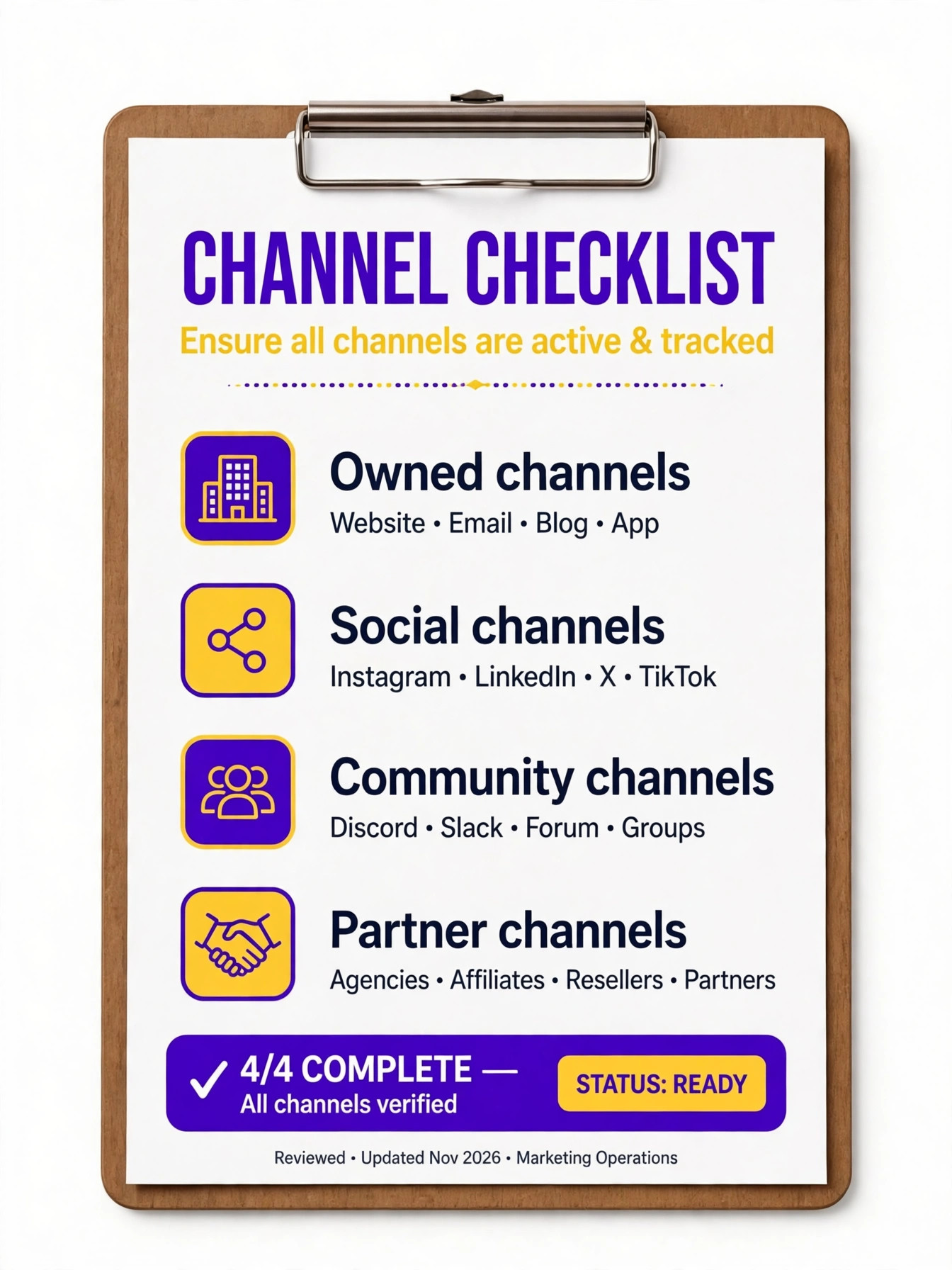
Channels are where launches waste the most time, because businesses try to be everywhere at once and end up nowhere properly. A launch marketing strategy small business teams run well therefore limits channels early and expands only after proof. A launch marketing strategy small business teams can run well therefore picks two primary channels and one supporting channel, and runs those three properly, instead of running six channels badly. The right channels are the ones your buyers already use, not the ones that feel most exciting to you.
– Owned channels first, which are your email list, your website, and your existing customer base, because you control them and they cost the least to reach. – Waitlist as the launch hub, with a simple sign-up page, a clear promise of what waitlist members get, and a referral option for members who want to invite others. – One social channel where your buyers actually spend time, posted consistently through pre-launch, not only on launch day. – One community channel, such as a forum, a group, or a local network, where you contribute helpfully for weeks before mentioning the launch.
– One partner channel, such as a complementary business, a newsletter, or a local organisation, briefed early with ready-made assets. – Paid ads only as a test, with a small budget to check message and targeting, and scaled only after organic proof exists. – Press and podcasts only when you have a genuine story, such as a novel solution, a local angle, or early results worth reporting. – A launch day page that states the offer, the price or booking route, and the next step in one screen, without forcing visitors to hunt for it.
Check each channel against three questions before you commit. Do your buyers actually use it. Can you run it consistently for eight weeks. Can you measure whether it produced sign-ups or sales. A channel that fails any of those questions should be dropped, no matter how popular it looks in general. Launch focus beats launch breadth, every time.
Messaging That Survives Contact With Real Buyers
Launch messaging fails when it describes features instead of outcomes. Buyers do not buy features. They buy a solved problem, a saved hour, a avoided risk, or a result they can picture. Write the launch message around the outcome first, then add the features as proof that the outcome is real. A message that leads with features asks the buyer to do the translation work, and most buyers will not bother.
Test the message in three places before launch day. Test it in a waitlist email and watch replies and sign-ups. Test it in a community post and watch comments and questions. Test it in conversation with five buyers and watch whether they repeat it back in their own words. A message that survives all three tests is ready. A message that only sounds good in a planning meeting is not.
Prepare answers for the three objections every launch faces, which are price, timing, and trust. Price objections need a clear value comparison, not a defensive discount. Timing objections need a reason to act now that is honest, such as a founding offer with a real end date or limited early capacity. Trust objections need proof, such as early user results, a guarantee stated plainly, or a founder story that explains why this business exists. Write those answers before launch day, so objections get answered fast instead of stalling sales.

The Waitlist Done Properly
A waitlist is not a landing page with a form. In a launch marketing strategy small business owners build around relationships, the waitlist is the audience itself, not just a list. It is a relationship with people who raised their hands early, and how you treat that relationship decides launch day. A waitlist that hears nothing for six weeks will not respond on launch day, no matter how good the offer is. A waitlist that hears useful updates every week will be waiting for the launch email.
Send waitlist members three kinds of updates during pre-launch. The first kind is progress, which shows the offer taking shape and invites input on a real choice. The second kind is help, which gives useful advice about the problem whether or not they buy. The third kind is proof, which shares early user reactions or behind-the-scenes results. Mix those three, and the waitlist stays warm without feeling like a sales funnel.
Give waitlist members a genuine reason to act on launch day, and state it plainly. Early access, a founding price for a limited period, a bonus that will not be available later, or priority booking are all honest reasons, provided they are real and time-limited. A fake scarcity claim, such as a countdown that resets, will be noticed and will damage trust far beyond the launch. Honest urgency helps buyers decide. Fake urgency helps competitors, because disappointed buyers talk.
Referrals belong in the waitlist, but only as an option, not a requirement. Let members invite others if they want to, and reward both the inviter and the invited with something small and real. A referral system that gates launch access behind invites will annoy the very people who wanted to buy, and a launch that annoys its warmest audience has failed before it starts.
Launch Day and Launch Week Sequence
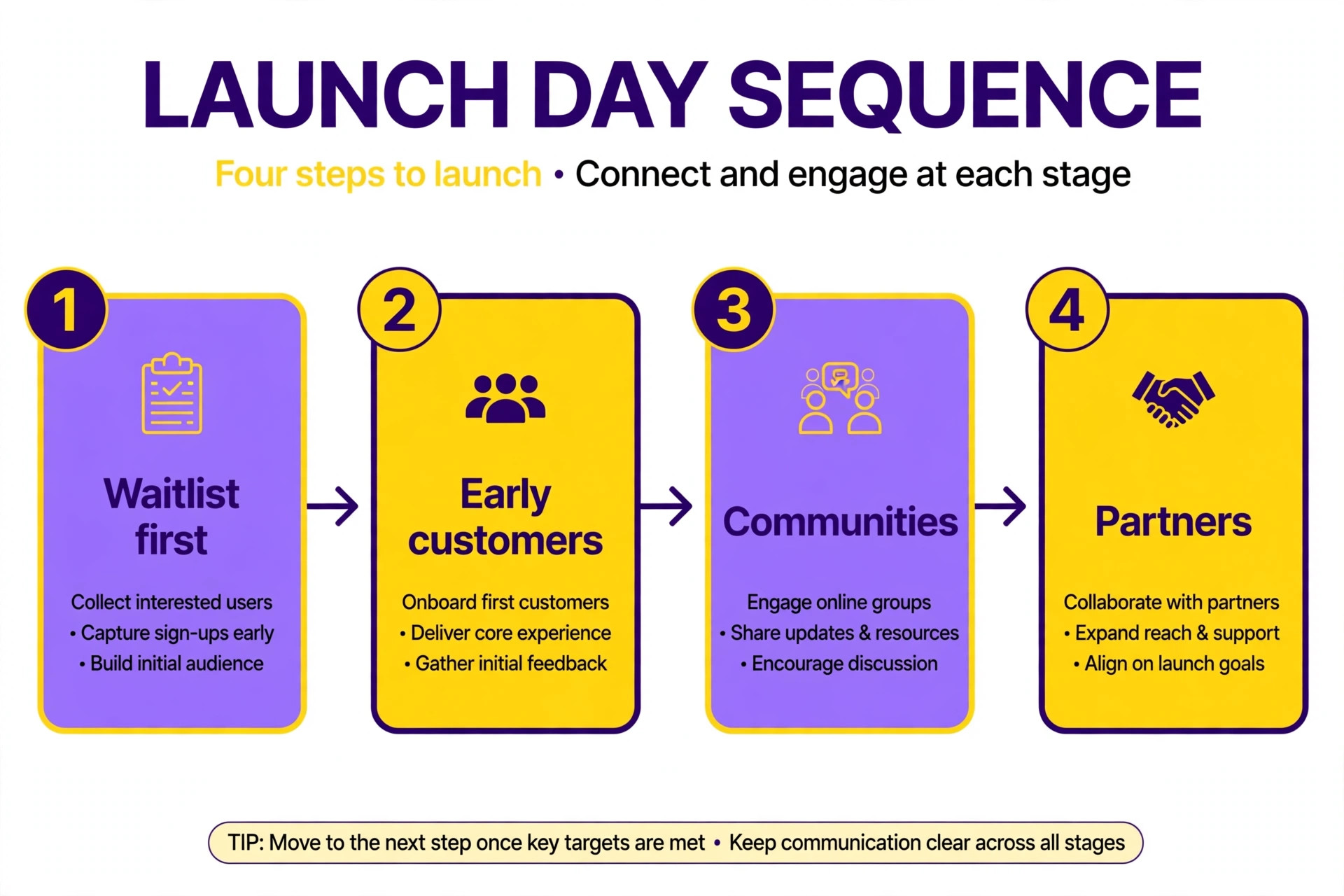
Launch day should feel planned, not improvised, and the sequence below is the order that protects momentum. Start with the waitlist in the morning, because those people asked to be first and deserve to be first. Follow with existing customers later the same day, because they already trust you and can buy quickly. Move to communities and partners on day two, once early sales and reactions give you proof to share. Save cold channels and paid promotion for later in the week, once the message has been proven on warm audiences.
Prepare for launch day problems before they happen. Test the purchase or booking route end to end, on a phone and on a computer, with a real payment or booking if possible. Prepare a short holding message for any outage, and decide who answers questions on launch day so replies stay fast. A launch day bug handled fast and honestly will be forgiven. A launch day bug discovered by buyers while the team is silent will define the launch.
Launch week is not one day of noise followed by silence. Plan content for each day of the week, such as early results on day two, a customer story on day three, answers to common questions on day four, and a reminder of the founding offer end date on day five. Each day gives a new reason to pay attention, and together they turn a single announcement into a week-long story that late buyers can still join.
The 30 Days After Launch
The month after launch is where most small business launches quietly die, because the team relaxes and the market moves on. Treat those 30 days as part of the launch, with their own plan. Week one is fixing, which means answering every buyer question, fixing every reported problem, and thanking every early buyer personally. Week two is proof, which means gathering testimonials, results, and stories from early buyers with their permission. Week three is expansion, which means publishing that proof as content and inviting referrals. Week four is decision, which means reviewing the numbers and deciding what continues, what changes, and what stops.
Testimonials gathered in this window are worth more than any launch copy, because they are proof in the buyer’s own words. Ask early buyers a simple question, which is what changed for them since buying, and use their exact words where they give permission. A testimonial that names a specific result beats a generic praise quote, and a testimonial that mentions an initial doubt overcome is even stronger, because it answers the doubt of the next buyer.
Referral invitations also belong in this window, and they work best when they follow a good experience rather than preceding it. Ask happy buyers who they know with the same problem, and make the referral easy with a simple message they can forward. A referral from a satisfied early buyer is the cheapest launch channel available, and it compounds, because each referred buyer can refer again.
Budgeting a Launch Without Guessing
A small business launch budget should be built from the channel plan, not from a round number. That discipline keeps a launch marketing strategy small business owners fund within their means, instead of overspending on launch week excitement. List each channel, estimate its real cost including staff time, and add a small reserve for fixing launch day problems. Staff time is the hidden launch cost, because pre-launch content, community participation, and launch day replies all take hours that could have gone elsewhere. A budget that ignores staff time will always look cheaper than the launch really was.
Spend in the order of proof, not excitement. Owned channels and waitlist work cost little and prove the message. Small paid tests cost a little more and prove targeting. Larger paid spend comes only after organic proof exists, because paying to amplify a message that has not worked organically is paying to learn a lesson you could have learned for free. That order protects cash and teaches you what actually works.
Set a launch budget ceiling before pre-launch starts, and a rule for what happens if launch day underperforms. The rule might be to extend the founding offer by a week, to shift spend to the best-performing channel, or to pause paid spend and gather more proof. Deciding that rule in advance prevents panic decisions on launch day, when every underperforming hour feels like a reason to spend more or to discount harder.
Mistakes That Flatten a Launch
The first mistake is announcing before an audience exists, which is the quiet launch day problem this guide opened with. A launch without a waitlist or an engaged list is a hope, not a plan, and hope is not a channel. Build the audience first, even if it means delaying the launch by a month. A delayed launch with an audience beats an on-time launch without one.
The second mistake is trying to launch on every channel at once. Six half-run channels produce less than two well-run channels, and they exhaust the team before launch week ends. Pick two primary channels, run them properly, and add more only after launch week proves the message. Focus is not a limitation. It is the strategy.
The third mistake is hiding the price, the booking route, or the next step behind extra clicks. Launch day visitors decide fast, and every extra step loses buyers who were ready. Put the offer, the price or booking route, and the next step on the launch page itself, and test that page on a phone before launch day. Friction on launch day is lost revenue that no later marketing recovers.
The fourth mistake is stopping after launch week. Early buyers, testimonials, and referrals are the launch dividend, and businesses that stop marketing after week one leave that dividend uncollected. Plan the 30 days after launch as carefully as the eight weeks before it, and the launch will keep producing buyers long after launch day.
The fifth mistake is faking urgency or social proof. Countdowns that reset, founding offers that never end, and testimonials that are not real will be spotted, and the damage lasts longer than the launch. Honest urgency, real early results, and genuine testimonials build a launch that helps the next launch too, because buyers remember being treated fairly.
Launching by Business Type
A product business launching a new item should weight the launch toward waitlist, early users, and proof, because buyers cannot try the product before launch and need evidence it works. Send samples or early units to a small group, gather their reactions, and let those reactions lead launch week content. Pre-orders work well here, provided delivery dates are honest and kept.
A service business launching a new offer should weight the launch toward existing customers and booking ease, because the warmest buyers are people who already trust the service. Offer existing customers first booking, make the booking route one step, and use early appointments as proof for the next wave. A service launch that fills its first week from existing customers has momentum that cold marketing cannot buy.
A local business launching a new location or a seasonal offer should weight the launch toward community and partners, because local trust travels through people, not ads. Brief neighbouring businesses, local groups, and existing customers early, and give them something easy to share, such as an opening event or a first-week offer. Local launches succeed on relationships, and relationships need the same pre-launch time as any other channel.
An online business launching a course, a membership, or a digital product should weight the launch toward content and email, because the buyer journey happens almost entirely online. Publish problem-solving content for weeks before launch, build the email list from that content, and run launch week as an email sequence with daily value, not daily pressure. Online buyers need to trust the teacher before they trust the course, and content is how that trust is earned.
Measuring Launch Success Honestly
Judge a launch by its primary goal first, and by everything else second. If the goal was first orders, count orders in launch week and in the 30 days after, not likes or page views. If the goal was waitlist growth, count sign-ups and their source. Vanity measures feel good on launch day and mislead for months after, because a launch with high attention and low sales has not succeeded. It has entertained.
Track source for every sign-up and sale, so you know which channel earned its place and which channel only looked busy. A channel that produced many clicks but no sales should lose budget next time. A channel that produced few clicks but several sales should gain budget, because it reached the right people even if it reached fewer of them. Source tracking is simple with basic form and order records, and it turns the next launch from a guess into a plan.
Review the launch two weeks after launch week, while memories are fresh, and write down three things to keep, three things to change, and three things to drop. That short review becomes the starting plan for the next launch, and after three launches you will have a playbook built from your own evidence rather than borrowed advice. A launch marketing strategy small business owners improve every time is worth more than a perfect first launch, because launches repeat, and improvement compounds.
Frequently Asked Questions
How long should pre-launch marketing run?
Four to six weeks suits a major launch, giving time to build a waitlist, publish problem content, and test the message on real buyers. Smaller launches, such as a new add-on or a seasonal offer, can run a one to two week runway to existing customers. The runway should match the size of the change for the customer, not the size of your enthusiasm for it.
How many channels should a small business launch on?
Two primary channels plus one supporting channel is the right scope for most small businesses, because each channel needs consistent work for eight weeks. Pick channels your buyers already use, and judge each one by whether it produced sign-ups or sales. More channels only help when the first three already run well without exhausting the team.
Should a small business spend on ads for a launch?
Paid ads work best as a small test after organic proof exists, checking message and targeting with a modest budget before any larger spend. Paying to amplify a message that has not worked organically wastes money and teaches you nothing you could not have learned for free. Scale paid spend only when the tested message already converts warm audiences.
What should launch day content include?
Launch day content should state the offer, the price or booking route, and the next step on one page, plus a genuine reason to act now such as early access or a time-limited founding offer. Follow launch day with a week of content, including early results, customer stories, and answers to common questions. Each day should give late buyers a new reason to join.
How do you handle a launch that underperforms?
Start with the pre-agreed rule, which might be extending the founding offer by a week, shifting spend to the best-performing channel, or pausing paid spend to gather more proof. Talk to early buyers and waitlist members who did not buy, and ask what held them back, since that answer usually points to a message or friction problem you can fix. Avoid panic discounting, which trains buyers to wait for the next cut.
Is a waitlist worth it for a small local launch?
Yes, scaled to size, because even a short list of interested locals beats a cold announcement on opening day. A local waitlist can be an email list, a booking interest list, or a simple sign-up sheet, and it gives you people to invite first, proof to share, and a direct route to early bookings. The principle is the same at any scale, which is audience before announcement.
The Launch Plan to Start This Week
Pick one goal, define one buyer, and write one message sentence, then open a waitlist and publish your first piece of problem content this week. Build the audience for four to six weeks, test the message on early users, and only then plan launch day as a sequence that starts with the waitlist and ends with cold channels. Follow launch week with 30 days of fixing, proof, and referrals, and review what to keep, change, and drop.
That order, audience before announcement, message before spend, and proof after launch, is the whole discipline in one paragraph, and it is what separates a launch that lands from a launch that quietly disappears. For related strategy reading, see the content marketing strategy guide, the community marketing strategy guide, and the guide on how to track marketing ROI.