

The verdict is clear. Learning how to start an AI automation agency in 2026 is worth doing only if you sell outcomes, not tools. Businesses do not pay for a chatbot, a workflow diagram, or a clever prompt. They pay for hours saved, leads answered faster, appointments booked without staff time, and follow ups that never slip. Agencies that win in 2026 are the ones that pick one painful problem for one type of client, prove the result in a short pilot, and then charge a monthly retainer to keep that result running. Agencies that lose are the ones that offer every automation to everyone and compete on price alone.
This guide is built for that winning pattern. You will learn how to choose a niche, design services clients understand, price them so the agency stays profitable, find first clients without a large ad budget, deliver work that does not break at 2 a.m., and grow from a solo operator to a small team. It also covers the legal, security, and delivery risks that new agencies underestimate, and the tools that actually matter at each stage. Tool pricing changes often, so check the official pricing page and checkout before you commit to any paid plan.
The Agency Model That Works Now
An AI automation agency sits between software vendors and busy business owners. The owner knows the business problem but does not have time to build, test, and maintain automations. The vendor sells a tool but does not implement it for that specific business. Your agency closes that gap. You design the workflow, connect the tools, test it with real data, train the staff, and stay responsible when something changes.
That model only works if you charge for ongoing value. A one off build fee sounds attractive at first, but it creates a treadmill. You must constantly find new clients to replace finished projects, and clients call you for free when the automation breaks after a tool update. A retainer model, where the client pays monthly for a working system, support, and small improvements, gives both sides stability. The client gets a system that keeps working. You get predictable revenue that lets you plan hiring and tool costs.
Start by defining what you will not do. A new agency cannot credibly serve restaurants, law firms, clinics, ecommerce stores, and real estate teams at once. Each industry has different systems, regulations, and buying habits. Picking one niche lets you reuse workflows, reuse sales language, reuse case studies, and answer objections from experience instead of theory. That reuse is your profit margin in the early months, because the second client in the same niche should cost you half the delivery time of the first.
A realistic first year goal for a solo founder is three to six retainer clients paying enough to cover your living costs plus tool and tax costs, with delivery you can handle without working every weekend. That is a better target than fifty low paying clients or a single huge client that could leave and wipe out your income. Plan your niche, pricing, and capacity around that goal, not around a headline revenue figure from social media.

Pick a Niche Where Pain Is Visible and Measurable
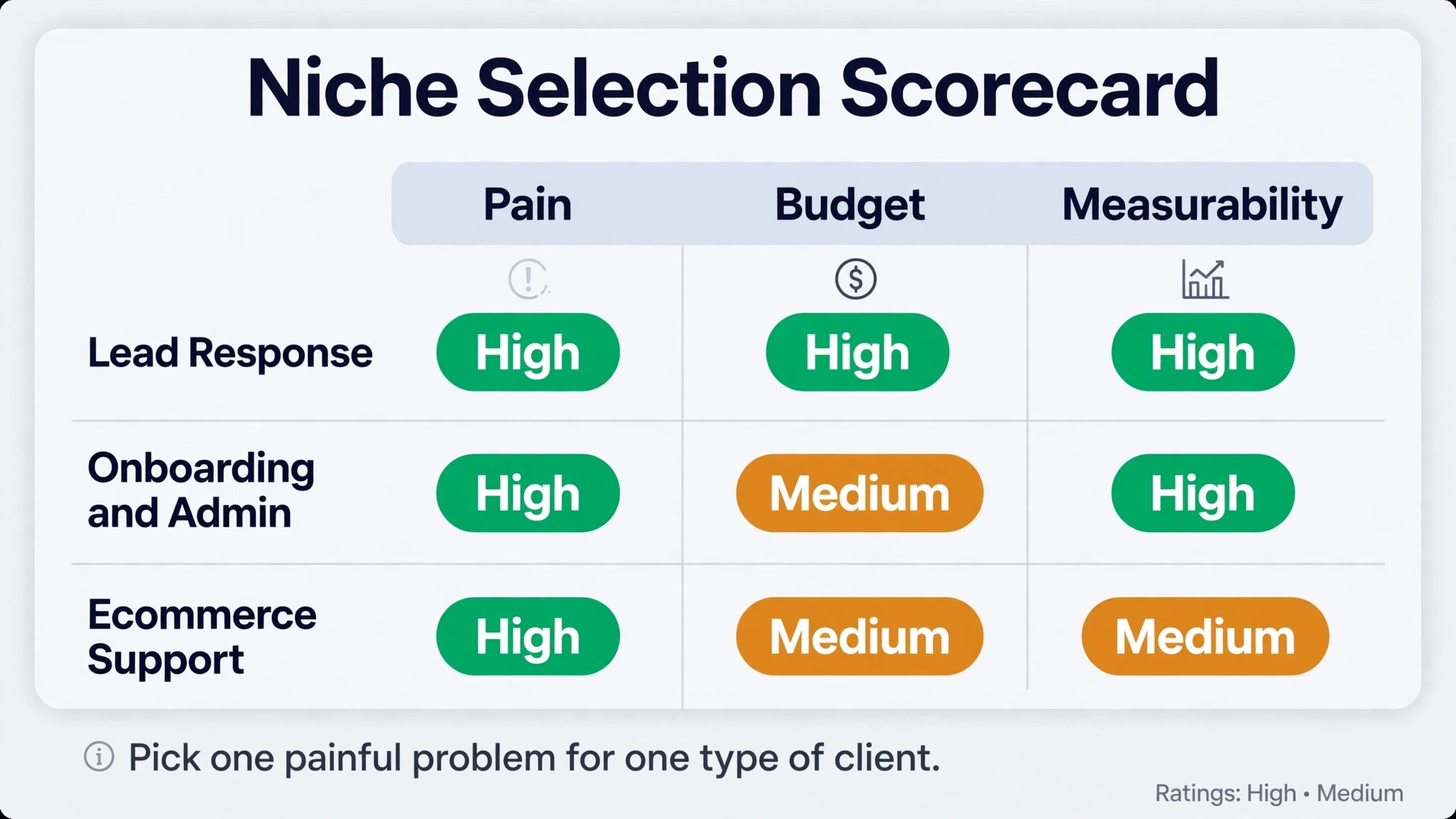
Good niches share four traits. The problem costs real money every week, the buyer can approve a monthly payment without a long committee process, the workflow repeats often enough to automate, and you can reach buyers through a channel you understand.
Consider lead response for service businesses. A plumber, dentist, gym, or estate agent who misses calls after hours loses bookings that are easy to count. An AI receptionist plus booking workflow that answers in seconds, qualifies the caller, and books into the calendar has a measurable payoff in more booked appointments, fewer missed calls, and less front desk time. Compare that with a vague offer such as “AI transformation for small businesses,” which no buyer can price in their head.
Consider onboarding and admin for agencies, recruiters, and professional services firms. Those businesses repeat the same intake, document collection, follow up, and reporting steps for every client. Automating intake forms, reminders, status updates, and basic reporting saves staff hours every week and reduces errors. The buyer is often an owner or operations manager who feels the pain daily.
Consider ecommerce support and order handling for small online stores. Order status questions, returns, and frequently asked questions repeat constantly. An AI support workflow with clear escalation to a human can cut response time and free staff for complex cases, but only if it is trained on real store policies and tested against tricky questions. A generic bot that gives wrong refund answers will cost the client trust, so this niche demands careful testing.
Avoid niches where you cannot measure the result, where the buyer has no budget authority, or where regulation makes a mistake expensive and hard to insure. Medical advice, financial advice, and legal advice automations carry risks that a new agency should not take on without specialist guidance and proper insurance. If a niche excites you but fails the measurability test, narrow it until you can name the result in one sentence, such as “We book X more appointments per month” or “We save Y staff hours per week on intake.”
Validate the niche before you build a website. Talk to ten potential buyers, not friends, and ask what manual task they hate, what it costs them, and what they already pay to solve it. If fewer than three describe the same painful task in similar words, keep narrowing. AI research can help you list competitors and price ranges, but those ten conversations are the real validation. Record them, note exact phrases buyers use, and reuse those phrases in your sales pages, because buyers buy language that sounds like their own problem.
Services Clients Understand When You Package Outcomes, Not Hours
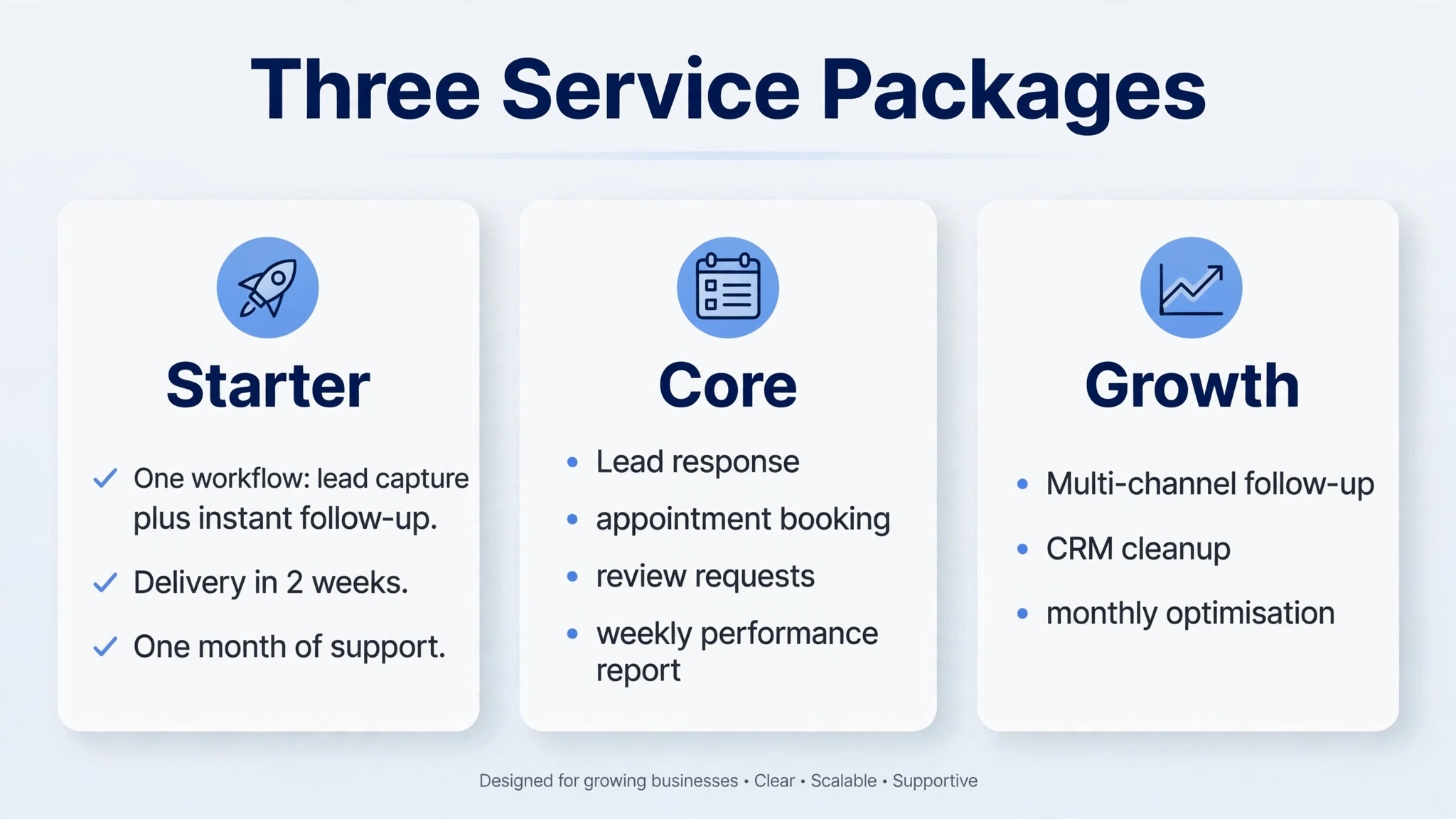
Clients do not buy hours of Zapier work. They buy a named package with a clear scope, a clear result, and a clear price. Design three packages that build on each other, and make the middle package the one most clients should choose.
A starter package might be a single workflow, such as lead capture plus instant follow up, delivered in two weeks, with one month of support. A core package, your main offer, might include lead response, appointment booking, review requests, and a weekly performance report. A growth package might add multi channel follow up, CRM cleanup, and monthly optimisation. Each package should state what is included, what is not included, how long delivery takes, and what the client must provide, such as access to their calendar, CRM, and phone system.
Write the scope in plain language and add limits that protect you. State how many revisions are included, how many workflows, how many users, and what counts as a new project versus a support fix. Without limits, a retainer client can expand the scope every week until the retainer no longer covers your time. With limits, you can say yes to extras at a clear additional price, which clients respect when the boundary was set at the start.
Delivery should follow a repeatable process covering discovery call, workflow map, build, test with real data, staff training, go live, and a 30 day check. Document that process and use the same checklist for every client. A checklist prevents missed steps, makes it easier to hand work to a contractor later, and gives clients confidence that you are not improvising. AI tools can help you draft the checklist, the workflow map, and the training guide, but you must test every workflow yourself against edge cases such as a caller with a thick accent, a customer who changes the appointment time twice, a form with a missing field, a system that is down for an hour.
Pricing should reflect value and cost, not just competitor prices. Calculate your monthly tool costs per client, your delivery hours in the first month, your ongoing support hours, and your tax and overhead. Then set a retainer that leaves a healthy margin after those costs. Many new agencies underprice because they count only tool costs and forget their own time. If a retainer does not pay you at least two to three times your tool and support cost, it will not survive a difficult month. Check competitor pricing as a reference, but do not copy a price that assumes a team, a brand, or a volume you do not have yet.
Fewer Tools, Better Tested
New agencies often collect tools like trophies. A smaller, well tested stack is cheaper, easier to support, and less likely to break when one vendor changes an API. Choose one tool per job and master it before adding another.
| Job | Common options | How to choose |
|---|---|---|
| Workflow automation | Zapier, Make, n8n | Pick the one you can debug fastest; n8n suits technical founders, Zapier and Make suit faster client onboarding |
| AI chat and voice | ChatGPT, Claude, voice platforms from vendors such as Vapi or Retell | Test with real client calls, not demo scripts; check call quality, latency, and cost per minute |
| CRM and pipeline | HubSpot, Pipedrive, GoHighLevel | Match the client’s existing system where possible; do not force a migration in month one |
| Booking and calendar | Calendly, Cal.com | Use the client’s calendar system; test time zones and buffers |
| Reporting | Google Sheets, Looker Studio, built in dashboards | Clients read one page reports; avoid dashboards they never open |
| Documentation | Notion, Google Docs | Keep client runbooks in one place your team can find at midnight |
Check pricing at checkout for every tool, because automation platforms charge by tasks, operations, or minutes, and a busy client can push you into a higher tier quickly. Build that variable cost into your retainer or set a usage cap with a clear overage price. Also check data processing terms, especially for voice recordings and customer data. Your clients will ask where data goes, how long it is stored, and who can access it. Have a short, honest answer ready, and do not promise compliance you have not verified.
Security basics are non negotiable. Use separate logins and API keys per client, store secrets in a password manager or secrets vault, never share a single admin account across clients, and keep a record of who has access to what. When you leave a project, revoke access promptly. Those habits cost little and prevent the most common agency security incident, an old contractor or former client still having access months later.
For readers comparing the wider tool market, this site’s guides to hubspot alternatives and best AI tools for content agencies help you judge whether a client should stay on their current system or move.

Find Your First Five Clients Without Paid Ads
Cold outreach still works for agencies, but only when it is specific. A generic message saying “We do AI automation” gets ignored. A message that names the buyer’s problem, shows you understand their business, and offers a short, low risk next step gets replies.
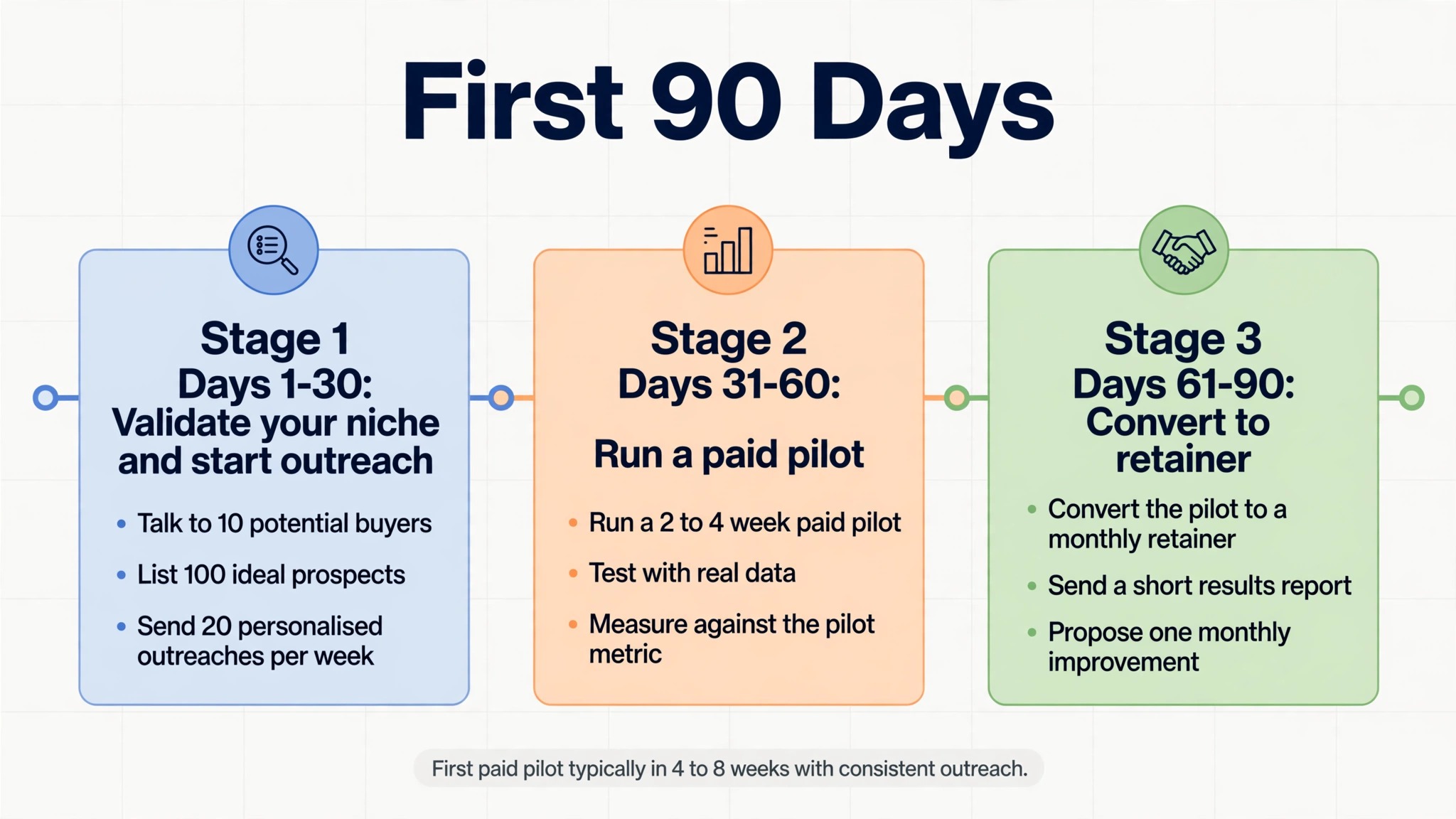
Start with a list of 100 ideal prospects in your niche, built from directories, maps, review sites, and local business lists. Research each one briefly. Do they answer the phone after hours, do they have online booking, do they reply to reviews, do they run ads? That research tells you which automation would help them most. Then send a short personalised message, by email or direct message, that states the observed gap, the result you can deliver, and a 15 minute call offer. Follow up twice, politely, over two weeks. Most replies come on the second or third touch, not the first.

Offer a paid pilot, not free work. A two to four week pilot with a clear scope, a clear success metric, and a fixed fee filters out buyers who will never pay and gives you a case study if it works. Free work attracts clients who value it at zero and who will demand unlimited revisions. If a prospect insists on free work, offer a paid audit instead, a short report mapping their workflows, estimates time saved, and proposes a build plan. The audit itself is valuable, and it often converts to a build because the buyer has already seen your thinking.
Referrals and partnerships beat ads in the early stage. Accountants, web designers, marketing consultants, and business coaches already serve your ideal clients and are often asked about automation. Offer them a simple referral arrangement, share a one page description of your packages, and deliver excellent work for their first referral, because that partner will judge you on that one client. Local business groups, industry forums, and short practical talks also work, because buyers trust a person who explains a workflow clearly more than a person who posts generic AI hype.
Track outreach like a sales pipeline, not a hope list. Record who you contacted, when, what you said, and the next step. A simple spreadsheet or CRM is enough at this stage. Aim for a consistent weekly volume, such as 20 personalised outreaches and five conversations per week, rather than a burst of 200 messages followed by silence. Consistency is what turns outreach into a pipeline.
Deliver, Support, and Keep Clients
Delivery quality decides whether a client renews. The first two weeks set the tone. Communicate daily during build, share a test link or demo early, and ask the client to test with real scenarios, not just happy path examples. When the client finds a flaw during testing, thank them and fix it fast. That early responsiveness builds trust that survives later small issues.
After go live, monitor the system. Set up alerts for failed runs, high error rates, and unusual volumes. Check the first week’s results against the pilot metric and send a short report covering calls answered, appointments booked, hours saved, errors fixed. Clients who see numbers renew. Clients who hear nothing assume the system is either perfect or forgotten, and both assumptions are dangerous.
Support needs boundaries and a response promise. State your support hours, your response time for urgent versus normal issues, and how clients report problems. A shared channel or ticket form beats scattered text messages. Keep a runbook for each client that lists systems, logins location, workflow logic, and common fixes, so a contractor or future hire can help without calling you at midnight. Update the runbook whenever you change a workflow, not at the end of the quarter when you have forgotten the change.
Monthly optimisation is your retention engine. Each month, review the data, propose one improvement, and show the client the before and after. That improvement might be a better follow up message, a new booking rule, or a fix for a common failure. Clients stay when they see the system getting better, not just staying alive. Use that monthly review to discuss expansion too, but only when the data supports it. Selling a second workflow to a happy client is far easier than finding a new client, and it is the fastest path from five clients to ten.
How to Start an AI Automation Agency on Solid Legal Footing
Before you take money, set up the basics properly. Register the business in the form that fits your country and tax situation, open a separate business bank account, and get basic insurance advice, especially professional indemnity cover for client work. Many founders skip this step and regret it when a client dispute or a tax deadline arrives. A short session with an accountant at the start saves far more than it costs.
Contracts should cover scope, price, payment terms, ownership, data handling, liability limits, termination, and what happens to workflows if the client leaves. State clearly whether the client owns the workflows you build or licenses them while on retainer. Both models are legitimate, but the client must understand which one applies before they pay. Include a clause for tool costs that says how price rises or usage overages are handled. Include a termination notice period, such as 30 days, so neither side is trapped and both sides can plan a handover.
Payment terms matter for cash flow. Take a deposit before build work starts, charge the retainer in advance each month, and use automatic payments where possible. Chasing late invoices is the least profitable work an agency does. If a client is repeatedly late, pause non urgent improvements until payment is current, and say so politely in writing. That boundary protects your time and signals professionalism.
Compare these pricing models. Project plus retainer is the most common and most sustainable for new agencies, because the project fee covers build time and the retainer covers support and optimisation. Pure retainer works when the build is small and the value is ongoing, such as lead response. Revenue share sounds exciting but is hard to measure, hard to audit, and risky when the client’s sales process is outside your control. Performance based pricing can work for a narrow, measurable outcome such as booked appointments, but only if you control the inputs and can track the result independently. For a first agency, project plus retainer is the safest default, with performance elements added later once you have reliable tracking.
Mistakes New Automation Agencies Make
The first mistake is building before selling. Founders spend months building a perfect demo, a website, and a service list, then discover no buyer wants that exact offer. Sell the pilot first, build for a real client second, and let real client needs shape your packages.
The second mistake is promising a fully autonomous system. AI workflows still need human oversight, especially for customer facing messages, refunds, medical or financial topics, and anything where a wrong answer has a real cost. Promise a system with clear escalation to a human, not a system that never needs a human. Clients trust that honesty, and it prevents a damaging error.
The third mistake is underpricing to win the first client. A low price attracts price sensitive clients, sets a precedent that is hard to raise, and leaves no margin for support when things break. Price for the value and the support you will actually provide, and let a prospect who wants the cheapest option go to a cheaper competitor. That prospect would have been your most demanding client.
The fourth mistake is taking on a client outside your niche for quick cash. One off niche client work feels like revenue, but it costs you learning time, reusable assets, and referral focus. If you must take it, charge a premium for the learning curve and be honest that it is outside your core offer. Do not let one off work quietly become your business model.
The fifth mistake is ignoring maintenance. Tools change APIs, pricing, and features regularly. A workflow that worked in January may fail in June after an update. Build a monthly maintenance check into every retainer, test critical workflows after major updates, and tell clients proactively when a change affects them. Agencies that only react to breakages lose trust fast.
The sixth mistake is doing everything yourself for too long. Solo delivery works for three to five clients, then support, sales, and build compete for the same hours. Hire help in the right order, starting with a part time virtual assistant or contractor for documentation and testing, then a builder for repeatable workflows, then sales support. Document your process before you hire, so the new person follows a checklist instead of learning by shadowing you for weeks. Related reading on support roles includes best AI tools for virtual assistants.
Grow From Solo Founder to a Small Team
Growth should follow demand, not ambition alone. Add a team member when support tickets, build queues, or sales conversations consistently exceed your capacity for two to three weeks, not when you feel busy for two days. Hiring too early burns cash. Hiring too late burns reputation through slow delivery.
Standardise before you scale. Turn your discovery call into a script, your workflow map into a template, your testing into a checklist, and your monthly report into a one page format. Each template saves hours per client and makes quality consistent when someone else delivers. Keep a library of reusable workflow patterns for your niche, with notes on what worked, what failed, and which client type each pattern fits.
Marketing should shift as you grow. Early growth comes from outreach and referrals. Later growth can add content that proves expertise, such as short case studies with real numbers, workflow breakdowns without revealing client secrets, and practical guides for your niche. A case study that says “We cut missed calls from 40 percent to 8 percent in 60 days for a dental practice” will win more clients than ten posts about AI trends. Get written permission before publishing any client result, and anonymise details if the client prefers it.
Consider partnerships and white label work carefully. Another agency may offer to resell your automations, which can bring volume fast, but it also puts your reputation in someone else’s sales process. Test a partnership with one client first, agree who supports the end client, and set a clear price and scope. If the partner cannot explain your service accurately, the end client will blame you for a mismatch you did not create.
Finally, protect your own time. An agency that depends on the founder answering every alert is not a business, it is a job with clients as bosses. Build on call rotations, even with one contractor, document escalation paths, and set client expectations about response times. The goal is a small team and a set of systems that keep working when you take a week off. That is the real test of whether you have built an agency or just a busy freelance practice.

Frequently Asked Questions
How much money do I need to start an AI automation agency?
Many founders start with under a few hundred dollars a month in tool costs plus business registration and insurance, using free tiers and client funded tool accounts where possible. The larger cost is your time for outreach, learning, and delivery. Keep fixed costs low until you have at least two paying retainer clients, and check tool pricing at checkout before you upgrade any plan.
Do I need to know how to code to start an AI automation agency?
No, but you need to understand logic, data, APIs at a basic level, and how to test thoroughly. No code tools such as Zapier, Make, and n8n handle most client workflows. Coding helps for custom integrations and debugging, and you can learn it gradually or partner with a developer for complex builds. What you cannot outsource is understanding the client’s problem and testing the result.
How long does it take to get the first client?
With consistent outreach of 20 personalised messages per week and a clear niche offer, many founders land a first paid pilot within four to eight weeks. That timeline assumes you are talking to real buyers, offering a specific result, and following up. A vague offer, a broad niche, or irregular outreach can stretch that timeline to months.
Should I charge per project, per month, or both?
For most new agencies, project plus monthly retainer is the best mix. The project fee pays for build time, and the retainer pays for hosting, monitoring, support, and optimisation. A pure project model creates constant hunting for new clients, while a pure retainer model underpays the heavy first month build. State both prices clearly in your proposal.
What if a client workflow breaks and costs them business?
Respond fast, fix first, and explain second. Notify the client, restore a manual fallback, document what happened, and propose a fix that prevents a repeat. Your contract should limit liability sensibly, and your insurance should cover professional work. The way you handle a breakage often matters more for retention than the breakage itself, provided breaks are rare and handled honestly.
Can I run an AI automation agency part time?
Yes, if you limit client numbers, set support hours clearly, and choose workflows that do not need instant response at all hours. Lead response and booking systems need monitoring, so a part time founder should use alerts, a contractor for cover, or clients whose peak hours fit the founder’s availability. Be honest about support hours in the contract.
The Bottom Line for Founders
Starting an AI automation agency in 2026 is not about owning the newest tool. It is about owning a specific problem for a specific type of client, proving the result in a pilot, and charging a retainer that keeps the result alive. Pick a niche you can measure, package outcomes clients understand, price for profit after support costs, and sell with personalised outreach and paid pilots. Deliver with checklists, monitor with alerts, and improve every month with data.
If you follow that pattern, your first five clients will teach you more than any course, and your reusable workflows will make client six, seven, and eight far more profitable than client one. If you skip the niche, underprice the retainer, or promise full autonomy without human oversight, you will work harder for less and lose clients when systems break. The choice is not between AI hype and hard work. It is between selling a tool and selling a result that keeps working. Choose the result, document the process, and grow only as fast as your delivery quality allows.